Friday, February 26, 2010

Continuity, Part Three: When You've Lost That Lovin' Feeling

Doug: Last chance to weigh in on continuity, O Faithful Followers. Our little triad of posts on this love/hate topic is drawing to a close. To recap -- in Part One, Karen and I just gave some general venom toward events over the course of the life of the Amazing Spider-Man. In Part Two, we examined the fall-out from DC's Crisis on Infinite Earths. Today we'll wind down with a look at a couple of things that have been bugging Doug and Karen, and then close things out with some suggestions of very good out-of-continuity stories.


Doug: What happens when you don't like continuity for a character? How do you feel when a good guy you really like just seems to get treated like dirt? Now I know in the real world we're not all alike, that some of us have advantages over others, more money, better-looking spouses -- whatever. And I'd even submit that there might be some among us who have it so rough they just feel like born losers. But when it's a fave comic do-gooder and the poor guy gets put through the wringer for, oh, almost 50 years, at some point continuity could maybe be ignored and the guy could get a fresh start. I'm talking about Dr. Henry Pym and the burden he's borne from the panels to the right.

Doug: I am not always a big fan of retcons, but if ever a guy needed one it's Hank Pym. I don't know where longtime Avengers fans rank Pym's court martial in terms of "great stories" -- while I have a complete run of the title, the DVD-ROM, numerous trades, etc., I've never read that story. I was out of comics during the years that was on the newstands and have just never gone back to read it. And you know why? I don't wan
t to. Hank had been a long-tortured soul by many writers, starting with Stan Lee and moving to Roy Thomas and then to Steve Englehart and Jim Shooter. In my Pym essay that is supposed to be a part of Van Plexico's Assembled 3, I deal with these issues. Writers after the infamous "slap" have chosen to dwell on that singular incident, unsavory as it may be, and pigeonhole Hank Pym as some neurotic case. Even in the few moments where he's been close to redemption, another telling of his adventures slides him back into the muck. Maybe someday the guy will be made a hero again.

Karen: I've warmed up to Pym the last few years. I had no particular interest in him as a kid, and when the infamous slap (looks like more of a karate chop in that image!) occurred, I drank the kool-aid like many others and thought, "What a bum!" But as I've had time to go back and read more stories with Pym I have grown to appreciate him, and really wish that Shooter hadn't decided to go that route with him.

Karen: As I understand it, Shooter wanted to have a long-standing hero become a vil
lain, and he chose Pym as his tool. Of course, we'd see this happen again with Phoenix over in X-Men. I think I've even read that Shooter liked the idea of her becoming a regular villain for the team, but this wasn't at all what Claremont wanted. But I digress.

Karen: I think writer Steve Englehart did a lot to try to redeem Pym in West Coast Avengers. When I contacted Englehart about one of the articles I was working on, he told me that he had pitched a Hank Pym series to Marvel which would take Pym from loser to a top hero. It was going to be called "A-Man", as in Ant-Man but also "the story of a man". I sure wish we'd had a chance to see that, instead of all the derogatory stuff that has been published. I think Brian Bendis has really propagated this idea that the super-hero community looks on Pym as a joke.


Doug: My biggest complaint is perhaps how Hank was treated by Mark Millar in The Ultimates. Millar had a tabula rasa and went with the old "crazy Hank" stereotypes that had come before in the 616 universe. Nothing new or redeeming; shoot, more brutal would be a more accurate description.

Karen: That depiction of Hank was one of the reasons I couldn't buy Ultimates for a long while. I really hated that; as it seemed to seep over into the regular universe, at least in the sense that everyone seemed to despise him.

Karen: You know, this is a small complaint, but another character that I wish they hadn't messed with is the Black Panther. We've got this whole back story now that he joined the Avengers so he could spy on them. This just really bothers me. The Panther was alway
s a noble hero, just as virtuous as Captain America. But recently he's been transformed into Marvel's Batman - scheming, never trusting anyone, covered in gadgets. While I appreciate the elevated status he seems to be enjoying, I don't like the fundamental changes to his character. There was a way to increase his standing in the Marvel Universe without completely making him a different person.

Doug: Agreed. The Silver Age idea that Wakanda was this technological wonder of a country that controlled an infinitely important resource had so many story possibilities. For example, one complaint I'd seen about the Panther was that if he was such a benevolent ruler, why didn't Wakanda help the rest of Africa? Many possibilities there, and some poignant stories could be written even today with all of the unrest on that continent involving Sudan, Congo, etc. All written without him being a jerk, that is.

Doug: Shifting gears, we'd like to recommend some fine out-of-continuity stories that can just be enjoyed without any fear of baggage.

  1. Justice (DC) -- Alex Ross paintings over Doug Braithwite pencils. Doesn't get too much better than that. Throw in words from Ross's buddy Jim Krueger and a bevy of Silver Age/Bronze Age good guys and bad guys, and it's a really, really fun ride. Ross provides cameos from just about everyone, including the Teen Titans and the Metal Men. While the premise of the story may not be entirely original, the pretty pictures more than make up for it.

  2. Superman: Secret Identity (DC) -- Kurt Busiek and Stuart Immonen made a nice story about a real guy named Clark Kent who suddenly discovers that he has the powers of the fictional Superman. It's a quaint tale that gave me a smile as I read it. A feel good story that's part superhero yarn, part slice-of-life.

  3. Kingdom Come (DC) -- As we discussed last time, this one may no longer be considered "out of continuity", and that's a shame. This apocalyptic story, from Mark Waid and Alex Ross, is very, very good. The panel where Captain Marvel shows up to combat the Man of Steel is among the finest splash pages ever crafted, in my opinion. This mini-series is one I return to often.

  4. Hulk : Future Imperfect (Marvel): I don't think this is in continuity -at least, I hope it's not! Modern Hulk vs. Future Hulk, who happens to be ruling what's left of Earth. Great Perez art, a well-written script by Peter David, and a story that makes it easy to understand why the heroes would feel the need to shoot the Hulk off into space.

  5. Superboy's Legion (DC): The Legion in their classic Silver Age costumes, the Fatal Five, and Alan Davis on the artwork -- what's not to like?

Wednesday, February 24, 2010

5 Turn-it-Up! Songs to Love

Today we discuss five songs that, when they come on the radio or my iTouch, I turn 'em up loud enough that no one can tell I can't carry a tune. But when you're at the heart of your rock-star-wannabe glory, who cares?


Immigrant Song by Led Zeppelin


What's better here? The head banging intro., Robert Plant's vocals (gotta love that Tarzan-like yell), or just the general gutteral growl of Jimmy Page and John Paul Jones? How about all of the above? Shoot, I don't even know the words here -- I just move, man. People must think I'm an idiot...


Roll With the Changes by REO Speedwagon


One of the best bridges ever. Ever. Neal Doughty's organ followed by Gary Richrath's guitar. And don't forget Doughty on piano, either. I loved this one the first time I ever heard it, as the lead track on the album at right, You Can Tune a Piano but You Can't Tuna Fish. And if that isn't one of the best names for an album, ever, I don't know what is.

So if you're tired of the same old story,
Turn some pages.

Yeah!


Just the Same Way by Journey


Ah, yes, back in the days before Steve Perry had completely taken over lead vocals -- and don't get me wrong -- he has a phenomenal voice and to me embodies Journey. But Gregg Rolie is featured here, as he was on two of the band's other hits, Feelin' That Way and Anytime. What works for me here is the mixture of their vocals -- different pitch, style, but sounding great together. Sort of like the Reese's of '70's rock!

I like Jonathan Cain on keyboards, but Rolie's vocals gave Journey an additional resource.


Shoot to Thrill by AC/DC

Just when you think it's about over, it gets better. Fast, then slow, then fast again. A rocker worthy of stadium play, and in fact, I do play it when doing the PA at my sons' high school baseball games. Hey, I'm not interested in their music; folks on the fence have to listen to my music! Brian Johnson's vocals are great on this track.


Rosalita by Bruce Springsteen and the E Street Band


Doesn't the Boss just paint you a picture with a lot of his songs? None more so than here. The scenery, the characters, the situations... Clarence Clemons is great on that sax as usual, and the rest of the band meshes well, also as usual. Another tune that reaches a stopping point, but heads right into a crescendo that takes it home the rest of the way. Fun, fun, fun!


BONUS track --


Never Been Any Reason by Head East


The first time I heard this song I thought it was Emerson, Lake, and Palmer -- the synthesizer is reminiscent of ELP's Lucky Man. Head East hails from my native Illinois, originally forming at the University of Illinois. They never really had another hit, but this one's lasting -- sounds great everytime I turn it up!

Monday, February 22, 2010

Part Seven: Oh, Hawk... Not the Skirt, Boy!


Doug: February is Fashion Police Month here at BAB (not really...) and today we're going to look at the evidence stacked against one Clint Barton, better known as Hawkeye!

Karen: One thing I like about Hawkeye is that, at least for his archer costumes, he kept the same blue and purple color scheme! And of those costumes, there's only one that's really flat-out horrific - you know the one I am talking about!

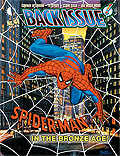
Doug: Do I ever! Let's do a little history lesson on our pal. Clint started off with a Don Heck-designed (Tales of Suspense #57, September 1964) get-up that's really been Hawkeye's enduring look. I, too, have always viewed it as purple and navy blue; however, in the Fantastic Four/John Byrne article in the current Back Issue! (#38), Byrne states that when he changed the FF's uniforms and increased the amount of white, the suits were black and white, not blue and white. Byrne's contention was that blue was a lighting effect, and his example was a good one -- Superman's hair is often colored with a lot of blue, but does anyone really think that he has blue hair? So I guess I am going to assume that Hawkeye's main garb is black with purple accents. What about you? How do you view it?

Karen: Eh, Byrne might be right about some outfits but I think ol' Clint is wearing purple and blue! What's interesting to me is all the minor variations we've seen in his costume. I think he had a slightly more detailed costume than most 60s characters. So little things would get tweaked, like the 'H' on his forehead, or his arm bands. Sometimes his hands were bare, sometimes gloved. Later on, I believe it was George Perez who added little pouches to his strap of his quiver.

Doug: Then he entered the Goliath phase, in a curious outfit designed by Gene Colan (?) and appearing in Avengers #63. While I love my giants (Goliath, Colossal Boy, et al.), I always thought the top half of Clint's version was outright weird. What the heck was holding that shoulder fabric in place -- some of Phantom Lady's boob tape??

Karen: Oh boy, I just had a terrible thought - Hawkeye on the same team as Phantom Lady! The poor girl would never get a moment's peace! As for the Goliath outfit, I wonder if John Buscema designed it? To me it has more of a Buscema feel to it. Of course, it also has the weird harness thing going on, which I guess harkens back to circus strongmen. Hercules had something similar. I thought the red and blue color scheme worked best.


Doug: And so, chronologically, we come to the bane of Karen's comic-collecting existence. The infamous Barry Smith-designed outfit that Hawkeye debuted back in Avengers #98 (April 1972).

Karen: You know, I like Barry Smith's work. Really I do. But I've often said that I thought he was better suited to non-super-hero titles. I think this design is proof of that. Who is Clint supposed to be? I guess Smith took his namesake seriously, because he could have stepped out of Last of the Mohicans - although I think even that Hawkeye would have worn leggings!

Doug: So, what's your verdict, Karen? I will state that the ol' standby Hawkeye outfit is a winner that's stood the test of time, and according to press ahead of the coming new Avengers title, Clint's back in that suit (readers will note that neither Karen or I chose to discuss (and I hate even this acknowledgement!) the Ronin fiasco). As for his stint as Goliath, like you, I also prefer the red and blue schematic, but not the costume in general. And everyone should guess where we both stand on his third get-up -- and that's what it was -- a get-up!

Karen: Hawkeye's standard garb is a classic, and despite a few mis-steps here and there, I consider him "dressed for success"!

Friday, February 19, 2010

BAB Two-In-One: Jacked-up Storytelling and the Savage art of Barry Smith

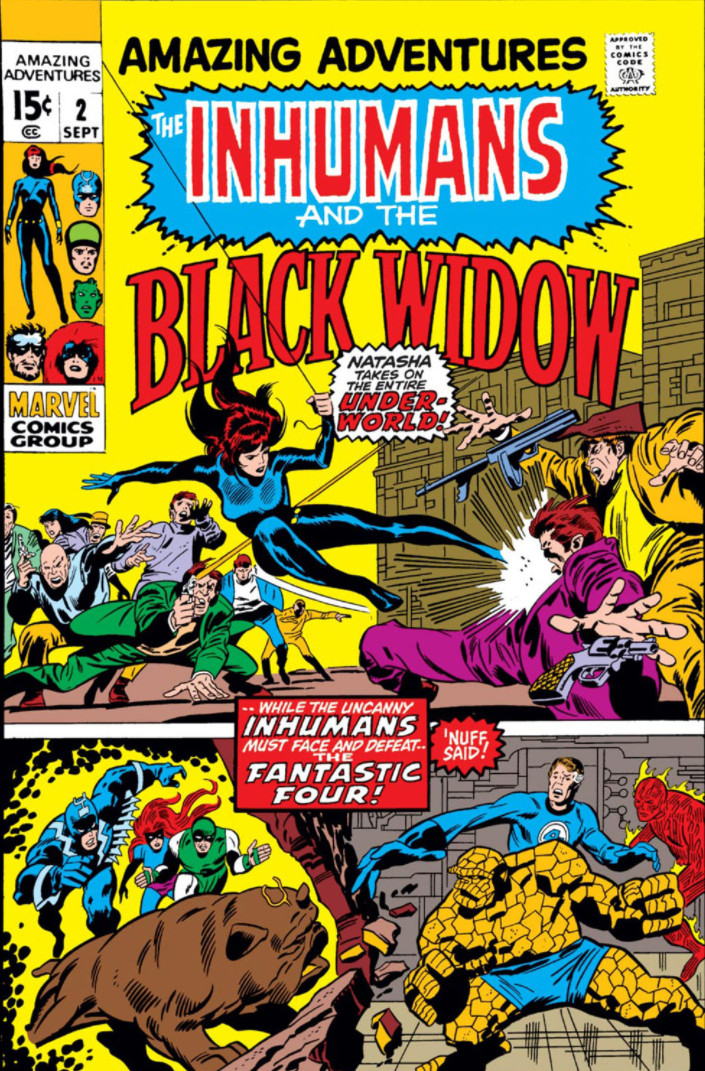
Doug: Back atcha with a look at Amazing Adventures #2 from September 1970. As with the premiere ish of the Inhumans solo series, this story was written and drawn by Jack Kirby with inks by Chic Stone (who incidentally seems to have tipped over the ol' inkpot square on Black Bolt's mug on the splash page!).

As I'd commented last time, while Jack Kirby might have been known as the King, it certainly was not a title to be associated with his writing prowess. Let's see if things get better with experience... When we left off, the Great Refuge had been attacked by a cobalt missile. Destroyed by Black Bolt, the scraps carried the insignia of the Fantastic Four. With the revelation that former allies had instigated the attack, Black Bolt gave the signal for the royal family to now make war.

This issue opens with Lockjaw teleporting the Inhumans directly into the Baxter Building where they find Ben reclining in his personal quarters and Crystal (still can't figure out why she's in this story -- as I'd said, she had been called back to the Great Refuge some months ago) and Johnny dancing to records (that's right -- vinyl, baby!) in the rec. room. There's a great scene of Lockjaw holding the door knob to Ben's room so that he can't get out, and Ben on the other side giving a firm tug. When Lockjaw finally plows through, Black Bolt follows and hits Ben with an electron burst from his antennae. Ben's floored then by Karnak and the scene switches to the young lovers.

Moving into the hallway to check out the commotion, Crystal is subdued by Medusa while Johnny squares off against Gorgon. Of course the Baxter Building is virtually destroyed in the melee. When Reed and Sue return from a shopping trip, there's not much left of their home.


Meanwhile, Maximus is on his secret island gloating about the events transpiring. However, Black Bolt had dispatched Triton on a hunch that the Mad One was behind all of this (as he usually is in an Inhumans yarn...). Yep -- Triton sees the missile launcher, catches a little of Maximus' gloating, and takes him into custody. Shortly after that the fighting in New York comes to a halt.


While Black Bolt regenerates Ben's destroyed bath robe, Medusa gives an odd soliloquy about doing right in the face of a false attack (or something like that). It's a real moralizing speech, and coming from Kirby's pen is understandable given his war experiences but the delivery is just odd. And that's also the overall evaluation of this 2-parter -- while Jack's visual storytelling works, the plot and dialogue are just so contrived and basic that it's really a bore. As I've read so much history about the man, I find myself sad that all of the ideas caged up in his head didn't make him happy on the graphic page -- that he had to write, when that was not his gift, somewhat seems to diminish the overall talent. And I'm sorry I feel that way about it.


Karen: My comrade in comics, Doug, has inspired me with his selection of the split-book, Amazing Adventures. Since I've been reading Astonishing Tales featuring Deathlok, I decided to go waaay back to issue 3 of that title, back when it was a split book as well, shared by the incongruous pairing of Dr. Doom and Ka-Zar! I've had this book plus a number of other early Astonishing Tales issues sitting in my comic boxes, unread. So I pulled out the earliest one I had and was pleasantly surprised to be greeted by the art of Barry Smith. While best known for Conan, Smith left his mark in a number of other titles, such as Avengers and Dr. Strange. But I've always felt that his style worked best with the non-super-heroes. There is a sort of otherworldliness to it - at least, in my eyes. Here, he turns in a terrific Ka-Zar, who resembles Conan in many ways - the blond hair being the primary difference!

The story in this issue, "Back to the Savage Land," was written by Gerry Conway, another guy who popped up all over the Marvel universe. According to Wikipedia, this was Conway's first writing job for Marvel. If that's the case, then it's no wonder he was soon scripting almost every title Marvel had. It's a really solid adventure that continues with the next issue. But probably the most interesting thing about it is that it is the precursor to a much-better known X-Men story. Chris Claremont, John Byrne, and Terry Austin basically did a sequel to this issue in issues 114-116 of that title, when the X-Men found themselves stuck in Ka-Zar's home base.


In this story, the blood-thirsty priestess Zaladane of the Sun People uses the worship of their god, Garokk, to influence her tribe to attack and conquer the other people of the Savage Land, breaking years of peaceful co-existence. In the meantime, Ka-Zar, who has been living in New York, is contacted by the Petrified Man, the human avatar of Garokk. The Petrified Man was originally a sailor in the 16th century who wound up in the Savage Land. By drinking mystical water consecrated to Garokk he has become immortal; but he has also been turned into stone (but can still move, obviously). He senses things are not right in the Savage Land, so he and Ka-Zar return to their jungle home. They soon discover what Zaladane is up to and try to stop her.


I really enjoyed the artwork in this issue
. I think Barry Smith is one of the most immediately-recognizable of artists - I knew as soon as I looked at the first page that this was his work. He does an excellent job here in depicting the hidden world of the Savage Land, and his pacing moves the story along at just the right speed. His figures are dynamic. All in all, just a real joy to look at. It's always great fun for me to read an old book like this for the very first time - but when it is a truly good story, so much the better.


I won't review the Dr. Doom story here, but I must say something about the Wally Wood artwork. It is truly beautiful. It has a heavy, dark feeling that perfectly suits Dr. Doom. In some ways, it feels 'old' to me. But in a good way. It's extremely dramatic, and well....just take a look. Wow.

Thursday, February 18, 2010

Hold no Fear -- Spring is Coming!!

Major League pitchers and catchers are reporting to training camps, with the rest of the roster players and free agent invitees coming soon. Can there be any doubt that this loooonnnngggg winter in the States is coming to an end? Think warm!

And yes, that's Wrigley Field in Chicago, Illinois, and I am a long-suffering Cubs fan...

Doug

Wednesday, February 17, 2010

Who ya Got? Kang the Conqueror or Ultron?


Doug: The New Year brings with it some new features here on the BAB blog. Today we'll begin a semi-regular series called "versus", where we'll pit two opposing yet similar entities against each other -- not in some faux battle, but more along the lines of who we've liked better, why one is better than the other at "X", and so on. Today it's the two greatest nemeses of the Avengers, but who knows? Next time it could be Elton John versus Billy Joel! Maybe later it'll be Karen's favorite baseball player versus my nominee. So let's get on with the debate.

Doug: I guess any discussion like this can't help but start with one's personal preferences -- hey, throw objectivity out the window! So I'll begin by saying that I like the "Celestial Madonna" storyline better than I like the "Bride of Ultron" (but close -- how does one choose between two masterpieces?) -- those would be my favorite Avengers stories involving these two do-badders.

Karen: Well, you already know I'm biased! I mean I did write a whole article on Ultron for Back Issue! (on the shelves now! -Doug). Both Ultron and Kang are great adversaries for the Avengers, but I give the edge to the mad robot because of the emotional response he always evokes from the team. He's definitely the black sheep that no one wants to talk about. The son of Hank Pym, father of the Vision, and he's tried to make wives out of both the Wasp and Mockingbird. There's a lot of twisted history there! On top of that, throw in indestructible adamantium skin, and you've got a heck of a threat.

Doug: Yeah, I wouldn't discount any of that, and I would never say that I don't like Ultron. I don't know... there's just something about Kang, time travel, and the possibilities. I will admit that I've read some bad Kang stories -- the "Council of Cross-Time Kangs" that ran in the Avengers #290's didn't do much for me. I think the intent was good, and there were some good elements, but overall I didn't like it.

Doug: I really like "Celestial Madonna" 1) for the scope of it and 2) for the little extras: the Legion of the Unliving (good Kang add-on), the origin of the Vision, as well as the origin of Mantis. Kang's certifiably maniacal, he has an interesting goal, and scribe Steve Englehart executes a grand tale. I'll admit that the story ends on a clunker in GS Avengers #4 when Kang is ridiculously shoe-horned back into the story, but there's redemption in the pages of the "Serpent Crown Affair" that ran shortly thereafter. Kang's the star of the substory involving the Wild West heroes and Hawkeye, Thor and Moondragon, and meets a memorable end in combat against Thor. Really good stuff, with art by a young George Perez.

Doug: I'd be remiss if I didn't give a shout-out to two fine Kurt Busiek stories -- the "Kang Dynasty" and Avengers Forever. Although Perez was not along for either ride, the art in both stories was ably handled by Ivan Reis, Brent Anderson and Keiron Dwyer and Carlos Pacheco (respectively). While "Kang Dynasty" is a bit long (I believe 16 issues total), either would be recommended as two latter-day Kang classics.

Karen: Kang has given Earth's Mightiest a huge heaping of trouble time and again (no pun intended). Doug, you know I am also a fan of the "Celestial Madonna" saga, and it was fascinating how Englehart explored the different identities of Kang -how he connected Kang, Rama Tut, and Immortus. That's one of the cool things about time travel stories: you have endless possibilities to play with.

Karen: That being, said, I think I can toss out some of Ultron's greatest moments here and find that they measure up nicely. I think his rebirth as an adamantium-coated nightmare in Avengers 66-68 is a great early example of just how devastating he could be. The "Bride of Ultron" storyline upped the ante quite a bit; now, instead of just wanting to kill Pym, we saw Ultron also wants to supplant him and take what is his - his wife! Disturbing on a lot of levels, and it certainly left the Avengers shaken.

Karen: But Kurt Busiek -funny how that name has popped up again, isn't it? - came up with the most dangerous and devastating Ultron story yet, "Ultron Unlimited", in the third volume of Avengers. Not only does the maniac take over an entire nation, slaughter its people and turn them into cyber-zombies, he kidnaps five Avengers with plans to use their brain patterns to create an entire android race under his dominion! The remaining Avengers have to battle their way through hundreds of Ultrons to get to the true villain, giving Thor a chance to utter the famous line, "Ultron, we would have words with thee." Besides the thrilling battles, we also learn a startling fact, one that makes absolute sense, of the kind where you slap yourself in the head and say, "Of course! Why didn't I see that before?" It is revealed that Pym used his own brain patterns when he created Ultron - in effect, Ultron really is Pym's son, he has a piece of him inside him. No wonder these encounters always weighed so heavily on Pym - Ultron's actions were reflecting something inside of Pym!


Doug: That Thor line you cited is one of the all-time greats! You're making a great argument here -- were you a lawyer in a former life?? But seriously, let's evaluate: both characters have evolved through different incarnations involving technology as well as personality, both have taken on Avengers teams showcasing line-ups that could truly be called Earth's Mightiest Heroes, both have raised some serious Cain on the Earth in terms of destruction, human casualties, etc., and both seem to keep popping up every few years. You could argue, too, that Kang's constant pining after Ravonna creates a love interest somewhat akin to Ultron's quest to make himself a complete man/robot by fulfilling that need with Jocasta, etc. Kang and Ultron are head and shoulders above any other nemesis the Avengers have faced, based on longevity alone!

Doug: So if our faithful followers determine that your argument was stronger, should I feel badly? Negative -- because in this "versus", could one really go wrong on a rainy day with a stack of comics featuring either super-baddie?

Friday, February 12, 2010

Who Can It Be Now?

O Faithful Ones:

If you happen to notice the hit counter to your left, and you are the 10,000th reader of the Bronze Age Babies blog, then consider yourself exalted! And, leave us a comment and identify yourself so the world might bask in your glory!!

Thanks to all for giving us a try -- we hope to keep you interested as we head toward 20K!

Doug and Karen

BAB Two-In-One: Cyborg on the Run and Writing from a Commoner


Karen:Welcome back to the on-going saga of Deathlok the Demolisher! This time around I'll look at Astonishing Tales #30 - and no, I didn't skip an issue; issue 29 featured a Guardians of the Galaxy reprint.


Karen: For this issue, Doug Moench is back as scripter on pages 6-32, with Rich Buckler credited for pages 1-5. The art team is a real smorgasbord, with Buckler, Keith Pollard, and Arvell Jones as pencillers, and Al McWilliams inking. Not to insult anyone, but I have to say right upfront, I thought this issue had was the weakest, art
-wise. And I don't think any of these artists are bad individually, but the mix really leaves something to be desired.


Karen: Our story picks up with Deathlok and the mysterious revolutionary who was following him being threatened by
Ryker's cyber-tank. From there it's one long chase, with Ryker's unstoppable tank and a group of laser -armed thugs following the cyborg as he makes his way through the deserted and dilapidated city.


Karen: Ryker continues to rant and rave and
generally appear like a complete loon. He has plans to turn himself into "The Savior-Machine", whatever that might be. So far, Ryker has seemed so over-the-top that I really can't take him seriously.

Karen: Deathlok overcom
es the thugs and somehow destroys the tank by creating a huge crossbow out of junkyard materials - no, I am not making this up! This issue had a very rushed feel to it. It also felt too similar to the previous issue, with the majority of time spent with Deathlok on the run. Perhaps if the art had been better it would have been a more enjoyable issue. These early issues have been more promise than pay-off, but that's all about to change starting with the next issue!


Doug: While many argue that Jack "King" Kirby's departure from Marvel to migrate to the Distinguished Competition was the end of the Silver Age and the beginning of the Bronze Age, today's story is written and drawn by Kirby and comes from 1970 -- a date which many historians alternatively temporally mark as the dawn of the Bronze Age. Let's take a look at Jack Kirby sans Stan Lee, with the debut issue of the Inhumans in Amazing Adventures #1 from August 1970 -- written and drawn by Kirby with Chic Stone providing the embellishment. After years of inks by Joe Sinnott and Vince Colletta, it's almost a trip back in time seeing Stone's less-powerful inks.

The story opens oddly enough with a "movie night" in the Baxter Building. Reed Richards has a video synopsis of the Inhumans' Royal Family, and narrates each person's name and powers -- as if Ben, Johnny, and Crystal wouldn't know! And wait a second -- Crystal is in the room... This book was on the spinner racks the same month as FF #101 (Kirby's second-to-last issue of the FF), and Medusa had long ago come to the States to take Crystal back to the Great Refuge in the Himalayas (FF #95, February 1970). I'll write this one off to the notion that Kirby may have had this story finished before he and Stan decided on the departure of Crystal, but since many Kirby apologists have argued that Jack had been plotting FF for years prior to his leaving Marvel, it is problematic.

The scene shifts to Asia, where a group of interlopers is attempting to find the Great Refuge. They're drawn in much the same fashion Kirby and other early Silver-Agers like Don Heck drew Asians -- as caricatured, menacing Commies. The entourage is met and opposed by Gorgon, he of the thunderous hooves, who creates a shockwave to startle the party. Karnak then chops off a large chunk of the mountain, setting it down perfectly to form a land bridge that will serve as an escape route for the trespassers. With a little additional "encouragement" from Medusa and Black Bolt, the group decides that it would be in their best interests to vacate the premises and leave the Inhumans alone. Black Bolt destroys the land bridge once the potential baddies have gone.

Triton greets the rest of his cousins upon their return, and informs them that a cobalt missile is rapidly approaching the city. Scene-switch a few moments in the past to Maximus the Mad and his henchmen Centarius, Timberius, Leonius, Aeolus (many first seen in August 1968's Incredible Hulk Special #1 and last seen in Incredible Hulk #119) -- where Maximus gloats of sending off a missile that will confuse and hopefully destroy his hated brother Black Bolt. The ultimate goal is for Black Bolt to begin a war with the outside world, fought mainly against Maximus' unwitting pawns the Fantastic Four.

As the Royal Family scrambles with the knowledge Triton has imparted, the missile approaches. Black Bolt takes to the sky to fend it off, destroys it, and reveals a piece of the shrapnel with a decal -- a blue circle within which is a blue 4. As Gorgon exclaims, the Fantastic Four are the only outworlders who know the exact location of the Great Refuge -- and Black Bolt silently proclaims war!

As this is a two-fer book with the other half being occupied by the John Buscema-drawn Black Widow, we'll have to wait until next time to see how this turns out! But before I leave you, I wanted to comment on Kirby's storytelling. Jack, as mentioned above, had been quite instrumental in the success of the Fantastic Four, as the driving force creatively. It's been well-documented that he was often frustrated with Stan's ignoring of Jack's margin notes, and particularly disgusted at what Stan chose to do with the Silver Surfer and Him (later Adam Warlock). Kirby had long-desired the opportunity to flex his creative energies on his own, to tell stories he wanted to tell and to do it his way. So here we have it -- one of his own creations, the use of the Fantastic Four, and pretty much the freedom to cut loose his way. And what we get is a very pedestrian style of writing. This story plays out as if someone were simply narrating "we're going to do this, and then this happens." The dialogue is simple, and each character seems to have lost his or her "voice". What we see, sadly, is that while Jack Kirby was the King of dynamic, violent, tornadic art and ideas, he was just an everyman when it came to the script. Many have said that what Stan Lee and Jack Kirby did together was truly a Marvel Masterwork; what they did apart falls considerably short.

Wednesday, February 10, 2010

Continuity, Part Two: It Takes a Crisis... or Does It?

Doug: Hey, back for another installment of continuity conundrums. Today we'll focus on DC's mid-80's answer to housecleaning, Crisis on Infinite Earths and the reboots that came in its wake.

Karen: As I mentioned last time, some retroactive changes can be a good thing. Going back to the Byrne Superman, I never liked the idea that there was no Superboy. Now decades later, Superboy has been quietly inserted back into continuity. It may still leave us wondering exactly what stories have or haven't taken place, but what felt like a wrong has now been righted. And speaking of Superboy, would any discussion of continuity be complete without some comments on the original arch-enemy of continuity, Crisis on Infinite Earths?

Doug: It was an adjustment that took me many years to, well, adjust to! And I think what made it worse was the fall-out that affected my fave DC book, the Legion of Super-Heroes. Although Superboy had not been in the book for some time, the removal of him as the inspiration for the team's existence in the first place seemed to cause the book to creatively wander in the years after the Crisis. Shoot, one could argue that it's still trying to return to it's pre-Crisis heydays. While I'm not presently a reader, I did enjoy some moments here and there in the 1990's.

Karen: Although ostensibly designed to streamline the DC universe and make it more accessible, this razing of years and years of material seemed to gut the DC universe and leave readers everywhere mystified as to what now was and was not in continuity, with the Legion and many other titles.

Doug: I'll go back to a point I made last time -- I really never felt like continuity was an issue at DC. Sure, I understand the powers that be wanted to move away from all of the Kryptonite colors, they wanted to de-power Superman, the Earth-1, Earth-2, etc. stuff was confusing for newer readers. But when you look at the 25 years since the Crisis and what a mess that ended up becoming -- and to some extent is still a mess with DC moving from one event to another (just like Marvel) -- one has to question just how wise the Crisis was in the first place. DC seemed to take what was uniquely its own (the multi-Earth DC universe) and just chuck it out the window.

Karen: Doug, I think I would agree that Silver Age DC didn't worry too much about continuity, but certainly by the 80s, DC was fairly steeped in it. If you think about it, Crisis was not so much about cleaning up continuity -which is to my mind a linear progression - than taking multiple parallel paths and combining them into one. But that combination -forcing all those universes into one - did result in continuity issues. The initial problem was not one of continuity, as each universe had its own distinct continuity. To be honest, I never understood why they thought readers would be so confused by the multiple universes. I was a casual reader of DC but completely understood that the Justice Society was on a different Earth than the Justice League, that there were two Supermans, two Batmans, etc. As a matter of fact, I liked the idea a lot!


Doug: Agreed on your last point -- to me, that was a part of the DC Universe that was very charming. In those pre-Crisis days, the Earth-One and Earth-Two characters could interact and they'd be the same age. However, over at the House of Ideas in the 1970's the Invaders became a popular series, so some of the characters from that series started to pop up in the then-present; I just wasn't buying that Bob Frank (the Whizzer) could all of a sudden show up and be any sort of factor in battle at the approximate age of 70! Marvel's reality-based stories, which we discussed last time, virtually forbade any mingling amongst their Golden, Silver, and Bronze Age characters. So advantage to DC on that point. Then they changed it...


Doug: Not only did DC destroy much of their history, but at least for the immediate future they wiped out a whole bunch of characters. Now admittedly, many of them were just chaff, but I'm sure there were fans attached to them. However, besides death and taxes, the third thing in life that's guaranteed is that due to American copyright laws any comics fan can rest assured that their faves will pop up every seven years or so.

Doug: So, weird alien Supergirl, Wally West Flash? Anyone bothered by those things? I certainly didn't care whether Wally was the new Flash, but I didn't understand how removing Superboy from the new DC meant that Supergirl also had to be removed. I only read the first couple of issues of Peter David's Supergirl series; of course the character originated in the pages of John Byrne's Superman revamp. I quit due to a) economics and b) just really didn't care. I enjoyed Byrne's little homages to the recent-past: Luthor's battlesuit, the return of Supergirl, etc. But like you, Karen, the complete overhaul of the Super-mythos didn't set well with me. And shoot, I'm on record as saying I was never a Superman fan -- I was a Superboy fan!

Karen: The Supergirl revision was one of the worst "rethinkings" ever.

Doug: And what about when out-of-continuity stories become in-continuity? I think Jason Todd's fate as Robin was sealed the second Frank Miller wrote Alfred's comment to Bruce Wayne "after what happened to Jason" back in the pages of The Dark Knight Returns. Additionally, we've seen both Magog and the Kingdom Come Superman enter current JSA continuity. Good or bad? I guess it was nice as it was -- not sure the leap into the mainstream was necessary.

Karen: Yes, I have some concerns about Kingdom Come now becoming a part of the regular DCU. Is DC dooming itself now to go down a certain path? I suppose the exact outcome of KC can be avoided but I just don't know that it was wise to incorporate any of that stuff.

Doug: Good point -- as much as we've discussed writers' hands being tied by certain events, how about apocalyptic events set far in the future? It would seem to me that writers would have to be constantly thinking about getting their ducks in a row.


Doug: Which brings us to next time, when we'll discuss certain events that various writers/editors keep coming back to, as well as out-of-continuity stories that work just fine as standalones. See ya then!

Friday, February 5, 2010

Continuity, Part One: Decry it or devotion to it?

Doug: I've been reading a few of our esteemed Bronze Age colleagues' blogs, and have noticed repeated aversions to that comic universe foundation known as Continuity. Karen and I would like to toss forth our evaluations and opinions and we certainly welcome comments at the conclusion of this post, which might further this as a discussion.

Doug: I suppose at the root of the problem is that word "universe". Once a creative team and/or editorial staff begins to craft real-life events for the protagonist and his/her supporting cast, things inevitably are set up to become sticky later on. This fictional realm where the title's cast, or as in the case of Marvel and DC (et al.), titles and casts, dwell now has moments frozen in time. This predicament is the main point of separation between the comic strip and the comic book.


Karen: Marvel had the relative luxury of being new to the scene, whereas DC was carrying around baggage from the last 20+ years. Marvel could do whatever they wanted - because as many of those early writers and artists have noted, they never thought these characters would be around so long! Marvel essentially created the comics continuity fever that most of us grew up with, by creating a fully integrated universe. We saw that the characters interacted with each other. Past events would be referenced repeatedly (remember all the footnotes the comics used to have?). Marvel built a sense of reality and history that had rarely been seen outside of such universe-building works like Lord of the Rings.

Doug: It's funny to me, re DC. Of course at some point in this conversation Crisis on Infinite Earths will be brought up, but I'll be quite frank -- I never thought (as a kid) that continuity was anywhere close to a big deal at DC. Marvel, sure -- continued stories, characters and villains crossing over all the time, big events (and I mean pre-1980's big events, like one of the FF's break-ups or an Avengers line-up change -- not the marketing junk)... DCs mostly contained one-and-done stories, and it never seemed like they were referenced later on. Even when villains popped up after a few years' hiatus I couldn't see that the new story built off of anything from before.

Doug: So concerning Marvel, it's hard to imagine that what was once the best thing about The Amazing Spider-Man has become the worst. As soon as Stan Lee and Steve Ditko chose to have Peter Parker graduate from high school (ASM #28), Peter entered our world and was marked by time. Now characters in the Marvel Universe could age. Charles Schultz's Peanuts gang didn't; over at DC Dick Grayson had been ~15 for over 20 years. Spidey was now unequivocally 18, and off to college. So Pete and the rest of the characters began to age, to experience life, and then to die.

Karen: I think Stan Lee had it right when he said the goal for Marvel was the illusion of change. Changes in relationships, powers, costumes - all of these contribute to the feeling of excitement and newness but don't really affect the main character in any significant way. Going with our Spider-Man example, even the death of Gwen was not an event that altered the Spider-Man universe in such a way that the basic core of the character was altered or violated. It did however bring an element of reality heretofore unseen in comics, and allowed the readers, many of whom were probably young men themselves, to relate to and grieve with Peter. But the basic concept of Spider-Man was unchanged.

Doug: Well since you brought it up, perhaps no events are as hallowed in the Bronze Age as the deaths of Gwen Stacy and the Green Goblin in June/July 1973. Both were surprises when they happened, and both carried enough weight that one felt that a chapter had closed in the life of Peter Parker. But then, only 14 months later there was a new Green Goblin, and as 1975 dawned there were hints that there would be a new Gwen Stacy.

Doug: Why? Sales would be the obvious answer. Fixing what many fans felt was a gross injustice? Maybe - but even that quasi-noble gesture oozed potential dollars. And I guess if we use this as a microcosm of the continuity question, we have to dwell for a moment on any publisher's ultimate goal: to turn a profit. In a perfect world, publishers would remain benevolent, always producing magazines within whose pages characters always behaved as we expect them to and change could be unexpected but would remain logical.


Karen: Peter's growth as a character continued as he got a job and got married. Personally I liked the idea that Peter was still growing, although perhaps at a rate of 1 year for every 5 real-time years. I didn't mind him being married -although I do think it was a mistake for Mary Jane to be a super-model. That took Peter out of the everyman role he should rightfully occupy in the Marvel Universe. It would have made much more sense for Mary Jane to be a struggling actress/model. But despite this, by the time the 2000s rolled around, Spidey had a rich history.

Karen: However, that rich history can also be like an anvil around one's neck. New writers may feel constricted by what stories they can tell. And by having any of the characters progress in age, the inevitability of adulthood, old age, and death starts to come into play. You almost have to commit to it fully, ie. have characters age, perhaps much more slowly than in real life, but eventually wind up hanging up their fighting togs and/or passing the mantle to someone else. But is that really what fans want? Can we imagine anyone else besides Peter Parker as Spider-Man? DC has made Dick Grayson the new Batman, but is there any doubt that Bruce Wayne will return to that role?

Doug: No, no doubt at all. By and large, Batman, Superman, and Wonder Woman are untouchable. But one could argue that where it appeared that the entire second-tier of DC characters were allowed to move on with others taking up the mantle of Green Lantern, Flash, Green Arrow, etc., even those changes have been reversed or at least diminished historically by the returns of Barry Allen, Hal Jordan, and Oliver Queen.

Karen: I realize I am primarily a Marvel fan, so I am sure hard-core DC fans would disagree with me, but I saw little personality at all in characters like Hal Jordan or Barry Allen. Many of these DC characters seemed almost interchangeable. I'm honestly surprised there was so much clamor for their return! And so now DC has multiple people running around with the same name. Those seem like characters where the passing of the torch really could (and I think did, particularly with Wally becoming the Flash) revitalize a title. I'm still surprised that Barry was brought back, although I do think that Geoff Johns has managed to give Hal Jordan a personality now.

Karen: But getting back to the limits of continuity - apparently the Marvel writers felt that Spidey's situation, which had been crafted over decades by numerous creators, had become unwieldy. And so we got the biggest cop-out in comics: Brand New Day. It was bad enough that they used this deus ex machina to remove the marriage; but then they went several steps further and also used it to alter his entire history.
Somehow, vast chunks of Spider-Man history were magically removed, so that Marvel could send Peter back to the Coffee Bean and relive his life.

Karen: Brand New Day was a complete disregard of not only continuity, but of Marvel's status as the 'reality-based' comics company. Marvel has always taken pride in the fact that they brought a sense of realism to comics. One might have expected them to end the marriage in a realistic fashion - say by divorce or even death. Instead, they just decided one day to revert the series to about 1975 and not make any effort to actually have it make sense.

Doug: I'm very happy to report that my mind was not polluted by any of the Spider-events of the past 12-15 years or so. I got out way back during the second clone saga, which was just a complete train wreck. It was so bad, as was much of what Marvel was producing in the 90's, that one has to wonder exactly what was going on in those editorial meetings. It wasn't creativity -- no, no -- my guess is the VP in charge of marketing was running each and every editorial meeting. All style (and that's debatable) and no substance. Or at least no substance that made sense.

Karen: This is probably the biggest violation of continuity that I am aware of. DC on the other hand, seems to be fond of continually 'ret-conning' their characters' stories, so much so that I don't even know who the original founders of the Justice League are supposed to be now. It seems as if much of John Byrne's revamp of Superman has gone out the window, which I can't say I mind. But for a casual DC reader like myself, the events of all the "Crises" have only made things more confusing than ever. Back before the original Crisis on Infinite Earths, I had a pretty good grasp on the multiverse and who was on what Earth. Now? No idea.

Doug: Sounds like a nice segue to Part Two -- catch ya then, friends!
Related Posts with Thumbnails