Showing posts with label BAB Movie Review. Show all posts

Thursday, October 29, 2015

BAB Review: Frankenstein Meets The Wolfman (1943)


Frankenstein Meets the Wolfman (1943)

Karen: Yes, your friendly co-editor has been on a bit of a Universal Monsters binge of late! A week after I watched The Wolfman, I put the disc with this gem in the player and sat back and enjoyed the first genre cross-over event! This really is monumental in a way; it's the first time the Universal creeps shared a film, and by doing so, it established something of a shared universe, even if the continuity of said universe was shaky at best. Was this the first shared universe in popular culture? I'm not sure, but it seems like it may have been.

Despite the Frankenstein Monster getting top billing, this is really a Wolfman picture, as poor Larry Talbot (played again by Lon Chaney Jr.) is unfortunately brought back to life when his tomb is disturbed by some grave robbers, in one of the most chilling scenes in a Universal monsters film. Transforming into his hairy self, he rampages and passes out, and is taken to a hospital. Realizing that he can't die, he decides to seek out the Gypsy woman Maleva (the wonderful Maria Ouspenskaya again) who agrees to help him. She has heard of a doctor who might be able to cure him, a miracle worker by the name of -Frankenstein! The two head of across Europe to the village of Visaria, only to discover Frankenstein's castle in ruins, the doctor dead, and his legacy held in loathing by the townspeople.However, Larry eventually discovers the Monster, frozen in the sunken ruins. 


The Monster this time around is portrayed by horror veteran Bela Lugosi. To this point, we had seen the Monster played by Karloff in three films (the original Frankenstein, Bride of, Son of), then Chaney Jr. stepped in for Ghost of Frankenstein, and next came Lugosi.  Honestly, while I thought Lugosi made a terrific Dracula, and I absolutely love him as Ygor in Son of and Ghost, he is a lousy Monster. Part of it is just his physical characteristics don't go well with the established Monster -his face is round and full, whereas the Monster we know from Karloff has a gaunt look. But what hurts him even more is that much of his performance was cut from the film, and what remains appears to be idiotic. To explain: this Monster had the brain of Ygor, the scheming murderer who had manipulated the Monster in the previous two Frankenstein films. But he was also blind as a result of incidents at the end of Ghost of Frankenstein. The script for this film had the blind Ygor-as-Monster talking to Larry Talbot, helping him look for Dr. Frankenstein's hidden notes so he could try to find release from life. But when executives saw scenes of the Monster speaking in Bela's thick Hungarian accent, they felt it was ludicrous, and had all his speaking scenes cut. So there's no explanation of why the Monster is stumbling and fumbling around as if he's had too much to drink, or why Larry seems to think he can be of help.


I'd be unhappy if my speaking scenes were cut too.

Some critics have pointed out that it is Lugosi's version of the Monster - arms outstretched, hesitant, jerky walk - that has actually become the accepted cultural version of Frankenstein! This was also how later actor Glenn Strange played the role, so I guess we can blame him too.

Despite this, much of the film still works. Chaney is still a compelling sympathetic figure in his quest for death, and this time he's got angry villagers after him, which is fun to watch. The usual suspects are here - Lionel Atwill shows up as the Mayor, and Patric Knowles is Chaney's doctor, who suddenly decides he wants to follow in Dr. Frankenstein's footsteps. Ilona Massey is the late doctor's daughter, who spends the last part of the film in a nightgown and must be partial inspiration for Madeline Kahn's character in Young Frankenstein.


The confrontation between the two monsters at the end is perhaps a bit of a letdown, in this day of flashy films. Even though Lugosi has clearly been replaced at points by a bigger stuntman (either Gil Perkins or Eddie Parker) as the Monster, the action is fairly mild, with the Wolfman and Monster doing some wrassling, the Wolfman jumping around a lot, and the Monster throwing lab equipment, before the dam above the castle explodes and washes them away. It's funny watching these films as an adult, because I certainly had built the action up in my head as a child. Still, it has its charms, and I wouldn't want to see some bloated CGI version of it (we shall never speak of Van Helsing at the BAB. Ever.)


I can't end this post without leaving you with the most memorable scene from FMTW -no, I'm not talking about the monsters, I'm talking about the Song of the New Wine! Listen at your own peril; it's like It's a Small World -once you get it in your head, you'll never get it out.


Tuesday, October 27, 2015

BAB Review: Dracula (1931) -Bilingual Style

Lugosi


Dracula (1931)

Karen: I had the pleasure of seeing the original Universal Studios  Dracula this last Sunday on the big screen courtesy of Fathom Events and Turner Classic Movies (TCM). I actually saw Dracula twice: first the classic Bela Lugosi version was shown, and after a ten minute intermission, the Spanish-language version, made on the same sets but with a different cast, was shown. I highly recommend seeing classic films like these on the big screen; it's a completely different experience than seeing it on a TV set. The Lugosi Dracula was also the restored, high def version that is  available as part of the blu-ray set of Universal Monsters films that came out a couple of years ago, and it's astonishingly clean and sharp. I know I was particularly amazed at how clear the sound was -no hissing or crackling!

I probably can't add anything new to the reams of commentary that have been made about this classic. I will say that the story seems almost truncated, like a Cliff's Notes version of the novel, with whole scenes whittled down to bare sketches (the time at Dracula's castle, the voyage on board the Vesta, etc.) although the Spanish version does slightly expand some scenes and adds a few shots that help tell the story a bit better. This was the first time I saw the entire Spanish language version, and while I can understand why some people might argue that it is the better production, there is one thing that keeps that from being true: Carlos Villarias is an absolutely awful Dracula! He is constantly mugging and grimacing, and his Count is utterly devoid of menace. 


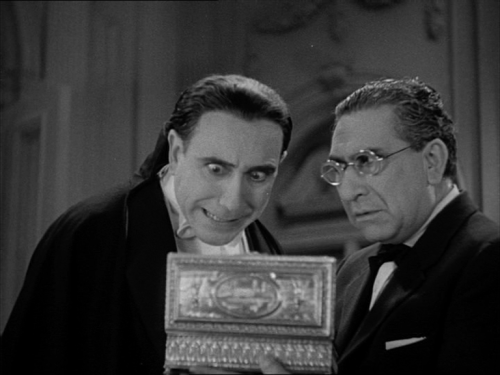
Carlos Villarias as Dracula

This brings us to Lugosi. I think over the years people have tended to downplay his performance. Perhaps they have seen Ed Wood and look upon him as some sort of goofy, tragic character. But if you really watch him, he's quite  compelling. Yes, his line delivery is odd at times, but it actually enhances the other-worldliness of the character. And the aura of command, of danger, around him is palpable. There's a reason his is the foremost image of Dracula (sorry Christopher Lee) even today.


I want to say I am not connected to Fathom Events, TCM, or Universal in any way, but I encourage all of you to catch these films on the big screen. Fathom showed Frankenstein and Bride of Frankenstein around Halloween last year and it was fabulous. At both last year's and this year's shows, TCM host  Ben Mankiewicz appeared at the beginning of both films to provide some insights into each movie. I've read a ton on the Universal films and nothing he said was new to me, but I'm sure it was enlightening to some of the folks in the audience I was with. I appreciate Fathom, TCM, and Universal putting these films back out there and keeping them alive in theaters. I hope that perhaps another generation of film-goers can experience them and understand what makes them so special. Please note that many theaters will also be showing this double-feature this Wednesday, October 28th, so you still have a chance to see it! Check out the Fathom website to locate a theater near you. 


Wednesday, October 21, 2015

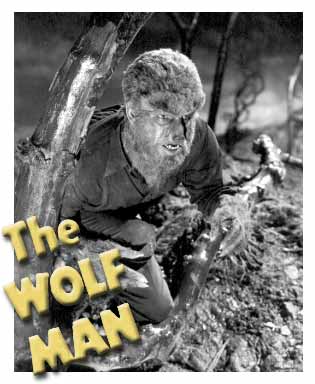
BAB Review: The Wolfman (1941)


Karen: Tis the season for spooky stuff, and certainly around here that includes the Universal Monster films of the 30s -50s. One of my favorites is The Wolfman, starring Lon Chaney Jr. Like all of its brethren, it's an atmospheric piece, with more mood than mayhem. It also has a tragic lead, in Larry Talbot, the hapless lead who is transformed into the Wolf Man. But I feel the film is often overlooked in the Universal ranks. It's actually a very good movie, with a terrific cast and an intriguing plot. Lon Chaney Jr. may have had a limited range, but as Larry Talbot, he comes off as likable and the viewer sympathizes with his feelings of discomfort, returning to  his birthplace in Wales after spending most of his life in America (and yes, it's probably the only way anyone could explain having the very English Claude Rains as his father). Later, when he begins to realize what has happened, Chaney's fear for his own sanity, and then fear for those around him, is handled well. Whenever watching a film from this time period, it would be easy to dismiss the much larger and more melodramatic acting style as a lack of talent, but this was how things were done then, as actors transitioned from stage to film. 

The rest of the cast, including Rains, Evelyn Ankers as Chaney's love interest Gwen, Bela Lugosi as the gypsy/werewolf Bela, and particularly Maria Ouspenskaya as the wise Gypsy woman Maleva all bring depth to their roles and give Chaney solid support. 


Writer Curt Siodmak, who wrote many screenplays from the 30s through the 50s, developed many of the concepts that would become 'modern' werewolf lore, although interestingly in the film, the full moon is never directly shown or referenced as being the cause of Talbot's transformations. The transformation itself is also initially left as something of a mystery -was Talbot truly physically transforming, or was it all in his mind? The people of the village all seem to know the lore and joke about it before Talbot is attacked by Bela, and the town doctor states that mass suggestion could make a man believe he could become a beast. Poor Talbot is completely confused about what is happening to him, and as a viewer, there's a level of uncertainty until near the end. At only an hour and ten minutes the film doesn't have a lot of time to play with this theme, but it's there.

Whether a wolf or not, Talbot is implicated in the attacks purely by being an outsider, and there's a wonderful scene in a church where you can feel the entire town turn their suspicion on him, and Chaney's fumbling, guilt-ridden reaction is perfect.

Although a minor detail, when Talbot goes to stop the werewolf's attack on a woman, although partially obscured by trees and mist, we can see that the beast is in a four-legged form (legend has it that the role was played by Chaney's dog, Moose). Was it a lack of money that caused this, or a desire to keep the werewolf makeup hidden til later? Or something else?

The Wolfman was Chaney's alone -no other actor played the character in a Universal film, something that can't be said of Frankenstein or Dracula, or the Mummy. Talbot spent the rest of his Universal life trying to find a way to die and rid himself of his curse, making him the most tragic of the monsters, and perhaps the most endearing too. 


Related Posts with Thumbnails