Showing posts with label Holocaust. Show all posts

Wednesday, May 23, 2018

Books With Pictures - and Some Without

Doug: Hello, and thanks for coming  around this week. It's good to be back in the blogger's chair, even if only for a few days. When last we met, it was over at Back in the Bronze Age when I contributed a post on DC's imaginary stories. That was over a year ago! And other than school work, I've really not written since May 2017. But I've done a heckuva lot of reading, and today I'd like to share some thoughts on the tomes I've consumed over the past 12 or so months.

A year ago I decided to start keeping track of the books I was reading. Since we quit blogging in November 2016, it really freed up time in the evenings for some leisurely reading. And as I got to forming that habit, I found that I'd missed regular reading - and particularly reading comics. Formerly, the comics I read were always blog-oriented. That's not a bad thing - I think our repository of reviews is a real treasure. But we're talking about me consuming 1-2 comics in a week over the 7+ years the BAB was active. However, that commitment had necessitated (at least, that's the story I'm telling) the acquisition of a massive amount of collected editions. At last count I have over 350 books on my shelves. For most of those books, they sat idle since arriving, waiting for a post idea or review to liberate them from their resting place. Once the blog shuttered, I felt able to crack open all of the books I'd amassed. If an evening goes the way I'd like, I'm on the couch or in the recliner with a tpb or hardcover, keeping an eye on some college sports or the Cubs. On a good night, I'll read 2-3 comics. I'd also add that the fact that our sons have been out of the house over the past few years has contributed to my disposable evening time. So you see how it's possible to rip through the amount of material I've read (see below).

Karen long ago said that we live in the golden age of reprints. She's not wrong. Just two weeks ago I finished the Batgirl Bronze Age Omnibus, collecting the character's early appearances in Detective Comics and Batman, up through the Batman Family years. Think about that... A 500-page hardcover devoted to mostly 8-10 page back-up stories, and featuring a C-list character. Karen was right!

You can count the Planet of the Apes B&W magazine strips among material I never expected to read. Thank goodness Boom Studios did what it took to put that mysterious content in my hot little hands. And if you've not seen these archive-like editions, you are missing out. The reproduction is outstanding - heavy stock, the same size as originally published, and wrapped by a sturdy hardcover. I have the first two volumes and intend to buy the next two. And speaking of those "damned, dirty apes", if you're into prose then you might like Tales from the Forbidden Zone. Karen and I both read it, and I can guarantee if we'd still been writing, you'd have seen our thoughts on it. Not every short story was a winner, but more often than not there was a smile and some thoughtful reflection before moving on to the next chapter. One story I'd mention specifically involved Taylor and Nova in a "What if Taylor had survived the nuke at the end of Beneath the Planet of the Apes?" Good stuff.

For our readers who've been with us for a few years, you'll recall that I have done contract work for the United States Holocaust Memorial Museum's education department. After spending 10 days each July in Washington, DC over the past seven summers, I am somewhat melancholy to report that I am not going back this year. However, my interest in the subject remains high, and you can see across my three reading logs that I've continued with my professional development by reading various selections in Holocaust witness and history. Two books I'd highlight to those interested: if you would be inclined to read a rather raw survivor testimony, told within months of liberation, then Five Chimneys is excellent. Certainly, it's a tough read, but very compelling throughout. If you want a concise history of some of the nuances of the event and era, then I heartily recommend Peter Hayes's very accessible Why? Explaining the Holocaust.
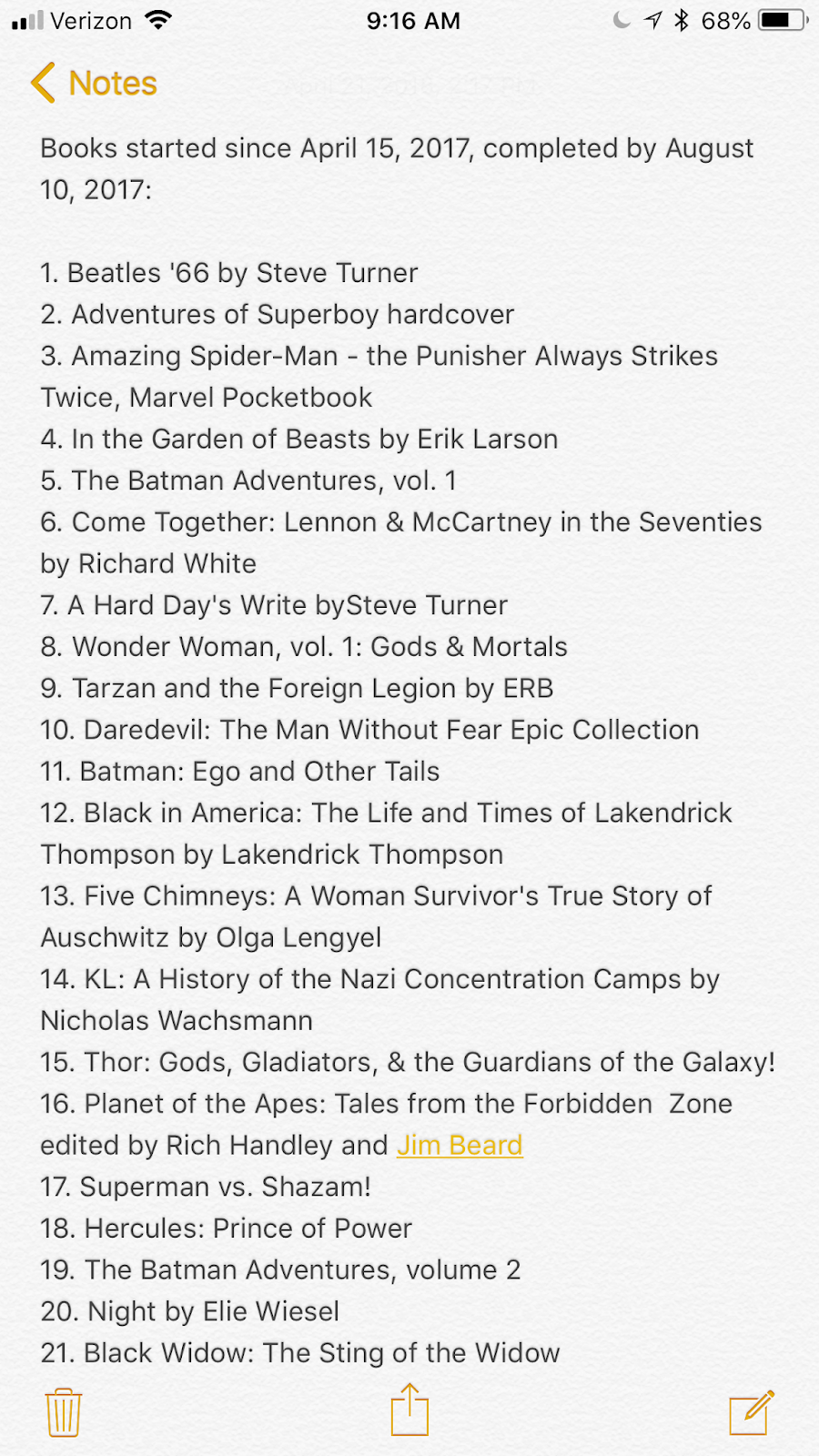

I didn't always care for the books I chose. Last summer I decided to give one of Edgar Rice Burroughs' last Tarzan novels a whirl. Tarzan and the Foreign Legion could best be avoided. In addition to Burroughs' formulaic storytelling, the racism that was so prevalent through the World War II era is off putting. I finished it, but can't say I bettered myself for the experience. Richard Wright's Come Together: Lennon & McCartney in the Seventies was OK, but the author's style was a little wonky; often he was repetitive. If he'd said one more time how much the four Beatles loved each other like brothers, I was going to scream. For funnybooks, I really liked the Essential Man-Thing once Gerber quit toying with the Nexus of Reality. I didn't care for that supernatural/occult stuff... which makes me wax hypocritical, as I absolutely loved the DC Comics Classics Library Roots of the Swamp Thing. I also found volume 2 of the Secret Society of Super-Villains disappointing as compared to my childhood memories. But overall, when you look at the almost-70 books on the lists, there were mostly hits among a few misses.

Shoot, why not toss you a good, better, best type of list?

Good: I was pleasantly surprised at how much I enjoyed the Aquaman trade "Death of a Prince". Outside of Super Friends, I had zero experience with DC's King of Atlantis. So I was interested at my growing enthusiasm as I waded through these Bronze Age reprints from Arthur Curry's days as a back-up feature in Adventure Comics. Solid art from Mike Grell and Jim Aparo, and a nicely done payoff at the end. Recommended.

Better: Beatles '66 by Steve Turner was wonderful. Turner begins his book in December of 1965, and then charts the careers and lives of the Fab Four month-by-month through December 1966. It's tough to say that the book "centers" on any one thing, as the last world tour, the decision to stop touring, increased drug use, the recording of Revolver, and the appearance of Yoko Ono all conspired to make the year of my birth a landmark era for the Beatles. Great book, and I'd read it again.

Best: I gave no thought to this whatsoever beyond my initial impression. It wasn't even close, or worthy of further consideration. The best thing I've read in the past 12-15 months was the Uncanny X-Men Omnibus, volume 1. The 800+ page heavyweight collects Giant-Size X-Men #1, and X-Men #s 94-131. Also included is the George Perez-drawn X-Men Annual #3. As most of you know, this title just kept picking up steam. Aside from the 2-3 filler issues (the Dreaded Deadline Doom), every issue was pulse pounding and senses shattering. You know what I'm saying!

As to my coming-up reading list, I've already pulled three hardcovers for immediate consumption: Batman Illustrated by Neal Adams, volume 1, Spider-Man Newspaper Strips, volume 1, and The Inhumans Marvel Masterworks, volume 2. Once school's out in a few days, I'll commence to also wading through a large stack of real books -- I need to finish Rep. John Lewis's (D-GA) memoir Walking with the Wind, and then I have a caboodle of additional Civil Rights books already purchased: The Autobiography of Malcolm X, The Autobiography of Martin Luther King, Jr., and Unforgivable Blackness: The Rise and Fall of Jack Johnson. For lighter fare, my son gave me Tim Kurkjian's (ESPN baseball commentator) book, I'm Fascinated by Sacrifice Flies: Inside the Game We All Love and Keith Richards's autobiography, Life.


So what are your thoughts? What are you reading presently, or recently? What would you recommend to me, or do you see something we share that you'd pass along to a friend? If you are just happening by this space for the first time ever, you must know that in order to join our Loyal Order of Water Buffalo Lodge a comment must be made and left for all to see. True story. All you veterans -- you know the drill.

Tuesday, September 6, 2016

From Chicago to Wakanda to Plaszow to Selma - Doug's Summer Reading List

Doug: With yesterday's observance of Labor Day here in the States, summer has unofficially come to an end. And as we've done in the past around here, we like to query the reading lists of friends and discuss that of your hosts. I always look forward to these times to get recommendations and really to just get a finger on the pulse of our readers' preferences inside and outside the comics/graphic novel genre.

I was really floored when I set to gathering images for today's post. I knew I'd been somewhat prolific since May -- way more than in the past several summers -- but I had no idea how ravenous an appetite for reading I'd had. So in chronological order (because I'm a history guy, you know...), here are my accomplishments.

In May I actually finished a book I'd started in the fall of 2015. Having lived in the Chicago area for 95% of my life, my wife and I have an interest in Chicago history. So last year, while she read The Devil in the White City, I started Sin in the Second City. You can see from the taglines on the book's cover what it is basically about. It centers on a pair of sisters who arrive in town with the goal of setting up the best brothel in America. The Everleigh (get it?) Club was notorious, and the circumstances around its existence and demise were compelling reading.

I followed that book with a biography of Eliot Ness. I probably haven't seen but one or two episodes of the 1959-63 television show The Untouchables, but I love the 1986 film of the same name that starred Kevin Costner, Sean Connery, Andy Garcia, and Robert DeNiro. Last year my wife and I toured Union Station, site of the most memorable scene from that film. So I've had this closet interest in Ness, and upon seeing the book for sale at the Chicago History Museum I purchased it. Like all people and events, lives and circumstances tend to be romanticized over time. This would definitely be true of the history of the Untouchables, a story actually promoted by Ness himself. I had not known that after Prohibition ended Ness landed in Cleveland and became that city's Public Safety Director. Ness led an interesting, and conflicted, life to be sure. It was a good read.

When I headed to Washington, DC in mid-July I wanted to read something that could probably be conquered in the four-plus hours (round-trip) of flight time. Having recently downloaded a file of all the Tarzan novels to my Kindle, I chose Jungle Tales of Tarzan. It was my third read of that book, and its format as a collection of short stories was perfect. This also helped to set my mind for seeing the Tarzan film, which I did after my return.


For light reading while in Washington, because being immersed in the Holocaust definitely requires a mental break, I took my copy of the the Black Panther Marvel Masterworks. I've long been reporting that a storyline I'd never read but needed to was "Panther's Rage". I actually read the first three issues (of 13) while away from home, and then finished it upon my return. I have something in the works for later this fall in terms of a review of the story. Footnote: As Marvel is soon releasing a paperback Epic Collection version of the "Panther's Rage" story, and with the Marvel Premiere BP stories also included, I decided to sell my Masterworks and pre-order the softcover as a replacement. My copy sold on eBay last month for $120, so it was a wise decision financially.

While at the Holocaust Museum, a colleague recommended I read My Grandfather Would Have Shot Me. You can see the tagline on the cover. But the kicker is that the author's grandfather was not some obscure Nazi lost to the sands of time. No... Jennifer Teege's grandfather was none other than Amon Goth, commandant of the Plaszow Labor Camp and immortalized in Steven Spielberg's Schindler's List. Goth and his mistress, shown a couple of times in the film, had a baby girl just months before the War ended and Goth was hanged for his crimes. That baby girl grew up and had a relationship with a man of African descent which bore a daughter, Jennifer. Ms. Teege did not know the full truth about her background until she was an adult and how that new knowledge turned her life upside down is the theme of the book. Fascinating reading.

I felt like I needed something a little lighter to help balance the Teege book. On Amazon's Kindle Store, books that have fallen to the public domain are offered for a free download. While browsing I found the first Lone Ranger book and snatched it up. It was OK -- I found it perhaps more sociologically interesting in terms of the attitudes and stereotypes than I found it to be any sort of high literature. But I'm glad I read it. Funny, because I could "see" Clayton Moore and Jay Silverheels in my head the entire time I read it and much of the dialogue seemed like it could have been used later in the television program.


I mentioned to a Twitter friend a few weeks ago, as he was on his way to hear Rep. John Lewis (D-GA) speak that I regretted passing on a rally in DC after the Dallas shootings. Lewis was to be the main speaker at a rally on the Capitol lawn. If you are not aware, John Lewis remains a major figure in the Civil Rights Movement, and is the last living person who spoke at the March on Washington on 28 August 1963 (site of Dr. Martin Luther King's famous "I Have a Dream" speech). Lewis has authored a memoir in the graphic novel format. March has been issued in three volumes. I have read the first two and am awaiting the third installment, which will arrive with the Black Panther book I mentioned above. Highly recommended!


While reading March I was also reading Robert E. Howard's only full-length Conan novel, Conan the Conqueror. I read it from a Kindle file of Howard's complete Conan stories. It was a solid read, and a nice balance to the themes of Lewis's memoir. I'll recommend any Howard Conan, and follow it up with a tip of the hat to the way Marvel (notably Roy Thomas) handled the character in the Bronze Age.

So summer's over and I've begun reading Viktor Frankl's Holocaust memoir Man's Search for Meaning. But you know I'll have to have a mental diversion from those difficult events and themes, so from the Kindle I will also soon begin Johnston McCulley's The Mark of Zorro. That, and all the comics I read so that I can bring the reviews your way for consideration are on the horizon.

Now, how about you?


Monday, November 16, 2015

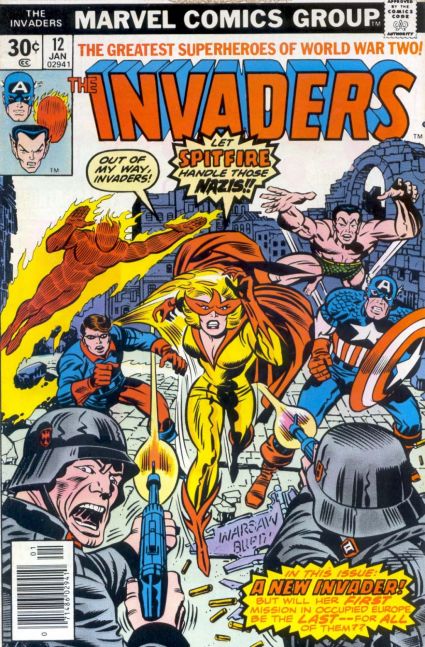
Dancing a Complex Step - Invaders 12


Invaders #12 (January 1977)
"To the Warsaw Ghetto!"
Roy Thomas-Frank Robbins/Frank Springer

Doug: I'll be proceeding with caution today, friends. Two reasons: No. 1 is the presence of Frank Robbins on the penciling. You know by now how I feel about that (his writing aside, which I enjoyed on many a Batman yarn). No. 2 is the title of the story. Our long-time readers know that I have done educational contract work for the United States Holocaust Memorial Museum since 2005. I'm just a bit leery to see how the Warsaw Ghetto (and largely the Holocaust) will be portrayed by the folks at Marvel. Fingers crossed. So the next obvious question would be, "But wait, Doug -- didn't you read this mag as a 10 1/2-year old?" The answer would be "yes", but the memory would say "Uhhhhhhhh...." You know what I mean. In spite of my strong reservations about the art on this title I was a regular reader when I could find it. I think I came on with the Liberty Legion crossover in #5 and stayed when I could through the end. I was never so happy to see Alan Kupperberg! I'll be reading and scanning from the Invaders Classic, Volume 2 trade paperback. Onward, then.

Doug: We open with the Human Torch (Original variety) flying through the night skies of London. He's mad at events that had just transpired, and we get a recap of some of the events of Invaders #s 7-11 which featured the "return" of Union Jack, the introduction of his daughter Jacqueline Falsworth, the introduction of a Professor Gold's Blue Bullet armor, the wounding of Jacqueline, and finally her healing after a blood transfusion from the android Torch -- which, by the way, gave her super speed! Got it? So the Torch decides he's going to the Tower of London to visit the now-imprisoned traitor Gold. After proving his identity to the Tower guards, our friend Jim Hammond is escorted to Gold's cell. Confronted, Gold says he's not interested in speaking about anything; he merely wishes his execution. But the Torch tells him he thinks he knows why Gold used the Blue Bullet armor to fight the Invaders on behalf of Hitler's Reich: Gold must be Jewish, and there must be more to his story.

Doug: Gold begins to sob, his head in his hands, and tells the Torch that his name was anglicized from Goldstein. He then begins to narrate his story. The Goldsteins were Hasidic Jews from Warsaw, and John Goldstein (the professor) had a younger brother named Jacob. Both boys were interested in science, John in physics, Jacob in geology. When September, 1939 came and the Germans invaded Poland, the Goldsteins were among the millions of Polish Jews who began to face intense discrimination. The Goldsteins were moved to the Warsaw Ghetto (this would have been late in 1940), but John managed to emigrate to Great Britain -- he does not say how, but does tell that his brother refused to come along. Once in England, Goldstein began to work on the Blue Bullet project. Until, that is, he was visited by a shadowy figure. The Torch puts all of the pieces together -- it was the Nazi agent who blackmailed Goldstein into turning the armor on the Invaders. Hammond ask him if the Invaders could get Jacob out of Warsaw, would the professor come back to the Allied side? In a minute, John exclaimed -- but only after seeing his brother alive. The Torch flew off, obviously with a mission in mind.


Doug: The Torch returns to his teammates and is met by Cap and Namor. Cap wants to talk -- you see, the Torch had originally flown off because when Jacqueline had awoken she jumped into Cap's arms. But it was the Torch who'd fallen for her -- now he couldn't see hanging around the team if he was going to have to see the girl he was sweet on chasing one of his mates. The Torch said he had not decided if he was quitting the team, and didn't want to discuss it. They had other issues with which to deal. So he told Goldstein's story, and it was Lord Falsworth who spoke first. The older gentleman voiced his regret that he'd not be able to join them as Union Jack. But just then, a female voice erupted from stage left -- it was Jacqueline, now sporting the costume we know as Spitfire! Of course the boys try to talk her out of it, but she baits them into a trial -- a trial she wins as no Invader can lay a hand on her. Lord Falsworth's again melancholy about the injuries he'd suffered earlier, but gives his blessing to his daughter to accompany the Americans (and Atlantean).

Doug: Namor's flagship transported the team into the heart of Europe, landing under cover of the night near the Warsaw Ghetto. As the team began their quest they came upon a couple of SS harassing a Jewish woman. Spitfire was the first to action, followed by Captain America. The fight did not last long. Cap speaks Jacob Goldstein's name aloud, and the German Jewess understands. Spitfire interprets her German, and they ascertain that Goldstein is in a book store not far away. The men go to him and tell they've come from his brother. But Goldstein says he's not leaving -- his place is in Warsaw with his books and his studies. And then one of the Invaders (off-camera, but I assume it was Cap) utters the first line in the story that gave me pause: "But all of you are in peril! Why don't you fight back?" Having studied this history for many years, I can unequivocally say that it just wasn't that easy. Goldstein tells him that the Jews must submit, and await the will of God. He even invokes an old Jewish belief from Prague -- that the Golem will save them. Cap loses it -- he screams about Hitler's atrocities, the camps and ghettos, and that Goldstein's brother can help them combat all this if Jacob will accompany them to London. As they argue, Bucky comes to the window and say they'd better get outside -- company's coming.

Doug: The Nazis bring a tank unit and the Invaders meet it head on. As you might suspect, this, too, is not much of a fight. Spitfire notices that one of the tanks had gone off to the side and has it's turret aimed directly at Goldstein and three others. The Invaders don't even debate surrender, quitting the battle immediately. A gas grenade knocks them all out (the Torch included), and they are captured. But Jacob Goldstein makes a stand, only to be kicked in the back and thrown to the ground. As the tanks roll back out of the ghetto, Goldstein says that he knows what he must do. And it's back to his bookstore, to fight back. The next issue title? "The Golem Walks Again!" You see where this is headed.


Doug: Although I didn't read it for detail, I did skim Invaders #13 so I could report to you how this 2-parter turns out. The Invaders are captured and bound in creative ways (think Batman '66). There's a Nazi thug who mocks them, but the festivities are broken up by the appearance of the Golem. He's big and bad, and wreaks havoc on the Germans. And at the end of the story Jacob still commits to staying in Warsaw, even positing that some day his people may rise up against their oppressors. It's a heroic, if tragic, monologue. And here lay my misgivings about this story -- to my recollection the only time this magazine dealt with the Holocaust. I wish they hadn't. Not because it's not an important part of the Second World War -- it most certainly was and is. But to introduce super-powered heroes to that narrative, to have them in the Warsaw Ghetto and so close to the Treblinka killing center without doing anything about the events that our heroes were obviously privy to... it just serves to increase the magnitude of the genocide and the missed opportunities for Allied intervention. Yes, this is fictional, but what of the real-world intelligence that had exposed these events to the West? What of the Allied leaders who had this information yet chose to remain focused elsewhere? "Win the War first." I get that. I also get that some 12 million Jews/non-Jews perished in the Holocaust. And like I tell my students -- don't dwell on those numbers that your mind cannot comprehend anyway. Instead, think of it as it happened, in human lives: 1 and 1 and 1 and 1. Surely the Invaders could have offered some succor to those trampled under Hitler's boots.

All that being said... would that have been even more disrespectful to the history?


Thursday, October 1, 2015

What Are You Reading?


Doug: I think it's been a long time since we've checked in with each other concerning what lies atop (or a'bottom for that matter) the reading pile. I know I never feel like I read enough, although at the end of any day I guess I've read quite a bit either in the context of work, checking Twitter a few times throughout the day, or a daily newspaper early in the evening. But in terms of some seriously dedicated reading, I always feel deficient. So in the interest of prying into your personal lives and interests, here goes:

Doug: Presently I find myself in the middle of no less than four books, and that's a lot of plates to be spinning for me. Academically, I'm a few chapters into Bloodlands: Europe Between Hitler and Stalin by Timothy Snyder and Hitler's Beneficiaries by Gotz Aly. Both are quite interesting and each book fills in my knowledge for the purpose of my teaching but also in regard to my "summer job" at the United States Holocaust Memorial Museum. Each of these books is engaging, and neither appears to be a slog to get through. I just seem to never find a decent run of time to dedicate to really digging into them with the attention that I need to give in order to truly internalize the material.


Doug: On the lighter side of fiction, I've mentioned a few times that I began A Princess of Mars over the summer. It really never grabbed me, and although close to 3/4 of the way through I am not very eager to return. I think I'd rather re-read The Return of Tarzan, or perhaps return to The Complete Chronicles of Conan. Those short stories were nice, and as we remarked earlier Robert E. Howard seems to stay away from some of the formulaic storytelling tropes employed by Edgar Rice Burroughs. I especially enjoy reading one of those short tales and then finding the adaptation in my first four volumes of Essential Savage Sword of Conan. It's great to see the words of REH set to the comic medium.


Doug: Comics-wise, you know I've been enjoying the Marvel Pocketbook edition of The Astonishing Ant-Man: Origins; the last story I read was the 3-parter with the Hulk that originally ran in Iron Man #s 131-133. David Michelinie, Jerry Bingham, and Bob Layton paid homage to Avengers #s 93 and 140 in IM #133. I've also returned to Ed Brubaker's Captain America, finishing the Red Menace: The Ultimate Collection and now well into The Death of Captain America: The Complete Collection. Brubaker's writing is simply excellent, and the cadre of artists who illustrated these stories are top shelf.  I must declare that when I've sat down to read one of these trades I do not want to put it down. It is so entertaining. And there aren't a lot of comics that I read that are like that - page-turners. James Buchanan Barnes has really become a complex character for me, rather than the one-dimensional sidekick I'd previously believed him to be. We remarked about it earlier, but Brubaker has respectfully touched on elements of war that had been glossed over for decades. That Captain America never killed in WWII? Foolish, and Brubaker deals with that. Again, as we've said (we do have an abundance of conversations around here, don't we?) in the past, I will pass on the modern coloring for a brighter palette. But I don't let that kill my pleasure from soaking in the narrative. And I've come to employ a tactic encouraged by our friend Edo Bosnar -- in regard to the return of Bucky Barnes I just treat these as a sort of What If? or Elseworlds tale and leave it at that. I just want to find enjoyment without the continuity baggage, and Brubaker et. al accomplish that for me. I've also recently purchased the collections of Captain America: Reborn and The Winter Soldier (purchased in Lima, OH last Saturday). Once I'm done with this massive "Death of" trade, I'm hoping to get into my soon-to-arrive copy of The Monster of Frankenstein, Vol. I. I've only read the first issue and some other appearances of the Monster, so am looking forward to digging a bit deeper. And, another hardcover I need to get off the shelf is Legion of Super-Heroes Archives, Volume 13 -- gotta love some Bronze Age Superboy!

Doug: Your turn -- let's hear about your triumphs, shortfalls, and wish lists!


Wednesday, January 2, 2013

BAB Classic: Magneto -- Testament. Historically Useful, or Travesty to Memory?


NOTE:  Today we begin a series of comics reviews that ran in the early days of the Bronze Age Babies.  This was our first review (and second post overall), originally published in early July 2009.  There were no comments on the post at that time.


Doug: I have a love for comics, specifically men in spandex (insert whatever joke you want here!!). Super-heroes, you know.

Anyway, I occasionally (although not often) get out of the box and read other genres of comics. Of particular note are comics that deal with another passion of mine, and that is study of the Holocaust. In my spare time, I am an educator with the United States Holocaust Memorial Museum, and I travel the country (and beyond at times) teaching teachers how to deliver this subject matter to secondary-aged students.

I use Art Spiegelman's Maus with my own freshmen-level classes, and I've cited that graphic novel as well as Will Eisner's The Plot (an extensive look at the writing and desemination of The Protocols of the Learned Elders of Zion) in my senior-level Social Injustice class. I just finished reading Magneto: Testament, and I want to recommend it to you. The edition I read is hardcover, runs $25 retail, and reprints the five issues of the mini-series that was published in 2008. It also includes historical endnotes and a teacher's guide. While I didn't wholeheartedly agree with all of the lesson suggestions, it would still be a welcome resource for many educators.

If for some reason you aren't up on your X-Men lore, or if you haven't seen any of the three X-films, Magneto is the main bad guy in the mythos. He is a tragic hero, bent on making the world safe for those with mutant powers. He is quite militant, and is opposed by Charles Xavier and his X-Men; think Malcolm X's means vs. Dr. Martin Luther King's means and you get the basic story. Make no mistake -- just above I stated that he is a "tragic hero". That's somewhat of a new characterization, as throughout the Silver and Bronze Ages Magneto was one of the premier do-badders in the Marvel Universe. He left a body count, to be certain. But, around 30 years ago, Chris Claremont (and subsequent writers) decided that a way to explain Magneto's militancy in the mutant vs. non-mutant conflict was to set his origins in the Holocaust. Magneto: Testament is the definitive origin/backstory of the character.

This graphic novel could be used in any high school classroom, and is a serious and straightforward look at a German-Jewish family and their lives before and during the Shoah. As a boy in this tale, Magneto exhibits no powers, so this truly is a Holocaust story and not a superhero story in any way. The author and artist (Greg Pak and Carmine Di Giandomenico) were edited by scholars at the Simon Wiesenthal Center; I can say that everything they wrote/drew is accurate to the best of my knowledge -- the Auschwitz I and II scenes are outstanding. I was able to travel to Warsaw and Krakow, Poland last October -- my journey included a tour of Auschwitz I and Auschwitz II-Birkenau. The author/editor of this graphic novel use the book's endnotes to offer specific support for many of the scenes in the story. I felt good that what had been presented was rooted in actual events, a danger that historical fiction often faces (and often loses, in my opinion). 

Magneto: Testament is a much shorter read than Maus, and probably more accessible to youngsters than The Plot. It is graphically violent in spots, but then I would add that no student of the Holocaust would be surprised at any of the situations depicted. I'd rate the book PG-13 I suppose, but there is more than that implied at times. Of course, with as much violence as generally makes its way in between the pages of the standard 20-page comic these days, perhaps no one will be surprised. I'd offer, however, that "real" violence -- that based on historical fact and in real-world events -- carries a bit more weight, even shock value.

So, if you have time to waste someday at a Barnes and Noble or Borders... or if you will actually part with your hard-earned cash, I'd recommend picking up this collection. I wanted to also give you a head's up that this could prove to be an exciting new resource for secondary teachers.

Note: There is a trade paperback collection available, as well as the hardcover edition.

Wednesday, March 28, 2012

BAB Book Review: MetaMaus


Doug: Two weeks ago I reviewed Mail Order Mysteries; today we're looking at another holiday gift I received late last year -- Art Spiegelman's 25th Anniversary retrospective on all-things-Maus.

As I've remarked before, the Holocaust is one of the passions of my teaching. I've been using Maus in my classroom for over 15 years. That graphic novel has literally been life-changing for me as a professional, and as a human being. Believe it or not, Maus was my entry point to the Holocaust. When I was in high school, we did not have a world history course. I attended a small liberal arts college in central Illinois, and although I feel I got a decent breadth of study in world history and U.S. history (as a history education major), there was virtually no mention of the Holocaust. Truth -- a few years ago, not believing that my professors had ducked the topic, I opened my textbook for "2oth Century Europe"; there were no more than three paragraphs on the genocide, well tucked within the chapter on World War II.


I vividly recall the day my fiance' and I were walking around one of the bookstores at her university; it must have been the fall of 1986. There on the shelf was this odd looking book with two mice framed by a swastika. Picking it up, I was amazed to see that it was a black & white comic! Browsing it briefly, I knew I wanted it so bought it right away. About two days later I sat down and read "My Father Bleeds History" in one marathon. It was absolutely like nothing I'd ever seen. It was so personal, so painful, so suspenseful... I didn't know at the time that I actually knew of Art Spiegelman's work -- who among us didn't know Wacky Packages or the Garbage Pail Kids? But the world of underground comics? Not for me. I knew R. Crumb and I knew I preferred the relative safety of Marvel and DC.

I'd only recently begun my teaching career when the second volume, "And Here My Troubles Began", was released. I gobbled that one up as soon as it was released, and was just amazed at the details of the Spiegelmans' time in Auschwitz. As the years of my teaching career passed, I knew I wanted my world history students to go deeper on this subject. In Illinois (as in many other states) the Holocaust is a mandated subject throughout public schooling. It really wasn't difficult to convince our department chair to let me and a few other interested colleagues begin incorporating Maus into our curriculum.

In 2000 a co-worker and I attended a one-day seminar in Chicago entitled "Teaching the Holocaust". It was delivered by the education department of the United States Holocaust Memorial Museum. I was floored. I hadn't been doing anything wrong over the years, but I'd been so incomplete! The methodologies, the anecdotes, the resources provided -- I was simply blown away. We were at Spertus College on Michigan Avenue -- a beautiful setting overlooking Grant Park and Buckingham Fountain. While there I noticed that they offered a distance-learning master's degree program. I signed up within weeks, and completed my Master of Science in Jewish Studies (I am Protestant, by the way -- people always ask when they hear about my degree...) with a concentration in Holocaust education in 2005.

But where this has really changed me professionally is in my involvement with the USHMM. In 2001 I applied for and was awarded a Museum Teacher Fellowship, which has forever changed how I teach. A few years later I was "promoted" to the Regional Education Corps. For the past five years I've gone around the country teaching teachers how to teach about the Holocaust. I've been to Chicago several times, to Des Moines, Indianapolis, Green Bay, Park City, and Washington, DC. In 2008 I was chosen to be in the inaugural group of teachers to go on a study tour of Poland, complements of the Polish Embassy. In October of that year we spent eight days in Warsaw and Krakow, with the culmination of the tour being a day spent at Auschwitz I and Auschwitz II-Birkenau. Words cannot describe... Later, I served on the Educator Advisory Board for the Illinois Holocaust Museum and Education Center (Skokie, IL), and was invited to its grand opening where Elie Wiesel and former President Clinton were among the speakers.

So, about this book. Should you own it, read it, skip it altogether? I'm sure you've already figured out where I'm coming from on it -- I love it. But why should you? Well, first off, if you haven't read Maus I think you should. If you enjoy any aspect of the humanities, from history to psychology, from sociology to biography, then Maus is for you. I am always reluctant to read outside of the superhero books; I'd be kicking myself if I'd never given Maus a try. MetaMaus is indeed a comprehensive retrospective on Spiegelman's masterpiece. Let me let him tell you about the premise of the book, from page 6:

"MetaMaus is built around a series of taped conversations with Hillary Chute. (She is currently Neubauer Family Assistant Professor of English at the university of Chicago and was previously a Junior Fellow in Literature in the Society of Fellows at Harvard University.)

In 2006, after reading her lucid takes on my work and that of others I gave her free access to my rat's nest of files, archives, artwork, notebooks, journals, books, and dirty laundry. She soon became my chief enabler and associate editor in a project I kept resisting. (It was hard to revisit Maus, the book that both "made" me and has haunted me ever since; hard to revisit the ghosts of my family, the death-stench of history, and my own past.) Her relentless enthusiasm, diligence, and intelligence allowed this project to happen." --a.s.
I've probably read Maus a dozen times -- I don't completely read it every year I teach it, but I generally read several pages at a time to refresh my memory for class discussions. That being said, when Spiegelman and Chute discuss certain vignettes and how and why Spiegelman chose his way of presenting the scene, I'm pretty in tune with them. So for me, or for any multiple reader or student of Maus, this book is simply fascinating. For you who might have read it once or just know of it, this is a window into the complete creative process. Maus was originally conceived as a three-page story; it was expanded to a 300-page graphic novel! Spiegelman takes us through his research, his struggles with panel lay-outs, the evolution of metaphor, struggles with how to accurately convey his father's broken English, etc. Along the way we are treated to seemingly endless examples of drafts for pages and even for specific panels.

But it goes beyond the creation of Maus and into the world of corporate big business -- of international translations, pressures for film and animation rights, and museum shows. One of the comments I found very interesting was Spiegelman's declaration that the original publication of Maus as a graphic novel of 6 1/2" x 9" is the only size at which he wants the art to be exhibited. He talks of being very unhappy one time when he entered an exhibit to see single panels from Maus blown up to poster size. He remarks that to do that is to lose all context of the page and what has come before and what is yet to be revealed. Later in the book he tells that working in the small, confined size limited him -- disciplined him -- to tell the story creatively yet not ornately. Spiegelman often calls himself a poor draftsman, an inferior artist, yet as we hear him soliloquize on his burdens of creativity, on the countless drafts and rejections of even specific figures within a given panel, we cannot but marvel at his brilliance in telling this story in the exact manner in which he wanted it told.

The table of contents goes like this:

  1. Introduction (8)
  2. Why the Holocaust (10)
  3. Family Album (83)
  4. The Early Maus (105)
  5. Why Mice? (110)
  6. Why Comics? (164)
  7. Family Tree (224)
  8. Vladek's Transcript (237)
  9. Memories of Anja (278)
  10. Chronology (290)
  11. Index (295)
The real prize in the book... I shouldn't have said that. The book is a prize in itself. Start again -- One of the most amazing elements of the book is the inclusion of a DVD-ROM that includes the complete Maus in a searchable digital format, complete with page and panel drafts, links to notes on research, and maps and photos where appropriate. There are several books on the Holocaust that were on Anja's bookshelf that are included, as well as the complete audio interviews between Art and Vladek that form the backbone of the book. Several essays and reviews about Maus round out the contents of the disc.

At an MSRP of $35.00 for the hardcover edition, this would be welcome in your comic book library, or on the bookshelf in your family room, den, or study.
Related Posts with Thumbnails