Showing posts with label Super-Villain Team-Up. Show all posts
Showing posts with label Super-Villain Team-Up. Show all posts
Friday, June 3, 2016


Monday, May 2, 2016
When Your Protagonists are Antagonizing... Super-Villain Team-Up 2

Super-Villain Team-Up #2 (October 1975)(cover by Gil Kane and Frank Giacoia)
"In the Midst of Life... the Way to Dusty Death!"
Tony Isabella-Sal Buscema/Fred Kida
Doug: Continuing a week's worth of Civil War-themed posts, what about bad guys fighting bad guys? This was the first issue of Super-Villain Team-Up that I ever bought, and I stayed with the series (when I could -- you know, distribution woes) until the end of the original run; I did not know until years later that there was a 16th and then a 17th issue (each released waaaay after the 15th issue).
 Super-Villain Team-Up seems typical of other short-lived series at Marvel in that (in my opinion) sub-par and oft-rotating creative teams doomed it. Case in point: during its 17-issue run (plus Giant-Size issues), the following writers and artists helmed the series --
Giant-Size SVTU #1 -- Roy Thomas-John Buscema/Joe Sinnott (framing sequences)So if you're scoring at home, that's six writers (I won't count Lieber due to the reprint), 11 pencilers, and (wait for it) 13 inkers. That's right -- 13 inkers working on 18 issues in the series (again, not counting the reprint). Granted, they doubled-up a few times, but still... If that's not a major reason why a book would look different month to month, I don't know what is.
Giant-Size SVTU #2 -- Roy Thomas-Mike Sekowsky/Sam Grainger
#1: Tony Isabella-George Tuska/Bill Everett/George Evans/Frank Springer
#2: Tony Isabella-Sal Buscema/Fred Kida
#3: Jim Shooter-George Evans/Jack Abel
#4: Bill Mantlo-Herb Trimpe/Jim Mooney
#5: Steve Englehart-Herb Trimpe/Don Perlin
#6: Steve Englehart-Herb Trimpe/Jack Abel
#7: Steve Englehart-Herb Trimpe/Pablo Marcos
#8: Steve Englehart-Keith Giffen/Owen McCarron
#9: Bill Mantlo-Jim Shooter/Sal Trapani
#10: Bill Mantlo-Bob Hall/Don Perlin
#11: Bill Mantlo-Bob Hall/Don Perlin
#12: Bill Mantlo-Bob Hall/Don Perlin
#13: Bill Mantlo/Keith Giffen-Giffen/Don Perlin
#14: Bill Mantlo-Bob Hall/Don Perlin/Duffy Vohland
#15: Larry Lieber-George Tuska/Wally Wood/Mike Esposito (reprint)
#16: Peter Gillis-Carmine Infantino/Bruce Patterson
#17: Peter Gillis-Arvell Jones/Bruce Patterson
 And regardless what you think of a guy like Herb Trimpe, when you place him under the influence of Don Perlin... well, let's just say it ain't Trimpe under John Severin! I will say, though, that the Bob Hall/Don Perlin issues look pretty good.
Doug: There's something for you to chew on as we now get on to the task at hand -- reviewing what's sort of a bridge issue, but fun nonetheless. We pick up the trail on one of our favorite Bronze Age conventions -- the visi-screen! I mean seriously... if I can't have a couple of panels with a rubber mask reveal, then just hit me upside the head with a visi-screen! Here's your 100-Word Review of the plot of this issue:
Doug: If I were an editor working at Marvel in the Bronze Age and I wanted to stabilize a book either to keep it on schedule or to smooth out its "look", I'd turn it over to Sal Buscema. That's not to say that he was the best artist Marvel had at their disposal, but he could crank out the "house style" in an efficient manner. I don't know if that is why he was tapped for this particular issue, but in the looks dept. his presence makes this one of my favorites in the entire series. So...
After a battle near Hydrobase, Namor has fallen under the combined might of Attuma, Tiger Shark, and Dr. Dorcas (now there's a moniker for ya). But somewhere distant Namor's would-be ally Dr. Doom watches, and reflects on the brief history of his and Namor’s alliance. Doom is found out, forcing his hand. Seeking to liberate Namor, Doom encounters the transformed Betty Dean Prentiss, former love of the Prince during the War. Doom infiltrates Namor’s prison, but in the melee Betty is killed trying to save Namor from Dr. Dorcas’ blast… she falls just as Namor breaks free. “Avenging Son”, indeed!
The Good: Obviously the art. I really don't have a lot of experience with inker Fred Kida, or at least I don't think that I do. Maybe that I can't recall Kida's work is a good thing? Perhaps you immediately inferred that he's not a memorable artist. Maybe that's his strength, because when I look at this I see Sal Buscema. It's no Joe Sinnott production, that's for sure (and you all know I love Joe Sinnott). At this stage of his career Sal was a grid guy, utilizing 4-8 panels on a page. Only the double-page spread (pages 2 and 3) rejects the notion of borders; every other panel in the book contains the art.
 So if you're looking for anything resembling the better design aspects of Jim Steranko or Neal Adams, you won't find it here. And that's OK. As I said, if someone felt this book needed a steadying hand, they got it.
 There is one specific panel that I think is genius. I've provided it here -- Tiger Shark emerging from the ocean. Look at his right hand. He skims the water with the backs of his fingers, just like you or I would if we were walking to shore, thinking or watching. I just find that bit of familiar motion fascinating -- what a detail. I also have a love/hate sense with a single panel of Doom holding his chin in the crook of his thumb and index finger. While it's an image that conveys the motion of stroking one's chin and it fits Doom's mood in the scene, it does seem somewhat odd that a fellow would place a hard metal finger beside a hard metal chin. Not exactly the pensive beard-stroking one might think of. The emotion on the final panel of the book leaps off the page. Fabulous ending (see the end of this post)!
Earlier I mentioned the visi-screen. Unlike in the past, when our would-be world-dominators are just able to kick back and look at these things as if possessing some sort of universal clairvoyance, here we actually find the source of the images Doom is perusing. Doom had devised a mechanical fish that looks to me quite a bit like a Joker fish. Even though Tiger Shark spied it and wrecked it, I did appreciate that we got a "plausible" explanation for Doom's spying capabilities.
While I'll take issue with Tony Isabella's characterization here in just a minute, I must compliment him here on making me root for the main character of the magazine (the Marvel Universe's alpha super-villain) against all other characters -- especially when everyone in the book is a bad guy! Namor's rogue's gallery is bereft of true heavyweights, so of course Doom would be able to out-smart them, out-tech them, etc. But there was still the sense that I wanted Doom to be the victor (no pun intended) here. I don't say that in he pages of the Fantastic Four.
Lastly, I've been on record for years stating that I love this life-giving suit that Namor wore in the early-mid 1970s. Love the look! It's certainly more regal than trying to rule or lay waste to the world in a green Speedo.
The Bad: Let's go right into my scripting complaint. If you would be so kind, hop back to my review of Sub-Mariner #8, written by Roy Thomas. That issue was narrated by Betty Dean Prentiss, who is a major supporting character in today's story. You can see some narration boxes in the art samples -- those were "written" by Prentiss in her diary. Got her voice? Yeah, Isabella must have just ignored all that, because I think he took her character profile (she worked for the NYPD) and just wrote her as some hardened beat cop-type of person. It's really off, and I think I'd feel that way even if I had not known the character from that other book. The way she addresses Doom is pretty stupid, as well. I'm all for bravado in the face of extreme adversity, but c'mon... the monarch of Latveria could have vaporized her on the spot. I guess I'd rather she'd been written differently.


Note - You may notice that some of the "human" characters, like Betty Prentiss, are amphibians. This was apparently a development in the last issues of Namor's solo mag, which was cancelled around six months before Giant-Size SVTU #1. I don't know if this is necessarily a bad thing as a plot device, but I'll put it here since I was discussing Betty Prentiss.
The Ugly: Tiger Shark's teeth. You know -- like a shark. Boy should have had braces! That being said, are his teeth uglier than Attuma's whole face? Discuss.
Doug: I am hesitant to read the entire trade Super-Villains Unite: The Complete Super-Villain Team-Up, which I have used for today's festivities. As I said, the art is a real turn-off at times. And that's a shame to middle-aged me, because my memories of this series are better than the reality of it with which I am now faced. "Hold up"? Umm...

Doug: For conversation starters, what other instances can you come up with where super-baddies fought super-baddies? Were there some memorable tussles? Who would you have liked to have seen -- where were two guys (or gals) who may have conceivably had a beef with each other?
Saturday, March 19, 2016
Discuss: Team-Up Covers

Doug: I have two things to say about team-up books, and then you can run with it in whichever direction you please. First, the interiors were rarely as exciting as the potential of the covers. Second, most of these stories don't "hold up" to the scrutiny of a middle-aged reader. A 10-year old's eyes? You betcha. I loved DD and the Black Widow -- sort of an odd match to team them with the Thing, but still high ratings on my cool-o-meter. And the Marvel Team-Up cover? The Ani-Men are pretty dopey in every incarnation and appearance I've ever read... But that's a good-looking cover!
But all seen through the eyes of a man two generations removed? Not so much. Go.


Tuesday, June 30, 2015
Hooking the Reader, Only to Fizzle?

 Doug: For my 49th birthday, which was 10 days ago, my in-laws got me a $20 Barnes and Noble gift card. I'm usually an Amazon kind of guy, because I feel their prices are better. But of course I took the plunge and snagged a used (although when it arrived it was as new as new can be) copy of Super-Villains Unite: The Complete Super-Villain Team-Up for $16. Thumbing through the book (which is thick -- I got a great deal) I was struck with how below-average the art was in the series. Lots of not-so-good Herb Trimpe, some really early Keith Giffen that is baaaaaad, etc. But the first appearance before the ongoing was actually in Giant-Size Super-Villain Team-Up #1. It featured two reprints, but the framing story was drawn by Big John Buscema. For the second G-S issue, DC guys Mike Sekowsky and Jack Abel turned in the pictures. While obviously a couple of notches below JB, it was serviceable. When the series finally began in 25c form the first issue featured George Tuska and the second Sal Buscema. So really, to get this ball rolling there was some pretty solid art. But as I said, it devolved quickly.
Doug: All this got me to thinking -- Marvel seemed to have a "hook" artist at the beginning of many of their 1970s start-ups. But did that last? Did the series (of course most of them barely made it past a second year of circulation) continue to deliver? Let's stick to the John Buscema theme for a minute. Below are the covers to three other series that Buscema was tapped to kick off: Ms. Marvel, Nova, and She-Hulk.


Doug: Obviously John Romita provided the cover for Ms. Marvel #1, and Rich Buckler and Joe Sinnott did the honors on Nova. Big John penciled the She-Hulk book. For the record, Buscema stuck around for three issues on Ms. Marvel, two on Nova (before giving way to his brother, Sal), and only penciled the inaugural issue of She-Hulk. I'm not going to denigrate the work of guys like Mike Vosburg, but let's be honest -- he isn't JB! And as I said above, each of these books petered out around the 25th issue.
Doug: So what else? Marvel had tried to get an Inhumans series going earlier in Amazing Adventures. It lasted around 10 issues before the second attempt was made a few years later. It should have succeeded -- during its short life, the book featured pencils by George Perez, Gil Kane, and Keith Pollard. Perez, young and green, handled five of the first eight issues. But Kane's style is such a stark contrast to that of Perez, was that a factor in perhaps driving readers away? Hard to say. Another book in which Kane was involved was the Champions. Maybe this book had other issues involving the writing and/or hero line-up, but covers by Kane, Ron Wilson, and Rich Buckler couldn't save the book from the interiors of Don Heck and George Tuska (in fairness, both past their prime).
Doug: So speaking of interiors, one of the great mysteries of short-lived series in the Bronze Age is the survival of The Invaders. From the get-go Frank Robbins was on duty (often inked by Frank Springer) -- to say Robbins' art is not to my liking would be an understatement. I've read his scripting on the Batman books -- I absolutely have no problem at all with him as a writer. But I have a struggle each time I try to read books he penciled. To further confound the Invaders problem, the series enjoyed wonderful covers by John Romita (I'm featuring the second issue, as I'd shown the first issue's cover a few weeks ago) and then an extended run by Jack Kirby. Many have said that Kirby should have done the interiors as well. By the way, the fifth issue, penciled by Rich Buckler, was a treat.


Doug: What do the readers say? I guess we're talking about a subject that comes up then and again -- covers vs. interior art and also the major issue of short-lived series -- the often-revolving creator carousel. And what's your opinion on those first-issue artists? I was surprised at how many kick-offs John Buscema shepherded us through. Was he editorial's go-to guy? Was he the Bronze Age's Jack Kirby, in terms of "if we want this to be good and get off the ground, Big John has to do it"? Do you think these series had a focus, or were they merely to take up shelf space in order to cut into DC's market share? Thanks in advance for your thoughts.
Thursday, July 17, 2014
A Simple Question About Comics and Time

Doug: When we say a comic book story or its art "doesn't hold up", what does that mean?

Friday, January 17, 2014
BAB Classic: Nothing Ends a Relationship Like Cancellation!

NOTE: This post was originally published on 2 November 2009
Doug: Today we'd like to take a look at some of the titles and characters we enjoyed as kids, but for one reason or another (generally the lack of the almighty dollar flowing into Marvel's or DC's coffers) they didn't last more than 2-3 years. And even within that timeframe, bi-monthly publishing, the dreaded deadline doom, rotating artists, etc. often made following these lovable titles difficult. Yes, we're talking about short-lived series, and why we liked them!
 Doug: Three titles that I was somewhat fond of but that ended before I was done with them were Super-Villain Team-Up (17 issues -- I only recall that there were 15; I've only recently discovered the last two books, and here's why: #15 was published in November '78, but #16 didn't see the stands until May of 1979 and #17 was well after that, in June, 1980), The Champions (again, 17 issues, but more if read in continuity when Avengers #163 and an Iron Man Annual, plus Peter Parker #16-17 are factored in -- see the Champions Classic tpb's for the full bibliography), and DC's The Secret Society of Super-Villains (15 issues, but again more, if some Super-Team Family, et al. quarterlies are included).
Doug: I enjoyed SVTU because of the dynamic of Doom and Namor. Namor was such a confusing character to me as a youngster. Coming to the Marvel Universe largely after Tales To Astonish and Namor's solo book had passed on, my exposure to the character was in the FF story running through FF #'s 147-149. I was just always a little confused about whether Namor was a hero or a bad boy. I liked the introduction of the Shroud in SVTU, and felt there were possibilities for further exploration of him. Right when the title began to wane (and apparently was deep-sixed) was when I thought it was reaching it's potential -- Namor was gone and Doom was "teaming-up" with Magneto, and then the Red Skull. It had become a true team-up book. And then it ended. The two additional stories later (#'s 16-17) teamed the Skull with the Hate Monger.
 Karen: Like you, I really enjoyed SVTU and had no idea issues 16 and 17 existed! Once they got away from the Doom-Namor relationship, I wasn't quite as interested. But it was a great book when it started, and very typical of the almost 'experimental' types of product Marvel was willing to put out in the 70s. I liked Steve Englehart's work on the title, and also wish that the Shroud had gone on to better things. He was a lot of fun - an amalgamation of the Shadow, Batman, and who knows what else!
Karen: Like you, I really enjoyed SVTU and had no idea issues 16 and 17 existed! Once they got away from the Doom-Namor relationship, I wasn't quite as interested. But it was a great book when it started, and very typical of the almost 'experimental' types of product Marvel was willing to put out in the 70s. I liked Steve Englehart's work on the title, and also wish that the Shroud had gone on to better things. He was a lot of fun - an amalgamation of the Shadow, Batman, and who knows what else! Doug: The Champions was offbeat, but a nice smorgasbord of Avengers, X-Men, and the Ghost Rider (way before he was so over-exposed! -- back then he was just creepy). The art, while handled by George Tuska, Don Heck, and later a young John Byrne was usually good enough (best under Byrne's run, although I did sometimes enjoy Tuska's distinctive style) and the stories were fresh due to the orientation to the West Coast as opposed to NYC. The villains were fun -- some a little campy. The opening arc, with the Greek gods was good, and the introduction of Rampage and Swarm plus the stories with the Crimson Dynamo, Titanium Man, and the Griffen were good. I enjoyed the issues with Black Goliath and the Stilt-Man and the last story with the Sentinels evoked excitement due to the strong classic X-Men tie-in. Overall, and I said this above, the title could have gone on longer with some deeper characterization exploration and perhaps a tweaking of the line-up here or there.
Karen: I was always a sucker for team books, and Champions was no exception. Although I didn't think there was any real chemistry here, I did enjoy the later issues with John Byrne's art, and I thought they had potential.
 Doug: As a kid I always identified with kid heroes and as a fan of the original Teen Titans series (when it picked back up after having been on hiatus for a few years -- this would be around issues #'s 47-53) I was excited to see Kid Flash starring in The Secret Society of Super-Villains. Captain Comet, while largely unknown to me, seemed pretty cool, and the inclusion of the Flash's Rogues Gallery (and other baddies, like Star Sapphire) made for a fun book month-to-month. The art was always steady (again, by Rich Buckler at times) month to month, if I recall. It's, again, one of those books that just seemed to stop showing up on the newsstand. And at the time this then-12 year-old couldn't help but wonder "why?".
 Karen: How about Warlock?? That was one of my favorites! I still pull out my ragged copy of Marvel Two in One Annual #2 every so often to read that fantastic coda to the whole Warlock/Thanos saga. Truth be told, I sort of wish they had left those two characters there. I never felt anything that came after really measured up to that story. I recently picked up the Marvel Masterworks edition that has Marvel Premiere 1 and 2, Warlock 1-8, and Incredible Hulk 176-178. There's a very nice intro by Roy Thomas where he basically says the plan was always to write the character as "Jesus as a superhero". I was lucky enough to exchange some email with Mr. Thomas and get some more info about how Warlock was 'born'. Thomas planned to have the character around for about three years, then he would die, but be reborn. To be honest, I still can't believe none of the higher ups at Marvel didn't balk at the series, particularly the Hulk issues where we see the Last Supper and crucifixion! I guess things were different back then!
 Karen: If nothing else, Warlock is a character that seems to be constantly transforming into a different character (via his cocoon). I've also found it bizarre, the leap from that Christ-Warlock to anti-church Warlock. But then again, he was facing a version of himself (Magus) that was so corrupt and evil, Warlock would rather die than become that! After his experiences with the Church, Magus, and Thanos, is it any surprise he went from idealist to pessimist?
Karen: Roy Thomas admits he was heavily influenced by Jesus Christ Superstar, at least the soundtrack. If I remember correctly, the musical Godspell was also out around that time. In fact, the early 70s were the era of the Jesus Freaks, and 'born-again' entered the language.The Hulk stories are really a trip; Hulk becomes an unwitting Judas, and goes bananas during the Last Supper of Warlock and his disciples. This brings the Man-Beast's (aka Satan's) soldiers, and they capture Warlock. He is crucified, while shouting, "High Evolutionary! Why have you abandoned me?" ! Hulk takes off with Warlock's body, which is back in his cocoon. Of course, three days later, he bursts free and sets things to right. then he takes off for space....where Jim Starlin found him.
 Doug: Were Pip and Gamora part of this tale? As a kid I always knew of Warlock, had some Avengers and the aforementioned Marvel Two-In-One Annual with him guest-starring, but don't know much about him even today outside of the excellent article you wrote for Back Issue #34...
Karen: Pip and Gamora came about when Starlin started his series. Honestly, the only pre-Starlin Warlock books I could recommend would be Marvel Premiere 1 and 2, which are fairly interesting, what with introducing Counter Earth, and having some nice Gil Kane art; also the Hulk issues are just fun for the sheer audacity of doing the whole Christ story in comics form. Warlock 1-8 are OK but not really that interesting. The first couple of issues have Gil Kane art and are at least nice to look at. But the religious connections are heavy-handed and, at least today, seem pretty ridiculous. But if you are looking for a comic that really feels like a 70s product, it's this book. The youth movement, anti-government sentiment, groovy styles - it's all here.
 Doug: Did you ever read The Man Called Nova? I got in on the first issue, and if memory serves at one time had the complete 25-issue run. It started out very well, with solid art by the brothers Buscema, but really tailed away for me when the pencilling went over to Carmine Infantino. While his Silver Age DC stuff is amazing, by the mid- to late-70's his skills had really declined. I also enjoyed the conclusion of the Nova story that ran in the pages of the Fantastic Four -- especially the battle between the Sphinx and Galactus! Don't mess with the Big G, baby!
Karen: Of course I read Nova! I actually started with issue 2 - I had to convince my mom to take me to a "head shop" to get it! I would agree with your estimation - good at the beginning but it dramatically tapered off in quality. I've never been an Infantino fan so I felt his pencils hurt the book. But I enjoyed Marv Wolfman's attempt to sort of re-create the early days of Spider-Man (teenage hero with problems) in a new book, in a new decade.
Doug: So, lots of angst among we young comics buyers of yesteryear. How about you, Faithful One? What were the series that ended before you were done loving on them?
Tuesday, November 12, 2013
Oddball Team-Ups
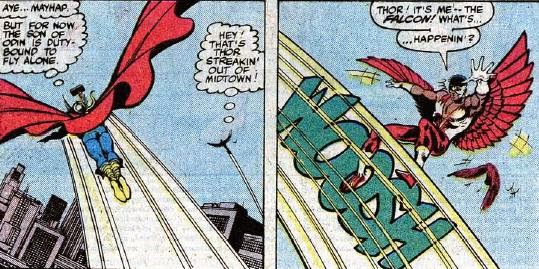
 Doug: I was down in the comic/exercise room a couple of weeks ago, checking out my Marvel Legends in between sets. As I admired the Avengers shelf, it occurred to me that Thor and the Falcon would make quite an odd couple if ever teamed together in a buddy story. So, because stimulate conversation is what we attempt to do around here, I thought I'd lay this at the feet of the masses and invite some thoughts from our readers. As I was getting set to write this, our colleague Ross over at Super-Team Family posted one of his awesome fantasy covers teaming Superman and Wolverine. Now there's a story possibility for you!
Doug: Your job today is to tell of some combinations you'd like to see that would make either incredible or awful storylines. Feel free to mix companies or eras if you'd like (the Punisher and Archie, anyone?), and there's no reason to feel like you have to be straight or silly -- anything goes, as long as you bring a ray of sunshine into the lives of the BAB community!
 |
| Scan courtesy of supermegamonkey.net |
Friday, March 30, 2012
Discuss: Your Favorite Super-Villain Team-Ups
 Doug: Not the magazine Super-Villain Team-Up per se, but any get-together by super-baddies is fair game!
Monday, April 25, 2011
Taking the Polar Plunge: Super-Villain Team-Up #14

"A World For the Winning!"
Bill Mantlo-Bob Hall/Don Perlin/Duffy Vohland
Doug: Hi, kids -- here we are with a second chance for Super-Villain Team-Up. If you recall, the last time we visited this book, the Herb Trimpe art was only slightly worse than the Steve Englehart words.
 So it's only fair if we check in again a bit later to see if the series improved. Additionally, this one's a two-parter with a fave 1970's book of ours, The Champions. So buckle in, and stop back by next Monday for the conclusion.
 Karen: Before we get started, I have to say, I've always loved that Byrne/Austin cover!
Doug: We open on the streets of Latveria. It cracks me up that everyone is always in traditional native costume -- or at least look a few decades out of time! Magneto, in full costume, strides the capital byways, looking to cause some trouble. He has come to Latveria to meet Doom -- but can't seem to get to Castle Latveria. The monarch has decreed that all in the kingdom must celebrate his victory over the Red Skull in the previous storyline. Magneto,
 quite put-out by the lack of attention, succeeds in toppling both Latverians and an enormous statue of Doom. Then he takes to the magnetic waves (yeah, whatever that means -- this story will require a suspension of disbelief in regard to the realm of physics) and rides them toward Doom's domicile.
 Karen: You know, I never even considered how ludicrous those 'villagers' looked until we started doing reviews. Between Marvel and the old Universal monster films, I guess I'd been conditioned to think that all small towns in Europe looked like that!
Doug: Inside the castle, Doom gloats over a plan that Reed Richards knows nothing of -- a plan that's already been executed.
 Suddenly Magneto bursts in through a window, and seems surprised that Doom recognizes him. Say what? Why would Bill Mantlo write such a thing? I thought it was silly -- even in real time, the Marvel Universe would have been 16 years old -- Marvel time, that's at least probably 6-8 years. And Magneto thought someone of Doom's caliber wouldn't have known him? He's further amazed when Doom asks him to recount his recent rejuvenation from his infant state. Magneto's somewhat humiliated, but ends his story by saying how the X-Men ran from him. Not quite the way we reported it here on the BAB!
 Karen: Hmmm.... is this actually the first meeting between these two? I can't think of another before this, not off-hand. But then, I haven't read every 60s and 70s Marvel comics. At this stage, Magneto was still not raised quite to Doom's level as a top tier villain. But he wouldn't have to wait long.
 Doug: Doom reveals his plan -- cannisters of neurogas have already been released into the atmosphere, essentially making everyone his obedient slave. To prove himself, he works Magneto like a puppet. After enlisting his friendship, the two toast. But Doom has laced Magneto's goblet with a drug that knocks Magnus out. He next finds himself on the streets of Latveria. So, thinking that if he himself is to conquer the world, he's got to break Doom's grip. So he does what any of us would do -- he goes to Manhattan and attacks the Avengers!
 Karen: I suppose even if Magneto had knocked politely, there was a good chance the Avengers would have attacked him! But yeah, this is definitely the 'obligatory fight scene'. Still, I enjoyed it on some level.
Doug: It's a four-page conquest, but Magneto makes quick work of the Avengers. I found it odd that the Vision could be subdued so easily (really -- synthetic blood would have iron in it?), as could the ionically-powered Wonder Man. Oh well -- guess it was necessary to the plot. Then to prove his point, Doom holographically appears in the middle of Avengers Mansion and, using the effects of the neurogas, forces the Avengers to bow to him.
 Then it gets even more unbelievable. Magneto decides that the Beast can aid him in allying with other heroes who can bring down Doom. He takes the Beast to a quinjet, and then magnetically affects the iron in Hank McCoy's blood, controlling his brain activity in a bid to negate the effects of the neurogas. That's right -- why didn't you think of that? Magnetic mind control. Oh, and in case you thought Mantlo made that up, go back and check Avengers #111 -- that's when Mags did this to the Scarlet Witch.
 Karen: Although I like the idea of the neurogas and the whole subversive nature of it, I have a hard time believing that beings like Thor, the Vision, and Wonder Man could succumb to it. But if I was Magneto, I do think I might have chosen Thor or maybe Iron Man instead of the Beast as an ally!
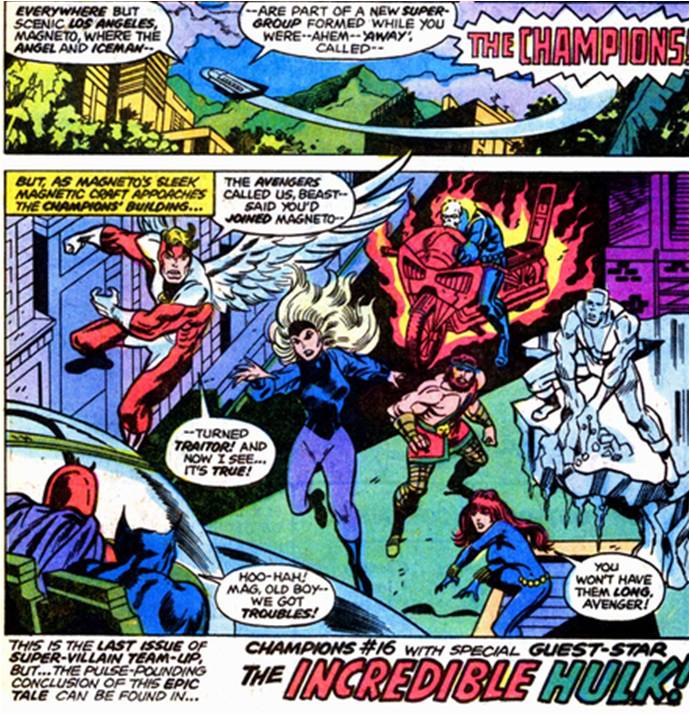
Doug: After striking out at the Baxter Building and at Westchester's School for Gifted Youngsters, the Beast decides that they have one more shot at help -- Los Angeles and the Champions! So away they go;
 I'll bet the conversation on that cross-continental flight was fun! The note at the bottom of the last story page states that this is the final issue of Super-Villain Team-Up (although I did have issue #15, which was a reprint of a Doom/Red Skull battle), and up until a couple of years ago, I thought that it was! But lo and behold, there were actually more issues -- over the next three years! I have no idea why it became so sporadic. Does anyone else know?
 Doug: I've intimated that Mantlo's script leaves a bit to be desired. He has all of the proper speech patterns down for the most part; I thought the plot was just silly. As we mentioned back when we looked at this book before, it just seems to be written like some monster movie from the 1930's (and don't get me wrong -- I liked those!). And what of the art team? Well, it's a huge improvement over Trimpe's output earlier. But Perlin's and Vohland's inks tend to be heavy, as I've seen Bob Hall look better than he shows here. So, cancellation? Even though I was fond of this book as a child, I'm feeling that it for the most part doesn't "hold up" on the re-read 30+ years later. Other opinions?
Karen: Mantlo seemed to get put on a lot of titles in the late 70s/ early 80s, but while he usually did a good enough job, I can't think of anything that knocked my socks off. But with SVTU, I think it's a very limited concept to begin with, and not necessarily an easy task to keep it both interesting and making sense. While I enjoyed this as a kid, I would agree, reading it now it has been somewhat disappointing.
Friday, September 10, 2010
Shrouded in Mystery, Part 2 -- Super-Villain Team-Up 6

Super-Villain Team-Up #6 (June 1976)
"Prisoner!"
Steve Englehart-Herb Trimpe/Jack Abel
Doug: Last time I wrote about my feelings toward the storytelling (words and pictures) in SVTU #5. I have to say, all are still valid as I re-read (for the first time in almost 35 years -- egad!) #6.
 Englehart's script continues to remind me of a Larry Lieber-style story, and Herb Trimpe's art is stiff. I'll have a specific remark concerning the depiction of Namor coming up.
Karen: I think the Trimpe-Abel team is even more uninspiring than the Trimpe-Perlin team from last issue.
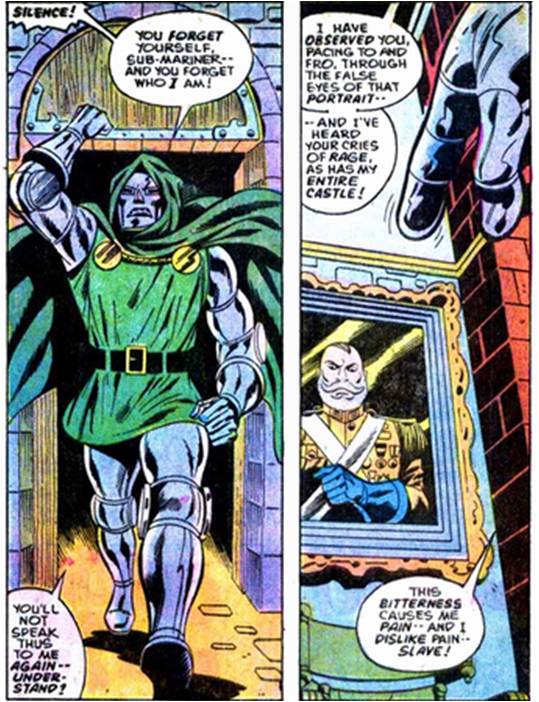
Doug: At the conclusion of our preceding installment, Namor had been forced to pledge his allegiance to Dr. Doom. Doom had ruined Namor's ability to process oxygen, and was holding the antidote away from him. The splash to this issue has Namor behind bars, trapped in a chamber of Castle Doom. He makes no bones about his displeasure, screaming Doom's name and echoing it throughout the castle. Doom finally bursts into the room to chastise his fellow monarch. In a scene straight out of a Mel Brooks movie, Doom reports that he's been spying on Namor through the eyeballs of a portrait on the wall! Doom makes it clear that he is indeed in charge, and storms out.
 Karen: Oh man, that thing with the portrait was just terrible -Mel Brooks indeed! I don't know how a talented writer like Englehart could come up with such a stereotypical portrayal of Doom. There are no nuances, no subtleties -he's a complete cartoon villain here.
Doug: Once back in his control room, Doom notices that the Fantastic Four have arrived to rescue Namor. In a much-too-long 4-page battle, the FF are confronted by various defenses to Doom's castle. Finally defeating an android army, our heroes move toward their target. During this spread Johnny spies a black, bird-like jet swooping low and wonders if it might belong to the Shroud. He deduces that it might because the plane is the same color as the Shroud's costume -- now how's that for detective work?
 Well, it is the Shroud and Namor spies him as well from his cell.
Karen: For a guy who is all about stealth, the Shroud sure gets seen a lot. And deducing that a plane belongs to the Shroud because it is the same color as his costume -which is black I suppose?-...oh boy.
Doug: In the midst of all of this Doom is meeting with a shadowy figure who seems very intent on learning more of Doom's technology, specifically his military technology. They seem to be bargaining, and Doom is told that he may yet achieve superpower status. Who is this guy? Not only is his identity hidden, but Doom addresses him as an equal. No, check that -- Doom almost seems to be on his best behavior because he wants something from this man. But the negotiations, if that's what they are, are suddenly interrupted by one of Doom's lackeys. "Bela" bursts in and tells Doom that the FF are almost to the castle.
 Wasting no time, Doom finds a nearby monitor and summons Namor to attack!
Karen: As a kid I would have had no idea who Doom's guest was; this time around I was able to figure it out, based on his silhouette. Englehart did like to get political!
Doug: I mentioned a quirk in the art at the top of this post. If you'll notice the panel below (found on story page 15), tell me that Jazzy Johnny Romita didn't draw Namor here?! This style is not found anywhere else in the story. I'm not sure what Trimpe/Abel turned in, but it obviously wasn't up to snuff and I'd imagine that as the printing deadline drew near, JR Sr. in his position as art director did the necessary doctoring-up. Anyway, the FF take Namor down relatively easily. But when they finally enter Castle Doom, who is there to greet them alongside the Doctor but our Secretary of State -- Henry Kissinger!
 Dr. Kissinger and Dr. Doom had just concluded a non-aggression treaty! Wow -- shades of Stalin and Hitler, and we know how that turned out! But waiting in the wings, literally, is the mysterious Shroud, who seems about to make his presence known. To be continued...
Karen: I could see there might be some 'correction' there, although it doesn't scream Romita to me. Romita definitely re-drew both Reed and Sue's faces on the Starlin/Weiss cover though, and maybe the entire figure of the Torch. It seems like Starlin was always being subjected to having his covers re-touched.
 Karen: I'm really not sure where any of this is going. I did read it years ago, but my memories are dim, except for the stuff regarding the Shroud and his origin. Let's hope the next issue is a bit more enjoyable.
Subscribe to:
Posts (Atom)