Showing posts with label Peter Parker. Show all posts

Monday, April 18, 2016

A Modern Stone Age Fantasy - Marvel Fanfare 1-2


Marvel Fanfare #1 (March 1982)
"Fast Descent Into Hell!"
Chris Claremont-Michael Golden

Marvel Fanfare #2 (May 1982)
"To Sacrifice My Soul"
Chris Claremont-Michael Golden

Doug: Hey, it's a Two for Tuesday! Except today is Monday. Well, you're still going to get some extra bang for your time spent on the BAB today, kids. Marvel Fanfare was a book that landed during my hiatus from comics, which stretched from around the spring of 1980 to the spring of 1985 (give or take). The whole direct market thing, comic shops, creator-owned properties, the "Indies"... all of that rose up while I was chillin' in high school and my first three semesters of college. Today's review material came to me in the form of one of Marvel's very early forays into the trade paperback business, in a tome titled The Savage Land (1987) and containing reprints of Marvel Fanfare #s 1-4 -- all for the low, low cost of $5.95! I also have the collected Wolverine mini-series in the same format; maybe we'll get to that some day (if I can stand Claremont's repeated "I'm the best at what I do, and...").

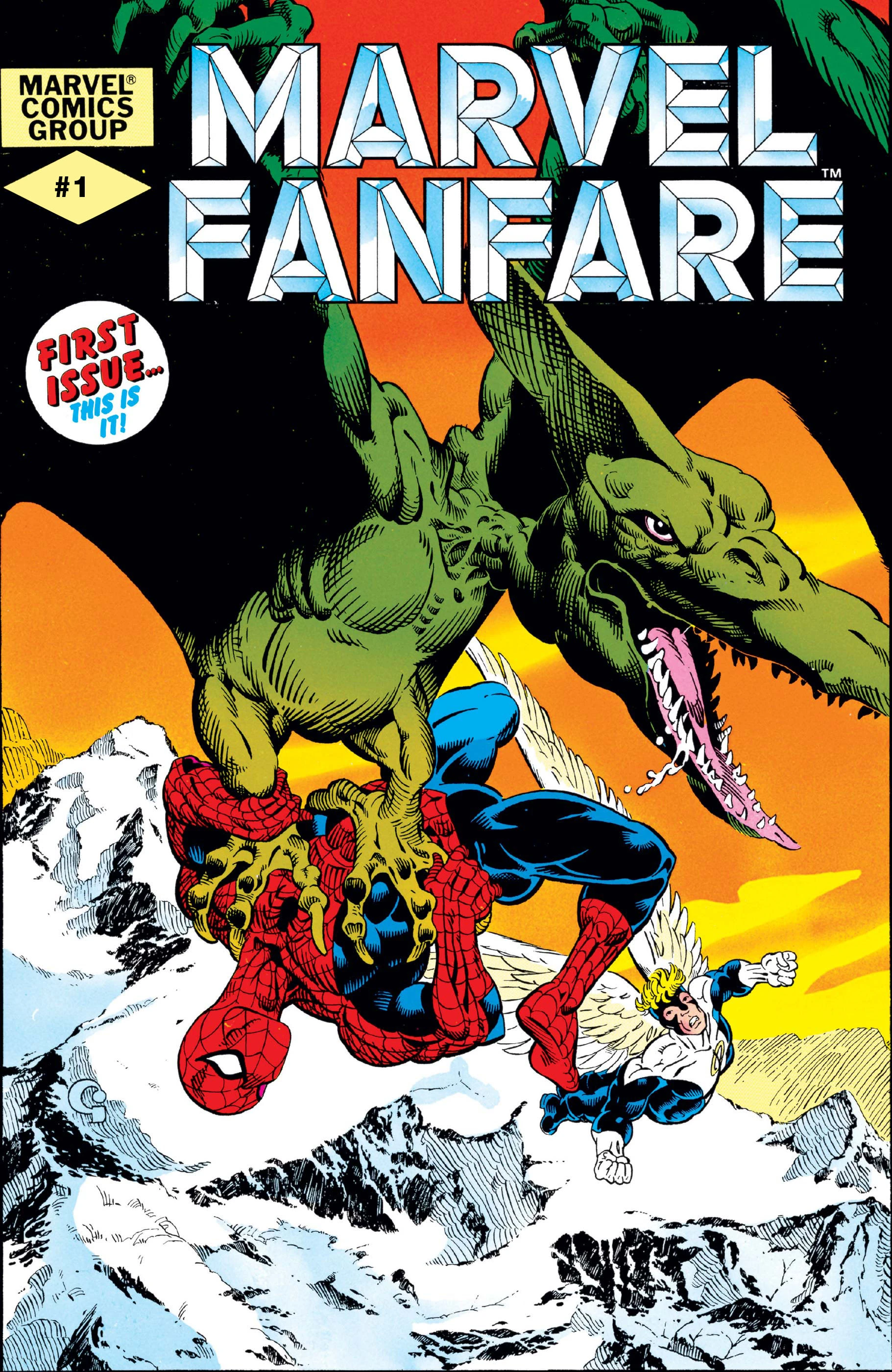
Doug: That's a sweet cover above left, isn't it? I always gape at it in all its airborne terror. That is, until I look at Spidey's legs. Umm... yeah, it just looks weird. But then I come back to the flying lizard from the bowels of hell, Spider-Man's hands working to free himself, and the Angel -- and I gape at it some more. But those legs.

Doug: Today, as you can see, we're going to look at the first two issues of Marvel Fanfare, brought to you by long tenured (even by 1982) X-Men scribe Chris Claremont and artist Michael Golden. At the time Golden was perhaps best known as the penciler of the Man-Bat feature that ran in Batman Family, the Mister Miracle book, and long runs at Marvel on Micronauts, ROM, and Savage She-Hulk. To me, Golden's detailed and expressive style at times channels Alan Davis, but also Marshall Rogers. Not bad company, huh? -- at least in my mind. Here's some background on the series, from Wikipedia (one reference is left in for those concerned with such things):

Marvel Fanfare was envisioned as a showcase of the comics industry's best talent. Each issue featured 36 pages of material with no advertisements and it was printed on magazine-style slick paper. it was more than twice as expensive as standard comic books ($1.25 in 1982 when most titles were 60 cents and $2.25 in 1991 when most were $1).
Editor Milgrom wrote of his experience with the series:
Doug: I know not whether the material we're looking at today was "inventory" or specifically created to launch the book. My guess is that even if it was inventory for an annual or some such thing, Al Milgrom made a solid choice in choosing it. I think you'll agree that the story is OK, but the art is simply gorgeous! Let's get rolling then, with not one but two 100-Word Reviews (one for each issue) --
Marvel Fanfare #1 (17 pages): Tanya Anderssen loved Karl Lykos. Trouble was, Lykos was the mutant energy vampire Sauron, who leached life force from others to keep himself alive. Lykos was believed killed in the Savage Land, until a photograph of him surfaced, taken six months prior. Anderssen enlisted the Angel to find Lykos. Meanwhile, the Daily Bugle is doing a feature on the Savage Land and sends Peter Parker to do the photos; he ends up on the same transport as the Angel and Anderssen. The chopper is wrecked and our heroes are captured by Magneto’s Savage Land mutates. To be continued!

Marvel Fanfare #2 (19 pages): Brain Child hooked Spider-Man and the Angel up to some nefarious gizmo that would in turn mutate each of our heroes. Ka-Zar and his warrior friends rescue Tanya Anderssen from a t-rex attack, but later they themselves are attacked by the horribly disfigured Angel and Spider-Man. Anderssen is kidnapped by the Angel; Spider-Man fights his transformation. Ka-Zar figures out that our heroes are at Zaladane’s citadel, so leads a band to rescue them. Brain Child, however, has subjected Anderssen to his ray, devolving her. Lykos knows only one way to reverse the process, so drains some of her life force. And Sauron returns…

The Good: As you may have guessed, and can see plainly for yourself from the samples I've provided, Michael Golden's art is fabulous. He is also the credited colorist on both issues. You can see that the evolution of paper and printing technologies really gives the art a clean, lush look. I mentioned above the level of detail -- there is great care taken in the rendering of each panel, every figure and even most backgrounds. Golden truly took no shortcuts here. And I think the fact that he was the whole enchilada on the pictures really gave him an investment in the work.

The teaming of Spider-Man and the Angel provides some solid visuals, although I'd argue that dropping Spidey into the Savage Land strips the character of some of his strengths -- notably web-swinging. Still, Golden's backgrounds, colors, and detailed clothing pulled my attention away from that small gripe. I enjoyed the links between this story and X-Men #s 60-63 and #s 113-116 with appearances by Magneto's Savage Land Mutates and references to Garokk and Zaladane. The Savage Land truly is a great backdrop for a story; who doesn't like dinosaurs?

The Bad: I don't really have any severe complaints at all about the story. Sure, Claremont's writing is Claremont's writing, and I can't say I didn't get what I was expecting. But I think taking Spider-Man and mutating him into a voiceless Spider-creature detracted from what one might normally wish to receive in a Spidey mag. In that regard, this was a loss -- sort of like Jeremy Renner's Hawkeye in Marvel's The Avengers. Dude spent 2/3 of the film possessed! Same thing here. But the Ka-Zar and Zabu action sort of made up for it.

The Ugly: Brain Child is one ugly dude. Barbarus is another. Sauron is also one ugly dude. A flying lizard with tattered pants and a gun. But then, what's not to like? I would say, on the serious side, that Ka-Zar comics suffer from one of the same tropes that Tarzan stories suffer, and that's the great white hope coming to save (and even subjugate) the local savages. We get a little of that here, but it's somewhat tame.

Doug: In that Wikipedia article linked above there was a section that shows where several Marvel Fanfare stories have been reprinted. I have the Marvel Premiere Hardcover Black Widow: Web of Intrigue that reprints a George Perez-drawn Widow story. There are plenty of other locations for this material. However, it's high time Marvel did a nice, neat package in their relatively new Epic Collection format and put this varied product between two covers.

Doug: At some point maybe I'll return to finish this tale -- obviously it ends in a pteranodon-level cliffhanger! Marvel Fanfare #3 features the X-Men and was drafted/finished by Dave Cockrum and Bob McLeod; Marvel Fanfare #4 has pictures provided by Paul Smith and Terry Austin. Shoot, those art teams alone are reason enough to revisit!


Friday, April 1, 2016

Guest Review -- The Spectacular Spider-Man (1976) 1


The Spectacular Spider-Man #1 (December 1976)
"Twice Stings the Tarantula!"
Gerry Conway-Sal Buscema/Mike Esposito

Doug: We received this review via email from Thomas F. Thomas had some thoughts on his mind regarding this first issue of a mag I've always simply called "Peter Parker"; the official name (according to various databases), as you see above, is The Spectacular Spider-Man. Whatever... I can guarantee anyone reading this that when I saw this mag on the spinner rack way back in the autumn after my 10th birthday, I couldn't say "Take my money!" fast enough. We'll see if Thomas feels the same way. Thanks, Thomas!

Thomas F.: Peter Parker, the Spectacular Spider-Man was Marvel’s third monthly Spider-Man title after The Amazing Spider-Man, which debuted in 1963, and Marvel Team-Up, which was launched in 1972. (A fourth Spider-Man title, Marvel Tales, was a reprint book that reproduced classic stories taken from The Amazing Spider-Man for newer readers who had missed the early issues of the 1960s the first time around.).

Some readers may have felt that a third monthly Spider-Man book was excessive, but bear in mind that Spider-Man was Marvel’s flagship character, and most fans couldn’t get enough of ol’ Spidey. Plus, other popular Marvel characters including the Hulk and Captain America were appearing in more than one regular monthly book. Hulk appeared in The Defenders and a reprint book of his own, Marvel Super Heroes; and Captain America appeared in The Avengers and the reprint books Marvel Super Action and Marvel Double Feature. This, of course, was in addition to their own individual books.

Peter Parker, the Spectacular Spider-Man is a rather long title, in my opinion. It’s definitely a mouthful. Later on (as of issue #134) the title was truncated, omitting the first two words and modifying the title font so as to resemble that of The Amazing Spider-Man.

The first issue was scripted by Gerry Conway, responsible for a number of notable Spider-Man storylines in the 1970s, including the death of Gwen Stacy, the introduction of the Punisher, and the original Clone Saga.


Many people didn’t like the Clone Saga, perhaps because it seemed to stray too far into the realm of science fiction for a Spider-Man book, but as a sci-fi aficionado myself, I thought it was intriguing and entertaining. For such a young fellow (as Gerry Conway was in the 1970s—he started writing The Amazing Spider-Man in 1972 when he was only nineteen), his scripts are surprisingly good.

Interestingly, in a note midway through issue #1, Gerry Conway explained that characters and subplots in Peter Parker, the Spectacular Spider-Man would be coordinated and “overlap” with the events and situations occurring over in The Amazing Spider-Man, so that the two books would mesh together “in a carefully structured ballet.” Not a bad idea, and over the next two decades, this worked fairly well.

PPTSS #1 was drawn by Sal Buscema, who had a long tenure at Marvel. Sal had a very distinctive style, and as the decades went by, his style became even more pronounced—overly so, in my opinion. On a positive note, he was good at conveying characters’ emotions through their facial expressions. But personally, I find his pencils somewhat rough-looking. Compared to his older brother John, a first-rate penciler, Sal’s artwork is weak, and I consider him a mediocre artist (at worst) and average (at best). He’s no John Romita, Sr., a definitive Spider-Man artist.

That being said, Sal’s 1970s work, at least, was decent, particularly his early work on The Incredible Hulk, The Defenders (1972-1976 run), and Captain America (1972-1975 run). I would even venture to say that some of it is classic material. But this quality did not last, in my view.

Sal Buscema returned to The Spectacular Spider-Man for a nearly unbroken decade-long run from 1988 to 1998. Unfortunately, by the early 1990s the characters drawn by Sal looked as if they had immense jowls, and the characters’ stances looked stiff and unnatural, like pasted cutouts. Characters’ faces looked pretty much identical, and characters—particularily men—could really only be differentiated from one another by their unique hairstyles and clothing. Oh well, we can’t all be Jim Steranko or Neal Adams.

Just to throw it in there, why do Sal Buscema’s characters have mouths that look like trapezoids? Many examples of this are found throughout PPTSS #1 itself. Just a few samples:


And now, to get on with the synopsis: the story opens on a Monday morning outside the Administration Building of Empire State University, with Spider-Man dangling from a gargoyle above a crowd of students who are listening to a speech by the university’s vice-chancellor, Edward Lansky. Lansky, standing resolute at a lectern, reiterates the importance of quality university education and urges that regardless of the city’s “financial crisis,” the city’s commitment to funding the university must be upheld. In the audience are two familiar supporting characters, Flash Thompson and Mary Jane—both students at Empire State and friends of science student Peter Parker.

Meanwhile, Spider-Man takes photos of Lansky, hoping to earn some extra money for his pix later from J. Jonah Jameson, publisher of the Daily Bugle. We learn that the Tarantula and several of his masked thugs are also attending the pep rally, although they are partially hidden by leafage and they are as yet unseen by the public.

The Tarantula is a terrorist from Delvadia, a fictional republic in South America, and he was physically trained to be his nation’s equivalent of Captain America. Clearly Marvel didn’t want to besmirch a genuine South American nation by associating it with a rogue like the Tarantula, although they obviously had no qualms about villains being from Soviet Russia or Red China, or if set during World War II, Nazi Germany.

Before long, the Tarantula betrayed his country’s fascist/authoritarian government and turned to crime in America, which proved to be more lucrative. One of his characteristics is that the Tarantula occasionally speaks in Spanish, particularly when agitated.

As far as I’m concerned, from among Spider-Man’s rogues gallery, the Tarantula is a colorful B-villain at best. Probably a C-villain. I found that he simply didn’t seem to pose as great a danger to Spider-Man as, say, A-list villains like the Green Goblin or Dr. Octopus—he’s not as cunning—although he certainly exhibits much wanton cruelty and ruthlessness.The Tarantula had last appeared in The Amazing Spider-Man #135, where the treacherous bandit had a run-in with Spider-Man and the Punisher aboard a cruiser.

Suddenly the Tarantula and his cohorts burst onto the scene. They accost Vice-Chancellor Lansky and announce their intention to kidnap him. Shocked, Spider-Man jumps down from his perch and into action. The webslinger manages to avoid the Tarantula’s deadly kicks (the razor-sharp tips of his pointy boots are spiked with lethal poison) and manages to stun the Tarantula with a shot of his webbing. The Tarantula reels off balance, disoriented. Meanwhile, the Tarantula’s cronies are forcing Lansky into a getaway car. Flash Thompson, Peter Parker’s athletic friend, joins the fray. He charges the Tarantula’s henchmen, ignoring Mary Jane’s shrill cry not to interfere, but a muscular henchman knocks him to the ground with a brutal roundhouse punch.

As the Tarantula lays sprawled, Spider-Man approaches him. But as Spider-Man gets near, the Tarantula, who was shamming all along, fiercely kicks Spider-Man in the gut, knocking the wind out of him. Why didn’t his trusty old spider-sense warn him? By rights, it should have. In any case, this gives the Tarantula the chance to escape, and he leaps on top of his getaway car, digging in with his toe spikes while his underlings speed away.

With the fight over, the angry students jump to the conclusion that Spider-Man might have been in cahoots with the Tarantula and his gang. They try to apprehend him, but Spider-Man easily swings away, annoyed that the students, who are usually on his side, decided to turn on him. Spider-Man chides himself for allowing the thugs to escape with Lansky. The irrationality and danger of enraged mobs who seek a malefactor to punish, often an innocent one, has been well-documented throughout history, and Sal Buscema conveys the ugliness of the hostile crowd effectively enough.

When Spider-Man retrieves his camera, which he had left suspended from a strip of webbing from a nearby rooftop, he discovers to his chagrin that his webbing had snapped and his camera had fallen to the pavement, shattering on impact, unsalvageable. Dismayed, Spider-Man realizes that he won’t earn any extra cash for photos this time, and he angrily punches the stone wall, cutting his right hand. Ol’ Spidey should exercise some more self-control!

Less than an hour later, Peter Parker arrives home at his modest apartment in Chelsea. He’s wondering who will pay Lansky’s ransom when his attractive neighbor, Gloria Grant, chats him up. She notices that Peter has an injury on his hand, and offers to bandage it. As she dresses the wound, she tells Peter that she’s looking for a steady nine-to-five job, as the “modeling biz” hasn’t been going very well lately. As for me, I’m left wondering whether this is because there aren’t many modeling opportunities available, or whether the modeling gigs themselves just don’t pay enough—Gloria didn’t specify which it was.
Mary Jane then spontaneously shows up at Peter’s door—which seems rather contrived to me—and there is clearly some tension between them. Peter is irked that Mary Jane has been seeing a great deal of Flash, and when he mentions it, Mary Jane airily tells him he’s just “imagining things.” The trio sets off for the Daily Bugle, and as they pass City Hall, Peter’s spider-sense tingles. He notices the Tarantula’s escape vehicle in the street, a limousine, shrewdly identifying it by the hastily-concealed puncture marks on its roof. Making an excuse, Peter begs off and in a restroom quickly changes into Spider-Man. It seems as if Peter Parker is always making sudden excuses to withdraw for one reason or another. You’d think that his friends would eventually have grown suspicious of his spontaneous comings and goings and perhaps put two and two together.

In the parking garage beneath City Hall, the Tarantula and his crew are receiving instructions from an unknown man in a car. Who is this mystery man? That won’t be revealed until issue #3, and this subplot helps add suspense and establish that there is a behind-the-scenes conspiracy. A talented writer, Gerry Conway was good at piquing his readers’ interest and making them want to find out more.

The criminals are to kill the mayor and make it appear to be an accident—a kidnapping gone wrong. The Tarantula and two of his cronies make their way into the building, and the Tarantula kicks a policeman in the back. This time the chemical on the tips of the Tarantula’s boots is only a knockout drug, not the usual fatal poison. I don’t see why the Tarantula bothered to change the lethal poison on his toe spikes to a soporific. It’s obvious that the Tarantula has no regard for human life; it would be more in character for the Tarantula to kill a police officer without scruple.
Probably the editor didn’t want a Marvel comic book—Spider-Man, no less—to actually portray a villain openly killing a policeman. Such a thing might convey the wrong message to young readers.The criminals are making their way down a corridor when they come across Spider-Man standing upside down from the ceiling, obviously anticipating them. The Tarantula and his accomplices are utterly surprised. Spider-Man renders one of the Tarantula’s men unconscious with a quick blow, and the other one seizes him from behind. A well-placed punch knocks out the other thug, and Spider-Man pursues the Tarantula. Unfortunately the Tarantula has taken the mayor’s personal elevator up to the mayor’s floor, and the door is three inches of solid steel and accessible only by key—which so happens to be in the Tarantula’s possession. Digging in with his fingers, Spider-Man uses every ounce of his spider-strength to tear out the reinforced elevator door and climbs up the elevator shaft to the mayor’s floor.To me, this didn’t make much sense. Why didn’t Spider-Man spare himself all this effort and just access the mayor’s office through a window from outside the building? That kind of dramatic entrance is one of the wallcrawler’s signature moves.

Meanwhile, in the mayor’s office, the mayor and his aide Ogilve are quibbling over monetary matters—the city budget—when the Tarantula brazenly enters. The mayor mistakenly thinks that the Tarantula intends to hold him for ransom, and informs him he won’t get “a red cent,” but the Tarantula contemptuously retorts that he isn’t after money, but the mayor himself.

In a full page spread, suddenly Spider-Man leaps into the room, tackling the red-garbed Tarantula from behind. This kind of page-sized action scene is remniscent (to me, anyways) of the full page action shots in Amazing Spider-Man Annual #1, where Spider-Man is portrayed in combat six times, each time with a different member of the Sinister Six—classic Steve Ditko.


A battle between the two combatants ensues, with Tarantula kicking ferociously and Spider-Man nimbly dodging the attacks. Incensed by the Tarantula’s endless prattling, Spider-Man tackles him again and they crash through the window, plummeting downward.
Unfortunately, just before the pair broke through the window, the Tarantula had managed to grab the front of the mayor’s suit and pull him out as well.

Spider-Man has a choice: either capture the Tarantula, or save the mayor, and obviously he chooses the latter.

The Tarantula saves himself and makes good his escape—for the second time. Spider-Man catches the mayor, and using his webbing, descends carefully to the street with the mayor in his grasp. The mayor is concerned that the Tarantula will return; Spider-Man tells him that if the Tarantula comes back, he will be ready and waiting. The mayor doesn’t find this very comforting at all. Spider-Man bids farewell to the mayor and swings away, having left Gloria Grant and Mary Jane waiting for him outside City Hall.

Overall I enjoyed this suspenseful story and looked forward to its continuation. At the bottom of the final page, it was revealed that the main antagonist of issue #2 would be Kraven the Hunter, and I was curious to see whether Kraven the Hunter and the Tarantula would be able to work together. Both of them are alpha males with large egos, and it seemed likely to me that there would inevitably be friction between the two of them, even if they were both taking orders from the same mysterious, unknown figure.


Thursday, March 12, 2015

Young, Gifted, and Black: Why not Miles Morales?


Let's try this again.

When we originally posted this, unfortunately an anonymous commenter came on and made a personal attack on another commenter, and things quickly escalated before Doug or I could intervene. We've always said that our vision for this blog is one of a friendly place to hang out (unlike so much of the internet), and we've been lucky to see that come true. What happened with this post was a rare exception, thankfully. We pulled down the post to let things cool down a bit, and have deleted the attack post and the argument that came after. If anyone has questions about the sort of conduct we expect here at BAB, it's posted on the sidebar under "Drama-Free Zone" (that should be a clue). Basically: play nice. We encourage discussion and debate, but we won't tolerate personal attacks or hostility towards others.

We hope by re-opening the post it will allow anyone who might have been discouraged from commenting to join in and move the conversation forward. 


Karen:  I want to talk about something that's been popping up on the interwebs lately -the idea that when Spidey appears in the genuine Marvel cinematic universe, he might not be Peter Parker at all, but Miles Morales. Or at least, he might not be white.

OK, now that the collective gasp and initial outrage has passed, let's  rationally look at this idea, shall we? I'll admit, my first reaction to the idea of a non-Peter Parker Spider-Man on the big screen was one of dismay. Peter is MY Spider-Man. That's who I grew up with. The kid with a million problems and a huge sense of responsibility, who comes alive when he puts on that red and blue suit. It's hard to think of seeing anyone else up there. But these feelings were mired in sentimentality. I tried to steer clear of that, and consider the idea with an open mind.What, I asked myself, seemed essential about Spider-Man, as an idea, a concept?

There are certain things I think have to be retained to make any version of Spider-Man feasible. The "with great power comes great responsibility" theme is the backbone of the character and has to be present. The Everyman nature -the kid with a million problems -is also at the core of what makes him so appealing. And finally, the sense of fun, of youthful exuberance, of sheer rebellion, with the web-slinging and wisecracking, is the final ingredient in the mix.


So why couldn't we get this with Miles Morales? Admittedly, I haven't read a single comic with him in it. I had to look up info on him to get the lowdown. But he's been Peter's successor in the Ultimate universe for four years now, so it's not as if we're pulling somebody out of thin air, or taking a white character and 'turning' him black, ala Nick Fury or Johnny Storm in the new Fantastic Four film. So no one can complain that he's not a 'real' comic book character. No, Miles has been around and he's got fans.

He's also a lot like Peter, in that he's a science nerd. He was also pretty young when he first became Spidey -just 13, even younger than Peter. He got his powers through a spider bite too, although this spider was created by Norman Osborn. Now they'd probably have to change his origin in the movies, if there's no Peter Parker. But big deal. They could do that. He's got problems with his family -his uncle is even a super-villain. So there's plenty of angst there.

So what are the pros? Well, it would distance Marvel from the last two Spider-Man films, which were not that successful (although, unlike some folks here, I really liked Andrew Garfield as Peter/Spidey). It would also make it clear that this was an entirely different Spider-Man. It would be fresh, and exciting.

It would bring some much needed diversity to the Marvel cinematic universe, which currently has only three African American characters (Fury, Falcon, and War Machine), all  in supporting roles, although Black Panther is on his way. With Miles we'd have an A list hero of color. Some might ask, 'Why does this matter?' It does matter. It's important for our heroes to reflect society as a whole and I'm betting for some kids, to see a super-hero who looks like them among a bunch of otherwise white heroes, is a very big deal. Of course, Spidey has always been one of the few heroes who was covered head to toe, and could "be" anyone -Stan Lee makes that point in this clip at around the 1:15 mark:


Marvel's lucky -they really wouldn't have to change their toys or other products at all. Well, Miles' outfit is different but they might elect to stick with the traditional suit just for marketing purposes. 

What are the cons? Dumping Peter Parker does risk fan backlash. And let's admit it, there are still a lot of just plain prejudiced people out there. There's also the marketing issues, but again -Spider-Man looks like Spider-Man, regardless of who's in the costume (well, unless it's the Blob). 

I have to admit, I wish I knew more about Miles. My number one complaint about the Raimi Spider-Man films was that I never felt they captured the glib, smart-aleck nature of the character. The two recent, reboot films seemed to get that right, although that was about all they got right. I don't know if Miles has a similar personality. I'd miss that if he was a more serious guy.

But honestly, I feel like I am ready to give Miles a chance. I didn't think I could get to this place when I first heard the idea bandied around, but you know, I've had MY Spider-Man, maybe it is time to try a new one. When the new Star Trek films came out, with new actors playing Kirk and Spock and the rest, it wasn't MY Trek, but you know, I enjoyed them for what they were, and I always have my DVDs of the original series and movies to look at if I need that fix. I think we have to seriously consider the idea of Miles Morales as Spider-Man in the film universe, and not dismiss it so easily.

Wednesday, July 17, 2013

Related Posts with Thumbnails