Showing posts with label Fine Line. Show all posts

Friday, January 15, 2016

Suggestion Unboxed - Wonky-looking Teeth and Other Concerns


Doug: Back in October we ran a post requesting ideas from our readers. We promised to run all of those suggestions at some point. While we've covered many of them, it's been a while since some of those thoughts graced our blog. Here's another one:


DisneyMarvel: I know that there have been discussions of the Thing and his different artists, but I would like to read opinions on if he should be shown with teeth or not. The way Kirby would do it was only show them when great effort or anger was involved. A friend of mine feels that the Thing needs to have teeth to seem more realistic for modern audiences. For me, showing teeth makes him look ridiculous - especially if the proportions are off. He looks like a 'have a nice day' meme of a cat with human teeth. Even Buckler has redrawn Fantastic Four #159 showing the Thing's open mouth now with teeth and I don't like it.

Doug: And I'll add on -- what other aspects of certain characters can just seem "off" to you?

Saturday, January 24, 2015

BAB Firsts - It's a Fine Line: The Thing in the Bronze Age


Doug: Karen and I would like to start a new series where we look at some of our favorite characters as depicted by some of our favorite artists. Of course Karen has expressed her love recently for the Bashful One, so we thought we'd kick this off with a look at Benjamin J. Grimm, as seen throughout the Bronze Age of Comics.

Doug: To commence, we have to discuss the King himself, Jack Kirby.


Karen: I like how the Thing's look became more refined over time. He went from looking lumpy and almost soft to the more solid, rocky hero we all know and love. How much of this, I wonder, was also due to the inkers involved?

Doug: The image at left is indeed inked by the stalwart of the Fantastic Four strip, Joe Sinnott. I think it goes without saying that Sinnott's inks added polish and depth to Kirby, really texturing Jack's pencils. I mean, look at that picture -- it looks like Ben's skin is made of rocks!

Doug: Next up was the Jazzy One, John Romita.

Karen: He was on the strip for such a short time period, it's almost easy to forget he was there! Just 4 issues -103 to 106. Although Romita seems able to draw any character well, I don't think his style was especially suited to the Thing, although his take on Ben was certainly acceptable.

Doug: I think the fact that John Verpoorten inked Romita for most of his short tenure might lead to the less-than-memorable memories! I believe Sinnott only inked him on his last issue. I've read before that Romita was not satisfied with his work, and part of that was his insecurity from following Kirby's run.

Karen: I've read the same thing, and it certainly makes sense! That's a very tough act to follow.

Doug: After Romita's brief tenure on the Fantastic Four, Big John Buscema took the reins of the World's Greatest Comic Magazine.

Karen: Now we're talking! In my mind, John Buscema is the Thing King! It probably has to do with the fact that he was the artist on the FF when I started reading it.

Doug: I actually have the original art to the sample at left, and it's just beautiful. Buscema's facial expressions on this page really convey first Ben's irritation, then his determination during this battle against the Miracle Man. I also like that Buscema really gives Ben some bulk, but as I'd remarked during our Marvel Two-In-One posts, kept Ben within that six-feet tall range of height.

Karen: That's definitely how I think of Ben -as bulky, heavy, but not particularly tall. I agree with you, he is frequently drawn too tall nowadays -but then so is the Hulk. As always, Buscema is a master of facial expressions and body language, able to easily convey Ben's emotions, despite his monstrous appearance.


Doug: Following Buscema was the sometimes dubious run of Rich Buckler.

Karen: I feel badly for Buckler. I believe he was told to emulate Kirby early on in his career. It's unfortunate because I really like his own style. I'm not even going to get into the swipes issue here. But he did a good job on the Thing.

Doug: I've included parts of two pages from FF #159 that really show off Buckler's finer effort. You know, the larger panel on the far right brings up a point -- how do you like Ben's exterior to be drawn? Large rocks (like here), or small (as in the Buscema image above)?

Karen: Hmm, I haven't really considered it, but I can tell you this: I notice when I feel that the rocks are not drawn properly
. I think it's actually a fairly difficult drawing challenge -how do you get across the idea that he's composed of those crazy, interlocking rocks? How do you shadow them? Are they flat or do they project slightly? I think some artists and inkers can pull it off, and some just can't.

Doug: After Buckler, the FF were penciled by George Perez.


Karen: Can Perez draw anything bad? I don't think so! His runs on FF were beautiful, and he brings a lot of character to his version of Ben.

Doug: The sample I chose for George Perez comes from his earliest stint, and from a period I just loved -- the exoskeleton era that followed the Thing/Hulk two-parter. Perez seemed to have a way of making the Thing somewhat bulbous, which is not a bad thing. Funny -- if you've ever seen the book How to Draw Comics the Marvel Way, I really think Perez actually draws Ben the very way Big John Buscema instructs! I'd also argue that, again early on, Perez echoed Buckler's later work (after he got away from his Kirby-ish phase).

Karen: Perez' Thing was maybe a little more streamlined than some of the others, but still had the expressiveness and mass that I like.

Doug: Keith Pollard was the successor to Perez. I'll say here that when I read these issues off the newsstand/spinner racks, I thought Pollard's art was quite good. Looking at these issues again after 30 years, he's certainly not bad -- quite serviceable in fact. But being sandwiched between George Perez and John Byrne? That would be tough for anyone! I did like the story that Pollard illustrated, when the FF were on the outs -- there were four solo issues followed by a good Doc Doom story that culminated with issue #200. Pollard really drew some dynamic scenes in the series.

Karen: Pollard is probably the most overlooked Thing artist. He had a very solid style, not especially flashy, but very good nonetheless.

Doug: John Byrne's first stint on the title extended from issue #209 to #221 and was initially dominated by Joe Sinnott's inks. However,
Byrne later changed the way he interpreted the Thing, bringing him back to his lumpy origins. We've provided two samples here -- the panels to the left were inked by Joe Sinnott, and the panels below to the right were inked by Byrne himself. In fact, our latter example is from the story when the Thing did indeed return to his original Kirby-style form.

Karen: Byrne 's run is of course highly regarded and I think his Thing always looked great, although I was not fond of the return to the lumpy version. However, I've always felt that Byrne was his own worst inker, and I prefer Sinnott's inks to Byrne's. But either way, his Thing is a big brute, which I like. Sometimes though, Byrne's Ben seems to be extremely round -have you ever noticed that?

Karen: Speaking of Sinnott, shouldn't we remark on the man who was with Ben the longest? His inking brought a certain continuity to Ben and the FF regardless of who the penciller was at the time. His version of t
he FF is indelibly marked in my brain, the same way Terry Austin's contribution to the X-Men has shaped how I see those characters forever.
Doug: There is no mistaking that, in spite of the heavy hitters who've put pencil to paper on the FF, Joe Sinnott is the magazine's most valuable player. He really provided a pretty seamless reading experience. I'd argue that the only time the art on the book seemed to lack were the issues when Sinnott was not present. I'd say that even for Byrne's highly-regarded second stint on the book. No doubt it's classic -- but could it have been even moreso with Sinnott on board?
Karen: How about
Ron Wilson? He drew Ben over in Marvel Two In One for many years. Perhaps his most memorable work was in Marvel Two In One Annual #7, when the Thing battled the Champion. He seemed to really 'get' the Thing, and did some very good work on the title.

Doug: Wilson's a solid guy, and perfect for the team-up style books. I
always felt like he gave a great effort on those books.
Karen: There's been a lot of other artists who have drawn the Thing as a guest star in other titles. A couple that come to mind are Neal Adams and Jim Starlin. It's hard to get a real impression of Adams' Thing, as I only recall seeing it in The Avengers during the Kree-Skrull War. I would say his version is OK, but there are a number of other artists that I feel do a better job. Surprising, as Adams is right up there in my personal favorites of comic book artists.

Doug: I wonder what a Neal Adams commissioned sketch of Ben would look like? I know Adams would give it his all...

Karen: I think regular readers know that Jim Starlin is a comics god to me, but...his Thing looks a little, I don't know, off to me. It's not bad, but for some reason it just doesn't quite look like the Thing to me.
The two panels here are taken from Marvel Two In One Annual # 2. The bulk is right...maybe it's the legs. I can't put my finger on it.

Doug:
I'm with you, though on the image at left -- the arms and legs seem just a bit off.

Karen: OK Doug, I know this isn't Bronze Age, but what do you think of Al
ex Ross' Thing, shown here from Marvels? I have to say I like it. He looks thick and bulky, and his rocks/scales are all so defined. And look at those big ol' hands!

Doug: I'm sure by now our readers know that we collaborate on these posts by coming to Blogger at different times to make our posts/edits. So they might be surprised at the level of same-mind that we sometimes have -- I literally had thought of the very image you posted at right, and when I next logged in here to see what your last work had been about here it was! Ah, yes -- great minds... And no, Alex Ross doesn't draw anything poorly!

Tuesday, February 22, 2011

It's a Fine Line: Batman in the Bronze Age


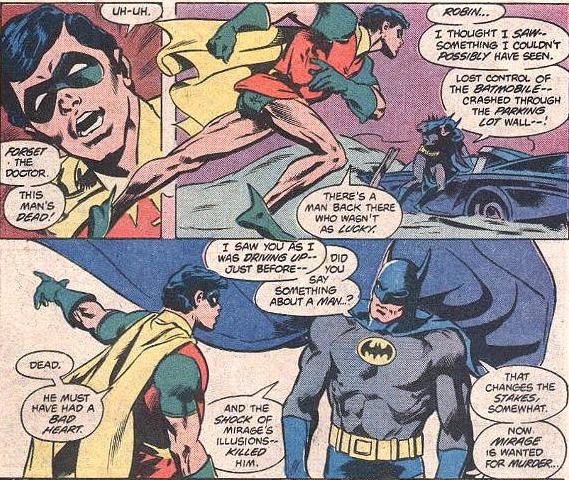
Doug: You may have noticed a bit more Batman around these parts lately, and Neal Adams' work is always a welcome topic on this blog. So what say we just combine 'em, throw in some Marshall Rogers and a little Jim Aparo and see what we get? All of the picture references for today's post come from the wonderful World Wide Web, as my Batman collection over the years has dwindled.

Bob Brown --

Doug: We're currently looking at Bob Brown's work on the Avengers/Zodiac story, and some time ago we checked in on his Daredevil and the Black Widow. Brown actually drew quite a few issues of Batman and Detective Comics, and as I've said, he was always pretty solid if not spectacular. I know he's not for everyone's taste, however.

Karen: I don't think I've ever seen a Bob Brown Batman comic. But then my Batman collection is limited. This looks serviceable but that's about all.


Dick Dillin --

Doug: Dillin is of course best known for his long tenure on Justice League of America, but he, like Brown, showed up from time to time on Batman's solo adventures. I think one thing that most everyone will notice is the style of the cowl and the bat insignia. This panel definitely comes from the very early Bronze Age, when the comics still mimicked the 1966 television show. The ears were short, man!

Karen: I've always liked Dillin. But you're right, this has a heavy TV influence. I'm just waiting for Aunt Harriet to pop up.

Doug: Ha! We laugh about that, but let's face it -- how many Bronze Agers owe their entry into this hobby/interest to that TV show?

Dick Giordano --

Doug: Giordano's spot in Bronze Age history is, for most folks, as the sidekick to Neal Adams on Batman and the Green Lantern/Green Arrow run. However, his was a varied career, and every now and then he did his own pencilling. Many criticize (or laud, depending on your point of view, I guess) him for aping Adams when he pencilled. There are worse sins than aping Neal Adams.

Karen: No kidding, very much looks like Adams.


Don Newton --

Doug: I know Newton has many fans, and I am certainly no detractor. However, I don't think I know enough about his body of work to even foster an intelligent comment here.

Karen: Newton's another one of those guys that I've thought was serviceable but never got me excited about the art.


Ernie Chan --

Doug: I like this panel, because it's just through-and-through Ernie Chan. Many of you will recognize his work on Conan the Barbarian, either on his own or for his extensive run as the inker for John Buscema. But in the mid- to late-'70's he was the lead artist on the Dark Knight, in both magazines.

Karen: Chan is just not my cup of tea, regardless of who he's drawing.

Doug: I thought he was OK on the Batman books that I owned. I always resented him, however, for exerting too much influence over Buscema's pencils on the Conan run.

Frank Robbins --

Doug: We've never covered the Invaders on this blog, and I suppose at some point we need to. But one look to the left will tell you why I would not be partial to such a strategy. Robbins did quite a bit of writing on the Bat-books, but only a few times was he called on to pencil. Thank goodness...

Karen: I'm not going to say anything. I'm trying to keep my reputation as a nice person.

Doug: Mom always said...


Irv Novick --

Doug: Novick's one of the '70's artists readily recognized as one of Batman's prominent artists. As I commented above, you can tell which part of the decade this panel hails from. But that's OK -- it's still pretty powerful. There's quite a bit of action and emotion in this single panel. But it's kind of funny (not Hahaha) to me that it just seems like a panel from a DC and not from a Marvel. Thoughts?

Karen: It has me intrigued. I'd like to see more of his work.


Jim Aparo --

Doug: If anyone out there doesn't like Jim Aparo, I would like to know why. This guy wrapped the best of a whole bunch of artists, Adams and Novick included, into his own style. One of the stalwarts of the Caped Crusader's stable of pencillers, Aparo lasted well into the 1980's and illustrated several important stories.

Karen: This is 'Mr. Batman' to me. Aparo was drawing Batman when I first started reading it. I've always loved the tall, lean look he gave the Dark Knight. He had a very strong style, good story teller, and very dynamic too. He's the guy to whom I compare all other Batman artists.

Doug: I agree with you. While not an Aquaman fan (lordy, the King of the Seven Seas has surfaced (ha!) on this blog twice now in the past week!), Aparo's work on that title was great as well.

John Calnan --

Doug: You know, this isn't a name I ever would have come up with. When doing research and art collection for this post, I noticed that he pencilled many of the issues that I actually had at one time. Wow -- seriously, never would have named this guy. The panel at left is good -- no problems. But I had a hard time finding anything significant in color to pass along. So I guess I'll just have to plead "no memory" on this fellow.

Karen: No idea who he is, but the art reminds me of the old Hostess Cupcakes/Twinkies/Pies ads. That's not really a good thing.

Doug: Another slice of Bronze Age life, those ads were...


Jose Luis Garcia-Lopez --

Doug: You'll all identify this as a model sheet, which it most certainly is. And if you run across some of the others that Garcia-Lopez drew, they are all just as beautiful. Garcia-Lopez was the "house artist" for many of DC's mass marketed items, like licensed items that became toy packaging, etc. While I didn't find a good sequential example of his work, I'm sure you've run across his stuff on New Teen Titans, etc. Solid, solid artist.

Karen: Always liked Garcia-Lopez. Very distinctive look, clean, and as you say, solid artist all the way around. His stuff worked with pretty much any character you could think of. His Batman looks great.

Marshall Rogers --

Doug: We're also in the midst of a little 3-Saturday series from the Englehart/Rogers collaboration from Detective Comics, and I don't know about you, but I'm really enjoying it. I've seen it said elsewhere on the 'net that no one drew Batman's cape like Rogers, and I'm not so sure that I wouldn't echo that. I think his "real people" are finely rendered, and his fight scenes are well-choreographed. And then there's Silver St. Cloud...

Karen: Great stuff. He and Terry Austin made a terrific team. Of course, I think Austin is one of those inkers that makes anyone look better. But Rogers was an excellent penciller.


Mike Grell --

Doug: I was surprised to see Grell's name on several of the credits in these books. When I think of Mike Grell, like you, I'm probably seeing his work on the Legion and on Green Lantern/Green Arrow. But this is a nice sample at left. I know some of our readers were detractors of Grell when Karen ran the Grell-Cockrum Face-Off a couple of weeks ago. But for me he's always been a fine draftsman. Not without his faults, mind you -- but you could do a heckuva lot worse.

Karen: I don't see anything wrong with the sample. But then, I do like Mike Grell's work. He reminds me a bit of Aparo here, with that lean look to the Batman which I favor.


Neal Adams --

Doug: I have no further comment. None needed.

Karen: I have one comment: beautiful.


Rich Buckler --

Doug: We've discussed Rich Buckler around these parts many times. I'll stand by former comments that he's just a well-rounded artist. The panel at left looks like his style -- not flashy, but strongly straightforward. And I appreciate the backgrounds in the first panel. Not all artists take the time to fill in the mood of a scene, but this first panel is nice.

Karen: I have no complaints about Buckler's work here or pretty much anywhere else. He's a very solid artist.

Doug: There were a few other artists worth mentioning for their body of work in the 1970's, but I didn't notice that they did much in the way of interiors. The two most prolific artists I'm thinking of would be Michael Kaluta and Nick Cardy -- both did extensive cover work on both Batman and Detective Comics.

Tuesday, February 8, 2011

It's A Fine Line: The Vision in the Bronze Age


Doug: After previous examinations of the Thing and Spider-Man (and even Spidey's cast of offbeat co-stars!), we're back at it with a look at our favorite Avenger. The Vision has been a stalwart on the roster since his introduction in Avengers #57; but what sort of treatment would he get as he headed into his second decade? Well, funny you should ask...

Sal Buscema, 1970. How about Our Pal Sal? While always overshadowed by his big brother John, Sal was (in many people's estimation) "the look" of Marvel throughout much of the Bronze Age. The sample at left is from Sal's first run on the book and shows off a powerful Vision. One of the things I've always admired about Sal was his ability to make just about anyone in the Marvel Universe look good -- maybe not great, but good. Vizh is buff but not too much, tall but not a giant. He's pretty much right in the groove.

Karen: I think you put it just right. Sal can draw everybody well, but I never think of him as a spectacular artist. Still, I never complained when he was the artist on a title.

Neal Adams, 1971. In contrast to Sal's rather sturdy-looking Vision, here to the right we see a typically lithe Neal Adams figure. Adams could make just about anyone look 6'5" and strong. Of course this is a page from the "Kree/Skrull War" and showcases Vizh's power of intagibility as he slugs it out with the Super Skrull. By the way, I love the way Adams draws the cape clinging to the synthezoid's body in the first panel.

Karen: I love Adam's depiction of the Vision -and pretty much everyone else! Vision is very unearthly here. The work with the cape makes him mysterious. I especially like the way Adams draws his face and eyes-with just that little spark in a field of darkness.

Barry Smith, 1972. I don't know about the rest of you, but I'm pretty hot and cold with Barry Smith. I think his earliest Marvel work is quite atrocious (OK, maybe that was a bit strong, but c'mon -- it wasn't worthy of being called a "Kirby clone"). However, by the time we got past the first few issues of Conan the Barbarian, he was putting out some beautiful pictures. I think this little stretch of the Avengers (#'s 98-100) was in the latter mold. This sample at left is pretty solid. I really like the dynamism of the first panel, and the panel on the bottom is pretty good -- although I'd argue that the hands look just a bit off. Too small? Overall nice work.

Karen: It's certainly better than his early work on Avengers, but I've just never cared much for Smith's super-hero work. I think his style was great on Conan and even Dr. Strange, but these issues really didn't do much for me. His Vision is decent enough.

Rich Buckler, 1972. I think Buckler's stint on the Avengers (just after Barry Smith's short tenure) is among his best work -- ever. We just finished a series of posts showcasing his pencils on the FF; this sample at right really looks nothing like it, despite the fact that both series were inked by Joe Sinnott! Here we see a brooding Vision, and I absolutely love the third panel -- that's what the Vision should look like. Again, he's leaner than Thor or Iron Man, but more muscular than Quicksilver. Buckler, at least in these pages, "got it" about his stature and musculature. The face, again, is just super.

Karen: This is some of Buckler's best looking work in my opinion, but I suppose this was when he was aping Neal Adams! It's really hard to believe that Sinnott inked this, because I don't see much of his influence at all, and I consider him a very heavy inker. The Vision looks great here; mysterious and dark.

Don Heck, 1973. Ah, Don Heck. I've gone on record 100 times to say that Don Heck was the guy who taught me about the Avengers, back in the reprint series Marvel Triple Action. But just a few years later, into the Swingin' '70's, the Dashing One had lost it. Big time. Look at how stiff the Vision is in the page sample. His body looks to be out of proportion as well, unless those are the biggest artificial pectorals in history. Heck could tell a story well enough -- moves the action along, etc. But his figure and facial work by this time had really become a liability. And I'm always sorry when I talk this way.

Karen: I'm sorry but no; just no. As you say, his work had really deteriorated. Perhaps this was due to age or illness, and I feel badly for putting down his art, but by the 70s Don Heck was in second place for the artist I least wanted to see in my books (Frank Robbins held down the top spot).

Bob Brown, 1973. Now Bob Brown... Bob Brown could also tell a story. But alas, his figure work could be a little strange. Always liked his Daredevil (even if he did draw weird boobs), but his work on the Avengers was hit-and-miss. In fact, we have a Brown Avengers/Zodiac story on our to-do list. The first two panels here at right show some good stuff at top, but the three face-shots at the bottom are not good. Yeah, it's a Bob Brown face, no doubt -- but he's got the eyes all wrong! Go back up to Buckler's close-up... you've got to have the glimmer! Oh, and do you ever wonder why Ultron left the teeth white when he made the skin red? Why not purple teeth, or orange teeth? Maybe that was beyond the suspension of disbelief.

Karen: Bob Brown was acceptable, but I was never excited about his work. It was sort of flat looking. And yes, the eyes should have a tiny glimmer.

Dave Cockrum, 1974. Man, I like those Giant-Size Avengers issues that Dave Cockrum drew during the "Celestial Madonna" saga. I know we're all thinking of the X-Men when we think of Cockrum, but he really had a pretty varied career at the House of Ideas. The panel sample here is from a slugfest against Wonder Man, at the time a member of the Legion of the Unliving, and Vizh's left arm hung by a thread (or wire, or duct tape...). I think the fourth panel is really fun -- it's really a quite acrobatic move for a guy we either think of in terms of a) stealth, or b) strength.

Karen: Those GS Avengers by Cockrum were awesome! I don't even think this sample really does his work justice. If only he could have been the regular artist on the book! We had such a boatload of mediocre artists during Englehart's run.

John Buscema, 1974. Big John Buscema was called upon to perform his magic on the Avengers in between the runs of the aforementioned Bob Brown and John's own brother Sal. This is a real interesting sample for two reasons. The first is that it is unmistakably inked by Dave Cockrum (sheesh -- is everyone in this section aforementioned?). The second point of interest is the first panel. Doesn't that just strike you as a very human posture for our hero? Karen and I have long debated the Vision's humanity. I usually stand as a small but somewhat vocal minority. But I really like that panel.

Karen: You're right, looks more like Cockrum than Buscema to me. Of course Big John may have just done rough layouts for this book. But what can you say about John Buscema and the Vision, other than he drew the best Vision ever? He's my pick for the number one Vision artist of all time, and heck, I would say that based on just one image alone:


Karen: Of course that's from 1968, and we're talking 70s, but still -the guy is Vision artist number one in my book.

George Tuska, 1975. When I think of George Tuska in the Bronze Age, I think of the Champions. While Tuska had a relatively short tenure on the Avengers (known mostly by me for one of my favorite stories -- #'s 139-140), we had to include one of the scenes from Vision's and Wanda's honeymoon, with Vizh chillin' on the beach! Guess he couldn't sunburn, huh?

Karen: I've never been a fan of Tuska's art. Particularly when inked by Colletta. I don't like his anatomy, his facial expression -just not my taste. So I can't really say anything about his Vision. Although seeing him out of costume is always a weird thing.

George Perez, 1976. We ran this panel earlier when we did the Squadron Supreme story. Really, nuff said about its greatness.

Karen: He's another one that draws everybody well -but he can also be spectacular! The Vision looked good here. I wasn't quite as happy with his efforts when he and Kurt Busiek were doing Avengers. His Vision during that time period had a very thin face and I liked the more full-faced version, like Buscema's. But that was when Perez was giving everyone different facial features.


Jack Kirby, 1977. This is the cover of Avengers #158, which is another of my fave stories from the Bronze Age. The King is in all of his blocky glory here. I really like, however, that he shows the reader a whole lot of what the Vision can do -- all in this one panel! Talk about getting someone up to speed.

Karen: What can you say? It's Kirby, everyone is built like a brick house. There's no subtlety at all to the Vision here!


John Byrne, 1977. Lastly, we'll close this one out with one of the masters of the 1970's-'80's, John Byrne. As we both remarked back when we reviewed the Count Nefaria stories, Pablo Marcos wasn't the best candidate to ink Byrne's pencils. I think the muddy look doesn't help this at all. But let's focus on Byrne's interpretation of our poster boy. The one thing that really stands out to me is the way the cloak clings to the Vision's body -- an attribute that's as much Vizh's as it is Batman's. Also, the way he reaches out toward Nefaria with the intent of disrupting his molecules (or whatever the heck it is he does) is really creepy -- good representation of that power.

Karen: Byrne does a good enough job. Vizh is suitably dark and spooky. Thankfully he's still in his green and gold togs and not the hideous all white suit Byrne gave him after he lobotomized him.

Karen: For my money, I would go with John Buscema as my all-time favorite Vision artist, but Neal Adams, George Perez, Rich Buckler, and Dave Cockrum all did very nice work on the android avenger.

Monday, November 15, 2010

It's a Fine Line: The Amazing Spider-Man in the Bronze Age (part 2)


Karen: Welcome back as we finish our look at the various artists who have drawn the web-head over the years. When we left off, we had finished discussing Gil Kane. Now, we move on to the man who drew the adventures of the web-head for a good chunk of the 70s: Ross Andru.

Doug: I can't recall what my first issue of ASM was, but I'd bet a dollar to a donut that the artist was Ross Andru.

Karen: I've always had mi
xed feelings about Andru. While I thought he was dynamic and talented, I never really warmed to him. I guess I couldn't get Romita Sr. out of my head. I can enjoy Andru's work much more now than I did back in the days when he was drawing the book. His Spidey was certainly agile and exciting, as illustrated here in this scene from ASM 129.

Doug: It's really quite subjective, how we view certain artists. Because Andru was my first guy, his interpretation was the way I thought Spidey was supposed to look. It was only later on that I saw some of the earlier work from Romita, Kane, Buscema, and Ditko.

Karen: He had a hand in a number of important storylines, such as the introduction of the Punisher and the beginnings of the Clone stories -if only it had been left where Conway and Andru stopped!

Doug: I really love the first clone saga. It was one of the first epic storylines that I can recall firsthand. Great cast of super-baddies, the slow reveal of Gwen, and the uncertainty at the end concerning which body actually went into the incinerator -- Peter or his clone? Yep -- should have left well-enough alone. Lordy, how that second clone-saga sucked. Badly. Mega-badly.

Karen: Perhaps the biggest difference for me between Andru and Romita was in the way Andru drew Peter and his supporting cast -let's face it, Romita drew some beautiful people! Andru's Spidey cast were acceptable but not eye-candy, as seen in this example from ASM 141. Still, Andru had a pretty long run on the book -he was the main artist from mid-1974 to late 1978. That's certainly nothing to sneeze at!

Doug: Andru's faces could seem very harsh, as in the panel at left. Let me say this about him, too -- I really only liked him on the Spider-Man books. I've seen his work on the Fantastic Four, Superman, and Wonder Woman -- just don't really care for it. Faces aside, his style seems made for Spider-Man.

Karen: Spider-Man appeared in more than just his main title in the 70s -he also was the star of Marvel Team-Up and
later, Peter Parker, the Spectacular Spider-Man. With the arrival of these two titles, an even wider assortment of artists would get a chance to draw the wall-crawler.

Karen: Over in MTU, Sal Buscema would draw a good chunk of the stories. He also worked on Spectacular Spider-Man. Sal was always a steady guy and while I bought a lot of Spidey books with his artwork, I have to say he never really struck me as being a great Spider-Man artist. Don't get me wrong, I've always thought Sal was a great story-teller, but his Spidey just never did anything for me. Here's some art from SSM #1.

Doug: Sal's just steady. I'd agree that he probably doesn't make my top 5 Spidey artists, but he has to be lurking there at #6. He just never mailed one in -- I always felt like I got a solid effort out of Sal for my quarter, or 30c, or whatever.

Karen: Another a
rtist who would spend time on both MTU and SSM was Jim Mooney. Besides penciling issues of these titles, he had also inked issues of ASM, as well as the rest. Mooney was another acceptable, workman-like artist. One thing I've noticed is that when he inks someone, whether it be John Byrne or John Romita, they all tend to wind up looking like Jim Mooney! To the left are a couple of panels from SSM 30.

Doug: I actually like the images you've chosen -- and if I had to compare them to the Sal Buscema panels I think I like Mooney's better! You make a spot-on claim about Mooney's inks, which we somewhat addressed in part one of this little inspection. Solid artist, nothing spectacular. Oh, and by the way, since you chose Carrion as the subject of your sample, I'd add that I did enjoy that storyline in SSM, and did not feel that it diminished the clone saga. It was another nice build-up and fairly decent pay-off, if I recall.

Karen: Speaking of John Byrne, he drew a number of issues of MTU. The stories he did with Chris Claremont were -in my opinion -some of the best in the title's history. I really liked the look of his Spidey -muscular but still prone to fits of Ditko-like athleticism! Here's some of his work from MTU 62, with Spidey and Ms. Marvel facing off against the Super-Skrull.

Doug: John Byrne is just such a morpher. It really depends on what point of his career you want to examine him, who his inker was, etc. When I look at the panels at right, I think the Spidey could be anyone's; there's no mistaking the Super Skrull for Byrne's pencils, however. I don't think I'd care to see Byrne drawing Spider-Man during the second run he had on the FF -- where he inked himself and his figure-work often became elongated and wiry. I know -- that's Spider-like. But I just don't think I'd have liked it.

Karen: Frank Miller might not immediately pop into mind when discussing Spidey, but he did draw a few issues of SSM early in his career. These issues also featured Daredevil, and I'm sure they started the wheels of fate rolling! In SSM 27, Spidey has been blinded. You can see his pa
nic in the splash page presented here. The issue is inked by Frank Springer and is awfully murky at times. But I thought Miller did a decent enough job.

Doug: Wow -- talk about a morpher! Frank Miller early, or around the time of Dark Knight? Shoot -- during Dark Knight! Compare what he did in the first issue of that story with how his art ended up! And you can say that about his Daredevil, too -- the stuff he did on Elektra in the 1990's looked so much different than what he had done on DD a decade or more earlier. The panels at left, though, are from his pretty-straight super-hero period.

Karen: Finally, we return to the original title, Amazing Spider-Man. With Ross
Andru's departure, a number of artists would try their hand at the web-slinger. The first up would be Keith Pollard. It's kind of funny, Pollard drew a lot of titles for Marvel but I honestly can't mentally picture his style. There's just nothing about it that stands out to me. On the other hand, there's nothing wrong with it either -it just doesn't do anything for me one way or the other.

Doug: You'll get no argument from me. I see him attempting to ape Ditko with the angular feet while Spider-swinging. I think Pollard often found himself in between runs by other artists who were perhaps more memorable. Strong artist, not stupendous -- just getting it done. I guess that's not so bad.

Karen: And with that, at the end of the 70s, we'll wrap up our little feature. So let us know -who was your favorite artist? Who could you not stand?


Related Posts with Thumbnails