Martinex1: From the depths of inner space to the reaches of the outer ring, from a galaxy far, far away to where no man has gone before, artistic creators from the 20th Century introduced a new breed of heroes to the pulp and punk generations... the adventurous spacefarer. Whether a space cowboy, a cosmic guardian, a scientific genius with a laser gun, a sportsman with a penchant for interstellar travel, or a cyborg bent on justice, these star-spanning celebrities offered countless hours of entertainment. In books, magazines, comics, television and film these adventurers sparked our imaginations. So which spacefaring hero is the best?
Showing posts with label Captain Kirk. Show all posts
Thursday, May 19, 2016
Who's the Best... Spacefaring Hero?
Martinex1: From the depths of inner space to the reaches of the outer ring, from a galaxy far, far away to where no man has gone before, artistic creators from the 20th Century introduced a new breed of heroes to the pulp and punk generations... the adventurous spacefarer. Whether a space cowboy, a cosmic guardian, a scientific genius with a laser gun, a sportsman with a penchant for interstellar travel, or a cyborg bent on justice, these star-spanning celebrities offered countless hours of entertainment. In books, magazines, comics, television and film these adventurers sparked our imaginations. So which spacefaring hero is the best?
Wednesday, May 18, 2016
Star Trek at 50: Court Martial
Season 1
Episode 14: Court Martial
Filmed: October 1966
First Air Date: February 2, 1967 (20th episode aired)
Karen: Re-watching 'Court Martial' was a pleasant surprise. To be honest, I hadn't looked forward to reviewing this episode. My memories of it were that it was rather boring, and there was some flawed science. But sitting down with it again, although there are definitely problems, I found it much more interesting than before. The main reason for this? William Shatner's performance. I know, I'm sounding like a broken record, but Shatner was just fantastic in this first season, and I suspect one of the main reasons for Star Trek's success. If you haven't seen this one, or don't recall it, here's a brief summary: Kirk faces a court martial when it appears that he jettisoned an ion pod containing Officer Ben Finney before giving him the warning to clear out, causing the man's death. This is verified by the ship's computer records. But Kirk maintains that his recollection is correct and the computer is wrong. Complicating the matter is the fact that Finney, once Kirk's friend, had grown to resent Kirk, both for an incident in their past and for Kirk's success. Kirk must prove his innocence, but how?
Karen: This episode was a "bottle show" -so called because most of it takes place on the Enterprise, with a few scenes shot at Starbase 811, which is just redressed Enterprise sets. This was a cost saving measure; the series needed a few of these bottle shows every season to keep the budget down. The risk with such shows was always that they would feel confined, or could be too talky, or boring. And this episode certainly walks that edge. But as I said at the start, for me, this one was saved by William Shatner. He projects the kind of confidence one would expect of a starship captain -not swaggering braggadocio but a steady sureness that is utterly believable. Even after he sees the starship visual recording showing him pressing the ion pod eject button before red alert has been signaled, he still maintains that he pressed it after the red alert was initiated. But back in his quarters, he has a moment of doubt. Just a moment. "Spent my whole life training for decisions like that one...is it possible...no, I know what I did." I have to add, Shatner was amazingly handsome. His Kirk was the consummate hero: brave, handsome, and morally strong, but with more than a little loneliness.
Karen: This episode also gives us some more insight into Kirk's past. It would have been fun to have been a fan watching that first season as it aired, trying to put all the pieces together with the characters, and the universe in general. Back in 'Conscience of the King', we learned a 13 or 14 year old Kirk had seen the mass executions at the Tarsus IV colony. Here we learn that Kirk met Finney when he was a midshipman and Finney was an instructor at the academy. They became friends and Finney even named his daughter Jamie after Kirk. Finney had a slow start to his career, and the two wound up serving on the USS Republic together. It was here that Finney made a dangerous mistake that Kirk had to correct, which got Finney a reprimand. Thus began his grudge against Kirk.
Karen: This is the first episode where we hear the terms "Starfleet" and "Starfleet Command" used, thanks to Gene Coon. The Star Trek universe was firming up, as the producers and writers grew more comfortable and confident. This episode went through a number of revisions and writers. The story was initially written by Don Mankiewicz. The Mankiewicz family has a long and proud history in Hollywood. Don's father Herman won an Oscar for co-writing Citizen Kane with Orson Welles, and his nephew Joseph was the award-winning writer/director of Guys and Dolls and All About Eve. If you watch Turner Classic Movies, you've probably seen Ben Mankiewicz, who hosts many films on the station -he is also Don's nephew. So quite the prestigious group! Roddenberry was thrilled to have Mankiewicz write for Trek. Mankiewicz proposed a court room drama. The basic idea of the story was the same but many of the details were changed as the script was rewritten several times, by Mankiewicz at first, and then by Steven Carabatsos, Trek story editor, and Gene Coon, as well as Roddenberry. One of the major changes involved the computer. In the initial draft, the Enterprise's computer had a personality -and it didn't like Kirk! It conspired with Finney to get Kirk in trouble. This was removed rather early on, thankfully.
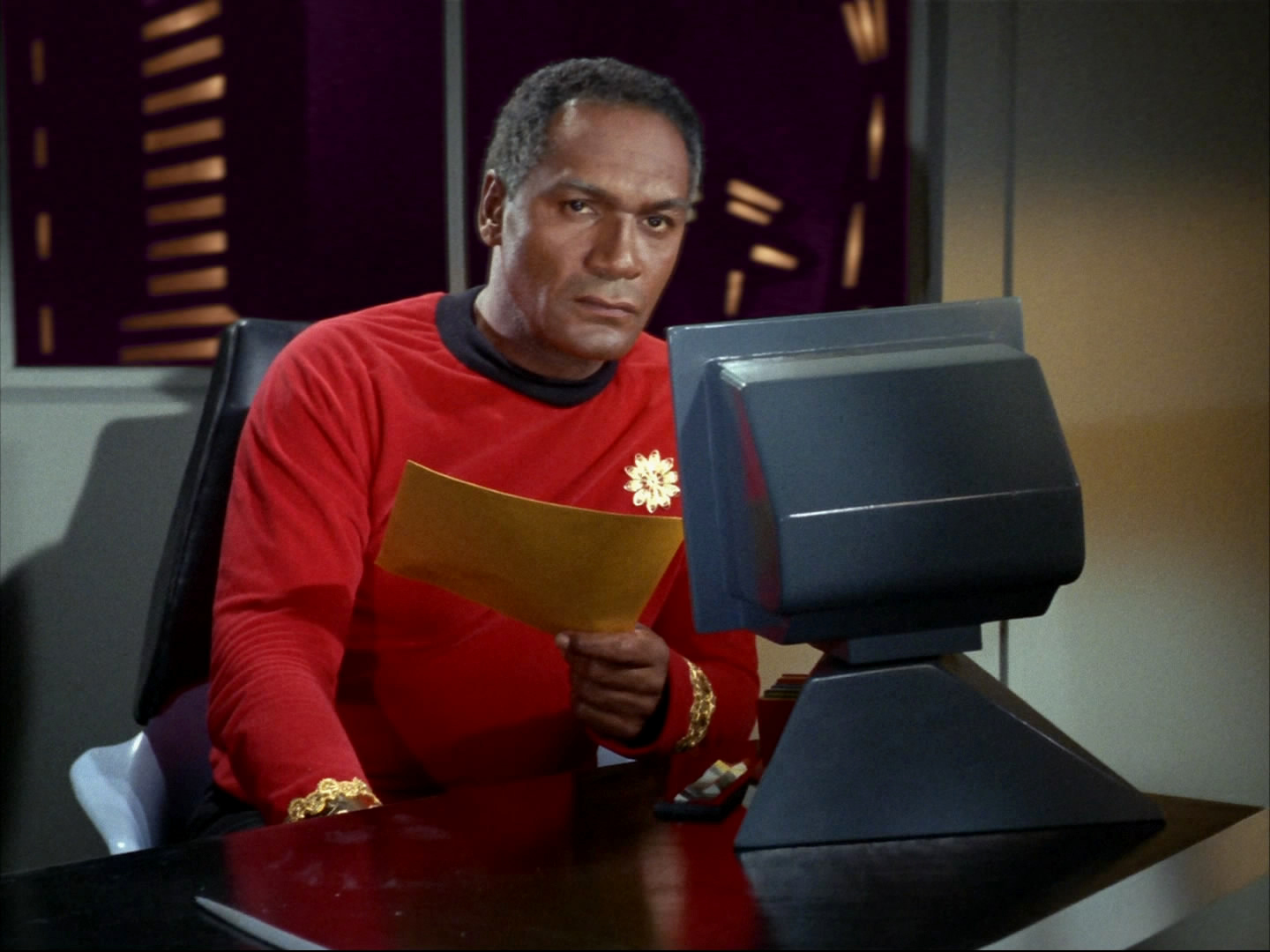
Karen: I said earlier that there were some good performances. I appreciated guest star Percy Rodriguez as Starbase Commander Commodore Stone. I think it's worth noting that he was a Black actor playing a man of high rank, who commanded a starbase and was said to have commanded a starship. They could have cast anyone but they chose to hire a Black actor for an important part and that's commendable. Rodriguez delivers -Stone is looking out for the service, and although he respects Kirk, he believes the computer records. The confrontation between Stone and Kirk buzzes with electricity.
Karen: I also found the way Finney is portrayed to be rather intriguing. The actor looks sort of like an older, skid-row Kirk -his hairstyle and color is much the same, and he's got the gold tunic, but he's haggard and more than a bit deranged. It's almost as if we are seeing what Kirk could be if he'd been an utter failure. I don't know that they put that much thought into it, but it struck me as I watched the episode.
Karen: There are a lot of problems with this episode though. I think any time you have narration suddenly pop up in a movie or TV show -as it does in the third act of this episode -you know there are problems with the plot that have to be explained to the audience. Here, there are missing scenes that are described to us by Kirk, but not in the form of a Captain's log, it's just narration, from out of the blue. It feels sloppy. We also had some very obvious stunt doubles in the fight between Kirk and Finney. It's even more noticeable now that I am watching these high definition versions.
Karen: There's also some crappy science through out. What is an ion storm, exactly? I cringed when Spock gave an example on the witness stand about dropping a hammer on a "planet with a positive gravity." Perhaps worst of all, is when the court convenes on the Enterprise bridge and McCoy uses a 'white sound' device to eliminate the sound of all the heartbeats of all the people on the ship from a transmission they are relaying to the bridge. The device is obviously a microphone, and Kirk says the device boosts sounds by "one to the fourth power". Well, even when I saw this as a kid, I knew that 1 to the 4th power was still just 1! He wasn't amplifying anything. How that got past Star Trek's researchers I'll never know.
Karen: This wasn't a terrible episode, but certainly not one of Trek's best.
Karen: Re-watching 'Court Martial' was a pleasant surprise. To be honest, I hadn't looked forward to reviewing this episode. My memories of it were that it was rather boring, and there was some flawed science. But sitting down with it again, although there are definitely problems, I found it much more interesting than before. The main reason for this? William Shatner's performance. I know, I'm sounding like a broken record, but Shatner was just fantastic in this first season, and I suspect one of the main reasons for Star Trek's success. If you haven't seen this one, or don't recall it, here's a brief summary: Kirk faces a court martial when it appears that he jettisoned an ion pod containing Officer Ben Finney before giving him the warning to clear out, causing the man's death. This is verified by the ship's computer records. But Kirk maintains that his recollection is correct and the computer is wrong. Complicating the matter is the fact that Finney, once Kirk's friend, had grown to resent Kirk, both for an incident in their past and for Kirk's success. Kirk must prove his innocence, but how?
Karen: This episode was a "bottle show" -so called because most of it takes place on the Enterprise, with a few scenes shot at Starbase 811, which is just redressed Enterprise sets. This was a cost saving measure; the series needed a few of these bottle shows every season to keep the budget down. The risk with such shows was always that they would feel confined, or could be too talky, or boring. And this episode certainly walks that edge. But as I said at the start, for me, this one was saved by William Shatner. He projects the kind of confidence one would expect of a starship captain -not swaggering braggadocio but a steady sureness that is utterly believable. Even after he sees the starship visual recording showing him pressing the ion pod eject button before red alert has been signaled, he still maintains that he pressed it after the red alert was initiated. But back in his quarters, he has a moment of doubt. Just a moment. "Spent my whole life training for decisions like that one...is it possible...no, I know what I did." I have to add, Shatner was amazingly handsome. His Kirk was the consummate hero: brave, handsome, and morally strong, but with more than a little loneliness.
Karen: This episode also gives us some more insight into Kirk's past. It would have been fun to have been a fan watching that first season as it aired, trying to put all the pieces together with the characters, and the universe in general. Back in 'Conscience of the King', we learned a 13 or 14 year old Kirk had seen the mass executions at the Tarsus IV colony. Here we learn that Kirk met Finney when he was a midshipman and Finney was an instructor at the academy. They became friends and Finney even named his daughter Jamie after Kirk. Finney had a slow start to his career, and the two wound up serving on the USS Republic together. It was here that Finney made a dangerous mistake that Kirk had to correct, which got Finney a reprimand. Thus began his grudge against Kirk.
Karen: This is the first episode where we hear the terms "Starfleet" and "Starfleet Command" used, thanks to Gene Coon. The Star Trek universe was firming up, as the producers and writers grew more comfortable and confident. This episode went through a number of revisions and writers. The story was initially written by Don Mankiewicz. The Mankiewicz family has a long and proud history in Hollywood. Don's father Herman won an Oscar for co-writing Citizen Kane with Orson Welles, and his nephew Joseph was the award-winning writer/director of Guys and Dolls and All About Eve. If you watch Turner Classic Movies, you've probably seen Ben Mankiewicz, who hosts many films on the station -he is also Don's nephew. So quite the prestigious group! Roddenberry was thrilled to have Mankiewicz write for Trek. Mankiewicz proposed a court room drama. The basic idea of the story was the same but many of the details were changed as the script was rewritten several times, by Mankiewicz at first, and then by Steven Carabatsos, Trek story editor, and Gene Coon, as well as Roddenberry. One of the major changes involved the computer. In the initial draft, the Enterprise's computer had a personality -and it didn't like Kirk! It conspired with Finney to get Kirk in trouble. This was removed rather early on, thankfully.
Karen: I said earlier that there were some good performances. I appreciated guest star Percy Rodriguez as Starbase Commander Commodore Stone. I think it's worth noting that he was a Black actor playing a man of high rank, who commanded a starbase and was said to have commanded a starship. They could have cast anyone but they chose to hire a Black actor for an important part and that's commendable. Rodriguez delivers -Stone is looking out for the service, and although he respects Kirk, he believes the computer records. The confrontation between Stone and Kirk buzzes with electricity.
Karen: I also found the way Finney is portrayed to be rather intriguing. The actor looks sort of like an older, skid-row Kirk -his hairstyle and color is much the same, and he's got the gold tunic, but he's haggard and more than a bit deranged. It's almost as if we are seeing what Kirk could be if he'd been an utter failure. I don't know that they put that much thought into it, but it struck me as I watched the episode.
Karen: There are a lot of problems with this episode though. I think any time you have narration suddenly pop up in a movie or TV show -as it does in the third act of this episode -you know there are problems with the plot that have to be explained to the audience. Here, there are missing scenes that are described to us by Kirk, but not in the form of a Captain's log, it's just narration, from out of the blue. It feels sloppy. We also had some very obvious stunt doubles in the fight between Kirk and Finney. It's even more noticeable now that I am watching these high definition versions.
Karen: There's also some crappy science through out. What is an ion storm, exactly? I cringed when Spock gave an example on the witness stand about dropping a hammer on a "planet with a positive gravity." Perhaps worst of all, is when the court convenes on the Enterprise bridge and McCoy uses a 'white sound' device to eliminate the sound of all the heartbeats of all the people on the ship from a transmission they are relaying to the bridge. The device is obviously a microphone, and Kirk says the device boosts sounds by "one to the fourth power". Well, even when I saw this as a kid, I knew that 1 to the 4th power was still just 1! He wasn't amplifying anything. How that got past Star Trek's researchers I'll never know.
Karen: This wasn't a terrible episode, but certainly not one of Trek's best.
Thursday, September 27, 2012
Who's The Best...Starship Captain?
Subscribe to:
Posts (Atom)