Monday, May 23, 2016

That Zany Bob Haney:The Brave and the Bold 143


The Brave and the Bold #143 (September/October 1978)
"Cast the First Stone"
Bob Haney/Cary Burkett-Jim Aparo

Doug: At the end of March the Creeper's name came up in our discussion of costume accessories. It then occurred to me that we've never had this weirdo on the BAB. That, for better or worse, changes today. And yes, he is a weirdo. NOTE: Apologies at the top for the quality of the scans. I am reading/scanning from Legends of the Dark Knight: Jim Aparo, volume 2. As this is my first review from that book, the spine is pretty tight.

Doug: The 50c cover price really threw me -- when I got to setting up the post I assumed this issue would be from the early 1980s. I was never a reader of The Brave and the Bold as a child, so that the book apparently went double-sized eluded me. It seemed an oddly short-lived experiment, lasting only two issues (this one and #144) before settling in at 40c. So basically the marketing dept. at DC charged you 35c, but when Marvel raised their prices to 40c DC actually went to a 44-page book at 50c for two months. I believe this up-and-down occurred across the line and was the last straw before the famed "DC Implosion". You can check out the well-referenced facts on the Wikipedia article -- it's interesting.

Doug: Let's check out the plot of this story in a 100-Word Review:

We open with a news broadcast from “the most trusted man in America”, Cosmic Broadcasting’s Monty Walcott. He’s being trailed by the Batman; his top security man is Jack Ryder (secretly the Creeper) – you see where this is headed. Batman and the Creeper meet, tussle briefly, and the Batman tells him of an adventure he’d had with Aquaman concerning the log of a ship sunk 30 years earlier. It’s a tale of drugs, drug lords, and a revelation about Aquaman’s father. But the true bombshell was the reveal of the Gotham City kingpin – Monty Walcott! Can our heroes stop him?

The Good: When you're reading a Bronze Age B&B, you know you start your praises with Jim Aparo's art. As many around these parts say, he's the definitive Bronze Age Batman artist, and the favorite of more than a few of our readers. Aparo stays inside the lines for every one of his panels, but he really varies the size and shape of each one -- no grid system here. He paces things well, and of course his action sequences are top shelf. Although not the colorist on the issue (Jerry Serpe is credited), the page where Batman narrates to the Creeper the adventure with Aquaman from the previous issue is really well done in solid colors with only the inks for shading. And as three of the panels are underwater scenes, it's nicely effective.

Aparo also chooses interesting camera angles, really showing Batman from all perspectives -- I've chosen a panel with a shot from above that is pretty cool -- of course, the blowing cape doesn't exactly lend itself to stealth, does it? I also enjoy Aparo's depiction of Commissioner Gordon with the tousled hair and thick mustache that's really wanting to become a handlebar! If I have a qualm, and it's a minor one, it's in the way Jack Ryder is drawn. Fortunately he's named in each panel that starts a scene, as one might be tempted to think "Bruce Wayne" if just bouncing through the book visually. This was a real problem in the Silver Age in the Avengers in any scene where Cap, Goliath, and/or Hawkeye were shown sans masks -- all that square jaw/blond hair was tough to differentiate. That's what I'm saying here about Aparo's "tall, dark, and handsome" guys. And they are that -- he draws a good-looking man. If I have any knock on the guy's style, it's that his female faces are not equally attractive.

The story in this issue is only 17 pages, as again the book was divided but extra length. Bob Haney's script is pretty simple, with the surprise revealed at the beginning. After all, who would suspect the DCU's version of (apparently) Walter Cronkite as a drug kingpin? Not me. But that's out of the way at the front, and Batman really doesn't have to do much convincing to get the Creeper to help him out in putting Monty Walcott away. Walcott does get crafty in the middle of the tale, as he employs a "vertigo effect" that allows him to escape the clutches of the Batman and Gordon during an interrogation. Batman later learns that this is actually a gas weapon whereby the gas could be set off with a bomb, but activated by a particular radio frequency (there's your Zany) and causing crippling dizziness. There was an antidote, and Walcott had used it to escape from GCPD headquarters. You know he won't be on the lamb for long, though...


The Bad: I am searching the dark depths of my memory for facts lost among minutiae like what I'm supposed to get from the grocery store, in order to recall if I've read many Creeper stories. I know I've owned a few, notably in a longbox of Batman comics I bought for $30 in June 1989 (I've told that story -- took 'em right off the hands of a fellow at a flea market who apparently didn't know there was a Batman film about to be released. Two copies of Detective Comics #400 in there among the other 200 Bat-books). I must say that I don't really care for the character -- not his look, and I find his personality a bit confusing. Bear with me -- it could be just because I'm a novice. I'd like our readers to "sell" me on the character if you have a particular affinity for him. I thought the mash-up of his laughter, mystic talk, and regular-guy talk was off-putting. I guess I couldn't decide which was the "real" him. I said at the top the Creeper is weird -- standing by that, but then again -- maybe that's the point. Other than that general impression, there wasn't anything else in the story that wasn't either positive or what I would have expected from the Haney/Aparo team.

The Ugly: First, can you imagine if the Creeper was really out there running around all yellow and red hairy-cape-thing? That's ugly. Second, as mentioned above, I really tire of megalomaniac talk that includes admonitions like "Mortals!" and "Humans!" Pfah... spare me.

Saturday, May 21, 2016

Fire up the grill for a Fantastic Four Roast!


Fantastic Four Roast #1 (May 1982) ( Cover by Fred Hembeck and Terry Austin)
"When Titans Chuckle" 
Story by Fred Hembeck, plot by Jim Shooter, art by: Fred Hembeck and just about everyone else

Redartz:  Happy Saturday everyone! Today we will kick back, loosen up, and laugh a bit; the source of the hilarity: one of my all-time favorite single comics, Fred Hembeck's "Fantastic Four Roast". It may be possible to fit more fun into a 32 page comic, but I don't know how. 

To start, here's the 100-Word Review:

The Fantastic Four are the honored guests at a "roast" dinner, featuring blessings and brickbats from just about everyone in Marvel's 80's universe. Fred Hembeck himself serves as Master of Ceremonies, and he introduces both the dinner courses and the abundant speakers. We witness loads of banter between the guests and guests of honor, replete with puns both verbal and visual. Unfortunately some mystery villain appears to be sending deadly dishes for our Foursome to partake of. After Dr. Doom denies his involvement, the assembled heroes discover the identity of the true culprit,and the day (and dinner) is saved! 

Man, where to start? Why, the cover! Fred Hembeck fills it up completely with his signature curly-jointed figures. I loved Fred's humorous cartoons in the 80's, and bought several of his comics (and I need to replace those...). His stories are good for lots of laughs, full of puns and nostalgia. He speaks for the comic geek in all of us! 

Once we open the book, we are bombarded by a hailstorm of humor. The artwork is so jam-packed, you need a magnifier to catch all the detail. I would love to see some pages of original art for this story, simply so I could admire the artwork better! For instance, page 3 introduces the Avengers, Defenders, Inhumans, X-Men, and Legion of Monsters (!), in the space of 5 panels; complete with claustrophobic crowd detail in the backgrounds. My eyes are still refocusing...


The artwork in this comic is a treasure trove. Hembeck provided layouts, and everyone (a list follows shortly) took it from there. Often the characters were rendered by the artists most associated with them, for example: the Spider-man panels by John Romita Jr. and Sr., Captain America by Mike Zeck, Iron Man by Bob Layton, Daredevil by Frank Miller and Hulk by Sal Buscema. The artists seem to have had a lot of fun doing this book. Miller's Daredevil page is hilarious, with some self-parody as DD dramatically mugging with a flashlight. 

Hembeck has a fine feel for the voices of the characters he works with. He handles everyone with familiarity , starting from  the first pages with the Fantastic Four ( by Ron Wilson and John Byrne), with Ben and Johnny sparring as usual. He continues perfectly capturing each player, through the various character roasts and audience banter, to the last page where he brings the house down (literally). Fred has the whole Marvel toybox to play in, here; he makes the most of every piece.

There is way too much in this book to cover in detail, but I will mention a few great scenes: 

Here Spider-Man and the Torch , old friends and rivals, engage in some verbal sparring. Love Johnny Storm's comment about Spidey's showbiz faux pas...

Next up we find Prince Namor, the Sub-Mariner, making a splash with his entrance...and breaking the third wall with a reference to his return in the FF's comic...


 HB, this page on the left is for you, courtesy of  "Our Pal Sal". On the right,  the Avengers and Champions get a few words in with their comments on the Fantastic Four's origin story:


Frank Miller's Daredevil page is a big highlight in this book. The Torch at a self-serve pump; gotta be a potential problem.

Eventually, after Black Bolt (of all people) reveals the existence of a threat to the gathering, Ben Grimm quickly assumes it is the work of Dr. Doom...


Nonetheless, the gathered heroes quickly find the culprit, order is (somewhat) restored, and all is well. Yet I can't conclude without sharing this colossal two-page spread:


Ok, now take a deep breath; here's the list of artists  I promised earlier:
Fred Hembeck, Ron Wilson, John Byrne, Michael Golden, John Romita Jr. and Sr. , Al Milgrom, MIke Zeck, Bob Layton, Alan Weiss, John and Sal Buscema, Mike Vosburg, Kerry Gammill, Bob Hall, Keith Pollard, Frank Miller, Denys Cowan, Marshall Rogers,  Don Perlin, Gene Day, Walt Simonson, Frank Springer, Brent Anderson, Steve Leialoha, Dave Cockrum, Bill Sienkiewicz, Chic Stone, Terry Austin, Joe Rubinstein, Joe Sinnott, John Beatty, Ricardo Villamonte, Dan Green, Klaus Janson and Bob McLeod . Whew...

Thanks deeply to the Grand Comics Database for this list , here's a link to the page for this comic with all the specifics:
 http://www.comics.org/issue/36361/

This comic is a terrific remnant of the day when comics could be silly, free-wheeling and just plain fun. It would be wonderful to see a bit more of such things today ( albeit, to be fair, there are some light-hearted books coming out today, but that's a topic for another day)...

Thursday, May 19, 2016

Who's the Best... Spacefaring Hero?


Martinex1: From the depths of inner space to the reaches of the outer ring, from a galaxy far, far away to where no man has gone before, artistic creators from the 20th Century introduced a new breed of heroes to the pulp and punk generations... the adventurous spacefarer. Whether a space cowboy, a cosmic guardian, a scientific genius with a laser gun, a sportsman with a penchant for interstellar travel, or a cyborg bent on justice, these star-spanning celebrities offered countless hours of entertainment. In books, magazines, comics, television and film these adventurers sparked our imaginations. So which  spacefaring hero is the best?


Wednesday, May 18, 2016

Star Trek at 50: Court Martial


Season 1
Episode 14: Court Martial
Filmed: October 1966
First Air Date: February 2, 1967 (20th episode aired)

Karen: Re-watching 'Court Martial' was a pleasant surprise. To be honest, I hadn't looked forward to reviewing this episode. My memories of it were that it was rather boring, and there was some flawed science. But sitting down with it again, although there are definitely problems, I found it much more interesting than before. The main reason for this? William Shatner's performance. I know, I'm sounding like a broken record, but Shatner was just fantastic in this first season, and I suspect one of the main reasons for Star Trek's success. If you haven't seen this one, or don't recall it, here's a brief summary: Kirk faces a court martial when it appears that he jettisoned an ion pod containing Officer Ben Finney before giving him the warning to clear out, causing the man's death. This is verified by the ship's computer records. But Kirk maintains that his recollection is correct and the computer is wrong. Complicating the matter is the fact that Finney, once Kirk's friend, had grown to resent Kirk, both for an incident in their past and for Kirk's success. Kirk must prove his innocence, but how? 


Karen: This episode was a "bottle show" -so called because most of it takes place on the Enterprise, with a few scenes shot at Starbase 811, which is just redressed Enterprise sets. This was a cost saving measure; the series needed a few of these bottle shows every season to keep the budget down. The risk with such shows was always that they would feel confined, or could be too talky, or boring. And this episode certainly walks that edge. But as I said at the start, for me, this one was saved by William Shatner. He projects the kind of confidence one would expect of a starship captain -not swaggering braggadocio but a steady sureness that is utterly believable. Even after he sees the starship visual recording showing him pressing the ion pod eject button before red alert has been signaled, he still maintains that he pressed it after the red alert was initiated. But back in his quarters, he has a moment of doubt. Just a moment. "Spent my whole life training for decisions like that one...is it possible...no, I know what I did." I have to add, Shatner was amazingly handsome. His Kirk was the consummate hero: brave, handsome, and morally strong, but with  more than a little loneliness.

Karen: This episode also gives us some more insight into Kirk's past. It would have been fun to have been a fan watching that first season as it aired, trying to put all the pieces together with the characters, and the universe in general. Back in 'Conscience of the King', we learned a 13 or 14 year old Kirk had seen the mass executions at the Tarsus IV colony. Here we learn that Kirk met Finney when he was a midshipman and Finney was an instructor at the academy. They became friends and Finney even named his daughter Jamie after Kirk. Finney had a slow start to his career, and the two wound up serving on the USS Republic together. It was here that Finney made a dangerous mistake that Kirk had to correct, which got Finney a reprimand. Thus began his grudge against Kirk.


Karen: This is the first episode where we hear the terms "Starfleet" and "Starfleet Command" used, thanks to Gene Coon. The Star Trek universe was firming up, as the producers and writers grew more comfortable and confident. This episode went through a number of revisions and writers. The story was initially written by Don Mankiewicz. The Mankiewicz family has a long and proud history in Hollywood. Don's father Herman won an Oscar for co-writing Citizen Kane with Orson Welles, and his nephew Joseph was the award-winning writer/director of Guys and Dolls and All About Eve. If you watch Turner Classic Movies, you've probably seen Ben Mankiewicz, who hosts many films on the station -he is also Don's nephew. So quite the prestigious group! Roddenberry was thrilled to have Mankiewicz write for Trek. Mankiewicz proposed a court room drama. The basic idea of the story was the same but many of the details were changed as the script was rewritten several times, by Mankiewicz at first, and then by Steven Carabatsos, Trek story editor, and Gene Coon, as well as Roddenberry. One of the major changes involved the computer. In the initial draft, the Enterprise's computer had a personality -and it didn't like Kirk! It conspired with Finney to get Kirk in trouble. This was removed rather early on, thankfully.


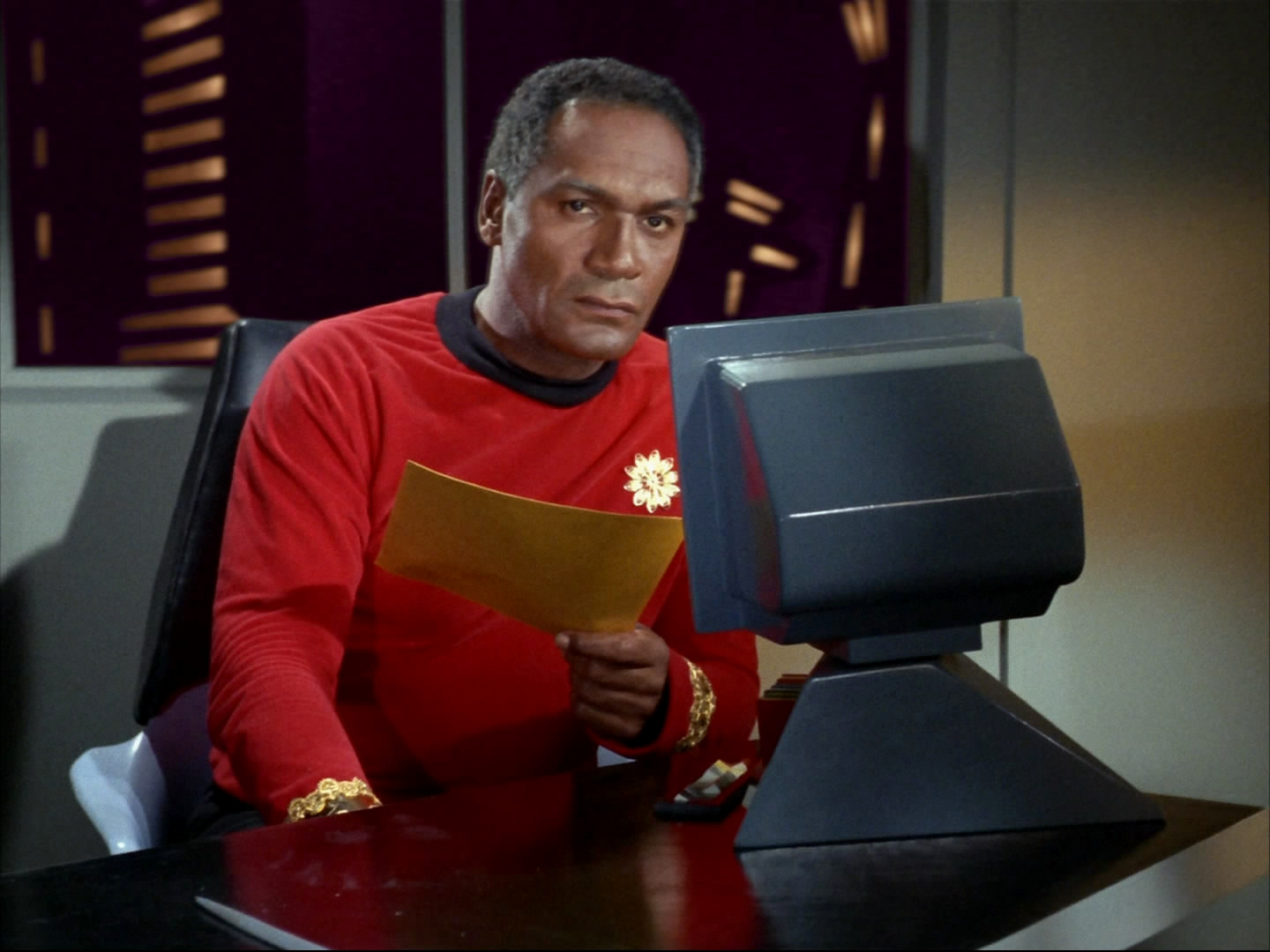
Karen: I said earlier that there were some good performances. I appreciated guest star Percy Rodriguez as Starbase Commander Commodore Stone. I think it's worth noting that he was a Black actor playing a man of high rank, who commanded a starbase and was said to have commanded a starship. They could have cast anyone but they chose to hire a Black actor for an important part and that's commendable. Rodriguez delivers -Stone is looking out for the service, and although he respects Kirk, he believes the computer records. The confrontation between Stone and Kirk buzzes with electricity. 


Karen: I also found the way Finney is portrayed to be rather intriguing. The actor looks sort of like an older, skid-row Kirk -his hairstyle and color is much the same, and he's got the gold tunic, but he's haggard and more than a bit deranged. It's almost as if we are seeing what Kirk could be if he'd been an utter failure. I don't know that they put that much thought into it, but it struck me as I watched the episode.

Karen: There are a lot of problems with this episode though. I think any time you have narration suddenly pop up in a movie or TV show -as it does in the third act of this episode -you know there are problems with the plot that have to be explained to the audience. Here, there are missing scenes that are described to us by Kirk, but not in the form of a Captain's log, it's just narration, from out of the blue. It feels sloppy. We also had some very obvious stunt doubles in the fight between Kirk and Finney. It's even more noticeable now that I am watching these high definition versions. 


Karen: There's also some crappy science through out. What is an ion storm, exactly? I cringed when Spock gave an example on the witness stand about dropping a hammer on a "planet with a positive gravity." Perhaps worst of all, is when the court convenes on the Enterprise bridge and McCoy uses a 'white sound' device to eliminate the sound of all the heartbeats of all the people on the ship from a transmission they are relaying to the bridge. The device is obviously a microphone, and Kirk says the device boosts sounds by "one to the fourth power". Well, even when I saw this as a kid, I knew that 1 to the 4th power was still just 1! He wasn't amplifying anything. How that got past Star Trek's researchers I'll never know.

Karen: This wasn't a terrible episode, but certainly not one of Trek's best.


Tuesday, May 17, 2016

If I Had a Buck... Now I See You!


Martinex1: Designing comic covers and trying to invent something new and eye-catching each time has to be a real challenge. After countless comics have hit the stands month after month for decades, creators are bound to repeat. So we continue to see some tropes, themes, and positions revisited time and time again. In part, comparing and contrasting these layouts is what makes comic collecting fun for me.   


This installment of If I Had a Buck... investigates the topic of reflections and visions, from electronic view screens to mystical crystal balls to simple rearview mirrors. The artists must have been challenged to explore methods of showing action and reaction at the same time. Sometimes it fits into the book's story and sometimes it is a simple shorthand for storytelling. We see examples where witchcraft is in use as well as outlandish holograms. We see where the reflection is part of the action and is terrifyingly close and other situations where  the image is worlds away. 

You know the drill... spend a dollar (25 cents at a time) choosing comics you would like to own from the selections I offer. Pick your favorite four and share why. Comment on this week's theme, the comics themselves, the creators, the art, the story and the memories.

Today, feeling rather inspired, I leave you a few quotes to ponder as you make your choices:

"I love those that can smile in trouble, who can gather strength from distress, and grow brave by reflection." attributed to both Leonardo Da Vinci and Thomas Paine (and perhaps Captain America).

"I used to live in a room full of mirrors; all I could see was me. I take my spirit and I crash my mirrors, now the whole world is here for me to see." Jimi Hendrix (and possibly the Mirror Master).

"I went to a shrink once, but I caught him going to a fortune-teller so I quit." James Caan (and I would think Tony Stark).


Related Posts with Thumbnails