Friday, March 8, 2013

An Obscure Silver Surfer Story: The Answer


Epic Illustrated #1 (Spring 1980)
"The Answer, A Tale of the Silver Surfer"
Stan Lee-John Buscema/Rudy Nebres

Doug:  Back on January 21, our friend and frequent commenter Edo Bosnar subtly reminded me that back in January of 2010 I'd made a pledge to review a short Silver Surfer story that I'd read within the pages of the hardcover (must-have hardcover to you) Marvel Visionaries: John Buscema.  I told him in a reply that I'd totally dropped the ball on that, and would soon enough provide said review.  That's today.  You'll see that the story was published in the pages of Marvel's Epic Illustrated, the company's attempt to catch on to a bit of the market enjoyed by such publications as Heavy Metal.  One might also consider this an evolution of Marvel's extensive foray into the realm of black and white magazines during the early Bronze Age; you'll note that Epic Illustrated was entirely in color.  Let's check it out --


DougOne of the aspects of this story that you may notice right from the get-go is the quality of the artwork.  From the linework to the coloring to the panel details, this is far different from any four-color comic books we've examined in the past here on the BAB.  While the pencils are John Buscema's, I wouldn't say the pages scream Buscema.  Rudy Nebres is overpowering to say the least.  It seems that every time we discuss Big John outside the Silver Age, the issue of lay-outs vs. full pencils comes to the fore.  As this was published in 1980, I honestly don't know how tight John's pencils would have been.  While he could draw anatomically correct figures with the best of the masters, there are details in the story that lead me to believe that Nebres had some real liberty with the finished product.  As I said above, this magazine was a conscious effort by Marvel to get into whatever comics/magazine market periodicals such as Heavy Metal occupied.  For those of you who've seen anything in that genre, I think you'd say this is a pretty solid effort on Marvel's part.

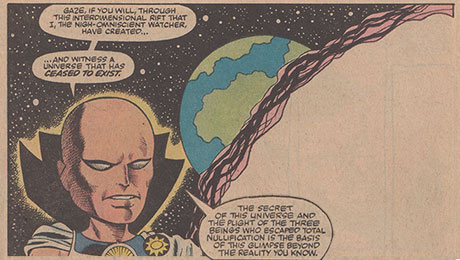
Doug:  The story is only eight pages, and it's quite simple.  What we have here is an untold tale of Galactus and the Silver Surfer, from their earliest adventures together.  This almost has a warm feeling to it, sort of a mentor/mentee vibe.  Norrin Radd asks his master how he might learn the answer to the mystery.  As you can see, Galactus' answer is a flat "There is no answer."  The Surfer pushes him, asking if he himself knows more.  The Surfer, feeling small in comparison to not only Galactus but the universe, compares himself to a mere flyspeck.  Galactus declares that while he himself is more than man, he is less than god.  The Surfer presses him, even accusing the master of lying to him.  Galactus calmly states that he is power absolute, and has no reason to lie.  He repeats that there is no answer, but encourages the Surfer to seek his own resolution.


Doug:  The Surfer takes to his board, seeking to "strip away the final veil of darkness".  In a quest to see beyond the furthest star, he streaks away from the asteroid he and Galactus had occupied.  Pledging to not turn back, the Surfer goes deeper and deeper into space, until finally he finds what he is looking for:  a black hole, a fissure in the very fabric of space.  Entering it, Norrin Radd is positive that his power cosmic will protect him while he searches for infinity.  What he finds is an overload for his senses, a writhing, sharp, stabbing collection of light colors that spiral to the center of the black hole.  This is no Kirby spacescape!  This is akin to a journey to the center of the human being rather than down Alice's rabbit hole.


Doug:  The Surfer begins to feel very emotional -- excitement, anticipation, and perhaps even trepidation.  He nears his goal: the answer.  Yet, closing his eyes, he is astounded upon opening them that he found not what he sought and is instead on his way out of the black hole.  Disappointed, he's somewhat incredulous to return to Galactus so soon.  Asking his master if he had reached the answer first, Galactus assures his herald that he has not moved in the Surfer's absence.  The Surfer cries out, "It cannot be!  There must be something -- somewhere --".  Galactus answers that he tried to warn Norrin Radd.  And here is the resolution:

Doug:  Is anyone out there surprised that this comes from Stan Lee and not Jack Kirby?  Kirby had for years explored religious themes in his art and plotting/scripting, but for the most part Stan's dalliances in religious topics seemed to focus more on ethics rather than theology or the existence of God.  Here Stan not only names God, but takes one of Marvel's more powerful beings and humbles him in the presence of God.  This would seem to be an examination of the very nature of and existence of a deity as it might have played out in the Marvel Universe.  The result seems not too different from interpretations of God from the great religions around the world, and Stan seems careful not to make this God slanted toward any of those specific religions.  

Doug:  It's a curious tale, tucked far away from the eyes of the everyday Marvel Comics reader.  While I knew Epic Illustrated existed, this was the time when I was not buying comics.  It was still published, and indeed on its last legs, when I returned to the hobby in late 1984/early1985.  I believe the Surfer series ran throughout, and I'd be in debt to any of our readers who can shed some light on the life of this magazine and even moreso on the Surfer feature.  You have my thanks in advance.

Thursday, March 7, 2013

Out to Lunch

Doug:  Last month we spent quite a bit of time discussing Sean Howe's very fine Marvel Comics:  The Untold Story.  Since it's been a little while, let's revisit the idea of all of those creators and their various trials and tribulations.  Today's question is really quite simple, but maybe you might want to put a little thought into your comment before writing --

Doug:  Let's say you have the opportunity to go out with any comic book creator of your choice: any company, any era -- shoot, make it a tandem if you want.  If you've always idolized the Ross Andru/Mike Esposito or maybe the Curt Swan/Murphy Anderson teams, then take both creators out for a bite!

Doug:  So you've got this lunch date, and there are a bazillion thoughts burning in your head about this creator's career.  Try to come up with a list of two or three questions you'd like to ask them, and share it with the rest of us.  First, who would you love to have this sit-down with?  And second, what are you going to ask?


Wednesday, March 6, 2013

Discuss: Star Trek: Deep Space Nine


Karen: Continuing our discussion of Star Trek TV series, let's move on to the series that deviated from the starship-exploring-space mold: Star Trek: Deep Space Nine. Let's hear your thoughts on this addition to the mythos.


Tuesday, March 5, 2013

The Very Best 10-Issue Runs

Doug:  A long time ago we did an Open Forum on the best runs of the Bronze Age.  Since we got a lot of mileage in January out of both older posts reprinted as well as turning our new and larger audience loose with some of their own ideas, I figured we could sort of hit the best of both worlds today with a fun comic-oriented question that plays off of an older topic and showcases what we do best around here:  discuss stuff!

Doug:  So here's your task, and it's a bit of a toughie.  What is your favorite 10-issue run of any comic, any era?  It doesn't have to be a run that begins and ends in nice and even numbers; for example, one of the first things that comes to mind for me is X-Men #'s 56-65, the bulk of the Thomas/Adams run on the book.  You can choose any 10-issue series of books that has consecutive numbers -- even if the title had a reprint or some other interruption in the middle, you'd still count it in the 10 issues of the run you're going to brag on.

Doug:  In your comments, please mention the creative teams, plotlines, villains, significant doings, etc. that make the run one of your all-time favorites.  And thanks in advance for your consideration -- who knows, you may sell someone on the purchase of a new trade paperback or other collection.


Monday, March 4, 2013

Derivative Ladies: Ms. Marvel


Ms. Marvel #1 (January 1977)
"This Woman, This Warrior!"
Gerry & Carla Conway-John Buscema/Joe Sinnott

Doug:  Today we're going to begin a four week look at three heroines and a hero who were either derived from another existing hero by some connection to the original's origin, or in a couple of cases were specifically named to secure a copyright.  We'll start off with the lovely half-naked lady you see above (sporting a Farrah-like coif, no less), and then check in on Spider-Woman, She-Hulk, and Black Goliath.  In Big Bill's case, we're going to review Black Goliath #1 rather than his actual first appearance, which was in Power Man #24.  As we've done over the past year or so with first appearances, the trade paperback Marvel Firsts: the 1970's (volume 3) will be our resource for reading and images. Below you can see Sean Howe's mention of Ms. Marvel in the BAB recently-reviewed Marvel Comics: The Untold Story.  We'll consult Howe as we go through this month's series.

From Marvel Comics: The Untold Story, (c) Sean Howe

Doug:  I'm going to start off by saying that it's a shame there's a UPC code on the cover of this book, because it really prohibited the inclusion of one more call-out!  Sheesh -- we get it already!  Number one book, exciting heroine.  Enough!  But the main image of Ms. Marvel as drawn by the Jazzy One is pretty nice, isn't it?  Do you want to start in on the costume now, or wait?  I say we hit it right now.  To begin, her midriff was bare until the 9th issue.  Does that express a confident, independent woman, or is it sexually exploitative?  Most people feel Dave Cockrum rescued Ms. Danvers near the end of the series.


Karen: Oh boy, that costume... I mean, they took a costume designed for a male character, what with the broad bands at the shoulders and hips, which is really not flattering for most women, and then to make it worse, they just sort of nonsensically removed the lower front and back of the suit!  It's not a two piece, it's just two strangely shaped cutouts. I'm not even sure how that thing stays adhered to her body. So yeah, it's sexist, but certainly not sexy. It's just ugly. But to top it all off, they must have realized it didn't look very feminine, so somebody thought it was a good idea to throw a scarf on it! Oh good lord. Yes, thankfully Dave Cockrum showed up and saved poor Ms. Marvel. Not only that, he gave her a really memorable outfit, perhaps one of the best female costumes at Marvel.

Doug:  Gerry Conway drops us right into the action, as our heroine swoops in on a bank robbery in progress.  Some thugs with nylons over their heads (man, that's a creepy look.  You ever do that when you were a kid to get a rise out of a sibling?) are making a break for it when Ms. Marvel arrives to quickly mop up the place with them.  The scene is really a showcase for her powers:  flight, super strength, and a mysterious "seventh sense" (uhhh....).  Of course, the assembled crowd just gawks at her, and we get the sometimes painful pop-culture reference "I've seen tough... but that little lady makes Lynda Carter look like Olive Oyl!"  As an aside, if like me you were wondering about the temporal proximity of the Popeye live-action film to that line, the film was not released until 1980.  Anyway, back in the bank we see who the mastermind of this caper really is:  none other than the Scorpion!  Now, while it was good to see ol' green-scales, that he'd mastermind anything seems a bit of a stretch to me.  He makes his getaway out a side door, on his way to see a Professor Korman, and we're sent back to the street to survey the damage.

Karen: Buscema and Sinnott do a great job of showing off our heroine's powers. She's certainly strong and tough, not afraid to throw a punch, and the seventh sense is intriguing. You know, it seems like at some point they dropped that power from her repertoire. At least, I don't seem to recall her using it later on. The Scorpion seems like an odd choice of villain, but as we'll see, he was not the only Spider-Man element to grace this mag.

Doug:  Ms. Marvel stands amongst her handiwork while the residents make claims of a publicity stunt and the like.  She scoffs to herself, and as the NYPD arrives she takes flight.  We then get dropped right into a projection room at the Daily Bugle, where none other than J. Jonah Jameson is watching film of Ms. Marvel.  Seated beside him is one Carol Danvers -- we've met Miss Danvers earlier on this blog in our reviews of the "Kree/Skrull War" and a Captain Marvel yarn that Karen reviewed, as well as in various Avengers stories.  JJJ tells Carol his vision for a new magazine he's launching, one for women that would contain pretty sexist fare.  Carol reminds him that although she was once tops in the field of military security, over the past year she's acquired a reputation as a writer (really -- in a year?).  They negotiate her salary, and Carol wins; she also makes it clear that the magazine isn't going to include recipes and fashion spreads.  This is not the JJJ we've come to know and loathe over the years.  As Carol takes leave of Jonah, who should she bump into but Peter Parker and Mary Jane Watson?  Mary Jane takes a shine to Carol and they begin conversing while Pete heads in to see Jonah.

Karen: Wow, they developed that film pretty fast. So what did you think of them co-opting Spidey's cast? It seemed kind of odd to me. I don't know that I think it's a good idea, although I suppose it's easier on the writer, not having to come up with a bunch of new characters. But it feels like exactly that -a cheat. 

Doug:  The next scene shows our boy Mac Gargan hightailing it across town, money bags still under his arms.  He's reached his destination, the lab of Prof. Korman.  The joint's booby-trapped, though, and the Scorpion has to run a gauntlet of hazards to get to the lab.  The Scorpion hands the cash over to Korman and in return receives a high-tech key.  And, the use of the space apparently.  Korman lets on that he's a big-time weapons designer for Hydra and others, but wants to get out of the game; the loot the Scorpion's just given him will go a long way toward that desire.  Nit-pick:  Did you notice that Korman's name was spelled two different ways in the same narration box?  Talk about oversight!

Karen: That was all rather mysterious. And yes, some carelessness with the spelling. Doesn't $200K seem like pretty small change for a robbery now? It's like the "$1 million dollars!" joke in Austin Powers.

Doug:  Back to Carol and MJ, who've apparently become fast friends...  They arrive at Carol's deluxe apartment in the sky, complete with doorman (who looks a lot like the guy on The Jeffersons), and ascend for some coffee.  They chit-chat, when all of a sudden Carol collapses.  MJ helps Carol to her feet.  Carol says that she's had migraines, and if MJ just leaves it will get better.  Carol vehemently denies MJ's offer to call a doctor.  As MJ heads out, we see Carol stagger into her bedroom and collapse on the bed.  Back on the street, JJJ is in a bit of a snit.  His driver is late, and Jonah ain't happy about it.  Suddenly the Scorpion's tail (in broad daylight, people) knocks Jonah clean out, and we see our nasty-of-the-day spiriting the publisher up the side of a building and away.  As he climbs, all the Scorpion can think of is revenge for what Jameson did to him and how he'll now pay with his death!

Karen: Well, I get migraines, and I've never collapsed like that! I kind of doubt Gerry Conway had ever experienced one. But really, Carol could afford that ritzy apartment from the royalties off one book? On the space industry?? Uh huh... It's interesting though that when they decided to create a female Captain Marvel (to protect the name?) they went back to the Carol Danvers character. They could have just come up with a brand new person but instead they chose to really tie it to the old Captain Marvel series, as we are reminded several times over by writer/editor Conway's footnotes. Apparently (based on the text piece in the back of the book) it was Conway himself who made this choice, partly because he was a continuity fan, and partly because he thought a woman who could be a security chief at NASA could be a super-hero too. I guess that's not bad reasoning.

Doug:  Ms. Marvel flies across Manhattan, telling the reader that she felt that Jameson was going to be kidnapped, but could do nothing about it.  She flies to the Daily Bugle offices to "pick up the necessary vibrations" that will help her track down her enemy.  Landing through an open window, she has a funny feeling that she's been in the offices before.  She meets Joe Robertson, and when he asks her for her name, she tells him that she doesn't have one!  As her "seventh sense" allows her to "see" where Jameson's been taken, the police arrive.  That's her cue to leave, and she does.  As she flies past Carol Danvers' apartment, she makes no notice of it.  OK, I can't take it anymore -- obviously this book's 36 years old by now and we all know how this plot device would turn out.  But are we to assume that a different hairdo is any better disguise than a pair of thick-rimmed glasses?  The whole "mystery woman/dual identity" schtick -- I'm just not feeling it here.

Karen: I have to agree with you partner. What bothers me even more is the fact that she has amnesia. Again, going back to the text piece, Conway thought he was making some sort of statement about modern women not knowing who they were, or trying to find themselves, but the whole thing about Ms. Marvel and Carol Danvers not being aware they were one and the same is tiresome and we're not even through the first issue.

Doug:  Back at the tenement laboratory, ol' Scorp has JJJ suspended above a vat of bubbling acid while he rails on about how Jameson ruined him.  Of course, Jonah can't understand why, when Gargan had been offered a membership to the private club, he'd turn on him this way.  We get a 2-panel recap of the Scorpion's origin and how the super-suit has actually bonded to his skin.  And then he sticks the magic key in the magic keyhole and boom -- Jameson begins to lower into the vat.  But since this is a hero mag, the hero(ine) arrives in the proverbial nick of time.  She enters the front door, thwarts three deadly defense mechanisms, and flies into the lab.  The Scorpion is happy to see her (shoot -- he doesn't even know her!), and is probably less happy when she jacks him in the jaw.  Ms. Marvel surveys Jameson's predicament, and as she's about to set him loose she gets knocked to the ground by a hunk of machinery.  As the Scorpion pounces, he remarks that her costume is like that of Captain Marvel; we then see another of our lady's powers -- super-agility.  Suddenly Ms. Marvel seems to come to life, calling herself a Kree warrior.  Apparently the reference to Mar-Vell stripped away some mental barriers and she now finds herself mentally unchained and fighting like a tigress.  What we the reader get is the wordiest slugfest in comics history as Ms. Marvel works through all of her problems and shortcomings for our benefit.  Finally, she grabs Gargan by his tail and swings him into the vat -- it bursts, spilling acid all over him.  He runs from the building screaming, and Ms. Marvel helps Jonah down.  She tells him her new superhero name, and leaves with a coy smile as Jonah screams at her to free his hands.


Karen: Wordy is right! It's like a very aggressive psychoanalysis session! One thing though: Mar-Vell's red and blue togs were not an official Kree uniform. If her powers really came from the Kree, you'd think she'd wind up with an outfit more like his old green and white one. But yeah, they want it to look like Captain Marvel's, and blue and red probably sells better than green and white, I get it, I get it. 

Doug:  The last page is sort of an "awakening" page that is used for recap, set-up, and further mystery.  Carol Danvers has been commissioned by Jameson to write an expose' on Ms. Marvel.  What we find out is that Carol still does not know that she is indeed Ms. Marvel, but she feels a weight on her mind and soul whenever she hears the name or thinks of the other woman.  The plot remains a bit thick, and we're promised an origin for Ms. Marvel -- next issue!

Karen: Well, not awful, but certainly not great. I did buy this issue when it first came out, and I recall feeling the same way then. I only picked up the title sporadically. It really never caught on with me, although I gave it a more of a chance after the costume change. Still, it was never a book I read regularly.


Doug:  Here is the letters page from the first issue, which is included in the Marvel Firsts, volume 3.  You can see author Conway's musings on the character and his goals --

Saturday, March 2, 2013

The World of the Micronauts


Karen: We have mentioned the comics, but what about the toys? Who entered the world of the Micronauts?? (And who didn't but wished they did?)


Thursday, February 28, 2013

The Origin of the Golden Age Batman


Secret Origins (1986) #6 (September 1986)
"Golden Age Batman"
Roy Thomas-Marshall Rogers/Terry Austin

Doug: Marshall Rogers drew pretty pictures.  And he left us too soon.  Today's review really has no history to it.  I never owned this book, and really didn't even know of its existence until this past December 25th when I received a copy of the DC hardcover Legends of the Dark Knight: Marshall Rogers as a gift from my wife for Christmas.  As most of you know, we've been working through the Jim Aparo book in the same series and my copy of the Alan Davis edition arrived two weeks ago.  But today we're going to delve into a fun and great-looking story that will take us back to the War years and the dawning of the career of the Dark Knight Detective.  It's interesting because it's anchored by dates, which when writing an historical piece is fine -- if you check the date of the issue's release you'll see the era of Crisis nigh, and the coming reboots will make all of this moot anyway.  NOTE:  I want to apologize here at the top for the quality of the scans. As I said, the book is new and the spine is very tight -- you'll forgive the muddy look on the edges of scans that were located on interior margins of the book.  Thanks.

Doug:  Roy Thomas starts us out with what we've known since Detective Comics #27 was published way back in 1939 -- young Bruce Wayne went to a motion picture with his parents, Thomas and Martha.  In this version of the story, it was not a Zorro film, but one starring Rudolph Valentino, and the year is set for us as 1924.  A mugger accosted the family while walking home and demanded Mrs. Wayne's necklace.  Her husband stepped forward in her defense and was shot twice at close range.  Martha Wayne began screaming for the police as the man grabbed her necklace.  She apparently had a heart attack as the thief ran away.  Bruce never got a good look at him, and slumped to the ground over the bodies of his dead parents.  Later, while in the care of his Uncle Philip, Bruce is reminded to say his nightly prayers.  Telling his uncle that he never forgets, young Bruce prays, " -- and I swear by the spirits of my parents to avenge their deaths, by spending the rest of my life warring on all criminals!  Please Dear God -- help me keep my promise!  I'll do anything --!"

Doug:  As Bruce got older and entered his high school years, we're told that while he was a fine student he made few friends.  Part of that reservation might have been a fear that his friends would be taken from him.  As he entered college, an adviser told him that he needed to live life to the fullest -- it was more than just books and knowledge.   So Bruce threw himself into athletics and the stage.  We know that he had ulterior motives in each area, but through this branching out he met a girl -- Julie Madison.  They get to know each other through their mutual love of the stage; Bruce says that while he enjoys it, it's really a sort of vocational training for his real passion and career goal -- police work in Gotham City.  Soon the two youngsters proclaim their love for each other, but must separate soon after graduation (the Class of 1939) as Julie heads off to pursue her dreams on Broadway.

Doug:  Twenty-five year old Bruce Wayne has moved into a downtown penthouse, part of his inheritance.  He overlooks the city and again pledges his war on crime.  He muses on Julie, who has sent him a letter telling that she's unhappy being apart from him.  Bruce also meditates on his desire to be a detective, something she is not crazy about.  So he thinks, there must be a way...  Suddenly, a large bat flies in through an open window.  It's an omen.  A few nights later some of the finest costume designers in the business arrive at the Plaza Hotel.  A bent over old man greets them, and commissions them to build him a costume of his own design.  The two men work through the night, and when finished are rewarded quite handsomely for their efforts.  Later that night, the Batman makes his debut!

Doug:  On patrol, the Batman has spied a man looking like he might be interested in breaking into a warehouse.  The Caped Crusader sees him as "filth", and readies his attack.  The guy is descended upon quickly and roughly.  Falling onto a giant spoon that was part of a billboard (a great homage to the days of Dick Sprang), he starts crying about a broken leg.  Batman comes closer for a look and gets whacked upside the head with a hammer handle.  Stunned, the Dark Knight falls back while our tough makes his getaway.  Fleeing across a freshly-tarred street, he's gone.  Batman pauses to look at the guy's tracks, and notices some small white particles that have stuck in the tar.  Upon inspection, he realizes it is thallium, a mineral used to make glass.  Following his instincts, Batman heads to a nearby glass factory.  Once inside, he's trapped in a net, thrown by our criminal from a catwalk.  Our baddie, however, being a member of the "stupid and cowardly lot", binds Batman and puts him in the basement, rather than deep-sixing our hero.  Bad guy's mistake.  It doesn't take long for Batman to free himself, and KO his nemesis.  Announcing himself publicly for the first time, the baddie is tied up and left on the street under a lamp post, a note from the Batman attached.

Doug:  Back at the penthouse, Bruce phones New York (man, DC just drives me crazy with real cities/fake cities.  The Marvel Universe is so much more manageable) and catches Julie on her way out the door.  He says he wants to talk, and has something to ask her.  She is on her way to a rehearsal, and so asks him to call back the next night -- at 3:00 am!  Bruce decides to kill the time by calling on a friend of his Uncle Philip -- Commissioner James Gordon.  Meeting Gordon, Wayne goes through some pleasantries.  I'd have thought Bruce was going to try to get some inside information on the Gotham City crime scene, but he actually was hoping to get familiar enough with the commissioner to get a recommendation to the NYCPD.  That would be the "tell"; the "ask" was for Julie to marry him.  So as I read this the first time, I'm thinking "who is this Julie Madison?", as I couldn't remember her.  I checked out the comicbookdb, which Karen and I use for our cover shots.  You can look for yourself -- to this point she'd only had nine prior appearances, five of those in the Golden Age.  Anyway, Gordon gets a call that David Lambert, "the Chemical King", has been killed.  He asks Wayne if he'd like to tag along to see a murder investigation.


Doug:  Once at Lambert's home, Gordon interrogates John Lambert, the son.  With his fingerprints on the knife that killed his dad, Gordon asks John Lambert to explain.  Apparently the youth had come home, found his father face down with the knife in his back, removed the blade, and rolled his father over.  David Lambert's dying word was "contracts".  Lambert tells Gordon that his father had three business partners, and one of them -- Steven Crane -- calls right at that time to report that Lambert had told him of a threat; Crane got the same threat.  Asking for protection from the police, Gordon tells him not to move.  Bruce Wayne takes the opportunity to slip out, only to reemerge as the Batman.  As he arrives at Crane's home, shots ring out.  Two thugs climb a rope made of bedsheets to the roof of the home.  Batman attacks them, and it goes much better than during his maiden voyage only nights before.  After defeating the henchmen, Batman lands on the ground and scoops up a rolled up paper that had been dropped during the fracas.  At that moment the police arrive, and of course you know how this is going to go.

Doug:  Or so you thought.  The Batman gives them the slip, as Gordon orders his men to get to the homes of Paul Rogers and Alfred Stryker, Crane's other two partners.  But Batman, in a red roadster, has beaten them to it.  Rogers arrived at the home of Stryker moments before, and was greeted by his manservant (any chance you get to use the term "manservant", take it) Jennings.  Welcoming Rogers into the home, Jennings wallops the visitor with a blackjack and ties him up.  Carried to a laboratory in the house, Jennings places Rogers in a chair inside a large glass dome.  In effect, it's a gas chamber!  As Jennings gets set to introduce the toxin, Batman breaks through the skylight, grabs a vice from a nearby table, and hurls it through the glass enclosure.  Jennings pulls a pistol from his back pocket, but the Dark Knight is upon him instantly.  Roy Thomas' script does a nice job of evolving the Batman right before our eyes.  As Batman and Jennings scuffle, Stryker comes down the steps to the lab.  Rogers implores his partner to free him from his bounds, but is instead greeted with a drawn knife!  Cripes -- this story is dangerous to be in!  Batman grabs Stryker's arm and jerks the knife out of his grip.

Doug: Stryker admits to the plot:  years ago, the four partners had signed contracts whereby Stryker would pay each man a designated sum of money over the years until a point where Stryker would own the entire company.  However, falling short of cash, and with the contracts known to none but the partners, Stryker began to have his partners killed.  Now found out, Stryker twists away from the Batman and falls over a rail and into... a vat of acid.  Because every lab in a Batman story has one, sort of like Reed Richards keeps a vat of water in his (don't believe me? - click here, too).  After the dust has settled, Wayne finds himself back at Gordon's for a debriefing.  The Commissioner agrees with Wayne that this Batman fellow might be useful after all; Wayne states that he might be able to cut through some red tape that might otherwise hamper the police.  Bruce scoots off just before 3:00 am to make his phone call to Julie.

Doug:  The phone in Julie's apartment rings, and she staggers out of the bedroom to answer it.  She tells Bruce that her rehearsal had gotten cancelled, but she tried to wait up for his call.  He says that he is coming to New York the next week for a visit, and to ask her something.  She sprightfully says that he needs to ask something that she can say "yes" to.  He does tell her that he is no longer interested in being a policeman, in front of or behind a desk.  He suggests that he might just become a playboy.  As they hang up, each declaring their love for each other, Bruce thinks that he will be much more effective in his war on crime... as the Batman. 


Doug:  This was one of those Roy Thomas-scripted tales that took well over the normal 20 minutes to read.  At 23 pages in length, it was a bit wordy, not boring, with enough plot twists and scene changes to keep it rolling along.  You'll notice that the creators kept a couple of now-important elements out of this origin story.  First, there is no training with Eastern mystics and martial artists.  Second, this is a Batman sans the sidearm that he carried very early on in the 1930's.  The art is simply stellar.  The Rogers/Austin team just pulls out all the stops, making this story have a real Golden Age feel to it; the costuming of the characters in the story is spot-on for the WWII period.  Terry Austin's linework evokes Vinnie Colletta -- sort of soft, feathery even.  It's really nice.  And these two can certainly draw a beautiful lady; of course they are best known for their Bronze Age Bat-girlfriend Silver St. Cloud; this Julie Madison is every bit as gorgeous (and in the 4th panel above, we see Marshall Rogers teasing us with a sexy see-through look he'd use a few years later when drawing Shalla Bal in the revived Silver Surfer mag).  Austin puts so much effort into these pages, that the times when your eye sees zipatone, it's actually the inking.  Outstandingly crafted.  And who draws the Batman's cape better?  No one.  Great stuff!

BONUS:  Because I care, and I do, here's a look at the first appearance of Julie Madison from Detective Comics #31 (September 1939).  She first shows up in only the fifth appearance of the Batman, and is billed as his fiancee.

Related Posts with Thumbnails