Friday, February 19, 2016

How to Make Comic Covers the Marvel Way

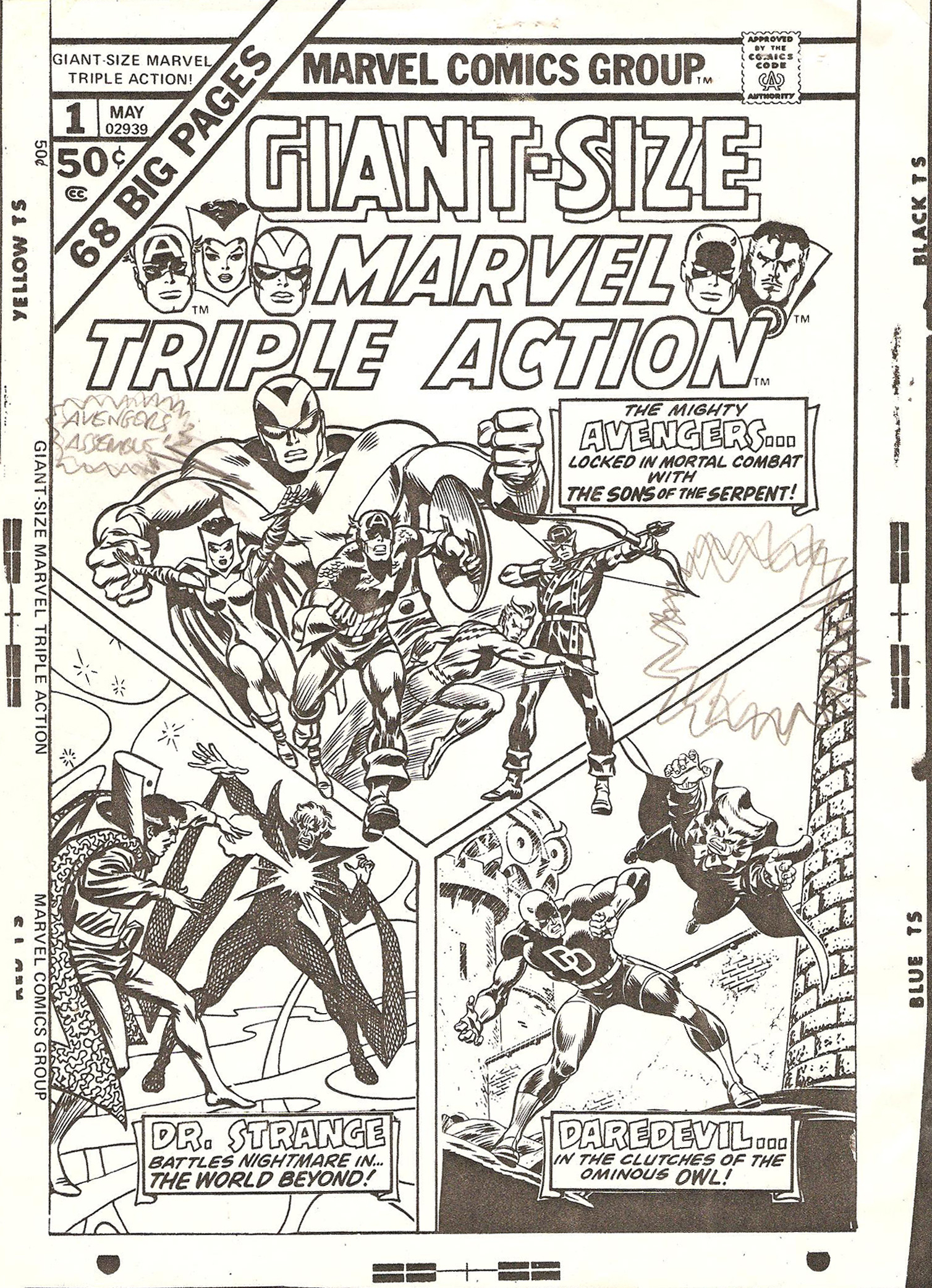
Karen: I recently had the good fortune to chat with Scott Edelman, well-known former Marvel staffer in the 70s, who not only was involved in a wide number of projects during his time at the House of Ideas, but also has become a virtual historian on that time period. Luckily for all of us, Scott kept a number of memos and art and has been publishing them on his blog, www.scottedelman.com. Scott told me that he had a story related to the cover of the most recent Back Issue magazine (#86, on sale here), which featured art from Giant-Size Marvel Triple Action #1. 

Karen: It seems that Stan Lee had sent out a memo regarding this cover,  finding it dull, and describing ways it and other Marvel covers should be changed to make them more exciting to the readers. Please hop on over to Scott's page linked here to see Stan's memos and learn the whole story  (and check out the rest of his blog while you're there -it's a treasure trove!). I think it shows just how much Stan cared about doing things right -I mean, the Marvel way! Below you can see the cover rough and the areas Stan marked up, as well as the final cover and how it changed (note Giant-Man's more aggressive expression).


Doug: Man, that's a subtle change, isn't it? I guess it does punch it up a bit, but much like I had some qualms about editing the cover submissions of Big John Buscema, Johnny "Ring-a-ding" Romita would also seem to be above that. Guess not. To the best that my eyeballs can discern, the facial expression on Goliath is the only change that was made. Stan knew what he wanted, and of course could provide the rationale to support his preferences.

Karen: Hawkeye's expression is very slightly altered but you'd have to see it up close. There's also that blurb on the right-hand side about "More Madcap mayhem" which Stan had suggested. They did not, however, incorporate his suggestion of "Avengers Assemble!" on the left-hand side of the cover. You can see he pencilled this in on the rough cover.

Doug: The cover I think of most often when our conversations turn to comic book covers that were amended or rejected is the cover to X-Men #56 by Neal Adams and Tom Palmer. Below left is the rejected version and to the right is the famous published cover.


Doug: As we've mentioned in the past when discussing this cover, apparently Stan did not like that the logo was obscured by the hostage mutants. I'll go to my grave liking the rejected version better. You can see these covers, as well as 19 (!) other rejected X-Men covers by clicking here. If you jump over to Nic Caputo's blog, you can find a rejected Gene Colan DD cover, as well as another Silver Surfer cover from John Buscema that never saw the light of day.

Doug: I don't have any sort of inventory of these things myself, but I did ask Karen if it would be OK to do a gallery of published covers from the Marvel Comics Covers Artist Edition. She thought that would be great, since we love this topic. So feast your eyes on a dozen and a half such gems, from a wide range of Marvel luminaries. NOTE: Please keep in mind that the Artist Editions are huge books, so you're looking at photographs rather than scans. I wish it could be the other way... but no way.

Karen: I love seeing the rough versions! Thanks Doug. So here's a question for you all: what comes to mind when you think of a 'Marvel-style' cover?


Thursday, February 18, 2016

Carry On - A Comics Covers Genre


Doug: I was thinking of the cover to Avengers #30 for some reason that now escapes me, and that made me think of the cover to Avengers #41, which then led my mind to Amazing Fantasy #15. And of course you know that my stream of consciousness led to today's post. Check out my Marvelcentric offerings, and be sure to add your own (from any and all publishers). As in the past, I'll try to run a follow-up in the near future with everyone's suggestions. Thanks for playing!

PS: I am thinking that the "dead hero" motif, as seen on Thor #127 and X-Men #136 could be a post genre all its own!

NOTE: This post was reconstructed on April 21 2020. As all of the cover images were lost, I rebuilt this with a few images off the top of my head. Comments that refer to the original post may not make as much sense given these samples.


Wednesday, February 17, 2016

Star Trek at 50: Mudd's Women


Season 1
Episode 3: Mudd's Women
Filmed: June 1966
First Air Date: October 11, 1966 (6th episode aired)

Karen: Sex and drugs in space? You better believe it. This episode always struck me as such an oddity. Reading about its genesis and production in Marc Cushman's These are The Voyages Volume 1, it only became stranger. This was essentially a story of prostitution, with three 'mail order brides' that seems better suited for a Western than for Star Trek. It also involves the use of a drug (the Venus drug) which makes a man or woman irresistible. How in the world did any of this get past the censors back in 1966? Cushman posits that part of the answer may lie in the addition of the lovable con man Harry Mudd to the script. As played by actor Roger C. Carmel, Mudd was a larger than life rogue whose comedic behavior distracted from the fact that he was basically a pimp.

Karen: Another thing that got past the censors: the incredibly daring outfits on the women. Trek's wardrobe designer, Bill Theiss, put together some 'barely-there' costumes for all three of the actresses. Apparetnyl this was at the direction of producer Gene Roddenberry. Cushman quotes the show's star, William Shatner, as saying, "Somehow Gene always showed up for the fittings to make his own design adjustments. He'd like to add his own two cents. 'A little less here,' he'd ask Bill, 'A little shorter there.'" Trek  Associate Producer  John D.F. Black said, "The basic problem we had with 'Mudd's Women' was not the script so much as the wardrobe, as designed, getting it past the censors. It was a very overtly sex-oriented piece."

Karen: That's probably the main reason I never cared for this episode as a kid, and even today, it isn't one of my favorites. I can appreciate some of the ideas but there's nothing about it that says "Star Trek" to me; with a few minor changes it seems like it could be a Western or a contemporary drama. It just goes out of its way to titillate without providing any really interesting plot. Although I will grant that Mudd himself is a well-drawn character, and I enjoyed him in his return, in the second season episode, "I, Mudd."


Karen: I think there is also something less than appealing about seeing the male crew turn into quivering adolescents when the women come aboard. Although looking at this clip below, I am again stunned that it got on TV in 1966. I guess you really could get away with almost anything if you called it science fiction!


Tuesday, February 16, 2016

He's Gotta Be "The Man"


Doug: My oldest son and I frequently evaluate life's pleasures in an ongoing conversation about "The Man".

Doug: For example, one of his contentions is that the inventor of brown sugar-cinnamon Pop-Tarts is The Man. I have been known to counter that the person who invented crunchy Cheetos is The Man. But just to show that it's not always positive, we both agreed last week when I was feeling a little under the weather that whoever created DayQuil is also a strong candidate! Take a dose of those, and your cold goes on vacation for four hours!

Doug: So please join the conversation. I think you get the hang of it. What are those pleasures in life that you just think, "Whoever made this..." Show some love today!


Monday, February 15, 2016

The Dark Knight Returned, But Was He Batman? Part One


Batman: The Dark Knight (March 1986)
"The Dark Knight Returns"
Frank Miller-Miller/Klaus Janson

Doug: "It Had to Happen!" "Because You Demanded It!" Get set to have your senses shattered and your minds blown as Karen and I begin a four-part discussion of Frank Miller's magnum opus, The Dark Knight. When we were discussing whether or not we'd like to commit to a series of partner reviews once January gave way to February, I suggested this series. Karen hesitated, thinking we'd already reviewed it. We have certainly spent a fair amount of time on this series in various posts and even more conversations -- near as I can tell, there have been over a dozen posts in our history dedicated specifically to some aspect of this graphic novel. But no -- we've never actually given it the BAB partner review treatment. That ends now.

Doug: One of the pledges we made to each other when we cut the deal to do this was that neither of us would be writing any sort of exhaustive plot summaries. Each volume in this series is 48 pages long -- sorry, I don't want to have to summarize that much text and to be honest, who hasn't read this? *note the sorry fellow there in the back with his hand sheepishly positioned near his ear* So what we are going to do is break this thing down into particular themes, scenes, and general impressions. We hope that you'll feel like you're eavesdropping on a couple of consumers at the comic shop racks. And once you join in, that aisle could become a little crowded!

Doug: Below is a page of publicity from DC Comics released in anticipation of what many now consider Frank Miller's masterpiece. Read what Dick Giordano had to say about The Dark Knight:

Scan courtesy of Greg A (@garaujo1) via Twitter. Thanks, Greg!
 

Doug: Let's begin by talking about the Batman and the basic premise of the story. It's somewhat of a psychological/sociological mashup, in that an aging Bruce Wayne, retired from crime fighting for the better part of a decade, has watched his city crumble around him. He satisfies his urge for action by driving race cars. The Batcave has long ago been shuttered. Bruce Wayne is restless as the Gotham City Police Department struggles to maintain any semblance of order in the face of the rising threat of the Mutants street gang. Frank Miller crafts several young/old dichotomies with his plots and subplots: Batman and the Mutants, Commissioner James Gordon and his coming retirement (to be replaced by a woman decades his younger), the new Robin and history. I liked all of this conflict. From the time I first read this I thought Miller had a good handle on these basic antagonisms for the leads of his subplots. Seen as an Elseworlds-type of story, Miller crafted a wonderfully dysfunctional Gotham, really one that would come to life in Tim Burton's 1989 film, Batman.

Karen: When Doug approached me about reviewing this series, my chief concern was being able to separate the work from the influence it has had on comics in the years since it premiered. As he says above, taken as a one-shot, Elseworlds sort of story, it is just fine. But it proved so popular that it became the template for not only Batman but comics in general. Personally I felt it that while the story itself had its merits, the impact it had on comics as a whole was terrible. It continues to this day - one has only to see the commercials for the Batman v. Superman film to see that. So I have very mixed feelings about The Dark Knight but will try to look at the material only for this commentary.

Karen: It's difficult to imagine the Batman ever retiring. One aspect I liked about this story was the fact that we are dealing with an older Batman who has physical limitations. Unlike so many heroes, Batman is truly just a man -yes, he's brilliant, an expert martial artist, rich, but he's still only human and his body has taken a huge amount of abuse. Returning to the role of the Batman at his age is not easy. We also see that being Batman is like an addiction for him: he's fought it, buried it as much as he can, and used other diversions to distract himself from his craving, but eventually, he gives in. 

Doug: We've both hit on Batman's age. Having just read the entire mini-series, it seemed to me (unless I totally missed it along the way) that Miller was all over the place on Batman's "current" age. It seemed I was asked to do a little math in the first issue and came up with an age of 50. Later on, I was leaning heavily toward 60. And if I'm not mistaken the number "55" was finally announced in the fourth issue. I can deal with either of the last two age suggestions; 50 seemed too young to me for this story. Maybe that's because I'm almost there? I did think it was interesting that Miller/Janson aged Bruce Wayne's face as the story wore on.

Karen: Despite Gordon's dedication and skill, Gotham City is still a cesspool. What does that say about him? And the attempt to rehabilitate Harvey Dent was a failure. Gotham feels like a little pocket of Hell, but Batman continues to try to save it.

Doug: Miller returned to the "Gotham City as cesspool" theme in Batman: Year One as well. I really enjoyed this grizzled old Gordon. He was obviously worn out, a man looking 20 years older than the 69 that he was. Whereas Gordon was still in the fight, it was obvious that he was ready to throw his hands up. But we know he welcomed the return of the Batman. So a couple of questions for you: First, what did you think of the cryptic manner in which all of the super-powered types disappeared, and then second, did you like or dislike the ambiguity of "what happened to Jason"?

Karen: At the time, the mystery of what had happened was very intriguing. Obviously, nothing good had happened in the  preceding years! Reading this as a 22 year old, none of the pessimism about the future really got to me, but I find it hard going now. What does it say? Our childhood heroes couldn't make things right. It is just so damned bleak.

Doug: I guess on my first read, and it's difficult to remember, I saw some of Miller's politics across the story. Here's a bit of irony for you: When this came out I was a sophomore at Eureka College, alma mater of Ronald Reagan. To attend that school while he was in the White House was an experience that had a little good and a little bad, as you might imagine. Anyway, upon leaving high school I suppose if I had a political worldview I would have been characterized as "moderate". However, the friends I soon began to run in college with were pretty left-leaning. So there I was at the school associated with Reagan, yet interested in the political ideas of Illinois Senator Paul Simon (for one). But I have to tell you -- when I read this first issue of Dark Knight, I rooted for this aging Right-winger Bruce Wayne! But if you think of the Left's view of the Reagan years, many of the themes present in Dark Knight were social concerns of the day. Miller chose to portray those issues as solvable by force. Hmmm... not unlike some of those criticisms of the Reagan administration.

Karen: And yet... Batman, when he shows up, is wearing that bright blue cape. For some reason that really struck me this time around. Now he soon winds up in a dark grey and black outfit, but here, as he makes his return to the city in a night of sheer, in-your-face domination of Gotham's criminal element, he could easily be a humongous version of Adam West.  

Doug: The splash where Batman first appears in the traditional colors is one of my favorite panels in the series. It's just so powerful, and a real "Oh, yeah!" moment for the reader as the suspense has built.

Doug: Let's talk about the panel layouts. What did you think of telling the story through a series of small panels emulating television screens? I liked it. I think by the mid-'80s we were becoming so inundated with media coverage and the dawn of media "stars" (beyond the journalists of previous decades, who had their start in radio and/or in TV's infancy) across the many cable channels that became available. It made sense to use the storytelling itself as a form of commentary for Miller. Interesting that Miller chose Lana Lang for a mouthpiece rather than, say, Vicki Vale. I'd also pick your brain on the aforementioned Harvey Dent and his "curing" by Dr. Bartholomew Wolper. Did you like this element of the greater story? I thought the addition of a psychiatrist who can rehabilitate the "un-rehabilitatable" served as an interesting consideration opposite the Batman's increasing presence in Gotham City.

Karen: One thing I did notice regarding layout was the small panel size. By and large, pages are laid out on a tight grid of about 16 panels. Now when Batman is in action, that changes, but otherwise there is a sort of staccato rhythm to the art due to this layout. The TV screens -was this a new idea? So hard to recall now! It seems reasonable -- obviously, Miller had a lot to say about the media, and it's not good! I know we had some discussion about the media here on the blog recently, and it wasn't favorable. Our news programs are full of 'personalities' and a lot of fluff, and it had its beginnings in that era. I don't have any real problems with that. It's Miller's contempt for psychiatry that  I do take issue with, as I think the practitioners of psychology and psychiatry can provide valuable help to some people. Are you going to be able to rehabilitate, or save, everyone? No, I don't think so. But we have to try. I think the effort is as important as the result. Back in the 80s, everyone was so concerned about being "soft" on crime, that we often got reactions that went too far in the other direction. You could make the argument that in some areas, that never stopped,  but this is a comic review and not a political forum, so let's move on. I will say that the politics of TDKR bother me much more now than when I first read it. When I was younger, I could enjoy it as over the top satire, like Robocop. But with all the years between, it becomes less humorous to me.

Doug: Across this nation we see the results of inadequate care for the mentally ill. Perhaps Miller was harping on that. Or, maybe he wanted to use both Two-Face and the Joker as counter-weights to the Batman's terminal obsessions. Either way, they were interesting elements to the story that proved thought-provoking throughout. You know, in the end if you wrap in Superman and even Green Arrow, no one really changes from how they begin this tale. Maybe that's part of Miller's statement.

Doug: Of course we're not going to leave today's post without any discussion of the new Robin, Carrie Kelly. We only just meet her in this first issue; in fact, I'm not even sure I knew she was going to become the new Robin. It's hard to remember the publicity of the story ahead of it's release -- mostly I remember wire service stories telling of the basic premise of an aging Batman and so on.

Karen: I've never had much of an opinion on her, one way or the other. I've heard that it was John Byrne who insisted that this new Robin be a girl. That's intriguing. She's got spunk, which is nice. And she does what Robin should do -she helps keep Batman human.

Doug: Do you have a favorite scene in this issue? The one I distinctly recall having an "Oh, maaaaaaan..." reaction to is on page 39, where the Batman lay in wait under some stairs for a descending thug. Miller makes it quite clear that this is not the Silver Age Batman, but one that hearkens back to the 1930s roots. "The other... hurts." Indeed.


Karen: That full page shot of Batman in his blue and grey outfit is still stunning to me.


Doug: Wrapping up today's installment, I wanted to discuss the art and coloring. I've gone on record a few times as saying that I feel Miller's art devolved throughout this series. But after having re-read the entire graphic novel recently I think I'd come off that complaint. Overall Miller delivered the goods throughout the series. Sure, it's a little inconsistent here and there, but I almost feel now like that's a storytelling device in and of itself. When Batman's down, Miller draws him very big and heavy, really sketchy. But when Batman's strong and in control, it's seems he's drawn in a more toned fashion, tighter. The art in this first issue is magnificent, and Klaus Janson's inks really let Miller's pencils do the talking. Miller's wife, Lynn Varley, completes the package with excellent colors throughout. This first issue is a sight, yes it is.


Saturday, February 13, 2016

This Cover Made Me Buy This Comic Book


DC Super-Stars #17 (Nov-Dec 1977)
Cover by Joe Staton and Bob Layton

Doug: Way too many words and the logo is too big! But a giant square-bound DC with these three "secret origins"? Take my money!


Friday, February 12, 2016

Who's the Best... Batman Story?


Doug: Our long-awaited (yeah, seriously - people have been clamoring for it) review of The Dark Knight Returns lands in just a few days. Ahead of that, let's talk Batman stories. Whatcha got for a fave? Is it TDKR? How about something from the Englehart/Rogers/Austin team? There has been some love around here before for "The Joker's Five-Way Revenge!" Or, maybe it was an episode of Batman: The Animated Series? Whatever -- let's have some fun reminiscing on the adventures of the Caped Crusader.


Thursday, February 11, 2016

BAB Classic (again): What's Missing?

Doug: Today's post last ran on April 4, 2013... Milk it for all it's worth!! But seriously, this was such a great topic when Karen wrote it almost five years ago that it's worthy of a revisit every so often. And if you check out the number of comments at the bottom, we've sure had a lot to say on the subject. In fact, I have a few ideas of my own, and am looking forward to perusing all of the previous conversation. Thanks, gang!

__________________________________________________________________________________

Doug:  This post originally ran on June 28 2011, but I thought after almost two years it was worth revisiting.  As you read Karen's original premise and the comments that followed, why don't you chime in with any updated thoughts, wish lists that have been met, and maybe reiterate what it is that you are still anxiously awaiting.  Here's my partner --

Karen: As we've seen from posts and comments here at BAB, we all love a lot of old comics. Thankfully, a great many of the comic series that we adore have been reprinted in either hardback or TPB format. But there are still some books and stories from the bronze age that are waiting to see print.

Karen: While I'm very happy that Warlock, Captain Marvel, and Deathlok have all received the Masterworks treatment (and soon Iron Fist), how about Killraven? I know, he got his own Essentials. But Essentials are black and white, and I need color.
There are a number of books that have been put in Essentials format that I would like to see in color, including most of the Marvel monster titles. Tomb of Dracula has several volumes out, but what about the short-lived Frankenstein series or Werewolf By Night? Although I wasn't a regular reader, I bet Man-Thing has its fans. And since the Masterworks started collecting Marvel Team-Up, how about some love for the Thing and collecting Marvel Two-In-One?

Karen: I'd love to have the "Who remembers Scorpio?" story from The Defenders all in one TPB. Likewise the Legion of Super-Heroes' "Earthwar Saga".

Karen: I'm sure there are some favorites you'd like to see in a nice trade or hardback -so start naming them!

Wednesday, February 10, 2016

Star Trek at 50: The Corbomite Maneuver


Season 1
Episode 2: The Corbomite Maneuver
Filmed: May 1966
First Air Date: November 10, 1966 (10th episode aired)

Karen: Probably best remembered now for pint-sized Commander Balok (played by Ron Howard's little brother Clint) offering Kirk and company glasses of 'tranya,' 'The Corbomite Maneuver' is surprisingly well-crafted considering it was the first episode filmed following the second pilot. It was in this episode that the  Enterprise crew we know and love would come together. DeForest Kelley was now aboard as ship's doctor Leonard McCoy, and Nichelle Nichols had been hired to play Lieutentant Uhura, the ship's Communications Officer. In the role of the Captain's Yeoman, Janice Rand, was Grace Lee Whitney. Interestingly, according to These are The Voyages by author Marc Cushman, all three were signed to limited contracts. Kelley and Whitney were guaranteed at least seven episodes each, while Nichols, who was brought in later than everyone else, received no such guarantee, but did get a rather high pay rate per episode of $1000. In comparison, Shatner received $5,000 per show, while co-star Nimoy took home $1,250 per episode, and Kelley was making  $850. As budgets became more and more strained on the show, Desilu would renegotiate with Nichols.

Karen: With the exception of Whitney, all of the supporting cast appeared in more episodes than they were originally contracted for. It became apparent quickly that the chemistry between the characters -and particularly between Kirk, Spock, and McCoy - was a key element of the show. This initial episode has a lot of nice character interactions, particularly between Kirk and McCoy. The peaceful nature of the ship's mission is borne out here, as once Balok's ship is disabled, Kirk takes McCoy and young officer Bailey over to ensure the alien is all right. The decision to have Bailey stay for a time with Balok, as a way to exchange information about their two cultures, showed hope that we could find common cause with others, and overcome our fears. That hope was one sorely needed in the 60s -and today.

Karen: Although show producer and creator Gene Roddenberry had wanted to premiere the show with this episode, the demands of post-production special effects got in the way. The first company hired to handle them, the Howard Anderson Company, found the challenge of a weekly science fiction show greater than anticipated. "The Corbomite Maneuver," with its gigantic First Federation starship and other effects, took longer than planned, and was pushed back repeatedly in the schedule, until it was finally shown as episode ten, much later than anyone had hoped. By that time, the characters and their relationships were much better established. But this episode is still a standout.

Karen: One last thing: that Balok puppet scared the crap out of me as a kid! My brother used to torment me whenever it was on screen in the end credits, and try to force me to look at it!


Late breaking Trek fun: Our pal Mike W. sent us this great snippet from the book, Star Trek 30 Years Special Collectors Edition by Lee Anne Nicholson. It seems Clint Howard was only willing to go so far for his role as Balok...Thanks again Mike!


Karen: As a special addendum to today's post, we'd like to give a shout out to our Super-Blog Team-Up team-mate, Paul O'Connor, proprietor of the Longbox Graveyard. Paul's comic story, 4 Seconds, is premiering on Mark Waid's Thrillbent.com site today. Paul won an open microphone pitch contest at San Diego Comic Con a couple of years ago, and now his comic, with art by Karl Kesel, will appear free on the site. Paul's pitch went like this:

4 Seconds is a noir thriller about a petty thief who discovers she can see four seconds into the future. That’s just enough precognition to get into trouble, but not nearly enough time to pull off the heist that will save her sister’s life.

Karen: Congratulations to Paul! Please take a look!
Related Posts with Thumbnails