Karen: This past weekend I had a chance to see the two actors featured in 2001, Keir Dullea and Gary Lockwood, at a show called Monsterpalooza in Burbank, California. They discussed the making of the film and shared memories of it and director Stanley Kubrick. These two men were very entertaining -they came across a bit like The Odd Couple, with Dullea as Felix and Lockwood as Oscar! Both had been fans of Kubrick's work prior to being cast in 2001 (both cited Paths of Glory as a favorite film), and Dullea in particular had been a fan of science fiction, actually recognizing elements in the script as having come from Arthur C. Clarke's short story, The Sentinel, which he had read years before. Both felt like they were making an important film at the time, although neither could have predicted the lasting impact of the film.
Karen: Another amusing tidbit: the fellow playing the voice of HAL on set had a very strong Cockney accent -a far cry from Canadian actor Douglas Rain's smooth tones! Dullea gave us a sample of a Cockney HAL doing the 'Daisy' shutdown speech and it was hilarious.
Karen: Share your thoughts on this classic SF film - you can take this any direction you want. Discuss the film's meaning, influence, effects -have at it.
Karen: We're back for more cinematic debate, this time centering on the greatest science fiction films of the 1960s. Honestly, I'm more comfortable with genre films from either the 50s or 70s, so I may mis-step here. While it was easy to come up with a bunch of 50s films off the top of my head, with the 60s, I struggled a bit. But I think we've got some winners here.So in no particular order, here are my picks for the best of the 60s. 1. The Planet of the Apes (1968): It was pure allegory, and a bit goofy at times, but what a fun and exciting film. Things that immediately stand out are the spectacular crash sequence at the beginning, the amazing make-up designs of John Chambers,the fantastic soundtrack, the bizarre architecture of the Ape City, and of course the shocking closing scene. There are also splendid performances here from Charlton Heston, Maurice Evans, Kim Hunter, and Roddy McDowall. By far the best of all the apes films, and a classic.
2. 2001: A Space Odyssey (1968): I've always had mixed feelings on this film. While itwas certainly visually compelling and far more intellectual than most science fiction films, it also drags quite a bit, in my opinion. Still, it's ambitious and spectacular. There are so many different -yetinterrelated -things going on here: the evolution of man, the rise of artificial intelligence, and man's journey to connect with another intelligence. The film also ushered in a new era in special effects, with its incredibly detailed spaceship models and new filming techniques.
3. Fantastic Voyage (1966): Some would rank this as outstanding simply for the presence of Raquel Welch, but let's look at the rest of the film, shall we? A submarine-like ship and a crew are micro-miniaturized and injected into the body of a Soviet scientist who is defecting, but due to an assassination attempt, lies in a coma with a blood clot in his brain. The real selling point of the film are the wonderful visuals as we travel through the human body. It might not stand up to close inspection today, but I recall being completely enthralled with it when I first saw it.
4. Five Million Years to Earth (1967): This British film is also known as Quatermass and the Pit. I absolutely love this film, although it's a bit hard to describe. It involves the discovery of a buried alien spaceship, and these same aliens messing around with the evolution of human beings, species memories, psychic phenomena -there's so much more to it than that. It's smart, and scary at times. I wish I could get a copy of this on DVD. If you have a chance to see it, do it!
5. Day of the Triffids (1962). Another product of Great Britain, this film is sort of like a zombie film but with the zombies replaced by huge, ambulatory plants. I'm not kidding. It sounds hokey but believe me, these plants were pretty darn frightening. Actually, the zombie connection is even more appropriate when you consider that both 28 Days Later and the recent Walking Dead TV show essentially stole the beginning of Triffids - where the protagonist wakes up in a hospital room, alone. In triffids however, there is an even more interesting twist: our hero is one of the few people alive who can still see. The plants arrived on our planet during a tremendous meteor shower, which also had the effect of blinding most of the populace. As in zombie films, society has begun to collapse and the survivors are fighting it out amongst themselves, with the plants coming off as a lot less threatening than our fellow men.
OK, what do you think deserves to be on the list? What film did I overlook?
If you were alive in the 1970s, it would have been hard for you to avoid hearing about Erich Von Daniken and his book, Chariots of the Gods. The book was first published in English in 1969, and quickly became something of a sensation. Von Daniken, a Swiss author, proposed that our planet was visited in ancient times by alien astronauts, and these visitors were worshipped as gods by our primitive ancestors. Von Daniken even theorized that the aliens engaged in interspecies mating, which helped advance mankind! He pointed to many ancient drawings and artifacts, declaring that they showed the influence of an advanced culture on human development. Although Von Daniken was not the first to promote such an idea (nor was he the last), he is undoubtedly the most well-known proponent of the ancient astronaut theory.
This theory, no matter how outlandish, struck a chord with people, as the book became a best-seller and even led to a TV special, In Search of Ancient Astronauts, hosted by Rod Serling. I recall that my father had a paperback copy of the book, and as a child I enjoyed looking through it, as it had pictures of a variety of archeological wonders. Although scientists in general found little evidence to support Von Daniken’s theories, the idea of star-spanning voyagers coming to our backward little planet and driving our evolution has proved to be irresistible to many.
The ancient astronaut concept crops up again and again in popular culture. References to ancient astronauts are often found in works of science fiction. In the film 2001: A Space Odyssey, an ancient alien monolith is found on the moon, and we are shown in flashback that a similar alien monolith on Earth influenced the evolution of early primates.
The original Battlestar Galactica TV series (1978) had opening narration that went, “There are those who believe that life here began out there, far across the universe, with tribes of humans who may have been the forefathers of the Egyptians, or the Toltecs, or the Mayans. That they may have been the architects of the great pyramids, or the lost civilizations of Lemuria or Atlantis. Some believe that there may yet be brothers of man who even now fight to survive somewhere beyond the heavens…” The show’s design featured a vaguely Egyptian motif.
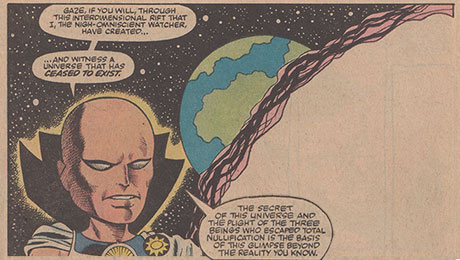
In 1976, comic book legend Jack Kirby created the Marvel Comics series The Eternals, which related the story of a hidden race of super-powered beings who had been created millennia before by mysterious alien beings known as the Celestials. The Celestials interfered with the natural evolution of humanity. The Eternals were superficially human but possessed of long life spans and great powers, and had been worshipped by human beings as gods in the past. Their names were bastardized versions of gods and heroes (“Makkari” =”Mercury”, “Zuras” = “Zeus”, etc).
The list could go on and on, as the ancient astronaut theory remains popular to this day. As a matter of fact, Von Daniken is still on the lecture circuit at age 74! I did finally get around to reading Chariots of the Gods years ago, and while I found it somewhat entertaining, I really couldn't buy into any of Von Daniken's theories. For one thing, I tend to think our ancestors were a much smarter and more talented bunch of folks than Von Daniken does. For another, it seems like Von Daniken is mostly concerned with stating how dangerous his ideas are, and how "courageous" he is for expressing them. He's almost like a religious fanatic in the sense that he's so convinced he's right, he doesn't even consider other possibilities. But he's not alone -there are many other people who have written books on the subject, and both TV and film continue to keep the idea alive with the public. Although there seems to be little reason to believe in ancient astronauts, the idea still fascinates many.
Friends, we've given a lot of attention to this, our baby. However, if you find a broken link in regard to an image or video, help us out by leaving a comment on that specific post. Thank you! -Doug and Karen
Karen's at Echoes from the Satellite!
Join Karen as she shares her thoughts on science fiction, film, music, and more!
Love Bronze Age Black & White Comics?
Doug crafted a year's worth of B&W awesomeness - check it out by clicking the image above!
Rocket over to Planet 8!
Karen has joined the ranks of podcasters along with her friends Larry and Bob on the Planet 8 podcast. Click on the image to hear them explore all things geek!
Even More Bronze Age Conversation!
Join Martinex1 and Redartz as they continue the Bronze Age conversations each Tuesday at Back in the Bronze Age!
Bronze Age True Believers Descend on Chicago!
On Sunday, 3-24-19, Redartz, Doug, Colin Bray, Martinex1, and Charlie47 represented our Bronze Age family of blogs with a get-together at C2E2 in Chicago. Great day!!
Bronze Age Babies, Unite!
On Sunday, 4/23/17, Martinex1, Doug, and Redartz gathered for a day of fun at C2E2 in Chicago. It was great to finally meet in person after years of online cameraderie.
Translate
Rules of Engagement
Welcome to the Bronze Age Babies.
We hope you'll find the conversation stimulating. Not only will you be able to participate in the day's discussion, but don't hesitate to journey into our archives and visit almost 2300 posts on all manner of pop culture.
We hope you enjoy our community. Please be aware that this is a TROLL-FREE ZONE. We'd appreciate if combativeness, prejudicial or racist statements, and general surliness be taken elsewhere. Here, we are free to hold an opinion and to be asked to argue for it -- but all in a spirit of respect.
Karen and Doug met on the Avengers Assemble! message board back in September 2006. On June 16 2009 they went live with the Bronze Age Babies blog, sharing their love for 1970s and '80s pop culture with readers who happen by each day. You'll find conversations on comics, TV, music, movies, toys, food... just about anything that evokes memories of our beloved pasts!
Doug is a high school social science teacher and division chairman living south of Chicago; he also does contract work for the United States Holocaust Memorial Museum. He is married with two adult sons.
Karen originally hails from California and now works in scientific research/writing in the Phoenix area. She often contributes articles to Back Issue magazine.
Believe it or not, the Bronze Age Babies have never spoken to each other...
Disclaimer
We don't own property rights for any of the images we show on Bronze Age Babies -- those copyrights are retained by their respective owners. Most images are from books, etc. that we have individually purchased, while others have been copied from the Internet. All images are displayed here for the purpose of education and review within the "fair use" terms of U.S. Code: Title 17, Sec. 107. If we've used something we shouldn't have, please ask and we'll take it down. Thank you -- Doug and Karen
Dig Karen's Work Here? Then You Should Check Her Out in Back Issue!
BI #44 is available for digital download and in print. I've read Karen's article on reader reaction to Gerry Conway's ASM #121-122, and it's excellent. This entire magazine was fun! -- Doug
Back Issue #45
As if Karen's work on Spidey in the Bronze Age wasn't awesome enough, she's at it again with a look at the romance of the Vision and the Scarlet Witch in Back Issue's "Odd Couples" issue -- from TwoMorrows!
Karen's talking the Mighty Thor in the Bronze Age!
Click the cover to order a print or digital copy of Back Issue! #53










.jpg)


