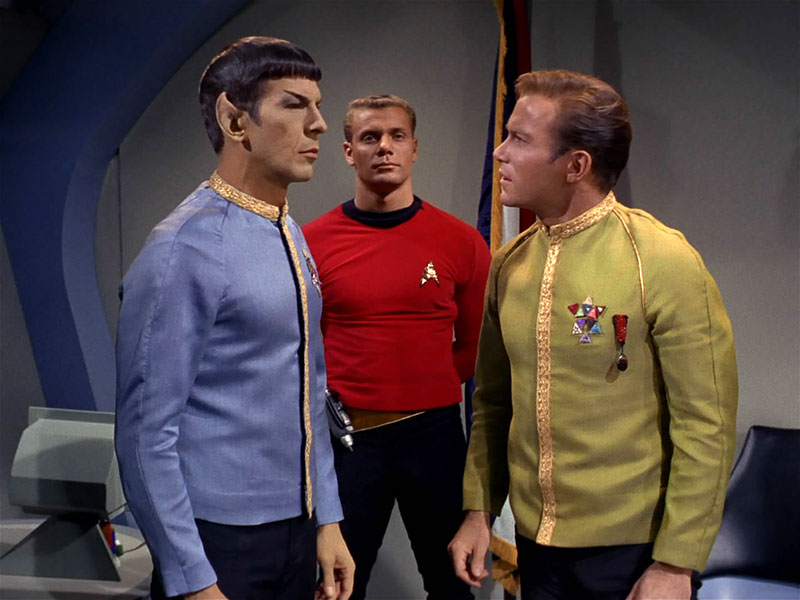
Season 1
Episode 28: The City on the Edge of Forever
Filmed: February 1967
Filmed: February 1967
First Air Date: April 6, 1967
Karen: Kirk sacrifices the woman he loves to save the future. It's a heart-breaking story that has gone on to be hailed the best Star Trek episode ever by many. And yet, the original story would not have had the Captain making this soul-rending decision. Perhaps more than any other episode "City" suffered from incredible behind the scenes strife. But it turned out to be a beautiful, touching tale.
Karen: Star Trek fandom has for years heard tales of the rancor between Roddenberry and Harlan Ellison, the writer of this episode. Depending on who you're listening to, you may hear a very different version of what happened. Again, we turn to Trek historian Marc Cushman and his book These are the Voyages Volume One for a detailed and (seemingly) unbiased account. If you're looking for all the minutiae I suggest you pick up the book (well, I suggest you pick it up anyway) but the basics are that Roddenberry approached a number of high-profile science fiction authors as he began getting Star Trek off the ground. Ellison was one of them. Ellison, besides having written a number of stories, had also written scripts for TV shows, including the script for the Outer Limits episode "Demon with a Glass Hand," which won a Writers Guild award. There was no doubt about his talent. Ellison had an idea about Kirk going back in time and meeting a character based on the evangelist Aimee Semple McPherson, who Kirk would fall in love with but have to let die in order for the future to proceed properly. Roddenberry gave the go-ahead and Ellison quickly produced a story treatment. This was in March of 1966.
Karen: However, while producer Robert Justman and others thought the story was beautifully written it also was not something they could film, for a number of reasons. Part of it was due to budget -there were too many things in the script that they couldn't translate to film given the meager funds they were working with. But perhaps just as important, there were things in the script that simply weren't consistent with the type of show Trek was. Maybe the best known of these is that rather than having McCoy become temporarily insane from an accidental overdose of a drug, as was filmed, Ellison had a crew member (not one of the regular cast) selling hallucinogens on the ship, and bludgeoning to death another crew member who threatened to turn him in. This is certainly not typical behavior on the Enterprise. It was felt by the Trek staff that the script needed revision.
Karen: This is where the merry-go-round starts. Ellison provided a revision -but it took five weeks to get it. It was May, and they were beginning to film the first episode ("The Corbomite Maneuver"). Even at this point, they were concerned about running out of scripts. They needed to turn them out with some alacrity. But Ellison was moving slowly on getting the teleplay finished. So in an act of desperation, Roddenberry set Ellison up with a desk in a tiny office at the studio, hoping they could keep an eye on him and get that script. Unfortunately, it may have distracted Ellison more, as he was frequently found on set. D.C. Fontana defended Ellison, to some extent, saying that, "Harlan did spend some time visiting the set, but that's considered necessary research for a writer. When a show hasn't been on air yet, freelance writers must have an opportunity to study the actor's speech patterns and delivery, the little gestures and nuances that each one brings to his or her role -and most of all - the character relationships which are being built episode by episode."

Karen: Robert Justman finally got his script from Ellison on June 7. After the first blush of excitement, Justman realized they were in trouble. Although the script was "brilliantly written" it was still too expensive to film, and the characters weren't acting the way they'd been established in the show. They were stuck at the same point. Ellison revised his script, unhappily, feeling that the special qualities of the script that he had worked so hard to put in were being lost with each revision. And there were many, many revisions. According to Cushman, Ellison himself provided three versions of the story outline, then did three versions of the teleplay (script), at which point Steven Carabatsos, who was still story editor (October 1966) stepped in to provide a rewrite. It was Carabatsos who removed the drug dealing element and instead introduced the idea of Dr. McCoy getting hurt and then injected with Adrenalin, which makes him go temporarily mad. After Carabatsos' effort, Ellison again went at it. What was marked as his final draft arrived in the Trek offices December 19th. It still wasn't where the staff felt they could use it. So Gene Coon took a shot at it over the Christmas holiday, then D.C. Fontana came in and worked on it, then Coon again, then Fontana, and finally Roddenberry touched it. By February of 1967, nearly a year later, they finally had their script.
Karen: Typically, when you have this many people fiddling with a script, it comes out a mess. But somehow, they managed to create a gem. The Ellison script was, by all accounts, absolutely incredible, and would have been perfect for an anthology show like Outer Limits. But it was felt that it didn't have the 'feel' of Trek. The finished episode however is resolutely Trek to its core; the characters are the people we have spent this entire first season getting to know. Their mannerisms, their personalities, are all there. I should note that Ellison does not feel this way at all about it and you can easily find out more by searching the web.
Karen: The acting in this episode is top-notch. Shatner is still working hard as Kirk. We see the gears turning in his head and the love and the anguish he feels is very real. Nimoy is as understated as ever but Spock's sense of concern for Kirk and his plight is tangible. DeForest Kelley gets to have some fun as the demented McCoy, but he has a sweet scene with Joan Collins as well. Kelley said that he decided to play it as if McCoy was also enchanted by Keeler. And what of Edith Keeler? Joan Collins was a well-known actress at this time and a casting coup for Trek. She and Shatner had real chemistry and the two of them made a lovely couple. Director Joe Pevney, who helmed many episodes, said of this show, "It was a pleasure working with the actors. They realized their full potential in that one."

Karen: There was one scene in this episode that I never completely saw until I got the DVD set, and that was McCoy's arrival back in 1930. When it went into syndication, they removed the part where the derelict he encounters accidentally phasers himself out of existence. The full scene is in the clip below.
Karen: Most of this episode was filmed back in Mayberry again -there is one well-known publicity still where Floyd's Barbershop can be seen behind Kirk and Keeler - and desperate for stage space, the crew even borrowed the My Three Sons empty stage to film some scenes. I'd always wondered about the design of the Guardian, the mysterious machine/entity that transports our heroes through time. It was a strange design, but effective. Apparently it was not the work of the series regular designer, Matt Jeffries, who was ill at the time, but of Rolland Brooks. D.C. Fontana stated that Brooks misread the script, somehow translating 'runes' into 'ruins' and so we got the broken classical columns surrounding the Guardian. It's unclear where the lop-sided shape of the portal itself came from. Reportedly, when Jeffries walked onto the set he burst out with, "What the Hell is this?"

Karen: I have to admit, as a kid, this episode didn't do it for me. But now...it really guts me. Throughout the series Kirk has to make many hard decisions, but this one is surely the most terrible. Despite the short time he is with Edith, she is a real kindred spirit and it's easy to see how he could fall in love with her so quickly. The line "The needs of the many outweigh the needs of the few, or the one" has become a standard within Trek fandom since Star Trek II:The Wrath of Khan but long before Spock performed the math on that and made his decision, Kirk does it here, to its brutal conclusion. When Kirk discovers that McCoy is in the mission and races back to it, the brief joy he and Spock and McCoy experience at being reunited, plunges quickly into utter devastation when he realizes Edith's fate has arrived, and he has to actually hold back McCoy from saving her. McCoy's anger at Kirk -"Do you know what you've done?" and Spock's almost-consoling, "He knows, Doctor. He knows" were pitch perfect. Of course the final line, uttered by Kirk as they leave the planet was the perfect way to end the episode: "Let's get the Hell out of here."
Karen: Kirk sacrifices the woman he loves to save the future. It's a heart-breaking story that has gone on to be hailed the best Star Trek episode ever by many. And yet, the original story would not have had the Captain making this soul-rending decision. Perhaps more than any other episode "City" suffered from incredible behind the scenes strife. But it turned out to be a beautiful, touching tale.
Karen: Star Trek fandom has for years heard tales of the rancor between Roddenberry and Harlan Ellison, the writer of this episode. Depending on who you're listening to, you may hear a very different version of what happened. Again, we turn to Trek historian Marc Cushman and his book These are the Voyages Volume One for a detailed and (seemingly) unbiased account. If you're looking for all the minutiae I suggest you pick up the book (well, I suggest you pick it up anyway) but the basics are that Roddenberry approached a number of high-profile science fiction authors as he began getting Star Trek off the ground. Ellison was one of them. Ellison, besides having written a number of stories, had also written scripts for TV shows, including the script for the Outer Limits episode "Demon with a Glass Hand," which won a Writers Guild award. There was no doubt about his talent. Ellison had an idea about Kirk going back in time and meeting a character based on the evangelist Aimee Semple McPherson, who Kirk would fall in love with but have to let die in order for the future to proceed properly. Roddenberry gave the go-ahead and Ellison quickly produced a story treatment. This was in March of 1966.
Karen: However, while producer Robert Justman and others thought the story was beautifully written it also was not something they could film, for a number of reasons. Part of it was due to budget -there were too many things in the script that they couldn't translate to film given the meager funds they were working with. But perhaps just as important, there were things in the script that simply weren't consistent with the type of show Trek was. Maybe the best known of these is that rather than having McCoy become temporarily insane from an accidental overdose of a drug, as was filmed, Ellison had a crew member (not one of the regular cast) selling hallucinogens on the ship, and bludgeoning to death another crew member who threatened to turn him in. This is certainly not typical behavior on the Enterprise. It was felt by the Trek staff that the script needed revision.
 |
| A graphic novel featuring Ellison's original story is available |

Karen: Robert Justman finally got his script from Ellison on June 7. After the first blush of excitement, Justman realized they were in trouble. Although the script was "brilliantly written" it was still too expensive to film, and the characters weren't acting the way they'd been established in the show. They were stuck at the same point. Ellison revised his script, unhappily, feeling that the special qualities of the script that he had worked so hard to put in were being lost with each revision. And there were many, many revisions. According to Cushman, Ellison himself provided three versions of the story outline, then did three versions of the teleplay (script), at which point Steven Carabatsos, who was still story editor (October 1966) stepped in to provide a rewrite. It was Carabatsos who removed the drug dealing element and instead introduced the idea of Dr. McCoy getting hurt and then injected with Adrenalin, which makes him go temporarily mad. After Carabatsos' effort, Ellison again went at it. What was marked as his final draft arrived in the Trek offices December 19th. It still wasn't where the staff felt they could use it. So Gene Coon took a shot at it over the Christmas holiday, then D.C. Fontana came in and worked on it, then Coon again, then Fontana, and finally Roddenberry touched it. By February of 1967, nearly a year later, they finally had their script.
Karen: Typically, when you have this many people fiddling with a script, it comes out a mess. But somehow, they managed to create a gem. The Ellison script was, by all accounts, absolutely incredible, and would have been perfect for an anthology show like Outer Limits. But it was felt that it didn't have the 'feel' of Trek. The finished episode however is resolutely Trek to its core; the characters are the people we have spent this entire first season getting to know. Their mannerisms, their personalities, are all there. I should note that Ellison does not feel this way at all about it and you can easily find out more by searching the web.
Karen: The acting in this episode is top-notch. Shatner is still working hard as Kirk. We see the gears turning in his head and the love and the anguish he feels is very real. Nimoy is as understated as ever but Spock's sense of concern for Kirk and his plight is tangible. DeForest Kelley gets to have some fun as the demented McCoy, but he has a sweet scene with Joan Collins as well. Kelley said that he decided to play it as if McCoy was also enchanted by Keeler. And what of Edith Keeler? Joan Collins was a well-known actress at this time and a casting coup for Trek. She and Shatner had real chemistry and the two of them made a lovely couple. Director Joe Pevney, who helmed many episodes, said of this show, "It was a pleasure working with the actors. They realized their full potential in that one."

Karen: There was one scene in this episode that I never completely saw until I got the DVD set, and that was McCoy's arrival back in 1930. When it went into syndication, they removed the part where the derelict he encounters accidentally phasers himself out of existence. The full scene is in the clip below.
Karen: Most of this episode was filmed back in Mayberry again -there is one well-known publicity still where Floyd's Barbershop can be seen behind Kirk and Keeler - and desperate for stage space, the crew even borrowed the My Three Sons empty stage to film some scenes. I'd always wondered about the design of the Guardian, the mysterious machine/entity that transports our heroes through time. It was a strange design, but effective. Apparently it was not the work of the series regular designer, Matt Jeffries, who was ill at the time, but of Rolland Brooks. D.C. Fontana stated that Brooks misread the script, somehow translating 'runes' into 'ruins' and so we got the broken classical columns surrounding the Guardian. It's unclear where the lop-sided shape of the portal itself came from. Reportedly, when Jeffries walked onto the set he burst out with, "What the Hell is this?"

Karen: I have to admit, as a kid, this episode didn't do it for me. But now...it really guts me. Throughout the series Kirk has to make many hard decisions, but this one is surely the most terrible. Despite the short time he is with Edith, she is a real kindred spirit and it's easy to see how he could fall in love with her so quickly. The line "The needs of the many outweigh the needs of the few, or the one" has become a standard within Trek fandom since Star Trek II:The Wrath of Khan but long before Spock performed the math on that and made his decision, Kirk does it here, to its brutal conclusion. When Kirk discovers that McCoy is in the mission and races back to it, the brief joy he and Spock and McCoy experience at being reunited, plunges quickly into utter devastation when he realizes Edith's fate has arrived, and he has to actually hold back McCoy from saving her. McCoy's anger at Kirk -"Do you know what you've done?" and Spock's almost-consoling, "He knows, Doctor. He knows" were pitch perfect. Of course the final line, uttered by Kirk as they leave the planet was the perfect way to end the episode: "Let's get the Hell out of here."