Showing posts with label Denny O'Neil. Show all posts

Wednesday, April 30, 2014

"I'm Just a Lucky Dude Who Got to Write..."

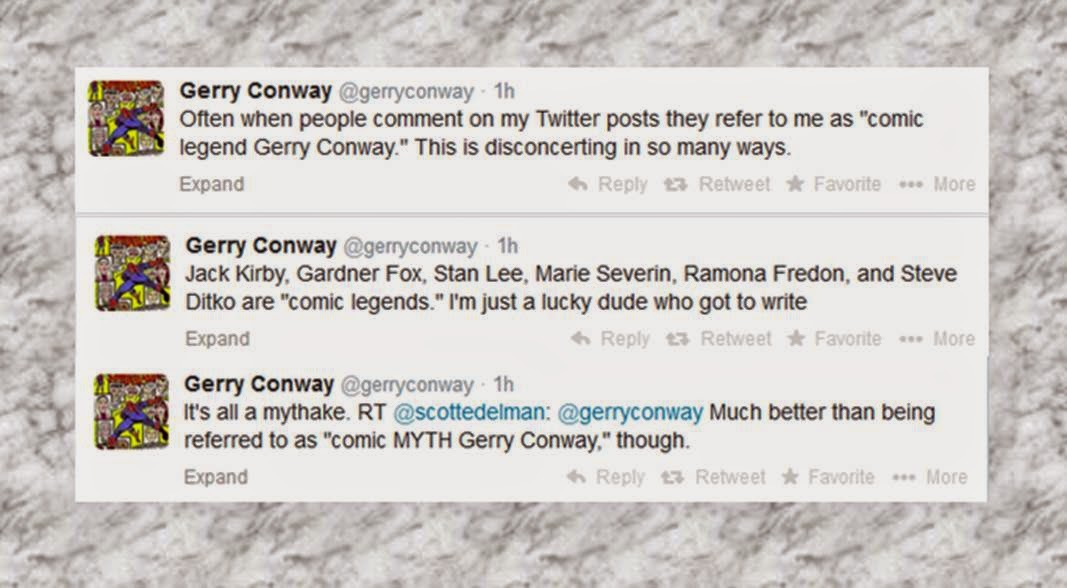
Doug: Two days ago, while perusing the BAB Twitter account's timeline (I have two accounts/timelines -- one for "me", and one for "us" that I share with my partner), I came across a series of tweets from Bronze Age scribe Gerry Conway. I'll admit to being tired of Conway often being referred to as "the guy who killed Gwen Stacy". While that may be a claim to fame of his (or infamy, depending on your perspective, I guess), it's certainly in no way indicative or summative of the body of his work in the industry. Conway was lamenting the fact that he's often referred to as a "comics legend", and took just a smidgeon of umbrage. He deflected the "legend" status to folks like Stan Lee, Jack Kirby, and Steve Ditko. So of course, I meditated on that for awhile and thought to myself, hey -- we need to discuss this on the blog!

Doug: Gerry Conway wrote a memorable run on Amazing Spider-Man, following an incredible run of 106 out of the first 110 issues written by Stan "the Man" Lee (with issue #s 101-104 penned by Roy Thomas). Conway stayed on the title for over three years; the deaths of Gwen Stacy and the Green Goblin came inside his first 12 issues. As Jim Shooter before him, Conway cut his professional teeth as a teenager.


He crafted that story -- perhaps the most pivotal 2-issue "arc" of the Bronze Age, and also co-created the Punisher as well as several Bronze Age villains that have become Spider-Man mainstays. He wrote the controversial clone saga (which looks like a literary classic in its own right as compared to the second clone saga) and brought a sort of second closure to the death of Gwen Stacy. Additionally at Marvel, he co-created Werewolf by Night and Man-Thing, and wrote the premier issue of Tomb of Dracula. Click here for a listing of Conway's creations/co-creations during his prolific career at Marvel and at DC.

Doug: So -- what exactly is a legend, then? If we look at the parameters of this blog, which most of us agree generally (but not always) focuses on the period from 1970-85, then I'm going to stand up and say that Gerry Conway is a Bronze Age legend. His Spidey run, coupled with his eight years as scribe of Justice League of America, is enough to get brought up in the conversation. My next question would be -- additionally, who else is a "legend"? I know that I often use the term "master" in describing the art of John Buscema, Neal Adams, Kirby, and sometimes even John Byrne. Are they legends (Kirby undeniably is, so no one needs to go there), too? Is Julius Schwartz, the shepherd of the Bronze Age as an editor, a legend? I'll be curious to see what our masses have to say about this oft-bandied term. And when today is all said and done, Gerry Conway may just have to wear that crown...

http://www.imdb.com/name/nm0176689/

Monday, February 3, 2014

"Only there's skins you never bothered with." Green Lantern 87


Green Lantern #87 (December/January 1971)(cover by Neal Adams)
"Beware My Power"
Dennis O'Neil-Neal Adams/Dick Giordano

Doug:  Welcome to our first post-vacation comic review.  In the United States, February has been designated "Black History Month" -- it was first officially recognized by the federal government during our bicentennial year of 1976.  The observance is also celebrated in the UK and Canada.  Karen and I have never done anything specific on our blog to bring notice to this, but during our time away we had conversation about it and decided to make 2014 a bit different.  With this in mind, we're going to review today's fare -- the introduction of the Green Lantern perhaps most recognized by novice superhero fans of today, John Stewart.  We're going to follow it with Fantastic Four #119, an anti-apartheid story featuring the Black Panther.  After that, we'll get away from our usual trend of arcs contained with a calendar month and begin a long stretch of the "Secret Empire" storyline from Captain America.  Throughout these reviews, we'll do our best to not only provide the sort of commentary you've grown accustomed to but also hopefully shine a spotlight on the treatment of Black characters in these stories.  The new Green Lantern, T'Challa, the Falcon and Leila -- should be enlightening and hopefully a lot of fun.

Karen: Although comics have become far more inclusive of African Americans and characters of other ethnic backgrounds over the years, it's rather sobering to realize that there's still not a major Black super-hero at the big two headlining their own title. Characters like John Stewart and the Panther, and Luke Cage, the Falcon, Storm, Cyborg, and others have become regular fixtures in titles but none have moved into that upper echelon of popularity. But then, how many characters born after the initial wave of creation at either company have gone on to become big hits? I'm pleased to see more diverse faces in books over the years, but when it comes down to it, the big names are still mostly white guys.

Doug:  When last we visited the groundbreaking Green Lantern/Green Arrow series, Karen and I were left underwhelmed by the heavy-handed liberalism and compact storytelling of Dennis O'Neil.  While the visuals provided by Neal Adams and Dick Giordano provided a saving grace to the four issues we reviewed, the stories themselves seemed to wear on us.  I found myself not necessarily disagreeing with O'Neil's passion for social issues, but the large club he seemed to wield proved most unsavory as a means of delivery.  But today's story is significant as mentioned above, and certainly merits our notice.  Let's have a look.


Doug:  We open with a look-in on Hal Jordan, in full GL costume and charging his power ring.  Suddenly he's aware of an earthquake.  Quickly he exits the room to get outside, but by the time he does the tremor has subsided.  He does a survey of his surroundings and realizes the damage is slight.  That is, until he reaches the outskirts of the city.  There, a long bridge over a deep chasm has disintegrated, leaving a school bus and its passengers precariously perched on the edge of oblivion.  As Green Lantern lands, the children explain that they were on a field trip when the quake hit.  One of their classmates is at the edge of what's left of the road and their teacher, Mr. Gardner, is trying to help her back to safety.  As GL looks up, the school bus moves forward and strikes Gardner squarely in the back.  As Gardner and the young girl vault over the precipice, the green energy of Jordan's ring encircles them and brings them back to solid earth.  Hal recognizes "Mr. Gardner" as Guy Gardner, once named the alternate Green Lantern of Earth.  Gardner (this one's a faaaaaaaar cry from the Guy we knew and loved/hated during the Bwhahahaha Justice League days) tells Hal that he's pretty beat up and will need some time to heal and rehabilitate.   As Jordan walks away he muses to himself that he'd been very comfortable knowing that he had a back-up should the need ever arise.  Now he's not so sure.

Karen: OK, I have to get this out of my system, as someone who was born and raised in California and lived there most of my life: any earthquake that buckles walls, makes a big crack in the street and causes a car to flip over isn't "slight"! I had to read that twice. There was no reason for him to have Green Lantern saying that. It goes at odds with the pictures and it's just plain wrong. I was also kind of surprised Gardner was still conscious and talking after getting pulverized, but I'll let that one go. 


Doug:  So while Hal debates his future without a "first runner-up", the Guardians appear to him and tell him that he must have that alternate, and they know just who that someone will be.  Jordan wonders who, so scribe Denny O'Neil is going to show us.  We scene-shift to an "urban ghetto" where some Black youths sit against a store front playing dominoes.  The police want them to move, using the excuse that the young men have no "games permit".  Suddenly another gent in his 20s comes up and tells the police that these youngsters have done nothing wrong.  This new guy stands up to the police, albeit in a very smart-alleck way.  The cops are ticked, and our guy challenges them, saying they aren't man enough to give him trouble.  O'Neil does strike a chord with this bit of temporally-embedded dialogue:

"Blast 'em... They got no respect!"
"Fred, respect has to be earned!  The way you acted, you didn't earn a nickel's worth!"

This almost sounds like dialogue from In the Heat of the Night or some such period film.  That Denny O'Neil strikes the "us vs. them" antagonism seems perfect for the urban mood found in northern cities in 1971.  These were the days of busing of school children, newly-segregated schools, and racially-based fighting.  But then part of me wants to know -- why'd he go with the easy stereotype of the slick-talking, anti-establishment Black man?  Why not throw us for a loop and choose a smooth Sidney Poitier-type?

Karen: After reading the whole story, I would just venture a guess that O'Neil probably hadn't spent a whole lot of time around young African American men. John Stewart is a strange amalgam of traits to be sure.

Doug:  GL watches the scene from a rooftop, with the astral projection of one of the Guardians, and asks if this is really the guy they want to recruit.  Jordan is assured that he is, in spite of his "petty bigotries".  I remarked to Karen in an email as we were preparing this that I wonder if there's ever been another comic book where the star of the mag plays straight man to everyone else -- it seems Hal Jordan always has a lesson to learn and usually learns it by being put firmly in his place.  So we cut moments ahead to a candy store, where GL (in full costume) is sitting down with our new protagonist and enjoying a milk shake.  Yup -- full costume, milk shake... you read that right.  We learn that our prospective Green Lantern is an unemployed architect named John Stewart -- "Square John" to his friends.  Shortly, the two men are on a rooftop where Hal begins his protege's instruction.

Karen: Yes, getting back to our off-line conversation, one of the things that really bothered me about the GL/GA stories was the fact that GL was constantly being taught some lesson -the poor guy was always made out to be a tool. It was just so heavy-handed. Whether I agreed with O'Neil's political leanings all the time or not, it just grew more grating over time. Back to our story now -they meet in a candy shop? What? Couldn't two grown men like this at least have coffee?

Doug:  Hal uses his ring to encompass Stewart's body in the full garb of the Green Lantern Corps.  Stewart remarks that these aren't exactly threads like James Brown would wear, and then declares that he will not wear a mask.  John Stewart is a Black man who "lets it all hang out!  I've got nothing to hide!"  Jordan's again left standing, and bewildered.  The next lesson is on flight, which Stewart quickly masters; he remarks that flying is much easier than staying ahead of the muggers on the way back to his apartment after dark.  And here's where I think I grow tired of O'Neil's writing.  His soap boxing is a constant drum beat.  I don't care if we're reading this as 40-year old history or if we were readers fully in the moment.  The Black/white social dichotomy was no secret and had not been for quite some time.  Is this a socially-aware story?  Yes, sure it is.  But why couldn't it just stand on those merits?  Everything seems to become cliche', and delivered with a hammer blow.  My take, I suppose.

Karen: Well, you already know how I feel about it!  I try to figure out how this went over back when it first came out, but I can't help but think it would be perceived largely the same way -John Stewart is a caricature, but an oddly uneven one.

Doug:  Our heroes arrive to the airport as a large crowd has gathered adjacent to the tarmac to welcome a particular plane.  But suddenly, a fuel truck hits an oil slick and careens out of control.  Stewart actually gives the order for the dual maneuver that will save everyone and Jordan responds.  As Hal spirits the spectators away, Stewart uses his own imagination to craft a shape that will right the tipping, sliding truck.  But as he does, oil spurts from the rig, some landing on Senator Jeremiah Clutcher, the man the crowd had come to see.  Clutcher's face is covered in the crude and Stewart flies right up to him and makes a racist comment himself.  Moments later, Hal gives John Stewart a stern chewing-out.  Stewart responds angrily, saying the Clutcher is a racist who wants to be President; he calls Hal "whitey" during the argument.  Incensed, Hal reminds Stewart who the teacher is and assigns the novice Green Lantern to guard Senator Clutcher.


Karen: One thing I notice with these O'Neil GL/GA stories is I always feel like they're more sketches of stories -like they're missing text or something. We get no introduction to the senator, the Lanterns are just suddenly there and blammo. I guess I'm used to reading longer-winded Roy Thomas and Gerry Conway stories from that time period.

Doug:  I'm not going to give O'Neil and Adams a pass, but for whatever reason Green Lantern and Green Arrow do not appear together in this book -- rather, there are two separate stories (Black Canary is also in the GA story).  So O'Neil was dealing with smaller page counts for his stories.  Still, we've certainly reviewed our fair share of short stories through the years -- make it work.

Karen: Another interesting thing here is how Jordan stresses to Stewart that he's not there to make judgments on people. Understandable to a degree, but don't superheroes tend to put themselves in that position by default? 

Doug:  Later, Clutcher makes a speech filled with racist epithets and innuendo. The Green Lanterns stand nearby listening, both men disturbed by what they hear.  Suddenly a Black man emerges on the left side of the stage and fires a shot at the Senator.  Hal leaps to action, but Stewart says he's leaving!  Hal catches the shooter and lays him out.  Stewart, on the other hand, finds a white man in the parking lot with a machine gun set on a cop.  Stewart rescues the cop, subdues the gunman, and is reunited with Jordan.  Hal again lights into Stewart and calls him a disgrace.  Stewart tells Jordan to get his hands off and follow him to the police station.  There John Stewart explains details he'd seen earlier in the day that led him to believe the attempted assassination was a frame-up; he tells Jordan to empty the confiscated revolver.  Blanks.  The machine gun handler, on the other hand, was the real shooter and the set-up was to make it look like Clutcher was attacked by Blacks but would end up a hero in the end.  This was Clutcher's plan to generate positive propaganda for himself, all the way to 1600 Pennsylvania Avenue.  Jordan again looks like a dope.

Karen: Stewart's explanation still seems a bit weak. In fact, the whole thing is like a wisp of a plot.


Doug:  In the last panel epilogue, Jordan tells Stewart that he doesn't like his style.  Stewart counters by telling Jordan that style isn't important... any more than is color.  And I could agree with that sentiment.  As this story sits firmly in the Bronze Age, the days of whitebread hero personifications such as the Silver Age DC male heroes were largely a memory.  So while I may have been initially put off by Stewart's flip and even disrespectful attitude throughout this story, I have to keep reminding myself that when this came out the times they were a'changing.  It's just that when Denny O'Neil went for anti-establishment characterization, he fed it to us with a very large shovel.

Karen: I feel like O'Neil wanted to create a Black hero who would be a titillating "angry young Black man" type but not too 'scary' for DC's mostly white readers.  Because of this, he comes off as an unconvincing character, kind of a jerk really, and Hal comes off as a dope, as you say. It's an inauspicious beginning for DC's first Black costumed hero.

Doug:  I agree, and I'm left wondering -- would I buy a comic featuring either of these characters?  The established superhero who never seems to star in his own magazine, and the angry black man with a power ring.  Hmph.
 

Friday, December 6, 2013

A Classic Illustrated? Batman 251


Batman #251 (September 1973)
"The Joker's Five-Way Revenge!"
Dennis O'Neil-Neal Adams

Doug:  One of the all-time greats today, kids.  It's about time we got around to reviewing it!  I'll be reading/scanning from my copy of The Greatest Joker Stories Ever Told, (c) 1988.  At the bottom of the post I'll show you a unique feature of the book.  Let's get on with it, then!

Doug: We open with a downright maniacally-visaged Joker driving on the outskirts of Gotham.  Denny O'Neil's splash page script is hyperbolic, but seems fitting to Neal Adams's rain-soaked night.  As we turn the page, we enter a crime scene where Gotham's finest is on the scene of a murder.  Commissioner Gordon discusses the circumstances with one of his officers.  The victim lies prone, a grotesque grin locked onto his face.  The Bat Signal had gone up, and Gordon wonders when the Batman will arrive.  Well, as we would all have assumed, he is already there, and has been -- conducting his own investigiation prior to the arrival of the PD's detective corps.  After a brief conversation, Gordon says he'll get his best men on the case.  Batman basically says "if you wish", and swings away to begin his own investigation.

Doug:  Knowing that the dead man had once been in the Joker's gang, the Batman decides to make contact with another of the Clown Prince of Crime's gang.  As he swings to a local boxing gym, the Dark Knight thinks to himself that the very recent news of the Joker's escape from the State Hospital for the Criminally Insane wasn't going to bode well for Gotham City.  Packy White (no relation to Perry, I'd assume) is hitting the heavy bag when Batman enters.  Packy greets his former enemy, and the two exchange pleasantries while discussing the Joker and his potential doings/whereabouts.  Packy asks the Batman to hold the bag, and then proceeds to "miss" it twice, striking our hero.  But what's funny is that their conversation continues!  Packy moves away from the bag and the two spar -- again, still having their conversation.  Batman begins to pummel Packy White, telling him that maybe a "fist accident" could land Packy in the hospital, where armed guards could protect him for a few days until the Joker is caught.  Packy sort of likes the idea, and moves over to the corner to get some water.  He chuckles that the Batman would take concern for a former tough like him -- and then takes a gulp of water.  He starts to laugh, recoils, and falls on his back, the rigor of a wide grin settling over his mouth.  Batman kicks the water bucket away.  Victory Joker.


Doug:  We cut to a seedy hotel, where the Joker confronts another member of his gang -- a nervous fellow named Alby.  Alby says he's surprised to see the Joker out in the open; the Joker says he fully expects to eventually confront the Batman.  The two exchange awkward words, and then the Joker asks Alby if it was he who was his betrayer.  Of course Alby denies it, so the Joker offers him a cigar.  Alby reluctantly takes a drag, and the says to the Joker -- ha ha, I'll bet this is the ol' exploding cigar trick.  And then VOOMM!  Nope -- it was the ol' Huge exploding cigar trick.  Three of five former associates down; two to go.

Doug:  Batman, now in a race against time, speeds toward Gotham's docks where Bigger Melvin lives on a converted garbage scow.  Batman will make him the same offer he tried to make Packy White -- get into protective custody asap.  But Bigger sees the Batman's boots outside his window and decides to break for it -- he's convinced that the Caped Crusader knows of a mugging he perpetrated.  With great effort, Melvin ends up about a mile from the docks.  And right into the Batman's clutches.  Batman tells Melvin what's going on and makes the offer; Melvin agrees, but asks to go back to his home to get his toothbrush (?).  The Batman agrees, and away they go.  But Melvin, he's not so dumb -- he asks Batman to go in front of him, just in case the Joker is lurking nearby.  And what does Batman do?  He goes for it!  And, a blackjack across the back of the head later, it's nighty-night for the Dark Knight.  Melvin's now feeling pretty good about himself.  As he races into his home to grab some things, he plots how he's going to beat it out of town and lay low.  But up from behind comes the Joker, and the next we see of Bigger Melvin he's swinging from a rope -- his feet 36" off the floor.  The Batman is groggy and frustrated as he arrives, and wonders if the Joker has gotten far away yet.  Careful, Bats -- and then a blindside attack later, it's the Joker on top!

Doug:  As Batman lay unconscious, the Joker placed his shoe right on his sworn enemy's throat.  He ponders the ease with which he could end this life, and then thinks better of it.  In his twisted mind, the endgame must come from a battle of the Batman's detective skills in combat against the Joker's mania.  No -- not this way.  And the Joker walks out.

Doug:  Batman awakens, and he wipes some oil and sand from his face.  Having traced the whereabouts of the Joker's gang, he knows that the only member left alive is Bing Hooley (hey, I gotta hand it to scribes O'Neil and also to Zany Bob Haney -- these guys could sure come up with some names for underworld types!), and he is in a Catholic home for the elderly.  But as Batman arrives, a nun tells him that Hooley had checked out some time ago -- under the supervision of a Mr. Genesius.  Batman can hardly contain himself, and asks the sister if she doesn't know that St. Genesius was the patron of actors and comedians -- a joker?!  Batman walks away, but is suddenly beset with an epiphany -- he knows where the Joker is!

Doug:  Jumping into the Batmobile, Batman races to the distant shores of Gotham where the day before an oil tanker had run ashore, spilling its load.  With the entire area closed, the Batman knew the Joker would hole up there.  Assuming he'd find the maniac in the Gotham Aquarium, Batman marched right in, flashlight beaming.  The Joker announces that he knew Batman was on the grounds, and almost immediately steps into the light.  The two engage in a weird dance of laughing gas grenades and chemical antidotes.  The Joker lures the Batman into the main exhibits area, where we see Bing Hooley trussed up in his wheelchair, several feet above a tank -- the chair attached to a chain, the chain attached to a lever the Joker now holds.  The Joker assures Batman that Hooley won't drown... the sharks circling in the tank will ensure that!


Doug:  The Joker says he'll spare Hooley, if the Batman will allow the shackling of his hands behind his back -- yep, shark bait.  Batman asks why the Joker wants to end this with a shark.  Simple, the Clown Prince of Crime cackles -- he and a shark resemble each other!  Batman climbs to the top of the tank, where the Joker kicks him into the water.  As the Batman struggles to tread water, the Joker then kicks Hooley in!  Sinking, the wheelchair and Hooley's bright red robe attract the big fish.  Batman struggles against his restraints.  Managing to step his legs through the chains, he ends up with his arms at his front, albeit still chained.  However, this newfound mobility allows the Dark Knight to swim after the shark and loop the chain into its mouth.  Now struggling to steer it away from Hooley, Batman pulls back on the big fish, killing it.  Somehow, the manacles also come off and Batman swims to Hooley to try to get him up to the surface.  But the best way to save them both is to break out -- so Batman takes Hooley's wheelchair and strikes it again and again against the container -- until it breaks, spilling the salt water and the two men across the exhibit floor.  By the way, how large do you think that tank had to be to support a 12-foot shark?  Larger than what Adams drew, I'll wager.


Doug:  The Joker decides it's over, and hightails it out of the aquarium.  Outside, the Batman sees a getaway car, equipped even to ride on the oily sand.  Still dazed from the two blows to his skull as well as the underwater ordeal, Batman fears that the Joker's head start may be too much.  But in one of the more anticlimactic endings I've ever read, the Joker slips.  He slips on the oily sand, falls, and rises to a pummeling at the hands (fists) of the Batman.  And that's basically it!  End of story as they walk off together into the sunset, and no doubt to a more heavily-guarded padded cell!


Doug:  Classic.  I believe I said at the top this is "one of the all-time greats".  And it is/was... until that ending.  At over 22 pages, there was plenty of room to either come up with a worthy ending to what had built up a lot of promise, or at least leave us with a decent cliff-hanger to carry into the next month.  But instead we get slipping on oily sand?  Was that supposed to be some sort of dazzling irony?  I just don't know.  I've often been critical of Denny O'Neil's Bronze Age DC work, and I really thought he was spinning a quite-nice yarn here.  Of course Adams was at the top of his game (you'll notice that this hardcover collection predates the new coloring processes that Adams has fallen in love with), including the iconic splash page that I presented above.  So while I'd like to leave you gushing all over this story, I can only say that I liked it.  It was pretty good.  But I didn't love it.  The O'Neil/Adams combination seems to often leave me feeling like maybe I slipped and fell just a hair short of the finish line.  On oily sand.

EXTRA:  I mentioned at the top that my copy of The Greatest Joker Stories Ever Told has a nice feature.  Back in the early 1990s I took the book with me to the Chicago Comicon.  Below you'll see the fruits of that labor -- autographs from Denny O'Neil, Shelly Moldoff, and Julius Schwartz.  The conversation I had with Julie Schwartz led me to write a letter that was published in the Comics Buyers' Guide.  Seeing that, Julie sent me a postcard.  I wrote back thanking him for taking the time to do that -- and he sent another!  Very cool...

Friday, August 30, 2013

Kryptonite Nevermore! Superman 233


Superman #233 (January 1971)
"Superman Breaks Loose!"
Dennis O'Neil-Curt Swan/Murphy Anderson; cover by Neal Adams

Doug:  I mentioned to you quite a while ago that I bought a copy of the DC Comics Library edition of Superman: Kryptonite Nevermore.  I got a sweet deal on Amazon from a book dealer in Arizona (took it right out from under Karen's nose, did I).  How's a used-like-new copy for $5.50 sound?  Yep, MSRP was $40 on that bad boy.  I was a happy fella when the package arrived back around my birthday in June.  We've been saying for years that we have to get more DC on the blog, and we especially need to get some Superman reviews posted.  Since I don't have very many stories featuring the Man of Steel, this book seemed to fit several bills.  I'll be picking through these stories off and on in the months to come; we'll enjoy the ride together!

Doug: You know, we joke now (scoff, sometimes) at DC's seemingly-constant rebooting of their heroes, titles, and indeed universes.  But even back in the late Silver Age and early Bronze Age, the Distinguished Competition was doing some heavy market strategizing with revamps to Batman ("new look" in 1964, O'Neil/Adams "Dark Knight" in 1970), Green Lantern (O'Neil/Adams in 1970), and Wonder Woman (Diana Prince arc, 1968).  It only seems fitting that the company's flagship character would also get a makeover, and that came in today's reviewed issue.  Julius Schwartz had taken over the Superman titles from longtime editor Mort Weisinger; things were going to change.  Gone would be the Superman robots, the bazillion survivors of Krypton, and the Super-Pets.  Oh, and one more thing -- Kryptonite.  Yep, this was billed on the splash page as "a return to greatness", and the iconic Neal Adams cover even sported a big fat 1 on it.  This wouldn't be yer daddy's Man of Steel, junior!

Doug: We begin in a "proving ground" somewhere in the American desert.  Superman's come to monitor an experiment whereby a Professor Bolden hopes to create a reaction that would provide cheap energy from green Kryptonite.  Superman, always prepared for the worst, had crafted a giant leaden dome-like shield should the experiment somehow go awry.  Well -- you guessed it:  AWRY City, baby!  There's an explosion, and as Superman rushes in with the shield the whole lab blows, bathing Supes in a green glow.  Gonna be a goner, is he -- has to be!  You'd be wrong.  Superman is knocked unconscious, and tense minutes later he comes to with the Professor and other scientists present.  They notice that a small sample of Kryptonite that had been in the lab has been transmuted to harmless iron.  Soon, another lab rat runs up with some green K that had been stored at some distance; it, too, has been changed to iron!  Superman flies off to investigate to see if indeed all the world's green Kryptonite has been rendered harmless.


Doug:  We cut to the Daily Planet, where the usual cast of reporters and cub reporters is assembled.  The Planet has just published a "stop the presses!" edition proclaiming the end of green K, and the no-doubt invulnerability of Superman.  Clark Kent, amazingly -- must have been a quick trip around the world to scope out that green K cache -- is at his desk and decides to mute his enthusiasm somewhat as Jimmy Olsen rushes through the office blaring the good news.  However, in walks Morgan Edge, now owner of the Planet.  He's not a happy guy, you see -- any fella whose invulnerable simply cannot be trusted.  Then Edge brings us to the next big change in the life of Clark Kent/Superman -- he assigns Kent to take a television camera and cover the launch of the new mail-rocket.  Kent protests, saying he's a newspaper man; Edge reminds him that he's an employee and is now working for WGBS-Television.  This scene evoked memories of several weeks ago, when the Chicago Sun-Times laid off their entire photography staff of 38, choosing instead to send their reporters out with a digital camera.  Denny O'Neil was somewhat prophetic when writing this scene!

Doug:  Kent does indeed cover the launch, which is apparently within driving distance of Metropolis.  I'm thinking if Metropolis is some sort of stand-in for New York City, this is pretty implausible.  Hmmm... was this still writing intended for 10-year old boys?  Anyway, Clark uses his X-ray vision while on the air live (so that wouldn't erase the tape in the video camera?) and spies a "suspicious-looking" chap with a walkie-talkie.  Sending his report to a station break, Clark whips through a change into his fighting togs.  I'd forgotten one of the sillier aspects of the Clark Kent/Superman backstory -- when doing the quick change, Clark obviously couldn't leave his clothes laying around in a phone booth or some other public locale, so he instead stuffed them into a pocket in his cape!  Funny how we never saw that bulk -- I mean, the guy just took off a suit -- and his shoes!  Glory be....  Ah, I'm trying to be positive here.  Superman accosts the creep, who boldly admits that he and his cronies are going to heist the rocket and sell it for money to some foreign power.  And just to show that they've covered their bases, this guy busts out a piece of green Kryptonite from his satchel!  What, could you just buy this stuff at Wal-Mart??  Of course, it's gone  powerless, and to prove it, Superman snatches it from his adversary and... eats it!  This triptych of panels has been reprinted before.  I think in the first two Curt Swan shows one of his strengths, and that is facial expression; however, in the third I'd argue that Superman doesn't even look like the same guy!  Weird...  Superman then thumps the crook on the chin, and hightails it back to his spot on camera as Clark Kent.

Doug:  Clark announces the launch, which goes off without a hitch.  Using the dust from the rocket ignition, Clark switches back to Superman and tails the rocket.  He assumes that it will be taken over once above the clouds, and he's right as two small jets appear and on an intercept path.  But feeling more alive than ever, Clark takes it right to them.  He gets a greeting from some missile fire and shrugs it off, attempting to fuse the airplane's electrical system.  He's dismayed, as for some unknown reason it doesn't work.  No worries, though -- ripping a hole in the plane's fuselage, he enters the cockpit and knocks the pilots' melons together.  He remarks that he had then set the plane's auto-pilot to glide safely to the ground, and then turns his attention to the other jet.  Landing on top of it, he rams his fists through the roof of the cockpit and knocks the pilots unconscious.  Flying to the front of the craft, Superman digs his fingers into the nose and pulls it along until he catches the first plane.  And then he makes this puzzling statement:  "Next stop, the Metropolis Airfield... and then jail!  Curious coincidence... I'm now directly over the spot where I landed yesterday, after the prof's gimmick exploded!"  SAY WHAT??  I don't have a problem with the launching of the rocket taking place in the desert -- makes a heckuva lot more sense than launching it somewhere on the East coast.  But then how did Clark Kent (don't play the Superman card on me) get to the launch site so quickly, and wearing the same clothes he had on at the Planet?  Just sloppy storytelling...

Doug:  As Superman flies over the site of the earlier accident, he's suddenly overcome by a feeling of weakness.  He thinks that his strength is waning, and that it's worse than the feeling induced by prolonged exposure to Kryptonite.  But as he passes that area, he's suddenly revitalized.  Back at the Daily Planet, Clark returns (still wearing the tan suit) to a sea of compliments from Jimmy, Lois (sort of), and Morgan Edge.  One guy isn't too happy about Kent's report, and that's Planet editor Perry White.  White protests that he needs Kent on the paper; Edge reminds Perry White who is boss now.  And on the side, Clark Kent wonders how in the world he'll be able to switch to Superman while waiting for the next commercial break.

Doug:  There's an epilogue to the story.  Back in the desert, the impression that Superman's body had made in the sand after the explosion suddenly comes to life.  It rises as a filled-out figure, and then begins to shuffle off toward the mountains -- heading east!


Doug:  As I've clearly stated, this story has some holes in it.  If you've followed the Bronze Age Babies through the years, you've probably gotten the vibe that I'm not generally gushing over Denny O'Neil's scripts.  He's OK -- certainly he's made his mark with plenty of other fans.  But I find his writing either heavy-handed or like this -- just a bit on the sloppy side.  But tossing the benefit of the doubt his way, perhaps a couple of the things working against him were a) the tight editorial control DC was known for and b) the fact that the story was only 16 pages in length.  I am willing to cut him some slack in this inaugural authoring of the Man of Steel.  As to the art, count me among those who generally like the Curt Swan-Murphy Anderson team.  When we did our recent Bronze Age penciler polls, Swan had his detractors.  I've always found him "comfortable" -- not flashy as some other artists of the era, but very steady.  And as some of us commented about certain characters who have a "look" in our mind's eye, Curt Swan is the artist on the Superman that shows up in my head.  As I said, it's a sense of the familiar.  One last comment, before it's your turn:  you might notice the coloring of the art samples, which are from the above-mentioned collection.  I really like the true four-color, somewhat muted, presentation here.  As we all know, reprint coloring can be all over the map -- this standard reproduction is actually quite nice in its aged look.

Thursday, March 14, 2013

Return of the New Gods


DC 1st Issue Special #13 (April 1976)
"Lest Night Fall -Forever!"
Plot and editing: Gerry Conway
Dialogue: Denny O'Neil
Art: Mike Vosburg

Karen: This is certainly an oddity in my collection. I was looking through my old DC books, trying to find a one-and-done to review, since we have an acknowledged lack of DC books here at BAB, and ran into this title. This was my first exposure to the New Gods, and I can honestly say, it was not a memorable one. In fact, although my memory in general seems to be going south these days, I still tend to remember my comic book trivia fairly well, but I didn't remember a darn thing about this book! I imagine I read it once and filed it away, and never looked at it again. So in some ways, it's like a brand new book to me. So let's take a look at this strange offering, shall we?

Karen: First off, I have little experience with Mike Vosburg, but based on his work here, color me unimpressed. It's not terrible artwork, but it certainly doesn't pop. I guess I would call it passable, but it has a rough, almost unfinished  look to it. Particularly if one were to compare it to Kirby, it comes off lacking. Also, after the cool Dick Giordano cover, well, it feels like a letdown. The splash page features Orion, in a less than inspired new uniform (really, a big "O" on his chest?) attacking some Apokolips goons. The truce between the New Gods and Apokolips has been broken, and Orion has come to Earth, where he finds his half-brother, Kaliban, and a bunch of Darkseid's troops. As Orion and Kaliban fight, we get a flashback, with Orion recalling recent events in New Genesis. We see Highfather, Metron, Big Barda, and Scott Free, aka Mister Miracle, although he is not dressed in his standard super-hero outfit. Orion had just returned from a scouting mission to Apokolips and came back with the disturbing news that their long time enemy was preparing for war, and planned to invade Earth. No sooner had Orion shared this information then New Genesis was attacked by parademons. The New Gods fight off the creatures, with Orion thinking, "I cannot help myself! I glory in warrior's work - in violence and destruction!" Metron ultimately uses his Mobius chair to create a boom tube to send the parademons hurtling back to Apokolips. Highfather reluctantly tells Orion to do "whatever is necessary"  and sends him to Earth. Orion takes this to mean killing Darkseid, and heads off for our blue planet, which brings us back to the present.

Karen: Kaliban seems to have the upper hand in their fight, but Orion manages to break free. His brutish half-brother grabs a war club and swings it at his head, but Orion dodges it and uses his astro-force to knock Kaliban through the floor. About two years ago I read volumes one and two of the Kirby Fourth World omnibus, and I have to say, I'm really missing Orion's original look and his whole astro-harness get-up. It was a unique look. Here, Orion looks like any other generic, force blasting hero. He moves on in search of Darkseid but instead finds Granny Goodness. Gotta love these Kirby names. Granny manages to blast Orion and knock him out. 

Karen: Back on New Genesis, Highfather sits in a big comfy chair looking worried next to a gigantic fireplace. That New Genesis really looks like  a nice place to hang out. Suddenly Metron materializes and tells Highfather that the Source has become active,and takes him to see a large wall standing in the middle of a field. It is the Wall of Prophecy, and the Source has written, in glowing letters, "When son slays father chaos reigns." Well that seems pretty obvious, right? Orion has gone off to kill Darkseid, his pop, and this makes it sound like that might not be such a good idea. But Highfather seems mystified by it all. Apparently the New Gods are not immune to senility -or maybe this was just Conway's way of slipping in some exposition. Metron explains to the reader -er, Highfather -that he has used a boom tube to locate Darkseid. It turns out the fiend is not on Earth after all, but back on Apokolips, where he and Doctor Bedlam have somehow attuned Darkseid's heartbeat to Earth's sun in such a way that if Darkseid dies, the sun will explode. After having revealed this shocking bit of news, Darkseid has another surprise: he senses that Metron and Highfather are watching him, and grinning, shuts off their boom tube. Although I thought most of Vosburg's art was rough, his Darkseid here is effective (if a bit lean). Highfather finally gets the meaning of the message from the Source and he and Metron realize they have to stop Orion from finding Darkseid.

Karen: Orion has his hands full with Granny Goodness' thugs, who wait just a little too long to start his beating, giving the warrior time enough t orecover and instead beat the stuffing out of his would-be tormentors. He busts out of a window only to realize he's no longer on Earth but in Apokolips, near Darkseid's palace. He decides to go after him, when he's attacked from behind by Kalibak. Tired of dealing with his half-brother, Orion puts everything he has into his punch and sends the brute flying right through the wooden door of the palace. Orion storms in and demands to see Darkseid, and lo and behold, there he is. After callously dismissing Kalibak, Darkseid strides over to Orion and tells him that if he kills him, he'll also wind up destroying the Earth. Orion angrily accuses Darkseid of lying, and works himself up into a frenzy, building up to unleash his astro-force. But before he can blast Darkseid, Metron and Highfather arrive and stop him, rather anti-climatically I might add -they just tell him to stop, and he does. No struggle, no mad dive to divert an energy blast, nada. With Orion powered down, Darkseid goads him, saying that if he'd killed his father, he'd feel guilty. Orion seems genuinely confused about how he'd feel. The New Gods depart, and return to New Genesis, where Orion continues to brood amongst the beauty and happiness around him.

Karen: My understanding is this was a bridge between Kirby's original New Gods series and a second series that began with issue #12 (July 1977). If it was supposed to be an introduction to the New Gods and the Fourth World concepts for new readers, it fails at that task. Surprisingly there's no recap, no introductions or explanations given. The book assumes you know who these characters are, which seems really odd given how careful writers typically were in the 70s to make sure to include a recap for readers of even the previous issue. There is a brief text feature at the end that has a few sentences that discusses the war between Apokolips and New Genesis, but that's it.  Now that I have read Kirby's New Gods series I had no trouble reading this issue, but back when I bought it? I probably didn't have a clue what was going on, which is why it went unread all these years. I'm not one of those people who thinks that only Kirby can do the New Gods (I thought Starlin had a decent handle on the characters and mythology in Cosmic Odyssey), but this is pretty bland fare.   I'd recommend this issue only for New God completists, whomever they might be (do they exist?). It certainly isn't a great work of comic book art.

Wednesday, April 11, 2012

So Who's This Batman Fellow?

Doug: There has been quite a bit of talk in these parts lately about the Caped Crusader. We've dealt with him on TV, at the movies, and under the creative watch of such luminaries as Denny O'Neil, Neal Adams, Steve Englehart, Marshall Rogers, and Frank Miller. Of course, some of his rogues have come up in conversation as well. Many of you have expressed very differing opinions on the Batman. How about today if we put it all in one place -- who is your Batman: what's he like, what does he do, and how should his villains be played?


Friday, October 28, 2011

Ain't Nothin' Like Halloween in Rutland, Vermont! Part 2011

Batman #237 (December 1971) "Night of the Reaper!" Denny O'Neil-Neal Adams/Dick Giordano Doug: Welcome back to our third annual trip to those Halloween days of yore, as celebrated in Rutland, Vermont. The early 1970's were filled with stories about the legendary Halloween parties and parades hosted by Tom Fagan. So far we've visited this town with the Defenders, and twice with the Avengers. Today we drop in on the Dark Knight Detective and his young ward, Robin. As you see from the creator credits, this was produced by the Hall of Fame crew that revitalized the Batman in the post-TV show days. A note to our readers -- while at one time I had this book, I'll be reading and scanning from Batman Illustrated by Neal Adams, volume 3. You'll notice that the images have been recolored, an act that Adams insisted on when these hardcovers were pitched to him. Doug: We open with a quite-ominous splash page -- the Batman, staked through the heart to a tree! In the background, a darkened manse on a hill, and a sense of a windy chill in the air. Cue the next page, and elsewhere on this night the Halloween parade through Rutland, Vermont is taking place, and Dick Grayson and some college friends are there to see it. One of the fellows seems to be tripping on the lights and sounds. As the boys make their way along, eventually deciding to head to a party, they come upon a mugging in progress. As they approach, they see a group of thugs beating a youth in a Robin costume. Dick takes over, but the trippin' fool stumbles into him, leaving him wide open for a blow from a blackjack. The thugs run off as the boys lick their wounds. Doug: Robin loses the guys, and we next see him in his fighting togs. Looking for clues as to why a professional hit squad would be working a small town like Rutland, Robin begins to explore the surroundings. He sees a familiar figure in the distance leaning next to a tree; upon moving closer, he sees the same Batman we'd seen on the title page -- a man in costume with a stake through his heart! As Robin squats to inspect for footprints, a shadow sweeps over him and a grim reaper appears, scythe swinging! Robin ducks, but rising to maneuver out of the way, he loses his balance and plunges over a cliff. He lands face down on the rocky shore of a brook. Suddenly the Batman swoops down from a nearby tree, turning the youth over to free his lungs from the rippling water. Scooping up his young ward, the Dark Knight carries him to the home of Tom Fagan, where a doctor friend is staying.


Doug: Batman's friend is a Doctor Gruener, who is a Nazi concentration camp survivor. Batman explains that he has come to Rutland not by chance, but to assist the doctor in finding and bringing to justice Colonel Kurt Schloss, known during the War as the Butcher! Schloss was accused of atrocities in the camps, notably the deaths of Dr. Gruener's family. The Colonel has allegedy been sighted in the Rutland area -- he has a fetish for masquerade parties and was known to have purchased a pirate costume. Batman and the doctor tell Robin that the goons the boys had tangled with might be the former henchmen of Schloss -- tracking him for his stolen Nazi gold. Batman decides to move among Fagan's party-goers (the shot of a Thor with a colander for a helmet is priceless), to see if he can pick up any clues. Doug: We cut to the outside where Dick's "stoned" friend continues to stumble about. He comes across a dead body while being drawn toward a large house with a red beacon. The reaper appears again and our guy runs off. He's quickly intercepted by the Batman, who decides to head toward the light -- having eyeballed it for a few seconds, he ascertained that the beacon was sending Morse code! Arriving, Batman takes out one hood and then moves to the belltower. But unseen, Col. Schloss (replete with pirate doo-rag) sneaks out. In the tower, Batman accosts the light operator, tossing him onto the roof. Grabbing him and doing his best Michael Keaton impression, Batman gets some information -- the goons are indeed after Schloss, but not as allies. They feel that he's held out on them with the stolen gold, and want their cut. As a means of revenge, a car bomb has been set; and it's at that point that Batman hears an auto start and shift into gear. Doug: After the explosion, Batman is despondent over the loss of life -- and of legal justice. Robin attempts to encourage his mentor, but Batman brushes him off. He chastises Robin not seeing the bigger picture -- why would the Nazis off the man dressed as Batman, and rough up the kid dressed as Robin, if they were looking for Schloss? Batman is convinced that the reaper is still at large and sets off to find him. It doesn't take long, and Batman confronts the man in the flowing purple robes -- a man he knows as Dr. Gruener! Batman tells him that he deduced that the thugs had no way of knowing that Batman or Robin would be in the area unless they'd been tipped -- which Gruener arranged. Gruener then admitted that he had done that, because he'd decided that his revenge would be personal, and not through the Batman or through the courts. The reaper would make Schloss pay for the loss of Gruener's family. Batman begins to close on Gruener, they scuffle, and Gruener is able to get away. We see Dick's wayward friend one more time, talking with other kids on top of the local dam, and as fate would have it he is directly in the path of the fleeing reaper. There is contact, and as the youth falls his necklace becomes wrapped around the reaper's scythe. Dangling before his eyes is a Star of David, and Gruener questions what he has become. Next we see him fall/leap from the dam, apparently landing on his own weapon. Doug: This was a well-done done-in-one. Denny O'Neil's words are straightforward and solid -- the mystery is good, and not obvious. Of course Neal Adams is incredible, and moody. Recently some of our commenters have questioned whether Adams was good on heroes like Thor, or the FF; I could enter that argument, but for the sake of staying on topic here, I'll offer that he is perhaps the best Batman artist -- ever. His long, lithe figurework perfectly suits the Dark Knight, and his Joker several stories later in "The Joker's Five-Way Revenge!" is a classic. Toss in the fact that Adams had his finger on the pulse of fashion during the times he was at his peak, and you really have a complete artist. The recoloring is nice, and adds to the feel of the story. Adams is of course a perfectionist and I see care in his move to recoloring; others have likened it to interference, akin to George Lucas' meddling with the Star Wars films. Overall, a great example of the O'Neil/Adams/Giordano collaboration that is truly one of the highlights of the early '70's.
Doug: Incidentally, this isn't Neal Adams' only foray into material dealing with the Holocaust. Adams, along with Joe Kubert and hundreds of other comic book/strip artists, went to the defense of Dina Babbitt against the museum at Auschwitz. Babbitt, while a prisoner, was commissioned by Dr. Joseph Mengele (the "Angel of Death") to paint portraits of Sinti and Roma (Gypsy) prisoners. She did, and it saved her life as well as the life of her mother. In her later years, Babbitt worked tirelessly to get the artwork returned to her; the museum has steadfastly refused. Adams and others, attempting to drum up support, created a graphic novel telling of Babbitt's plight. You can see one version of it below:


Related Posts with Thumbnails