Marvel Comics: The Untold Story
Sean Howe
Harper, (c) 2012Doug: We're back with a look at the second half of Sean Howe's intimate examination of the history of Marvel Comics. If you're somehow just landing here for the first time, or if you missed our first examination of this book last Friday, you might want to peruse the comments section. Author Howe chimed in with some information in regard to some of the issues raised by our discussion. If it could be said that the first half of Howe's book is about heroes -- fallen and otherwise -- then it might be safe to say that (from this guy's perspective at least) the second half of this history is about villains. And not of the super-powered variety. Maybe the greedy type, but no one ends up "super" here for my money. We'll be picking up the trail along about page 205 for those playing at home.
 |
| Jim Shooter, c. 1980's |
Karen: Howe's recounting of John Verpoorten's death was shocking and depressing. The circumstances were part of it, but his age-37! - just stunned me. From the pictures I had seen of him, I always thought he was a much older man. He comes across as a true casualty of the business end of things. With Shooter's reign, while he might have made "the buses run on time" he also managed to drive away the most creative people and demand a more formulaic approach to comic book stories (story arcs no longer than two issues, the Shooter 'grid', etc.). You're not wrong to say that he took what he learned at DC and applied it to Marvel. And has any other comics figure ever been so reviled? I doubt if even Mort Weisinger was burned in effigy.
Doug: The pages running from around 200-230 not only deal with creators becoming increasingly disgusted, but begin to discuss the descension (my word) into the business side of Marvel. We get tons of anecdotes about Stan in Hollywood, licensing deals, toy tie-ins, cartoons in production, ads taken out in Variety "pimping" (Howe's word) Marvel's stable of characters, etc. But two men stand out among all of this -- Stan Lee and Jack Kirby. According to Howe, Stan still wielded some influence among the staff and freelancers, and many a'time Howe reveals that this angry creator was placated or that brewing situation was smoothed over by a call from or meeting with Stan. Jack Kirby left Marvel quite unceremoniously. For a guy who arguably built the company, it was a sad send-off. He was not respected, and we're given the impression that he may even have been reviled. He had developed real animosity toward Stan Lee and Roy Thomas, and found himself soon again working with them -- but not by his choice. When the Fantastic Four cartoon was set to air in the late '70's, Kirby had found a place as a "concepts guy" and storyboard artist at Hanna-Barbera -- working under scripts written by Stan and/or Roy. Stan's other claim to fame as the 1970's closed? Derivative characters. Worried that the very studios to whom he'd catered Marvel's characters all these years would somehow spin-off similar characters and retain their rights as new creations, Stan ordered up a heaping dose of She-Hulk, Ms. Marvel, and Spider-Woman. Lee had long derided DC for their stable of Superman and Batman knock-offs, but found this to be a necessary side of the business.

Doug: As I'm framing this week's concluding review, I've already become conscious that I've been pretty wordy. I'm not going to lie -- this is a tough post to write! The text is so anecdotal and thoroughly researched, that breaking out topics without ignoring the labor that Sean Howe put into the production seems a disservice. But for the sake of space, I think we'd better make a lane change. So rather than rehashing a bunch of the stories you've either a) already read or b) we're hopefully prompting you to read, I think I'll take this down to some break-outs that we can latch on to -- you're now going to get a series of Open Forum-worthy topics, each of them a day's discussion in their own right!
Doug: So, here's the first one: The ascension of the writer-artists, specifically in the persons of Frank Miller and John Byrne (later, Walter Simonson), given carte blanche on their respective books which included the ability to ignore chunks of continuity that had gone before. Would Jack Kirby, in his third tenure at Marvel, have been the first to have such control?
Doug: Creator rights. One of Shooter's first moves as the new EiC was to retool the work-for-hire contracts, specifically stating within that any and all characters or plotlines created would be the sole property of Marvel Comics. This created a furor among creators and led to a major exodus of talent. Contrast that response, however, with two thoughts: Stan Lee had rushed the above-mentioned derivative characters into production to protect Marvel's interests. He'd co-created almost all of the foundational elements of the Marvel Universe anyway -- and never owned any of them. And secondly, at this time none other than John Byrne stated on more than one occasion that he was a "company man" through and through and had no interest in any burgeoning guild or union movements. Yet for Steve Gerber, David Anthony Kraft, Dave Cockrum, and others mentioned in the latter half of the book, there were certainly inherent economic and moral considerations in this line of thinking.
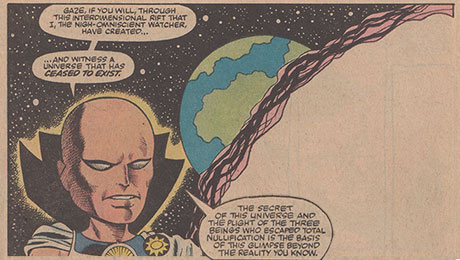
Doug: Jim Shooter's alleged "Big Bang", whereby the Marvel Universe as we know it would have ceased to exist. The characters of Thor, Spider-Man, etc. would have returned, but with new secret identities and re-tooled origins. It was seen as taboo to even think about and was shelved. Instead, Shooter won approval, and a dreadfully low promotional budget, for what would become known as the "New Universe". Decades later, both Marvel and DC would be able to pull off new characters in established super-hero identities (John Stewart, James Rhodes, and the "feminization" of established male good guys and bad guys would be examples).
Karen: Although I've read about Shooter's proposed "Big Bang" in a couple of different places, I've never really understood the whys behind it other than what -pure ego? It's not as if all of those characters were doing poorly and needed a reboot. Certainly as the book goes on it portrays Shooter as getting further and further out there in terms of his grip on reality.
 |
| Bill Jemas |
Karen: I believe I can point to Secret Wars as my own personal point at which comics changed for me and started to become less fun. It was such an obvious marketing ploy, such a poor quality product, that it was apparent even then that the business side of things had trumped the creative side. It only got worse as time went on, what with the gimmick covers, the endless number 1 issues, and so on.
Doug: The maturity of the direct market, where retailers got a voice in what would sell, and how many copies of a given book that they could move. See previous point.
 Doug: I think that, again as Karen said last week, the overall takeaway of the second half of the book is the business aspect of it. The truly maddening aspect of that? The people who owned and ran Marvel Comics didn't read comics, they didn't even like comics. And they wanted only a return on their investment. Integrity of product? Secondary. Gimmicks? Bring 'em on! I was somewhat reminded of a line said in the first half of the story. One of the creators, feeling handcuffed creatively toward the end of the Bronze Age, had complained that editorial wasn't really interested in the avant garde anymore; rather, they wanted to know "what's it like?" Egos like that of Bill Jemas brought Marvel down to porn-like levels with his "I'll show you what we can do/sell!" attitude in the creation of his Marville mini-series in 2002.
Karen: I think one of the best examples of how disengaged the business guys were was at one point in the book, when some group buys Marvel and one of the idiots runs around saying, "We just bought Superman!"
 |
| Tom DeFalco, c. late 1980's |
Karen: I think this little excerpt from an interview with McFarlane after he'd been given the penciling AND writing reigns on Spidey says it all: "Uh...I don't really consider myself a writer, so I don't pay attention to writing. Now I'm sure the people at Marvel won't be too impressed with that statement, but by the time they read it, it'll be too late." Too late, indeed.
Doug: The ongoing feud between Jack Kirby and Stan Lee. To the day Kirby died, they never did completely reconcile. Kirby began to say that he'd created everything by himself, including Spider-Man. There's an anecdote about Kirby being on a radio show and Stan calling in and confronting Kirby on some of the issues at hand. It was awkward, and ultimately ended somewhat amicably -- but they never again had anything close to a working relationship or even an "agree to disagree" relationship. They had basically created Marvel Comics -- but fell far, far apart as the years passed. So much hurt...
 |
| Ronald Perelman |
Doug: The X-plosion. Just... bah.
Doug: Spending money like they got it -- Fleer, Skybox, ToyBiz, etc. Good lord, it's no wonder they went bankrupt! But guys like Ron Perelman, who basically drove the company into the ground, came out smelling like a rose.
Karen: Oh yeah, the Revlon guy. There were so many businessmen in the second half of the book that I could not keep them all straight. I had to constantly flip back to remember who was who. They all basically stunk.
 |
| Joe Quesada |
Karen: Ugh, Wizard. They might as well have been holding up paychecks from Marvel and DC on their covers.
Doug: Finally, the Marvel Comics of today, as headed by Joe Quesada. Constant crossovers, the Ultimate Universe, renumberings, "irreversible" deaths each quarter, reboots, "events"... But, also the long-awaited presence of Marvel at the cinema and back on the small screen in various animated programs. Toys we could only dream of when we were kids, and quality reprints of material we thought we'd never again get our mitts on. Is Marvel today an evil empire, or benevolent toward comic book lovers?