Showing posts with label William Shatner. Show all posts

Wednesday, August 24, 2016

Star Trek at 50: The City on the Edge of Forever


Season 1
Episode 28: The City on the Edge of Forever
Filmed:  February 1967
First Air Date: April 6, 1967

Karen: Kirk sacrifices the woman he loves to save the future. It's a heart-breaking story that has gone on to be hailed the best Star Trek episode ever by many. And yet, the original story would not have had the Captain making this soul-rending decision. Perhaps more than any other episode "City" suffered from incredible behind the scenes strife. But it turned out to be a beautiful, touching tale.


Karen: Star Trek fandom has for years heard tales of the rancor between Roddenberry and Harlan Ellison, the writer of this episode. Depending on who you're listening to, you may hear a very different version of what happened. Again, we turn to Trek historian Marc Cushman and his book These are the Voyages Volume One for a detailed and (seemingly) unbiased account. If you're looking for all the minutiae I suggest you pick up the book (well, I suggest you pick it up anyway) but the basics are that Roddenberry approached a number of high-profile science fiction authors as he began getting Star Trek off the ground. Ellison was one of them. Ellison, besides having written a number of stories, had also written scripts for TV shows, including the script for the Outer Limits episode "Demon with a Glass Hand," which won a Writers Guild award.  There was no doubt about his talent. Ellison had an idea about Kirk going back in time and meeting a character based on the evangelist Aimee Semple McPherson, who Kirk would fall in love with but have to let die in order for the future to proceed properly. Roddenberry gave the go-ahead and Ellison quickly produced a story treatment. This was in March of 1966.

Karen: However, while producer Robert Justman and others thought the story was beautifully written it also was not something they could film, for a number of reasons. Part of it was due to budget -there were too many things in the script that they couldn't translate to film given the meager funds they were working with. But perhaps just as important, there were things in the script that simply weren't consistent with the type of show Trek was. Maybe the best known of these is that rather than having McCoy become temporarily insane from an accidental overdose of a drug, as was filmed, Ellison had a crew member (not one of the regular cast) selling hallucinogens on the ship, and bludgeoning to death another crew member  who threatened to turn him in. This is certainly not typical behavior on the Enterprise.  It was felt by the Trek staff that the script needed revision.


A graphic novel featuring Ellison's original story is available

Karen: This is where the merry-go-round starts. Ellison provided a revision -but it took five weeks to get it. It was  May, and they were beginning to film the first episode ("The Corbomite Maneuver"). Even at this point, they were concerned about running out of scripts. They needed to turn them out with some alacrity. But Ellison was moving slowly on getting the teleplay finished. So in an act of desperation, Roddenberry set Ellison up with a desk in a tiny office at the studio, hoping they could keep an eye on him and get that script. Unfortunately, it may have distracted Ellison more, as he was frequently found on set. D.C. Fontana defended Ellison, to some extent, saying that, "Harlan did spend some time visiting the set, but that's considered necessary research for a writer. When a show hasn't been on air yet, freelance writers must have an opportunity to study the actor's speech patterns and delivery, the little gestures and nuances that each one brings to his or her role -and most of all - the character relationships which are being built episode by episode."


Karen: Robert Justman finally got his script from Ellison on June 7. After the first blush of excitement, Justman realized they were in trouble. Although the script was "brilliantly written" it was still too expensive to film, and the characters weren't acting the way they'd been established in the show. They were stuck at the same point. Ellison revised his script, unhappily, feeling that the special qualities of the script that he had worked so hard to put in were being lost with each revision. And there were many, many revisions. According to Cushman, Ellison himself provided three versions of the story outline, then did three versions of the teleplay (script), at which point Steven Carabatsos, who was still story editor (October 1966) stepped in to provide a rewrite. It was Carabatsos who removed the drug dealing element and instead introduced the idea of Dr. McCoy getting hurt and then injected with Adrenalin, which makes him go temporarily mad. After Carabatsos' effort, Ellison again went at it. What was marked as his final draft arrived in the Trek offices December 19th. It still wasn't where the staff felt they could use it. So Gene Coon took a shot at it over the Christmas holiday, then D.C. Fontana came in and worked on it, then Coon again, then Fontana, and finally Roddenberry touched it. By February of 1967,  nearly a year later, they finally had their script.

Karen: Typically, when you have this many people fiddling with a script, it comes out a mess. But somehow, they managed to create a gem. The Ellison script was, by all accounts, absolutely incredible, and would have been perfect for an anthology show like Outer Limits. But it was felt that it didn't have the 'feel' of Trek. The finished episode however is resolutely Trek to its core; the characters are the people we have spent this entire first season getting to know. Their mannerisms, their personalities, are all there. I should note that Ellison does not feel this way at all about it and you can easily find out more by searching the web. 

Karen: The acting in this episode is top-notch. Shatner is still working hard as Kirk. We see the gears turning in his head and the love and the anguish he feels is very real. Nimoy is as understated as ever but Spock's sense of concern for Kirk and his plight is tangible. DeForest Kelley gets to have some fun as the demented McCoy, but he has a sweet scene with Joan Collins as well. Kelley said that he decided to play it as if McCoy was also enchanted by Keeler. And what of Edith Keeler? Joan Collins was a well-known actress at this time and a casting coup for Trek. She and Shatner had real chemistry and the two of them made a lovely couple. Director Joe Pevney, who helmed many episodes, said of this show, "It was a pleasure working with the actors. They realized their full potential in that one."


Karen: There was one scene in this episode that I never completely saw until I got the DVD set, and that was McCoy's arrival back in 1930. When it went into syndication, they removed  the part where the derelict he encounters accidentally phasers himself out of existence. The full scene is in the clip below. 


Karen: Most of this episode was filmed back in Mayberry again -there is one well-known publicity  still where Floyd's Barbershop can be seen behind Kirk and Keeler - and desperate for stage space, the crew even borrowed the My Three Sons empty stage to film some scenes. I'd always wondered about the design of the Guardian, the mysterious machine/entity that transports our heroes through time. It was a strange design, but effective. Apparently it was not the work of the series regular designer, Matt Jeffries, who was ill at the time, but of Rolland Brooks. D.C. Fontana stated that Brooks misread the script, somehow translating 'runes' into 'ruins' and so we got the broken classical columns surrounding the Guardian. It's unclear where the lop-sided shape of the portal itself came from. Reportedly, when Jeffries walked onto the set he burst out with, "What the Hell is this?"


Karen: I have to admit, as a kid, this episode didn't do it for me. But now...it really guts me. Throughout the series Kirk has to make many hard decisions, but this one is surely the most terrible. Despite the short time he is with Edith, she is a real kindred spirit  and it's easy to see how he could fall in love with her so quickly. The line "The needs of the many outweigh the needs of the few, or the one" has become a standard within Trek fandom since Star Trek II:The Wrath of Khan but long before Spock performed the math on that and made his decision, Kirk does it here, to its brutal conclusion. When Kirk discovers that McCoy is in the mission and races back to it, the brief joy he and Spock and McCoy experience at being reunited, plunges quickly into utter devastation when he realizes Edith's fate has arrived, and he has to actually hold back McCoy from saving her. McCoy's anger at Kirk -"Do you know what you've done?" and Spock's almost-consoling, "He knows, Doctor. He knows" were pitch perfect. Of course the final line, uttered by Kirk as they leave the planet was the perfect way to end the episode: "Let's get the Hell out of here."



Wednesday, August 10, 2016

Star Trek at 50: The Devil in the Dark


Season 1
Episode 26: The Devil in the Dark
Filmed:  January 1967
First Air Date: March 9, 1967

Karen: We're back to a monster episode, this time featuring a creature called a Horta -or as I referred to it as a child, 'the pizza monster.' Of course, this is Star Trek, so a monster is never just a monster, which we -and the Enterprise crew -figure out over the course of this episode. "Devil in the Dark" speaks to one of Trek's main themes -overcoming our prejudices -and it does this quite well. It isn't perfect -there's obvious budget issues, some story-telling gaps, and well, at times I thought it was a bit boring. But it's quite a feat to take an amorphous shambling mess and make us feel sympathy and pity for it. 


Karen: This episode, written by producer Gene Coon, came about for the most prosaic of reasons: costume maker and stunt man Janos Prohaska created the suit and the production team loved it, especially when they saw it in action. Coon quickly wrote a script, and after a few revisions, they were ready to go. As Marc Cushman points out in These are the Voyages Volume 1, the story is somewhat reminiscent of the early season episode, "The Man Trap," where we also have a creature that is the last of its kind, killing humans on a planet. But in this Coon-penned episode, Kirk is not so quick to condemn the creature; instead he tries to understand its motivations and shows compassion for it (much as he did the Gorn in "Arena," another Coon effort).  Star Trek was evolving before the audience's eyes.


Karen: That's not to say this episode isn't clunky -how did the blobby Horta dismantle the reactor? I never could figure that out. And they don't have any spare parts for a critical piece of equipment? But it's necessary for the drama, so you have to buy it. If you're willing to buy a silicon-based blob boring through solid rock, the rest should be easy, I guess. 


Karen: Depending on your tastes, Spock's mind melding with the Horta is either a fascinating scene or a silly one. Personally I go back and forth over it. I always wondered how he could touch it -shouldn't it still have the residue of the acids it secreted to burn through the rock still on its hide? McCoy is in perfect form, complaining that he is not a "bricklayer" as he has to shovel cement into the creature's wounds. 


Karen: Many fans already know the story about how William Shatner's father died while they were filming this episode. In Shatner's book, Star Trek Memories, the actor described how the show's cast and crew helped him through the tough day of waiting to fly out from Los Angeles to Miami, where his father's funeral would be. Initially they were going to stop filming but Shatner asked them to continue -that he couldn't take the waiting, he needed to be occupied. The show went on.

 "An hour later, after we'd broken for lunch and after the tears and the anguish, we started shooting what we'd been rehearsing all morning. And all through the scene, I kept having trouble with a particular line. My emotion was getting in the way, making me forget. And even though I really can't remember the day's details anymore, the one thing I recall perfectly and that I'll never forget is the closeness that my friend Leonard (Nimoy) had toward me. Not just emotionally but physically as well. I mean I've seen films of elephants that support the sick and dying with their bodies, and Leonard somehow always seemed physically close to me. Our cinematographer, Jerry Finnerman, whose father had also recently passed away, stayed close, too. And together, they kind of herded around me, assuring me that there were people close by in case I wanted to talk or just needed a friend. Between Leonard and Jerry, we were able to make it through that awful afternoon, and I was able to fly out that evening to my father, warmed by their love and affection."

Karen: Shatner says "Devil in the Dark" is his favorite Star Trek episode.


Wednesday, August 3, 2016

Star Trek at 50: This Side of Paradise


Season 1
Episode 25: This Side of Paradise
Filmed:  January 1967
First Air Date: March 2, 1967

Karen: Mr. Spock in love. What else need be said?


Karen: Well, OK, it's more than just that. Similar to "The Naked Time," everyone loses their inhibitions and basically goes awol. But this time, they all go to their happy place, even our favorite Vulcan. Was it a take on 60s drug culture? It seems so. When people are inoculated with the 'spores' they are blissful and contented - but not very productive. The colonists have done almost nothing for three years on Omicron Ceti 3, and the crew of the Enterprise, once under the spell, all decide to chuck it and beam down to the planet. This crew, said to be the finest in the fleet, suddenly abdicates all responsibility, and happily heads to the transporter to beam down and spend their time on the planet, staring at clouds. I suppose to many adults in the 60s, they probably thought that was a fair description of what was happening with the youth, with their own kids, back then!

Karen: Jerry Sohl came up with the premise and the story outline. Surprisingly, it had Sulu falling in love, not Spock. When the story was turned over to D.C. Fontana to turn into a full-fledged script, she immediately felt that it had to be Spock falling in love to really make an impact. Producers Gene Roddenberry and Robert Justman loved it, and so the change was made. It's a wonderful showcase for the character, and for actor Leonard Nimoy, who was initially hesitant about the idea, but did a terrific job, particularly when the effect of the spores is violently stripped from Spock, and he realizes exactly what he's lost. 

Karen: Although this is typically thought of as a Spock episode, it is also a great vehicle for Captain Kirk, providing insight into his character as well. Above all, Kirk is driven by his dedication to his ship, and his mission. Of the entire ship's complement, it is Kirk alone who resists the spores' influence. Being the commander of the Enterprise is his paradise. He quickly shakes off the effects. But he must get his crew back. The Enterprise is nothing without the people running it. He knows he needs Spock to do this. The scene where Kirk provokes Spock into a fight in order to negate the effect of the spores is one of the most memorable of the season, with Kirk getting verbally abusive towards his First Officer, questioning his parentage and his manhood. It might be considered tame today but knowing these characters as we do, it's still hard to take.


Karen: "All right you mutinous, disloyal, computerized half-breed, we'll see about you deserting my ship." Whew! The only really flaw with this scene was the (once again) obvious use of stunt men for the two leads. It might not have been as noticeable years ago with smaller TV screens and standard definition, but with today's high definition format and giant screens, it is just painful.

Karen: Freed from the spores, Spock's sense of duty, and loyalty to Kirk, kick in. He helps the Captain rig a signal that will cause irritation in the crew on the planet and bring them out of their stupor too. But  Leila Kalomi (Jill Ireland), the woman with whom he's become involved, is released by her discovery that Spock is no longer "one" with them (sounds a bit like 'Return of the Archons', doesn't it?). The Vulcan treats her kindly, but it's clear that the laughing, smiling Spock of the spores is gone. And both the dialog, and Nimoy's acting, let us know that he feels some dismay at this, even while he accepts it. The music that plays in this scene is the "Ruth" theme recycled from "Shore Leave", and it's quite effective here.


Karen: It must have been quite a shock to fans watching the show when it first aired to see the stoic Mr. Spock grinning and hanging from a tree branch, and smooching with a pretty girl. This could have been a disaster for Trek, if handled poorly, but instead, it was a breakout episode that gave not only Nimoy but Shatner chances to shine and expand their characters. 


Wednesday, July 20, 2016

Star Trek at 50: Space Seed


Season 1
Episode 23: Space Seed
Filmed: December 1966 
First Air Date: February 16, 1967

Karen: Star Trek had a number of impressive guest stars, but perhaps none as striking as Ricardo Montalban. His powerful portrayal of the genetically-enhanced tyrant Khan Noonien Singh was unforgettable, and the raw energy between he and Shatner as Kirk was one of the reasons that this episode was chosen, out of the entire series, to form the basis for the second Star Trek film. Producer Harve Bennett was looking for something in the old episodes that would make for an exciting movie; he certainly found it in "Space Seed."


Karen: Khan is a mystery at first, but Kirk and Spock soon suss him out. He is one of a group of scientifically created super-humans who ruled Earth in the 1990s during a period known as The Eugenics Wars (obviously we are living in an alternate timeline). Apparently these super men and women decided that they should be running the show. As Spock puts it, "Superior ability breeds superior ambition." Eventually however, 'normal' folks prevailed. Khan and 72 of his fellows blasted off into space to escape being put on trial (or just shot, one supposes).  And that's how the Enterprise came upon them, adrift for a few hundred years in space. A normal man would feel gratitude and contentment at being revived from an endless sleep. But not Khan. No, right from the start, he begins plotting to take over Kirk's ship. Could there ever be a place for such a man in the enlightened era of the Federation?  


Karen: Montalban is a pleasure throughout the episode. His Khan is a being of power, amoral, existing only to fulfill his destiny -to rule. He reminded me of nothing less than a great white shark, ruthlessly pursuing his primal function. In some ways, Khan is a great Dr. Doom - seeing as how we've yet to get a fully realized Victor Von Doom on screen, Khan is not a bad template. He doesn't see himself as a villain; indeed, he thinks that what he was doing was right -"We offered the world order!" Khan says, slamming his fist on the table during the formal dinner. It is only natural and right that he should rule; he is superior. That others can't see this must perplex him to no end. Montalban throws himself into the role with everything he has, and is a great counterpoint to Kirk. Shatner, at this stage, was still very much controlled, capable of subtlety and quiet strength. His Kirk is a man of action, but also great intelligence and perception. The scenes in the dining room and  the one in Khan's quarters are all dialog, but you can feel a tremendous exertion of will between the two of them. The one place this episode falls flat, unfortunately, is the fight sequence towards the end where clearly stunt doubles have replaced the two actors. This would happen repeatedly in the first season.


Karen: McCoy and Scotty also had some fine moments in this episode. When Khan is recovering in Sickbay, he feigns unconsciousness, and when McCoy comes to check on him, he grabs him and holds a scalpel to his throat. McCoy remains cool as a cucumber and tells him that cutting the carotid artery on the left side would be the quickest way to kill him. It's a great bit for the character and for actor DeForest Kelly. We see much more of Scotty in this episode than in previous ones -he was becoming more popular with the showrunners, who saw the potential not only of the chief engineer but of the man who played him, James Doohan. While Scotty gets off a few quips, my favorite moment of his is after the Enterprise command crew has been taken hostage by Khan. Kirk and Spock have escaped, and they flood the room where Khan and his men are holding the crew with a knockout gas. Scotty jumps up to run out of the room, but pauses, turns back around, and socks one of Khan's men in the jaw and then runs out! It's that gratuitous punch that tells us so much about this character. Uhura also has a nice moment of defiance when Khan demands she turn on a viewscreen. No Sulu in this one, and of course, no Chekov, who didn't appear until season two, which is one of the faux pas of Star Trek II: The Wrath of Khan, when Khan recognizes the Russian.


Karen: One thing that always bothered me about this episode is Marla McGivers. What a worthless officer.  She falls apart over Khan, betrays the ship, then just as quickly betrays Khan -this is a truly spineless and awful character. Necessary for the plot I suppose but she makes me cringe. Also, everyone talks about the great love story here, and much of Khan's motivation in Wrath of Khan is supposed to be about his desire for revenge on Kirk over losing this woman he loved so deeply. But in the episode, Khan treats her horribly. He manipulates her and physically abuses her (he forces her on her knees by crushing her hand). I don't see love here -I see a powerful man taking advantage of a weak woman. Whatever became of this relationship, I'm pretty sure it was a dysfunctional one. 


Karen: Once again, Marc Cushman's excellent book These Are The Voyages Vol.1 has some interesting information about this pivotal episode. The original story, by writer Carey Wilbur, featured a group of 20th century criminals who had been put into suspended animation and launched into space; it was Gene Roddenberry who added the idea of making the criminals super-humans, and that created the hook that made Khan so intriguing. Gene Coon came in to do a major overhaul of Wilbur's script, making the Enterprise crew sound like the people we know and love, as well as working out a number of rough spots. Originally Khan was to be called 'Harold Ericsson' and was envisioned as a Viking-like  antagonist.It was Roddenberry who, in the very final draft made the name change (supposedly to that of a long lost friend). McGivers started out as a Communications Officer; Coon changed her to a historian, to give her an intrigue with men of the past. Roddenberry conceived of a 'Dark Ages' in the late Twentieth Century -a very un-Star Trek like idea, one that contrasted with the generally hopeful vision of the future that the show portrayed. This ultimately became The Eugenics War.

Karen: Certainly "Space Seed" is a highlight of the first season, and I would argue one of the best episodes of original Trek -maybe of all of Trek? That is due in no small part to the work of Ricardo Montalban - one of the most memorable of Star Trek's guest stars.


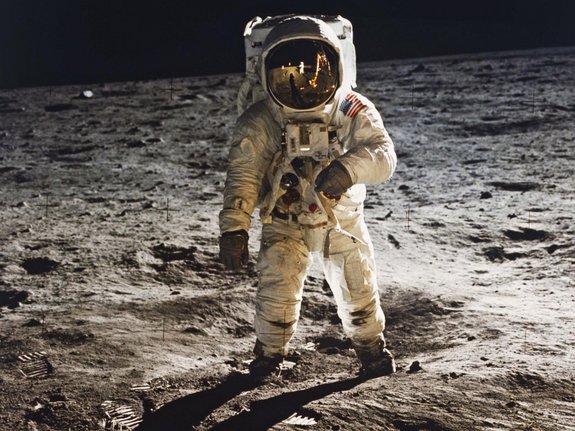
Addendum: I couldn't let it go unmentioned that today is the 47th anniversary of the Apollo 11 crew landing on the moon (and yes, it really did happen). 

Here men from the planet Earth first set foot upon the Moon, July 1969 AD. We came in peace for all mankind.


Wednesday, June 8, 2016

Star Trek at 50: Shore Leave


Season 1
Episode 17: Shore Leave
Filmed: October 1966 
First Air Date: December 29, 1966

Karen: One of the more fanciful episodes of original Trek, 'Shore Leave' makes an impression. Our crew is bewildered by encounters that simply cannot be occurring, but are. Some of these are funny, some are melancholic, and some are outright lethal. Even our good Captain finds himself overcome by the phantoms of his past. The pace is quick and there's never a dull moment. The episode is greatly enhanced by being shot on location -something that would become a rarity in later seasons.


Karen: Surprisingly, it takes quite some time before the Enterprise crew begins to understand the nature of the planet  and what's going on around them. Kirk still can't resist giving his old adversary Finnegan a good beating, even though he knows it's not really him.  Well, after he had already gotten the tar knocked out of him earlier, I guess Kirk had earned it.


Karen: Kirk also encounters Ruth, an old flame. Shatner portrays this well, with mixed emotions: confusion, longing, regret...you can tell that whoever Ruth was, she was no one night stand. The music by composer Gerald Fried in these scenes also highlights these feelings. My one complaint is that I always thought Ruth (played by actress Shirley Bonne) looked a bit too old for the presumably Academy-aged Kirk. But then again, Kirk never seemed to discriminate. 

Karen: In the book Star Trek Memories, Shatner recounts how filming this episode was a bit tricky. NBC had wanted major revisions done to the story by science fiction author Theodore Sturgeon, so Gene Roddenberry, who was about to go on a vacation to Hawaii, left behind notes for Gene Coon. For some reason, Coon never received the notes. So Roddenberry went off on his vacation, and when he returned, the crew was ready to film "Shore Leave" the next day -without any of the changes NBC requested! Roddenberry rewrote the script on location (both Africa USA and Vasquez Rocks were utilized). However, Shatner notes that Roddenberry couldn't finish everything, and there was quite a bit of ad-libbing by the actors in this episode. Roddenberry and the actors were  coming up with all sorts of ideas to fill out the story. One that didn't make it into the finished episode: Captain Kirk wrestling a tiger. There is a tiger seen in the show, and Shatner at one point thought it would be a terrific idea for Kirk to wrestle the big cat. Shatner, always enthusiastic, was a little too pumped up that day, as he explains:

"Now the words 'stuntman' and 'phony tiger' are probably already buzzing about your cerebellum, but I can assure you that strangely enough, I wasn't the least bit interested in such precautions. Even stranger, I can remember being really excited about the whole thing. I mean, here I was, this middle-aged actor, caught up in the adrenaline of the moment, and I stood there, like a dope, actually contemplating hopping on top of Shere Khan. Roddenberry, who had about a hundred thousand other things to worry about, came over and tried to talk me out of this unarguably stupid idea, but I was, for some reason, determined to go through with it.

"Then Roddenberry did something brilliant. With his arm around my shoulder, we strolled through the park as he tried to convince me I was far too important to the show to risk wrestling some man-eater. He really wasn't getting far, but then, and in retrospect I'm sure it was premeditated, we 'stumbled' upon the tigers' habitat at precisely feeding time. There sat the tiger I would be battling, enormous, majestic,  and gnawing away at a bone full of red meat.

"Immediately my testicles rose up into my Adam's apple, and the ignorant machismo that had been pulsing so heartily through my veins was now replaced by sheer abject terror. I stood there trying not to look too horrified as I now gracefully backed down, 'for the good of the show.'"

Karen: Despite not getting to see Kirk battle a tiger, this is an exciting, action-packed episode. The knock-down, drag-out fight with Finnegan is a heck of a brawl. This episode also sees Dr. McCoy killed - not almost killed, but d-e-a-d, dead. The advanced technology of the planet is used to bring him back to life, as if nothing had happened. Trek seems at times to treat death lightly. Scotty was also killed in "The Changeling" and brought back to life with no adverse reactions. I think there may have been a few other deaths and resurrections, I just can't think of them at the moment. You can make the argument (as some people have) that every time someone steps into the transporter, they actually die and are reconstructed -a copy of the original person. So I wonder where the concept of the soul or the afterlife comes in to Trek? Is a person just a machine you can restart? Is there no element to us greater than our biochemistry? The fact that Star Trek makes me think about things like this makes me love it even more. 

Karen: All in all this is a very enjoyable, if atypical, episode of Trek.


Wednesday, May 18, 2016

Star Trek at 50: Court Martial


Season 1
Episode 14: Court Martial
Filmed: October 1966
First Air Date: February 2, 1967 (20th episode aired)

Karen: Re-watching 'Court Martial' was a pleasant surprise. To be honest, I hadn't looked forward to reviewing this episode. My memories of it were that it was rather boring, and there was some flawed science. But sitting down with it again, although there are definitely problems, I found it much more interesting than before. The main reason for this? William Shatner's performance. I know, I'm sounding like a broken record, but Shatner was just fantastic in this first season, and I suspect one of the main reasons for Star Trek's success. If you haven't seen this one, or don't recall it, here's a brief summary: Kirk faces a court martial when it appears that he jettisoned an ion pod containing Officer Ben Finney before giving him the warning to clear out, causing the man's death. This is verified by the ship's computer records. But Kirk maintains that his recollection is correct and the computer is wrong. Complicating the matter is the fact that Finney, once Kirk's friend, had grown to resent Kirk, both for an incident in their past and for Kirk's success. Kirk must prove his innocence, but how? 


Karen: This episode was a "bottle show" -so called because most of it takes place on the Enterprise, with a few scenes shot at Starbase 811, which is just redressed Enterprise sets. This was a cost saving measure; the series needed a few of these bottle shows every season to keep the budget down. The risk with such shows was always that they would feel confined, or could be too talky, or boring. And this episode certainly walks that edge. But as I said at the start, for me, this one was saved by William Shatner. He projects the kind of confidence one would expect of a starship captain -not swaggering braggadocio but a steady sureness that is utterly believable. Even after he sees the starship visual recording showing him pressing the ion pod eject button before red alert has been signaled, he still maintains that he pressed it after the red alert was initiated. But back in his quarters, he has a moment of doubt. Just a moment. "Spent my whole life training for decisions like that one...is it possible...no, I know what I did." I have to add, Shatner was amazingly handsome. His Kirk was the consummate hero: brave, handsome, and morally strong, but with  more than a little loneliness.

Karen: This episode also gives us some more insight into Kirk's past. It would have been fun to have been a fan watching that first season as it aired, trying to put all the pieces together with the characters, and the universe in general. Back in 'Conscience of the King', we learned a 13 or 14 year old Kirk had seen the mass executions at the Tarsus IV colony. Here we learn that Kirk met Finney when he was a midshipman and Finney was an instructor at the academy. They became friends and Finney even named his daughter Jamie after Kirk. Finney had a slow start to his career, and the two wound up serving on the USS Republic together. It was here that Finney made a dangerous mistake that Kirk had to correct, which got Finney a reprimand. Thus began his grudge against Kirk.


Karen: This is the first episode where we hear the terms "Starfleet" and "Starfleet Command" used, thanks to Gene Coon. The Star Trek universe was firming up, as the producers and writers grew more comfortable and confident. This episode went through a number of revisions and writers. The story was initially written by Don Mankiewicz. The Mankiewicz family has a long and proud history in Hollywood. Don's father Herman won an Oscar for co-writing Citizen Kane with Orson Welles, and his nephew Joseph was the award-winning writer/director of Guys and Dolls and All About Eve. If you watch Turner Classic Movies, you've probably seen Ben Mankiewicz, who hosts many films on the station -he is also Don's nephew. So quite the prestigious group! Roddenberry was thrilled to have Mankiewicz write for Trek. Mankiewicz proposed a court room drama. The basic idea of the story was the same but many of the details were changed as the script was rewritten several times, by Mankiewicz at first, and then by Steven Carabatsos, Trek story editor, and Gene Coon, as well as Roddenberry. One of the major changes involved the computer. In the initial draft, the Enterprise's computer had a personality -and it didn't like Kirk! It conspired with Finney to get Kirk in trouble. This was removed rather early on, thankfully.


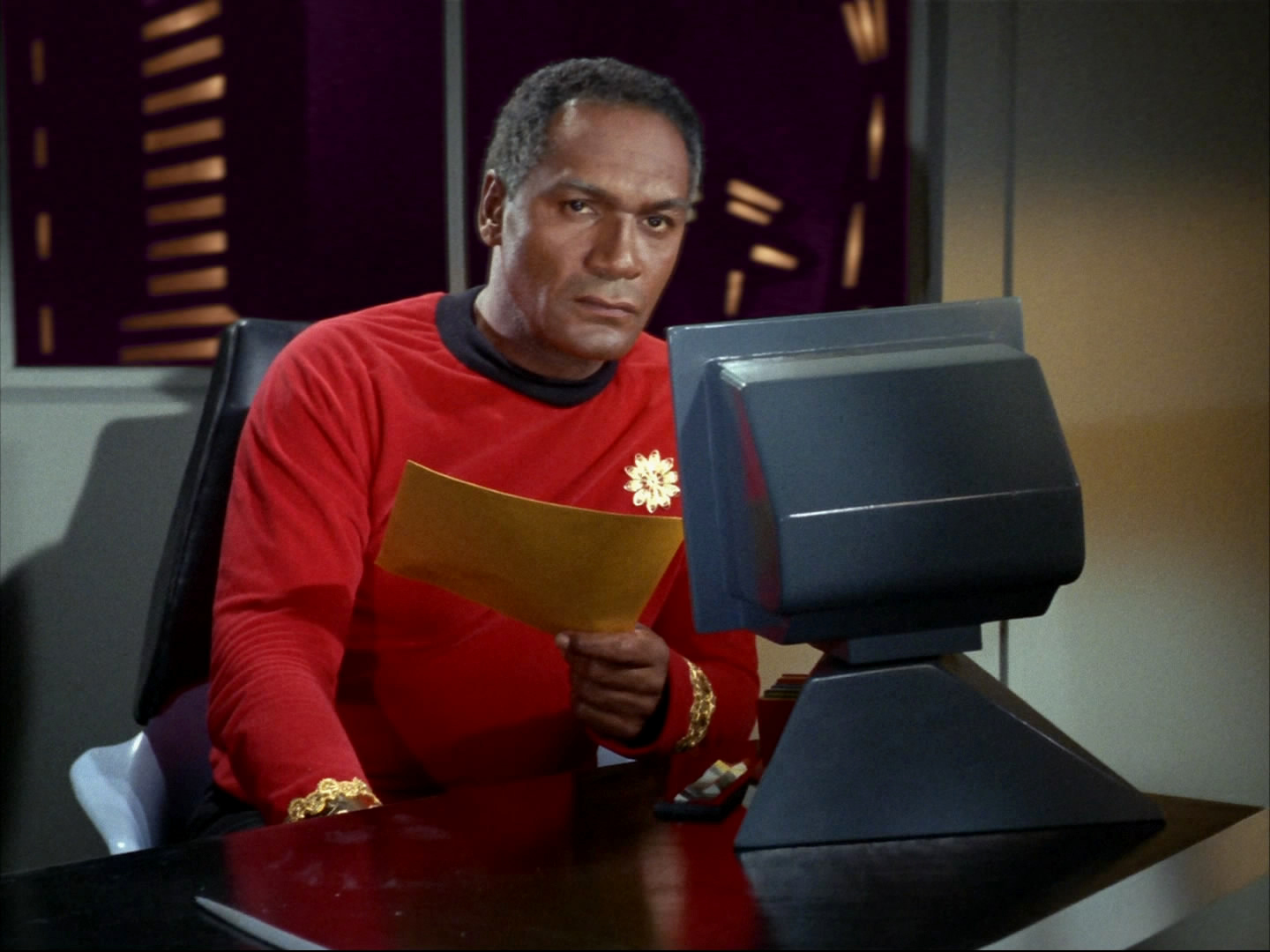
Karen: I said earlier that there were some good performances. I appreciated guest star Percy Rodriguez as Starbase Commander Commodore Stone. I think it's worth noting that he was a Black actor playing a man of high rank, who commanded a starbase and was said to have commanded a starship. They could have cast anyone but they chose to hire a Black actor for an important part and that's commendable. Rodriguez delivers -Stone is looking out for the service, and although he respects Kirk, he believes the computer records. The confrontation between Stone and Kirk buzzes with electricity. 


Karen: I also found the way Finney is portrayed to be rather intriguing. The actor looks sort of like an older, skid-row Kirk -his hairstyle and color is much the same, and he's got the gold tunic, but he's haggard and more than a bit deranged. It's almost as if we are seeing what Kirk could be if he'd been an utter failure. I don't know that they put that much thought into it, but it struck me as I watched the episode.

Karen: There are a lot of problems with this episode though. I think any time you have narration suddenly pop up in a movie or TV show -as it does in the third act of this episode -you know there are problems with the plot that have to be explained to the audience. Here, there are missing scenes that are described to us by Kirk, but not in the form of a Captain's log, it's just narration, from out of the blue. It feels sloppy. We also had some very obvious stunt doubles in the fight between Kirk and Finney. It's even more noticeable now that I am watching these high definition versions. 


Karen: There's also some crappy science through out. What is an ion storm, exactly? I cringed when Spock gave an example on the witness stand about dropping a hammer on a "planet with a positive gravity." Perhaps worst of all, is when the court convenes on the Enterprise bridge and McCoy uses a 'white sound' device to eliminate the sound of all the heartbeats of all the people on the ship from a transmission they are relaying to the bridge. The device is obviously a microphone, and Kirk says the device boosts sounds by "one to the fourth power". Well, even when I saw this as a kid, I knew that 1 to the 4th power was still just 1! He wasn't amplifying anything. How that got past Star Trek's researchers I'll never know.

Karen: This wasn't a terrible episode, but certainly not one of Trek's best.


Wednesday, April 20, 2016

Star Trek at 50: Miri


Season 1
Episode 11: Miri
Filmed: August 1966
First Air Date:October 27, 1966 (8th episode aired)

Karen: I don't like 'Miri.' There. I've gotten that out of the way. It's not that it's bad, like 'And The Children Shall Lead' or anything like that. I can see it has redeeming qualities. But for me, personally, it grates. Like nails on a chalkboard, oh, it grates.

Karen: I think what gets to me is mainly the two chief guest actors, Kim Darby and Michael J. Pollard. Darby's Miri is a simpering woman-child who does little to make me feel like her planet is worth all the effort the Enterprise crew makes towards saving it. Pollard is quite simply obnoxious. I get that he's doing his shtick, but it's not something I find amusing. So - this coupled with what I find to be a weak premise -a planet ridiculously similar to 20th century Earth that has fallen victim to a biological experiment that wiped out all but the children -makes for a poor Trek for me. Plus, a lot of Yeoman Rand. Of course, your mileage may vary.Sorry about the poor video quality in the trailer.


Karen: Even though I personally don't care for this episode, it's worth noting that it was at this point that Gene Coon jumped aboard as a producer on Star Trek. Coon's influence cannot be underestimated. He provided a great deal of re-writing help with scripts, as well as story outlines and scripts himself. Although he would leave during the second season, he would continue to submit scripts under a pseudonym, Lee Cronin, during the third season. Coon was responsible for much of the geniality among the crew and outright humor that made its way into the series. Prior to Trek, Coon had worked on a number of shows, including The Wild, Wild West and had even come up with the initial concept for The Munsters, although he did not receive credit for it.


Gene Coon
Karen: Writer Marc Cushman details Coon's arrival and how he contributed to the script for 'Miri' in his book, These are the Voyages, Vol.1. The story, originally written by Adrian Spies, went through several rewrites, first by Spies, then by Gene Roddenberry and then-associate producer John D.F. Black. But Roddenberry still felt the script wasn't quite there. Coon came aboard on August 8th, 1966. After a quick course in Star Trekology, he went to work on the script over a weekend. While Coon left in most of the established story structure, he tightened up the dialog and made the situation more mysterious. In earlier drafts of the script, everything is explained to the Enterprise crew - the meaning of the terms 'grups' and 'onlies', even what happened on the planet and the nature of the disease. Coon reworked the script so that things were revealed slowly, with our intrepid cast figuring it out for themselves. It makes for a much better story, with less exposition, and the crew doesn't look like a bunch of dimwits.


Karen: Despite my dislike of it,  this IS a memorable episode, simply for all the weirdness with the kids in their 'Lord of the Flies' setting, and the unforgettable lines -"Tell 'em Jim, tell 'em Jim" and "Bonk bonk on the head" and such. Many people remember the show because of Miri's crush on Captain Kirk. Cushman quotes director Vince McEveety as describing Darby, who was just 18 at the time, as being "extremely strange. She had a neurotic and very, very bipolar kind of personality. She'd do a scene and I was happy with her performance - very happy, I thought she was wonderful in that respect -and then she'd go off and cry like a baby afterwards. I'd never know why and, after a while, I didn't care." Darby admitted in another interview that she had completely fallen for Shatner, so apparently Miri's crush was shared by the actress portraying her.Well, who could blame her for falling in love with the dashing Captain of the Enterprise?


Saturday, March 22, 2014

Are you ready for... the Hulkbuster?? How about William Shatner?


Karen: Last Tuesday (March 18) ABC aired a special called "Marvel Studios: Assembling A Universe" which looked at past Marvel films and provided a few glimpses at upcoming productions. This included some concept art for the second Avengers film, "Avengers: Age of Ultron." Among the images displayed was one sure to get every Marvel geek excited: it features the green goliath, the Hulk, squaring off against the Hulkbuster! You can see it below:


Karen: Now who knows what the story behind this is. Does Hulk go bananas and Iron Man has to bring him down? Or is it the other way around? Or does Ultron take over the Hulkbuster armor? I guess we'll just have to wait until the film comes out in 2015. In any case, it should make for a pretty heart-pounding sequence!

Karen: Today is also the 83rd birthday of The Man, William Shatner. May he keep on trekkin'.

Thursday, December 20, 2012

Holiday Goodies

Karen: It's that time of the year when it seems like food is everywhere. People bring goodies to work, there's stuff at home, there are parties and other activities where food is around. So let's discuss favorite holiday food and treats.

Karen: Who doesn't love a good, juicy turkey? And yet, preparing that bird so that it comes out just right is no easy task. I recall my parents getting up repeatedly Christmas Eve to tend to the turkey as it sat in the oven, the tantalizing aroma permeating the house. They would be a bit bleary-eyed the next day, but it was worth it when the turkey came out plump and moist. And the stuffing! I personally prefer the stuffing made inside the bird; I think it has more flavor. I have to admit, my own efforts at making a great turkey have been hit or miss, and most of the time, it's just me and my hubby, so we're content to buy a pre-cooked turkey breast, and that's fine. One thing I don't get is the deep-fried turkey. Not only does it seem like it would not taste as good as a slow-cooked oven  turkey, it seems dangerous. Don't believe me? Just listen to what William Shatner has to say about it:


Karen: I already mentioned tamales in our winter wonderland thread, so I won't expound any further on them here, but  come on - meat, corn meal? What's not to like?

Karen: Of course sweets are a big part of this time of year too. One of my favorites is the chocolate orange. Not only does it combine two great tastes -chocolate and orange, duh - but it gives you the visceral thrill of whacking it hard on a counter to break it open. That's nearly as good as a pinata, which is another holiday pleasure for those of us raised out west. 

Karen: My Mom used to make a ton of cookies when I was little. I really liked the snickerdoodles, which had cinnamon, and of course sugar cookies were great because we got to decorate them. But I also enjoyed snowballs, which were almost more salty than sweet (keep it clean). She also made divinity, which I can only describe as solidified corn syrup -it was mind-numbingly sweet -I could never eat it now. But I loved it back in the day. I've never been a big one for traditional flavors like peppermint or gingerbread, and you can keep your eggnog to yourself, thanks. But I'll gladly take a thermos of hot chocolate when I go looking at neighborhood decorations.

Karen: So -what are your favorite goodies this time of year?

Wednesday, December 30, 2009

Karen says: Welcome to the Sanctum, part 4

Welcome back to part 4 of my own little magical mystery tour of my comics room, or The Sanctum, as I like to call it. Today we'll be looking at the southwest corner, which is home to both the Justice League of America and all things Star Trek.

Besides Marvel Comics, Star Trek is probably the other major influence on my childhood. When I say Star Trek, I'm talking old school here: the original show, with the legendary team of Kirk and Spock (and McCoy too). Although I did enjoy Next Generation, and I really liked Deep Space Nine, classic Trek is and always shall be, my favorite.

On my bookshelf here you will see a signed photo of Kirk and Spock. For some reason I really dug the black and white picture, and managed to get it signed by William Shatner and then a year later, signed by Leonard Nimoy. It's one of my favorite items in my collection.

On the table in front of the photo are a variety of Trek knick-knacks, including a Spock button I purchased way back in 1975 at the San Diego Comic Con -my first convention -and some poker chips from the Las Vegas Hilton, former home of the Star Trek Experience. There's also a nice communicator replica that a friend got for me. As a kid I had a ton of Trek toys, models, Mego figures, etc, but that stuff is all gone now. Mostly I just have my books and autographed photos.

On the wall to the left of that photo are autographed pics of Shatner and Ricardo Montalban. I was very lucky to see Montalban at a Star Trek Creation Convention in Pasadena; I believe it was his only convention appearance. He was a wonderful speaker; I enjoyed his honesty, as he said there was no work for "crippled old mexicans" in Hollywood! Still, despite his obvious frustrations, he was a perfect gentleman, and despite being in considerable pain from back problems, he signed hundreds of autographs, and was gracious and friendly when I spoke to him.

I have gotten Shatner's autograph three times now. Although I have an insane admiration and love for The Man, he can be somewhat indifferent when signing. I did manage to get his attention one time when I mentioned that I loved his film Incubus, a film where all of the dialogue was in Esperanto. That got a very strange look from him. I don't know if he thought I was joking, or if he was afraid I was serious and possibly dangerous.

Nimoy on the other hand has been very friendly the couple of times I have met him. Unlike his Spock role, he seems to be a very warm guy. I also met George Takei (Sulu) outside of a convention panel one time and had a brief conversation with him, which resulted in taking a photo together. A year later, I returned to the convention and brought the photo for him to autograph. He looked at it and said, "I remember this!" and we chatted briefly, much to the annoyance of the folks in line behind me! Another good egg was the late James Doohan (Scotty). Back in the days before the Trek cons became so commercialized - ie, back when autographs were free! - I was able to meet Doohan a couple of times. He was a gregarious guy and loved talking to people. After one show in San Francisco, I spotted him in a gourmet market at Fisherman's Wharf, strolling around shopping. People came up to him and he was just as nice as could be.

Then on the other hand...I hate to say this, because the character of Uhura is so dear to me, but Nichelle Nichols was not the nicest person I ever got to sign. I think the reason for this was, the photo I asked her to sign was a group shot from Star Trek II, and her face was partially in shadow. All I know is, when I slid the photo before her, she looked at it, then looked up at me with a frown. She then turned to a friend sitting next to her and pointed to the picture. Her friend then also frowned at me. She signed it but said nothing to me. A few years later at another convention, the program explicitly stated that "Ms. Nichols will not sign photos where her face is obscured". Well OK!

The other residents of this area are the Justice League. I absolutely love the Bruce Timm Justice League cartoon and these large and small figures are here because of that. The glasses are ancient history. I got them from Taco Bell back in the mid70s. At one time I had all of them - the set included not just the ones here but also Superman and Wonder Woman - but only Aquaman, Batman, and Robin have survived. Unfortunately we didn't know back in those days not to put these glasses in the dishwasher! Because of that they are quite faded, but I still enjoy having them around to look at.

Up above this area of the room, I have some small sci fi posters, and a couple of copies of Famous Monsters of Filmland magazine, signed by the late, wonderful Forrest Ackerman. I had been hoping to get Ray Harryhausen's autograph on the same magazines at the same time but unfortunately I was in the wrong place at the wrong time. Maybe some day though...

Last but not least, although it's not technically part of the sanctum, my tiki mug shelf would be in the sanctum if I still had any wall space! These tiki mugs, shot glasses, coasters, and swizzles sticks come from a variety of tiki bars (and stores) chiefly in California and Arizona. What's ironic about all this is I'm not actually a drinker -I just like the way they look! I'm particularly fond of the top shelf, which includes a nifty rocket decanter, as well as robot and space-alien mugs. A good source for cool tiki mugs is Tiki Farm (http://www.tikifarm.com/index.asp). There's just something about the tiki aesthetic; it fits in perfectly with comics, sci fi flicks, and monsters! One of these days, I'll have to provide a tour of the Orbit Room, my outdoor tiki patio/lounge. But we'll save that for another time! I hope you all enjoyed this little glimpse at one woman's idea of heaven.
Related Posts with Thumbnails