Showing posts with label Tony Isabella. Show all posts

Monday, May 2, 2016

When Your Protagonists are Antagonizing... Super-Villain Team-Up 2


Super-Villain Team-Up #2 (October 1975)(cover by Gil Kane and Frank Giacoia)
"In the Midst of Life... the Way to Dusty Death!"
Tony Isabella-Sal Buscema/Fred Kida

Doug: Continuing a week's worth of Civil War-themed posts, what about bad guys fighting bad guys? This was the first issue of Super-Villain Team-Up that I ever bought, and I stayed with the series (when I could -- you know, distribution woes) until the end of the original run; I did not know until years later that there was a 16th and then a 17th issue (each released waaaay after the 15th issue). Super-Villain Team-Up seems typical of other short-lived series at Marvel in that (in my opinion) sub-par and oft-rotating creative teams doomed it. Case in point: during its 17-issue run (plus Giant-Size issues), the following writers and artists helmed the series --
Giant-Size SVTU #1 -- Roy Thomas-John Buscema/Joe Sinnott (framing sequences)
Giant-Size SVTU #2 -- Roy Thomas-Mike Sekowsky/Sam Grainger
#1: Tony Isabella-George Tuska/Bill Everett/George Evans/Frank Springer
#2: Tony Isabella-Sal Buscema/Fred Kida
#3: Jim Shooter-George Evans/Jack Abel
#4: Bill Mantlo-Herb Trimpe/Jim Mooney
#5: Steve Englehart-Herb Trimpe/Don Perlin
#6: Steve Englehart-Herb Trimpe/Jack Abel
#7: Steve Englehart-Herb Trimpe/Pablo Marcos
#8: Steve Englehart-Keith Giffen/Owen McCarron
#9: Bill Mantlo-Jim Shooter/Sal Trapani
#10: Bill Mantlo-Bob Hall/Don Perlin
#11: Bill Mantlo-Bob Hall/Don Perlin
#12: Bill Mantlo-Bob Hall/Don Perlin
#13: Bill Mantlo/Keith Giffen-Giffen/Don Perlin
#14: Bill Mantlo-Bob Hall/Don Perlin/Duffy Vohland
#15: Larry Lieber-George Tuska/Wally Wood/Mike Esposito (reprint)
#16: Peter Gillis-Carmine Infantino/Bruce Patterson
#17: Peter Gillis-Arvell Jones/Bruce Patterson
So if you're scoring at home, that's six writers (I won't count Lieber due to the reprint), 11 pencilers, and (wait for it) 13 inkers. That's right -- 13 inkers working on 18 issues in the series (again, not counting the reprint). Granted, they doubled-up a few times, but still... If that's not a major reason why a book would look different month to month, I don't know what is. And regardless what you think of a guy like Herb Trimpe, when you place him under the influence of Don Perlin... well, let's just say it ain't Trimpe under John Severin! I will say, though, that the Bob Hall/Don Perlin issues look pretty good.

Doug: There's something for you to chew on as we now get on to the task at hand -- reviewing what's sort of a bridge issue, but fun nonetheless. We pick up the trail on one of our favorite Bronze Age conventions -- the visi-screen! I mean seriously... if I can't have a couple of panels with a rubber mask reveal, then just hit me upside the head with a visi-screen! Here's your 100-Word Review of the plot of this issue:

After a battle near Hydrobase, Namor has fallen under the combined might of Attuma, Tiger Shark, and Dr. Dorcas (now there's a moniker for ya). But somewhere distant Namor's would-be ally Dr. Doom watches, and reflects on the brief history of his and Namor’s alliance. Doom is found out, forcing his hand. Seeking to liberate Namor, Doom encounters the transformed Betty Dean Prentiss, former love of the Prince during the War. Doom infiltrates Namor’s prison, but in the melee Betty is killed trying to save Namor from Dr. Dorcas’ blast… she falls just as Namor breaks free. “Avenging Son”, indeed!
Doug: If I were an editor working at Marvel in the Bronze Age and I wanted to stabilize a book either to keep it on schedule or to smooth out its "look", I'd turn it over to Sal Buscema. That's not to say that he was the best artist Marvel had at their disposal, but he could crank out the "house style" in an efficient manner. I don't know if that is why he was tapped for this particular issue, but in the looks dept. his presence makes this one of my favorites in the entire series. So...

The Good
: Obviously the art. I really don't have a lot of experience with inker Fred Kida, or at least I don't think that I do. Maybe that I can't recall Kida's work is a good thing? Perhaps you immediately inferred that he's not a memorable artist. Maybe that's his strength, because when I look at this I see Sal Buscema. It's no Joe Sinnott production, that's for sure (and you all know I love Joe Sinnott). At this stage of his career Sal was a grid guy, utilizing 4-8 panels on a page. Only the double-page spread (pages 2 and 3) rejects the notion of borders; every other panel in the book contains the art. So if you're looking for anything resembling the better design aspects of Jim Steranko or Neal Adams, you won't find it here. And that's OK. As I said, if someone felt this book needed a steadying hand, they got it.

There is one specific panel that I think is genius. I've provided it here -- Tiger Shark emerging from the ocean. Look at his right hand. He skims the water with the backs of his fingers, just like you or I would if we were walking to shore, thinking or watching. I just find that bit of familiar motion fascinating -- what a detail. I also have a love/hate sense with a single panel of Doom holding his chin in the crook of his thumb and index finger. While it's an image that conveys the motion of stroking one's chin and it fits Doom's mood in the scene, it does seem somewhat odd that a fellow would place a hard metal finger beside a hard metal chin. Not exactly the pensive beard-stroking one might think of. The emotion on the final panel of the book leaps off the page. Fabulous ending (see the end of this post)!

Earlier I mentioned the visi-screen. Unlike in the past, when our would-be world-dominators are just able to kick back and look at these things as if possessing some sort of universal clairvoyance, here we actually find the source of the images Doom is perusing. Doom had devised a mechanical fish that looks to me quite a bit like a Joker fish. Even though Tiger Shark spied it and wrecked it, I did appreciate that we got a "plausible" explanation for Doom's spying capabilities.

While I'll take issue with Tony Isabella's characterization here in just a minute, I must compliment him here on making me root for the main character of the magazine (the Marvel Universe's alpha super-villain) against all other characters -- especially when everyone in the book is a bad guy! Namor's rogue's gallery is bereft of true heavyweights, so of course Doom would be able to out-smart them, out-tech them, etc. But there was still the sense that I wanted Doom to be the victor (no pun intended) here. I don't say that in he pages of the Fantastic Four.

Lastly, I've been on record for years stating that I love this life-giving suit that Namor wore in the early-mid 1970s. Love the look! It's certainly more regal than trying to rule or lay waste to the world in a green Speedo.

The Bad: Let's go right into my scripting complaint. If you would be so kind, hop back to my review of Sub-Mariner #8, written by Roy Thomas. That issue was narrated by Betty Dean Prentiss, who is a major supporting character in today's story. You can see some narration boxes in the art samples -- those were "written" by Prentiss in her diary. Got her voice? Yeah, Isabella must have just ignored all that, because I think he took her character profile (she worked for the NYPD) and just wrote her as some hardened beat cop-type of person. It's really off, and I think I'd feel that way even if I had not known the character from that other book. The way she addresses Doom is pretty stupid, as well. I'm all for bravado in the face of extreme adversity, but c'mon... the monarch of Latveria could have vaporized her on the spot. I guess I'd rather she'd been written differently.


Note - You may notice that some of the "human" characters, like Betty Prentiss, are amphibians. This was apparently a development in the last issues of Namor's solo mag, which was cancelled around six months before Giant-Size SVTU #1. I don't know if this is necessarily a bad thing as a plot device, but I'll put it here since I was discussing Betty Prentiss.

The Ugly: Tiger Shark's teeth. You know -- like a shark. Boy should have had braces! That being said, are his teeth uglier than Attuma's whole face? Discuss.

Doug: I am hesitant to read the entire trade Super-Villains Unite: The Complete Super-Villain Team-Up, which I have used for today's festivities. As I said, the art is a real turn-off at times. And that's a shame to middle-aged me, because my memories of this series are better than the reality of it with which I am now faced. "Hold up"? Umm...


Doug: For conversation starters, what other instances can you come up with where super-baddies fought super-baddies? Were there some memorable tussles? Who would you have liked to have seen -- where were two guys (or gals) who may have conceivably had a beef with each other?

Monday, November 10, 2014

Arc of Triumph? Incredible Hulk 176-178


Karen: These three issues were somewhat scandalous back in the day, taking Warlock and putting him in the role of Jesus (with Hulk as an unwitting Judas!). They also had heavy Watergate allusions. When they came out it all pretty much went over my little noggin but reading it today it seems fairly harmless if a bit silly. Any thoughts on this three parter by Gerry Conway and Herb Trimpe?


Monday, March 25, 2013

Derivative Gentlemen: Black Goliath


Black Goliath #1 (February 1976)
"Black Goliath"
Writer: Tony Isabella
Pencils: George Tuska
Inks: Vince Colletta

Karen: Last time around in our look at derivative characters, Doug and I had to give one of our toughest reviews ever. I think that reading that first issue of She-Hulk, and then trying to write it up, was really one of our most painful blog experiences yet. So I was quite relieved to find that this week's assignment was actually rather entertaining. I wasn't expecting to like Black Goliath #1, but I did.

Doug:  You'll get no argument from me.  I read this for the first time just a couple of weeks ago and was pleasantly surprised.  I've always liked the character, but had never owned an issue of this solo series.

Karen: Now, I had read this book when it originally came out, but I didn't remember it very well when it came time to re-read it for this review. I didn't know what to expect, but let's say my expectations were set pretty low. But writer Tony Isabella does a solid job here, making Bill Foster (aka Black Goliath) a likable hero with just enough problems to make him a true Marvel character. As for the art, well, I have to admit, I've never been a fan of George Tuska's. I don't hate his style, but it just doesn't do anything for me. It's a little too cartoony, in my opinion. But overall, my complaints are minor.

Doug:  I guess I'd go more quirky than cartoony for Tuska.  My main experience with him was in the Champions mag, where he was also inked by Vinnie Colletta.  I've seen some older samples of his work (specifically Avengers #48) and generally liked it.  Tuska is like this for me:  you know how people around here will criticize Mike Grell for continually using "stock poses"?  Tuska has a certain number of shots, poses, and facial expressions that are pretty repetitive.  Like you, I don't hate him -- but he's not going to make my Top 10 list either.


Karen: The story opens with Foster wandering through his old Los Angeles neighborhood, thinking about the days of his youth. Things have changed -and not for the better. As he loses himself in memory, three very cartoonish thugs (Benny and his Jets -I kid you not) begin to follow him. Foster starts to head over to Pop's corner store, thinking to find the kind old man he remembered, only to instead find a scowling proprietor surrounded by some posters apparently touting black militancy (are we to assume that's a picture of Angela Davis behind the new Pops?). I wonder who put this in there -Tuska? It seems really odd. Foster, a bit surprised and dismayed, walks off and right into Benny and his two goons. They grab him and pull a knife on him, and rip off his jacket, exposing his costume. Before they can do much more though, Foster turns the tables on these pathetic losers and shoots up to 15 feet, sending them running.  All but Benny, who Foster grabs and deals with, off-panel. Then he lobs a trash can at the other two, knocking them off their feet.  He hangs them up from a street sign and grabs his overcoat and starts to head off just as the sun rises. He thinks to himself he might have a real talent for sculpture, but he should take off before anyone sees his masterpiece -and then we see what he did with Benny: he wrapped part of a lamp post around him, suspending him high above the ground. Soon after Foster leaves, police and the press show up. Benny refuses to say anything, other than just to get him down!

Doug:  Can I just say that in spite of the "iconic" image of BG on the splash page (it was used in the silly stickers set we looked at last week), it's a waste.  We lose a story page just so they can do the credits in an eye-catching way. 
It actually sort of smacks of the way comics are today with the recap page.

Doug:  I triple-checked the first few pages to see if we are ever told why Foster is wearing his fightin' togs under his trench coat.  We are not.  Don't you just have to laugh when the creators do that, and the skin tight pants and yellow cuffed boots (in this example) are on full display?  Anyway, I've stated before that I always feel a little disoriented when the stories are set on the West Coast, as is the case here.  For you, partner, I'm sure these stories were welcomed.  It's dumb of me, as I've only been to New York City once.  I found the caricatures of "Pops" and the three street goons bordering on reprehensible.  Whereas Bill Foster was drawn as a handsome black man throughout the story (as a Chicago-area guy, I see Gale Sayers when I look at Tuska's Foster), it seems that every other Black man was almost a joke.  The fracas was sort of fun, as we got to see Foster's powers on display right away -- this had been a theme through the Ms. Marvel and Spider-Woman books, showing off right from the top.  I love books with giant-sized characters, but as I often complain of, consistency of scale is a major issue.  Hmmm...  come to think of it, when we get to Avengers #'s 139-140 in May, Tuska's the artist there, too!

Karen: I have to agree with you on Tuska's depictions of Foster and the thugs here, and in general, the way he drew African Americans, whether it was in this book, or over in Iron Man, or Power Man, or any of the other titles he worked on: his Black heroes were all quite handsome, but his Black criminals were stereotypically ugly, almost 'Buckwheat' types, big buck teeth, you name it. Now I know it's not unusual for artists to make bad guys look ugly or unattractive but these guys ...I don't know, it just makes me feel uncomfortable.

Doug:  In regard to the Black Power posters at "Pop"'s store, I'll admit that the Angela Davis reference went over my head.  But there's not a doubt that there was a militant vibe in this scene, with Foster's reference to never seeing cops in Watts when he was a kid.  The infamous Watts riots were in 1965; if Marvel time in these days was still roughly akin to a very slow version of real time, we could assume that Foster would have been a young adult during the upheaval.  Obviously, then, when the cops did show up in the neighborhood it wasn't just for a meet-and-greet.  But I have no idea if the inclusion of this scene, subtlely done, yes, would have been a political agenda on the part of Tony Isabella or George Tuska.

Karen: It seemed totally unnecessary to me. Why draw the connection to crime and the Black Power movement? Sure, there were radical groups that were involved in illegal activities, but there was a lot more to the movement than just the Black Panthers. But it's just one panel and we're reading a lot into it. It's more a sign of the times than anything.
Also, it serves to show us what a straight-laced guy Foster is.

Karen: After his little incident with the street thugs, Foster's thinking about all the people who've trusted him and given him a chance when one of those people, Hank Pym, gives him a call. Pym and his wife, Janet, are better known as Yellowjacket and the Wasp. Both are recovering from wounds suffered fighting the Toad in Avengers #137 (a nice bit of continuity) when Pym calls Foster to congratulate him on his return to super-heroing. Pym's been watching the news and has rightly surmised that only a giant could've twisted that lamp post like a pretzel around Benny. But Foster's not so sure he wants to be a super-hero. He's got his hands full running Tony Stark's L.A. labs. There've been attacks on a number of local labs and Foster's worried that his is next. Pym chides him -why not use your super-powers to protect your lab? The call ends, and Foster realizes that he may have been looking at things the wrong way. Still, he's got a big chip on his shoulder, as he feels like the third-string Goliath. First there was Pym, who invented the growth process, then Hawkeye,who used it to become Goliath for awhile. But then Foster came along and used it, primarily to try to win back his girlfriend. He faked being trapped at giant-size to get her sympathy (this all happened in the pages of Power Man). But, during the course of his history recap, we're told that Foster found a way to work out the bugs in Pym's serum, so that it no longer had any of the nasty side effects that plagued Pym over the years.
That's pretty impressive, and gives us an idea of the kind of big brain he's sporting.

Doug:  I also liked the guest appearance of the Pyms, which not only tied this book to the
Avengers stories I mentioned earlier, but was a nice reach back to Foster's original appearances in the Marvel Universe.  Since I'd not read the Power Man stories where Black Goliath first appeared, I was grateful to Tony Isabella for the brief recap.  But hey -- talk about that inferiority complex!  When Foster brags on himself about his power and then says he could hold his own against the entire Circus of Crime...  well la di da!

Karen: Foster can't decide what to do -whether to put on his blue and yellow togs or not. He decides to go see what his "whiz kids" are up to. Frankly this was the weakest part of the story for me. This supporting cast just did nothing for me, but perhaps they might have grown on me later on. I actually did have all five issues of this series but can't recall anything about it. Anyway, Foster steps into the lab and finds the three scientists under his supervision: Herbert Bell, Dale West, and Talia Kruma. I thought it was odd that they were all dressed in skin-tight generic super-hero type outfits rather than in normal clothes and lab coats. West is sort of a trouble-maker and wants to try out a force field vest while the other two think it needs more time to be developed. But Foster indulges West and hi-jinks prevail.
This had the feel of bad sitcom humor and like I said, was the only sour note for me in the story.

Doug:  The lab assistants looked like they would have been more at home in an Archie comic.  I should give out a kudo along with my former criticism of the depiction of Black characters by George Tuska:  Talia Kruma is drawn beautifully.


Karen: After his time in the lab, Foster returns to his office and sees in the paper that another lab has been hit by raiders. That's enough for him. Suddenly he decides that he'll defend his lab as Goliath. I thought this was kind of sudden -after all his equivocating, he just seems to make the decision, but OK. The book wouldn't be much fun if it was the adventures of Bill Foster, lab manager.

Doug:  Yep, one-panel turnaround, basically.


Karen: That night, a bunch of yellow-garbed bad guys gather outside the lab, casing the joint. They turn to a figure in the shadows and ask what to do. Then we get a glimpse of their leader, Atom Smasher.
He's an orange-skinned guy with little atoms spinning around his head. If this wasn't a comic it would seem goofy but I kind of like it. He blasts some guards outside the building and then proceeds to blast a hole in the building. He's not subtle. The robbers are looking for radium, and head for a vault. But just as they round a corner, they run into Foster, just putting on his gloves, finishing his costume. He announces himself as Black Goliath, and says that he knows both parts of the name "belabor the obvious." I thought this might have been Isabella's way of complaining about having to label an African American character "Black" whatever, but then again, this is the man who created Black Lightning, so who knows. Once Goliath is suited up, and the thugs are over their initial shock, the shooting starts. You'd think a giant would be an easy target, but as Goliath explains (thinking to himself), "I just realized why Happy Henry never got so much as nicked by a bullet in all his years as a giant! These guys are shaking so much they can't shoot straight!" That's a bit hard to swallow, but in any case, Goliath knocks the thugs around like ten pins.

Doug:  Nothing screams "stalking the night shadows for radium" like bright yellow body suits with brown sweater vests.  There was a real DC feeling to this first appearance by Atom Smasher and his gang, at least for me.  The half splash of Foster getting his fighting gear on was a pretty cool entrance.  You make a good point on the name of the character -- Black Panther is obvious, as it's what we call the cat.  But all of the others?  It just seems unnecessary.


Doug:  You want to know a strong guy gimmick that I think is just stupid?  Ripping up concrete and shaking it like it's a rug.


Karen: Unfortunately, Atom Smasher has been waiting his turn, and he blasts Goliath in the back, sending him to the floor. As Goliath struggles to recover, Atom Smasher stands over him, his energy building up, about to blast our hero!

Doug:  It's a nifty little cliffhanger.

Karen: I thought this was fairly entertaining, but as I said at the top, I had lowered my expectations coming in. But we get a good idea of who Goliath is and some decent super-hero action at the end. The middle does drag a bit. I looked up the rest of the series on the Comic Book Database (
http://comicbookdb.com) and was surprised to see that Chris Claremont is listed as the writer for the remaining four issues of the series. Now I wish I hadn't sold my issues years ago. I'd like to revisit this and see what it was like. I'm curious what Claremont would have done with the character. I enjoyed Goliath's guest appearances in The Champions and also in the "Project Pegasus" story over in Marvel Two In One (which we reviewed here). He was a rarity in comics; you don't see a lot of African American heroes who are also scientists -well, you don't see a lot of African American heroes, period. But that particular combination is even more difficult to find, especially way back in 1976. It was cool and I thought he was a character with potential, but never realized. I'm still annoyed that Marvel brought him back for Civil War apparently just so they could kill him. He deserved better.

Doug:  This was a book I recall seeing on the spinner racks, but for whatever reason I never picked it up.  It's always been on my Bronze Age wish list, along with titles like Claws of the Cat.  But as we've seen, sometimes adult reality clashes with childhood memories.  I'm like you, though -- this issue was good enough that I would definitely read the other four if given the opportunity.  Now that being said, I must declare that I'd also love to get my hands on Claws of the Cat #2, the only issue I've not read.  But that's mainly to see if it is as gawd-awful as the other three in that short-lived series!

Doug:  I enjoyed Big Bill's adventures from the latter days of the Kooky Quartet, and always felt it was somewhat inspired to take him off the shelf and revitalize him.  I have to wonder if the Los Angeles-based setting for the book sort of doomed him, as it really cut into his interaction with the rest of the MU.  I certainly could have seen this Goliath in the Shooter/Perez Avengers; like you I also really liked his guest appearance in the Champions.  But as I commented at the time, I thought he was very poorly handled in the "Project Pegasus" arc.  They played him as a bumbler, always seeming to act on bravado with an absence of brains.  Which is a pity, because at that point he'd lost some of his dignity in my eyes. 

Monday, October 29, 2012

BAB Frightfest: That Sex Kitten, Tigra... Monsters Unleashed 10


Monsters Unleashed! #10 (February 1975)
""The Serenity Stealers" (4th story, featuring Tigra)
Chris Claremont (script)/Tony Isabella (plot)-Tony DeZuniga

 As a public service, today's review should be considered as falling somewhere between PG-13 and R.

Doug:  Today we end our 5-part "Frightfest" with a foray into the land of the Marvel black & white magazines.  While Marvel certainly filled up the spinner racks with all sorts of ghouls, ghosts, and goblins, it was on the magazine shelves where some real heavy-hitting creatures lurked.  It's only somewhat obligatory that we give this genre its due in this series of posts.

Karen: I have to admit, when I was a kid- say 9 or 10 - a lot of these black and white mags actually scared me. I'd flip through them nervously at the drugstore or wherever and most of the time put them back on the rack. Occasionally I would pick one up. But they kind of freaked me out. What a chicken.

Doug:  You know, that cover illustration (by Jose Antonio Domingo, by the way) is not only scary, but pretty indicative of what lies within today's tale.  And speaking of tales, how about the homophone "tail", as in when did Tigra get a tail?  She doesn't have one in this story, but certainly by the time we got to the Avengers/West Coast Avengers she sure did.  If I recall, in one of those horribly convoluted West Coast Avengers stories she made some sort of deal with the devil so to speak and was made into a real cat.  Or something like that.  Stripes and fur are her coverage in this story, but that fur isn't hiding the fact that it must be a little chilly at the beginning of the story, as artist Tony DeZuniga leaves no doubt that we are indeed reading a magazine published outside the confines of the Comics Code Authority, nipples and all.  Anyway, today's review centers on the cat-lady's second appearance as the were-woman.  Shall we?

Doug:  We begin on the dark streets of Chicago, where Tigra 1st-person narrates a little bit of her history to get new readers up to speed.  The splash page is split, also telling about a cabbie out for a stroll.  He's a family man, who works very hard to make life easy.  As he walks, and Tigra trails him -- not maliciously, apparently, although she does let us know she's "on the prowl".  Suddenly the man turns, seemingly calling out to his wife and children.  We, the readers, see that he is beset by a trio of crazed, knife-wielding assailants.  Tigra sees, and senses, nothing.  Yet the man is visibly stricken, and when the were-woman descends to investigate she is driven back by a horrific odor.

Karen: Should I start by saying I've never been a fan of the various Philipino artists that were so prominent in these mags and many of the comics back in the 70s? I just never cared for that dreamy, soft style of art. Anyway, this is early Chris Claremont, and you can already pick up on his style here, the first-person narration that was also common to Iron Fist and some of his other titles.

Doug:  Claremont's 1st-person format really seemed to get to me in the Wolverine mini-series.  Every issue began with the same dialogue.  C'mon -- it's a mini-series!  There shouldn't be a jumping-on point!

Doug: Tigra at this point in her history lets us know repeatedly that she is struggling with control between her impulsive cat-nature and the remnants of her compassionate humanity.  Seeking to help the man, Tigra is suddenly taken aback by a flash of light from an alley and the emergence of a huge anthropomorphic rat!  Tigra reacts as a cat would, hissing and fur raising on her back.  Yet before she can instinctively attack the rat-thing, it instead leaps upon the corpse.  Draining it of whatever life force remained, the rat stood up and released a Tarzan-like triumph.  A husk was all that remained of what had once been Richard Diaz, and the rat ran.  Tigra gave chase, and in an Alice-like romp the rat eventually disappeared.  Tigra was frustrated.

Karen: That struggle with her inner demons would go on for a long time -- remember the weird stuff with her eating mice in WCA? Or was she under the influence of a demon? I think I blocked it all out. I was right in there with this story until the giant rat-man showed up. I guess in a book about a were-woman I shouldn't scoff, but rats? Oy.

Doug:  We scene-shift to the home of Dr. Joanne Tumolo, the scientist who had originally endowed Greer Nelson with her super-powers.  Tumolo tells Tigra that the Cat-People (wait for it) can't give any information on the recent murders, all following a pattern similar to what Greer had just witnessed.  Tumolo is concerned for Tigra's safety; Tigra is taken back to the day she was transformed, by the afore-mentioned Cat-People (and did I mention that it is also quite cold in Dr. Tumolo's apartment?  If they were to make a film of this story, any episode of Friends could have served as Jennifer Aniston's audition).  Greer Nelson had been dying of radiation poisoning, and the Cat-People knew how to cure her.  Has anyone out there ever read this story, from Giant-Size Creatures #1?  Below is a synopsis, from the Comic Book Database:

Greer Nelson, who had been given superhuman powers and become the costumed heroine known as the Cat, was shot with an "alpha radiation" pistol when she interrupted Hydra agents attempt to kidnap her mentor, Dr, Joanne Tumulo. Dr. Tumulo revealed that she was a member of a race of humanoids mystically evolved from cats. She could save Greer by making her one of them. Greer agreed. They used a serum to transform her body and an incantation to bind one of their souls to her. The combined being resembled a legendary warrior of the Cat People, Tigra, and she took the name as her own. Tigra, aided by the passing Werewolf By Night, helped the Cat People drive off their attackers from Hydra.


Doug:  After another scene-shift we find one Brock Hunter, self-proclaimed stud about to get his.  But what's weird (well, weirder than the last time the big rat appeared), is that we know he's gonna get it -- but he's transformed into a beautiful woman first!  After the switch, our nasty rat-guy appears and it's a repeat of the previous kill.  Tigra happens to be close by and hustles to the scene of the crime.  This time she's not going to let "Ratso" (hey, how annoying was that nickname?) get away.  Tigra tracks him, to -- a rat hole.  They wind and wind, ever downward, until it opens up into a chamber.

Karen: "Brock Hunter"? Really? That's a name right out of a Saturday Night Live sketch! The shift from Tigra's first-person narration to third person was jarring. Or was it still supposed to be Tigra? But  how could she know all those things about him? I'm confused. I'm also confused as to why he turned into a woman. Because he abused women? Loved them and threw them away? But then why did Diaz see his family -- the most important thing in his life? This is not consistent. And Ratso is an annoying nickname, but Claremont has a habit of using annoying nicknames.

Doug:  At the heart of the chamber was a white witch, who called the rat creature "Aeskla".  She was old and haggard, and said that she needed what the rat had.  And then Chris Claremont used the word "mounted" and DeZuniga gave us a bestial missionary position -- the only saving grace for those of us with weak stomachs is the fact that the witch's gown continues to cover her legs.  The rat-creature releases his hold and the witch now rises as a beautiful white queen.  She sends Aeskla off again, to kill -- the life essence that he brings to her is in effect, her Lazarus Pit.  Tigra hides as the rat exits, and then makes herself known to the woman -- Surisha, revealed as the Mistress of the Dark Circle.

Karen: Although he uses the word "Mounted" there appears to be some sort of material passing from the creature's mouth to the old woman's. It is still unpleasant though. Actually "mounted" was used when the creature attacked Diaz too.


Doug:  Claremont and DeZuniga then use a "split-screen" view to show the next kill, but juxtaposed with Tigra's battle against Surisha.  The next target is a younger man who has just been let go of his job, yet tries to remain self-confident.  Surisha tells Tigra that it is the serenity of a man that she craves, as a vampire craves blood.  The target begins to be drained, as we've seen twice before; but as Tigra battles, the queen finds that her powers do not affect the were-woman.  The cat-side in control, Tigra cannot be tamed.  As the rat moves in for the draining, Tigra slashes Surisha, and draws human blood.  Surisha summons Aeskla, and the man is instantly healed.


Karen: Again, this secondary narration just doesn't work for me -- it's a broken story mechanism. And this time Ratso/Aeskla is talking -why didn't it talk before? The whole serenity of man idea seems a bit off too. And sloppiness -'Aeskla' become "Aekslos' at the end.

Doug:  As Aeskla arrives back in the bowels of the Chicago sewer system, Tigra grabs the queen's sword.  But at that instant, the rat turned away from Tigra and back toward Surisha -- whose serenity was fading.  The rat sensed that, and did what he did -- drained her of her life force.  Trouble was, he hadn't taken into consideration that she was half of his own symbiotic relationship... no more "Ratso".  With that, Tigra gave us one of those Silver Age DC-type explanations, where she told us that her half-human, half-cat status threw her own serenity into question -- the witch didn't know what to do with her and was consequently thrown all out of whack.

Karen: Say what?

Doug:  Exactly.  Well, where to begin with this one?  For starters, if this was supposed to be the second life of Greer Nelson and a better selling point than her first four-color foray as the Cat, I'm not sure today's tale is exactly a sales jump-starter.  On the positive side, Tony DeZuniga's art is pretty good -- for the plot he had to work with.  The rat-creature is pretty scary-looking, and the "mistress of the Dark Circle" is at once ugly and then beautiful.  As we've said several times at the top, the story is heavily over-sexed.  So that would bring us to the words portion of the story.  Tony Isabella's plot seems average at best -- this isn't a terrible story, but there are certainly some holes in it.  The serenity angle is weird to me, first off.  How was it that Tigra just happened to be at the point of the crime?  How did Surisha get in the Chicago sewers (if that is indeed where she was located), and was Aeskla always a rat, or a transformed man?  Did Aeskla impart the life essence to Surisha actually through sexual intercourse, or was that just implied and betrayed by the art?  And lastly, Chris Claremont was not at his finest hour in the dialogue department -- I got very tired of Tigra referring to her nemesis as "Ratso".  And that she didn't recoil at his first appearance -- yeah, I know she's a cat, a were-woman, etc. -- seemed just a bit off to me.  But let's hear my partner's critique...

Karen: Oh, I agree with you, this seemed like a real mess, and I didn't even really care for the art that much. So Surisha feeds off a man's sense of worth -- so Diaz's worth came from his family, Hunter's from his sexual prowess and Edwards from his youth (?) -- OK, I can buy it. But I still don't feel like there's anything here really interesting or exciting. We never do really understand how Tigra found Diaz -- she knows murders have been going on, but apparently the first real lead was finding the rat. It just feels incomplete to me. I think the story could have benefited from some editing.  Of course, it's probably good to remember that these guys were trying to fill up these mags with stories so they were probably just cranking these things out pretty quickly. And it shows.

Saturday, September 17, 2011

Checkin' In With Billy Graham: Hero For Hire #15


Hero for Hire
#15 (November 1973)

"Retribution, Part II"
Tony Isabella/Billy Graham/Steve Englehart-Graham/Graham

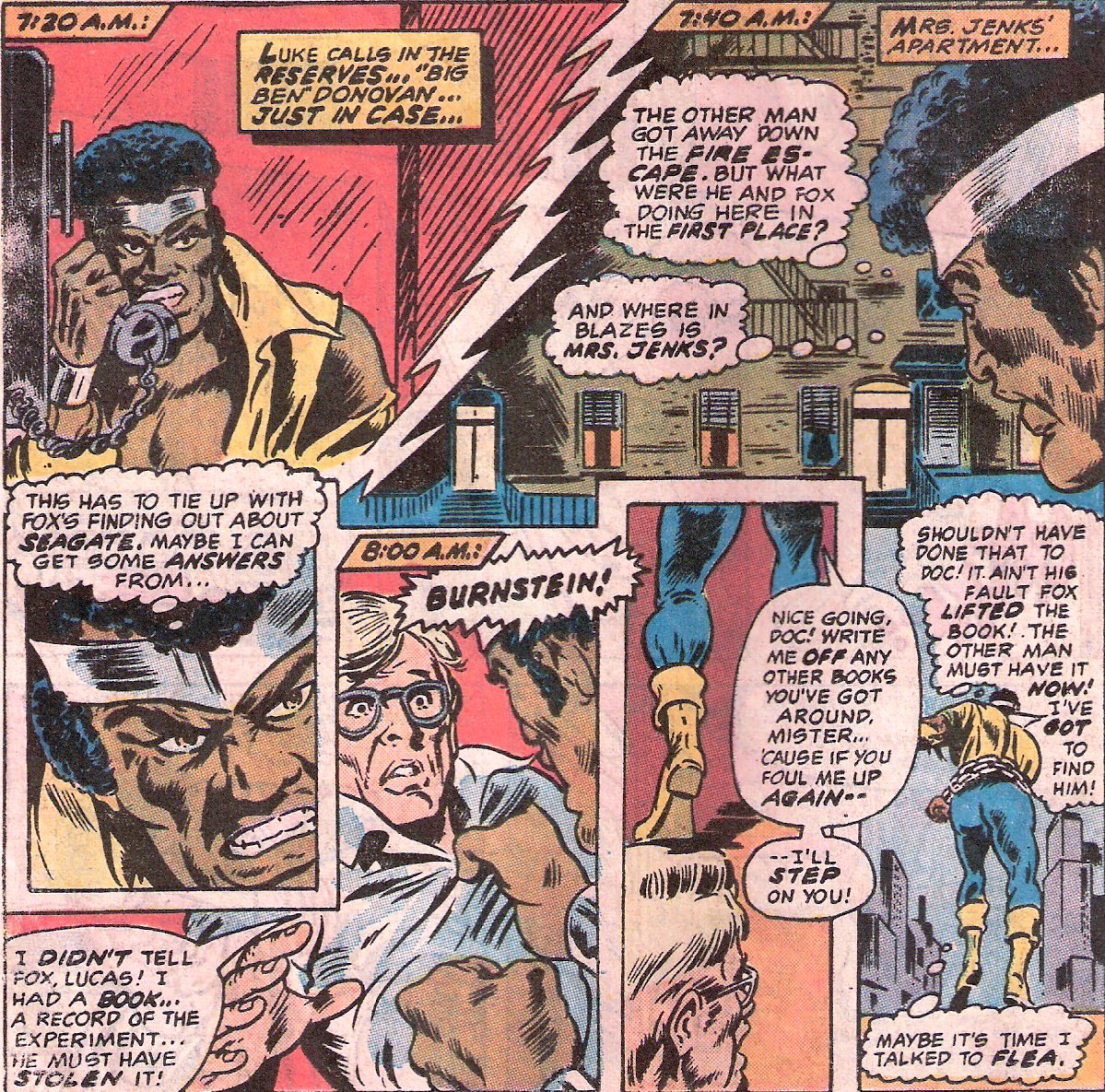
Doug: I can't tell you how cool it's been spelunking through the two reader lots I've won over the past few years on eBay. I've gotten a lot of mileage out of those, bringing Bronze Age love to you every so often. Here's one -- we've been digging on Billy Graham's pencils in our 4-part look at the Black Panther in Jungle Action. I saw this one in the pile, noticed Billy credited, and grabbed it. Let's see what he looked like on Luke Cage a few years prior to the arc with T'Challa we've been enjoying. By the way, how about the writing credits? Three guys? Hmmm... wonder if there will be too many cooks in the kitchen? We shall see.

Doug: To begin, I always like to do a quick page-through, mainly to see the organization of the book, see where the Bullpen Bulletins and letters pages are, check on the Marvel Value Stamp when applicable, etc. I was very surprised to see that this has two stories in it, and one's a reprint (a 1954 Sub-Mariner yarn by Bill Everett, of all things)! As this is part two of a story, and upon checking I found that the previous issue was all one tale, I wondered if perhaps this story may have been intended for a Giant-Size book. Well, so you don't have to look it up, I did. I found that Giant-Size Power Man (the book is still Hero for Hire here) wasn't published until 1975, but did indeed include this entire story! How's that for irony? Not bad when you can be right and wrong with the same thought! And before we even get into the story, I'm going to say up front that Graham's art doesn't look as polished as it did in the Jungle Action books -- here it seems to have a bit of a caricature-look and feel. I'm not saying that's bad -- just my first impression, that it's different. OK, enough pontification.

Doug: Wow. Just wow. After the splash page, I'm wishing I had the previous issue. This one looks like it's going to be good. Seems everything that's gone on in Luke Cage's life has come to a head at the same time, and it's not looking so hot for him. Complicated, but not positive. The writers really tell a rapid-fire story. The evil guard from Seagate Prison, Rackham, has come to New York to ruin Cage's life. He's brought along a Dr. Fox, but apparently in the last issue Rackham accidentally killed Fox. They had kidnapped a young black lady who they thought was Cage's girlfriend; she saw Rackham kill Fox. After Rackham had fled with the girl, Cage's real girlfriend, Dr. Claire Temple stumbled on Fox's body at (you guessed it) the exact moment the police arrived. So she's taken to jail. And on top of all of that, the second and third men to ever bust out of Seagate are on the prowl as well, and about to break into a liquor store in Harlem.

Doug: So Cage, in his office, gets word that Claire's in jail. He ain't happy, so heads to the precinct. The cop on duty gives him the business and refuses to let Cage see Claire. Moving outside, Cage goes to the top of the building across the street from the lock-up, and leaps from one roof to the other. Then making like Spider-Man, he climbs down the wall to the 6th-floor, where he knows Claire is held. Cage gets lucky and finds Claire pretty quickly. She is able to tell him what really happened with Fox's death, but as they talk a guard comes by her cell. Startled, Cage loses his grip on the bars and falls the six stories to the ground (shouting "Christmas!" as he takes his leave) -- but fortunately lands on the roof of a passing bus.

Doug: In a series of events far-too-convoluted for this jumping-on reader, Cage goes around town looking for information that will lead him to the killer of Fox. There are attorney names, informants, etc. Finally, he lands at a diner shortly after 8:00 am. His associate, Flea, tells him that he'd heard about Claire and figured that after putting 2 and 2 together that it all had something to do with Seagate Prison. Flea then took Cage a short distance to a liquor store -- the store that Cage's old prison mates had just knocked off. This doesn't look good...

Doug: And that's where it ends! Man, why isn't this story longer than 11 pages? It does conclude in Hero for Hire #16, which is the last issue before the title switches to Power Man. So, I am soliciting any of our readers who can fill us in on the before and after of this short tale. It was really engrossing, albeit a bit confusing since I was literally dropped right into the middle of it. Help a brother out, please!

Doug: Oh, I'd better finish my evaluation of the art. It is definitely different from what we've been seeing in Jungle Action, but it's not bad. It's funny, because I sometimes associate Luke Cage with George Tuska -- there's a bit of a Tuska feel to this. I actually got a little Frank Robbins vibe. But it's pretty good stuff. The writing is fun, too -- you can feel the "blaxploitation" era, for sure!

Friday, February 4, 2011

FOOM Fridays: FOOM #5


FOOM #5 (Spring 1974)

Karen: Hey kids, ready for some more foomtastic fun? I'm back with a nostalgic look at issue #5, which sports a sensational Rich Buckler/Joe Sinnott Thing cover. This issue we discover that editor Jim Sternako is gone, replaced by Tony Isabella. Isabella was a Marvel mainstay in the 70s; you'd recall him from an assortment of titles, including Champions. Looking at the credits, you'll also notice John Byrne's name. This may have been his earliest work for Marvel.

Since this issue sports a Thing cover, you won't be surprised to find out that the lead-off feature of the issue is an overview of the Thing's career. There's not a lot of substa
nce to it, but there are a few nice quotes from different creators.

Next we get bullpen profiles of Buckler and Steve Gerber, complete with Marie Severin caricatures. Buckler mentions how he want
s to be a writer. Gerber held a number of jobs before coming to Marvel -he worked as a used car salesman, and at a radio station and an ad agency. Gerber says he would like to write films. I'm not sure if he ever did, although I do know he got into animation.

We get a conte
st -pick out the cover for Giant-Size Avengers #1 - and some cartoons before reaching the news section, the Department of Infoomation. This is always my favorite part of these magazines. It's fun to read what was happening -especially when some of the news items never saw the light of day, or changed significantly. First up is a couple of pages on giant-size comics. "Marvel might just come up the winner in the current paper shortage [There was a paper shortage?]...we've finally firmed up our plans to release a full line of 68 page, full color comics." Ah yes, the giant-size books! How I loved them. Fans would be able to get giant-size issues of favorites like Avengers, Conan, Spider-Man, Fantastic Four, Defenders, Dracula, and even Man-Thing (yes, the infamous giant-size Man-Thing), Shang-Chi, and Werewolf by Night. I have to say, when these books had all-new material, they were great. But later on, it seemed like they were mostly crammed with reprints -in some cases, the entire book was a reprint -and they lost some luster for me. Side note: the writer for G-S Dracula is "neo-scripter Chris Claremont" ! Another couple of years and everyone would know his name.

We're on to the Marvel magazines next. Marvel was really expanding in this area: "In addition to our 75c line, we're now preparing five $1 magazines." Man, a whole dolla
r! These new additions included Monsters of the Movies, which I grabbed as soon as I saw it! It had an article on the TV movie The Night Stalker, one of my favorites back then. Another favorite magazine was Planet of the Apes. For some reason I only had a few of these, but they included adaptations of the films, original comic stories, and articles and photos from the movies.

Marvel Previews was a try-out mag. The first issue
featured "Chariots of the Man-Gods" - gee, I wonder if Erich von Daniken knew about that? Savage Sword of Conan would be the fourth title, and the most successful. It's predecessor, Savage Tales, would make the switch to the larger $1 format.

There was plenty of news for the 75c line. For Dracula Lives, we find out that "every writer in the bullpen is trying to top the other guy's Dracula story." A lot of mainstream char
acters would appear in the horror mags, like Blade, Brother Voodoo, and Morbius. These mags were perfect venues for these horror-based characters, allowing for more mature story-telling.

One mag that I don't think ever saw the light of day was a proposed black and white Go
dzilla title. The news says that Marvel was closing a deal with Toho Studios but I think all we got was the color comic, not a magazine.

As for the regular comics, there was plenty h
appening. The titles were reviewed alphabetically this time around, which made more sense. Deathlok would be premiering in Astonishing Tales, not Unknown Worlds as stated in FOOM 4. For Captain America, we're told, "The star-spangled Avenger calls it quits...the Falcon fights alone...and Steve Rogers' brand new super-hero identity...face it, Steve Englehart's gone berserk...get it on the excitement now!"

Comments on Incredible Hulk: "Warlock reborn, a prelude to an exciting new series that will be written and drawn by Jim Starlin...exorcism for a Wendigo...the topper: a Canadian super-hero, the Wolverine!" Little did they know that 'Canadian super-hero' would take over their company!

Spidey and the Torch were still sharing the starring role in Marvel Team-Up. Funny to think that Spidey wasn't always th
e star! Speaking of Spidey, over in his own title he was dealing with the Jackal and the Punisher - those were fun times! And you know, the Torch even had his own title -although it was all Strange Tales and Golden Age reprints! I know, because I actually bought a few issues.

It's amazing the kind of variety in the books published at that time. Even as late as 1974, Marvel was still publishing War is Hell. The western books were all gone I think, their places taken by the explosion in the horror/monster titles. But that one war book was hanging on. I wonder if it will still be around by the time I get to FOOM #6?

There's a short preview of Deathlok, which really doesn't say much, but boy did I dig that drawing of the cyborg! Excuse my tracing, please. The FOOM fan art gallery had drawings by Ken Steacy and John Byrne and Duffy Vohland. I guess they actually were still fans, although Byrne would be drawing Marvel titles by the next year. Byrne and Vohland also provide the back cover, a shot of Mantis.

Towards the back of the issue is a ballot for the Irving Forbush Awards. I see that I chose Hulk as my favorite comic - which surprises me now, as I almost never re-read my old Hulks. I guess they had more appeal to a 9 or 10 year old! My favorite Marvel star was Spider-Man. Roy Thomas and John Buscema were my picks for writer and artist. Now
that's not surprising!
Related Posts with Thumbnails