Doug: Super-duper treat today, kids -- times TWO!! I'll get out of the way and let Dr. Oyola and Mike W. drive this bus.
In putting this series of posts together, Mike and Osvaldo split the work by
alternating writing summaries (with a little input from each other) and then
following up with a Doug/Karen style discussion. We cover issues #1 and #2 in
Part One, #3 and #4 in Part Two, and the final issue, #5, in Part Three.
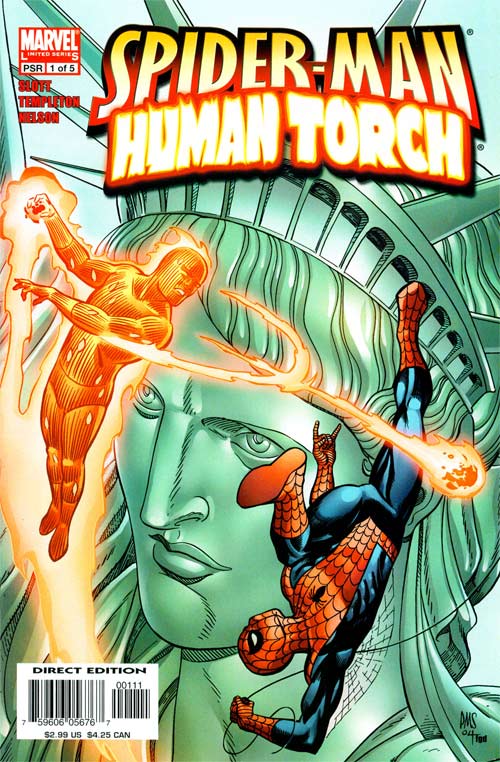
Spider-Man/Human Torch is a five-issue limited series written by Dan Slott, with pencils
by Ty Templeton and published in 2005. The series is a nostalgic look back on
the relationship of these two rivals/friends and each issue takes place in a
distinct era—with the earliest story being in the Ditko-era Spider-Man and the
last story taking place just before Civil War. In keeping with the
rolling timeline of the Marvel Universe, events we know were published in
issues that came out in the 1960s are referred to as “10 years ago,” while
events of the 70s and 80s are “several” and “many years ago,” but since the
eras are evoked by the stories themselves, the whole sense of a timeline is
muddled despite Slott’s obvious careful consideration of continuity and
detailed knowledge of both characters’ histories.
Overall the series’ tone is comedic, which is fitting for these two characters’
usual interactions, but there is also a sentiment of genuine developing friendship,
which leads to poignant moments.
Spider-Man/Human Torch #1: “Picture
Perfect”
 Spider-Man/Human
Torch #1 (March 2005) opens with the FF fighting Mole Man and his
subterranean minions. Johnny saves the day, and doesn't let any of his
teammates forget it. Johnny anticipates a lot of good publicity, but is pushed
off the front page of the Daily Bugle by a story about Spider-Man fighting (or
teaming up with, if you believe the headline) Mysterio. Spidey fought Mysterio
in Amazing Spider-Man #24 (1965), so this issue must take place right
after that (and well before #42, since he hasn’t met Mary Jane yet). Johnny was
still dating Dorrie Evans at this point. Anyway, Johnny decides to hire Peter
Parker to take pictures of him, since Peter always seems to get Spidey on the
front page. Peter is reluctant, but he and Aunt May need the money, so he
finally agrees.
Spider-Man/Human
Torch #1 (March 2005) opens with the FF fighting Mole Man and his
subterranean minions. Johnny saves the day, and doesn't let any of his
teammates forget it. Johnny anticipates a lot of good publicity, but is pushed
off the front page of the Daily Bugle by a story about Spider-Man fighting (or
teaming up with, if you believe the headline) Mysterio. Spidey fought Mysterio
in Amazing Spider-Man #24 (1965), so this issue must take place right
after that (and well before #42, since he hasn’t met Mary Jane yet). Johnny was
still dating Dorrie Evans at this point. Anyway, Johnny decides to hire Peter
Parker to take pictures of him, since Peter always seems to get Spidey on the
front page. Peter is reluctant, but he and Aunt May need the money, so he
finally agrees.
Johnny's
ego makes Peter's job harder; when Johnny tackles some bank robbers, Peter
changes to Spidey to lend a hand and is promptly told to butt out by the Torch.
To top it off, Johnny refuses to use the photos Peter took of the fight (with
his camera set on automatic, natch) because he doesn't want to share the
spotlight with Spidey. Peter suggests he stay out of sight and follow the Torch
around all day. Johnny isn't sure how Peter will manage that, but we know,
don't we? Unfortunately, Johnny's adventures when Peter/Spidey is trailing him
are less than awe-inspiring (although Spidey has a hilarious interlude with
Paste-Pot Pete, soon to be known as Trapster!), so Johnny gets the (not-so)
bright idea to attack Dr. Doom in the Latverian Embassy—that'll make the front
page for sure! Of course, he's caught (cryogenically frozen) in about three
seconds. Spidey goes to his rescue and manages to convince Doom that he's
reconsidered Doom's offer to team up (from Amazing #5). Doom wants proof
of Spidey's loyalty, so Spidey says he'll kill the Torch, but instead he picks
up the giant ice-ball with Johnny inside and swings off.
 Later,
Spidey meticulously chips away the ice to free Johnny, who is understandably
impatient. Spidey warns him that it's a delicate job, and to illustrate his
point, he accidentally (as far as I can tell) chips Johnny's hair right off!
Johnny flies back to the Baxter Building and begs Reed to reattach his stylish
'do, but Thing ruins it when he's clowning around. Spidey snaps a pic of the
no-longer-hirsute Johnny from outside and takes it to Jameson, thinking that a
front page photo of a bald Human Torch will make it all worth it. But Jameson
prints the photo of Spidey (on the same roll of film) groveling to Dr. Doom
instead, robbing Peter of his revenge, and making the Torch livid at being
bumped from the front page by Spidey yet again.
Later,
Spidey meticulously chips away the ice to free Johnny, who is understandably
impatient. Spidey warns him that it's a delicate job, and to illustrate his
point, he accidentally (as far as I can tell) chips Johnny's hair right off!
Johnny flies back to the Baxter Building and begs Reed to reattach his stylish
'do, but Thing ruins it when he's clowning around. Spidey snaps a pic of the
no-longer-hirsute Johnny from outside and takes it to Jameson, thinking that a
front page photo of a bald Human Torch will make it all worth it. But Jameson
prints the photo of Spidey (on the same roll of film) groveling to Dr. Doom
instead, robbing Peter of his revenge, and making the Torch livid at being
bumped from the front page by Spidey yet again.
Osvaldo:
I had not read this series in some years, but remembered it fondly. However,
upon starting with this issue the humor seemed a little heavy handed and I was worried
that it did not hold up. Fortunately, Slott seems to get a handle on the tone
and dialogue by issue’s end and it is not so much a problem for the rest of the
series. I have a similar (non-)complaint about the art. There are moments in
this issue where it looked a little muddy, like the inking was a little too
heavy. The rest of the series also has heavy inks, but the lines while heavy
remain clean and the art is bright and fits the comedic/nostalgic tone of the
series, so it ends up not being a big deal. The Paste-Pot Peter scene was
worth the price of admission though.
M.S.
Wilson: I’m more of a “writing” guy than an “art” guy, so Templeton’s art to me
was … fine. It isn’t spectacular, and it isn’t horrible--it’s good, generally
speaking. I agree about the Paste-Pot Pete scene, which I think actually fits
roughly into continuity, since Pete first used the name Trapster in FF
#38.
Osvaldo:
Oh, in general I like the art quite a bit! I think Templeton’s rendition of
well-known characters and how they dress in those eras is spot on, and the
“cartoon-y” style fits with the series tones. The coloring by “Nelson” (I
assume this is not a reference to the terrible band) is also very good.
M.S.
Wilson: The whole notion of jealousy, which runs through this mini-series, gets
started here, as we see Spidey’s familiar envy of the Torch, but surprisingly
Johnny finds himself jealous of Spidey and Peter Parker. He’s mad because
Spidey’s adventures keep pushing him off the front page, but he’s envious of
Peter Parker because of the close relationship Peter has with Aunt May.
Johnny’s parents are dead (as are Peter’s), but Peter has Aunt May as a
surrogate, where Johnny doesn’t have anyone quite like that in his life.
Osvaldo:
Except for Sue, right?
M.S.
Wilson: Yeah, and Sue did sort of act as a “mother figure” (especially in the
early days), but I’m not sure Johnny ever really saw her as a surrogate
mother, the way Aunt May is for Peter; Sue was just his loving-but-annoying big
sister most of the time.
Spider-Man/Human Torch #2: “Catch You
on the Flipside.”
 Issue
#2 of SM/HT opens with Johnny Storm making quick work of the Vulture. Spidey’s
usual struggle with the flying codger is easily avoidable when you can just set
his feathers on fire and let him plummet to the ground. Meanwhile, Crystal
(Inhuman, and sister of Medusa) is waiting for Johnny at the Coffee Bean, where
a uniformed Flash Thompson decides to hit on her. The fact that Crystal
is Johnny’s girlfriend, Flash is in his Vietnam Era uniform and Captain George
Stacy is around sets the story between Amazing
Spider-Man #56 and #90 and before Fantastic
Four #105 (when Crystal returns to Attilan “for good”)—so between 1968 and
1970. Captain Stacy is at the Coffee Bean to pick up coffee for his men and to
slip a lead to Spider-Man via Peter Parker. The tip is given in the guise of
something to snap pictures of for the Bugle, but Captain Stacy knows Peter’s
identity, but is not letting on that he knows, even to Peter (reinforcing his
admission as he died in ASM #90). This switch from the Ditko era
of ASM (in the previous issue) to the Romita, Sr. era is also made clear
by Johnny’s noting that somehow Peter Parker has it made, since both Gwen and
Mary Jane are fawning over him. Johnny doesn’t know that Peter and Spidey are
the same person (something that becomes an issue throughout this series).
Issue
#2 of SM/HT opens with Johnny Storm making quick work of the Vulture. Spidey’s
usual struggle with the flying codger is easily avoidable when you can just set
his feathers on fire and let him plummet to the ground. Meanwhile, Crystal
(Inhuman, and sister of Medusa) is waiting for Johnny at the Coffee Bean, where
a uniformed Flash Thompson decides to hit on her. The fact that Crystal
is Johnny’s girlfriend, Flash is in his Vietnam Era uniform and Captain George
Stacy is around sets the story between Amazing
Spider-Man #56 and #90 and before Fantastic
Four #105 (when Crystal returns to Attilan “for good”)—so between 1968 and
1970. Captain Stacy is at the Coffee Bean to pick up coffee for his men and to
slip a lead to Spider-Man via Peter Parker. The tip is given in the guise of
something to snap pictures of for the Bugle, but Captain Stacy knows Peter’s
identity, but is not letting on that he knows, even to Peter (reinforcing his
admission as he died in ASM #90). This switch from the Ditko era
of ASM (in the previous issue) to the Romita, Sr. era is also made clear
by Johnny’s noting that somehow Peter Parker has it made, since both Gwen and
Mary Jane are fawning over him. Johnny doesn’t know that Peter and Spidey are
the same person (something that becomes an issue throughout this series).
 Flash
and Johnny get into an argument over who is the better hero, Spider-Man or
Human Torch after Flash’s failed attempt to hit on Crystal, but when Johnny is
called to join the rest of the Fantastic Four for an interdimensional mission,
he has to abandon his argument to join them. As he flies to the Baxter
Building, he is interrupted by a quick-changed Spider-Man who calls him out for
badmouthing Spidey and saying he could do anything Spider-Man can (as evidenced
by taking out the Vulture that morning). They decide to switch for the day.
Johnny follows up on the lead about drug-dealers provided by Captain Stacy,
while Spider-Man joins the Fantastic Four on their adventure. The limited
window of opportunity for the FF’s adventure means there is no time for the
rest of the FF to object, as Spidey shows up with moments to spare and they
rocket off to explore a “subspace fissure.”
Flash
and Johnny get into an argument over who is the better hero, Spider-Man or
Human Torch after Flash’s failed attempt to hit on Crystal, but when Johnny is
called to join the rest of the Fantastic Four for an interdimensional mission,
he has to abandon his argument to join them. As he flies to the Baxter
Building, he is interrupted by a quick-changed Spider-Man who calls him out for
badmouthing Spidey and saying he could do anything Spider-Man can (as evidenced
by taking out the Vulture that morning). They decide to switch for the day.
Johnny follows up on the lead about drug-dealers provided by Captain Stacy,
while Spider-Man joins the Fantastic Four on their adventure. The limited
window of opportunity for the FF’s adventure means there is no time for the
rest of the FF to object, as Spidey shows up with moments to spare and they
rocket off to explore a “subspace fissure.”
Of
the two plot threads in this issue the Spider-Man hanging out with the
Fantastic Four is not nearly as interesting as Torch doing Spidey’s thing.
Essentially, Spidey’s actions are played for laughs. He make constant jokes,
freaks out when the world goes “trippy” as they travel between
dimensions, annoys the other members of the FF, and in the end when the team
could have used Torch’s powers to siphon off extra heat from “dimensional
meta-friction,” Spidey saves the day by insulating their ship by covering the
entire interior with his webbing.  The problem is this covers/ruins most of
Reed’s sensitive instruments for the better part of an hour and the fissure is
only going to remain open for 62 minutes! In other words, because of Spider-Man
they only get two minutes of data collection. The old Parker luck, I
guess. You actually get to see Reed Richards lose his cool, which is a rare
sight.
The problem is this covers/ruins most of
Reed’s sensitive instruments for the better part of an hour and the fissure is
only going to remain open for 62 minutes! In other words, because of Spider-Man
they only get two minutes of data collection. The old Parker luck, I
guess. You actually get to see Reed Richards lose his cool, which is a rare
sight.
The
Human Torch plot thread is more interesting. He quickly discovers that it is
difficult to sneak up on underworld thugs if you are literally on fire
(everyone runs away before he can get close enough to grab them), so he
approaches the warehouse in his civilian garb and is quickly knocked out and
taken prisoner. Tied to a chair with a gun to his head, Johnny worries
that he can’t raise his heat fast enough to melt a bullet before it kills him,
but he tricks the criminals into thinking that an invisible Sue Storm is in the
room, and uses the distraction to “Flame On!” and take them out. It turns out
Kraven the Hunter is behind the drugs. There is a funny scene where Johnny and
the cops do some play-acting to fool a member of Kraven’s gang into giving up
their boss’s location (an abandoned zoo, where else would you find Kraven?).
Johnny takes to acting, because he uses a similar trick to fool Kraven
into thinking he is dying of venomous snake bites (but he isn’t, since he can
boil his blood Johnny is immune to that kind of venom). Thinking the hero is
about to expire Kraven admits who else he was working with (members of the
Maggia), and the stalling Torch gives up his act to capture the hunter as well.

The
issue ends with Spider-Man being shown the door by the rest of the FF and
Johnny Storm being given the key to the city and coming back to the Coffee Bean
with it to gloat. However, in sticking with the Archie-like comic
gimmick/punchline at the end of these stories, Flash makes sure Torch is served
coffee laced with laxative.
M.S.
Wilson: The jealousy theme continues here, but this time it's more along the
lines of "anything you can do, I can do better;” each one thinks the other
has it easier...or is happier. A scientist like Peter would love to be seeing
other dimensions and so on (or "Thursday" as the FF calls it), while
Johnny obviously doesn't appreciate it in the same way. Meanwhile, Johnny seems
to actually BELIEVE that fighting Spidey's enemies would be easier (and more
fun) than what the FF has to deal with. The Coffee Bean scenes are interesting
with Captain Stacy obviously knowing Pete's secret, Flash defending Spidey (and
his hilarious "revenge" at the end on Spidey’s behalf); I thought it
was a little weird for Johnny to be jealous of Pete "fighting off two of
the hottest women I've ever seen" when Johnny's there with Crystal,
supposedly the love of his life! In the end it seems like they both realized
that things aren't as easy for the other guy as they look, but of course, it
works out OK for the Torch...not so much for Spidey.

Osvaldo:
I thought of the “two hot girls” thing as a wink and a nod in recognition of
the drastic change in Peter’s social life and how beautiful everyone suddenly
looks when Romita, Sr. takes over art duties. The only “problem” with this
story (and it is hardly a “problem”) is that in the end Johnny seems to be
right that Spider-Man’s job is easier for him. He has the reputation and
connections to do things in a way Spidey has to struggle to do (like his
relationship with the cops) and does not have the burdening sense of
responsibility that might rob these adventures of their fun for him. The Coffee
Bean scenes are my favorites.
M.S.
Wilson: Yeah, I always liked the “hanging out” scenes in the old Spidey comics.
They blended well with the action stuff. I guess the “ease” with which Johnny
handles Kraven and the mobsters shows that Spidey’s job is even harder than it
looks. He doesn’t have public opinion or the cops on his side, so he really is alone.
I’m not sure any of that actually occurs to Johnny though … he seems too full
of himself to figure it out. Considering how arrogant he is, he deserves to
drink Flash’s laxative!
Osvaldo: Flash’s love of Spider-Man and dislike for “puny” Parker
is one my all-time favorite incarnations of the consequences of a secret
identity in superhero comics. Slott does a good job of capturing the former
aspect, though in the Vietnam Era the dislike portion began to fade (something Jeph Loeb follows up in in
his Spider-Man: Blue series).
That is all for today. In part two we jump to 1974 and then
1984, in the era of the Spider-Mobile and the Black Cat respectively. Hope to
see you there!