Showing posts with label Ty Templeton. Show all posts

Thursday, July 2, 2015

Guest Review - "I'm With Stupid"... Teaming Up to Review Spider-Man/Human Torch, Part Three


Welcome to the third and final part of our overview/review of the Spider-Man/Human Torch limited series!


Spider-Man/Human Torch #5: “Together Alone”

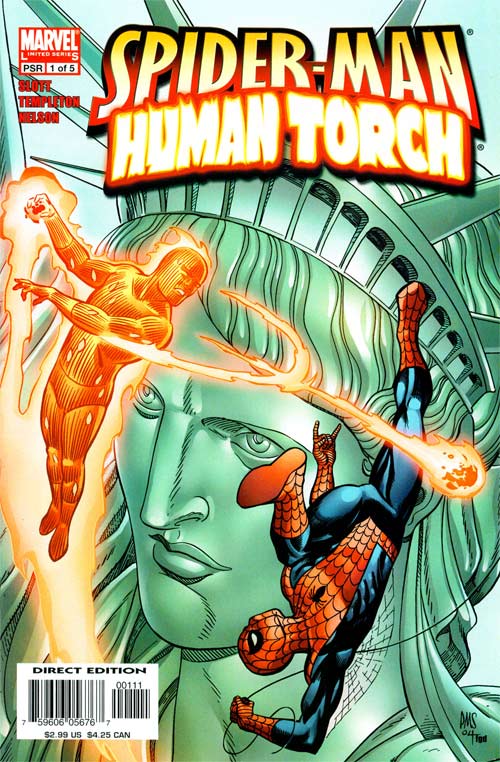
Spider-Man/Human Torch #5 (July 2005), like the four previous issues are written by Dan Slott and penciled by Ty Templeton. This time inks are by Drew Geraci and Greg Adams. The final issue (which seems to take place a little while before House of M and Civil War) starts with Spidey and Torch meeting in "the usual place"--the Statue of Liberty. They reminisce a bit about some of their earlier adventures (like their first meeting at the Statue from Strange Tales Annual #2) and they neatly recap the previous four issues of this series. Torch brings up a bunch of other adventures, but Spidey says that wasn't really him, it was his clone; they agree to "skip over that whole period". You're preaching to the converted, guys. Finally, they get to the reason behind this particular meeting, and we get an extended flashback of what led them here.

At the school where Peter teaches, Johnny is a special guest. He and Pete trade insults (and Johnny is blown away when MJ shows up with Peter's lunch and he realizes she's Pete's wife). Unfortunately, someone else is there to see the Human Torch, but he's not a fan, which he makes abundantly clear when he sucker punches Johnny from behind. He's a mobster named Carmine Villanova (whose son Johnny caught in Spider-Man/Human Torch #3) and he wants revenge, because his son was killed trying to bust out of prison. Naturally, Villanova blames the Torch, as well as District Attorney Blake Tower, whose son (coincidentally) goes to this very high school. So Villanova's goons hold everyone hostage as they search for Tower's son (luckily for him, their photo is out of date). One of Villanova's men has the high ground and could spray the auditorium with bullets if Torch tries anything. Peter knows he can take out the guy on the balcony if he has a distraction. So he finally (!) decides to clue the Torch in on his secret identity. He (and MJ) engage in some exaggerated pantomime to get the point across. After Johnny gets over his initial surprise (and chagrin), he provides the necessary distraction, Pete takes out the goon on the balcony, and Johnny makes short work of the rest. He leaves a flaming message in the sky for Spidey to meet him at the usual place...


...which brings us back to the Statue of Liberty. Johnny still can't believe that Spider-Man is Peter Parker, and is understandably upset when Peter catalogs all the other heroes who already know his secret. Johnny expresses his disbelief (and envy) that Peter could have everything going for him (a loving Aunt, a great job, scientific genius, and beautiful women falling all over him) and then be Spider-Man on top of it all--Johnny refers to it as "the Parker luck", which obviously means something quite different than when Peter says it about himself. Peter then confides that HE has always envied Johnny for his style, his adoring fans, no secret identity, his opportunities to explore other worlds ... and then having super powers on top of it all. They both realize that they've got it pretty good, and Johnny invites Peter (and his family) to the Baxter Building for supper. Pete, MJ, and Aunt May show up and we get some great scenes of the two families interacting. When asked how to tag the photos of the event, Reed sums it up perfectly when he says: "...place this and all future Parker files under 'Friends and Family'."


Osvaldo: The nostalgia is a bit thick in this issue. It even invents nostalgia for the series itself, as if the stories it has been telling really are from issues back in the day. Still the two families coming together is sweet, and captures what works about the Fantastic Four-that it’s a family first.  I love the “Uncle Bens are always right” line that Peter tells Franklin about the Thing, and the reference to the coffee table book Webs.  I LOVE the joke about the 90s and the clone stuff, but the irony to me is that the very time this issue takes place in (married to MJ, Aunt May knowing his identity, living at Avengers Tower) has been ret-conned away to a great extent, while the clone stuff is still canon (kind of).


M.S. Wilson: Well, obviously Slott didn’t know when he was writing this that everything was going to be swept away a few years later. I’m glad they mentioned Webs too … that seemed to be a forgotten part of Peter’s life, but it was a major subplot at the time. I liked the callback to their original Statue of Liberty meeting in Strange Tales Annual #2 … it gives it a nice sense of continuity.
I’m not sure about the references Johnny makes to his adventures with the clone … are those real, or just made up? The Diablo one sounds vaguely familiar, but I didn’t read any of the Ben Reilly/Scarlet Spider stuff, so I have no idea if those are published adventures or just a bunch of stuff that Dan Slott made up. The jealousy theme is kind of wrapped up here, when both of them realize that their own lives aren’t so bad when seen through the other guy’s eyes. It’s weird that Johnny is so surprised at Pete being married to MJ; I’m sure Johnny’s met them before (Web of Spider-Man #73 comes to mind). By the way, what happened to Blake Tower? He used to look like Steve Rogers and now he looks like Jarvis! All those interactions with super-heroes have taken their toll, I guess.

Osvaldo: Where did Blake Tower appear previously? I don’t recall the character.

M.S. Wilson: Tower was the District Attorney for (I guess?) Manhattan. He appeared in a bunch of Daredevil issues (his first appearance being DD #124); also in some Power Man/Iron Fists, and a few Amazings, among other places. Tower was the one who offered Spidey the pardon in (I think) Amazing #186; he also appeared at the poker game with Ben Grimm, Nick Fury, Carol Danvers et al. in MTIO #51.

Osvaldo: It looks like Slott knows his Marvel continuity very well. Better than I do, anyway. But I think the key to handling that stuff well is managing to make it work for the reader whether or not they are familiar with the detailed backstory and previous appearances of characters. In other words, a comic should (without resorting to burdensome exposition) have character appearances make enough sense in any particular context so that as far as a reader is concerned the character could have been made up for the particular story (like you felt about Red Ghost when you first came across him and his Super-Apes), while a reader familiar with all the continuity stuff gets the pleasure of recognizing it (without needing to). I think this series accomplishes that.

M.S. Wilson: Yeah, I agree with you there. Previous continuity should be used to spice up the new story, but if you make the new story dependent on it, you risk losing readers who aren’t familiar with the references. Longtime readers can get a kick out of spotting the Easter eggs, and newer readers won’t know the difference. As you said, Slott does it quite well … you can tell he’s actually read those old Spidey stories--for fun, not just as research. Kurt Busiek also did it pretty well in Untold Tales of Spider-Man; on the other hand, something like Bendis’s Spider Woman: Origins just muddled her past up even more than it already was.


Osvaldo: My hope is that in a post-Secret Wars/Battleworld (whatever the heck they are calling it) comic universe there will be more room for these kind of retro-feel apocryphal stories that don’t have to be so strongly tied to current continuity as to lose the feel of the time in which they are supposedly set.

M.S. Wilson: It’s hard to tell where they’re going with the new Secret Wars thing, but it seems like you might get your wish. Personally, I’d love to see a (non-canon) series devoted to retelling the early years of Marvel with a modern sensibility … like a cross between Marvel Saga and Marvels; some of those old stories could be snazzed up a bit, plus extra continuity could be retrofitted in. But I agree with you … we definitely need more stories like this one!

Osvaldo: I’d love something like this for Marvel Team-Up or Marvel Two-In-One. New old stories told in the style and setting of the period the original comics came out, but with a contemporary self-aware sensibility.

We hope you enjoyed this extended review of Spider-Man/Human Torch. There is a collected edition called “I’m With Stupid” for those of you interested in this series, but that don’t want to hunt down the original issues. Excelsior! 

Monday, June 29, 2015

Guest Review - "I'm With Stupid"... Teaming Up to Review Spider-Man/Human Torch, Part Two


Doug: We hope everyone had a great weekend. Summer's awesome, isn't it? Today Osvaldo and Mike W. are back with their second installment of their review of a series they both liked. Take it away, boys!


Here is part two of our overview/discussion of the Spider-Man/Human Torch mini-series, covering issues #3 and #4.

Spider-Man/Human Torch #3: “Auto Motives”

Spider-Man/Human Torch #3 (May 2005) is written by Dan Slott, penciled by Ty Templeton with inks by Tom Palmer and Nelson. This issue starts with Peter Parker reminiscing about some of his recent adventures. We see Punisher, Hammerhead, and the bizarre plot of Doc Ock almost marrying Aunt May, so this must take place after Amazing Spider-Man #132 or so (he also mentions the Spider-Mobile, which will be the REAL star of this issue!) He swings away, and we find out he was on the Brooklyn Bridge, talking to Gwen Stacy in the last place he saw her alive. Later, at the Baxter Building, Johnny Storm hits on an attractive Russian scientist (Nina Pushnikov), who's there as an intern for Reed Richards. Unfortunately, the Russian beauty is more impressed with Peter Parker (Reed's other intern) and Johnny's kind of jealous of Peter excelling in yet another area: science. Reed shows them his latest invention (a gravity localizer), but after the Russian scientist leaves, we find out she's working for the Red Ghost, Reed's villainous Russian counterpart.

Peter soon returns to the Baxter Building (as Spider-Man) to see Johnny about teaching him how to drive the Spider-Mobile ... like many New Yorkers, Peter never learned. Johnny agrees to teach him and hijinks ensue. They stop for a break on Yancy Street, where Spidey devours some Hostess--er, sorry, I mean MOSTESS--Fruit Pies; why do I mention the fruit pies, besides simple nostalgia? You'll see. After the Yancy Street Gang steals their hubcaps, Spidey gets the idea to add Reed's gravity localizer to the car so they can literally drive each other up the wall! He claims that Peter Parker told him about it. While working on the car back at FF headquarters, Spidey and Johnny have a heart-to-heart talk about Crystal and Gwen. Spidey doesn't name Gwen, of course Johnny (he still doesn’t know Peter and Spider-Man are the same person), but he confides to that the love of his life is dead.

They take the car out to test its new gravity-defying ability, and the Red Ghost and his Super Apes attack, determined to get Reed's device. After a short but entertaining fight, the Apes steal the Spider-Mobile, but Spidey manages to distract them with--what else--some delicious Mostess Fruit Pies! They use the gravity localizer to catch the intangible Red Ghost, but Peter is let go from his internship, for "sharing" Reed's passcode for access to the device with Spider-Man. The issue ends on another comedic note, with Spidey doing donuts on the side of the Daily Bugle Building ... right outside Jonah Jameson's office!


Osvaldo: I think this is my favorite of the five issues. The anti-gravity car is not that interesting, but the jokes about the Spider-Mobile and NYC traffic and an orangutan being able to parallel park while Spider-Man can’t are funny as hell, as is the call back to Hostess Fruit Pies. I may also be biased by the fact that Red Ghost and his Super-Apes are among my all-time favorite villains.  Of course, their origins and the other intern/spy further jumble the timeline here, since these events are tied to the Cold War and Soviet Russia.

M.S. Wilson: This is my favorite issue of the mini-series as well. I have a soft spot for the Spider Mobile because I had the toy as a kid. It’s nice to see Carter and Lombardo again … Carter looks like Stan Lee, but is Lombardo supposed to be Roy Thomas? I also liked the young Dan Ketch cameo (reminiscent of the one at the end of Marvels #4); maybe this is where Ghost Rider got the idea to drive his motorbike up walls? We see more of the jealousy theme; this time Johnny’s jealous because Peter is a science whiz. And you’re right about the jokes … this one has a zinger on practically every page! I also like the quieter moments, when Spidey confides in Johnny about Gwen, and admits that Johnny’s the only one he can talk to about that sort of thing. Strangely, the first time I ever saw Red Ghost and his apes was in a Spidey comic (Amazing #223, I think); I wasn’t an FF fan, so I had no idea he was one of their villains … I just assumed he was a new Spidey baddie! The Cold War feel is here, but it’s not overwhelming (at least not to me). Maybe Slott was trying to evoke a general sense of the times without getting too deep into it. With Marvel’s sliding timeline, I guess we have to assume the Red Ghost showed up after the fall of the Soviet Union, but that he’s still a scientific rival of Reed Richards (hence his attempts to steal Reed’s device).

Osvaldo: Yes. The balance of madcap fun and human moments makes this issue shine in a way that the others don’t (though the Aunt May scene in #1 is close).

Spider-Man/Human Torch #4 – “Cat’s Paws”

Spider-Man/Human Torch #4 (cover dated June 2005) takes place between Amazing Spider-Man #252 and #258, since Spider-Man still has the symbiote suit he got in Secret Wars, but doesn’t know that it is in fact a symbiote yet.  The story opens with a flashback to “A dozen years ago” (so earlier than the events in issue #1) depicting a man trying to steal a sacred headdress/mask from the Wakandan Embassy and setting off the alarm, thus he must flee before getting caught.

The next scene is captioned “A few years ago” and finds Johnny Storm waiting for She-Hulk to arrive (recent sub for the Thing who was still on Battleworld) to go to a costume party. Johnny is dressed as classic red and blue costumed Spider-Man, but She-Hulk shows up in a French maid’s outfit (a few sizes too small), and when the Torch comes on a little too strong, suggesting they “stay in” rather than go to the party, Shulkie balks and leaves.  Johnny is left feeling like he can’t win in the ladies department.  He flies off in a huff and discovers what appears to be Peter Parker on a roof arguing with Felicia Hardy, the Black Cat. Just moments before the two of them handed over a webbed up Beetle to Jean DeWolfe, but fell to arguing about what to do next.  Black Cat wants Peter’s help to steal something from the Wakandan Embassy and he refuses.  Once again Johnny is blown away by the women Parker seems to attract, but in the sleeze mode he occupies through most of this series, he takes the opportunity of a lovers’ tiff to agree to accompany Felicia to an event at the embassy and help her out.

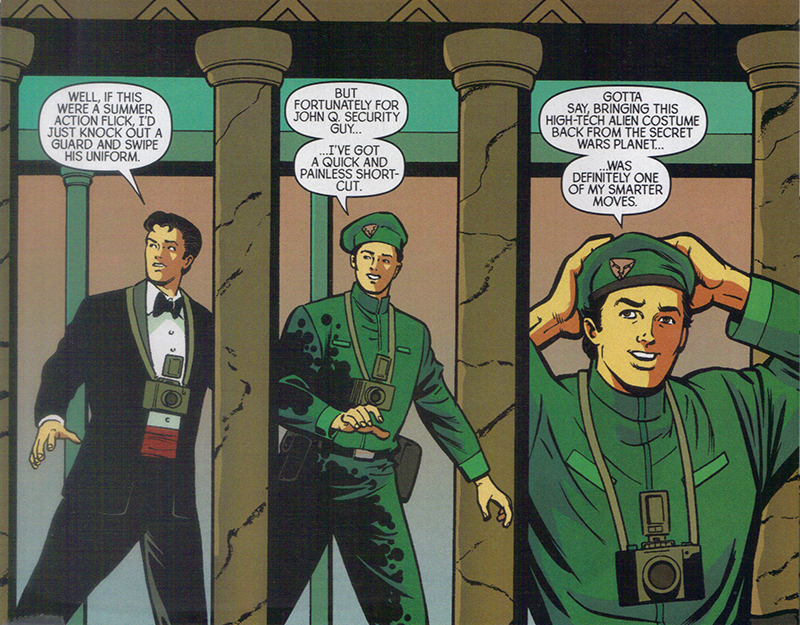
That night Peter arrives at the Wakandan Embassy to cover the event for Daily Bugle wearing an impromptu tuxedo courtesy of the symbiote-suit’s camouflage powers (something played for a laugh in several scenes later in the comic). He is there when Johnny Storm and Felicia Hardy arrive together and Peter confronts them, certain that Black Cat is just using Johnny and Johnny is too stupid and/or horny to know better. When Johnny uses his relationship with Black Panther to get him and Felicia a closer look at the mask in the display case, Peter decides to try to stop them by having his alien costume replicate the uniform the guards are wearing including a beret in order to move through the embassy unimpeded. Unfortunately for Peter (but fortunately for good taste) the symbiote suit cannot make Peter look black, so despite his uniform he is spotted by the guard accompanying Johnny and Felicia. When the guard gives chase, the two would-be thieves are left alone with the mask. 


After another failed attempt to “blend in” that leaves Peter exposed in a some kind of traditional Wakanda tribal get-up, he transform to Spider-Man and ends up being a great inadvertent distraction for the others while he is confronted by T’Challa himself.

Meanwhile the Human Torch is using his powers to suck all the heat out of the room to mess with the heat sensors while the Black Cat disables them and put the cameras to play a loop of an empty room, and then he uses a focus of heat to distort the lasers around the mask itself allowing Felicia to squeeze through. Of course, there is a gratuitous need to make her strip down to her underwear to be able to squeeze through the laser bars. When she cuts through the glass case the mask is in the alarm goes off, but by the time the distracted guards and the Black Panther arrive the two thieves are long gone, but what is this? The mask is still there!  Spider-Man slips away.


Confronting the Human Torch and the Black Cat on a nearby rooftop, Spider-Man says he doesn’t care that they didn’t get away with their heist, he is still mad at them. It is then that the Black Cat reveals when she really came there for, her dad’s lucky lockpick. He was the man in the original flashback who failed to steal the mask. He dropped it when the alarm went off and it was hidden among the mask’s plumage.  Felicia had noticed it when she saw a photo of the mask in the paper, but Peter Parker had never given her a chance to explain what she really wanted. It was just “more fun” to try to steal it than to use Johnny’s connection to the Black Panther to ask for it.  Torch explains that he and the Black Cat were using both Spider-Man and Peter Parker (remember, he still doesn’t know Peter’s identity), knowing that Peter would be there to cover it for the paper and that he’d contact Spider-Man when he saw them, thus causing the distraction.

While he is explaining, he turns his back to the couple and when he turns back around Spidey and Black Cat have reconciled and are making out.  Human Torch is outraged that Spider-Man is making time with Peter Parker’s girl, and takes off, but not before letting Felicia know she can still call him up to go out.

M.S. Wilson: Johnny is still having no luck with his love life, and gets jealous of Pete and Black Cat this time, after striking out with Shulkie. The scene of Johnny hitting on She-Hulk was weird...did he expect her to just jump him? And the remark about Starfox seemed kind of “slut-shaming” to me. Was Slott writing She-Hulk at this point? I think he was the one who wrote the “Starfox on Trial” issues, so it seems a bit weird here, but I suppose it’s meant to illustrate how bad Johnny is when it comes to women; Dorrie, Crystal, Frankie Raye, now Shulkie … I guess he and Alicia weren’t an item yet?


Osvaldo: Maybe Slott just wanted to avoid one of the most hated plot lines in Fantastic Four continuity: Alicia and Johnny as lovers and then Alcia’s retconning into a skrull! Anyway… Yes. Slott was writing a She-Hulk series at this same time, which I mostly love and wrote about over on The Middle Spaces. The She-Hulk/Johnny Storm interaction here was an awful choice by Slott that he didn’t think through. Not only does it come off as slut-shaming, but when She-Hulk says that “This’s probably my fault” I cringed and felt bad for She-Hulk, and that is not the the reaction you want to evoke in a book with a comedic focus. To make thing worse, when Johnny storms off (no pun intended) the focus of the story is on his feelings. “Woe is me! I keep striking out because I assume all women should want to sleep with me at all times!” It just comes off as so arrogant and creepy that left a bad taste in my mouth. This is just the kind of thing when I find in comics that I cannot ignore.  As someone who loves comics I think it important to address this stuff. There were plenty of ways to handle that scene in a romantic farce kind of way that would have gotten the character where he needed to be narratively without reinforcing negative ideas about women’s sexuality.

M.S. Wilson: Yeah, it seems like Slott was just using She-Hulk because she’s got the reputation of being … uninhibited when it comes to sex, shall we say? He probably could’ve used Tigra and gotten the same result. It does really make Johnny look like an asshole (more than usual), so I’m not sure what Slott was going for exactly. Is this the first time Johnny’s been attracted to her? I mean, her regular costume isn’t exactly conservative; I hope Torchy isn’t ogling her in the middle of a life-or-death battle with Annihilus or whoever. I’m assuming maybe Slott was just trying to show how crappy Johnny’s luck is when it comes to women (another reason to be jealous of Peter Parker!), but there had to be a better way to do it than this. And if Johnny’s that crass with women in general, maybe that’s why he’s still single!  

M.S. Wilson: Anyway, this plot is a bit strange (probably best not to scrutinize it too closely); Pete thinks Felicia wants to steal a Wakandan tribal mask that her father failed to get years ago, and when he refuses to help she gets Johnny instead … classic hijinks, right? But if she'd just explained things in the first place (I know Pete didn't give her much chance, but still) the whole mess would've been avoided. There are a lot of plot contrivances in this one to make it work: Pete not giving Felicia a chance to explain, Black Panther assuming Spidey is a bad guy, and especially, Johnny assuming Black Cat is cheating on Peter with Spidey instead of putting two and two together and realizing Pete and Spidey are one and the same. I know Johnny's supposed to be kind of dense, but he really comes off as being thick as a brick here. The shot of Black Cat in her underwear was gratuitous too--I mean, she looked good, but it really wasn't necessary to the story; it might have fit better in a story that was originally published in the 90s.

Osvaldo: Still, despite this, the issue still works. Slott manages to keep Black Cat as the “bad influence” character, but instead of an actual robbery the ridiculous aim of getting a lockpick fits with the comedic tone of the series. My favorite part is the symbiote suit trying to help Peter “blend in.”  I did like the inclusion of Captain Jean DeWolfe at the beginning of the issue and makes me miss her. I wrote about the “The Death of Jean DeWolfe” story line last year, and one of my conclusion was that it was a shame she had to die for that crappy story.  Black Panther mentions that he has met up with Spider-Man twice before at this point. Do you think this is an a reference to two actual team-ups at this point? Knowing Slott, it must be.  He must be referring to Marvel Team-Up #20 from 1974 and #87 from 1979, but surely they have met up other times in the intervening years? Any ideas?


M.S. Wilson: The only other places I can think of are in some of the “group scenes”, like The Death of Captain Marvel Graphic Novel, the Contest of Champions, and the Hulk’s presidential pardon from Incredible Hulk 277-279; Spidey and the Panther were present at all those events, so we could assume that they interacted in some way, even if it wasn’t specifically shown (especially at Captain Marvel’s funeral). But maybe Slott is assuming they didn’t and is just going by the stories as published … in which case, Panther’s suspicion follows from their last meeting in Marvel Team-Up #87, where he was really suspicious of Spidey if I remember correctly. In fact, that story always bothered me; you’d think Panther would’ve known by then (or other heroes would’ve told him) that Spidey was OK. Then again, I suppose it fits with the later retcon of Black Panther being suspicious of everyone and joining the Avengers just to spy on them.

Osvaldo: By the way, if you accidentally do a search for “Spider-Man Human Torch slash” like I did you will find a bunch of fan written stories that solve Johnny’s love woes by putting him and Spidey in a whole other kind of relationship (wink, wink, nudge, nudge).


We hope you’ve been enjoying our journey through Slott’s exploration of the development of Spider-Man and Human Torch’s friendship. We have one more issue to review, when Slott and crew handle the crappiness of 1990s Marvel Comics in the only way anyone should…by ignoring them!  See you next time!

Thursday, June 25, 2015

Guest Review - "I'm With Stupid"... Teaming Up to Review Spider-Man/Human Torch, Part One

Doug: Super-duper treat today, kids -- times TWO!! I'll get out of the way and let Dr. Oyola and Mike W. drive this bus.

In putting this series of posts together, Mike and Osvaldo split the work by alternating writing summaries (with a little input from each other) and then following up with a Doug/Karen style discussion. We cover issues #1 and #2 in Part One, #3 and #4 in Part Two, and the final issue, #5, in Part Three.

Spider-Man/Human Torch is a five-issue limited series written by Dan Slott, with pencils by Ty Templeton and published in 2005. The series is a nostalgic look back on the relationship of these two rivals/friends and each issue takes place in a distinct era—with the earliest story being in the Ditko-era Spider-Man and the last story taking place just before Civil War. In keeping with the rolling timeline of the Marvel Universe, events we know were published in issues that came out in the 1960s are referred to as “10 years ago,” while events of the 70s and 80s are “several” and “many years ago,” but since the eras are evoked by the stories themselves, the whole sense of a timeline is muddled despite Slott’s obvious careful consideration of continuity and detailed knowledge of both characters’ histories.

Overall the series’ tone is comedic, which is fitting for these two characters’ usual interactions, but there is also a sentiment of genuine developing friendship, which leads to poignant moments.

Spider-Man/Human Torch #1: “Picture Perfect”

Spider-Man/Human Torch #1 (March 2005) opens with the FF fighting Mole Man and his subterranean minions. Johnny saves the day, and doesn't let any of his teammates forget it. Johnny anticipates a lot of good publicity, but is pushed off the front page of the Daily Bugle by a story about Spider-Man fighting (or teaming up with, if you believe the headline) Mysterio. Spidey fought Mysterio in Amazing Spider-Man #24 (1965), so this issue must take place right after that (and well before #42, since he hasn’t met Mary Jane yet). Johnny was still dating Dorrie Evans at this point. Anyway, Johnny decides to hire Peter Parker to take pictures of him, since Peter always seems to get Spidey on the front page. Peter is reluctant, but he and Aunt May need the money, so he finally agrees.

Johnny's ego makes Peter's job harder; when Johnny tackles some bank robbers, Peter changes to Spidey to lend a hand and is promptly told to butt out by the Torch. To top it off, Johnny refuses to use the photos Peter took of the fight (with his camera set on automatic, natch) because he doesn't want to share the spotlight with Spidey. Peter suggests he stay out of sight and follow the Torch around all day. Johnny isn't sure how Peter will manage that, but we know, don't we? Unfortunately, Johnny's adventures when Peter/Spidey is trailing him are less than awe-inspiring (although Spidey has a hilarious interlude with Paste-Pot Pete, soon to be known as Trapster!), so Johnny gets the (not-so) bright idea to attack Dr. Doom in the Latverian Embassy—that'll make the front page for sure! Of course, he's caught (cryogenically frozen) in about three seconds. Spidey goes to his rescue and manages to convince Doom that he's reconsidered Doom's offer to team up (from Amazing #5). Doom wants proof of Spidey's loyalty, so Spidey says he'll kill the Torch, but instead he picks up the giant ice-ball with Johnny inside and swings off.

Later, Spidey meticulously chips away the ice to free Johnny, who is understandably impatient. Spidey warns him that it's a delicate job, and to illustrate his point, he accidentally (as far as I can tell) chips Johnny's hair right off! Johnny flies back to the Baxter Building and begs Reed to reattach his stylish 'do, but Thing ruins it when he's clowning around. Spidey snaps a pic of the no-longer-hirsute Johnny from outside and takes it to Jameson, thinking that a front page photo of a bald Human Torch will make it all worth it. But Jameson prints the photo of Spidey (on the same roll of film) groveling to Dr. Doom instead, robbing Peter of his revenge, and making the Torch livid at being bumped from the front page by Spidey yet  again.  

Osvaldo: I had not read this series in some years, but remembered it fondly. However, upon starting with this issue the humor seemed a little heavy handed and I was worried that it did not hold up. Fortunately, Slott seems to get a handle on the tone and dialogue by issue’s end and it is not so much a problem for the rest of the series. I have a similar (non-)complaint about the art. There are moments in this issue where it looked a little muddy, like the inking was a little too heavy. The rest of the series also has heavy inks, but the lines while heavy remain clean and the art is bright and fits the comedic/nostalgic tone of the series, so it ends up not being a big deal.  The Paste-Pot Peter scene was worth the price of admission though.


M.S. Wilson: I’m more of a “writing” guy than an “art” guy, so Templeton’s art to me was … fine. It isn’t spectacular, and it isn’t horrible--it’s good, generally speaking. I agree about the Paste-Pot Pete scene, which I think actually fits roughly into continuity, since Pete first used the name Trapster in FF #38.

Osvaldo: Oh, in general I like the art quite a bit! I think Templeton’s rendition of well-known characters and how they dress in those eras is spot on, and the “cartoon-y” style fits with the series tones. The coloring by “Nelson” (I assume this is not a reference to the terrible band) is also very good.

M.S. Wilson: The whole notion of jealousy, which runs through this mini-series, gets started here, as we see Spidey’s familiar envy of the Torch, but surprisingly Johnny finds himself jealous of Spidey and Peter Parker. He’s mad because Spidey’s adventures keep pushing him off the front page, but he’s envious of Peter Parker because of the close relationship Peter has with Aunt May. Johnny’s parents are dead (as are Peter’s), but Peter has Aunt May as a surrogate, where Johnny doesn’t have anyone quite like that in his life.


Osvaldo: Except for Sue, right?

M.S. Wilson: Yeah, and Sue did sort of act as a “mother figure” (especially in the early days), but I’m not sure Johnny ever really saw her as a surrogate mother, the way Aunt May is for Peter; Sue was just his loving-but-annoying big sister most of the time.

Spider-Man/Human Torch #2: “Catch You on the Flipside.”

Issue #2 of SM/HT opens with Johnny Storm making quick work of the Vulture.  Spidey’s usual struggle with the flying codger is easily avoidable when you can just set his feathers on fire and let him plummet to the ground. Meanwhile, Crystal (Inhuman, and sister of Medusa) is waiting for Johnny at the Coffee Bean, where a uniformed Flash Thompson decides to hit on her.  The fact that Crystal is Johnny’s girlfriend, Flash is in his Vietnam Era uniform and Captain George Stacy is around sets the story between Amazing Spider-Man #56 and #90 and before Fantastic Four #105 (when Crystal returns to Attilan “for good”)—so between 1968 and 1970. Captain Stacy is at the Coffee Bean to pick up coffee for his men and to slip a lead to Spider-Man via Peter Parker. The tip is given in the guise of something to snap pictures of for the Bugle, but Captain Stacy knows Peter’s identity, but is not letting on that he knows, even to Peter (reinforcing his admission as he died in ASM #90).  This switch from the Ditko era of ASM (in the previous issue) to the Romita, Sr. era is also made clear by Johnny’s noting that somehow Peter Parker has it made, since both Gwen and Mary Jane are fawning over him. Johnny doesn’t know that Peter and Spidey are the same person (something that becomes an issue throughout this series).

Flash and Johnny get into an argument over who is the better hero, Spider-Man or Human Torch after Flash’s failed attempt to hit on Crystal, but when Johnny is called to join the rest of the Fantastic Four for an interdimensional mission, he has to abandon his argument to join them. As he flies to the Baxter Building, he is interrupted by a quick-changed Spider-Man who calls him out for badmouthing Spidey and saying he could do anything Spider-Man can (as evidenced by taking out the Vulture that morning). They decide to switch for the day. Johnny follows up on the lead about drug-dealers provided by Captain Stacy, while Spider-Man joins the Fantastic Four on their adventure. The limited window of opportunity for the FF’s adventure means there is no time for the rest of the FF to object, as Spidey shows up with moments to spare and they rocket off to explore a “subspace fissure.”


Of the two plot threads in this issue the Spider-Man hanging out with the Fantastic Four is not nearly as interesting as Torch doing Spidey’s thing. Essentially, Spidey’s actions are played for laughs. He make constant jokes, freaks out  when the world goes “trippy” as they travel between dimensions, annoys the other members of the FF, and in the end when the team could have used Torch’s powers to siphon off extra heat from “dimensional meta-friction,” Spidey saves the day by insulating their ship by covering the entire interior with his webbing. The problem is this covers/ruins most of Reed’s sensitive instruments for the better part of an hour and the fissure is only going to remain open for 62 minutes! In other words, because of Spider-Man they only get two minutes of data collection.  The old Parker luck, I guess. You actually get to see Reed Richards lose his cool, which is a rare sight.

The Human Torch plot thread is more interesting. He quickly discovers that it is difficult to sneak up on underworld thugs if you are literally on fire (everyone runs away before he can get close enough to grab them), so he approaches the warehouse in his civilian garb and is quickly knocked out and taken prisoner.  Tied to a chair with a gun to his head, Johnny worries that he can’t raise his heat fast enough to melt a bullet before it kills him, but he tricks the criminals into thinking that an invisible Sue Storm is in the room, and uses the distraction to “Flame On!” and take them out. It turns out Kraven the Hunter is behind the drugs. There is a funny scene where Johnny and the cops do some play-acting to fool a member of Kraven’s gang into giving up their boss’s location (an abandoned zoo, where else would you find Kraven?).  Johnny takes to acting, because he uses a similar trick to fool Kraven into thinking he is dying of venomous snake bites (but he isn’t, since he can boil his blood Johnny is immune to that kind of venom). Thinking the hero is about to expire Kraven admits who else he was working with (members of the Maggia), and the stalling Torch gives up his act to capture the hunter as well.


The issue ends with Spider-Man being shown the door by the rest of the FF and Johnny Storm being given the key to the city and coming back to the Coffee Bean with it to gloat. However, in sticking with the Archie-like comic gimmick/punchline at the end of these stories, Flash makes sure Torch is served coffee laced with laxative.

M.S. Wilson: The jealousy theme continues here, but this time it's more along the lines of "anything you can do, I can do better;” each one thinks the other has it easier...or is happier. A scientist like Peter would love to be seeing other dimensions and so on (or "Thursday" as the FF calls it), while Johnny obviously doesn't appreciate it in the same way. Meanwhile, Johnny seems to actually BELIEVE that fighting Spidey's enemies would be easier (and more fun) than what the FF has to deal with. The Coffee Bean scenes are interesting with Captain Stacy obviously knowing Pete's secret, Flash defending Spidey (and his hilarious "revenge" at the end on Spidey’s behalf); I thought it was a little weird for Johnny to be jealous of Pete "fighting off two of the hottest women I've ever seen" when Johnny's there with Crystal, supposedly the love of his life! In the end it seems like they both realized that things aren't as easy for the other guy as they look, but of course, it works out OK for the Torch...not so much for Spidey.


Osvaldo: I thought of the “two hot girls” thing as a wink and a nod in recognition of the drastic change in Peter’s social life and how beautiful everyone suddenly looks when Romita, Sr. takes over art duties. The only “problem” with this story (and it is hardly a “problem”) is that in the end Johnny seems to be right that Spider-Man’s job is easier for him. He has the reputation and connections to do things in a way Spidey has to struggle to do (like his relationship with the cops) and does not have the burdening sense of responsibility that might rob these adventures of their fun for him. The Coffee Bean scenes are my favorites.

M.S. Wilson: Yeah, I always liked the “hanging out” scenes in the old Spidey comics. They blended well with the action stuff. I guess the “ease” with which Johnny handles Kraven and the mobsters shows that Spidey’s job is even harder than it looks. He doesn’t have public opinion or the cops on his side, so he really is alone. I’m not sure any of that actually occurs to Johnny though … he seems too full of himself to figure it out. Considering how arrogant he is, he deserves to drink Flash’s laxative!

Osvaldo: Flash’s love of Spider-Man and dislike for “puny” Parker is one my all-time favorite incarnations of the consequences of a secret identity in superhero comics. Slott does a good job of capturing the former aspect, though in the Vietnam Era the dislike portion began to fade (something Jeph Loeb follows up in in his Spider-Man: Blue series).

That is all for today. In part two we jump to 1974 and then 1984, in the era of the Spider-Mobile and the Black Cat respectively. Hope to see you there!
Related Posts with Thumbnails