Showing posts with label Tony DeZuniga. Show all posts

Monday, June 27, 2016

Then I Guess He Had to Crash - Thor 269


Thor #269 (March 1978)
"A Walk on the Wild Side!"
Len Wein-Walt Simonson/Tony DeZuniga

Doug: Marvel should have been embarrassed to put these two on the same cover. Am I seriously supposed to believe that Stilt-Man's rocket pods could vanquish the God of Thunder? The same God of Thunder who Marvelites continue to argue over concerning the victor in a tussle with the Hulk? That guy. If you're stopping by for the first time, back in April we had a fun conversation about mismatches in comics -- and a couple of weeks ago we checked in on one, when Daredevil was pitted against ol' Jade Jaws himself. If you're in a hurry today, I'm going to save you some time and just say this comic was "average". It wasn't horrible, but it certainly in no way distinguished itself in any positive light beyond expectation. I've been reading and have provided the scans from the Gods, Gladiators, and the Guardians of the Galaxy! trade (recommended for the reprints of Thor Annual #s 5 and 6). Here, then, are the details: 

100 Word Review: It’s all cloak and dagger as we find some menacing electronic voice and a shadowy hirsute brute egging on Wilbur Day, also known as the Stilt-Man. Day’s armor has been specially augmented for a job: steal cargo from a messenger helicopter and return it to the electronic voice. For the job, Day’s armor has been adamantium plated and loaded full of gas, concussion blasts, etc. But in the middle of the heist the Stilt-Man is accosted by Thor. In a match that lasts far longer than it should, Thor is victorious. His prize, though? A challenge from Day’s co-conspirator – Blastaar!

The Good: I never think of Walt Simonson's Thor during this period; instead I of course think of his turn as writer/artist a few years hence. I like his work here -- and just to show my heretical side, I'll say that his style here is more pleasing to my eye than his later work. Some may argue that Simonson is aping John Buscema during this run -- and who could go wrong if that was indeed the case? This is a mighty God of Thunder, well-muscled yet regal. He moves smoothly, though, whether on land or in flight. And Tony DeZuniga's inks? DeZuniga's in the same category for me as Pablo Marcos, in that I can pick out his work from a mile away. I don't dislike it at all, but these guys are definitely in the neighborhood of Joe Sinnott's overpowering style. Hear me -- I don't dislike the art. I'm just not sure how much of Walter Simonson I'm seeing. But overall it's pretty tasty.

The scan to the right captures a nice scene that was reminiscent of the airplane catch in Superman Returns, albeit shorter and less dramatic. After Stilt-Man's aerial robbery, the whirlibird went into crisis mode and began to descend wildly over Manhattan. Fortunately, one Dr. Donald Blake happened to be among the masses below. The art team did a nice job of conveying the duress Thor came under.

The story had a one-page vignette with the Warriors Three and the All-Father, Odin. It's not much -- just the boys coming home from a mission accomplished and Odin offering them a boon for their trouble. But Odin does utter a cliffhanger statement about the Realm Eternal being threatened... to be continued. I always dig Fandral and his mates; Balder, too. Thor's supporting cast, melodrama aside, is always a favorite.


Stilt-Man's dorky, but I've always kind of liked him...

The Bad: ...when he's fighting Daredevil. This book is pretty lame. It really is. We've had some arguments around here in the past about street-level stories versus cosmic stories. I've argued in the past and will do so again that my favorite Thor stories are in far off lands, pitted against other gods, or spacefaring. I get that he's not a cosmic hero like Captain Marvel or the Silver Surfer, but if Stilt-Man and Blastaar are all Earth has to offer in the way of adversaries, then editorial needs to make a change.

The plot of the story is basic, and not suspenseful at all. The hidden voice commanding Wilbur Day, the heavy in the background there to keep Day in check (c'mon - who didn't know that it was Blastaar right from the beginning?), the heist, Thor's initial engagement of Stilt-Man, the foregone conclusion that was the outcome, and the "big reveal" splash to end the story. I did not have this particular book when I was 12, but I'd like to think I was a more discerning reader than to be infatuated with this book.


Additionally, are we really to believe that Mjolnir wouldn't put a pretty severe dent in Stilt-Man's armor? Adamantium is not vibranium -- I don't think it repels energy. So while I could accept that the outfit wouldn't crack or split, I do think Mjolnir is more formidable than was implied in the script. That being said, Thor did use the hammer to solve the problem, and that alone makes the plot bad. If Stilt-Man's armor could have been disrupted by lightning, then that could have happened at any time. The battle scene then simply negates itself in my mind.
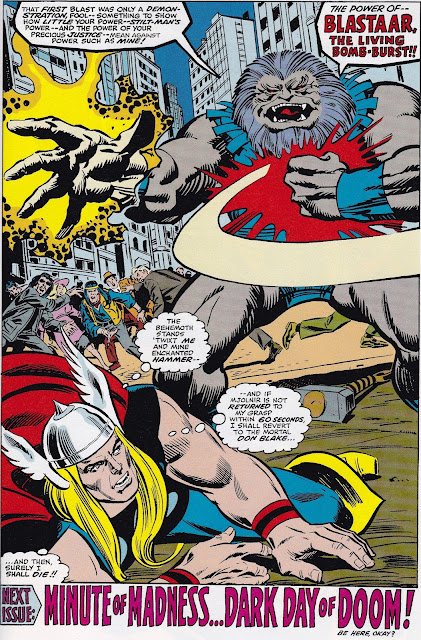
 

The Ugly: My frame of mind, for one. I'm sorry to bring a cloud over your Monday. It's not what I usually do -- generally I can get on board with most of what I read for the reviews I write. But outside of the art, I can't toss a single kudo Len Wein's way. Well... OK, I lied about that. There was one specific panel, early in the story, when I segued back to my 12-year old self and did a Beavis and Butthead laugh in the back of my head. So maybe my sense of humor is the "big ugly" here. And a request for forgiveness if my sophomoric humor offends anyone. Thanks in advance.  

Monday, April 4, 2016

All That's Left is a Band of Gold - Savage Sword of Conan 14


Savage Sword of Conan #14 (September 1976)(cover by Earl Norem)
"Shadows in Zamboula"
Roy Thomas-Neal Adams/"the Tribe" (although databases credit Tony DeZuniga on the inks)

Doug: A little over a month ago I mentioned in a comments section that today's review would be coming your way. I said then that I'd originally intended to do a Thor issue from the first few post-Kirby offerings. Noticing that Neal Adams was the first artist on the post-Jack scene, I was drawn to that 2-parter. However, upon leafing through those two books and seeing the odd combination of Adams with Joe Sinnott's inks I was pushed away. Eyeballing the shelves in my comics room, I was reminded that it has been years since we ran a Savage Sword of Conan review (we've only done two in our long history here), so I zeroed in on the spines of the four collected volumes I own. I decided just to grab the second compilation and see what lurked within. Of all the stories inside, only two were not penciled by John Buscema. Since he's sort of the Conan go-to artist, I wondered about finding something different so I checked out first the Gil Kane story and then the Neal Adams tale. If you ever ask me to pick between those two artists I'm going to choose Adams 100% of the time -- no question. So here we are.


Doug: I've said it before, but some of the things I'd snatch up had I a time machine and a fair amount of cash are Marvel's various Bronze Age B&W magazines. The art is so spectacular -- from the limited amount of material I've seen, there weren't many misses in terms of quality. The inks are lush, and the use of wash, zipatone, etc. really give some great textures that the coloring of the day simply could not provide. If you've never laid eyes on these "essential" Savage Sword books (I lower-cased that, as these are published by Dark Horse, not Marvel), I'd encourage you to seek them out. They are thick, and a sight to behold.

Doug: So let's get this moving with a 100-Word Review of the plot, as I'm guessing few among our throngs of readers have read this particular tale.

Conan finds himself in Zamboula, warned against staying at the tavern of Aram Baksh. Allegedly men who sleep there disappear, their goods sold at the bazaar. Conan’s investigation soon leads him into conflict with cannibals from Darfar, and a bare-breasted damsel in distress. Further, a drugged Turanian soldier and an idol for human sacrifice add to the suspense. Conan is tested against a Black giant, reality-warping drugs, and the peddler of flesh, Totrasmek. A magical ring is the center of attention, for it enslaves the hearts of the opposite sex. Lies, peril, swordplay, and thievery dominate this fast-paced tale.

The Good: I sometimes feel like I need to take a deep breath when I'm reading these Savage Sword stories. It's pretty well known that John Buscema felt most at home with Conan the Barbarian. I think we could make that same argument of Roy Thomas. Sure, we all know of Thomas's affinity for the WWII-era heroes and the opportunity to retcon their histories. But he seemed to really put out with the Cimmerian. You could also add to the argument by stating how easy it must have been to work with the likes of Buscema, Kane, Adams, and the wonderful lot of Filipino artists that dot the Marvel B&W titles, as compared to lesser (and that's not really a dig) talents that might have been his partners in the four-color books. I just think there's a true comfort in the pacing, dialogue, and eventual payoff in a Roy Thomas Conan story. That being said, I know he has his detractors in the regular Conan mag, and it's been stated on this blog that post-#50 the drop-off in quality is marked. So what do I know?

Neal Adams's art is Neal Adams's art. It's beautiful. I read somewhere (maybe it was even Sean that suggested it in earlier comments here on the BAB) that Tony DeZuniga had tremendous influence on this issue. I suppose I see it in some places, but I mainly see Adams. The faces, angles of the body when walking, the motion of a turn -- some of those are specific traits that I see in Adams's pencils whether here or in a Batman or X-Men story. I also liked the attention to detail on Conan's hair. I know, sounds sort of metrosexual for a barbarian yarn. But if you've read some of the Robert E. Howard stories, Conan's hair is jet black and trimmed straight across his forehead. Adams honors that in nearly every panel. Small detail, but it adds authenticity to the portrayal of the character.


The plot, as I mentioned, was solid. It was extremely well-paced, slowing only when the tension of an action scene was required. There are some movements in the story, but I never felt that getting from here to there required me to suspend my disbelief (beyond "normal" in a sword/sorcery story) or accept any deus ex machina developments. Adams's panel layouts stayed mostly to the grid, but he just often enough mixed in a no-panel layout to keep me enthralled. There are three splash pages in the story, all appropriately placed and effective. Often the figures and/or accessories spill outside the panel's constraints, and I find that effective as well. The end panel is suitably "Conan", and left me with an "of course" smile.

An element of Conan stories is a sort of continuity-without-continuity. For example, on the first page Thomas pens that Conan is accosted in the bazaar by "one of his former Zuagir comrades". I don't necessarily need to know of that episode, but it places the thought into my mind that this Conan fellow is well traveled and well-adventured. Also, the use of city and national names gives Conan stories a "universe" feel. A Tarzan story, to draw on another major mythical adventurer, doesn't give me the same sense of geographic wonder; perhaps that's because Edgar Rice Burroughs anchored his ape-man in our own world.

My favorite part of this story was the 8-page mano-a-mano battle to the death between Conan and the Darfarian giant Baal-Pteor. The creators crafted a vignette with a great deal of tension and an outcome of which I assumed but could not be fully convinced.


The Bad: There's really not much to say here, other than I wondered about this rough-and-tumble world where barbarians stride through town shirtless and later meet and have an adventure with a beautiful woman, also shirtless. Makes me wonder why I'm sitting here wearing clothes... (no, not really). Cover up! Sheesh.

The Ugly: The only ugly thing about this story, or any Conan story for that matter, are the baddies. Whether here with Adams or in a Big John-penciled tale (or shoot -- in my imagination as I read a Howard short story), the denizens of these mythical cities never disappoint in terms of menace. But as to any story element? I got nuthin'.

As I said at the top, do yourself a favor and check out some of these stories. You know, we often bat around "what's so great about the Bronze Age?", and we always tend to focus on Treasury Editions, Megos, the Giant-Size and Dollar Comics, etc. But these magazines are a vital component of 1970s comics history and should not be neglected as part of the larger experience.


Monday, December 1, 2014

Arc of Triumph? Amazing Spider-Man 176-180


Doug: Here's a little run of comics that I actually just sold about three weeks ago. What recollections do you have of this 5-parter? I recall it being very exciting, and especially liking the redemption of Harry Osborn. The Ross Andru art was just very steady throughout the 1970s, and this arc was no exception. I'd have to read this again, but overall I have fond memories.


Sunday, November 10, 2013

BAB Classic: Doug's and Karen's Favorites -- Thor Annual 5


NOTE:  This post was originally published on July 25 2011.


Thor Annual #5 (Summer 1976)
"The War of the Gods!"
Steve Englehart-John Buscema/Tony DeZuniga

Doug: Man, how do you put your finger on that favorite Annual? The usually-summertime release of these treasures makes them so memorable! I'll declare right now that this is my favorite, and that's saying something. There are some great Fantastic Four Annuals (#'s 5 and 6 come to mind), and I've always enjoyed Amazing Spider-Man Annual #1 as well as Daredevil Annual #1. Oh, and I forgot to mention FF Annual #2, with the origin of Dr. Doom. And then there's... See what I mean? But this one's really stuck with me over the past 35 years, and as it also happens to be a fave of my partner's, we're going to give it the BAB treatment to close out this summer's Giant-Size July.

Doug: Scribe Steve Englehart gives us the "Tales of Asgard" treatment over the first 7-8 pages, and it's a nice rendition with John Buscema providing the visuals. Sure, you can't go wrong with Jack Kirby, but there's such a majesty to Big John's art and it's on full display here. Englehart reminds us how, according to Norse mythology, the universe, Earth, the giants, gods, trolls, and finally humans were formed. It's a nice story, and a great entry point for readers who might have come along here to a Thor magazine for the first time.

Karen: I find it really interesting that Steve Englehart wrote this story. As far as I know, Englehart never had any kind of run on Thor. The only time he worked with the character was in Avengers. I'd love to know why he was given this assignment. But whatever the reason, I thought he handled this mythic narrative very well. Of course, Buscema's art is magnificent, even if DeZuniga is not my favorite inker for him.

Doug: As Chapter 1 begins, following the lengthy but able prologue, we meet the mighty Thor, prince of Asgard. Thor's personality is laid out for us: brash, loyal, a fighter. We're told of his affinity for Midgard, and that he is wont to pay heed to the prayers of mortals that are directed toward him. We also see the forging of Mjolnir, and here is the reason why I've always thought the mallet to be made of stone -- it's right here! Of course, every other source tells us it's made of a metal known as Uru, but here Englehart clearly states that it's stone. And no argument from me -- in my eyes, it had always been portrayed as if it were stone. As Englehart's background information segues into today's story, Thor appears near the Arctic circle to join a battle on the side of his beloved Vikings. These men are engaged by warriors not known to Thor, but nonetheless Thor brings death to them. We cut away briefly to the headquarters of the invaders and find that they are Greeks, who now pray to their champion -- Hercules, son of Zeus!


Karen: This reminded me a bit of that sequence in the Thor movie where we see the Vikings and then the Asgardians vs. the Giants. The idea that Thor really is a legendary figure is driven home here. Might this have been the first time any writer presented him as hearing and answering prayers? Regarding Mjolnir, yep, it always looked like stone to me, and Englehart calls it stone here -but we're always told uru is a metal. Eh, it's mythology -maybe it's both a metal AND a mineral???

Doug: So what do you think of this yarn so far? I recall as a kid just hanging on every word and picture. I was really into mythology at this point in my young reading life, so for these tales to spring to life was astounding. I don't think I'd fully fleshed out my opinions on various comic book artists, but I knew that Big John was something special. I knew nothing of Steve Englehart (though I'd been loving his run on The Avengers), but his manner was easy. I probably didn't know him from Roy Thomas, but I'd say now that Roy would have worded this up even more in order to include limitless literary references.

Karen: I checked out every book on mythology from our public library a dozen times. I couldn't get enough of it. So this -and the old "Tales of Asgard" tales -were music to my ears. As for Roy, when he finally did write Thor, we got that "Ring of the Nibelung" storyline that seemed plopped down in the middle of the very exciting Celestials storyline. I know people complain about the "Trial of the Flash" as an overlong storyline, but for me it was excruciating waiting for Roy to get done with his Wagner fixation and get back to the cosmic conflict!

Doug: Well, back to the battle royal at hand. Big John really cuts loose in this scene -- I don't think I'm exaggerating if I say that it's quite possible to hear the battle while looking at the beautiful tableau in hand. After several pages of awesomeness, however, Thor decides that the brutalities between he and Hercules can only end in a draw. So, agreeing to resume the battle of Greek and Norsemen in one week, they part. But, upon retiring to Asgard, Thor is much disappointed when Odin rebukes him for setting up the coming war. Of course Odin is the wiser, but brash Thor will hear none of it and turns on his heel. Wily Loki watches from above, grumbling to himself that Thor is never restrained. Turning himself into a fly, he departs for... you guessed it -- Olympus!

Karen: It's interesting that at this point in time, Thor and Herc have very similar personalities -brash, immature. Back when Hercules first appeared in Thor in the '60s, he was always shown in this manner, while Thor was portrayed as more somber and reasonable. It's fun to see a younger Thor here, with a little more fire -even if he was a dunderhead.

Doug: On the mount, Herc is meeting the same fate that Thor was faced with. It's a bit worse, though, as aside from bloodthirsty Ares (why, oh why, did Bendis ever think Ares was an Avenger??) no other among the pantheon of Greek gods will side with Hercules. I want to add that there's plenty of great characterization here -- Englehart gets the voice and personality of each of these gods and goddesses. But remember Loki... Suddenly "Thor" materializes in the midst of the Olympians and strikes Hercules while hurling insults at one and all. It doesn't take Zeus long to come over to Herc's point of view -- it shall be WAR!

Karen: Englehart knows his mythology too, as he has Hera show her disdain for Hercules, "the unfortunate result of earlier escapades"!

Doug: Yep -- caught that. And if she knew ol' Zeus was going and disguising himself as all manner of beast... What a war it is! Buscema again is really allowed to cut loose. There's a lot of pageantry in this battle, as it oozes "epic" right off the printed page. There's a nice little vignette involving Balder battling Ares and again, Englehart nails it. But in the end, it is the Asgardians who triumph. As the dust clears, the Valkyries ride low to gather their dead. One day, Thor says, all of them will ascend to Valhalla. But not this day.

Karen: The artwork is spectacular. I can only imagine that Buscema had a blast drawing ancient warriors, horses, weapons, etc. This was like Conan but on a larger scale.

Doug: Chapter 3 opens in Odin's throne room, as Loki is in custody and Thor stands before his lord. Thor, dull one that he is, wonders how Odin knew it was Loki who orchestrated the battle. Odin has a couple of great lines in this scene, as does Thor. I know I'm gushing over and over, but this story is so well-played that it rivals anything Stan and Jack did in the Silver Age. Correct me if I'm wrong, but I don't think I am. Thor, disgusted that his father will not pay him tribute, gathers his mates to set off to inspect their spoils. Venturing across Bifrost, they head to Olympus.

Karen: Odin is very well handled in this story. He comes off as regal and masterful, not petty as he often seemed in the Lee-Kirby era.

Doug: But in Olympus, Thor and the others are not recognized. In fact, they are insulted. Thor, ever the hothead, decides to bring the thunder to the Greeks. But as he raises Mjolnir, naught transpires! Disgusted and dismayed, the Asgardians immediately return to the North. Storming (no pun intended) into Odin's quarters, Thor seeks answers. As father and son battle to be heard, it is the All-Father's voice that wins out. When Odin speaks, he informs Thor of his machinations behind the scenes and with his counterpart Zeus. The Olympians, you see, believe that they won. And then Odin imparts wisdom in a morality play that ends our tale: the Asgardians exist because the Vikings believe in and worship them; likewise for the Olympians and their Greeks. It's a symbiotic relationship, Odin explains, and one Thor doesn't quite grasp. Why, then, would he have power in Olympus? They believe in him not. Departing abruptly, Thor wanders, feeling like he's been played. Venturing near the quarters of Karnilla the Norn Queen, he allows her to prophesy to him -- of coming champions with which he will ally himself: the Avengers. And our young thunder god knows one thing: that he doesn't yet know everything.

Karen: I liked that idea, that the faith of men strengthened the gods. Of course, it doesn't hold up when you think about Thor's battles in outer space with aliens who haven't a clue who he is, but it's still a neat idea. Buscema portrays Thor's frustration very subtly. The quick flash of the Avengers was nice, as was the final page showing the thunder god in his glory.


Doug: This story was recently reprinted in a trade paperback, Thor vs. Hercules. I'd say -- get your hands on it! I'll stop with the praises -- you should have gotten my message by now. What a great way to have spent 30-35 minutes as a 10-year old!

Saturday, August 3, 2013

Who's the Best... Inker on John Buscema?


Doug:  Given my love affair with the artwork of Big John Buscema, and given our love-in over his work on Avengers #56 just yesterday, and also given that in September I intend to showcase his first two issues on the monthly Conan the Barbarian, I thought it would be fun if we discussed the many men (and women?  I don't know, other than his grandaughter, Stephanie) who've put brush over his pencils.  Who did you think was a great match, who wasn't, what were some memorable jobs, and so forth.  I know this one should be lively, weekend aside.  Just in preview of those Conan reviews next month, issue #25 is inked by Sal Buscema and John Severin, and #26 by Ernie Chan.  The two books side-by-side could not look more different...

Doug:  For those of you curious or without that trained eye, the Avengers cover was inked by Tom Palmer, the Thor page by Tony DeZuniga, and the King Conan splash by Ernie Chan.


Related Posts with Thumbnails