And a Happy St. Patrick's Day to all.

 Doug: Wait - what? Where the heck is Man of Steel #5? Well, my partner Karen has been a frequent flier these past few weekends, and to give her a bit more time and to keep quality around here paramount, we've delayed your scheduled Superman fix to tomorrow. Hopefully, in a Bizarro sort of way, it will be worth your wait!

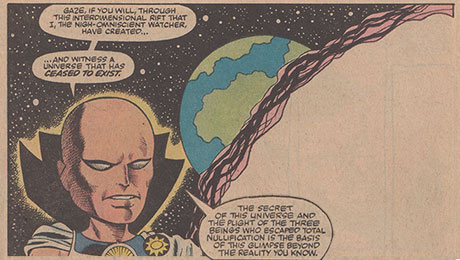
 Flashing back, we see a meeting of the inner council of the Guardians where debate rages over making the Corps independent. The major discussion centers on whether or not there is a ringbearer in the universe qualified to lead such a transition to independence. In a few panels that evoke Marvel's Watchers, the Guardians look to the future of potential offspring of the just-married Jor-el and Lara of Krypton. Allegedly genetically perfect, they would produce a child "of an incomparable nature". The Guardians are aware that Krypton will soon explode, and so dispatch Tomar-Re to slow the process until Jor-el (like an alien Noah) can ferry all Kryptonians to safety.
  The next two pages are quite exciting, as Tomar-Re uses the ring to guide him to Krypton with his next payload of Stellarium. We see interspersed panels of Jor-el and Lara with the rocket that can carry Lara and Kal-el to safety; Lara of course elects to stay with her husband. Tomar-Re's vision begins to come back to him and as he says "I think I can almost see... Krypton!" the planet explodes. He is nursed back to health by the Guardians and they discuss whether or not saving the planet would have been worth more than the outcome -- Superman's life on Earth and his maturation into the universe's greatest champion.
  Karen: Hey kids, I'm back with the next issue of the original Deathlok run, Astonishing Tales #27 (circa December 1974). This time around Rich Buckler and Doug Moench are credited as co-plotters, but Buckler is credited with art and story, so I guess he actually scripted it. The last time we saw our zombie-cyborg pal Deathlok, he was trying to find his war buddy Mike Travers. He tracks him to the Statue of Liberty, fights his way through a bunch of goons, and then opens a door to reveal his nemesis Ryker, along with a bizarre cyborg werewolf that Ryker calls the War Wolf. Ryker says that the War Wolf is actually Mike Travers, and this creates a dilemma for Deathlok: he can't kill his best friend. However, as Deathlok appears to be on the ropes, Ryker, for some reason, decides to tell him that the War Wolf isn't Travers after all; Travers died on the operating table. Why do villains always seem compelled to do stupid things like this? This of course gives old D-lok a big boost and he battles back, defeating the War Wolf, in particularly brutal fashion.
 former husband - and right before he's about to enter his son's room, Deathlok realizes what a terrible idea this was. He runs outside and in his despair tries to shoot himself in the neck, but his computer makes suicide impossible. He realizes that he can't escape the life he's in, and he can never return to the life he had.
 e he had been hearing (the one neither Luther Manning's nor the computer's) was actually an implant Ryker had been using to track the cyborg. Then there's some talk about him feeling persecuting and Ryker trying to make a god machine - honestly, it seems sort of crammed in there. I know what Buckler is going for here but it seems a bit ham-fisted.
 n't recall his name at all. In any case, it's very light and inconsistent.