Saturday, July 9, 2011

Good Day, Sunshine! It's Another Do-It-Yourself Open Forum!

Doug: By now most of our avid readers and commenters know the drill -- today is a day when the first respondent is el jefe (the boss)! Yep, you're in charge of whatever it is we're going to discuss. So make it a good one. And the rules remain the same -- no thread hijacking. Whoever set their alarm clock early should be rewarded, so play nice!

Everyone have a great day!


Friday, July 8, 2011

Shield-Slingin'


Karen: We're getting closer and closer to the opening of the Captain America film. I for one am very excited by what I've seen. Here's a short video about Cap's shield. I think maybe Norton had something to do with it...


Thursday, July 7, 2011

How Am I Doing on Your Worth-o-Meter?

Doug: Even though we really haven't shown it much (there's just too much to do and not enough time to do it!) around here, Karen and I are big Legion fans. We've done a few comic reviews, and there's certainly been a comment here and there in the midst of our Side-by-Side series when the Legion becomes a topic within a certain year. The multi-part "Great Darkness Saga" was a fun series to review, and sooner or later we're going to tackle some more Dave Cockrum and Mike Grell 1970's goodness. But today we'd like to ask you to rank some Legionnaires in regard to their usefulness. You can choose from the entire roster (reboots included) if you want, and tell us who in your mind are your MVP's, and then toss a little dirt on those you just scratch your head and mutter, "Say what?" Who are your favorite characters (usefulness aside), and who can you simply not stand?

Doug: If this seems somewhat familiar, Karen led a great discussion earlier in the year, with Triplicate Girl as a focus; but I figured the Legion is so large in its own right that we could toss the question out again, but keep it to just this team. After all, if you read our recent reviews of the JLA/JSA/Legion team-up, you saw us complain again and again about the strange combination of Legionnaires, and how certain characters when forced to fight solo weren't all that scary. So, using the wonderful George Perez image below as your guide, do some rank-ordering of our 30th Century teen heroes!

Have fun!

Wednesday, July 6, 2011

Marvel and DC: Side-by-Side in 1968


1968

Doug: Last week I asked you to pay close attention for signs that the Silver Age was gradually shifting into the Bronze Age. With today's post, I think we can all agree that change is coming. We'll see a "Marvel explosion" as their distribution problems that limited them to just over a dozen titles per month would be fixed. DC, still riding the high of the Batman television show, will be forced to continue to evolve as Marvel kept growing. And in the world outside our windows, turmoil was the daily word. Dr. Martin Luther King, Jr. was assassinated in Memphis in April, and sure-to-be Democratic presidential nominee Bobby Kennedy was gunned down in Los Angeles in June, the same month James Earl Ray was arrested for King's murder. Students rioted around the globe, and the Soviet army put down the "Prague Spring". The men aboard Apollo 8 became the first to orbit the moon. Hot Wheels were introduced in September, 60 Minutes premiered on CBS the same month, and in December the Beatles released the White Album. At the movies, the Beatles released Yellow Submarine; Planet of the Apes and Night of the Living Dead gave us pause, and 2001: A Space Odyssey was Stanley Kubrick's masterpiece.

Karen: Kind of amazing how we went from the 'Summer of Love' to this. I guess the final nail in the coffin of the hippie movement would be with the Stones and Altamont in the following year.
Doug: In the first quarter, Marvel brought back a character from its Atlas period when Roy Thomas re-made the Black Knight in the pages of Avengers #48. Later in the year, in Marvel Super-Heroes #17 (November), Dane Whitman met his predecessor Sir Percy of Scandia. By the way, neither was related to the dude who suited up with Baron Zemo's Masters of Evil in the early Avengers issues. Also in January, Whiplash first surfaced to menace the Golden Avenger, in the pages of Tales of Suspense #97, and Gwen Stacy's father was introduced in Amazing Spider-Man #56. George Stacy was a retired NYPD captain and close friend of Joe Robertson. Stacy was one of the few members of Spidey's supporting cast who deduced that Spider-Man was Peter Parker. The Wrecker debuted in Mighty Thor #148, and he was eventually empowered by Asgardian magic. In the 100th issue of Tales to Astonish, the Hulk and Sub-Mariner battled each other, and in X-Men #42, Professor X was believed to have perished; it was later revealed that the Professor was in reality the Changeling.

Karen: I've always liked the Black Knight, although any sword-wielding super-hero has the problem of how to not kill anyone with their sword. I recall BK and Valkyrie always saying stuff about using the flat of their sword -kind of takes all the fun out of it, doesn't it? Capt. Stacy was a nice addition to Spider-Man's cast, but I don't so much credit him with being a great sleuth; rather, the rest of Peter's associates were not very perceptive!

Doug: Across the street at DC Comics, January gave us a very liberated Lois Lane as our reporter shed her business attire in favor of more mod fashions; this "new Lois" would evolve throughout the remainder of the 1960's and into the '70's. Yep,
Superman's Girlfriend Lois Lane #80 was the demarcation line. In March, John Broome and Gil Kane gave us one of the 1980's (see the DeMatteis/Giffen/Maguire Justice League if you don't believe me) most memorable characters with the first appearance of Guy Gardner (Green Lantern #59). Believe it or not, as Abin Sur was about to die, his computers had located two men who would be worthy to wear the ring of the Green Lantern Corps: Hal Jordan and Gardner. Lucky for the universe that Jordan just happened to be closer to the crash site!

Karen: It sort of blows my mind knowing that Lois Lane had her own series for years. In the 60s even. But there were all sorts of books on the racks back then. And of course, her title was really more a comedy than anything else, although I gather it got more serious around this time period.

Doug: I'll admit, I'm taken aback by how relatively late some of these stories that I actually owned as a kid as back issues were published. I had the
Thor with the Wrecker (I had the previous issue with a battle against Loki as well), and as a child I just thought a 12c comic was ancient history. To think that this was 1968 already just seems odd to me. Yeah, I understand that prior to 1961 there weren't any Marvel Comics per se, but I'm still having a sort of time disorientation here. Maybe its the proliferation of reprinted material that's throwing me off, I don't know...

Doug: As we headed into the spring,
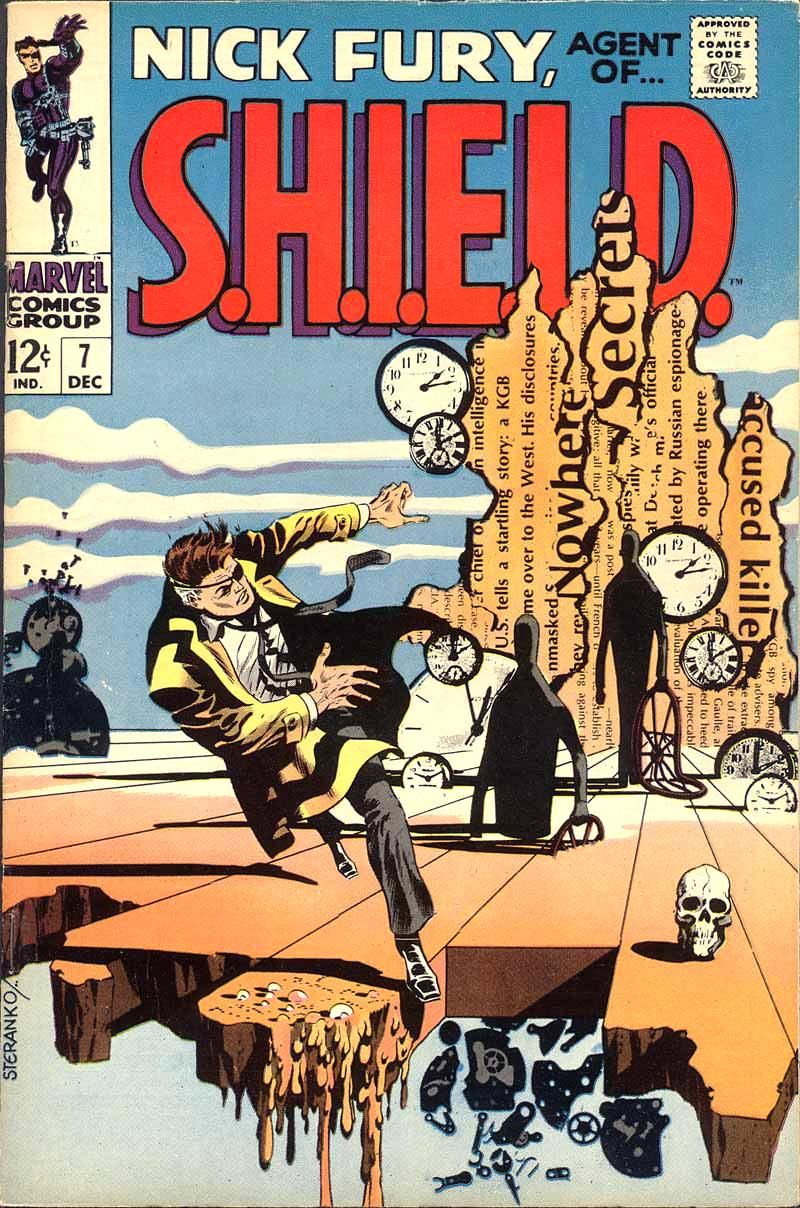
Iron Man and Sub-Mariner #1 served as a bridge to each character getting their own solo titles; this book was not a team-up, however, as each character appeared in an 11-page story of his own. Both title characters received eponymous first issues in May. Marvel's family history began to get a little convoluted in the pages of Avengers #52 (May) with the introduction of the Grim Reaper. It would get even more twisted in a few months... Also in May, Roy Thomas brought back another Golden Age creation when Red Raven appeared in X-Men #44. Another #1 hit the stands in June, as Nick Fury moved out of strange tales and into his own Nick Fury, Agent of SHIELD. Writer/artist Jim Steranko introduced Scorpio in this issue, a villain who was really Jack Fury, Nick's younger brother.

Karen: This was also the brief period where Marvel had the X-Men split up and the individual characters got solo stories -as demonstrated by the cover to the left, featuring the Angel. They were trying to find something that would turn the book around. That wasn't it.

Doug: Spring at the Distinguished Competition brought several key introductions and production firsts. In April, Showcase #73 featured the debut of the Steve Ditko-created Creeper. A quite bizarre-looking fellow, the Creeper received a solo title in June. In May, the man most associated with the Bronze Age Batman penciled a full-length adventure featuring the Dark Knight for the first time. Neal Adams drew a Leo Dorfman script in World's Finest #175; the rest is history. Also in May, DC further "complicated" its multiverse in Flash #179, when Barry Allen was cast into "Earth Prime", where super-heroes only existed in comic books. Yep, Earth-Prime is our world, and Julius Schwartz was the only man who could help the Flash return to Earth-1. Two other key debuts in DC lore were Secret Six #1 (May) and the debut of the Hawk and the Dove in Showcase #75 (June) -- it's amazing how that title just kept rolling, with every issue seemingly a key. There wasn't much that appeared in Showcase that didn't stick, at least temporarily.

Karen: Showcase does seem to have a pretty good track record. I mean, if you compare it to some of Marvel's similar titles, like Marvel Premiere or Marvel Presents - well, you don't exactly have people clamoring for Woodgod or Monark Starstalker stories.

Doug: The summer at Marvel was pretty significant, as Daredevil's foe the Jester (well, not so significant) first bowed in
Daredevil #42 and Ultron (way significant) debuted in Avengers #54. Hmmm... Wonder Man, the Grim Reaper, Ultron -- what could be next? Also in July, Mangog entered the scene with the destruction of Asgard on his mind, in Mighty Thor #154. Spidey ventured into the magazine world in Spectacular Spider-Man #1, a black & white tabloid, and in August the Silver Surfer received his own title. An extra-length book priced at 25c, the book featured a full-length story of the Surfer by Stan Lee and John Buscema, and a back-up spotlighting the Watcher by Lee and Gene Colan. For my money, cover-to-cover this had to be the most beautiful book on the stands at this time.

Karen: Beautiful work by Buscema. I have a hard time reading those old Silver Surfer comics now because they were just so ridiculously 'woe is me' and preachy, but there's no denying the art was gorgeous.
Of course, it was another thing that ticked Kirby off and hastened his departure from Marvel.

Doug: Summer was a bit thin (in my opinion) at DC, with only
The House of Mystery changing to a horror anthology (hosted by Cain) with issue #175, the August introduction of Bat Lash (Sergio Aragones and Nick Cardy, creators) in Showcase #76, and the introduction of Angel and the Ape in Showcase #77 by John Albano and Bob Oksner. None of these books would fall under the category of "Doug's fare". More substantially, CBS Saturday mornings welcomed the Batman/Superman Hour, which was the Caped Crusader's first animated program. And it took 30 years?

Karen: Oh boy, I really enjoyed those cartoons! It was really my initial exposure to the DC characters, and the main way I knew anything about them for many years. I can still hear the theme music from the Batman cartoon.

Doug: Well, we've been waiting for the completion of Marvel's weird, dysfunctional Avengers family. Wait no longer.
Avengers #57 was cover-dated October, and featured the introduction of the Silver Age Vision. Again, Roy Thomas often used names and/or characters already in Marvel's stable -- it's been said that Thomas did not want to create something that might go on to be hugely popular and financially lucrative; this was the era before creators' rights and royalties. This Vision, while somewhat resembling the Golden Age character, was an android created by Hank Pym's robotic construct Ultron. Imbued with the brain patterns of Simon Williams, Wonder Man, the Vision now completed what would go on to be a running story, to the present. In October, both Lorna Dane, the future Polaris, and Mesmero were introduced in X-Men #49. The issue was created by Arnold Drake and artists Don Heck and Werner Roth. The Badoon first appeared in Silver Surfer #2, and Dr. Faustus menaced Captain America for the first time in Captain America #107. In Amazing Spider-Man Annual #5, Peter learned what had happened to his parents, and in Fantastic Four Annual #6, we were introduced to Annihilus and witnessed the birth of Franklin Richards. The next month, in December, Crystal replaced Sue Richards on active duty in FF #81. Hank Pym did another costume (and personality) change in Avengers #59 when he became Yellowjacket. And to close the year, the devil himself, Mephisto, was introduced in Silver Surfer #3 as Stan further portrayed Norrin Radd as a messianic figure.

Karen: A great set of books there. It's no secret that I am a big fan of the Vision -well, up 'til the deconstruction. That whole speech by Pym about "we ask only a man's worth, not the accident of his condition" is such classic Marvel. However, I thought the story about Peter's parents being spies was a mis-step. Making them not normal folk seems to mess with Peter's everyman image. Luckily it doesn't have much effect on the title but it seems best forgotten.

Doug: Wrapping the year from DC, October featured a strange sort of "breaking the fourth wall" story in
Doom Patrol #121, when the creators implored fans to choose whether the Doom Patrol should save their own lives or the lives of 14 innocent civilians. Apparently comics buyers had been siding with the innocent civilians for many months, as the title was cancelled with this issue. The also-ill-fated Brother Power, the Geek (Joe Simon and Al Bare) #1 lasted only two issues. Simon attempted to tell his version of the Frankenstein story, but in a mod '60's style. Fish weren't bitin'. And in October, Diana Prince shed her Wonder Woman identity and became more of a Emma Peel-type of character in Wonder Woman #178.

Tuesday, July 5, 2011

BAB Re-Run: How Do You Interpret the Word "Collecting"?


Doug: We are re-running a post that originally appeared in the dawning of this blog, back in November of 2009. At the time it got no comments -- probably due to the fact that we had not-too-many readers back then. Several times in the past few weeks, our readers have commented on various purchases they've made lately that hearken back to the Bronze Age. I commented that Karen and I, too, are always looking for that next nugget that we'll parlay into a post or comics review. So, it sounds like we're all still, to some degree, buying old comics. And that brings us to today's (or way-back-when's) topic, which I've turned into an Open Forum question -- How do you interpret the word "collecting" in regard to your buying habits these days?


Doug: Thanks in advance, as always, for your participation.


Doug: Several posts ago, I made a remark about collecting comics. My posit was that I am more of a "possessor" than a "collector". I related a story about my mission of the late 1980's-early 1990's to amass a complete run of my favorite title, the Avengers. While I didn't chase after "reading copies", I was willing to accept some issues in the Good to Very Good range. Obviously, Fine or better was preferred, but as I got closer and closer and it was the very early issues that remained to be purchased, I compromised any investment potential.

Doug: While I was building the Avengers run, my friend Don was seeking to buy the entire Lee/Kirby run of the Fantastic Four. However, he was much stingier than I; consequently, he never achieved his goal -- but what he has (including FF #4) is in really, really nice shape.

Doug: I guess I somewhat fancy myself these days as having a comics library. I own a fairly nice collection of books about comics history, creator biographies, encyclopedias, and trade paperbacks/hardcovers from favorite stories/series. I would say the cornerstone of my collection these days are the four Marvel DVD-ROMs that I own -- complete collections (through about 2006) of Amazing Spider-Man, the Avengers, the Fantastic Four, and Iron Man. These discs have largely turned me away from collecting comic books themselves.

Doug: Of course the complaint about the DVD-ROMs is that you have to have a computer handy, and if that computer isn't a laptop then you can be talking about doing some uncomfortable reading. However, I'd argue that just the fact that each disc contains approximately 500 issues of continuity makes them a no-brainer economically. At the retail price they originally sold at, my four discs give me around 2000 comics for roughly $200. Do the math -- 10 cents an issue? DC's Archive Editions and Marvel's Masterworks offer you 10 issues for about $55 ($5.50/issue) and DC's Showcase Presents and Marvel's Essentials reprint 25 comics for around $16 (a little over $1.50/issue).

Doug: Now I do own several Archives (the complete Legion of Super-Heroes, for example) and Masterworks, as well as Essentials -- these are great things. The Essentials are especially nice, as they include complete stories, even when crossovers were involved. That would be one of the negatives about the DVD-ROMs -- no Giant-Size issues, for example. But here I am back to my original suggestion that I have become more of a possessor than a collector (as that term is generally applied to those who buy comics). To have, regardless of the format, has become my goal.
.
Doug: And therein lies part of the problem: what about that issue that can't be acquired in reprint form? A few posts ago we discussed the Secret Society of Super-Villains -- not available (to the best of my knowledge). How about some of the other short-lived series of the 1970's? Black Goliath, The Cat, and others? Not available. So, am I saying that I would never buy back issues that might rekindle those childhood four-color memories? No. But I guess I no longer go out of my way to find them. I sort of envy those fans who browse through the dollar boxes to find that hidden gem. But somewhat-sadly -- it's just not me any more.

Karen:
I think I am now a possessor as well. While I like having the original comics, it's just too expensive for me to try to buy them all, even in Good condition. Now that I have the DVDs, and a number of Masterworks, I feel I've filled in a lot of gaps. I can see myself spending my comics money on Masterworks for more obscure titles, or buying original comics of series that aren't too expensive. I just don't feel the need to have a NM copy of Avengers #1 - I just want a copy I can read, whatever the format.

Karen: That being said, I wish the Masterworks were like the DVDs and included ads, bullpen bulletins, and letter pages, or at least the letter pages. I like the ease of the masterworks (no computer necessary) but miss those elements.


Monday, July 4, 2011

Giant-Size July: Fantastic Four Annual #11


Happy 235th Birthday, America!


Fantastic Four Annual #11 (June 1976)
"And Then the Invaders!"
Roy Thomas-John Buscema/Sam Grainger

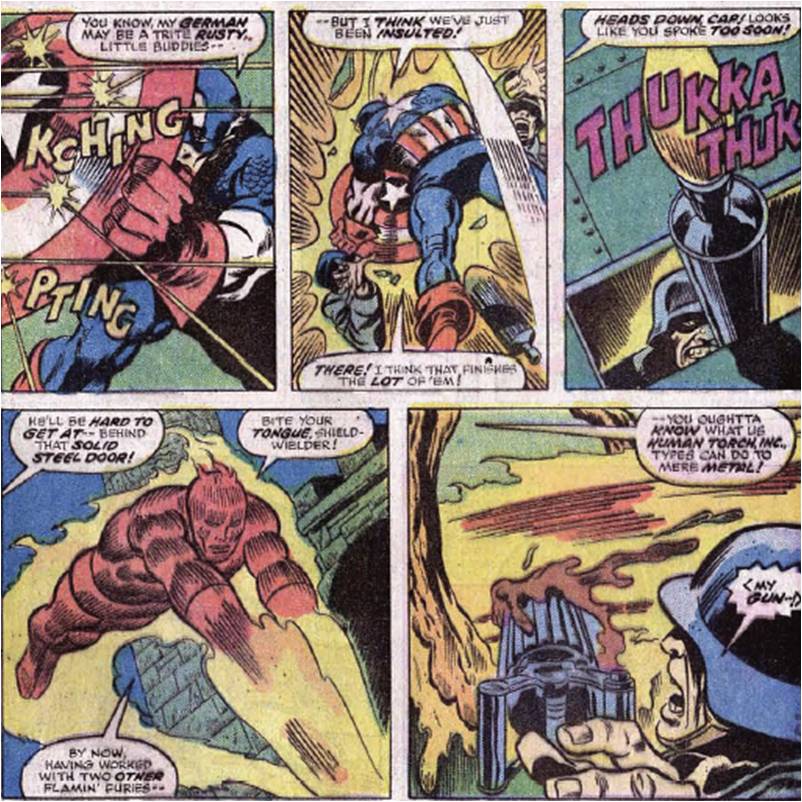
Doug: It seems only fitting that on the day the United States celebrates her independence we'd bring you a review of a story not only from our nation's bicentennial, but rife with American patriotism during the Second World War. Capitalizing on the success of The Invaders, scribe Roy Thomas brought together his two favorite Marvel teams and weaved a tale befitting the Annual format. This is a long but never drawn-out story -- a real gem from my 10th summer!

Karen: I'm going to say right up front: I really enjoyed this story! Nine super-heroes, Nazis, time travel - what's not to like?

Doug: We open in the Baxter Building with our heroes under attack. A page-turn later we understand why -- they are being put through their paces by technology provided by Professor Charles Xavier; in effect, the FF has opened up their own Danger Room! After much duress, Bashful Benjy's had enough -- his cries to Reed that's it enough already aren't met with the answer he'd like, so in a tantrum befitting his size and strength, the Thing pounds his way to freedom through the floor. Reed tries to get him to stop, as the drill has only 26 seconds remaining, but Ben's having none of it.
Once the dust settles, both Sue and Reed chastise Ben for his outburst, and harp on the financial situation of the team. Ben's response is to get on Doc Doom's time machine and seek wealth in the past, just before the California Gold Rush of 1849! Ben likens that mission to their first time travel expedition when they nearly had Blackbeard's pirate treasure. I'd comment that Roy Thomas, through all of his footnotes, has really woven a true jumping-on story. A new reader would feel very comfortable with this magazine in hand, as Thomas links this story to recent and "ancient" FF history, as well as describing each team member's powers and showing us his/her personality. I was just really struck by how accessible the first several pages of this story are.

Karen: Agreed. A nice little action sequence right up front to draw you in, with plenty of dialogue that really fleshes out each character.
Doug: On the way to the chamber where the time machine is stored, Ben and the others are shocked to find Nazi troops in the room! Of course a brouhaha breaks out and the overmatched soldiers are quickly subdued. Reed begins to speculate how they came forward through the time stream. Johnny wonders why there's such a hurry to return them and Reed explains how delicate the time stream is, and that the men must be returned to exactly the precise instant they left. Trouble is, he doesn't have that time stamp. Suddenly, Reed's also aware that a cylinder of Wakandan vibranium is missing from a table beside the time platform. Speculating that in the melee with Luke Cage just days earlier (or in reality, in the events chronicled in FF #'s 169-170 [April-May 1976]), the cylinder may have been dislodged and fallen onto the platform, thus activating it. But what's even more worrisome is that the vibranium must have materialized in Nazi hands.
Karen: This is a very talky book, even by Roy Thomas standards! But I loved it, then and now. It felt like a real science fiction story, what with time travel and alternate realities.

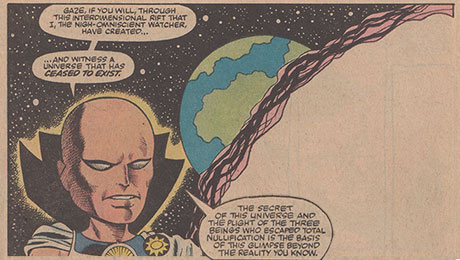
Doug: As Reed investigates further, he does find some information on a modification he'd made to Doom's original machine -- a time stamp of his own, but which will require further study. However, puzzling right from the get-go is the year: 1946! And as that weirdness sets in, the King of Weirdness arrives -- the Watcher! Seriously, that guy gives me the creeps. I cannot imagine what it must have been like in the "real" four-color world to encounter this big dude! The Watcher says nothing, but his mere presence clues the FF in pretty quickly that they're onto something big. Reed heads to another lab and rigs up a viewer set to the time on the time travel platform. The team is able to view images from 1946 -- images of Cleveland, New York, London, and Moscow -- all under the Nazi flag! These soldiers have come from a timeline where the Axis won WWII!


Karen: I love the old continuity. This story takes place after the trial of the Watcher from over in Captain Marvel, so Uatu is prohibited from actively helping or even speaking to the FF. But his presence here does indeed denote a serious situation.

Doug: Naturally, the FF hop on the time platform and Reed sets it for 1942 -- early enough that the team can stop the Nazis from getting the vibranium. And wouldn't you know it? Rather than re-materialize in the forests of Europe somewhere, the FF emerge right smack in the middle of an Allied intelligence meeting -- with the Invaders! You know Roy just did it that way because every superhero team-up must first start with the obligatory misunderstanding. Ben gets loud, Namor gets mad, all the Torches light up, and it's just game on! Reed tries to get things slowed down, and Cap overhears some of the chatter from our guys. Eventually the mess is put down and everyone agrees to play nice. Once listening, our stars are informed by the representative of the Free French that their mission will be to invade Castle Cherbelle and take down Baron Zemo!

Karen: Even Roy makes light of the contrived nature of the situation as he has Reed think, "I should have known it would be like this! If there's one thing I've learned in dealing with a bunch of super-heroes, it's that they can usually be reasoned with, but first you have to get their attention!" He follows this up by spraying the Torches with water. The Invaders seem to accept the FF's story a bit too easily, but on the other hand we didn't need more pages of the two teams fighting.
Doug: Namor supplies an Atlantean cruiser for transportation and the nine heroes land quietly in a forest outside the castle. It's really no sweat for them to get inside, and once there they break into three teams: Reed, Sue, and Namor (yeah, how dumb is Reed? And Roy does a nice job of playing up old storylines here), Cap, Bucky, and Johnny, and Ben and the Torches. Each team has it's share of stumbling blocks, but nothing they can't handle. Of course it's Cap who encounters Baron Zemo, and very similarly to Avengers #56, when our same creative team brought us the last moment's of Bucky's life, we see Cap strike the vat of Adhesive X and forever disfigure Zemo.
As long as I've mentioned the creative team of Thomas and Big John Buscema, we may as well comment on the effectiveness of inker Sam Grainger. I'm surprised as we've gone through all of our comics reviews at how often Grainger's work pops up. As I've said in the past, I rather enjoyed him working over Sal Buscema on the Avengers in the late 1960's; lately it seems we've remarked that he's serviceable in the 1970's, but a favorite of neither of us? I'd go so far as to say he's pretty inconsistent in this story -- overall the art is nice, but the character faces seem to oscillate between fully-Buscema to Buscema-under-the-influence. What sayest thou?

Karen: I thought Grainger was acceptable, but this was far from his best work. Honestly, I miss Sinnott here.
Karen: I also thought it was pretty funny to see Namor already hitting on Sue, and Reed having him with them on their team -dumb! But the scenes of Namor cutting loose in the castle were some of the most exciting in the book. I think Big John must have enjoyed drawing him.
Doug: Once fully-infiltrated, the Castle can't hide it's true purpose: as housing for the enhanced V-2 rockets, now fully-equipped with guidance systems containing vibranium. The Torches manage to destroy all of the rockets but one, which is launched! The Thing manages to hang on and ends up with the ride of his life. Ben claws his way to the control panel and is able to manipulate some of the wiring, turning the missile around and steering it back toward the castle. While his teammates watch from afar, the rocket explodes, destroying Castle Cherbelle.

Karen: I couldn't help but flashback to "Dr. Strangelove" and Slim Pickens' Major Kong riding the nuclear bomb. That was a pretty spectacular explosion of that castle.

Doug: We then see Ben awaken back at the Baxter Building with his friends. Reed fills him in, they see the Invaders on a viewer, mysteriously waving at the FF in a big "thank you". Reed explains that their adventure had taken place in a divergent timestream, and so their presence in the War was not a problem. And this strikes me as odd, and here I go off again into the discussion of real time and Marvel time. Roy Thomas is insistent throughout this story that it is indeed 1976 (any doubters, shame on you -- the splash page reference to Chico and the Man should have been enough proof). While in Europe during WWII, Reed comments to Ben that they enlisted just shortly after 1942. So let's say they were 20 when they enlisted in 1944 or so. They would have been born in 1924, which by 1976 would have made them 52? Uh uh. Unless those cosmic rays de-aged everyone...

Karen: The divergent time stream is very convenient for explaining why neither the modern Cap nor Namor remember meeting the FF back in WWII!
But it's a legitimate idea, in the vast grey area that is time travel. But yes, it is hard to reconcile the idea that Reed and Ben, in 1942, were old enough to enlist. Even if they snuck in and lied about their ages -say they were 16 - they'd still be 50! Already, just 14 years into the Marvel Age, we begin to see the 'real time' aspect of it unravel. Of course, now the only war they might have been involved in was the first Gulf War -even that, being 20 years ago, is probably too far back for them!
Doug: The end of the story sets up our next review, which will be Marvel Two-In-One Annual #1: The Thing and the Liberty Legion! It seems that Reed was only able to come up with half of the cylinder of vibranium, and assumed that the other half was destroyed with the cache of rockets was destroyed. Ben doesn't buy it, and when the Watcher appears again... well, trouble must still be afoot. See you in a week!

File this under "Say what? Why, we had no idea!" Guess what? Every issue in this series we're running, plus the first appearance of the Liberty Legion, is available in a Marvel Premiere Hardcover edition that ships this Wednesday. You can read more about it and even order it here. How about that?

Sunday, July 3, 2011

Spotlight On: Steranko


Karen: Steranko - like Cher or Elvis, he only needs one name! Jim Steranko burst on the comics scene in 1966. He worked first for Harvey, but would soon join Marvel, where he would become a very popular artist for his work on the Nick Fury, Agent of S.H.I.E.L.D. feature in Strange Tales. He would go on to work on Captain America and also X-Men and a number of other titles. He was also the first editor of Marvel's fan magazine, FOOM, and produced the now-famous club poster.

Karen: Although Steranko's overall output at Marvel was rather small, he had a huge influence on his fellow artists. His graphic artist background was extremely evident in his work, such as the way he composed his panels and pages. Composition is everything in a Steranko drawing. His work is always dramatic; he knows how to utilize lighting and shadow for great effect. He had the pulse of the pop art movement and incorporated photographs and movie poster design into his work. Like some others (namely Neal Adams) he has a cinematic sense to his storytelling. He was also very fond of double-page spreads.

Karen: What say you all? Any Steranko fans in the house? What are your favorite issues that he drew? 


Saturday, July 2, 2011

Which Creation Epitomized Marvel in the Bronze Age?

Doug: Today's question is sort of multiple choice, and you can even feel free to add in your own topics of conversation. A few weeks ago I was thinking of several of Marvel's Bronze Age creations -- superstars of the '70's, if you will. And I was contemplating all of the Bronze Age goodness that these folks typify and it got me to thinking of you, the faithful reader. So I'm throwing this out to the masses: Which Bronze Age creation from the House of Ideas epitomized the creativity, envelope-pushing, and general style of Marvel between the years 1970-1985?

I'll start with a short list, and if you feel really strongly about a character I didn't name, go for it in all your convincing finery. Here are the four-color wonders I was daydreaming about --

  • Man-Thing
  • Ghost Rider
  • Dracula
  • Warlock (yeah, I know he was created in the Silver Age, but...)
  • Werewolf by Night
  • Shang chi, Master of Kung fu
  • Luke Cage, Hero for Hire
  • Howard the Duck (I wasn't thinking of him, but what the heck...?)
Enlighten us!


Friday, July 1, 2011

Hulk Smash Puny Avengers: A Look at the Hulk’s Brief Avengers Career

Karen: Howdy friends - today we're throwing at you another essay that was originally written over three years ago for a collection called Assembled! 3, which seems to be residing in limbo. So we hope you enjoy this look at the Hulk and his impact on the Avengers.

It would be hard to dispute that the Hulk was the worst Avenger ever. As a team-mate, he was surly, uncooperative, and had questionable hygiene. Worse yet, he would later prove to be an actual enemy to the team, and cause them no end of headaches. On top of this, he was only a member for the first 2 issues of the title (and maybe again in issue 100), making him also the shortest-tenured Avenger. Yet the Hulk was a founding member, and one way or another, he has had his impact on the team, despite the brevity of his career with them.

If one examines the Hulk's interactions with the Avengers, with very few exceptions, they all revolve around him fighting the team, even when he was an actual member! In the first issue, the heroes are gathered by Loki tricking them into battling the Jade Giant. In the second issue, they are again tricked into fighting Hulk, this time by the Space Phantom, who is imitating him. By the time the deception is revealed, the Avengers have made it clear that they don't trust the Hulk. He astutely recognizes that not only is he disliked, but further association with the team may prove his undoing: “You all hate me…fear me because I’m the strongest! If I stay with you, you’ll find some way to destroy me!” Accordingly Greenskin quits the team and takes off, only to fall into cahoots with the Sub-Mariner. The twosome battle the Avengers in issue 3, and from that time on, the Hulk would become a recurring foe.

While the battles between the Hulk and the Avengers have been numerous, one early encounter stands out for producing something positive: the first meeting of the Avengers and the Fantastic Four. In Fantastic Four #25, the Hulk reads a newspaper article (yes, this Hulk could actually read) and discovers he’s been replaced in the Avengers by Captain America. He jumps to the conclusion that his pal Rick Jones has left him to become Cap’s partner. Enraged, he heads off to New York to beat the tar out of his former group. But the FF encounters him first, and the Thing makes a valiant but hopeless stand against him. When the Avengers finally show up (in the next issue), they bump heads with the FF at first. The two groups can’t seem to coordinate their efforts, and neither is willing to concede authority to the other. The Avengers make it clear that they feel it is their responsibility to defeat their erstwhile team-mate. Ultimately though, the two super-teams unite to end the Hulk's destructive New York romp.

Despite all their troubles with him, the team didn’t give up on the idea of bringing the Hulk back into the fold. When Iron Man and the other founders hand the reins of the group over to Captain America in Avengers #16, Iron Man encourages Cap to seek out the Hulk as a member. While Iron Man says that the Hulk's strength could be useful to Cap's less powerful team, there's also the sense that he might be trying to redress the past situation with the Hulk. In all of their previous encounters, Iron Man seemed to be the one Avenger who actually tried to reason with the Hulk. His sense of responsibility towards the Hulk has continued to current times, with disastrous results.


Honestly, it's unlikely that Earth's Mightiest could have kept the Hulk in line for
any length of time. His inherent nature abhors order and compliance (despite his tenure with the Defenders, which was less a team than a bunch of guys hanging out at Dr. Strange's sanctum). But they seemed to have a hard time of letting go of the idea of the Hulk as an Avenger. The Avengers are still stuck on this thought as late as Incredible Hulk #128 (in 1970 – Avengers #76 was out the same month). When the team is brought in by General Thunderbolt Ross to try to capture the Hulk, Goliath (aka Hawkeye) tells Ross, “Y’see, we’ve got two reasons to hogtie that green-skinned galoot! For his own sake---and so we can maybe add some more muscle to our team!” Predictably, they wind up spending more time trading punches than words.

Although he shows up and goes peacefully with the team to Olympus in Avengers #100, Hulk’s major contribution there is sitting around listening to music and putting the moves on a terrified Enchantress. But at least he didn’t smash anyone.

By the time of the Avengers - Defenders War, Hulk’s association with his original team is pretty much completely dissolved. He recalls being an Avenger – “didn’t like it!” – but no one is advocating for him to come back.

Probably his only real contribution to the team was not a direct one. He is, after all, responsible for the creation of She-Hulk, his cousin, who has been a valuable and loyal Avenger for many years. Although she too has had her bouts of unpredictability - just ask the Vision.


It does seem like whenever the Hulk has gone completely bananas, the Avengers have been there to take him down. To be fair though, it's not as if the Avengers haven't also tried to help the Hulk. Once the true nature of his transformation was known, they worked with other heroes like Mr. Fantastic to find a way to cure him. They showed up as character witnesses when he was on trial (Incredible Hulk #153), and they even supported his being granted amnesty later on for all his past misdeeds (Incredible Hulk #278).

But as the Hulk's destructive toll grew over the years, the heroes became less patient with him, less focused on finding a way to help him than on a way to stop him. This culminated with the decision by Iron Man, Mr. Fantastic, Blackbolt, and Dr. Strange to send the Hulk to an uninhabited planet, where he would be able to live out his life in peace. Unfortunately, the Green Goliath wound up instead on a war-torn world where he was enslaved and suffered both physically and emotionally. The Hulk returned to wreak even more destruction on Earth, particularly on those four heroes.

While it’s likely that the Hulk would never have been able to truly fit in to such an organized super-team, the inability of the Avengers to somehow find a place for him among them and curb his destructive tendencies could be seen as one of their greatest failures.

Related Posts with Thumbnails