Thursday, February 20, 2014

Spotlight On: Steve Englehart


Karen: It seems only fitting as we're currently reviewing the Secret Empire saga from the pages of Captain America to throw our spotlight on super-scribe Steve Englehart. The Stainless One was a prolific writer for both companies and produced some of the most memorable and beloved works in comics (and he's a big favorite here at the BAB).  He had noted runs on Avengers, Defenders, Dr. Strange, Captain America, Detective Comics, Justice League of America, Green Lantern, and so many others. His work was layered and his characters were complex. He could write down-to-Earth guys like Cap or Batman, or go way out there with the likes of Dr. Strange. You name it, Steve could write it, and make it all seem exciting and fresh. But let's hear from you -what are your favorite titles and stories by  Stainless Steve?


Alex Ross Does Spider-Man and the X-Men for Marvel's 75th Anniversary


Doug: It's a new mid-month, so it must be time for Marvel's solicitations! As you're aware, we've been posting the variant covers to Marvel mags, as done by painter extraordinaire Alex Ross.  Check 'em out, and leave an opinion (personally, I feel like the X-Men image is my favorite so far).

All-New X-Men #27

Amazing Spider-Man #1.1

Wednesday, February 19, 2014

Super Blog Team-Up: Was the Vision Really Carrying a Torch?


"We ask merely a man's worth -not the accident of his condition!" - Henry Pym, Avengers #58, 1968


Karen: Today we'll be taking part in a multi-blog effort, the Super-Blog Team-Up (doesn't that just sound cool?) where we and like-minded bloggers will all be discussing topics centered around the theme of retcons. Once you've read and participated in the discussion here, please be sure to check out the other blogs linked to at the end of the post. For our part, Doug and I decided to discuss a character we both like a lot (and based on recent comments, many of you do too): The Vision.

Doug: I've told the organizers of Super-Blog Team-Up that we are flattered to have been asked to join in today's festivities. If you are a new reader to this space, coming over from one of the other participating blogs (all of today's participating blogs' topics appear daily on our sidebar), we welcome you. To our own regulars, as Karen said -- please patronize our partners of today. You won't be sorry for extending past your normal routine.

Doug:  From my earliest readings of the Avengers, and keep in mind that I came to the team about a year before the "Celestial Madonna" storyline, I have been fascinated by the relationship between the Vision and the Original Human Torch.  To read the Vision as one of the cornerstones of the Bronze Age Avengers, while simultaneously reading about his "earlier self" in the pages of the Invaders -- my young imagination could have been overloaded.  What a man of mystery!  Well actually -- men of mystery!

Karen: I think you know he's always been a favorite of mine, since he was basically headlining the Avengers when I began reading comics. He was such a fascinating character: sort of like Mr. Spock - the superhuman outsider with the cool exterior, harboring so much turmoil within! And The Vision has had an existence rife with retcons! Considering neither Doug nor I are currently reading new comics, we'll only be covering things up to about 1999, but believe me, that's more than enough for the poor boy.
Karen: The Vision's initial appearance in Avengers #57 (October 1968) was not via a retcon but a reimagining. In an interview in Alter Ego magazine #50 (July 2005), writer Roy Thomas explained that editor Stan Lee had pressed him to bring in a new Avenger, and to make the character an android. Thomas, being a Golden Age comics buff, really wanted to bring back a character from that era: a mysterious, green-skinned being from another dimension called the Vision! But Lee insisted that the new Avenger be an android, so reviving the old character was out. Thomas sort of compromised, and took the name of the Golden Age character and the android background and voila! -new Avenger. He took the 1940s character design and worked it over with artist John Buscema, swapped green-skin for red, and the Vision as we know him was born.

Doug: It perhaps bears mentioning that Roy Thomas knew that creators maintained no property rights to new creations.  So "recycling" sort of became Roy's modus operandi. That certainly doesn't make the Vision or any of Roy's other contributions bad or cheap creations -- but it is a sign of the times in which Roy made his mark on the Avengers.

Karen: In his first appearance, we discover he was created by the Avengers' robotic foe, Ultron, to destroy them. But there's something about the Vision that causes him to rebel and ultimately turn against his master. Even in this first appearance he exhibits human qualities of emotion. Hank Pym (aka Goliath, aka Ant-Man, etc.) seems to accept him right off and becomes his champion. In the next issue, the Big Three (Iron Man, Thor, and Captain America) are brought in to vote on whether to make the Vision an Avenger. But they need more background on him. In the course of the story, the team discovers a few things: that it was Hank who actually created Ultron (and then was mind-wiped by him); that the Vision is a synthozoid, as Hank puts it, not an android ("You're basically human in every way -except your body is made of synthetic parts!"); and the Vision has the 'brain patterns' of the deceased hero Wonder Man, who died in Avengers #9. So what does it all mean? Well, in a strange way, the Vision is already 'part of the family,' as he is the creation of Hank's creation. And the comments on his basic make-up will come into play later on down the road, when we get into the John Byrne retcon.

Doug: Doing the re-read of Avengers #s 57-58 for this post, I really focused on elements of the stories that evoked the Vision's humanity. It's worth noting that the concept of the Original Human Torch as an android was quickly forgotten in those Golden Age tales. So I wanted to see just what might have been left of Jim Hammond as evidenced in our new hero in the Silver Age (of course hindsight is 20/20 in this case). Of note:
"I don't know why... but the mere remembrance of it (Ultron's name) fills me with a feeling of... hatred!" (57:12)
"But now, before you release the Avengers, you must answer the question which burns in my mind! I have human thoughts... human memories!" (57:19)
"I somehow sense you speak the truth... Master! And yet, I am consumed with curiosity..." (58:9)
"You've told me only what powers I possess... not what I wish to know! Who am I? What name is mine?" (58:10)
"I wonder... is it possible to be... 'basically human'?" (58:18)  
Doug: Iron Man, among others on the team, note that the Vision's voice is hollow (these stories predated the rectangular yellow speech balloons we'd know in the Bronze Age). However, that's merely a convention to establish the character as mysterious, and a line between the Vision and his human teammates.  If the above quotes are any indication, Roy Thomas really did intend for the Vision to be a synthetic human being, rather than a machine.

Karen: By the end of Avengers #58, the team gladly welcomes the Vision into their ranks, leaving the synthozoid at a loss for words. He excuses himself and we get one of the most famous pages in Avengers (and perhaps comics) history, beautifully rendered by John Buscema and George Klein, as we learn that "Even an android can cry!"

Doug: It really was a whirlwind of a ride in those two introductory issues. I'm envious of all the Silver Age Babies who would have come in on the Vision's ground floor!

Karen: The Vision would become a mainstay of the team for many years. Thomas clearly enjoyed writing the character, and the letters pages indicated he was a hit. His growth continued, as he developed feelings for the Scarlet Witch, which came to the fore during the spectacular Kree-Skrull War that ran through Avengers #89-97 (June 1971-March 1972). It was in issue #93 that we begin to get our first glimpse at retcon #1. It was not apparent at all at the time -in fact, most readers probably didn't give it a second thought -but there was a tiny seed planted that would grow into something quite surprising later on. Artist Neal Adams had come up with the idea of having Pym, as Ant-Man, go inside a comatose Vision. Thomas thought it was a great idea: "Neal's idea had nothing whatsoever to do with the war, but it sounded like fun, and 34 pages was a lot of space to fill. I told him to go for it." (Alter Ego: The Comic Book Artist Collection, Twomorrows Publishing, 2001). While inside, Ant-Man looks around the Vision's brain and sees something odd.

Thomas says, in the same article, "Neal said he wanted Ant-Man to have recognized somehow that the Vision's body had once been the (original) android Human Torch of 1939. Intrigued by the notion, I wrote a caption about  'a mystery within an enigma...one of which our readers may learn one day.' We'd see."  

Doug: I guess I'd be curious to know if there was any buzz at all among fans back when those issues were on the spinner racks. Really, it's such a throwaway line.  I do recall, the first time I read that issue, sort of going, "Oh, ho - there it is!" when I read it. But again, history's a powerful tool for examining today's topic. I do appreciate, though, Neal Adams's vision (pun intended) concerning this first retcon.  It really would add layers to the Vision's story, and in some fashion provide Marvel with a "legacy"-type of hero, the kind that DC was filled with in the form of the All-Star Comics revival of the mid-70s.

Karen: Oh, I agree! Marvel doesn't really have legacy characters, so I always liked this skewed version. Thomas let the whole idea rest a bit, not coming back to it until Avengers #102 (August 1972) when the Vision attacks a mutant-hunting Sentinel. The giant robot analyzes our hero and proclaims him to be an android "of three decades vintage." What? Another layer was added and ready to be explored, but it would have to be continued by Thomas' heir to the writing reins, Steve Englehart, who came on board with issue #105.

Doug: I guarantee you that my memory is not good enough now, and it probably would not have been good enough had I been a teenaged Marvel reader back in the day, to have made any connection to the Ant-Man bit and this new revelation.  But I can imagine a big "say what?!?" if reading this after coming in from a trip to the drug store.

Karen: Englehart took the idea created by Adams and Thomas and developed it fully over the course of his tenure on the Avengers. He planted more clues during his run, building up to a big reveal that the Vision was actually a re-born Torch in Giant-Size Avengers #3 (February 1975). Then back in the regular title, he spent several issues (#s 133-135) revealing how Ultron had used the body of the Torch as the foundation for creating the Vision. This revelation had a profound effect on the character, as Englehart said in response to an email from me for a Back Issue magazine article a few years ago: "His discovery of his complete origin solidified his self-identity, which gave him the inner peace to finally ask Wanda to marry him. Until that point, there'd always been a void at his center..."

Doug: Steve Englehart's contribution to the canon of the Vision is where I came in. My entry point(s) would have been a smattering of issues around the Zodiac story (Avengers #s 120-122), and then on into the Celestial Madonna arc (Avengers #s 129-135). Of note for me here would have been the Giant-Size issues that Englehart essentially used to make that storyline bi-weekly. If we talk about retcons, what we're basically saying is that what had been written was not true, or was just so sketchy that future authors felt that they'd found a wide-open door. I don't believe in the case of the Vision that either of those scenarios was evident.  Witness the panels that follow:


Doug: Englehart's plotting in Giant-Size Avengers #3, scripted fittingly enough by Roy Thomas, leaves no doubt in any reader's mind that the Original Human Torch was indeed the first form of the Vision. Just a bit later in the same issue, we see this scene:


Doug: I'd also note that the Vision is definitely not some sort of "toaster" here, but is instead every bit the synthetic man that Henry Pym had journeyed inside just a few years prior. After all, a toaster dents and scuffs; it doesn't raise a welt and bleed from the corner of the mouth. So in the view of both Englehart and Thomas, and Neal Adams and here Dave Cockrum, the Vision was a man built of synthetic parts, but parts that mimicked human bodily functions. Oh, and in regard to Thor's question at the bottom of the above page, Englehart would give us a detailed fleshing out of the transition from Torch to Vision in Avengers #135. In fact, this relationship between the Vision and the Original Torch had been strongly hinted at several months earlier during the aforementioned Zodiac storyline. I want you to look at the two page excerpts below...


Doug: Englehart knew his history. Back in November, I reviewed the first appearance and origin of the Original Human Torch from Marvel Comics #1. In that review, I wrote:
Doug:  It seems the grounds on which the Torch chose to trespass belong to a Mr. Sardo -- Grade A Smarm-meister and general organized crime-type.  Sardo is in the house with "Red", his assistant (I guess).  Red notices that the lawn is burned.  Well, it just so happens that Sardo is reading the papers about the Torch.  Sardo orders Red to get ready to winterize the pool -- even though it's not time.  Yep -- they catch themselves a Human Torch.  But having drawn the air from the pool, covering it, and then draining the water (yeah, I wasn't believing this, either), they have the Torch imprisoned and without his flame.   
Doug: Couple that scene with what we all know about the Torch's first days -- that after Professor Horton (and the media) learned that the flaw in the design of the Torch was his uncontrollable bursting into flame, the android was encased in an airtight cylinder and dropped into a vat of concrete -- and we really have no problem seeing the Vision's claustrophobia and seeming fear of water as logical and event somewhat nostalgic in hindsight.


Karen: So retcon #1, of the Original Human Torch into the Vision, was a done deal for many years. But eventually, someone decided to completely revise this accepted origin, creating our second retcon. That someone was John Byrne. Byrne took over as writer/artist on West Coast Avengers with issue #42 (March 1989) and began a storyline that would see the Vision "disassembled" by a coalition of government agencies that felt threatened by the android. Byrne's depiction of the Vision's flayed body was a far cry from the "synthetic man" Thomas and Englehart had described. Further, Professor Phineas Horton, the maker of the Torch who was believed killed when Ultron was turning the Torch into the Vision, was shown to be quite alive, and asserting that the disassembled android was not his creation. Piece by piece, Byrne went back and tore away each part of the Vision's origin as described by Englehart. Shortly after the Vision's deconstruction, the Original Human Torch was reintroduced as a character in the title (Avengers West Coast #50, November 1989), which seemed to be one of Byrne's major reasons for the move all along. It was explained that the Vision was constructed using essentially the molds and chemicals left over from the Torch's birth. The Vision went from being the WWII hero to being his left-overs.  And so retcon #2 was complete.

Doug: I recall being both awed and angry when I read this so-called "VisionQuest" storyline off the spinner racks. Again, having been ground floor on the origin that everyone knew to be canon, I kept hoping this would take a turn to be some sort of "Elseworlds", alternate reality, time travel mishap, or something. But nope -- as you said, this was John Byrne's vision of the Vision. And I didn't like it at all. I felt it discounted too much history, and really screwed with some characterizations of not only the Vision but of Wanda and Hank Pym that we'd known for decades. Shoot -- here's what Alex Ross thought of it, from the splash page of Marvels #0:


Doug: Those ain't toaster parts in Professor Horton's laboratory!

Karen: Well, Roy's intention -Torch or no Torch -was always that the Vision was a synthetic replica of a human being. I've misplaced my reference but I know he was a little dismayed when even Adams drew more mechanical parts (despite a very human-looking uvula!) inside the Vision  in Avengers #93. Byrne essentially continued that version, to the extreme. For Byrne, apparently, the Vision had always been nothing but a machine. He seemed to be ignoring everything that had gone on before in order to fulfill certain plots of his own, like making Wanda go evil and crazy, and bringing back the original Torch -who he saw as "not a toaster," for some reason. I  disliked how years of character development and relationships were destroyed in a couple of issues; it just seemed so disrespectful, and frivolous.

Karen: In 1999 fans would see yet another facet added to this story; perhaps not a full retcon, maybe only a partial one. You can decide. Writer Kurt Busiek and artist Carlos Pacheco had created a sprawling saga called Avengers Forever, a 12-issue series which took a group of Avengers through various time periods and realities to combat the schemes of Immortus. At one point, in issue #8 (July 1999), a Space Phantom recounts Immortus' various machinations of the team, which included manipulation of the timestream with something called the Forever Crystal  in such a way as to allow for there to be two comatose Human Torches -one for Ultron to take, and the other, to be buried and not seen again til revived by the West Coast Avengers. This solution allowed both retcons #1 and  #2 to now be true -wrap your brains around that!


Doug: About a month ago, in anticipation of this post I re-read Avengers Forever and was simply blown away. I'd read it as it was published all those 14 years ago, but to be honest I didn't really remember too much of it. I think the span of time since it was "new", as well as it's distribution over the course of a year had really dampened my recollection of even the major events of the storyline. I'll right now heartily recommend it to any and all Avengers fans, as it's a splendid read. So that being said, the pivotal issue as Karen said above, is #8. Right after I read it, I sent Karen an email and said that we needed to look for any comments author Kurt Busiek had made on the subject of retconning Byrne's retcon of Roy's retcon (got that?)! I did a little Internet research, albeit quickly, and decided that maybe contacting Busiek directly might be our best bet. This blog follows him on Twitter (for new readers, you can follow us @bronzeagebabies), and Karen had an email address for him from a time past when she'd interviewed him for an article on Ultron that she'd written for Back Issue magazine. On February 1st I approached Busiek on Twitter and asked if he minded if I emailed him a couple of questions about his treatment of the Vision/Torch situation in Avengers Forever #8.  Here is that conversation, and Karen and I are quite appreciative of Kurt for taking the time to write his rather exhaustive reply:
Doug: Thanks very much in advance for your time. 

Doug: Several blogs are putting together a "Super Blog Team-Up" day in mid-February where everyone will write something about retcons.  Karen and I have chosen to examine the intertwining backstories of the Original Human Torch and the Vision.

Doug: My main question centers on your treatment of the events in the life of the Vision in Avengers Forever #8.  I'm not really concerned with your outcome, which I felt was a nice compromise.  What I would like to know is the build-up to that decision/portrayal, either in your own mind or in collaboration with Roger Stern.  I'm not looking for any disparaging of John Byrne's take -- no, nothing sensational at all.  But I would like to know your attachment to the character as a fan.  I'd assume you were intrigued by some of the hints Roy Thomas and Neal Adams, and then Steve Englehart, had left ahead of Steve's definitive origin in Avengers #135.  Which version of the divergent timeline do you think was canon in the MU?
Doug: Thanks again -- I'm totally open to anything you want to say on the subject and respectful of your time.  If you don't mind if we quote you in the post, that would be nice.  We'll also respect any desire to be "off the record".
Kurt Busiek: I'm a big Vision fan, and thought Roy, Neal and Steve built and developed a fascinating, nuanced character. I did think that John's revelation that the Vision and the Torch weren't the same being was flawed in spots -- he clearly wanted them both around, but the reasoning he offered seemed to be based on a reading of what had gone before that didn't account for what we'd actually seen on the page. If the Vision wasn't a rebuilt Human Torch, for instance, why the claustrophobia? Why did he have suppressed memories of things that had happened to the Torch?
Kurt Busiek: Combined with other bits, like Phineas Horton being dead but turning up in Avengers West Coast without explanation, or him telling Hank Pym that Pym had misunderstood the word "synthozoid" when Pym had actually coined the word (how does one get the definition of a word wrong when making it up yourself?), that seemed to provide enough contradiction to build on -- it was easy to say that the "Horton" in that story was a fake, and that the Avengers had been messed with somehow in order to take his statements at face value. No disrespect is meant to anyone involved, it's just the sort of thing that comics creators do -- if there's an inconsistency, you can either paper over it or you can use it as "evidence" that things Are Not What They Seem, buttressing a change by pointing to "clues" that might not have been meant as clues when written or drawn, but which can be repurposed that way. Avengers Forever postulated an ongoing manipulation of Avengers history by Immortus, so we "found" lots of examples to back that idea up -- and all the better when we could point to examples of inconsistencies or oddities that were already there in Avengers history rather than have to make up new ones.
Kurt Busiek: I don't like to sweep away the past -- I'd rather say that everything we saw happen happened, but may not have the explanation you assumed at the time. So I don't have to choose between Hank making up the word "synthozoid" and Horton telling Hank that the word doesn't mean what he thinks it means, or the Vision's suppressed memories and the Human Torch being a separate entity. I can say, "Hey, it all happened, so what can explain such seeming contradictions?"
Kurt Busiek: In the end, I tried to keep as much true as I possibly could, from what Roy, Neal, Steve and John had all established, and wind up with an origin for the Vision that honored the past stories while still resulting in the original Torch walking around. And which version was canon? Both, of course. That's how the Forever Crystal works -- he diverged the Torch into two divergent paths, and kept both in the same timeline. One isn't a copy of the other; they're both branching pathways off the same root. Neither is "more real." Either one could have been reality, and Immortus used the Crystal to override normal causality so they could both be.

Kurt Busiek: It might be a bit too complicated, but hey -- if you're going to have Avengers history messed up and steered by an overcontrolling chronal scholar, complexities are going to happen.

Kurt Busiek: And sure, you can quote me on your blog.
Doug: So there you have it. Personally, I felt that Kurt Busiek was incredibly diplomatic, but I'm going to read right between those lines and say that I wonder if he feels like Karen and I feel -- that Roy Thomas, et al. had it right the first time.  And maybe I'm back to the ol' "history's 20/20" concept in that what John Byrne wrought has not stood the test of time. He killed the character of the Vision, and any hope Byrne had for a second life for the Original Human Torch never materialized. So what was the point? If it was to alienate readers who'd been along for the ride for over a decade (some to the point of two decades) when the Vision became a wholly different entity, then he was successful. I say, "big deal". He should have left it alone and figured out another way to do his "Dark Wanda" story. Come to think of it, his legacy on that storyline isn't so hot either, is it?

Karen: The Torch-Vision origin was a clever idea that provided not only continuity from Marvel's Golden Age history to the present but also gave the Vision a greater sense of humanity. Stripping this away from him seemed not only pointless but also mean-spirited. The character never seemed to truly recover from it, and became a lower echelon hero afterwards. He was even torn apart and absent from the books for many years.  He's finally back in the Marvel universe, and he may even appear in the next Avengers film. But which version will we get? The synthetic man or the toaster?

Tuesday, February 18, 2014

Who's The Best... Live Album?


Karen: What's your vote for best live album? There are some obvious choices (Live at Leeds by the Who, Frampton Comes Alive by Peter Frampton are two that immediately spring to mind), but let's hear some of your favorites.

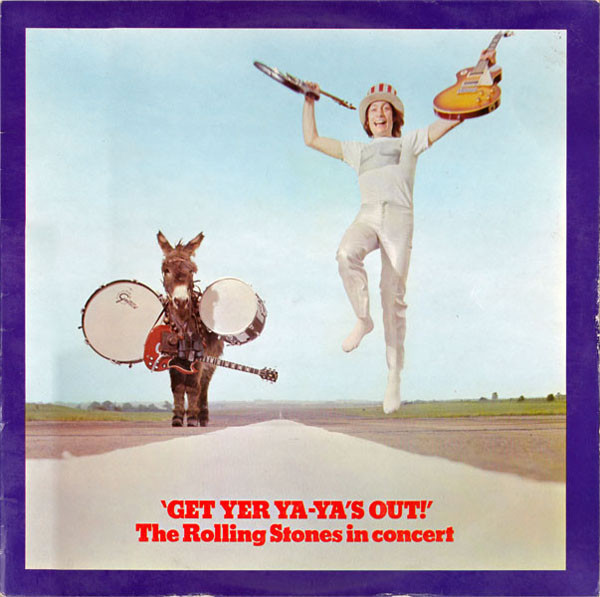
Karen: I'll get things going with a few favorites,a couple well known and one rather obscure. Get Yer Ya-Yas Out by the Rolling Stones is a great example of the band as they transitioned from the Brian Jones era into the Mick Taylor era (which I think was their most musically creative period). The band is tight and energized, and the production is clean -although some of this may be attributed to some clean up in the studio later on. But it's an exciting album that might be the Stones' best live album. Some of these versions of songs sound better than the studio versions -Stray Cat Blues and particularly Midnight Rambler stand out here. I heard this version of Midnight Rambler on the greatest hits album Hot Rocks before I heard the studio version (the original studio version came out on Let It Bleed). It's telling that they used the live version on that collection - it's clearly superior, played with much more drive. Charlie Watts is a beast throughout the album (culled from four performances over a three day period in November 1969).

Karen: Johnny Cash At Folsom Prison is a classic. To me, Cash transcends genres. He's his own type of music. I love listening to his voice here, and it's a kick hearing his interactions with his prison audience and the officials  in 1968. Everything here just screams authenticity, and Cash was certainly seen as an anti-hero type (the Man in Black), playing songs about bad men, regrets, and shots at redemption. I really like Cocaine Blues and I Got Stripes, but I think this is one of those albums where it's best to just listen to the whole thing rather than cherry pick tracks.

Karen: My obscure fave is by proto-punk godfather Iggy Pop. Recorded in 1988, King Biscuit Flower Hour Presents is a tour de force by the Iggster. A combination of old Stooges tunes and Iggy's later solo efforts, it's hard thrashing rock all the way. His backing band isn't particularly noteworthy - they're no Sales Brothers, unfortunately - but they do a good enough job with the material, and Iggy himself provides enough energy to send the set into the stratosphere. There are 17 tracks here and as Iggy says at one point, "we're gonna try to rock it to you straight, no bullsh*t" and they succeed at that. This album is practically worth the price just to hear Iggy's comments between songs. At this point in his career, he was obviously grateful to be performing. He comes off alternately humble ("thanks a f%$* of a lot for being here," "This is all the music I can give,") to crazed, confrontational ("You do it! Go ahead and do it mother f%@#er!"). In other words, prime Iggy. The sound quality is also surprisingly good -unlike some other live Stooges and Iggy albums I've heard.

Karen: All right, I've blathered long enough. Your turn!

Monday, February 17, 2014

The Falcon, the Frame-Up, and the Fallen Hero - Captain America 169


Captain America #169 (January 1974) (cover by Sal Buscema)
"When a Legend Dies"
Steve Englehart (p. 1-15)/Mike Friedrich (p. 16-32)-Sal Buscema/Frank McLaughlin

Doug:  When I see that cover, I think of the scene in Tim Burton's first Batman film when the kung fu guy does all this movement and posturing on his way to attacking Batman and it's one punch, LIGHTS OUT!  Somehow, I don't think the Tumbler should be any match for our star-spangled hero.  Hey, welcome to a series of reviews spanning the "Secret Empire" storyline, one of the true biggies of the Bronze Age.  This one'll take us out of February and through March, kids, so make sure you're buckled in and have packed some snacks.  It's going to be a long, but hopefully really fun, ride!

Karen: I had been reading Captain America and the Falcon since issue 138, but it was with Englehart's run that things really got interesting. The "Secret Empire" story was complicated and full of twists and turns - and unfortunately, due to the travails of the distribution system back in the 70s, I wound up missing several issues, so it took a few years before I was able to get the complete story. But it's one well worth reading, and it marked turning points for both Cap and the Falcon -and some great character development, too.

Doug:  We open on the streets of Harlem, with the Falcon mysteriously walking alone at night, right in the middle of the street.  As he thinks to himself about how great his life is, a car bears down on him.  He notices it a bit too late, and is knocked over as he attempts to leap out of the way.  Stunned, he's almost immediately set upon by five toughs brandishing brass knuckles and clubs; one guy has a gun.  Miraculously, Falc separates that hood from his piece, which evens the odds.  But without any super powers, the odds still don't look good.  These guys have come for some payback, from a boss named Morgan -- guy's upset that the Falcon won't join up.  The creeps keep piling on, but Falc fights them tooth and nail.  We pan down the street, where Steve Rogers emerges from a building, allegedly on his way to get a snack -- now that's a brave white man, going to get a bite after dark on the mean streets of Harlem.  Rogers sees the fracas, ducks back inside the building, and emerges a moment later on the roof -- dressed as Captain America!  Cap runs along the rooftop and then launches himself down onto the roof of a car.  He uses it as a springboard to take out three of the hoods.  Falc pummels one guy, when the gang decides they've had enough.  Cap wants to chase them, but Falc say to stay put.  He knows who they work for, and can deal with it later.  What he really wants to discuss is the inequality between he and his partner in the strength department, and how once Cap showed up the bad guys fled immediately.  What we have here is a bit of an inferiority complex on the part of one Sam Wilson.

Karen: And who could blame him? Paired up with one of the most famous (perhaps the most famous) super-hero in all of Marvel-Earth, a legend even, it's going to be hard to shine. Clearly the Falcon was no slouch when it came to dishing out punishment. But his enemies know he's  "just a man."

Doug:  Falc slumps down on the curb, and Cap offers to help in any way he can.  Falc reiterates his desire to be as strong as Cap.  We should mention that this was during a period when Cap's strength was really ramped up.  In my mind, though, I always thought the Super Soldier serum had given him more than just an edge -- but apparently he would have been considered in the "super strength" category during this run of stories.  Anyway, Cap offers to contact Hank Pym for a serum, or Tony Stark for some sort of mechanical advantage.  But Falcon knows what he wants -- he wants Cap to contact the Black Panther for assistance.  It's important to Falcon that the Panther help him, because it would just feel better.  Cap obliges, no questions asked -- he leaves for Avengers Mansion to make the contact.

Karen: Cap's recent (and I would say, unnecessary) acquisition of super-strength doesn't make things any easier on Sam. I like the way these two men relate to each other here. Sam is brutally frank with his frustration, not taking his anger out on Cap, but making it clear that he can't live in his shadow. He's got to have some way to keep equal footing with him -"Otherwise, I am to you what Redwing is to me: a pet!" Harsh words, but ones Cap needed to hear. And Cap is sympathetic; he wants to help his partner. It's interesting that Cap suggests Hank Pym and Tony Stark, but doesn't think of the Panther, who is every bit the scientific genius as the other two, despite his close connections with T'Challa. The Falcon  is very clear though about with whom he wants to work. I thought it was astute of Englehart to have the Falcon express this as he did.

Doug:  As much as Cap was a role model for Sam, you're right -- the Panther could give to Sam in a way that Pym or Stark simply could not.  And that's OK.


Doug:  On the way to the Mansion, Cap's eye is captured by an image of himself on a storefront television.  Slowing and then stopping, Cap listens to a "public service announcement" that portrays him as a vigilante who know one really knows, a man willing to take the law into his own hands while wrapped in the American flag.  The narrator speaks with a sensational tone of warning, attempting to drum up distrust and even suspicion in our hero.  The announcement ends with a screen showing who has paid for it:  The Committee to Regain America's Principles (go ahead -- make an acronym out of that!).  Cap is flabbergasted, and begins to mutter to himself, discounting every accusation that was made.  Suddenly he notices that a crowd has gathered.  He turns and addresses them, saying that what they'd heard was all lies and that they should believe him.  The crowd is a bit standoffish, however, and some even have a look of fear in their eyes.  Cap knows the damage has been done, and speeds away on his bike, his teeth clenched.

Karen: Yes, you gotta love that acronym! Englehart has said he based it on CREEP -Committee to Re-Elect the President (officially it was CRP but CREEP is the popular term). CREEP was a fundraising organization for President Nixon that was implicated of money laundering in the Watergate scandal. Who says the BAB is not educational? This isn't the first time Cap's seen this smear campaign -there was a newspaper ad in issue #166 too.

Doug:  The next morning, a flying saucer (literally) lands in the streets of Harlem.  Out of it steps the Black Panther, arrived to pick up a famous passenger.  Cap did get it worked out -- the Panther is in Harlem to spirit the Falcon to Wakanda.  Falc emerges from his building with his ladyfriend Leila.  Introductions are made, and the Panther says that it will not be a problem for Leila to accompany the men to Africa.  Cap arrives to see his friend off, and give off a real air of encouragement; but we know how uneasy Cap was the day before.

Karen: What did you think of the Panther's ship? It seemed a bit goofy. He sure doesn't know what trouble he's in for by taking Leila with him!

Doug:  Wakandan technology, and Wakanda in general, always leaves me guessing. On the one hand, they seem to be advanced almost to the point of the Kree.  Yet on the other hand, and we discussed this last week in our FF review that featured the Panther, they hold to these feudal ways and antiquated stereotypes in terms of dress.  Strange brew...

Doug:  Later, Cap storms into the building alleged to house the C.R.A.P. offices (heh...).  You know sometimes when people have an impression of you that you don't agree with, but then like a dope you go and act just the way you don't want to be portrayed?  You get me?  Cap didn't.  Because he's brusque with the secretary and then storms into the office of one Quentin Harderman -- the head of C.R.A.P. and the narrator of the TV spot that rankled Cap.  The men have words -- Cap talking about being defamed, Harderman telling Cap that his particular brand of justice doesn't jibe with C.R.A.P.'s.  Harderman offers Cap a concession:  If Cap can "prove himself" to Harderman, then he'll reevaluate the situation.  Cap agrees to a charity boxing match, and then storms back out.  His blood boiling, he wonders if he did the right thing in even going to see Harderman.  But he's soon distracted by a cry for help nearby.

Karen: Cap's acting pretty rashly here, that's true. But then, he's had a rough time of things lately. He had to face the deranged 1950s Cap, then he had a falling out with Nick Fury, he got evicted, and he's been agonizing over the return of Peggy Carter, his WWII girlfriend, who happens to be his current girlfriend's much older sister! So he can be excused for some erratic behavior.


Doug:  Who's under that cowl -- Steve Rogers or Peter Parker??  Cap enters the liquor store to see the clerk prone on the floor and a baddie making tracks for the back of the store.  Cap gives chase and finds that the robber is an old Silver Age enemy of his -- the Tumbler.  Cap takes it to him and the two men scrap for two pages, with Cap of course coming out on top.  In the midst of battle, the Tumbler thinks to himself that he's been hired to discredit Captain America.  Eventually, Cap is able to subdue the Tumbler, but as he turns to leave the Tumbler comes to.  Launching himself at Cap, our hero reacts by shielding himself.  The Tumbler uses the star-spangled disc as a launching pad and vaults over the alley wall and away to freedom.  Cap chastises himself, but vows to find his nemesis.

Karen: The Tumbler is another one of those early Marvel villains that just seems like a bad joke later on. I mean, really, he's just an acrobatic thief. Hardly a challenge for Cap, and Englehart pretty much acknowledges this here -the guy is a nothing, a throwaway, but Cap doesn't take him seriously either, and it costs him.

Doug:  Cap heads off to see his lady, Sharon Carter.  He's worried that she's seen the TV ads.  But when they meet, Sharon's disturbed about something else.  Her sister, Peggy, Cap's wartime love, has joined SHIELD!  Thinking it would be the best way to rekindle the love she and Cap once shared, Peggy joined up with the spy agency to hone her fighting skills.  Sharon tells Cap that a) he has to put a stop to that, and b) they have to tell Peggy about their true love for one another.  Cap leaves to go see Col. Nick Fury.  The agent at the door tells him he's not welcome, Fury's orders.  Then another voice is heard, and Cap wheels to come face-to-face with the Contessa.  She is pretty rude to our guy, and basically tells Cap that Fury was happy with the smear campaign against Cap and Cap should just get lost.  Wow...  Cap heads back to Sam Wilson's social work office and bunks in for the night.His spirits are still high, but he's obviously a bit perturbed.

Karen: It's like the bottom is slowly dropping out of his life. Englehart did a nice job in previous issues of building up the tension and you really see it getting to Cap here. Coming from 2014, it's unsettling -I tend to think of Cap as being always in control, in charge. Here he decidedly is not.

Doug:  The next day Cap heads to an exhibition hall, apparently to meet Harderman for details on the upcoming charity boxing match.  While children present are excited to see their hero, men in the crowd think to themselves that the ads could be true...  Harderman arrives, with a tough next to him.  He makes an introduction and Cap immediately recognizes the guy as the Tumbler.  Cap's incensed, as the liquor store clerk still suffers from injuries sustained during the robbery a few days earlier.  Cap lights into the Tumbler, who finds it difficult to maneuver in a suit and tie.  He really doesn't have a chance.  Cap knocks him down a couple of times, when suddenly the Tumbler recoils... and drops.  Dead.  Cap hovers over the body as a crowd gathers.  But above the fray, peeking through the ceiling panels we see a masked man -- a man who thinks to himself how perfectly his laser penetrated the Tumbler's skull and killed him.  And a man who thinks that Harderman has done well -- now the next step in the destruction of Captain America will begin.


Karen: When Cap goes after the Tumbler, who is in street clothes, he really does look like he uses excessive force. And the expression on the Tumbler's face when he is killed -yikes!

Doug:  Man, what a beginning!  I remarked last week how dense Fantastic Four #119 was; this one's no exception!  I thought the scripting between Steve Englehart and Mike Friedrich was pretty seamless -- at least I saw no evidence that Friedrich came aboard halfway through the story.  And Sal's art is just Sal's art.  He's so steady, always delivering.  I don't know that I have a comment to add on Frank McLaughlin's inks, but we may revisit his work in later issues, and Vinnie Colletta will be manning the brush and India ink in future installments.  There should be a contrast in styles, I'd guess.  But overall, hey -- what whets an appetite like a little murder mystery?  And Falc and B.P.?  Shoot -- we got some plot threads going on here!

Related Posts with Thumbnails