Doug: If I've not said it previously, I have really, really enjoyed the variety our guest writers have brought to the reviews here on the BAB. Karen is much more varied in her interests than am I. I am a Marvel first guy, but with a fair working knowledge of some things DC. But beyond that, call me mostly ignorant. So I've thought it just great that our readers have had the opportunity to consider formats beyond the four-color newsprinted page. Edo Bosnar is your moderator today for an Archie Goodwin/Gil Kane collaboration that is many likely new for most of us.

Blackmark (one of the earliest graphic
novels)(Bantam Books, 1971)
Created and drawn by Gil Kane; Script by Archie Goodwin
Created and drawn by Gil Kane; Script by Archie Goodwin
Edo Bosnar: Besides being
an artistic mainstay in American comics pretty much since the Golden Age, Gil
Kane was also one of the pioneers of the graphic novel, i.e., a long-form comic
story that deals with more serious, “adult” themes and appears in a format
different from the periodical comic books all of us love so much. Kane actually
first experimented with this different form to tell comics stories in a book
called “His Name is Savage!” that came out in 1968 (and later reprinted in the
early 1980s by Fantagraphics as “Gil Kane’s Savage”). It didn’t exactly set the
world on fire, but he didn’t let this daunt him.
So he came
back in 1971 with this book, a sort of barbarian epic set in a dystopian,
post-apocalyptic future. It was released in pocketbook format, and some years
back I found a really inexpensive copy online and snapped it right up.

As the
introductory page notes, the earth has devolved to a state of pre-industrial
barbarism. But there’s no magic, instead there’s the “old science,” for it is
looked upon as some kind of dark art that elicits fear, as do any who have some
knowledge of it and/or know how to make use of it. And to some extent, there
would seem to be good reason for this. Kane drew the backgrounds as suitably
bleak and desolate, and besides the normal-looking humans, everything else
seems mutated and grotesque – in fact, all of the animals have the hyphenated
suffix “-mute” added to their names, i.e., mutants.
The story
begins with a young woman named Marnie and her much older husband, Zeph,
described as a tinker, as they travel through some dangerous wasteland on their
way to a new home. At one point, after Zeph wards off a primate-like mutant
that attacks them, he goes off somewhere (it’s not really explained why – to
fetch firewood or hunt game I guess), leaving Marine alone with her thoughts,
when she gets some unexpected visitors.

They
introduce themselves as Amarix, the recently deposed king of a country called
the Westlands, and his companion Balzamo. The people of Westlands rose against
Amarix because he was trying to revive science. Amarix tells Marnie if she
undergoes this odd procedure (that looks something like a blood transfer), it
will transfer all of the knowledge he acquired into her mind, and also alter
her physical structure slightly to enable her to bear children (she is
infertile up to that point). He and Balzamo also offer her all of the wealth
they have a left, a small pouch of gold. She agrees and goes through with it.
The two then leave to try to evade their former countrymen who are in hot
pursuit.
Zeph returns
to the camp and Marnie tell him about all of the excitement and shows him the
pouch of riches – and this leads to the first of two genuinely disturbing and
brutal parts of the story, as Zeph, believing that Marnie cuckolded him, with a
man using science to boot, starts slapping her and then finishes the job by
caning her. It’s not drawn in explicit detail (thankfully), but it is narrated.
Marnie
eventually gives birth, to a healthy child who has the same black mark she does
on his upper thigh (hence his name, obviously). And she also has troubling
visions that she doesn’t understand – the consequences of the procedure Amarix
put her through.

At first Zeph
can’t stand the sight of the baby, even though Marnie insists that the child is
his. But by the time child is a year old, he eventually comes around.
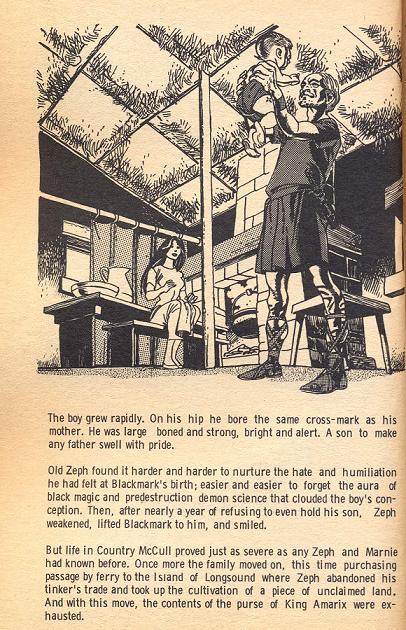
Zeph and
Marnie eventually used the last of the gold from the pouch given to her by
Amarix to buy a piece of land that Zeph farms. Blackmark grows into a strong,
intelligent and inquisitive boy, and the small family seems content. Of course,
any reader knows this won’t last. And sure enough, a band of raiders attack the
nearby village, and then eventually make their way to Zeph and Marnie’s
homestead. And this is the second of two scenes I mentioned, as the brigands
kill Zeph and proceed to beat and then rape Marnie in front of the young
Blackmark, and when she manages to scratch the face of her assailant, he plunges
his sword into her chest. All the while, her assailant wears a distinctive
helmet that Blackmark will never forget as he swears vengeance.

He eventually
gets caught by slavers and ends up in captivity. And the story now jumps ahead
to Blackmark as a 21 year-old man, a gladiator-slave in the court of the rather
repugnant king of the Westlands, Kargon. The narration indicates that Blackmark
actually escaped from captivity several times and even led a band of ex-slaves
in an abortive revolt before being captured again.

The
gladiatorial arena has an interesting feature: a giant rocket ship, pointing to
the sky. It is called the “Warlock Shrine,” and according to legend, anyone who
manages to free it from its earthly bounds (i.e., launch it), will become the
king of the world. Kargon explains to a visiting dignitary that the previous
king (i.e., Amarix) tried for years in vain to figure out its secrets (and was
probably on the verge of succeeding) before Kargon riled up the people to exile
him from the kingdom for “blaspheming” by using science. Kargon adds that he
has a standing offer to any who attempts to move the “Warlock Shrine”: he will
give his kingdom to anyone who succeeds, but the price of failure is death.

An additional
problem for Blackmark is that Kargon’s youngish and alluring wife, Lyllith, has
taken quite a shine to him (apparently Kargon is used to her having little
flings gladiators and visiting warriors who tickle her fancy). At one point,
Blackmark spurns her advances, so she sics the trainer on him. This doesn’t end
well for the trainer, who gets strangled by his own whip and Blackmark then
proceeds to beat the daylights out of most of guards. However, they finally
manage to subdue him. Kargon shows up and wants him killed, but Lyllith begs
for him to be spared. So he decrees that that Blackmark will face the “fire
lizard” (an actual fire-breathing dragon) the next day. He’s thrown into a dank
cell to get some rest the night before facing this challenge. There’s another
inmate in that cell, an old man who recognizes Blackmark’s, well, black mark,
and tells him that he’s Balzamo, a name Blackmark recognizes from his mother’s
stories. So the two do some catching up.
The next day,
both Blackmark and Balzamo are ushered into the arena to face the fire lizard. In
the stands, Blackmark notices that Lyllith’s new boy-toy has a very distinct
helmet – he recognizes it immediately as the one worn by the man who
slaughtered his parents.
The battle
goes well for Blackmark, as he unexpectedly (well, to Kargon and the spectators
, anyway) kills the dragon.

The crowd
goes wild, cheering for Blackmark. Even Lyllith realizes that Blackmark is a
threat at this point, and tells Kargon he should have him killed. Blackmark
rather impulsively wants to take the king out, even though there’s a bunch of
archers with arrows mounted ready to take him down. Balzamo advises caution.

(By the way,
that page above was apparently inked by Neal Adams, as Kane called in a few
artists to help him out when he was having trouble meeting his deadline.) Blackmark
tells he’ll take the challenge to move the rocket. Against Lyllith’s
opposition, Kargon agrees, thinking there’s no way he’ll figure out how to move
the thing. But the knowledge of Amarix apparently stored away in Blackmark’s genes
comes to the fore, and he enters the craft without much effort and, similarly,
just seems to automatically know how to operate the controls. He turns on the
ignition so to speak, and the rocket launches. The astonished spectators are
already calling him their new king,.

He turns the
rocket around and then lands back in the arena, and he’s greeted by the
adulation of the people. Kargon orders his guards to kill him, and a melee
ensues. The sword Blackmark found in the rocket seems to have a life of its
own, and makes a screaming sound as Blackmark easily slashes through his
opponents. He first takes down the king, and wants to get the mysterious
helmeted man who’s with Lyllith. He spots them fleeing in the crowd, and flings
his sword, but the mysterious man – a model of chivalry to be sure – uses
Lyllith’s body as a shield. The sword kills her and he gets flees through the
city gates just before they shut. Blackmark sees that he’ll have to get his
revenge another day, and instead returns to the people.

At the very
end of the story, there’s a scene that sort of sets up the sequel, as a large
dragon passes over the city and casts a pall over the otherwise cheering crowd.
Blackmark fires an arrow at it, which just flies right through. And then it
turns and leaves.

(I mainly put
that last image in there just to show the contrast between the original, aged
pocketbook I have and the later reprint edition. Also, I was starting to get
worried about doing too much damage to the spine of that older book by
repeatedly shoving it into the scanner.)
The story
hits all of the typical notes one would expect to a find a sword & sorcery
tale (although in this case it’s sword & science, I guess), with lots of
melodrama and a rather predictable ending. However, I still thought it was
pretty solid, and can’t help thinking that a Blackmark movie – with the right
director and production company – could be pretty good.
Kane did a
sequel to this story (also scripted by Goodwin) that never got the pocketbook
treatment, rather it was later published in Marvel Preview #17 in 1979. (The
original Blackmark story was also reprinted by Marvel in the first four issues
of Savage Sword of Conan.) Both of the Blackmark stories were then published
together in a very nice paperback edition in a larger, more attractive format
by Fantagraphics in 2002.
As I
mentioned at the start, Archie Goodwin was the actual writer, and one thing
that really bothers me about the original pocketbook edition is that his name
does not appear anywhere in it. Seems a bit unfair to me. The Fantagraphics
volume does redress this to some extent,
as there is an almost fine print credit above the indicia: “Written by Archie
Goodwin from an outline by Gil Kane”), and, commendably, publisher Gary Groth
also discusses Goodwin’s role in writing Blackmark in the afterword.

Like
Chandler: Red Tide by Jim Steranko, which I also reviewed not long ago, the
main thing I like about this one is simply the fact that it exists. I just love
all of these experimental efforts with comics and sequential art done in the
1970s. (This review, by the way, is dedicated in particular to frequent BAB
commenter Garett, who mentioned it in the comments to my review of Steranko’s
Chandler.)