Showing posts with label Krypton. Show all posts

Wednesday, October 28, 2015

Discuss: CBS' Supergirl


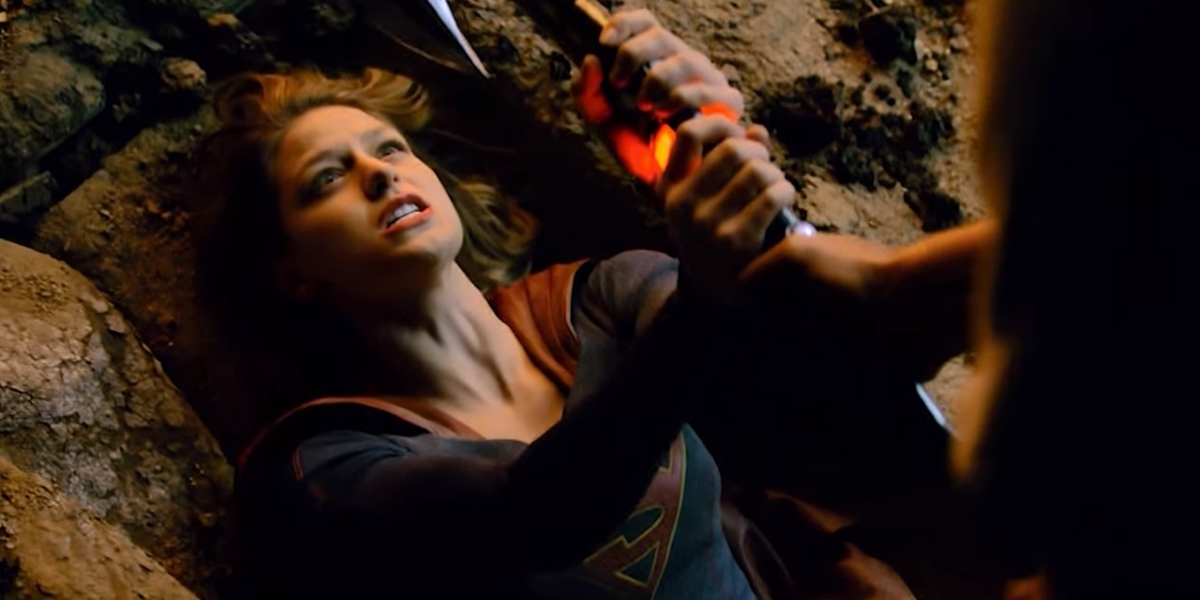
Doug: I've only seen about the first 2/3 of the show -- but I'd like to finish it. This show is the breath of fresh air DC has needed (admittedly I don't watch the Flash). What I saw was light, perfect fare for the 7:00 hour. And Melissa Benoist is charming in the lead role, both as Kara Danvers as well as our heroine. She looks great in the suit as well -- and I understand why they went with the tights after seeing a few of the flight sequences. There's a cute nod to the fashions of superhero women (see below). I couldn't figure out, however, why no one could utter the name "Superman". It's not like he's Y_HW_H or anything... Some of the plot seemed like it was getting a little wonky, and as I mentioned I'll need to find time to finish my viewing. But overall I thought I liked what I did see. Your thoughts?


Friday, September 27, 2013

Jose Luis Garcia-Lopez's Man of Steel -- Superman 307


Superman #307 (January 1977)
"Krypton -- No More!"
Gerry Conway-Jose Luis Garcia-Lopez/Frank Springer (cover by Neal Adams)

Doug:  This post goes out to our readers who have clamored for some Superman stories as illustrated by Bronze Age great Jose Luis Garcia-Lopez.  Today's your day.  And what's more, since I chose this story because it also contains Kara Zor-el, this will be a 3-part review stretching over the next couple of months.  Look for parts two and three (Superman #s 308 and 309) on Fridays in October and November.  And in case you didn't notice, famed Spider-Man scribe Gerry Conway is at the helm as our author.  Will he work some of that early 1970s Marvel magic, or will we walk away thinking "Of course... this is a Bronze Age DC mag."?  Let's check it out.

Doug:  DCs at this time had a curious layout, as the main stories were only 17 pages long.  The bonus, of course, was generally a 5-6 page back-up feature.  So while the headliner sort of got short-changed as compared to his Marvel Comics counterparts, the reader got a little more bang for his or her buck (or in this case his 30c).  We open with the Man of Tomorrow in a bit of a sour mood and bent on wasting a factory.  A figure we don't recognize, but who bears a striking resemblance to the Ray, sizzles into the panel from Stage Right.  He engages Superman and then knocks our hero for a loop using numerous different powers.  Claiming to be a mutant and with atomic-based abilities, he identifies himself as the Protector and makes a vow of his own:  he is the champion of all polluting industries.  Wait... say what?  He's standing up for the environment's enemies?  O...K...

Doug:  Superman's dumped out of the sky and onto his red panties, and right at the feet of a Mr. Slotvik.  Slotvik claims responsibility for bringing the Man of Steel to the factory; Superman replies that he only came to help.  We then get a flashback over three pages that shows how Milton Slotvik had approached Clark Kent after one of Kent's news broadcasts.  Slotvik knew the company for which he worked was using resources which were most likely causing employees to come down with cancer.  Slotvik wanted Kent to investigate and perhaps bring some publicity to the situation.  Clark suggested that maybe an impartial party should join in, and offered to contact Superman.  Slotvik agreed.  However, the conversation was interrupted by a "news groupie" named Terri who threw herself at Clark.  Of course, Lois Lane happened by at just the right (wrong) time, jealousy emanating from her pores as she coldly addressed Clark about her plans to fix him dinner.  Clark, however, exited with Terri.  And then... this took a really weird turn.  While on the elevator with Terri (nope, no Love In An Elevator here), Clark began to fill out the invitations to his own pity party -- "You call me a man -- but I'm really a native of a planet called Krypton -- and much as I like you, we can never be anything to each other -- any more than Lois and I!  I'm an alien -- an outcast -- a loner -- and that's the way it must remain!"  And he walked off in a foggy funk and left Terri wondering what the heck just happened.  Me, too!


Doug:  We cut back to the near-present as Superman makes an appearance at Slotvik's job site, Metro Chemical Plant.  Supes is greeted by Morton Kalmbach, the president of the company.  He's a smarmy sort, and offers our hero a tour.  Kalmbach's attitude is one of greed and uncaring, and he admits to Superman that there's bound to be some collateral damage on the way to a healthy bottom line.  Superman stops him and asks if he's admitting to knowing that what they do at the plant could be causing cancer for the laborers; Kalmbach says it's only a "socially acceptable" danger to the men.  And that's when Superman went off.  Once the flashback is over, Superman leaves Slotvik and flies away to the Rocky Mountains where he finds a high peak upon which to sit and brood.  He thinks about the mortality of the men in danger at the plant, and then his mind wanders to Krypton... his lost Krypton.  Readers are then treated to a brief backstory of Jor-el and Lara, the rocket bearing little Kal-el to Earth, the explosion of Krypton, etc.  Superman's losing his cool here, and shouts to the heavens, "Hear me, world!  I won't let you commit planetary suicide!  I swear I won't let you die... I swear it!"  I thought at this juncture the story began to take a turn down the path that Paul Dini and Alex Ross walked in their wonderful Superman: Peace on Earth treasury.  But it was short-lived.

Doug:  Superman swoops onto a giant ocean-faring tanker and begins to pluck sailors from its decks.  The men are whisked away and deposited on a nearby island.  As Superman works, he thinks to himself that a) these are the sorts of ships that have oil spills and b) this one must therefore be about to dump crude into the ocean!  His goal is to hoist the ship and put it into orbit (yeah, because that wouldn't burn up on re-entry and cause atmospheric damage...), then come back to Earth and corral any others he can find.  Umm...  Did Conway forget about the fuel crisis of the mid-70s?  Because pulling a whole lot of supply is going to increase the demand and drive that price up, up, and away...  Well, as Superman begins to gain some lift, he's suddenly attacked with ice.  Yup -- the Protector wants to be sure those super-tankers can do their thing, even if it is leak all over the seven seas (remember the query I posited about Conway's scripting back at the top?).  The two super-combatants get it on, with Superman again coming out on the short end and the Protector again escaping.  Superman figures no worries, and surfaces to again take care of the ship.  But who should be on site but his cousin, Supergirl?


Doug:  Kara asks Superman what the heck he's doing, and when he tells her she becomes the voice of reason... temporarily.  She barks at Clark that they have no right to interfere and that he needs to stop.  He asks her if she wants Earth to end up like Krypton, and here's where the wheels fall off.  Kara grabs Superman by the arm and tells him he needs to deal with the fact that Krypton didn't explode because there never was a Krypton!  Superman is no alien -- he's the Earth-son of Jonathan and Martha Kent!  And then she zips away, heading north.  Superman gives chase, and they are very soon at the door to the Fortress of Solitude.  Supergirl continues on this odd path, and once inside begins to destroy all of Superman's Kryptonian memories, including the large statues of Jor-el and Lara.  Superman begs her to stop, but she just keeps going, eventually showing him the Bottle City of Kandor.  Superman asks her how she would explain the fact that there are thousands of Kryptonians living in the bottle -- and she says to look again.  All of the people in the city, and the city itself, is just a plastic model.  Superman is about to lose his mind when Kara slaps him -- get with it and quit living the lie!  She tells Superman that they are not cousins, but they are mutants.  Their fathers, Jonathan Kent and Fred Danvers, were scientists working on atomic experiments.  Fall-out from their efforts mutated their children.  Superman's sweating now, really questioning everything.  And then the Protector arrives.

Doug:  Just like that -- this yahoo shows up and starts to mix it up with Superman again.  And once again, Superman looks like a second-stringer.  The Protector displays all the powers of Captain Atom, the Vision -- you name it -- he can about do it all.  And that keeps Superman off balance until he decides to use his X-ray vision to look inside his antagonist.  He notices that the Protector's heart glows just before he makes a molecular change.  The Protector can sense that Superman is using X-rays against him, and so begins to transmute himself into nitrous oxide.  However, at that same instant Superman switches to heat vision and WHOOM!  The Protector is nowhere to be found.  Supergirl asks Superman if he's all right.  He says that physically he is, but emotionally he's a mess.  He's excited that he's no longer an orphan, but what is his life now all about?  We'll find out together near the end of October, kids!


Doug:  I'm glad Edo Bosnar and others recommended that I check out some Garcia-Lopez Superman stuff.  As I've said at some point around here (shoot, I can't recall what I had for breakfast yesterday!), I had the Superman vs. Wonder Woman Limited Collector's Edition when I was a kid, but have no idea whatever became of it.  So I was excited to get the Adventures of Superman: Jose Luis Garcia-Lopez hardcover at WizardWorld Chicago in August and recover that story.  The art in this tale, as advertised, was really nice.  I haven't seen enough of Garcia-Lopez inked by others yet (well, Romeo Tanghal on the Teen Titans Baxter series, but I don't recall much about it), so I cannot really comment on Frank Springer's influence.  But the figurework is really done well, the panels have varied camera angles, and the story does move along.  My criticism isn't with any of the visuals herein but the story.  Sheesh!  I don't want to sound all negative and like a broken record, but tell me this isn't a Bronze Age DC!  I'm sorry, this story is more about Julius Schwartz and less about Gerry Conway.  That being said, and although I thought the level of the story was again marketed to that tween-aged male, I think it does show that Conway's no slouch.  Because he does sell the story -- it's ridiculous, but that's plot only.  The story itself is not poorly written.  And you know what?  I've already read the next two issues, and it gets just a trifle sillier as we go.  Stay tuned in about 30 days.

Monday, August 20, 2012

Building a Better Krypton: The Man of Steel #1


The Man of Steel #1 (October 1986)
"From Out of the Green Dawn"
John Byrne-Byrne/Dick Giordano

Doug: As many of us had said earlier, I was surprised during our recent round of Bracketology that Crisis on Infinite Earths bested the deaths of Gwen Stacy and the Green Goblin in the semi-finals. Today we'll begin a six-week examination of the fall-out from the Crisis -- the re-imagining of Superman, as told by John Byrne in the bi-weekly series The Man of Steel. Byrne was among the hottest creators in comics in 1986, having come off of lengthy runs on the X-Men and Fantastic Four. DC Comics wasn't afraid to go after some big names for their revisionist histories, handing the reins of the revamps to Byrne, Frank Miller (Batman), George Perez (Wonder Woman), Green Arrow (Mike Grell), Hawkman (Tim Truman), and the Justice League (J.M. DeMatteis/Keith Giffen/Kevin Maguire). Obviously you're sitting there reading a blog about the Bronze Age -- this series will look at what came next, for better or for worse.

Karen: I haven't looked at this series in a very long time. I don't recall feeling strongly one way or another when I read it originally. My main concern was that Superboy had been wiped out of existence, and that affected the Legion. I've never been a Superman fan.

Doug: That's an excellent point, and one that made me sad. Personally, I quit buying the Legion after Superboy #259 when little Clark got kicked out of his own book. To be honest, that time coincided with my cold turkey dropping of all comics, but I'll admit that I was very concerned that the Legion was going it alone after that story.

Karen: Well, the Legion's never been the same since Crisis, but that's a discussion for another time.

Doug: I'll be reading and scanning from the original issues, but did want to mention that I was a winner in the trade paperback raffle back in 1987. As I recall, readers could submit entries to each of the Superman mags being published at that time: Superman, Adventures of Superman, and Action Comics. I think I sent in 3-4 entries to each comic. How surprised do you think I was to get an unexpected package at college one day? I could not believe it! In case you've never seen one, DC basically bound the six issue mini-series. The stock used is the same as DC's covers and interior pages were printed on.

Karen: You lucky guy! I dug out my comics for this one.

Doug: Our story is divided into three parts: a prologue and two chapters. We pick it up on a Krypton far different from the one depicted by Wayne Boring, Curt Swan, et al. This is a highly advanced/evolved Krypton, where human emotion has been squelched for centuries. The Kryptonians are masters of their planet, controlling every aspect of their lives -- even down to when it rains. We meet Jor-el, a scientist troubled by impending events on his planet. Jor-el is served by two small robots (droids) who have the ability to converse with him and each other, and to follow directives. One says to the other that their master seems troubled; the response is that while all Kryptonians have been acting apprehensively, it is not in the programming to know why. This is our first clue that there seems to be little emotion on this planet.

Karen: Yes, this was certainly not the Krypton I was familiar with, although my knowledge of Superman and his mythos mostly came from the Superman films and my uncle's 50s and 60s Superman comics. That Krypton was also technologically advanced, but seemed a much warmer, human place. Byrne's decision to go with a cold, sterile version of Krypton seems an odd choice. Jor-El and Lara's wardrobes reflect this as well -almost every inch of skin is covered.


Doug: We see Jor-el next standing in front of a globe, or pod. He had instructed his servants to place "the matrix" within an orb in his laboratory. As he reaches out a hand toward the encased fetus, the Lady Lara enters. It's pretty obvious that although they are married and this is their child, there was no sexual contact whatsoever in the creation of the baby. Jor-el speaks of Krypton's impending doom, and of a civilization failed. Lara rebukes him, and questions his speech as archaic. But Jor-el tells her what he knows: the planet is going to explode due to pressures rising within its crust. While the matrix could not survive, even in the pod, it could survive after a journey through hyperspace. Lara is incredulous, but we're again aware that there doesn't seem to be a real motherly attachment. Jor-el says that he has scanned the heavens and found a suitable planet for which to send the baby -- Earth. He shows Lara an image of middle-America, and she recoils at the site of a bare-chested farmer. Again, it's obvious that any coupling between Jor-el and Lara took place in a test tube.

Karen: This lack of humanity and feeling (Jor-El is an anomaly) makes the death of Krypton seem a bit less sad -call me insensitive but the Kryptonians don't seem to be really living.

Doug:  I think it's interesting that in wiping away the 50-year backstory of Krypton, we're left only with these few sterile images.  I suppose we are to assume that they could do anything, so whether or not ore was their industry or service-type jobs is a moot point.  This is it, face value.

Doug: Jor-el says that due to the energy of Earth's yellow sun, the child will grow up with extraordinary powers; Lara interprets that as her superior Kryptonian son subjugating the savages of Earth's primitive culture. Jor-el is a bit more open-minded. Suddenly the eruptions begin to ravage Krypton's surface. Jor-el wastes no time in launching the escape pod. As it leaves, the planet begins to quake and groan; Jor-el says to Lara that he is glad that they will face the end in each other's company. As the rocket exits, the planet indeed explodes, and we see a small shard of Krypton reaching the tail of the rocket, and lodging itself there.

Karen: Ah yes, foreshadowing...

Doug: Chapter One opens on a high school football field, where young Clark Kent is leading his team to victory -- by scoring his 10th touchdown of the game! This ain't yer daddy's Clark Kent! We meet Jonathan Kent, near the sideline as the Smallville coach is about to explode in the "thrill of victory". Yet Pa Kent seems a bit dour. The game ends, and Clark comes off the field on his classmates' shoulders. But his teammates don't seem as jubilant. Pa steps forward and interrupts Clark before he leaves with his friends. Clark initially offers to talk later, but Pa's having none of it. They eventually leave the school, as some clouds start to roll in. Pa said it was time they had a talk, and begins to relate a story we are by now very familiar with: how Jonathan and Martha Kent saw a bright light in the Kansas sky, followed it out to one of their fields, found a rocket ship with a baby inside, and adopted the child. John Byrne adds a few updates along the way, such as (I believe) the blizzard that crippled the heart of Kansas for an entire winter; it wasn't a tough sell to the townsfolk when Martha appeared in the spring with a new baby.

Karen: Both when I first read this, and now, I found it odd that Clark was a super-star athlete. I know Byrne was trying to differentiate his version of Clark from what had gone before, but it just doesn't make sense to me that his parents, knowing his vast power, would allow him to potentially harm other kids. The idea that Ma and Pa had to take Clark aside and tell him that he had to pretend to be a nerd, basically, seems much more likely. 


Doug: We then see young Clark start to mature, from a toddler to an elementary-aged child. Along the way there are amazing feats, miracles, and other just unexplainable incidents that occur. While Jonathan and Martha realize that something is amiss, they try to keep Clark as grounded as possible. This explains why as a teen Clark was proud of his accomplishments on the gridiron, but wouldn't be characterized as big-headed. I think in this "origin" section of the origin story, Byrne crafts for the reader the roots of Superman as the "Boy Scout", fighting for "truth, justice, and the American way". It's pretty obvious that he's been raised with "Midwestern values", and has taken this teaching to heart. Eventually Clark realizes that he can fly -- for a really nice rendition of a man suddenly able to leave the ground, I'd encourage you to see Kurt Busiek's and Stuart Immonen's Superman: Secret Identity. As we take leave of the site where Jonathan had hidden the rocket ship, we see Clark suddenly take ill. Of course, we know it's due to the chips of his home planet, stuck throughout the nooks and crannies of the ship. But, who is the mystery man lurking in the shadows on this rainy Friday evening?

Karen: I got a different impression of Clark here, in that I did feel he was egotistical and a bit of a jerk. However, by the time Pa has explained things to him, he's talking about his responsibilities to the world. This seemed like an awful fast u-turn to me. I just didn't buy it.

Doug: Clark's personality as an adolescent is not revisited, so the adult altruistic Clark is all we'll have to work with.  We enter Chapter Two in the Kent kitchen as Jonathan comes down for breakfast. Martha has her scrapbooks out, and muses over all of the headlines Clark has generated through his activities over the past seven years. Seven years! I guess I was a bit surprised that Byrne chose to make Clark 25 in this story. I don't know if I felt he should have been older or younger, but once Superboy was taken out of the equation the age of 25 does seem to be a bit old for a Super-debut. As Jonathan opens his daily paper, he sees yet another headline of a mysterious "Superman" who saved a disabled space plane. Suddenly, there are creaks in the floor boards above them -- in Clark's room! Hustling up the steps, shotgun in hand, Pa and Ma burst into the room to find... a brooding Clark. Clark's depressed and confused, and begins to relate what had happened as the space plane had gotten into trouble.

Karen: It's much like what happens in the original Superman film, isn't it? Except there's no trip to the Arctic. Also, check your glasses pal: that's no shotgun -looks more like an ax handle to me.

Doug:  Obviously you've never been to Smallville and checked out an artillery store.  Actually you caught me trying to write from memory without opening the book back up.  Duh to me.  And really, it looks like a large utensil for use with a cauldron suspended within a fire place.  We use those all the time...  But we can go with ax handle.

Doug: In flight over Metropolis, everything seemed to be going well when suddenly a small civilian craft got too close and clipped the tail of the space plane (this is obviously pre-9/11, as any craft like that would be taken out of the sky by an F-16 escort). Clark had been in the crowd of spectators watching in horror as the big vessel tipped and began its nosedive. Streaking up from the ground, with no concern for his secret identity, Clark was able to right the plane. However, little did he know that onboard was not only the crew, but intrepid reporter Lois Lane. As the plane was stabilized and brought in for a landing, the crew had become aware that it was a flying man who was saving them. Never one to miss a story, Lois was first off the plane and accosted our young hero with a "Hold it right there, Buster!" Clark was taken aback, so much so that he didn't fly off. Their eyes met, a little chemistry began to brew, and then the crowds set in. The sense of claustrophobia was more than Clark could take.

Karen: Again, I had a feeling of deja vu for the Superman film, as Clark saves the plane here too. Although no one here said, "We got something. I'm not saying what it is, but trust me." I like Lois' look here -in fact, Byrne does a nice job with both Lois and Clark. Giordano's inks really complement his pencils.

Doug:  With Man of Steel, I think it was safe to say Byrne felt that the Superman movie was canon. Back in Smallville, Ma stitched a garment on her sewing machine as Pa and Clark entered the room. What we are seeing is a quick-hitter in the evolution of the Superman costume. Pa and Clark made the famous shield, while Ma came up with the color scheme. Ma also gets credit for noticing that clothes worn close to the skin never seemed to tear when Clark was playing as a child -- hence the skin-tight costume. She also gets credit for the boots. Pa came up with that brilliant disguise of wearing... eyeglasses with slicked-back hair. Uh huh. And then we get what can only be called a majestic last-page splash. Wow.

Karen: The idea that Superman has some sort of a protective force shield close to his skin I think originated with science fiction writer Larry Niven, of whom I have heard Byrne is a big fan. Niven is a proponent of the idea that all of Superman's abilities are really mental-telekinesis for flight and super-strength, force field projection for invulnerability, etc. We see this idea put to use by Byrne for the character of Gladiator when he had him appear in Fantastic Four. I don't think it was ever really stated that this was true for all of Superman's powers in the Byrne run though. And yes, you just have to roll your eyes and accept that no one can tell Clark and Supes are the same guy.

Doug: I really got excited re-reading this story for the review. It brought back a lot of memories I'd not felt in 25 years. I've talked often on the blog about my love of Superboy and utter disdain for Superman. But here, in this series, was a Man of Steel I could begin to embrace. Byrne grounded Clark Kent in the real world and brought his power levels down to the point where he was no longer a god. This was infinitely more appealing than his Silver Age personna as a do-everything. I just liked this a lot better. And overall, this sense of newness running throughout the DC Universe was very fresh, a true jumping-on point.


Monday, January 11, 2010

BAB Two-In-One: Failure is Good and Cybernetic Circuses


Doug: OK, so admittedly we've had a mixed bag with our DC reviews. Karen liked a Justice League story she read, and I told you how great Detective Comics #400 was. However, then I had to punish you (and me... whoo-boy!) with that super-lame Brave and the Bold yarn. I'm going to take another stab at it with an 8-pager that ran in Superman #257 from September 1972. I'm pulling this one out of the hardcover The Greatest Team-Up Stories Ever Told (c. 1989) and can honestly say I've never read this story. Let's see how we feel about "The Greatest Green Lantern of All!" by Elliot S! Maggin (off a Neal Adams plot) and Dicks Dillin and Giordano.


Here we go -- Green Lantern Corps member Tomar-Re is nearing retirement and is summoned before the Guardians to be told a secret about a planet of his sector, the only time Tomar-Re failed to save a world: the doomed planet Krypton! The title of the story, then, refers not to any of the Green Lanterns we know, but to what might have been had the offspring of Jor-el and Lara been enlisted in the Corps!


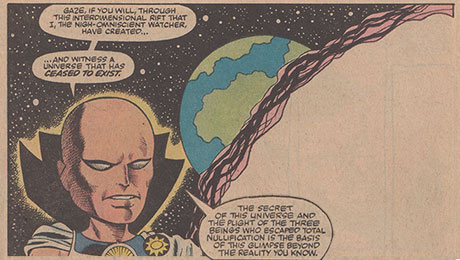
Flashing back, we see a meeting of the inner council of the Guardians where debate rages over making the Corps independent. The major discussion centers on whether or not there is a ringbearer in the universe qualified to lead such a transition to independence. In a few panels that evoke Marvel's Watchers, the Guardians look to the future of potential offspring of the just-married Jor-el and Lara of Krypton. Allegedly genetically perfect, they would produce a child "of an incomparable nature". The Guardians are aware that Krypton will soon explode, and so dispatch Tomar-Re to slow the process until Jor-el (like an alien Noah) can ferry all Kryptonians to safety.


We are reminded that Jor-el created not only a Space Ark, but the technology to shrink Kryptonian cities. We also see that Brainiac hijacked the Bottle City of Kandor. Little Kal-el is born in this sequence, and we see Jor-el pleading without results to the Science Council. In the meantime, Tomar-Re is in a race against time to pack the guts of Krypton with a stabilizing element called Stellarium. However, in his haste to gather the mineral, he neglects to sense a nova and is temporarily blinded by the yellow radiation of the exploding star.


The next two pages are quite exciting, as Tomar-Re uses the ring to guide him to Krypton with his next payload of Stellarium. We see interspersed panels of Jor-el and Lara with the rocket that can carry Lara and Kal-el to safety; Lara of course elects to stay with her husband. Tomar-Re's vision begins to come back to him and as he says "I think I can almost see... Krypton!" the planet explodes. He is nursed back to health by the Guardians and they discuss whether or not saving the planet would have been worth more than the outcome -- Superman's life on Earth and his maturation into the universe's greatest champion.


Hot dog! We got a winner here! This was a really interesting story, easily compared to a Marvel of the same time. The art was great – very polished. Giordano’s inks easily swung Dillin’s pencils toward Neal Adams – definitely evoked Adams’ Superman work of the era. And Maggin’s script was nice – not dopey like so many DC’s of the Bronze Age.

Karen: Hey kids, I'm back with the next issue of the original Deathlok run, Astonishing Tales #27 (circa December 1974). This time around Rich Buckler and Doug Moench are credited as co-plotters, but Buckler is credited with art and story, so I guess he actually scripted it. The last time we saw our zombie-cyborg pal Deathlok, he was trying to find his war buddy Mike Travers. He tracks him to the Statue of Liberty, fights his way through a bunch of goons, and then opens a door to reveal his nemesis Ryker, along with a bizarre cyborg werewolf that Ryker calls the War Wolf. Ryker says that the War Wolf is actually Mike Travers, and this creates a dilemma for Deathlok: he can't kill his best friend. However, as Deathlok appears to be on the ropes, Ryker, for some reason, decides to tell him that the War Wolf isn't Travers after all; Travers died on the operating table. Why do villains always seem compelled to do stupid things like this? This of course gives old D-lok a big boost and he battles back, defeating the War Wolf, in particularly brutal fashion.

Deathlok, now leaking 'life fluids', decides to get the heck out of Dodge and then makes a rather poorly thought out decision to go see his wife, Janice. She freaks out when she sees him - it's not really clear that she recognizes him as her former husband - and right before he's about to enter his son's room, Deathlok realizes what a terrible idea this was. He runs outside and in his despair tries to shoot himself in the neck, but his computer makes suicide impossible. He realizes that he can't escape the life he's in, and he can never return to the life he had.

This is a pretty good issue, although I get the feeling reading this (and other issues as well) that Buckler was so bursting at the seams with ideas for Deathlok that sometimes concepts and terms are thrown into the book willy-nilly, without much thought. There's a whole page of Deathlok symbolically hanging on a cross, where we discover that the third voice he had been hearing (the one neither Luther Manning's nor the computer's) was actually an implant Ryker had been using to track the cyborg. Then there's some talk about him feeling persecuting and Ryker trying to make a god machine - honestly, it seems sort of crammed in there. I know what Buckler is going for here but it seems a bit ham-fisted.

Ryker is also a difficult character to take seriously, as he is so over the top and manic in every scene. H
is motivations are vague; at one point he says, "I use people to create the future. My ultimate goal is to gain mastery over life...and finally, death." Well, that's a fairly vague statement that probably would work for some villains, but in a more realistic series like this one it just comes across as almost lazy. It doesn't help that he just seems (and looks) like a crazy cybernetically obsessed Thunderbolt Ross!


The last negative I'll mention, and this is an odd one, is the lettering. I almost never even notice lettering in a book, but the job done in this issue is very poor. Desmond Jones is credited as the letterer and I do
n't recall his name at all. In any case, it's very light and inconsistent.


On the good side, the fig
ht pages are pretty well done, although much more violent than most of the comics of that time. But the best part of the book is towards the end. The sequence with Deathlok returning to his former home is just gut-wrenching. The loss that Manning feels is palpable and really helps to make him more sympathetic to the reader. An interesting aside: Manning was a Caucasian, and his wife Janice is black. There are so few inter-racial couple in comics, and this was certainly the first time I can recall seeing one.

The attempted suicide is also moving. To see him, our protagonist (I can't quite call him
a hero) turn his laser gun on himself is still shocking today.

Related Posts with Thumbnails