Showing posts with label Michael Golden. Show all posts

Friday, July 1, 2016

Who's the Best... Doctor Strange Artist?


Redartz: With the Doctor Strange film coming up before the year is out, it seems appropriate to pay some love to the remarkable array of great artists the good Doctor has been blessed with...

Steve Ditko
Gene Colan
Dan Adkins


Frank Brunner
Marshall Rogers
Michael Golden


Paul Smith

Monday, April 18, 2016

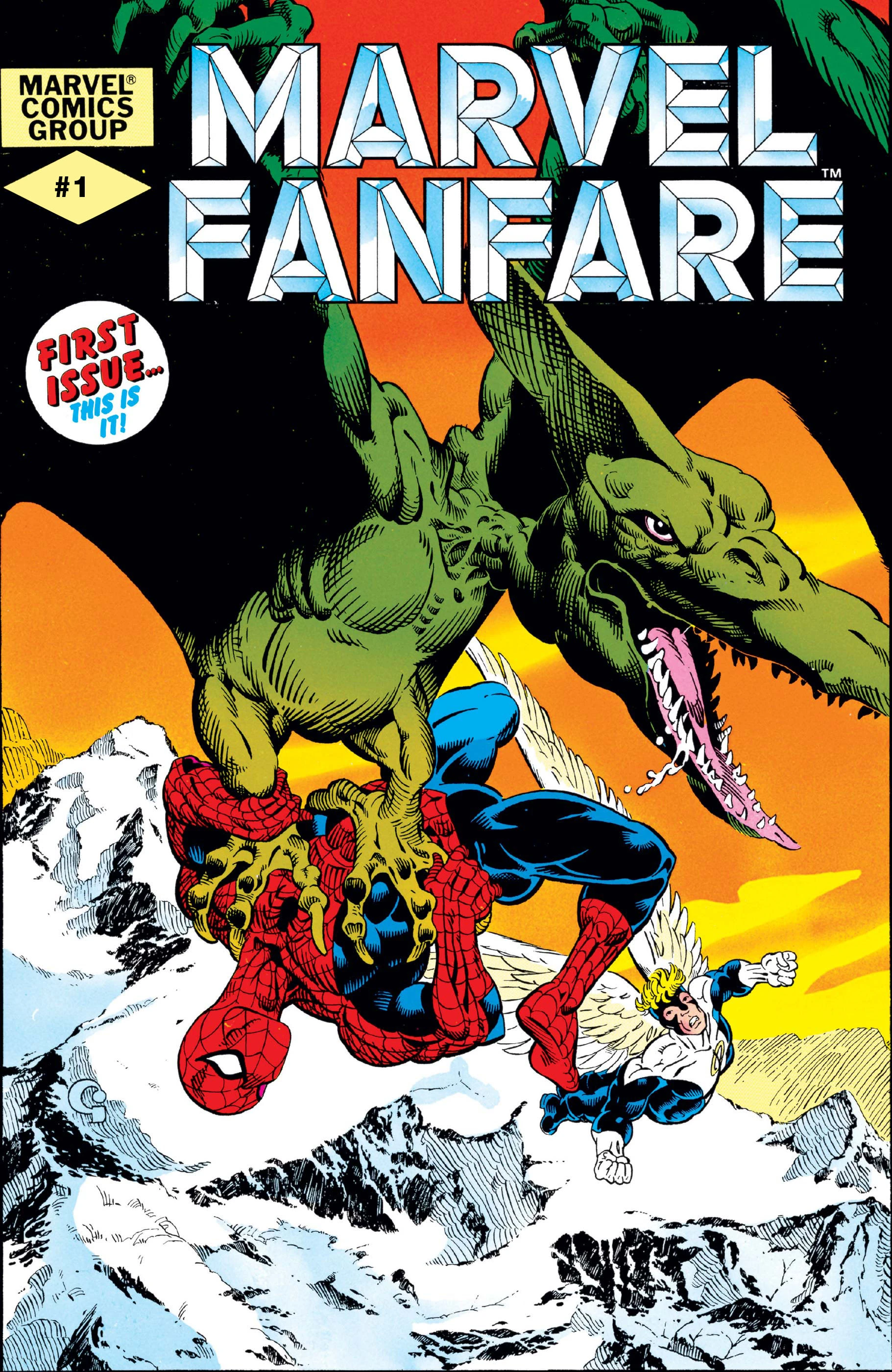
A Modern Stone Age Fantasy - Marvel Fanfare 1-2


Marvel Fanfare #1 (March 1982)
"Fast Descent Into Hell!"
Chris Claremont-Michael Golden

Marvel Fanfare #2 (May 1982)
"To Sacrifice My Soul"
Chris Claremont-Michael Golden

Doug: Hey, it's a Two for Tuesday! Except today is Monday. Well, you're still going to get some extra bang for your time spent on the BAB today, kids. Marvel Fanfare was a book that landed during my hiatus from comics, which stretched from around the spring of 1980 to the spring of 1985 (give or take). The whole direct market thing, comic shops, creator-owned properties, the "Indies"... all of that rose up while I was chillin' in high school and my first three semesters of college. Today's review material came to me in the form of one of Marvel's very early forays into the trade paperback business, in a tome titled The Savage Land (1987) and containing reprints of Marvel Fanfare #s 1-4 -- all for the low, low cost of $5.95! I also have the collected Wolverine mini-series in the same format; maybe we'll get to that some day (if I can stand Claremont's repeated "I'm the best at what I do, and...").

Doug: That's a sweet cover above left, isn't it? I always gape at it in all its airborne terror. That is, until I look at Spidey's legs. Umm... yeah, it just looks weird. But then I come back to the flying lizard from the bowels of hell, Spider-Man's hands working to free himself, and the Angel -- and I gape at it some more. But those legs.

Doug: Today, as you can see, we're going to look at the first two issues of Marvel Fanfare, brought to you by long tenured (even by 1982) X-Men scribe Chris Claremont and artist Michael Golden. At the time Golden was perhaps best known as the penciler of the Man-Bat feature that ran in Batman Family, the Mister Miracle book, and long runs at Marvel on Micronauts, ROM, and Savage She-Hulk. To me, Golden's detailed and expressive style at times channels Alan Davis, but also Marshall Rogers. Not bad company, huh? -- at least in my mind. Here's some background on the series, from Wikipedia (one reference is left in for those concerned with such things):

Marvel Fanfare was envisioned as a showcase of the comics industry's best talent. Each issue featured 36 pages of material with no advertisements and it was printed on magazine-style slick paper. it was more than twice as expensive as standard comic books ($1.25 in 1982 when most titles were 60 cents and $2.25 in 1991 when most were $1).
Editor Milgrom wrote of his experience with the series:
Doug: I know not whether the material we're looking at today was "inventory" or specifically created to launch the book. My guess is that even if it was inventory for an annual or some such thing, Al Milgrom made a solid choice in choosing it. I think you'll agree that the story is OK, but the art is simply gorgeous! Let's get rolling then, with not one but two 100-Word Reviews (one for each issue) --
Marvel Fanfare #1 (17 pages): Tanya Anderssen loved Karl Lykos. Trouble was, Lykos was the mutant energy vampire Sauron, who leached life force from others to keep himself alive. Lykos was believed killed in the Savage Land, until a photograph of him surfaced, taken six months prior. Anderssen enlisted the Angel to find Lykos. Meanwhile, the Daily Bugle is doing a feature on the Savage Land and sends Peter Parker to do the photos; he ends up on the same transport as the Angel and Anderssen. The chopper is wrecked and our heroes are captured by Magneto’s Savage Land mutates. To be continued!

Marvel Fanfare #2 (19 pages): Brain Child hooked Spider-Man and the Angel up to some nefarious gizmo that would in turn mutate each of our heroes. Ka-Zar and his warrior friends rescue Tanya Anderssen from a t-rex attack, but later they themselves are attacked by the horribly disfigured Angel and Spider-Man. Anderssen is kidnapped by the Angel; Spider-Man fights his transformation. Ka-Zar figures out that our heroes are at Zaladane’s citadel, so leads a band to rescue them. Brain Child, however, has subjected Anderssen to his ray, devolving her. Lykos knows only one way to reverse the process, so drains some of her life force. And Sauron returns…

The Good: As you may have guessed, and can see plainly for yourself from the samples I've provided, Michael Golden's art is fabulous. He is also the credited colorist on both issues. You can see that the evolution of paper and printing technologies really gives the art a clean, lush look. I mentioned above the level of detail -- there is great care taken in the rendering of each panel, every figure and even most backgrounds. Golden truly took no shortcuts here. And I think the fact that he was the whole enchilada on the pictures really gave him an investment in the work.

The teaming of Spider-Man and the Angel provides some solid visuals, although I'd argue that dropping Spidey into the Savage Land strips the character of some of his strengths -- notably web-swinging. Still, Golden's backgrounds, colors, and detailed clothing pulled my attention away from that small gripe. I enjoyed the links between this story and X-Men #s 60-63 and #s 113-116 with appearances by Magneto's Savage Land Mutates and references to Garokk and Zaladane. The Savage Land truly is a great backdrop for a story; who doesn't like dinosaurs?

The Bad: I don't really have any severe complaints at all about the story. Sure, Claremont's writing is Claremont's writing, and I can't say I didn't get what I was expecting. But I think taking Spider-Man and mutating him into a voiceless Spider-creature detracted from what one might normally wish to receive in a Spidey mag. In that regard, this was a loss -- sort of like Jeremy Renner's Hawkeye in Marvel's The Avengers. Dude spent 2/3 of the film possessed! Same thing here. But the Ka-Zar and Zabu action sort of made up for it.

The Ugly: Brain Child is one ugly dude. Barbarus is another. Sauron is also one ugly dude. A flying lizard with tattered pants and a gun. But then, what's not to like? I would say, on the serious side, that Ka-Zar comics suffer from one of the same tropes that Tarzan stories suffer, and that's the great white hope coming to save (and even subjugate) the local savages. We get a little of that here, but it's somewhat tame.

Doug: In that Wikipedia article linked above there was a section that shows where several Marvel Fanfare stories have been reprinted. I have the Marvel Premiere Hardcover Black Widow: Web of Intrigue that reprints a George Perez-drawn Widow story. There are plenty of other locations for this material. However, it's high time Marvel did a nice, neat package in their relatively new Epic Collection format and put this varied product between two covers.

Doug: At some point maybe I'll return to finish this tale -- obviously it ends in a pteranodon-level cliffhanger! Marvel Fanfare #3 features the X-Men and was drafted/finished by Dave Cockrum and Bob McLeod; Marvel Fanfare #4 has pictures provided by Paul Smith and Terry Austin. Shoot, those art teams alone are reason enough to revisit!


Monday, May 18, 2015

Guest Reviews - Mike W. Barr's Batman Annuals


Doug: As summer approaches, what better format of comic books to discuss than Annuals! Edo Bosnar is here today with his thoughts on a few of his favorite books from those warm days of our youths -- two Batman Annuals and a Batman Special written by a personal favorite, Mike W. Barr.


Edo Bosnar: When I was a youngster back in the ‘70s and ‘80s, Mike Barr was just one of many comics writers with whose name I was familiar, but who never had that same status in my mind as say, Chris Claremont or Roy Thomas, to say nothing of the then increasingly popular writer-artists like Frank Miller, John Byrne or Walt Simonson. But when I got back into comics sometime in the first decade of this new century and started thinking about all of the comics I liked (and slowly began to re-acquire some of the stuff that I had in my original long-lost comics collection), I realized that many of the Batman stories I recalled quite fondly were in fact written by Mr. Barr. Specifically, three ‘big’ issues immediately came to mind, Batman Annual #8 and the 1984 Batman Special in particular, but also Batman Annual #9.


Batman Annual #8 (1982)
“The Messiah of the Crimson Sun”
Mike W. Barr-Trevor von Eeden

Initially my favorite of these was Batman Annual #8. This is definitely one of those “the cover made me buy it” books. DC annuals were pretty uncommon at the time anyway, so that intrigued me right away, while the absolutely gorgeous art by Trevor von Eeden really sealed the deal for the young me.

The story begins with the horrible deaths of pretty much everyone in a small farming community north of Gotham City – they all have the flesh fried from their bones at the crack of dawn by some oddly reddish sunlight. Not long afterward, television transmissions in Gotham are interrupted by an announcement from a mysterious cowled figure and calling himself the Messiah of the Crimson Sun, who apparently runs some kind of cult that has a big church in the city. He tells the Gotham’s residents that they’re next. This prompts Batman to go to the farming community, which has been cordoned off by the military – not an obstacle for him, obviously.

There, he finds out that two people did survive the massacre by dawn’s early light: a kidney patient at the local hospital, who is hooked up to a dialysis machine, and some flaky guy in a white robe called Seth, who keeps telling everyone to have faith in the Crimson Sun. The latter is also very thirsty and keeps asking for water. The army physician can’t figure out why everyone was killed, and why these two survived. So there’s all the ingredients to a great Batman story: a mystery, a threat to Gotham, and a megalomaniacal villain.
Batman sends Robin (who happens to be in town), disguised as Seth, to infiltrate the Crimson Sun’s organization, and then there’s a shocking reveal - since this came out over 30 years ago, I don’t think I’ll spoil this too much by noting that the Crimson Sun is actually Ra’s al-Ghul.

It’s all another one of his schemes to wipe out most of the planet’s human population – this time by using a gigantic orbiting lens that focuses the sun’s rays (and gives them that crimson hue) on a specific point on the planet. The people get fried because he adds a chemical to the water supply in advance which reacts quite unpleasantly in the human body when hit by direct sunlight.
Batman, meanwhile, figures much of this out himself, and also where the goons sent by Ra’s/Crimson Sun will attempt to contaminate Gotham’s water supply. However, before takes them all out, one of them manages to flip the valve to release the chemical into Gotham’s main water plant.

Eventually, Batman confronts R’as in his orbiting space station – he gets there by borrowing a space shuttle from NASA, with Robin and Talia (always conveniently there when Ra’s shows up) in tow. When I recently re-read this to prepare for this review, I found that this last part of the story didn’t hold up for me: it just seemed to take the otherwise generous leeway I give to superhero stories a little too far. I think it would have worked better if the action had been a little more, well, grounded. That’s why I said above that it used to be my favorite – now it’s slipped a bit in my estimation, even though I still think it’s well worth reading. And this is because of my favorite aspects of the story: the really nice build-up, the somewhat shocking reveal of the villain, and the little character moments, mainly Batman’s interactions with Robin and Alfred in particular. These are in fact Barr’s strong suits.

I also have to laud the art in this one. Von Eeden was really on fire here, and every panel and every page look spectacular. The colorist, Lynn Varley, also deserves special praise, because the color palette is so perfectly suited to the story: it consists mainly of darks like various shades of black, gray and blue, and then tones of red, orange, magenta, scarlet, and yellow.


Batman Special (1984)
"...the Player On the Other Side"
Mike W. Barr-Michael Golden/Mike DeCarlo  

Sandwiched between these two annuals is the Batman Special from 1984, again with lovely art, this time by two more Mikes: Michael Golden and Mike DeCarlo. The story, called “…The Player on the Other Side” contains something of a retcon (long before that term became part of the everyday vocabulary of superhero comics at the big two) of Batman’s origin and Commissioner Gordon’s past. It really doesn’t impact Batman’s origin as such, but it tells the story of another killing on that same night, in a different part of Gotham City, in which a man and woman, with their young son in tow, are caught sneaking out of a ground floor window – apparently after breaking and entering – by a beat cop. The hot-headed dad takes a shot at the police officer, wounding him, but the officer gets off a few shots that take down both of the apparent burglars. The boy witnesses all of this and it shapes his future, just as Bruce Wayne was shaped by seeing the slaying of his parents. However, this little boy, understandably I suppose, swears revenge against the cop who killed his parents, and develops an abiding hatred for law enforcement and all of its representatives. That young beat cop, by the way, was James Gordon.

Although he spends the rest of his troubled childhood in foster care and juvenile detention, the boy (we never learn his name), much like Wayne, is consumed with his purpose, and hones and his body and mind to what will become his life’s mission of retaliation. He grows to manhood, spending time in and out of foster care and juvenile detention, and eventually becomes a secretive, world-class professional hitman called the Wrath, who dons a costume quite similar to Batman’s and basically wages a crusade against the law that is the opposite of Batman’s crusade for justice.


The Wrath is already in Gotham to finally exact his revenge on Gordon, and has made several attempts on his life (Batman was usually there to save him). Frustrated by Batman’s interference, the Wrath goes about finding out anything he can about him by threatening some of his known underworld informants, and he learns from one of them that Batman comes to that same spot in “Crime Alley” on the same date every year. It’s a date that obviously has meaning for the Wrath as well, and he breaks into the public library and checks on newspaper reports for any other significant events there on that date, and puts 2 and 2 together when he sees the report about the killing of Martha and Thomas Wayne. Makes a lot of sense, actually: any number of criminals with their ear to the ground should have been able to figure out the same thing.

So while Gordon is in hiding, the Wrath uses his new-found knowledge to hit Batman where it hurts, first by vandalizing the tombstone of his parents, and then by brutally assaulting Alfred. He makes it clear to Batman that he wants the Commissioner.


But Batman also gets busy, and eventually learns that the Wrath has his own weak spot: his lover, who is the daughter of some local crime boss and who just wants to get away from it all. Batman tracks her down and confronts her.


And this is where another character is re-introduced: Leslie Thompkins, who was first seen in another retcon of Batman’s origin, “There is No Hope in Crime Alley” (by Denny O’Neill and Dick Giordano, first published in Detective Comics #457 in 1976). In that story, she extends some solace to the young Bruce Wayne just after his parents are killed. Here, she is taken hostage by the Wrath, and this leads to a stand-off, as he bargains with her life for the Commissioner’s.


How it plays out is largely predictable, but that’s really not important. What I liked about this story is the whole idea of Batman having a counterpart whose life was scarred and then dictated by a similar event, but who went in another direction. Additionally, I like how this one focuses on Batman’s friendship with Gordon, his deep affection for Alfred, and his relationship with Leslie Thompkins, who, by consoling the young Bruce Wayne and showing him some humanity immediately after the death of his parents perhaps made her own little contribution to keeping him grounded, so that he even though his personal tragedy indelibly marked him, it didn’t turn him into a stone-cold vengeful killer like the Wrath.


Batman Annual #9 (1985)
"The Four Faces of Batman"
Mike W. Barr-Jerry Ordway/Alex Nino/Dan Jurgens/Paul Smith

Batman Annual #9 has always been my least favorite of these, but I thought it completed the little trifecta of “big books” I have going here. The story, called “The Four Faces of Batman,” actually consists of four short pieces, each one almost kind of a vignette, that is supposed to explore different aspects of Batman’s persona. To wit: the child, the avenger, the detective and the man. However, I never got the impression any time I read this that a clear delineation is made between these various “faces” of Batman. As with the previous two books, Barr is served by some outstanding artists, in this case Jerry Ordway, Alex Nino, Dan Jurgens (inked by Dick Giordano) and Paul Smith.

I think the first and fourth “faces” (i.e., ‘The Child’ and ‘The Man’) work the best. The first involves Batman rushing to track down some armed robbers who inadvertently run down and kill the parents of a young boy right in front of him. Bruce Wayne knows the family and happened to be at the scene when the tragedy occurs, and he sees the boy swear revenge. Obviously, he sees the similarity with his own situation, but Barr puts in another aspect – he flashes back to Bruce’s childhood, and we learn that before his parents were killed, he was a budding artist – a sculptor to be specific.

 After his parents died, however, he ignored his artistic talent as he became driven to fight injustice and crime. In the present, he fears that the young boy, who is a prodigy with the violin, will go down a similar path.  I really liked how Barr added in this harmless little retcon to Batman’s origin which adds another intriguing facet to the character.

The second face, ‘The Avenger,’ was my least favorite, not just the story but also the art by Alex Nino. I’m normally a huge fan of Nino’s work, but his style was really ill-suited to this story and it’s simply unattractive. The story is also rather bleak. It starts with a bank heist apparently perpetrated by a terrorist group that has already robbed a few banks before. However, this one ends with a fatality (not a trademark of the aforementioned terrorist group), as one of the tellers dies of a heart attack. It turns out that the robbers just pretended to be the terrorist group, and said terrorists then go after them for besmirching their reputation. Batman also goes after them, but instead of stopping them, he basically incites an armed confrontation between the two groups – and then just sits it out and lets them kill each other. It’s really pretty cynical and kind of out of character for both Batman and Barr.

The third face, ‘The Detective,’ is not as bad, but also not really notable in any way. It’s just a whodunit, meant to highlight Batman’s sleuthing capabilities (although these were better demonstrated in the first story). It seems more like one of those largely forgettable back-up stories you’d find in an issue of Batman Family or Detective Comics.

The last ‘face’, as I said above, is pretty good and it’s very nicely drawn by Paul Smith. Batman rescues a bunch of children from a fire in a hospital, and the event is shown from the standpoints of various witnesses to the event, and concluding with Batman’s own recounting of the night’s incident to Alfred. This one is really nice, and it has a lot of those great character moments that Barr does so well, especially the final brief scene that highlights Alfred’s role as something of a surrogate parent to Batman.

All three of these books that highlight why Mike Barr is one of my favorite Bat scribes: he tells engaging, well-paced stories first and foremost, interspersed with these wonderfully done interactions between Batman and the various members of his supporting cast.
Barr did quite a bit of work with the character throughout the 1980s and 1990s, which included ushering in and writing Batman and the Outsiders, and a rather well-regarded run in Detective Comics, initially teamed up with artist fan-favorite Alan Davis. Unfortunately, Frank Miller’s take on Batman at almost the same time got – and still gets – much more attention from comic fans, while Barr’s work is generally (and unfairly I think) overlooked. I definitely think that, like Archie Goodwin and Len Wein, Barr deserves his own “Tales of the Batman” volume. Not that I’d be likely to afford such a book should DC decide to publish it… :-(

Thursday, April 9, 2015

100-Word Review - Four from the Hip


Doug: What a treat we have today! Edo Bosnar decided to take the 100-Word Review challenge, and boy -- did he ever! Edo has provided us with not one, not two... but four capsule reviews of comics he's mentioned around these parts in the past. We're excited to present his thoughts, and hope that you'll enjoy your time here. So no sense in delaying any longer -- let's get to it!

Edo Bosnar: I wanted to try my hand at the 100-word reviews that Doug mentioned, and decided to write them for some random single issues I have in my current collection – books that I re-acquired simply because I remember liking them so much when I was a youngster. None of them disappointed upon being re-read: I found I like them just as much (or at least almost as much) now as I did back then. I wanted to write about them, but didn’t really feel up to doing complete blow-by-blow reviews. Nevertheless, keeping these down to just one hundred words proved quite challenging. So here they are in chronological order of publication:


DC Comics Presents #3 (November 1978)
Story: David Michelinie
Art: Jose Luis Garcia-Lopez

I have fond memories of the first few issues of DCCP, all so beautifully drawn by Garcia-Lopez. Originally I bought all of them in those drugstore three-packs, all with Whitman logos instead of DC’s. Years later, I came across this one in a local comic shop, also with the Whitman logo! The story is pretty simple: Supes and Adam Strange each find themselves on the other’s world, or rather, their worlds have switched solar systems. It’s all part of a nefarious plan by one of Strange’s old foes. Besides the lovely art, there’s some nice character moments in this one. 


Marvel Team-Up #79  (March 1979)
Story: Chris Claremont 
Art: John Byrne and Terry Austin

My favorite single issue of Marvel Team-Up ever. This little gem from the X-men’s legendary creative team features an unlikely team-up between Spider-man and Hyborian Age female fury Red Sonja. When a museum guard is drawn to put on a mysterious amulet on exhibit, he is transformed into the wizard Kulan Gath and begins wreaking havoc. Peter Parker is sent to the scene by Jameson; Mary Jane tags along and, after picking up a sword also on exhibit, is transformed into Red Sonja. It all makes sense by its own internal logic, and  it’s action-packed and entertaining to boot.


Marvel Two-in-One #51 (May 1979)
Story: Peter Gillis
Art: Frank Miller and Bob McLeod

Our story opens with the Thing meeting Nick Fury on the roof of the Avengers Mansion to join a poker game with Ms. Marvel, the Beast, Wonder Man, and also D.A. Tower and Jarvis. Fury gets an emergency call from SHIELD – Yellow Claw’s Sky Dragon is attacking the Helicarrier! So Ben flies Fury and the Avengers Three to the scene in the Fantasticar, and they get into a high-altitude slugfest with the invading goons (not sent by Yellow Claw, incidentally). What I like best about this largely tongue-in-cheek story is how it highlights the jocular camaraderie among the Marvel heroes. 


Star Wars #38 (August 1980)
Writer: Archie Goodwin
Art: Michael Golden (plotter/penciler/colorist), Terry Austin


This is basically a filler issue, and is only peripherally even a Star Wars story, but it’s probably my favorite of the entire series. Luke and Leia, on a covert mission in a spice tanker, are attacked by an imperial destroyer and TIE fighters. They jump into hyperspace, but apparently the hyperdrive sustained damage in the attack, and they end up in a starless void. They eventually run into an immense glowing object that appears to be alive. It sucks in their ship, and once inside they get caught up in what seems like an insane and very lethal game.


Related Posts with Thumbnails