Showing posts with label Marvel Tales. Show all posts

Tuesday, August 16, 2016

Guest Post - Who's the Best... Todd McFarlane Cover?


Doug: Dark Age, Copper Age, Best-Forgotten Age... Whatever you call the 1990s, there is no doubt some noise was made. Thomas F. is along today to shepherd us through a conversation on one of the decade's (and beyond) iconic artists -- Todd McFarlane.

Thomas F.: This entry assumes that the reader is a fan, or at least to some degree appreciative, of Todd McFarlane’s undeniably unique and extremely detailed artwork. That being said, I fully recognize that the criticism of Nineties artwork—McFarlane’s included—is valid. The countless complaints of human anatomy grossly out of proportion, ridiculously exaggerated muscles, and the gimmicky covers that were so obviously a cash-grab—all this is undeniably true.

In retrospect, no doubt we’ve all had our fill of hologram covers, embossed covers, glow-in-the-dark covers, foil covers, chromium covers, die-cut image covers, polybag issues, slide motion covers, thermal ink covers, multiple interlocking covers, etc. At least I’ve had enough of them to last a lifetime.

Nevertheless, I believe that there was at least some late Eighties/early Nineties artwork that had its appeal—with plenty of iconic covers—and like many fans at the time of McFarlane’s tenure at Marvel, I felt that McFarlane drew the “spideriest” Spider-Man my preteen eyes had ever seen. Caught up in the craze of McFarlanemania, I snapped up nearly everything and anything he’d penciled.

By the way, for a few dollars I recently picked up a copy of All-Star Squadron #47, from July 1985, “The Secret Origin of Dr. Fate.” The cover and interiors were drawn by a 24 year-old McFarlane early on in his career, just shortly after he’d broken into the comic book industry.
 
The covers reproduced below are some of my personal favorite McFarlane covers. If you have any favorite McFarlane covers of your own that aren’t portrayed here, please feel free to point them out!


Friday, January 29, 2016

BAB Classic - Ain't Nothing Like the Real Thing, Baby

This post was originally published on July 7, 2009

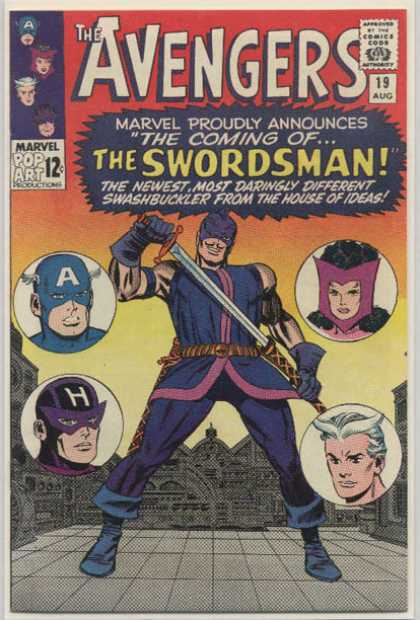
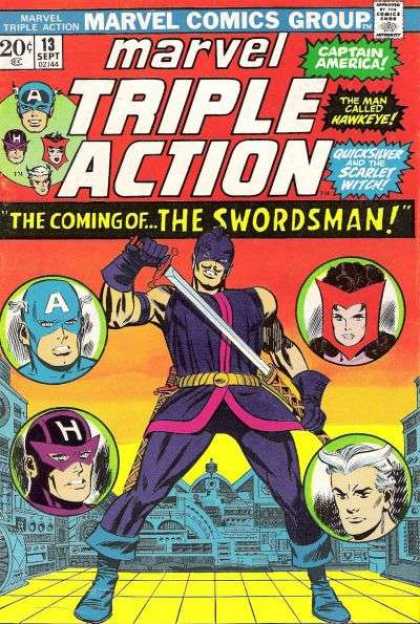
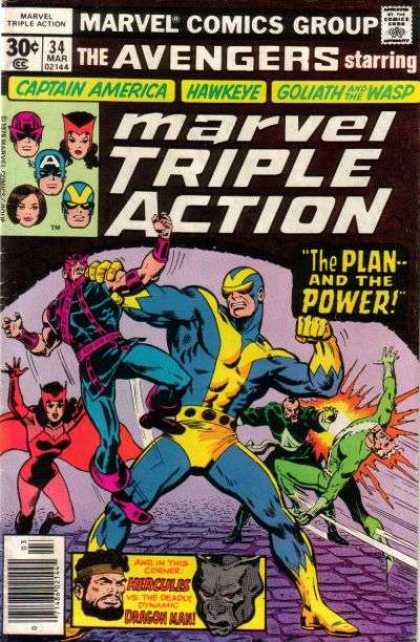
Doug: Almost from the very beginning of the Marvel Age, Marvel Comics began to reprint their Golden and Silver Age material for the benefit of not only a buck, but hopefully with an altruistic eye toward filling in the newer enthusiast. For books like Marvel Tales and Marvel Collector's Item Classics, covers were done with several panes, each showcasing a character or story within. However, as the Marvel line began to expand in the late 1960's, new titles were created for the purpose of keeping material from the seminal days of the Fantastic Four, the Avengers, et al. on the stands. Hence, we saw the rise of titles such as Marvel's Greatest Comics and Marvel Triple Action, respectively.


Doug: Below are some examples of covers that were used on the original titles and on the reprint mags. You'll notice that in some cases the following scenarios were applied (NOTE -- unless otherwise stated, all cover images are from http://www.coverbrowser.com/, and all creator information was obtained from the Grand Comic Book Database, available at http://www.comics.org/) --
  • the cover was reproduced faithfully in form and color
  • the cover was reproduced in form but not in color
  • the cover was redrawn
  • the cover was completely different, but somewhat faithful to the topic within


Doug: The covers above hold a special place in my heart, particularly the Marvel Triple Action on the right. This was the first issue of the Avengers I ever owned -- it was given to me by a girl whose family was friends with our family. I can almost recall the day she gave it to me; prior to that, I believe I had a copy of a JLA/JSA crossover and a couple of funny animal comics (Mickey Mouse or the Looney Tunes, maybe?).


Doug: As you can see, these covers are basically the same with a few very minor exceptions: the coloring of the floor, color has been added to the floating heads circles, the Cap head in the corner box is larger and a different rendering, there has been a removal of some text from the call-out, and the lowering of the artwork to make room for the larger masthead. In this case, it's my opinion that each of these changes actually improves the look of the cover -- score one for the revamp-guys!

Karen: The reprint does look sharper, but is some of that due to aging on the part of the older comic? In any case, very minimal adjustments were made to that cover.


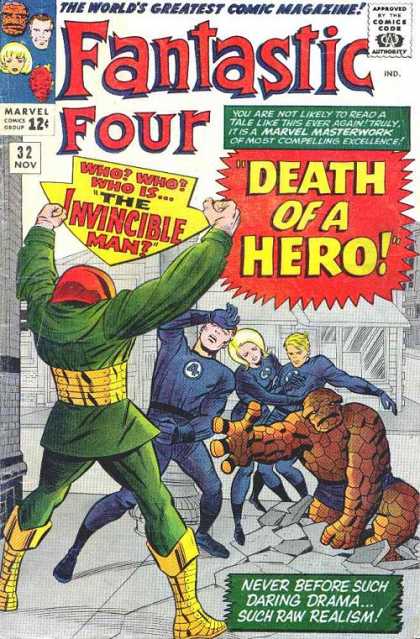
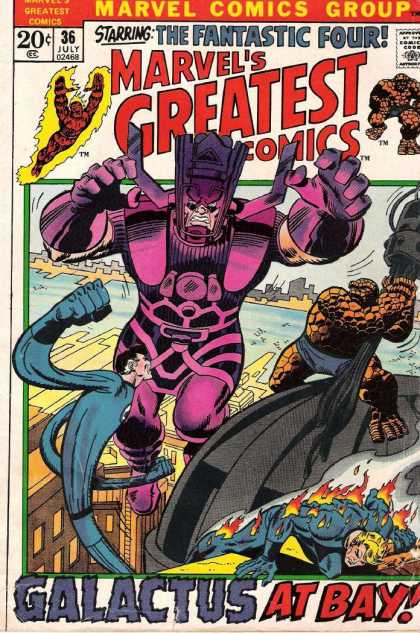
Doug: Similarly, the two covers above show only a difference in coloring (with slight size alterations to the call-out graphics), which for me is better on the updated version. Keep in mind, however, that the royal blue uniforms are what the FF was currently wearing when this issue of Marvel's Greatest Comics hit the newsstands.


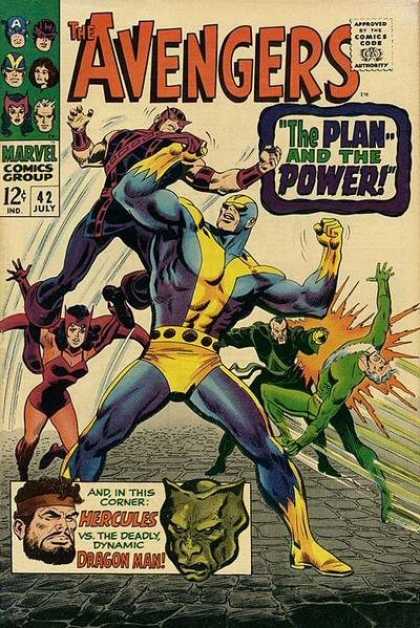
Doug: I've always had a slight problem with the John Buscema/George Roussos cover from Avengers #42. Certainly it's not the art -- that is splendid, indeed. It's more the white cover. I know my copy, which isn't in the greatest shape, is yellowed pretty badly. Let's face it, the publishers never intended that the materials would hold up over a 40-year period of love. But overall, Avengers #42 sports one of the many spectacular efforts Big John dispensed throughout his Silver Age tenure on the title. The reprint, however, has some problems. 

Doug: We can start with the color scheme. I'd take dingy-white over this black/lavender/purple trainwreck any day. Beyond the color choices, the incredibly large masthead near-necessitated that Buscema's pencils be altered; had the book been allowed to maintain the original artwork, it would either have had to have been shrunken or permitted to obscure the title. It's been documented (specifically in regard to a Neal Adams draft effort of X-Men #56) that Marvel wanted no monkeying around with the titles/logos to their books -- Martin Goodman felt that the book wouldn't sell if people couldn't read the title. So I'm guessing that the only viable option was to redo the Goliath figure. The cover art on the right is a combination of the Buscema/Roussos pencils from Avengers #42, with touch-ups by Ron Wilson (http://www.samcci.com/). It looks to me like the Hawkeye figure was repeated, although tilted to the right with the left leg and chest redone. Whether due to space or style, Wilson drew Goliath's head larger in proportion to the rest of his body than Buscema had -- the result is a much less menacing Hank Pym, in my opinion. Wanda's cape has also been elongated. I'll take the original effort on these two.

Karen: What's amazing to me is how much space the title takes up on the Marvel Triple Action book. That's easily a third of the cover! No wonder the art has a squished look to it. Hands down, the original is superior!


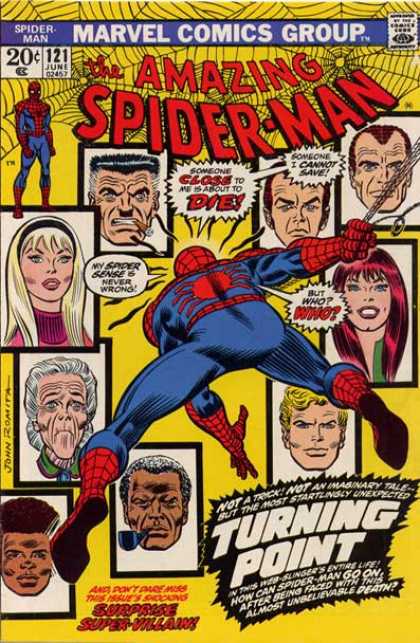
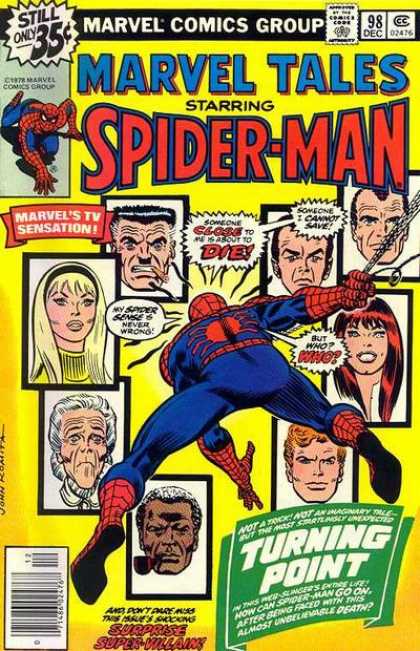
Doug: Here we have an example of a cover that is near-duplicated from original to reprint version. However, upon closer inspection there is one obvious difference and a few more-subtle changes. Randy Robertson gets the shaft for the UPC code in the corner, and for some inexplicable reason the call-out in the lower right corner is re-formatted. Now, if you look closely you'll notice that all three women on the cover are shown with some type of garment (Was this Code? None of the men are shown with collars, etc.) and the colors on each of them have been changed. Why? No clue, as the color scheme of each cover is virtually the same palette. About the only other difference, and it's even more subtle, is the shrinking of the artwork to accommodate the larger logo as well as the "Marvel's TV Sensation!" call-out.


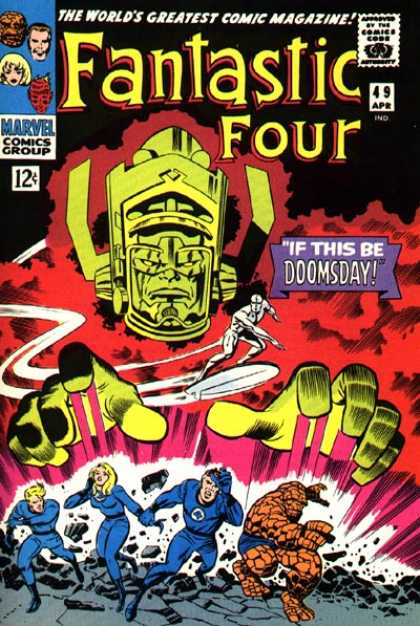
Doug: In the above duo, the left side depicts the iconic image of Galactus (FF #49 is the first cover appearance for both Galactus and the Silver Surfer) by Jack Kirby and Joe Sinnott. On the right is the cover to the reprint of the same story -- this time around the cover is pencilled and inked by Our Pal Sal Buscema. I'm a Sal-fan, but at first glance I really couldn't understand why editorial chose to go away from what many Marvelites might consider to be one of the finest covers of the Silver Age. However, upon doing a little research I think I came to a pretty fundamental answer -- simple cross-marketing among titles. Take a look at the cover to Fantastic Four #122, which is cover dated May 1972; Marvel's Greatest Comics #36 is cover dated July 1972:


Doug: The cover above is by John Buscema and John Romita. The proximity of Galactus to the FF, the frame around the cover art (typical of the 20-cent period in Marvel history), and the general style of the pencils show that Marvel intentionally used Sal's artwork to piggy-back on John's 4-part epic from only a few months earlier. Again, while Kirby/Sinnott had unleashed a classic cover back in 1966, the follow-up effort certainly had its motivations from a dollars standpoint.
Karen: I think this is a good guess on your part Doug. I distinctly remember reading both of these titles when they came out, and it took me some time to understand that one was current and the other was "historical" - or at least that was the way I thought of it as a youngster.

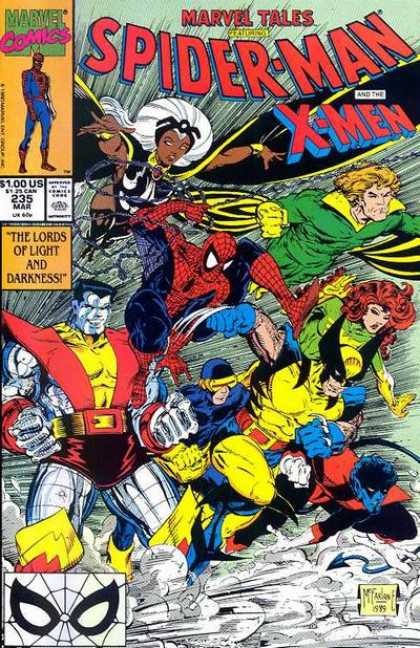
Doug: Here is another example of a reprint where the cover art used was strictly due to the "hotness" of the artist. On the left is the original Marvel Team-Up Annual (1976) with cover art by the original artist of the All-New, All-Different X-Men, Dave Cockrum. However, by the time the Marvel Tales on the right was published, Todd McFarlane was breaking all kinds of sales records with his rendition of Spidey. No wonder, then, that he also got the gig doing covers for Marvel Tales in addition to his work on Amazing Spider-Man in this era. Nevermind that there is absolutely no connection with the more recent cover to the story within. Hmmm... trend developing?


Karen: The Cockrum cover is vastly superior in my opinion. It has a nice clean layout which gives you an idea of what's in the book. As you point out, MacFarlane's cover is simply a pin-up of the characters. I don't know exactly when this trend started but I wish it would go away! The cover should give an idea of the story in the book - something to draw the reader in. X-Men and Spider-Man fighting a giant robot: OK, I'll check it out. X-Men and Spider-Man running: not really all that intriguing.

Doug: So what's the overall evaluation of reprint covers in general? I guess out of sentimentality I'll have to side with the originals. Despite the improved technology that allowed for a richer color palette on the reprints, and in spite of more modern marketing strategies that placed then-hot or -current artists reinterpreting the covers, those new covers sort of disconnected with the original stories. I think for long-time fans, there's that relationship between cover and story that perhaps today's younger readers don't understand. With so many "portrait" covers, a good ol' fashioned cover that makes the reader have that "can't wait!" feeling. Even on a Marvel Triple Action or a Marvel Tales, knowing that what was within was as good as what was on the outside was just a great sense of anticipation.

Wednesday, July 11, 2012

Karen's Favorites: Marvel Tales 33


Marvel Tales #33 (Feb 1971)
"Spidey Smashes Out!"
Writer: Stan Lee
Artist: John Romita

Karen: Recently Doug started us off on th
is semi-regular feature where we review some of our favorite books by recounting his love for Avengers 28. He noted that he couldn't recall if he'd read the original issue or the reprint version in Marvel Triple Action. Certainly for those of us who began reading comics around the early 70s, there were a number of reprint books available to help us fill in our gaps in our Marvel education. I always picked up Marvel's Greatest Super-Heroes, which featured the Fantastic Four, and Marvel Tales, which featured Spider-Man. It didn't take long to figure out that these were adventures that had taken place years before. I'm not sure how I knew, but I knew. There was a sort of thrill for me, learning about the history of what was-even then -a complex universe full of inter-connected characters. Although I was reading Amazing Spider-Man and Marvel Tales at the same time, it was John Romita's Spidey that imprinted itself on my brain. His athletic Spidey, cute Peter, and gorgeous Gwen and Mary Jane are the versions that always come first to mind.
Karen: This particular issue was, I think, my first of Marvel Tales. I read it so many times, the cover got torn off and ripped up. I taped the thing back together, and years later, purchased a nicer copy out of sentimentality. The things that impressed me then are what really define Spider-Man to me even to this day: Spidey has a lot of hard breaks, but he keeps going. Even if he has to fight with a broken arm, he will, because of his sense of responsibility.

Karen: This particular issue collects
two issues of Amazing Spider-Man: numbers 45 and 47. Yes, they skipped issue 46, which featured the Shocker. Seems kind of odd. But I'll just be reviewing the story from #45, as that's the one that really made an impact on me. I'm actually using the Spidey DVD for this review.

Karen: Our story begins with Spidey sporting a bum left wing, the result of fighting the Lizard in the previous issue. As he searches for his reptilian foe, he breaks up a high-jacking, and receives the thanks of a grateful trucker. But his mind is on the Lizard, who is actually his friend Dr. Curt Connors.Across town, the Lizard breaks into his family's high rise Manhattan apartment, searching Connor's lab for notes that will allow him to turn other reptiles into reptile-human hybrids. Seems ol' Liz thinks he is a mutated lizard! He's unaware of the fact that he is actually Connors and talks about him in the third person. His wife hides in a darkened bedroom with their son as the creature tears up the lab, frustrated that he can't understand any of the doctor's scientific notes.

Karen: Back at the Daily Bugle, Fredrick Foswell is planning to take on his 'Patch' identity so he can tail peter Parker, to discover how he gets so many pictures of Spider-Man. But this is nipped in the bud by J. Jonah Jameson, who sends Foswell out to find the Lizard. JJJ also reprimands Ned Leeds and Betty Brant, who are making wedding plans on their coffee break. "I work my fingers to the bone, keeping the newpaper together just to provide jobs for everyone---and that's the thanks I get!" Ah, classic JJJ. It's interesting how the book follows all of Peter's supporting cast, even when he's not in a scene with them. But of course his cast was just as important to the book as any super-villain.

Karen: Our hero is back in his civilian ID, and fretting ab
out his bum wing. Since Spidey has been seen with his left arm in a sling, will people make the connection between Spidey and Peter? Peter tries to go without the sling an d act normally but his arm hurts too much. Finally, he gets a little angry and puts on the sling, and decides to claim he injured his arm on his motorcycle. He runs into Flash Thompson and Harry Osbourne, and the excuse goes over without a problem. Flash soon leaves to have coffee with Gwen. Harry tells Peter that Gwen is throwing a party for Flash, because he just received his induction notice. When I read that, it made me stop a moment. He was drafted. To fight in Viet Nam. Think about how incredible that must have seemed when this story was originally published (1967). Is it any wonder that Marvel appealed to older readers far more than DC? Anyway, Peter asks why Gwen didn't ask him herself and Harry replies that they haven't seen much of him since Mary Jane's been around. At this point, Peter was not dating Gwen yet -but even here, he's already thinking about her that way. Peter explains that it's not only Mary Jane that's been keeping him busy - he spent all his dough to send Aunt May on vacation, so he's been taking a lot of pictures for the Bugle. Harry suggests that his Dad could use a gifted chemistry student like Peter, and Peter says he'll consider it.This was kind of surprising, since he already knows Osborn is the Goblin!

Karen: Later, Peter switches to Spidey a
nd takes to the skyscrapers to search for the Lizard again. But he's getting nothing from his spider-sense. He goes into the sewers too, but finds zip. Finally, he checks out the zoo, since he knows the Lizard wants to command an army of reptiles. It seems pointless, but then he spots a sign for an exhibit of "The world's largest collection of reptiles." The exhibit is gone, but he discovers it is being loaded onto a train bound for Philadelphia. He races off to the train depot and immediately his spider-sense goes off. He spots the Lizard on top of a train car and tackles him, and the two of them go flying. Spidey really pounds away at Liz, realizing that he has to press his advantage while he has the upper hand. But the Lizard's hide is too tough -he barely feels the blows. One of the things I like here is that the Lizard is not gigantic (unlike the new film, where he is of Hulk-like proportions). But he's definitely not human, and Romita does a nice job portraying his thick, scaly hide. You just know how much it must hurt to even punch him!

Kar
en: The Lizard swats Spidey away with his powerful tail and tears out a piece of railroad track and tries to hit Spidey, but our hero quickly jumps up and plants a blow to the Lizard's gut. Even then, he thinks how he can't help but pull his punches, knowing that his enemy is actually Dr. Connors. It sure seems like Spidey had this problem more than any other hero! The Lizard, The Goblin, and a variety of other foes all received Spidey's sympathy.


Karen: The Lizard shakes off the blow and whacks Spidey with a two-fisted blow to the head. Everything is spinning for our hero, as his reptilian foe lifts him overhead an
d hurls him into the side of a rail car. This whole fight sequence is so dynamic, so fluid. Romita really makes you feel every blow. Turning from Spider-Man, the Lizard tears open a car to let loose hundreds of snakes and crocodiles -apparently they were all just shoved in there together! The Lizard is able to actually command them all (a power I had forgotten until re-reading this story) and there's a great shot of all these cold-blooded nasties coming after Spidey.

Karen: As Spidey is facing an army of foes, Mary Jane accompanies her
Aunt Anna as she brings a pot of soup over to Pete's place, but they discover he's not there. Romita makes Mary Jane positively glow here -she's beautiful and full of life. Earlier in the book we got a shot of Gwen while Peter was thinking of her, and she's just as beautiful, but with a softer look to her. Of all the artists at Marvel in the 60s, I don't think there's any doubt that Romita drew the most gorgeous women. He was well suited to the romance comics he once drew. But I'm glad he switched to super-heroes!

Karen: Meanwhile, Spidey is trying to figur
e out how he can beat all the reptiles attacking him. He grabs a snake and uses it as a whip. The Lizard yells a warning to the reptiles and Spidey gets off a typical quip: "Knock it off Liz! They're doing fine without help from you!" Spidey gets the bright idea to grab a croc by the tail and swing it around to bash all the other animals. It works and he's given himself a little break, but then he sees that the train is taking off and the Lizard is going with it. Although he's nearly exhausted, he reminds himself that this about more than just winning a fight -he has to save Dr. Connors. He jumps onto the train and kicks Liz in the face, and an idea comes to him about how to beat him. He taunts the Lizard into chasing him. I have to say, a lot of my enjoyment of Spider-Man has always come from his smart-Alec remarks in the midst of battle, and nobody did it better than Stan. Here's an exchange I just love:

Lizard: Stand still, you weakling! Stand there and fight!

Spider-Man: I'd love to, Liz, but I'm just a bundle of nerves! How about if we just call each other nasty names?

Karen: Spidey goads the Lizard to chase him atop the train until he reaches a particular car. He dives in through a hatch on the roof and the Lizard follows. Spidey lays into him, thinking he has to keep him busy before he figures out where he is. It looks like the Lizard is going to pounce on Spidey, but suddenly his str
ength begins to leave him. It turns out the car is refrigerated. Being cold-blooded, the Lizard take s on the ambient temperature and soon becomes comatose. Spidey seals him in a web-cocoon to keep him just warm enough to stay alive. He pulls the cord to stop the train and asks the train engineer to flag down a t rain heading to New York, saying a man's life depends on it. Surprisingly, the engineer accedes and Spidey heads back to NYC with the Lizard -in his cocoon -slung over his shoulder.

Karen: Spidey carries the Lizard back to the Connors' apartment and c
limbs through the window. He looks through the disheveled lab and finds Connors' notes. Mrs. Connors has overheard him and starts to shout through the door. Spidey explains it's him, and tells her not to come out just yet. He's afraid to get her hopes up. He begins mixing up chemicals, and the Lizard starts to awake inside his web cocoon. Spidey quickly pours the concoction down his throat, and there's a tense moment as Mrs. Connors and son wait to find out what's happening. Then Spider-Man opens the door and Dr. Connors appears! The family is reunited and Connors thanks Spidey.

Karen: The next panel really threw me for a loop as a youngster. You can see it below. The caption says that they're leaving the panel for the readers to write their own dialog! Now if that doesn't have the feel of Silver Age Marvel, I don't know what does! (And yes, I did write in my comic!)


Karen: Pete changes back to his civvies and star
ts walking home. Harry and Mary Jane drive up, but he's so exhausted he doesn't notice them at first. They offer him a ride, but he says it's not far, he'll walk. They pull off and Peter is annoyed with Mary Jane for going out with Harry. "No doubt about it - that chick's as pretty as a pumpkin seed- but about as shallow!" What? 'Pretty as a pumpkin seed'? He has more complaints about MJ, but then begins to have recriminations, thinking that maybe he's just taking out his frustrations on her. Then we get the whole laundry list of problems -money, school, his arm, Aunt May - life was never easy for Peter! When he gets home, Anna Watson is there with the soup -was she waiting all this time? Pete goes inside the house and then really gets angsty, blaming all the problems in his life on his being Spider-Man. At the end of our tale, there's a brief cutaway to the Connors. Dr. Connors wishes he could do something to repay Spider-Man, but his wife says a guy like Spider-Man probably has it made! Oh, if only she knew!
Karen: To me, this is still the quintessential Spider-Man tale: Spidey's personal life is crumbing around him, but he feels driven to not only protect others, but to help people, even his enemies. It's the quality of Spider-Man that makes us all care about him and respect him. This issue is a great example of solid story-telling. The art and the script come together so flawlessly. Lee and Kirby is the team people think of first when they think of SA Marvel, but Lee and Romita were an incredible duo as well. Anyone who thinks Lee was nothing without Kirby needs to look at his Spider-Man work here. It's smart and funny and human. It may be a big super-hero soap opera, but that's what I love about Spidey. His personal life is at leas
t as important as his super-heroic life.

Karen: Just for the heck of it, here's the cover to Amazing Spider-Man #45 -pretty neat, huh?


Related Posts with Thumbnails