Showing posts with label Dracula. Show all posts

Tuesday, October 27, 2015

BAB Review: Dracula (1931) -Bilingual Style

Lugosi


Dracula (1931)

Karen: I had the pleasure of seeing the original Universal Studios  Dracula this last Sunday on the big screen courtesy of Fathom Events and Turner Classic Movies (TCM). I actually saw Dracula twice: first the classic Bela Lugosi version was shown, and after a ten minute intermission, the Spanish-language version, made on the same sets but with a different cast, was shown. I highly recommend seeing classic films like these on the big screen; it's a completely different experience than seeing it on a TV set. The Lugosi Dracula was also the restored, high def version that is  available as part of the blu-ray set of Universal Monsters films that came out a couple of years ago, and it's astonishingly clean and sharp. I know I was particularly amazed at how clear the sound was -no hissing or crackling!

I probably can't add anything new to the reams of commentary that have been made about this classic. I will say that the story seems almost truncated, like a Cliff's Notes version of the novel, with whole scenes whittled down to bare sketches (the time at Dracula's castle, the voyage on board the Vesta, etc.) although the Spanish version does slightly expand some scenes and adds a few shots that help tell the story a bit better. This was the first time I saw the entire Spanish language version, and while I can understand why some people might argue that it is the better production, there is one thing that keeps that from being true: Carlos Villarias is an absolutely awful Dracula! He is constantly mugging and grimacing, and his Count is utterly devoid of menace. 
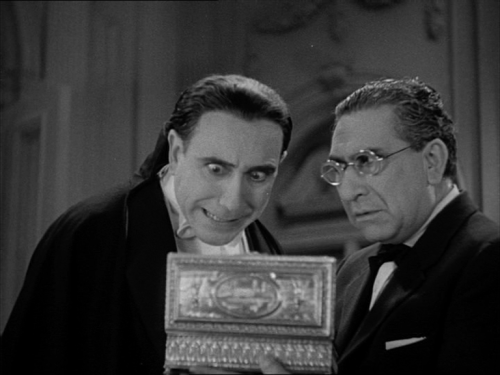

Carlos Villarias as Dracula

This brings us to Lugosi. I think over the years people have tended to downplay his performance. Perhaps they have seen Ed Wood and look upon him as some sort of goofy, tragic character. But if you really watch him, he's quite  compelling. Yes, his line delivery is odd at times, but it actually enhances the other-worldliness of the character. And the aura of command, of danger, around him is palpable. There's a reason his is the foremost image of Dracula (sorry Christopher Lee) even today.


I want to say I am not connected to Fathom Events, TCM, or Universal in any way, but I encourage all of you to catch these films on the big screen. Fathom showed Frankenstein and Bride of Frankenstein around Halloween last year and it was fabulous. At both last year's and this year's shows, TCM host  Ben Mankiewicz appeared at the beginning of both films to provide some insights into each movie. I've read a ton on the Universal films and nothing he said was new to me, but I'm sure it was enlightening to some of the folks in the audience I was with. I appreciate Fathom, TCM, and Universal putting these films back out there and keeping them alive in theaters. I hope that perhaps another generation of film-goers can experience them and understand what makes them so special. Please note that many theaters will also be showing this double-feature this Wednesday, October 28th, so you still have a chance to see it! Check out the Fathom website to locate a theater near you. 


Tuesday, October 9, 2012

Who's the Best...Dracula?

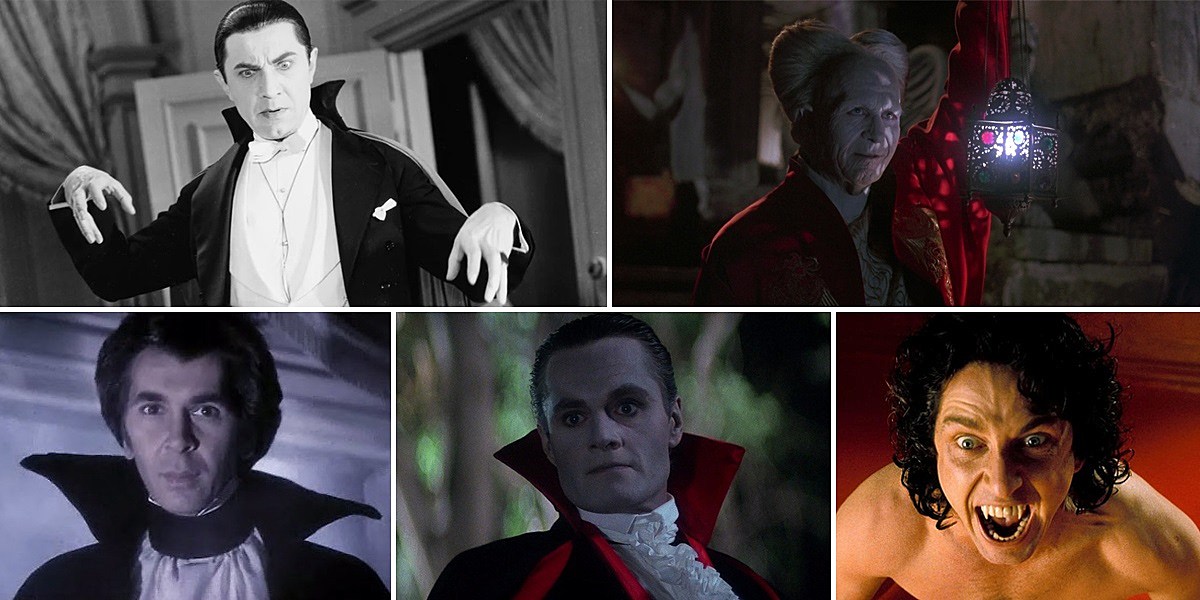
Karen: Who's your pick for the best film/TV  Dracula? There have been a lot to choose from....Bela Lugosi, Christopher Lee, John Carradine, Gary Oldman, Frank Langella. Let's hash it out.


Monday, October 8, 2012

BAB Frightfest: Tomb of Dracula 1


Tomb of Dracula #1 (Apr 1972)
"Dracula"
Writer: Gerry Conway
Artist: Gene Colan

Karen: Dracula was indisputably the most successful of Marvel's monsters. The series lasted far longer than any of its counterparts, running 70 issues, and Marvel's version of Dracula showed up in many of their magazines as well as other comics. I came late to the TOD fold; as I have mentioned in previous posts, I really hadn't read many issues of the title until I picked up the TOD trades, volumes 1-3. The series definitely improved as time went on. The early issues featured a parade of writers, until Marv Wolfman came along in issue #7, and began to forge his long and highly acclaimed run. Of course, any discussion of Dracula would be incomplete without praising the efforts of artist Gene Colan, who truly owned the character. Colan was the penciller for the entire run! His style, making great use of lighting and shadows, fit the book perfectly.

Doug:  Well you have much more of a history with all of our ghouls this month than do I -- I am lame-o supreme-o when it comes to the monsters.  I don't know why I never got into them, because as I read this stuff now in the Marvel Firsts, the Essentials, etc. I love them!  So I'm going to be positive about making up for lost time rather than dwelling on my lack of taste as a Marvel Superhero Zombie in days of yore.

Doug:  I'll echo your sentiments toward Gentleman Gene Colan -- I've always loved him on Daredevil and already get the feeling I'm going to like him on just about any Tomb of Dracula I'll encounter. 

Karen: This first issue would introduce us to the supporting cast, who in many ways were just as popular as the title character. Dracula was never portrayed as "the hero" in the series -- complicated, intriguing, yes, but the vampire was always shown to be at his core, evil. The heroic vampire hunters who took him on were given as much face time as the Count.

Doug:  And I'll ask everyone to pardon my ignorance, as I'm not trying to be coy -- I really did read this for the first time for this review.  But it was pretty obvious that the young folks were going to be the protagonists with the Count the antagonist.  They're a little formulaic, as we'll describe, but that seemed to fit well into the tale.

Karen: Our story opens, and it is a dark and stormy night. No, really. Three travelers are driving to  an ominous castle, when their jeep goes off the road. Frank Drake, his girlfriend Jeanie, and their companion, Clifton (Jeanie's ex-boyfriend -- that won't be a problem, will it?) scramble out of the vehicle unscathed and walk back to the last village. The villagers, who would all fit in nicely in any Hammer horror film, are sitting in the local inn, speculating about these newcomers, with an old man named Burgeister saying that the castle will bring them only sorrow. The door pops open and the three bedraggled travelers enter, and Burgeister welcomes them to Transylvania! At this point I do have to note that I found it odd that the villagers seem to be Germanic, calling everyone 'Herr' -- wouldn't Transylvanians speak Romanian? Another thing -- this whole scene plays a bit odd for me, as I had the impression that the threesome had already stopped in this village, and yet they introduce themselves as if no one knew them. Did you find that odd?

Doug:  You know, I read it and re-read it, and to be honest I'm not certain.  Clifton does remark that they passed the village, but it's sort of ambiguous as to whether or not they'd actually stopped.  And how about the period costumes on the denizens of said village?  Clifton reminded me somewhat of Sir William Cecil Clayton from Tarzan of the Apes -- you just know that down the road he's going to become a major pain-in-the-butt.

Karen: Frank and the others try to get someone to take them to the castle, but most of the villagers are afraid, but one, Otto, says he'll give them a lift in his carriage if they pay him well enough. On their way there, the three young people question Otto about the rumors of Dracula. Otto says its superstition -- and yet, he won't drive all the way up to the castle. The travelers dismount and begin their long walk. Clifton notes that they're almost out of money. They better hope the castle is a real tourist attraction.

Doug:  The carriage was the perfect touch, wasn't it?  Who needs a car in a yarn like this?  I thought Gerry Conway did a nice job of building suspense in these early parts of the story.  Certainly we know where this is all headed, but there's still a sense of wariness. 

Karen: As they approach the castle, Frank muses about how they got here. He had inherited a million dollars from his father, and blown through it in three years. He'd also wound up falling in love with his best friend's girl -- but oddly enough, Clifton took it pretty well. In fact, Clifton was the only one who stood by Frank after he lost his money. Frank realized his only hope to make some money was to sell the castle he'd inherited. "Castle?" Clifton asked. It turns out Frank is a direct descendant of Count Dracula -- yes, the real Dracula. Clifton tells him that this is huge, that it could make a ton of money. Frank reads back through the centuries-old diary he's been carrying around, one that was written by Dracula's daughter, grandson, and a man named Van Helsing. It describes how Dracula became a vampire and also how he was killed. Frank keeps thinking about the body of Dracula, lying staked in the depths of the castle. He can't get it out of his head. Clifton tells him that they could turn it into a museum and make a ton of money. And so the three of them are off.

Doug:  This section of the story was great -- Conway did a nice job getting the casual reader up to speed on the mythos of the Count.  One really begins to get the sense, too, that Clifton deserves to "get it"... and soon.  He's just smarmy, isn't he?  Frank, on the other hand, is somewhat of a dubious hero isn't he?  He's certainly not virtuous in regard to heisting Clifton's girl and his financial lack-of-prowess.  Yet at this point he's all we've got.

Karen: You're right, Clifton may be a creep, but Frank's no paragon of virtue either. By the time they reach the castle though, Frank is sick of Clifton.He doesn't trust him. Frank blows up at Clifton, but once they enter the castle, he gets caught up in a feeling of deja vu. It's like he knows this castle. Suddenly a gaggle (flock?) of bats fly past them. Startled, the three separate. Clifton falls through some rotted floorboards and winds up beneath the castle. He goes down a set of winding stairs and finds Dracula's coffin. Clifton is filled with excitement. Turns out he's been planning to take the castle, steal Jeannie back, and kill Frank.  He approaches the coffin and pulls it open to reveal a staked corpse. Clifton chuckles about what idiots people were to think Dracula was a vampire. He pulls the stake out and leaves, thinking about how he'll arrange Frank's 'accident'.  Now maybe I am asking too much, but isn't it convenient that he decides to pull the stake out for no reason?

Doug:  Actually, bats travel in a colony.  Or a cloud.  Not that I knew that...  Yep, ol' Clifton's got everyone in a pickle now, doesn't he?  And how about him falling through the floorboards?  Didn't you find it odd that no one heard the ruckus and came to his aid?  Surely, too, he would have cried out.  Colan is not called a master of shadows for nothing, and he certainly shows it throughout these pages.  The coloring, full of grays and browns, is aptly moody, but Gene the Dean's blacks are fantastic. 

Karen: As soon as Clifton leaves, the skeleton in the coffin begins to change. Flesh forms on the bones and suddenly, Dracula is back. The Count stops Clifton, who shoots him, but to no effect. Dracula tosses him down a hole, "with the Others," and pauses -- he hears voices above, including a woman. Dracula flies up as a bat and turns back into his human form to confront Frank and Jeannie. He mesmerizes Jeannie and she tries to go to him. Frank knocks Jeannie out and drives Dracula away with her silver compact. Now that just seemed silly. Dracula flies off to the village and slakes his thirst with the blood of a local barmaid. Her body is soon discovered and the enraged villagers head off with torches in hand to the castle. Torches?  It's 1972!

 Doug:  Sort of B&W magazine fare with Jeannie's blouse flying open, ya think?  Loved the scene with the villagers -- just goes to show you that these scary stories are timeless!  Everyone has a part to play, I guess.  Colan's scratchy style really lends itself to the turmoil brewing as Dracula comes back from the dead and begins to do his thing.

Karen: Dracula goes back to the castle and creeps towards the unconscious Jeannie, but draws back when he encounters the golden crucifix around her neck. Frank leaps out and tells Dracula that he is his descendant. Dracula says he'll wind up a vampire too, but Frank comes towards him with the compact again. Worse, he throws the compact at him. Oh come on! Dracula, annoyed, grabs Frank and slams his head against the wall. As Frank slips from consciousness, Jeannie awakens, and Dracula commands her to remove her cross.

Doug:  The thrown compact was pretty dumb.  C'mon -- when it's your only weapon, you've got to at least use it to buy some time, huh?  Dracula does exude power, and the scene where he gets Frank around the neck just feels like it would hurt (a lot!).  Dracula has about as many powers as Ultra Boy, ya think?

Karen: The villagers reach the castle and set it on fire (a stone castle??) just as Dracula begins to leave with the girl. But Frank wakes up, and armed once again with his trusty silver compact, he drives Dracula off. Frank grabs Jeannie and carries her outside. He fears she's dead, but she rises and turns to him. He sees her fangs and she tells him that once one is bitten by a vampire, one can never die. Frank covers his face and cries as the girl disappears into the night.

Doug:  I wish I had the following issues -- Conway and Colan wove an interesting tale; certainly not without some bumps, but compelling nonetheless.  I'd be curious to see how Wolfman settled in and started to steer this in his own direction, past this introductory tale that served mostly as set-up.

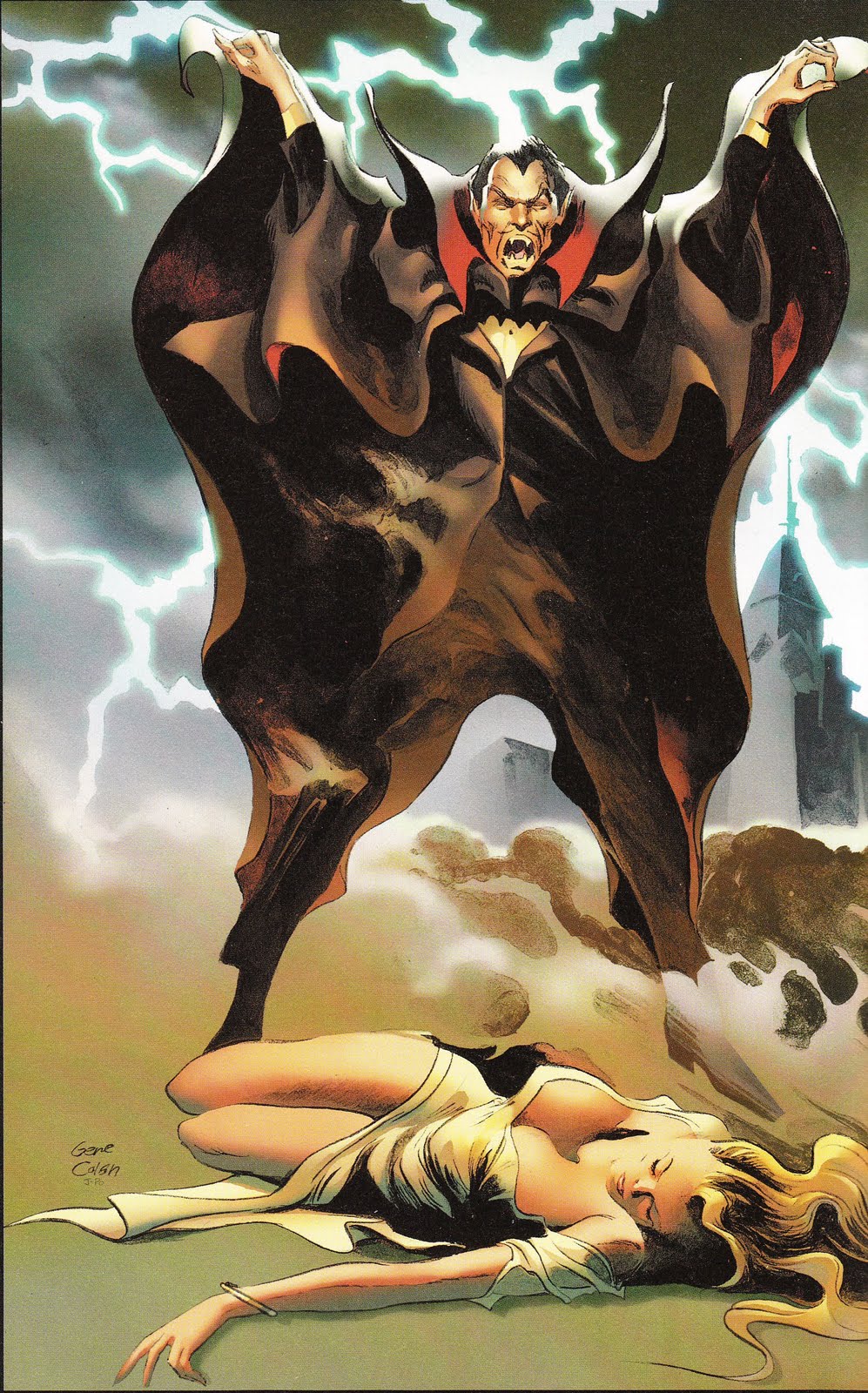
Karen: I have to say that the whole silver compact thing drove me a bit crazy. The story had a lot of atmosphere, but this was - -I thought -- a fairly weak start.The art was really the saving grace. As a bonus, I'm including a pin-up from the Tomb of Dracula TPB, which is apparently the piece Colan did to convince Stan Lee he should be the artist for the book. Pretty nice, huh? 


Wednesday, October 12, 2011

Classic vs. Modern Monsters


Karen: When it comes to horror and monsters
, I am decidedly old school. Growing up, the Universal Monsters -Frankenstein, Dracula, Wolfman, Mummy, Creature - were always on TV, usually on Saturdays, and I sat in front of the screen mesmerized by their tales. Each one had such a distinct back story and personality. Three of them, the Frankenstein Monster, the Wolfman, and the Mummy, also had tragic elements that made you feel for the characters. For me Dracula was just flat-out evil, and the Creature was more like a wild animal. But all of them had something that made them exciting and scary, but in a fun way.

Then in the 70s and especially 80s, a new type of monster came along: The slasher. This monster was far closer to our reality than the old monsters had been. He was essentially a serial killer with supernatural abilities or origins. There's Freddy from the Nightmare on Elm Street series, Jason from Friday the 13th, Michael Myers from Halloween, Chucky from Child's Play, and many others. Most of their victims are teenagers. While some of these characters were somehow wronged in their past, most of them are just plain evil psycho killers that deserve little sympathy, if any. Certainly the child murderer Freddy can hardly be considered worthy of our concern. And yet, these monsters are immensely popular with some fans.

So I'm curious: I know some of you also enjoy monster stuff. Where do you fall in this discussion? Classic or Modern? And if it's modern, I'd really be interested in hearing why.


Link


Tuesday, October 26, 2010

BAB Two- In -One: Fighting Fiends and Yer Mama's a Great Ape!


Karen: Recently my contribution to one of our Two In Ones was Tomb of Dracula #18, which was the first part of a Dracula vs. Werewolf By Night story. At that time I didn't have the concluding issue, Werewolf By Night # 15 -but now I do! Courtesy of my recent acquisition of the Tomb of Dracula volume 2 TPB, which includes the WBN issue (whoever thought of that, thank you!).

Karen: Werewolf By Night # 15 was also written by TOD scribe Marv Wolfman, and drawn by WBN artist supreme Mike Ploog. The story picks up
right from the end of TOD, with Drac and the Werewolf in a pitched battle. However, while Dracula appeared to be gaining the upper hand in his title, here the Werewolf ultimately does, and tosses the Count from the castle tower. However, Dracula changes into a bat and flies off. While Topaz and the Werewolf leave the castle, our vampire hunters, Rachel Van Helsing and Frank Drake, are arriving in a helicopter. Dracula attacks the copter but they manage to land safely.
Karen: The next day, the Werewolf has reverted to Jack Russell and he and Topaz manage to unlock his father's diary. He reads it and discovers that one of his ancestors had actually staked Dracula! But the man was then bitten by a werewolf at the Castle, so Jack's lycanthropic curse is in some sense due to Dracula. This seemed pretty interesting, tying the characters together this way. Unfortunately I don't have many issues of WBN so I'm not sure if anything else was ever done with it.

Karen: Later, Dracula returns to the castle in mist form and attacks Rachel and Frank -and then leaves! Oddly, rather than finishing them off, he heads off to the copt
er, to disable it, saying that he senses all four of his enemies will converge there. This just seemed a bit weird, maybe a case where the artist and writer weren't on the same page? In any case, Drac begins disabling the helicopter controls when the Werewolf shows up. Topaz has used her powers to enable Jack to be in control of his beastly form. Dracula realizes this as they fight. Before much of a brouhaha can ensue, the vampire sees Topaz holding the diary and declares he must have the book. Just as he takes it from Topaz, Frank and Rachel show up and get it away from him, taking off in the chopper, which apparently wasn't so disabled as we thought! Dracula declares that the book could be used to destroy him forever and he frantically pursues the chopper in bat form, leaving Topaz and the Werewolf looking on.

Karen: While I thought the quality of the story was a bit uneven, it was generally entertaining. I much prefer Ploog's sinewy Werewolf to Colan's interpretation, but Colan's Dracula is the definitive one. Now I really want to get my hands on some more Werewolf By Night comics!
Doug: Back before htmlcomics.com got really well-acquainted with the FBI, it had been my slithering intent to do some Tarzan reviews from the very excellent Joe Kubert years over at DC. I, however, made myself an honest man during a visit this summer to Geppi's Entertainment Museum while on vacation in Baltimore. In the museum store I spied the three volumes of the Tarzan Archives (now published by Dark Horse Comics). They were on the scratch-and-dent table for -- get this -- $10 apiece!! Yep, $150 worth of books at 80% off! Dumb luck -- that's me! By the way, I would most strongly recommend that if at all possible a visit to the Geppi Museum (and all of the other attractions near it) would be time incredibly well-spent!

So today's fare is the premier issue of DC Comics' adaptation of Edgar Rice Burroughs' Tarzan of the Apes. Tarzan #207 (April 1972), "Origin of the Ape-Man" continued the numbering from the Gold Key series. As the title moved to DC, veteran illustrator Joe Kubert took the creative reins as editor, writer, penciller, and inker. And it was a tour de force!

Kubert's jungles are lush, his beasts menacing, and his ape-man lithe, yet powerful. The first issue in DC's reboot is a basic retelling of the Burroughs' novel, originally published in pulp form in 1912.
Kubert, sensing that many a superhero movie takes 2/3 of the picture just to get the guy in the suit, opens with Jane and a guide (plus some porters -- you just have to have African porters!) on a voyage through the jungle in search of Jane's missing father. Suddenly, a black leopard bursts through the foliage, only to be intercepted by a white blur of fury. Tarzan descends from above, saving the life of the guide while at the same time engaging the big cat. As quickly as it began it is over, and Tarzan vanishes. Jane tries to catch her breath, and the guide tells her what he thinks the man was.

Kubert then takes us on a descent into what would be hell for any modern man. While sailing for Africa, John Clayton, Lord Greystoke, and his wife Lady Alice find themselves in the company of hooligans as poorly-behaved as the seas have ever seen.
Later in the voyage, as the crew mutinies, the Claytons are protected by Black Michael; however, stating that he could never protect them forever, Black Michael forces the Claytons to disembark amidst the African jungles. Leaving only a rifle and ammunition, and an axe, the crew leaves.

Lord Greystoke builds first a platform, then later a cabin to protect his wife from the denizens of the jungle. Lions, monkeys, and the great apes all at one time or another pay a visit -- sometimes a menacing visit. I've always been enthralled by Burroughs' apes -- neither gorilla, chimpanzee, nor orangutan -- they are almost an amalgam of all three. Kubert succeeds in making us believe they are real. On one fateful day one of the bull apes surprises Greystoke and it is only his lady's quick action with the rifle that saves them both. However, before the ape died it lurched at Lady Alice, knocking her to the ground. Her unborn child unharmed, the heir to the Greystoke name was soon born.
However, the trauma left Alice homebound, and a year later she died.

As John Clayton grieved, elsewhere nearby the leader of the local ape tribe, Kerchak, menaced his fellows. Gnashing his teeth and striking out, he eventually began to chase Kala, she a new mother herself. In the melee, the young ape was dropped to his death. As Kerchak's rage suddenly left him, he rallied his troops and set off for the cabin by the sea. Kala went to her now-dead baby, and clutching him fell in line with the rest of her "people". Attaining access to the cabin, the apes poured in and overwhelmed Lord Greystoke. Kala, seeing the newborn human, grabbed him and left her own in his place. She would defend the strange-looking infant as he grew.

The remainder of the tale follows Tarzan's younger years, culminating in his discovery of the cabin and seeing books for the first time.
It is only then, when he was about 13 years old, that he discovered that there were others who looked like him. And it was also on that first voyage to the "nest" that he found and appropriated his father's hunting knife. Sensing the moonlight and the need to return to the tribe, Tarzan left -- only to be confronted by Bolgani the gorilla. With self-defense as his sole option, Tarzan engaged the huge gorilla and plunged his new blade into the beast's hide again and again and again. And as the two of them collapsed -- Bolgani in death and Tarzan in exhaustion, it was this singular event that would start the Ape-Man on the path to leader of his people, and toward becoming a legend.

Kubert spreads Burroughs' first story over multiple issues, and it's my goal to begin a series here, much like Karen had done with the Deathlok stories she'd reviewed from Marvel's Astonishing Tales.
These are fantastic stories, and Kubert's writing and art seems a perfect fit for them. While John Buscema would add his own interpretation to the jungle lord later, Kubert's interpretation is perhaps more fitting -- the length, the grace, yet again the power kept are fine attributes of this Tarzan, and make these stories Bronze Age classics!

Tuesday, October 19, 2010

Monsters: Classic vs. Marvel!

Karen: Marvel Bronze Age fans know that in the 70s, Marvel published a ton of monster comics. But how do the Marvel versions stack up against the Universal movie classics that obviously inspired them? Let's take a look.

Dracula: The bloody Count has been featured in numerous films, and played by many actors, but one name always stands
above the rest: Bela Lugosi.

Lugosi left his mark on the role -and our psyches -with his interpretation of the world's most famous vampire. His Dracula set the standard for all images to come. On some levels, this includes Marvel's version. But the comics Count does have his differences.

Marvel's Dracula, as drawn by the
legendary Gene Colan, was tall and lean, with a thin mustache, and oddly enough, pointed ears! Although he had the same widow's peak hairstyle as Lugosi, he may have owed more of his look to either John Carradine's version, or the then-current Hammer films vampire, portrayed by Christopher Lee.


The Frankenstein Monster: Most famously portrayed by Boris Karloff, the Monster was played by no less than four actors in the Universal films (Karloff, Lon Chaney Jr, Bela Lugosi, and Glenn Strange), and since then a ton of other films have featured some version of the Monster. But that Universal image, with the elongated, flattened head, drooping eyelids, and the infamous neck bolts, is the one most firmly entrenched in the public mind. Particularly at Halloween time, you see representations of it everywhere: on toys, greeting cards, I even saw a box of tissues bearing the image of the Universal Frankenstein!

Marvel's Monster certainly owed a strong debt to the classic look. His head had a high forehead and a somewhat flattened top. The
eyes were typically drawn as half-shut. No neck bolts -that would've been too close to the Universal version, I'm sure. But interestingly, the Marvel version was typically shown wearing a fur vest, very similar to the Monster's garb in Son of Frankenstein. Perhaps the biggest change was making the Monster's skin tone a pale white. Although the original films were made in black and white, the commonly accepted skin color for the Monster has been green (you can still find some color shots floating around that depict a green Karloff in the role). Truthfully, the white skin seemed to make more sense than green. The Monster was drawn by a number of artists, including Mike Ploog, John Buscema, and Val Mayerik.

The Wolfman: T
he third member of the classic monster triumvirate is the bestial Wolfman. As portrayed by Lon Chaney Jr., the Wolfman was a tragic figure, cursed to become a beast when the moon was full. Universal's lycanthrope seems tame in comparison to modern movie werewolves, but in some ways, I think this classic version allows more of the humanity (and thus the tragedy) of the character to come through. The Universal Wolfman is hairy, with a wolf-like nose and fangs. Although the movies were in black and white, most representations of the character (such as action figures) depict him as having brown fur and skin.

In this case there are actually two Marvel characters who were influenced by the Wolfman. The first is Jack Russell, aka Werewolf by Night. He could almost be the Wolfman's twin brother. Same color scheme, and facially very similar, as WBN retains a more human appearance. One way they did differ: the Werewolf liked to run around shirtless! I'll go on record saying I prefer the Ploog Werewolf over all others.

On the other hand, the Man-Wolf looked decidedly different than the Wolfman. The most obvious difference is coloring: Man-Wolf had a white or silvery look to his fur. He also had a bit more of the wolf to his face, as he seemed to have a bit of a snout, and large, canine ears. He'd fit right in with werewolves in more recent flicks.

Now Marvel also had a Living Mummy, but there's not much to say here: both the Universal Mummy and Marvel's version were just guys wrapped up in bandages! As for that
later addition to the Universal Monsters, the Creature from the Black Lagoon, there's no strong Marvel analog. Yes, Marvel did come up with a monster called the Manphibian for the Legion of Monsters magazine, who definitely seemed inspired by the Creature, but he was a one hit wonder. If any Marvel monster reminds me of the Creature, it's probably Man-Thing. Although they look nothing alike, the concept of the solitary , one of a kind monster, living in an aquatic environment (in Man-Thing's case, a swamp) is similar. But visually there's no comparison.

Wednesday, April 28, 2010

BAB Two-In-One: Simians in White Sheets and Dead Guys Fighting

Doug: Marvel Magazine time, kids. Today we're looking at the first issue of Planet of the Apes, the black and white extravaganza that celebrated all things Ape in the early 1970's.
There are numerous articles about the films, and the magazine kicks off with a long explanation from Roy Thomas concerning Marvel's acquistion of the license. I'll examine the first comic story (which is actually the first part of a multi-part serial), with a fine creative team of Doug Moench and Mike Ploog. There is a second comic story that adapts Planet of the Apes, with art by George Tuska. This beauty was on the shelves at the supermarket in August, 1974.

The protagonists of this story are two teens -- a young human named Jason and a chimp named Alexander. They are just out of class and on their way to the village square to hear a message from the Lawgiver. This story, we find, takes place after the events of the fifth film in the Apes series, Battle for the Planet of the Apes. The Lawgiver, as you might suspect, preaches a message of peace and harmony among the "races". He then drops a bomb by informing the gathered public that he is leaving for an undisclosed amount of time. His place as magistrate is handed on an interim basis to Xavier; the lads are less than thrilled. This is a society dominated by apes, despite the former message, and it shows in the dialogue between our two leads -- there is much tension. The boys attempt to follow the Lawgiver to see which direction he heads, but they quickly lose him. They part ways, and Alexander heads to his house.


But when he get there, he's alarmed to find his father prone on the floor, beaten, and his mother cradling his head. She exclaims that gorillas in white hoods were there and carried out the violence, calling him a human lover and a traitor to the ape cause. Alexander's mother said that their parting words were that all humans were to be subjugated, or killed. She implores Alexander to run and warn his friend Jason. However, as Jason will soon learn, his parents received the latter sentence in a deadly inferno. Jason pursues as the villains ride away, but he is unable to keep up with the horses. He is exhausted, and filled with hatred for those "beasts".


With tensions between Jason and Alexander now higher, the two nevertheless strike a pact to ally and bring the hooded murderers to justice. Cut now to the encampment of the ape "klan", where the perpetrators return and we discover that they were on an initiation mission designed specifically to kill Jason's parents. We also find that the leader is none other than Brutus, the Lawgiver's peace officer. Brutus, the prejudiced, hateful peace officer. As Jason and Alexander have stumbled upon the camp, along with Brutus' wife, they are engaged by hooded miscreants and captured. Jason is eventually framed for the murder of Brutus' wife, a murder which Brutus himself commits when his wife rejects his offer to rule at his side over an ape-dominated society.


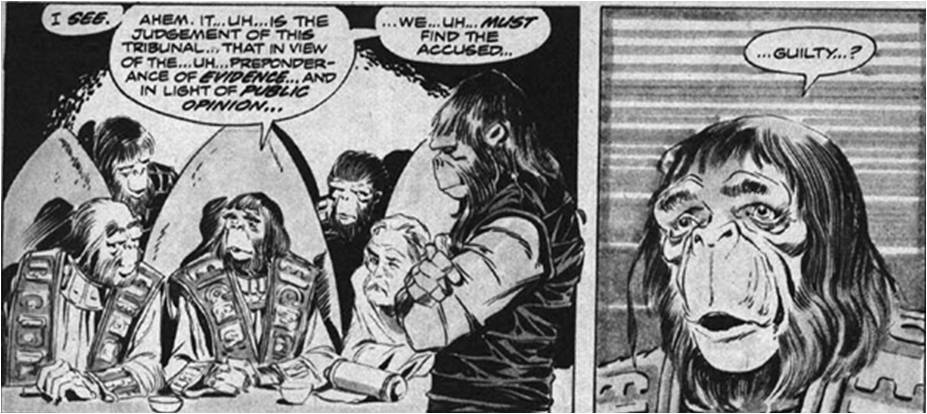
The remainder of the story shows Jason on trial for the murder charges. Xavier presides, and his ineptitude shines through as all that he learned of peace and harmony from the Lawgiver is brushed aside by Brutus' strongarm tactics. Jason is sentenced to prison ahead of his impending hanging. However, he is broken out by Alexander, and the two decide that they must trail the Lawgiver... into the Forbidden Zone.


Wow -- what a great story! Moench really nails the tensions between the apes and humans, playing directly off the tone from Battle. And Ploog's art is perfect. He really nails the look of the apes, and his backgrounds and landscapes evoke the best of the Apes films. This was a true winner from Marvel as the company expanded into the arena of black and white magazines -- seek it out, effendi!


Karen: I dug deep into the long boxes for this one. It's Frankenstein Monster #9 (March 1974), with the battle everyone's been waiting for: The Frankenstein Monster vs. Dracula, lord of Darkness! Brought to you by Gary Friedrich and John Buscema.

This issue is the second (and concluding) part of a two part story. While I don't have all the details, it's not too hard to comprehend. Frankie is in Transylvania, where he's
apparently gotten into trouble with both Dracula and the angry villagers (aren't they always angry?). As we begin this story, the big old lug is being burned at the stake! He's not even fighting back, as the Monster wants to die. But then a cream breaks the night and the villagers realize that while they were setting Frank on fire, Drac has taken advantage of the situation and attacked a woman. The villagers then turn their anger towards Dracula.

Although the Monster wants to end his life, he can't stand by while someone's in trouble -and he also wants to rid the w
orld of Dracula. So he busts loose and heads off to find Drac, only to have the villagers accost him again. He shakes them off and tells them, "I want nothing more than to end my wretched existence...but if you allow me...I will do one good turn for mankind before my death - though I am not at all certain you deserve it!"
Frank heads for a cave that is Dracula's lair. Inside is a beautiful gypsy girl that he met in the previous issue. She had been kind to the Monster when no one else was. Unfortunately, she has been turned into a vampire by Dracula, and attacks the Monster. Although it pains him to do so, the Monster ends her unlife with a stake to the heart.

Who should arrive then but Dracula? He wants to bite the Monster and convert him into a slave. Although Dracula is far more powerful than the Monster, it seems the Monster's hatred for Dracula is so great it gives him a tremendous burst of strength. He tosses Dracula to the entrance of the cave, where the sun is now conveniently rising. As the terrified vampire tries to crawl back into the cave, the Monster grabs two pieces of wood, making the sign of the cross. Dracula recoils, and as his flesh begins to be consumed by the rays of the sun, the Monster forcefully stakes him through the heart, leaving nothing but a skeleton. It is at this moment that we get a surprise visitor -a man who says his name is Vincent Frankenstein!

This was a fun read, a book I haven't seen in many years. It was also a short one, as the book also contains a 4 page horror reprint (the source is not identified). I felt that Buscema's art seemed rushed in places - particularly towards the end, with the fight between the Monster and Dracula. We got a couple of pages with just three panels on them, which looked very odd. Also, a lot of close-ups with no background detail. It's not terrible work by Buscema but far from his best. The inker was John Verpoorten, and it's a decent if workmanlike job. The cover is pretty eye-catching, or at least was to me as a 9 year old! I'm not sure who did it; the Grand Comic Book Database guesses possibly Ron Wilson, but I doubt that. It may be Buscema layouts. The heavy inks remind me of Tom Palmer, but I really don't know who it was.

I do wish Marvel had kept the Monster in the past (as he is here, sometime in the late 1800s). They had a number of characters that started out in other time periods (alternate future characters like Deathlok or Killraven) that wound up making appearances in the regular Marvel universe, and I never really thought that was a good idea. For
the Monster, seeing him running around with Spider-Man never felt right. He is ideally suited to "the old world" -I mean, how else are you going to get the angry villagers?

I do like the characterization of the Monster: he's hardly a brute or unfeeling. He's a sympathetic character, with a good heart and heroic qualities. Actually, the Monster was the prototype for many a Marvel hero -the misunderstood monster! How would the Thing have fared if he'd been in 19th century Europe, rather than metropolitan New York of the 1960s?
Related Posts with Thumbnails