Showing posts with label Gene Coon. Show all posts

Wednesday, August 24, 2016

Star Trek at 50: The City on the Edge of Forever


Season 1
Episode 28: The City on the Edge of Forever
Filmed:  February 1967
First Air Date: April 6, 1967

Karen: Kirk sacrifices the woman he loves to save the future. It's a heart-breaking story that has gone on to be hailed the best Star Trek episode ever by many. And yet, the original story would not have had the Captain making this soul-rending decision. Perhaps more than any other episode "City" suffered from incredible behind the scenes strife. But it turned out to be a beautiful, touching tale.


Karen: Star Trek fandom has for years heard tales of the rancor between Roddenberry and Harlan Ellison, the writer of this episode. Depending on who you're listening to, you may hear a very different version of what happened. Again, we turn to Trek historian Marc Cushman and his book These are the Voyages Volume One for a detailed and (seemingly) unbiased account. If you're looking for all the minutiae I suggest you pick up the book (well, I suggest you pick it up anyway) but the basics are that Roddenberry approached a number of high-profile science fiction authors as he began getting Star Trek off the ground. Ellison was one of them. Ellison, besides having written a number of stories, had also written scripts for TV shows, including the script for the Outer Limits episode "Demon with a Glass Hand," which won a Writers Guild award.  There was no doubt about his talent. Ellison had an idea about Kirk going back in time and meeting a character based on the evangelist Aimee Semple McPherson, who Kirk would fall in love with but have to let die in order for the future to proceed properly. Roddenberry gave the go-ahead and Ellison quickly produced a story treatment. This was in March of 1966.

Karen: However, while producer Robert Justman and others thought the story was beautifully written it also was not something they could film, for a number of reasons. Part of it was due to budget -there were too many things in the script that they couldn't translate to film given the meager funds they were working with. But perhaps just as important, there were things in the script that simply weren't consistent with the type of show Trek was. Maybe the best known of these is that rather than having McCoy become temporarily insane from an accidental overdose of a drug, as was filmed, Ellison had a crew member (not one of the regular cast) selling hallucinogens on the ship, and bludgeoning to death another crew member  who threatened to turn him in. This is certainly not typical behavior on the Enterprise.  It was felt by the Trek staff that the script needed revision.


A graphic novel featuring Ellison's original story is available

Karen: This is where the merry-go-round starts. Ellison provided a revision -but it took five weeks to get it. It was  May, and they were beginning to film the first episode ("The Corbomite Maneuver"). Even at this point, they were concerned about running out of scripts. They needed to turn them out with some alacrity. But Ellison was moving slowly on getting the teleplay finished. So in an act of desperation, Roddenberry set Ellison up with a desk in a tiny office at the studio, hoping they could keep an eye on him and get that script. Unfortunately, it may have distracted Ellison more, as he was frequently found on set. D.C. Fontana defended Ellison, to some extent, saying that, "Harlan did spend some time visiting the set, but that's considered necessary research for a writer. When a show hasn't been on air yet, freelance writers must have an opportunity to study the actor's speech patterns and delivery, the little gestures and nuances that each one brings to his or her role -and most of all - the character relationships which are being built episode by episode."


Karen: Robert Justman finally got his script from Ellison on June 7. After the first blush of excitement, Justman realized they were in trouble. Although the script was "brilliantly written" it was still too expensive to film, and the characters weren't acting the way they'd been established in the show. They were stuck at the same point. Ellison revised his script, unhappily, feeling that the special qualities of the script that he had worked so hard to put in were being lost with each revision. And there were many, many revisions. According to Cushman, Ellison himself provided three versions of the story outline, then did three versions of the teleplay (script), at which point Steven Carabatsos, who was still story editor (October 1966) stepped in to provide a rewrite. It was Carabatsos who removed the drug dealing element and instead introduced the idea of Dr. McCoy getting hurt and then injected with Adrenalin, which makes him go temporarily mad. After Carabatsos' effort, Ellison again went at it. What was marked as his final draft arrived in the Trek offices December 19th. It still wasn't where the staff felt they could use it. So Gene Coon took a shot at it over the Christmas holiday, then D.C. Fontana came in and worked on it, then Coon again, then Fontana, and finally Roddenberry touched it. By February of 1967,  nearly a year later, they finally had their script.

Karen: Typically, when you have this many people fiddling with a script, it comes out a mess. But somehow, they managed to create a gem. The Ellison script was, by all accounts, absolutely incredible, and would have been perfect for an anthology show like Outer Limits. But it was felt that it didn't have the 'feel' of Trek. The finished episode however is resolutely Trek to its core; the characters are the people we have spent this entire first season getting to know. Their mannerisms, their personalities, are all there. I should note that Ellison does not feel this way at all about it and you can easily find out more by searching the web. 

Karen: The acting in this episode is top-notch. Shatner is still working hard as Kirk. We see the gears turning in his head and the love and the anguish he feels is very real. Nimoy is as understated as ever but Spock's sense of concern for Kirk and his plight is tangible. DeForest Kelley gets to have some fun as the demented McCoy, but he has a sweet scene with Joan Collins as well. Kelley said that he decided to play it as if McCoy was also enchanted by Keeler. And what of Edith Keeler? Joan Collins was a well-known actress at this time and a casting coup for Trek. She and Shatner had real chemistry and the two of them made a lovely couple. Director Joe Pevney, who helmed many episodes, said of this show, "It was a pleasure working with the actors. They realized their full potential in that one."


Karen: There was one scene in this episode that I never completely saw until I got the DVD set, and that was McCoy's arrival back in 1930. When it went into syndication, they removed  the part where the derelict he encounters accidentally phasers himself out of existence. The full scene is in the clip below. 


Karen: Most of this episode was filmed back in Mayberry again -there is one well-known publicity  still where Floyd's Barbershop can be seen behind Kirk and Keeler - and desperate for stage space, the crew even borrowed the My Three Sons empty stage to film some scenes. I'd always wondered about the design of the Guardian, the mysterious machine/entity that transports our heroes through time. It was a strange design, but effective. Apparently it was not the work of the series regular designer, Matt Jeffries, who was ill at the time, but of Rolland Brooks. D.C. Fontana stated that Brooks misread the script, somehow translating 'runes' into 'ruins' and so we got the broken classical columns surrounding the Guardian. It's unclear where the lop-sided shape of the portal itself came from. Reportedly, when Jeffries walked onto the set he burst out with, "What the Hell is this?"


Karen: I have to admit, as a kid, this episode didn't do it for me. But now...it really guts me. Throughout the series Kirk has to make many hard decisions, but this one is surely the most terrible. Despite the short time he is with Edith, she is a real kindred spirit  and it's easy to see how he could fall in love with her so quickly. The line "The needs of the many outweigh the needs of the few, or the one" has become a standard within Trek fandom since Star Trek II:The Wrath of Khan but long before Spock performed the math on that and made his decision, Kirk does it here, to its brutal conclusion. When Kirk discovers that McCoy is in the mission and races back to it, the brief joy he and Spock and McCoy experience at being reunited, plunges quickly into utter devastation when he realizes Edith's fate has arrived, and he has to actually hold back McCoy from saving her. McCoy's anger at Kirk -"Do you know what you've done?" and Spock's almost-consoling, "He knows, Doctor. He knows" were pitch perfect. Of course the final line, uttered by Kirk as they leave the planet was the perfect way to end the episode: "Let's get the Hell out of here."



Wednesday, August 17, 2016

Star Trek at 50: Errand of Mercy


Season 1
Episode 27: Errand of Mercy
Filmed:  January/February 1967
First Air Date: March 23, 1967

Karen: Klingons! It's hard to imagine Trek without the Federation's main enemies, but they didn't appear until nearly the end of the first season. And considering that this episode, and the two that followed, were late orders by the network, who knows, in a parallel universe, Star Trek fans might never have heard of Klingons at all!


Karen: When NBC picked up Star Trek, the original order for episodes was 26. The production staff was on pins and needles around the time they were filming "Return of the Archons," waiting to hear from the network if they would get an order for additional episodes to round out the season. The network had given them a small sum of money and authorized the writing of four more episodes, but not the actual production. By December 9, the word was given: three more shows were to be made. Harlan Ellison had been slowly grinding away on "City on the Edge of Forever," and they hoped to produce that soon, and they had another story outline that would become "Operation:Annihilate." But one more was needed, so again, producer Gene Coon dashed off a script and we got "Errand of Mercy," a terrific episode that is a Cold War parallel, with a small planet (country) caught in the middle of two super-powers. 


Karen: Kirk has an unusually short fuse in this episode, when dealing with the seemingly simple minded Organians, and the brutal Klingons. Maybe he just needed to go on shore leave. But really, his frustration with the Organians and their apparent inability to comprehend the danger they're in only mirrors the viewer's own. I think while many of us respect pacifism, there's a point where self-preservation must kick in; that seems to be Kirk's issue as well in his struggle with trying to get his point across to the Organians. Of course, as we later discover, the natives are not truly threatened by the Klingons, nor do they need anything the Federation can offer. But the lesson about how two super-powers, no matter what their supposed goals might be, can completely devastate a smaller, poorer nation, is obvious.

Karen: This is a pure action-adventure episode, set mostly off the ship, and this made the network happy -they were always looking for these kinds of shows. In order to cut costs, we have no McCoy and no Scotty this time around. Also, despite the Klingons attacking the ship and beaming down in force, there are few effects -we never see a Klingon ship, and the Klingons beam down off stage. Still, it's likely the viewer will never notice as the story moves along at a nice clip.

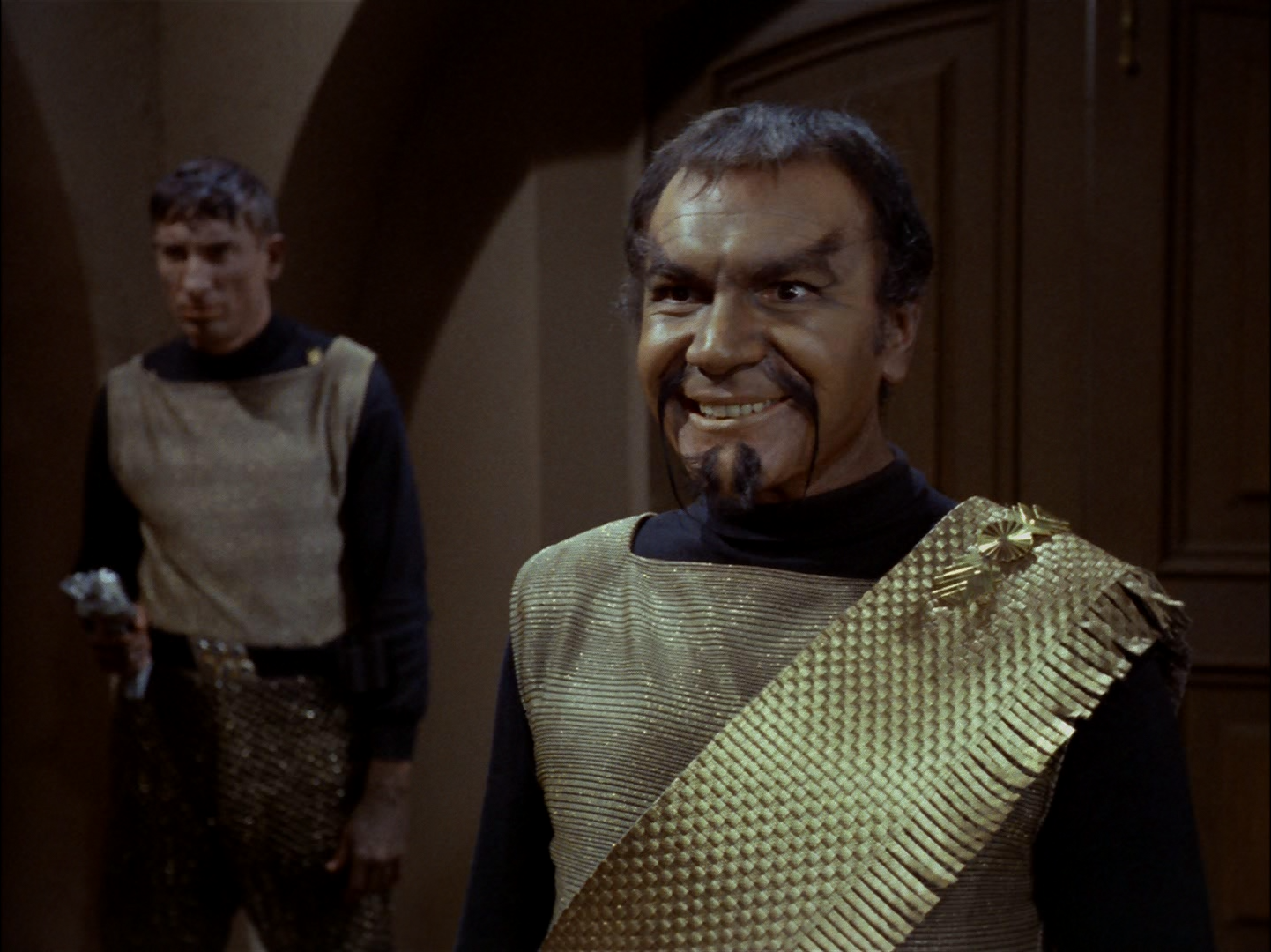
Karen: The Klingons themselves are nothing great to look at -a quick, "Genghis Khan" make-up was thrown together - but the leader of the military  force, Commander Kor, is played by John Colicos with great charm. Kor is no thug but a calculating, disciplined  man who knows very well the game they are playing. One can easily envision him as the military governor of Organia, or any number of other planets that the Klingons might bring under their heel. He is more than capable and amenable to carrying out the orders of the Empire. He's a part of the system and he recognizes this -whether he likes it or not seems perhaps irrelevant. Colicos creates a memorable adversary for Kirk. It's unfortunate he was never able to reprise the role, something the showrunners wanted to do, but could never work out (although he did play Kor on Deep Space Nine many years later). Of course, Colicos also played the villainous Baltar in the original Battlestar Galactica.


Karen: The final resolution involves more all-powerful energy beings, telling us how screwed up we are, but offering us some hope. I wonder if the Organians know the Metrons? Anyway, the Organians decided there would be no war between the Feds and the Klingons, and so the Organian Peace Treaty was instituted. This made it impossible for open warfare, but we would see the two sides compete to gain the people and resources of under-developed planets, in episodes like "Friday's Child" and "A Private Little War." In many respects, the peace treaty was a smart move by Coon -all-out war between the two space-faring cultures would have been too expensive for the show's budget. Also, once war was declared, surely all the episodes would have to revolve around it. This way, the Klingons were always a potential threat, hovering in the background.


Karen: It seems to me that as they got more popular (and their heads got bumpy), the Klingons picked up some of the traits of another Trek group, the Romulans. Klingons on the original show were never shown to be honorable. They were sneaky, deceitful, treacherous - basically, your stereotypical villains. But by the time of the Next Generation, we began hearing about 'Klingon honor' and tradition. I felt like this came out of nowhere -or was transplanted from the Romulans, who in the form of Mark Lenard's Romulan Commander, was a very admirable foe. Perhaps it was just the desire to give these aliens more depth and background. Who knows. But I kind of miss the guys with the droopy mustaches, who liked to stab people in the back and call the Enterprise garbage.


Wednesday, August 10, 2016

Star Trek at 50: The Devil in the Dark


Season 1
Episode 26: The Devil in the Dark
Filmed:  January 1967
First Air Date: March 9, 1967

Karen: We're back to a monster episode, this time featuring a creature called a Horta -or as I referred to it as a child, 'the pizza monster.' Of course, this is Star Trek, so a monster is never just a monster, which we -and the Enterprise crew -figure out over the course of this episode. "Devil in the Dark" speaks to one of Trek's main themes -overcoming our prejudices -and it does this quite well. It isn't perfect -there's obvious budget issues, some story-telling gaps, and well, at times I thought it was a bit boring. But it's quite a feat to take an amorphous shambling mess and make us feel sympathy and pity for it. 


Karen: This episode, written by producer Gene Coon, came about for the most prosaic of reasons: costume maker and stunt man Janos Prohaska created the suit and the production team loved it, especially when they saw it in action. Coon quickly wrote a script, and after a few revisions, they were ready to go. As Marc Cushman points out in These are the Voyages Volume 1, the story is somewhat reminiscent of the early season episode, "The Man Trap," where we also have a creature that is the last of its kind, killing humans on a planet. But in this Coon-penned episode, Kirk is not so quick to condemn the creature; instead he tries to understand its motivations and shows compassion for it (much as he did the Gorn in "Arena," another Coon effort).  Star Trek was evolving before the audience's eyes.


Karen: That's not to say this episode isn't clunky -how did the blobby Horta dismantle the reactor? I never could figure that out. And they don't have any spare parts for a critical piece of equipment? But it's necessary for the drama, so you have to buy it. If you're willing to buy a silicon-based blob boring through solid rock, the rest should be easy, I guess. 


Karen: Depending on your tastes, Spock's mind melding with the Horta is either a fascinating scene or a silly one. Personally I go back and forth over it. I always wondered how he could touch it -shouldn't it still have the residue of the acids it secreted to burn through the rock still on its hide? McCoy is in perfect form, complaining that he is not a "bricklayer" as he has to shovel cement into the creature's wounds. 


Karen: Many fans already know the story about how William Shatner's father died while they were filming this episode. In Shatner's book, Star Trek Memories, the actor described how the show's cast and crew helped him through the tough day of waiting to fly out from Los Angeles to Miami, where his father's funeral would be. Initially they were going to stop filming but Shatner asked them to continue -that he couldn't take the waiting, he needed to be occupied. The show went on.

 "An hour later, after we'd broken for lunch and after the tears and the anguish, we started shooting what we'd been rehearsing all morning. And all through the scene, I kept having trouble with a particular line. My emotion was getting in the way, making me forget. And even though I really can't remember the day's details anymore, the one thing I recall perfectly and that I'll never forget is the closeness that my friend Leonard (Nimoy) had toward me. Not just emotionally but physically as well. I mean I've seen films of elephants that support the sick and dying with their bodies, and Leonard somehow always seemed physically close to me. Our cinematographer, Jerry Finnerman, whose father had also recently passed away, stayed close, too. And together, they kind of herded around me, assuring me that there were people close by in case I wanted to talk or just needed a friend. Between Leonard and Jerry, we were able to make it through that awful afternoon, and I was able to fly out that evening to my father, warmed by their love and affection."

Karen: Shatner says "Devil in the Dark" is his favorite Star Trek episode.


Wednesday, June 22, 2016

Star Trek at 50: Arena


Season 1
Episode 19: Arena
Filmed: November 1966 
First Air Date: January 19, 1967

Karen: He's here at last: the Gorn! Easily one of the most recognizable Star Trek aliens, and a fan favorite, we have finally reached "Arena," a hallmark episode. Besides the memorable alien, there is a story here about the desire for vengeance, and the need for understanding and mercy. Everything seemed to come together in this episode to give us a story that is exciting and thought-provoking.


Karen: This episode was written by producer Gene Coon. He put together the first teleplay and it was substantially similar to what was filmed. However -during review of the teleplay, personnel at Kellam Deforest Research discovered that the plot points matched up closely to a story by Frederic Brown, also called "Arena," published in Astounding magazine in 1944. Coon had read the story but had apparently forgotten about it. Obviously the story was too similar to Brown's, so Desilu's legal department contacted Brown to buy the rights to his work. Brown was amenable, and  would get screen credit for the story. 

Karen: "Arena" is a favorite of mine. Yes, the battle between Kirk and the Gorn is exciting, but I find the exchanges between Kirk and Spock to also be highlights. After they return to the Enterprise from the attack on Cestus III, the Captain and First Officer discuss the situation in Kirk's quarters. Kirk is dead certain that the destruction of the outpost by the aliens can only mean one thing: they intend to invade. Spock protests, saying there could be other reasons, but Kirk will have none of it; he is adamant that there is no other explanation. The Captain seems unusually bloodthirsty. Spock appears ill at ease with this conclusion but if this is what Kirk believes, then he must ensure the alien (whom they are pursuing) never reaches his home base. Kirk says he intends to. He pushes the ship to high warp speed in the pursuit. On the bridge, Spock again asks Kirk if the destruction of the alien is necessary. "A regard for sentient life," he starts out when Kirk cuts him off, "There's no time for that." After some odd looks from Uhura and Spock, Kirk explains weakly that they are the only policeman around. It is one of the few times where Kirk is shown  off-balance. He has a point, but so does Spock.


"They've locked onto my tricorder..."

Karen: Before they can catch the aliens, both ships are halted by an unseen force. They have blundered into the territory of the Metrons. A voice informs them that their conflict will be resolved in a way best suited to their limited mentalities. And with this, Kirk and the captain of the Gorn ship are transported to a mysterious planet, to battle each other to the death.

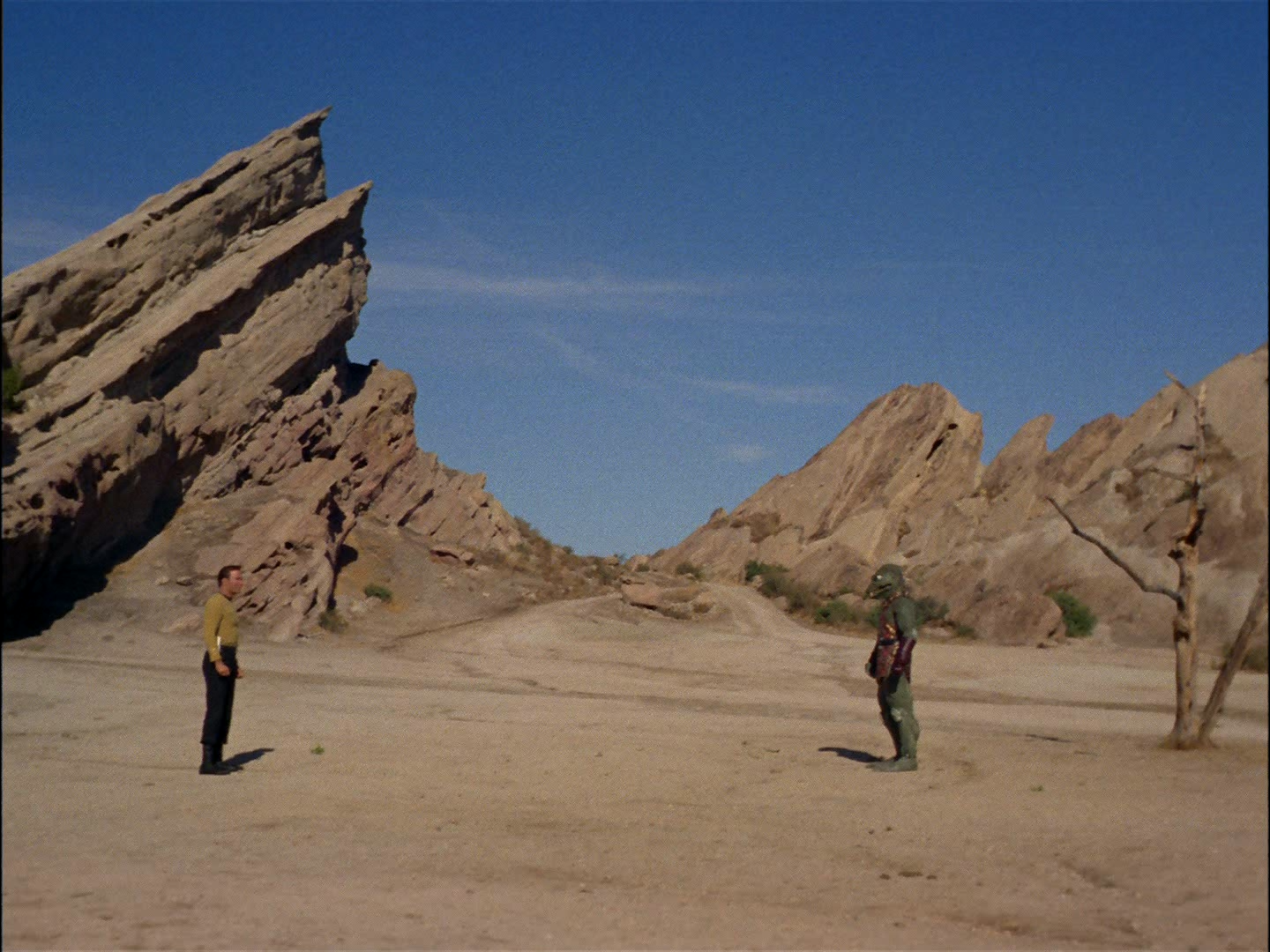
Karen: That mysterious planet was Vasquez Rocks, a park in northern Los Angeles county. At the time this episode was filmed it was privately owned. Vasquez Rocks,with its unusual angled rock formations, has appeared in many TV and motion picture productions. Star Trek filmed there several times, but "Arena"  is probably the episode that most people associate it with. I made the trip out to the park a couple of years ago and it was a real thrill to be standing in the same spot where Kirk and the Gorn had fought! If you ever go, be sure to check out the visitor center -they are well aware of the Trekkie interest in the park.


Kirk meets Gorn...

and so do I!

Karen: Kirk's opponent, the Gorn, was a complete suit created by effects man Wah Chang, who had also created the Salt Vampire for "The Man Trap" and the Romulan ship, as well as numerous monsters for The Outer Limits. Although it seems to come under ridicule today, for the time, it was a striking image (personally, I still find it impressive). Stuntman Bobby Clark alternated with Gary Combs in the suit, with actor Bill Blackburn, who was usually in the background at either the navigation or helm positions, putting on the outfit for a few shots. The suit consisted of a wet suit with a muscle overlay, gauntlets, and huge 16" feet. It wasn't easy moving or even seeing in the suit, but the three men got the job done. Admittedly, the Gorn moved ludicrously slow -when he swipes at Kirk and it takes half a minute, it strains credibility. But still, the Gorn does have an air of menace. As Kirk says into his recording device, "Like most humans I seem to have an instinctive revulsion to reptiles."


Karen: The Metrons informed both Kirk and the Gorn that there would be raw materials to make weapons on the planet. But Kirk is unable to turn up anything useful. However he comes across a variety of mineral deposits. This puzzles Kirk; he feels like there's something he should know. However, the Gorn has made a knife and set snares, and pins Kirk under an incredibly fake-looking boulder. Just like in The Galileo Seven, we are faced with the peril of styrofoam boulders. However, Kirk manages to escape. By this point, the Metrons have allowed the Enterprise crew to watch the action on the ship's viewscreen. The Gorn reveals that he has heard every word Kirk has said into his recording device. He offers a merciful death for Kirk. When Kirk fires back, asking if it was mercy they showed the colonists on Cestus III, the Gorn captain says they were defending themselves against invaders. McCoy, on the bridge, appears startled and turns to Spock and says if that's true, "We could be in the wrong." This is what Spock had been trying to get across earlier, with no success. 

Karen: Kirk and Spock both seem to figure out what to do with all those raw chemicals and minerals that are just lying around on the planet. As a kid when I saw it, I felt like I really should study chemistry more! The legend of Kirk's amazing hand cannon lives on; even the Mythbusters have tried to make one. Of course the Captain does manage to overcome his more powerful foe, actually shooting diamonds into his chest. No wonder Kirk is a legend in Starfleet. With the Gorn helpless, Kirk picks up his foe's knife and prepares to make the killing blow -and stops. He says, "No, no I won't kill you. Maybe you thought you were protecting yourself when you attacked the outpost." He faces skyward and shouts, "No, I won't kill him!" On the hill above him a shimmering being appears. It is a Metron. It looks like a fairy. Honestly, I would swear I can almost make out the outline of glittering wings on his back. In any case, it is quite ethereal. The Metron states  that Kirk has demonstrated the advanced quality of mercy. He offers to destroy the Gorn ship but Kirk says no, they will try to work things out. The Metron smiles and says very good. Maybe in a thousand years or so, mankind will be ready to meet with his people.Kirk is transported back to the ship, where the crew are both perplexed and delighted to see him -they did not see the last few minutes of what occurred. Kirk merely tells them that humanity is a very promising species.


Karen: "Arena" highlights one of Trek's main concepts: humanity overcoming our baser instincts. Kirk recognizes his prejudice, his anger, and in the end, moves past it. I am so impressed with this episode even now. It has great pacing, and provides practically everything you could ask for: action, conflict, drama, suspense, and a real, emotional core. It's almost a shame that we didn't get to see if a peace treaty was ever made between the Federation and the Gorn. William Shatner is still hanging around with the Gorn Captain, and the two of them are still having trouble getting along...


Wednesday, June 8, 2016

Star Trek at 50: Shore Leave


Season 1
Episode 17: Shore Leave
Filmed: October 1966 
First Air Date: December 29, 1966

Karen: One of the more fanciful episodes of original Trek, 'Shore Leave' makes an impression. Our crew is bewildered by encounters that simply cannot be occurring, but are. Some of these are funny, some are melancholic, and some are outright lethal. Even our good Captain finds himself overcome by the phantoms of his past. The pace is quick and there's never a dull moment. The episode is greatly enhanced by being shot on location -something that would become a rarity in later seasons.


Karen: Surprisingly, it takes quite some time before the Enterprise crew begins to understand the nature of the planet  and what's going on around them. Kirk still can't resist giving his old adversary Finnegan a good beating, even though he knows it's not really him.  Well, after he had already gotten the tar knocked out of him earlier, I guess Kirk had earned it.


Karen: Kirk also encounters Ruth, an old flame. Shatner portrays this well, with mixed emotions: confusion, longing, regret...you can tell that whoever Ruth was, she was no one night stand. The music by composer Gerald Fried in these scenes also highlights these feelings. My one complaint is that I always thought Ruth (played by actress Shirley Bonne) looked a bit too old for the presumably Academy-aged Kirk. But then again, Kirk never seemed to discriminate. 

Karen: In the book Star Trek Memories, Shatner recounts how filming this episode was a bit tricky. NBC had wanted major revisions done to the story by science fiction author Theodore Sturgeon, so Gene Roddenberry, who was about to go on a vacation to Hawaii, left behind notes for Gene Coon. For some reason, Coon never received the notes. So Roddenberry went off on his vacation, and when he returned, the crew was ready to film "Shore Leave" the next day -without any of the changes NBC requested! Roddenberry rewrote the script on location (both Africa USA and Vasquez Rocks were utilized). However, Shatner notes that Roddenberry couldn't finish everything, and there was quite a bit of ad-libbing by the actors in this episode. Roddenberry and the actors were  coming up with all sorts of ideas to fill out the story. One that didn't make it into the finished episode: Captain Kirk wrestling a tiger. There is a tiger seen in the show, and Shatner at one point thought it would be a terrific idea for Kirk to wrestle the big cat. Shatner, always enthusiastic, was a little too pumped up that day, as he explains:

"Now the words 'stuntman' and 'phony tiger' are probably already buzzing about your cerebellum, but I can assure you that strangely enough, I wasn't the least bit interested in such precautions. Even stranger, I can remember being really excited about the whole thing. I mean, here I was, this middle-aged actor, caught up in the adrenaline of the moment, and I stood there, like a dope, actually contemplating hopping on top of Shere Khan. Roddenberry, who had about a hundred thousand other things to worry about, came over and tried to talk me out of this unarguably stupid idea, but I was, for some reason, determined to go through with it.

"Then Roddenberry did something brilliant. With his arm around my shoulder, we strolled through the park as he tried to convince me I was far too important to the show to risk wrestling some man-eater. He really wasn't getting far, but then, and in retrospect I'm sure it was premeditated, we 'stumbled' upon the tigers' habitat at precisely feeding time. There sat the tiger I would be battling, enormous, majestic,  and gnawing away at a bone full of red meat.

"Immediately my testicles rose up into my Adam's apple, and the ignorant machismo that had been pulsing so heartily through my veins was now replaced by sheer abject terror. I stood there trying not to look too horrified as I now gracefully backed down, 'for the good of the show.'"

Karen: Despite not getting to see Kirk battle a tiger, this is an exciting, action-packed episode. The knock-down, drag-out fight with Finnegan is a heck of a brawl. This episode also sees Dr. McCoy killed - not almost killed, but d-e-a-d, dead. The advanced technology of the planet is used to bring him back to life, as if nothing had happened. Trek seems at times to treat death lightly. Scotty was also killed in "The Changeling" and brought back to life with no adverse reactions. I think there may have been a few other deaths and resurrections, I just can't think of them at the moment. You can make the argument (as some people have) that every time someone steps into the transporter, they actually die and are reconstructed -a copy of the original person. So I wonder where the concept of the soul or the afterlife comes in to Trek? Is a person just a machine you can restart? Is there no element to us greater than our biochemistry? The fact that Star Trek makes me think about things like this makes me love it even more. 

Karen: All in all this is a very enjoyable, if atypical, episode of Trek.


Wednesday, June 1, 2016

Star Trek at 50: Where No Man Ever Went


Karen: As we have reached the mid-point of the first season, I thought it might be interesting to discuss some of the story ideas that didn't make it into episodes in this first season (or maybe ever). Many thanks to Marc Cushman and his excellent book, These are the Voyages, Vol. 1 (if you haven't bought it yet, what are you waiting for?), wherein he discusses many of these failed concepts.

Karen: Stories were rejected at various stages of development, and for many reasons. Writing for a show as novel as Star Trek was not an easy task. Writers familiar with science fiction often came up with concepts too big (and expensive) for the TV screen. Those writers used to handling Westerns or police dramas just couldn't wrap their heads easily around the futuristic concepts of the show. So it was not unusual for stories to require a lot of hands-on from the staff. Sometimes they could be salvaged, but other times they had to be let go entirely.

Karen: In the first season, there were more than a dozen such stories which were either completely discarded, or reworked and produced in later seasons. Often considerable effort went into developing these stories, only to have Roddenberry or Coon come to the conclusion that it simply wasn't working. But perhaps a bit of an idea might be salvaged to be used elsewhere.

Karen: From the first season, prominent scrapped shows include Roddenberry's own "Omega Glory" which he had pushed again and again, and no one but he truly seemed enthused with it. It would eventually get produced in the second season, but grudgingly.

Karen: Science fiction writer A.E. van Vogt came up with an idea called "The Machine that Went Too Far," but apparently his idea went too far, and this story about an android who tries to take over the ship was reworked but rejected, although the second season episode "I, Mudd" had some similarities.

From "Elaan of Troyius"
Karen: Likewise, "The Galatea Syndrome" by Alfred Brenner involved the Enterprise transporting a hostile planet's leader to peace talks with another planet, and the leader's mistress used an aphrodisiac to wreak havoc on board. Although this treatment was disliked by Bob Justman and others, and rejected, elements of it can be seen in the third season episode "Elaan of Troyius."

Karen:  "Rites of Fertility" by Robert Sheckley, another SF writer, had the Enterprise crew turning into plant people. This one was rejected for a variety of reasons, including expense. 

Karen: One of the most intriguing, and perhaps infamous rejected stories, is "Portrait in Black and White." Fans have heard tales about this one at conventions and through other means for years. In his book, Cushman gives a detailed rundown of how this idea came to be. My short version: Roddenberry came up with an idea about a parallel world resembling the pre-Civil War era South, with the twist being that Blacks were the ruling class and Whites were enslaved. He handed this off to writer Barry Trivers to flesh out. Associate Producer Bob Justman was very uncomfortable with the whole thing, which included breeding camps, and he felt they had to send it over to NBC before they got too far along with the project. NBC flat-out rejected it, despite Roddenberry's protestations, and it died...but by the third season, a different story would use a blatant make-up technique to address racial hatred in "Let That Be Your Last Battlefield."

Karen: George Clayton Johnson, writer on the episode "The Man Trap" and numerous episodes of
George Clayton Johnson
The Twilight Zone, as well s the film Logan's Run years later, received an assignment to develop one of Roddenberry's ideas, titled "Chicago II," but it went nowhere. Johnson submitted his own idea, "Rock-a-Bye Baby, and Die," which involved the Enterprise becoming 'impregnated' with a newborn soul. As the being becomes aware of itself, it wreaks havoc on the ship. Gene Coon felt the story was too out there, and he and Johnson couldn't see eye to eye. Johnson went to Roddenberry for help and Roddenberry essentially said Coon, his producer, had final say. Feeling Roddenberry had taken the easy way out, and just generally annoyed by the whole situation, Johnson withdrew his story. It was the end of his affiliation with Star Trek.


Karen: One of the stories I find the strangest was titled "The Squaw," and was pitched by Simon Wincelberg, who had worked on "Dagger of the Mind." Essentially it is a cowboys vs. Indians story, where the Indians on the planet are primitive Vulcans, and the cowboys are human survivors of a spaceship crash. Spock winds up with the 'Indians' and one of them, a woman named Missie, becomes smitten with him. No, I am not making this up. This actually got through two drafts, but bad blood between Wincelberg and Roddenberry over the rewrites of "Dagger of the Mind" put a stop to any chance of our seeing Kirk and Spock riding horse -although come to think of it, we'd see them with six-shooters in "Spectre of the Gun" and they would encounter Native Americans in "The Paradise Syndrome."

Karen: There were many more lost episodes but I think this is enough for now (the second season had some even more interesting ones!). One thing is for sure: no concept was ever wasted! Even if a story never made it into production, some concept could surely be taken and reworked for another episode.


Wednesday, April 20, 2016

Star Trek at 50: Miri


Season 1
Episode 11: Miri
Filmed: August 1966
First Air Date:October 27, 1966 (8th episode aired)

Karen: I don't like 'Miri.' There. I've gotten that out of the way. It's not that it's bad, like 'And The Children Shall Lead' or anything like that. I can see it has redeeming qualities. But for me, personally, it grates. Like nails on a chalkboard, oh, it grates.

Karen: I think what gets to me is mainly the two chief guest actors, Kim Darby and Michael J. Pollard. Darby's Miri is a simpering woman-child who does little to make me feel like her planet is worth all the effort the Enterprise crew makes towards saving it. Pollard is quite simply obnoxious. I get that he's doing his shtick, but it's not something I find amusing. So - this coupled with what I find to be a weak premise -a planet ridiculously similar to 20th century Earth that has fallen victim to a biological experiment that wiped out all but the children -makes for a poor Trek for me. Plus, a lot of Yeoman Rand. Of course, your mileage may vary.Sorry about the poor video quality in the trailer.


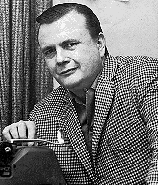
Karen: Even though I personally don't care for this episode, it's worth noting that it was at this point that Gene Coon jumped aboard as a producer on Star Trek. Coon's influence cannot be underestimated. He provided a great deal of re-writing help with scripts, as well as story outlines and scripts himself. Although he would leave during the second season, he would continue to submit scripts under a pseudonym, Lee Cronin, during the third season. Coon was responsible for much of the geniality among the crew and outright humor that made its way into the series. Prior to Trek, Coon had worked on a number of shows, including The Wild, Wild West and had even come up with the initial concept for The Munsters, although he did not receive credit for it.


Gene Coon
Karen: Writer Marc Cushman details Coon's arrival and how he contributed to the script for 'Miri' in his book, These are the Voyages, Vol.1. The story, originally written by Adrian Spies, went through several rewrites, first by Spies, then by Gene Roddenberry and then-associate producer John D.F. Black. But Roddenberry still felt the script wasn't quite there. Coon came aboard on August 8th, 1966. After a quick course in Star Trekology, he went to work on the script over a weekend. While Coon left in most of the established story structure, he tightened up the dialog and made the situation more mysterious. In earlier drafts of the script, everything is explained to the Enterprise crew - the meaning of the terms 'grups' and 'onlies', even what happened on the planet and the nature of the disease. Coon reworked the script so that things were revealed slowly, with our intrepid cast figuring it out for themselves. It makes for a much better story, with less exposition, and the crew doesn't look like a bunch of dimwits.


Karen: Despite my dislike of it,  this IS a memorable episode, simply for all the weirdness with the kids in their 'Lord of the Flies' setting, and the unforgettable lines -"Tell 'em Jim, tell 'em Jim" and "Bonk bonk on the head" and such. Many people remember the show because of Miri's crush on Captain Kirk. Cushman quotes director Vince McEveety as describing Darby, who was just 18 at the time, as being "extremely strange. She had a neurotic and very, very bipolar kind of personality. She'd do a scene and I was happy with her performance - very happy, I thought she was wonderful in that respect -and then she'd go off and cry like a baby afterwards. I'd never know why and, after a while, I didn't care." Darby admitted in another interview that she had completely fallen for Shatner, so apparently Miri's crush was shared by the actress portraying her.Well, who could blame her for falling in love with the dashing Captain of the Enterprise?


Related Posts with Thumbnails