Doug: Today we feature the conclusion of Mike W's and Edo Bosnar's review of the Manhunter saga.
Chapter
4. Rebellion
 The
chapter opens with a nice action sequence in which Manhunter dispatches
Nostrand with the old “light a match to the trail of leaking gasoline to blow
up the car” trick. Manhunter then finishes telling St. Clair about his past. He
recounts a meeting, more like an audience, he and Nitobe have with Mykros in
the Council Chamber. It turns out that the other members of the Council are all
in cryogenic stasis, with Mykros acting as their representative and spokesman.
He explains that this is because one of their number, the geneticist Dr. Oka
(for whom Nitobe served as bodyguard) had died, and besides enhancing Manhunter
and creating the clones, he was also supposed to devise a way to make them
immortal. With immorality off the table, they opted for going into the deep
freeze to keep the Council alive as long as possible. It’s during this bit of
monologuing that Manhunter sees that Mykros is rather mad and that the
Council’s apparent concern for humankind is basically just a ploy to take over
the world. So when Manhunter goes on his first mission to eliminate the
Interpol official, he warns him about the assassination, only to be told by
that same official – none other than Mr. Nostrand – that he’s in fact already
working for the Council – it was a test and he failed. The room is full of
clones sent to kill him, but he takes them all down and gets away. He then goes
to Nairobi, contacting the son of an old acquaintance named Kolu Mbeya, who is
an arms manufacturer and dealer. Mbeya outfits him with a number of specially
designed weapons and added features to his battle suit. After Manhunter
finishes telling his story to St. Clair, they go to Nostrand’s hotel room,
where they find a plane ticket to Istanbul and priest’s vestments, and they
assume that he was heading there for a secret meeting of Council operatives.
St. Clair is about to contact Interpol, when Manhunter discovers that Nostrand
had already put them both on the international wanted list.
The
chapter opens with a nice action sequence in which Manhunter dispatches
Nostrand with the old “light a match to the trail of leaking gasoline to blow
up the car” trick. Manhunter then finishes telling St. Clair about his past. He
recounts a meeting, more like an audience, he and Nitobe have with Mykros in
the Council Chamber. It turns out that the other members of the Council are all
in cryogenic stasis, with Mykros acting as their representative and spokesman.
He explains that this is because one of their number, the geneticist Dr. Oka
(for whom Nitobe served as bodyguard) had died, and besides enhancing Manhunter
and creating the clones, he was also supposed to devise a way to make them
immortal. With immorality off the table, they opted for going into the deep
freeze to keep the Council alive as long as possible. It’s during this bit of
monologuing that Manhunter sees that Mykros is rather mad and that the
Council’s apparent concern for humankind is basically just a ploy to take over
the world. So when Manhunter goes on his first mission to eliminate the
Interpol official, he warns him about the assassination, only to be told by
that same official – none other than Mr. Nostrand – that he’s in fact already
working for the Council – it was a test and he failed. The room is full of
clones sent to kill him, but he takes them all down and gets away. He then goes
to Nairobi, contacting the son of an old acquaintance named Kolu Mbeya, who is
an arms manufacturer and dealer. Mbeya outfits him with a number of specially
designed weapons and added features to his battle suit. After Manhunter
finishes telling his story to St. Clair, they go to Nostrand’s hotel room,
where they find a plane ticket to Istanbul and priest’s vestments, and they
assume that he was heading there for a secret meeting of Council operatives.
St. Clair is about to contact Interpol, when Manhunter discovers that Nostrand
had already put them both on the international wanted list.
M.S. Wilson: Another interesting chapter. We see the rest of
Manhuter's origin and the present storyline moves ahead as well. I like way the
Council tested Kirk's obedience by sending him to kill someone who was one of
their own...although I have to wonder what would have happened if Kirk HAD
obeyed orders; was Nostrand considered expendable by the Council? He seemed to
be in on the ruse, but I can't imagine him willingly sacrificing himself just
to test Kirk's loyalty. Mbeya is interesting too.  It's convenient for Kirk to
have someone who can supply him with weapons, but Mbeya has a reason to exist
other than plot convenience--he supplies weapons to various rebel groups in
Africa. I guess that could be read as plot convenience too, but at least it's
plausible. Speaking of convenience, Nostrand's hotel key being thrown clear of
his exploding car is a little hard to swallow. But I like the fact that
Nostrand had Interpol issue warrants for Manhunter and Christine. It keeps them
from going to the authorities and it hampers their movements. Nice to see the
bad guys acting logically for once.
It's convenient for Kirk to
have someone who can supply him with weapons, but Mbeya has a reason to exist
other than plot convenience--he supplies weapons to various rebel groups in
Africa. I guess that could be read as plot convenience too, but at least it's
plausible. Speaking of convenience, Nostrand's hotel key being thrown clear of
his exploding car is a little hard to swallow. But I like the fact that
Nostrand had Interpol issue warrants for Manhunter and Christine. It keeps them
from going to the authorities and it hampers their movements. Nice to see the
bad guys acting logically for once.
EB: Yeah, that bit with the hotel key was just a little too
far-fetched – one of the few places where I was thrown out of the story a bit
and found myself thinking, “yeah, right.” Anyway, I think it’s pretty obvious
at this point that the Council is quite ruthless in the pursuit of its aims, so
if Manhunter had killed Nostrand as ordered, I imagine Mykros would have
received the news with steepled fingers, muttering “excellent” a la Montgomery
Burns, and not giving Nostrand another thought. I really liked the addition of Mbeya to the
cast. As you indicated, he’s not just a two-dimensional deus ex machina;
instead, he has a reason for being that’s not connected to the story: he has
his own history, life, and motivations.
M.S. Wilson: Yeah, when I was originally
reading the story, I thought Batman (um,
Batman?) was
going to recognize Mbeya's name and say something like "Oh yes, Mbeya, I
know him...we're old friends." I'm glad they didn't do that. It's also
cool that Mbeya ended up joining them...after being set up by the Council, it's
a logical move on his part.
Chapter
5. Cathedral Perilous
 A
family of American tourists approaches the Romulus Cathedral in Istanbul. The
wife is getting bored with all of the inspections of religious buildings, the
father thinks it will be interesting because it’s not a mosque, and the little
boy is more focused on playing with his toy gun – the scenes of this family
interspersed into the story are entertaining and fit into the story well.
Meanwhile, Manhunter and St. Clair sneak in and knock out a pair of apparent
monks and then don their robes. Anyway, Manhunter and St. Clair join up with a
bunch of other ‘monks’ to infiltrate a meeting of Council followers. The
proceedings are interrupted by the arrival of Mykros and a few Kirk clones in
something called the ‘Gateway,’ which is apparently a teleportation device.
Mykros informs them of Nostrand’s death, at which point the guy presiding over
the meeting asks to be promoted to Nostrand’s position. This leads to an
argument about the inner workings of the Council, and why no one was selected
to replace the deceased Dr. Oka. Mykros then reveals that Oka was in fact
killed because he began to question the Council’s motives. However, at this
point, a device on Mykros’ ring indicates that they’re being recorded and he
sounds the alarm. Manhunter decides to reveal himself to create a distraction
so St. Clair can get away.
A
family of American tourists approaches the Romulus Cathedral in Istanbul. The
wife is getting bored with all of the inspections of religious buildings, the
father thinks it will be interesting because it’s not a mosque, and the little
boy is more focused on playing with his toy gun – the scenes of this family
interspersed into the story are entertaining and fit into the story well.
Meanwhile, Manhunter and St. Clair sneak in and knock out a pair of apparent
monks and then don their robes. Anyway, Manhunter and St. Clair join up with a
bunch of other ‘monks’ to infiltrate a meeting of Council followers. The
proceedings are interrupted by the arrival of Mykros and a few Kirk clones in
something called the ‘Gateway,’ which is apparently a teleportation device.
Mykros informs them of Nostrand’s death, at which point the guy presiding over
the meeting asks to be promoted to Nostrand’s position. This leads to an
argument about the inner workings of the Council, and why no one was selected
to replace the deceased Dr. Oka. Mykros then reveals that Oka was in fact
killed because he began to question the Council’s motives. However, at this
point, a device on Mykros’ ring indicates that they’re being recorded and he
sounds the alarm. Manhunter decides to reveal himself to create a distraction
so St. Clair can get away.  Manhunter manages to disable the Gateway, and then
another nicely rendered fight scene ensues, as Manhunter takes on the clone
assassins. The latter actually manage to subdue him, and one gets ready to
shoot him in the head when the little boy (the only one to actually see all of
the fighting going on) drops his toy gun from a mezzanine, hitting the clone in
the head and giving Manhunter an opportunity to take him down. As Mykros stalks
away from the scene with the ambitious Council acolyte who wants a promotion,
it’s revealed that the latter is St. Clair’s father.
Manhunter manages to disable the Gateway, and then
another nicely rendered fight scene ensues, as Manhunter takes on the clone
assassins. The latter actually manage to subdue him, and one gets ready to
shoot him in the head when the little boy (the only one to actually see all of
the fighting going on) drops his toy gun from a mezzanine, hitting the clone in
the head and giving Manhunter an opportunity to take him down. As Mykros stalks
away from the scene with the ambitious Council acolyte who wants a promotion,
it’s revealed that the latter is St. Clair’s father.
M.S. Wilson: We learn a bit more about the Council in this chapter.
The revelation about Christine's father being one of the bad guys seems a bit
too coincidental, but I guess unexpected connections are a staple of comics
(and pulp fiction in general). On the other hand, the "matter
transmitter" thing makes it feel less pulpy and more like a regular comic book.
I actually got a little tired of the "hick tourists" running joke
(which seems like it might be a comment on how Americans act when on
vacation...or am I reaching?) and the kid wandering off and playing cowboy. I
guess I shouldn't complain too much...if it wasn't for the kid, Manhunter
would've been blown away.
EB: Like I said in the summary, I found the tourists a nice
twist – it’s a different way to move the story along. In fact, if I were to
pick single chapter to call my favorite, or just as a sample of how cool this
story is, I think this would be it. I also like the fact that, as good as
Manhunter is at what he does best (and what he does best isn’t … holy crap!
Déjà vu!), he can be bested occasionally, and sometimes needs a little help to
get out of a jam, even if that help is just a kid and his toy gun. Also, the
one panel showing the toy gun getting tossed back up to the little boy is a
nice touch.
M.S. Wilson: Yeah, Manhunter returning the
kid's gun was kinda nice (although the first time I read it, my first thought
was that he'd thrown the bad guy's gun up to the kid...not very responsible of
him!) You're right about Manhunter not being shown as unbeatable...it's more
realistic. And that idea is repeated in the next chapter when Nitobe bests him
one-on-one.
EB: Oh, man. If he’d given that kid a real gun, the story would
have taken a really dark turn…
Chapter
6. To Duel the Master
 Manhunter
awaits a plane that is landing near Matsue, Japan. Mykros disembarks, feeling
rather surly because the destroyed matter transmitter means he has to travel
the hard way. Manhunter begins stalking him, but is then confronted by his
mentor, Asano Nitobe. The scene then switches to the Orient Express two days
earlier, with Agent St. Clair in a private compartment. Her father enters, and
soon reveals that he is involved with the Council. He threatens to shoot her if
she doesn’t give him the recording from the meeting in Istanbul, but she calls
his bluff. He departs from the train in Sofia, Bulgaria, where he is gunned
down soon afterward. Back in Japan, two days later, Manhunter and Nitobe are
still going at it. Manhunter is unable to convince Nitobe that the Council had
Dr. Oka killed, because Nitobe has been brainwashed in such a way that he can’t
believe anything Manhunter says. Eventually, Nitobe gets the best of Manhunter
and is about to deliver the killing blow, when he’s hailed by St. Clair
speaking from a loudspeaker in a chopper above. She plays the recording of
Mykros detailing how Oka was killed, and this turns Asano, who swears to help
Manhunter and St. Clair take down the Council.
Manhunter
awaits a plane that is landing near Matsue, Japan. Mykros disembarks, feeling
rather surly because the destroyed matter transmitter means he has to travel
the hard way. Manhunter begins stalking him, but is then confronted by his
mentor, Asano Nitobe. The scene then switches to the Orient Express two days
earlier, with Agent St. Clair in a private compartment. Her father enters, and
soon reveals that he is involved with the Council. He threatens to shoot her if
she doesn’t give him the recording from the meeting in Istanbul, but she calls
his bluff. He departs from the train in Sofia, Bulgaria, where he is gunned
down soon afterward. Back in Japan, two days later, Manhunter and Nitobe are
still going at it. Manhunter is unable to convince Nitobe that the Council had
Dr. Oka killed, because Nitobe has been brainwashed in such a way that he can’t
believe anything Manhunter says. Eventually, Nitobe gets the best of Manhunter
and is about to deliver the killing blow, when he’s hailed by St. Clair
speaking from a loudspeaker in a chopper above. She plays the recording of
Mykros detailing how Oka was killed, and this turns Asano, who swears to help
Manhunter and St. Clair take down the Council.
 M.S. Wilson: This chapter has the big confrontation between
Manhunter and his former mentor, Asano Nitobe. The whole
"student-confronts-the-master" thing is almost a cliché, since it's
been done so many times, but to be fair, this story predates Star Wars,
Wolverine, and a lot of the other uses of this trope. The fight is well
done--Simonson doesn't shy away from showing how brutal it is. I'm not sure
about how it ended, but I guess it makes sense for Christine's words to
convince Nitobe, since it was only Kirk he was brainwashed to disbelieve.
Speaking of Wolverine, the mask Nitobe wears looks a lot like the one worn by
Ogun in the Wolverine miniseries. I wonder if Frank Miller had this story in
mind, or if it's just a traditional Japanese design? The confrontation between
Christine and her father was handled well, and him being gunned down
immediately after fits what we know about the Council--they don't tolerate
failure.
M.S. Wilson: This chapter has the big confrontation between
Manhunter and his former mentor, Asano Nitobe. The whole
"student-confronts-the-master" thing is almost a cliché, since it's
been done so many times, but to be fair, this story predates Star Wars,
Wolverine, and a lot of the other uses of this trope. The fight is well
done--Simonson doesn't shy away from showing how brutal it is. I'm not sure
about how it ended, but I guess it makes sense for Christine's words to
convince Nitobe, since it was only Kirk he was brainwashed to disbelieve.
Speaking of Wolverine, the mask Nitobe wears looks a lot like the one worn by
Ogun in the Wolverine miniseries. I wonder if Frank Miller had this story in
mind, or if it's just a traditional Japanese design? The confrontation between
Christine and her father was handled well, and him being gunned down
immediately after fits what we know about the Council--they don't tolerate
failure.
EB: The fight between Manhunter and Nitobe is indeed rendered
quite nicely. And yes, it’s a storytelling cliché, but usually it’s the pupil
who ends up winning (provided that he/she is the story’s protagonist). In this
case, though, Nitobe eventually prevails, which realistically should be the
case, since he was sort of hyped up as almost the living embodiment of
ninjutsu. And I also liked the interlude showing Christine dealing with her
father. It’s very, well cinematic (I just keep coming back to that word when
thinking about this story).
M.S. Wilson: Yeah, Simonson's panel layouts
are really different from what most artists were doing back then. I'm more of a
"writing" guy than an "art" guy, but I can appreciate the
artistry on display here.
Chapter
7. Götterdämmerung
 The
prologue takes place in Gotham City. The police have found the body of a
private detective and martial arts instructor, Dan Kingdom, an ex-Green Beret.
Batman appears at the scene, noting that Kingdom was following a lead on some
jeopardy involving the new prime minister of the African nation of ‘Congola’
(ah, yes, gotta love comic-book political geography), for whom a reception is
being held that very evening at Wayne Manor. And later, at the reception, the
prime minister is assassinated by a sniper right under Bruce Wayne’s nose.
Wayne changes into Batman and rushes after the killer and almost catches him
outside. However, a mysterious masked figure calling himself the Enforcer gets
in the way. He manages to stun Batman with a very distinctive punch and he and
the sniper get away, although the sniper dropped his rifle in the confusion.
Batman takes it to a former arms dealer, who tells him it’s a specially made
weapon that was most like put together by a certain Kolu Mbeya of Nairobi.
The
prologue takes place in Gotham City. The police have found the body of a
private detective and martial arts instructor, Dan Kingdom, an ex-Green Beret.
Batman appears at the scene, noting that Kingdom was following a lead on some
jeopardy involving the new prime minister of the African nation of ‘Congola’
(ah, yes, gotta love comic-book political geography), for whom a reception is
being held that very evening at Wayne Manor. And later, at the reception, the
prime minister is assassinated by a sniper right under Bruce Wayne’s nose.
Wayne changes into Batman and rushes after the killer and almost catches him
outside. However, a mysterious masked figure calling himself the Enforcer gets
in the way. He manages to stun Batman with a very distinctive punch and he and
the sniper get away, although the sniper dropped his rifle in the confusion.
Batman takes it to a former arms dealer, who tells him it’s a specially made
weapon that was most like put together by a certain Kolu Mbeya of Nairobi.
The
scene then switches to Nairobi and Mbeya’s shop, where Manhunter is trying to
take the weapon-smith to join the assault on the Council’s Sanctuary. While
they’re talking, he’s looking through a sniper scope and spots a bat-like
silhouette on the rooftops above – and so does the actual sniper from before.
He’s got Batman in his sights, but then Manhunter appears beside him. He drops
his rifle in terror and starts running toward Batman, shouting that the
‘Council’ ordered the hit on the African prime minister’s and promising to tell
him everything if he just keeps Manhunter away. Just as he reaches Batman,
Manhunter shoots him dead. This rubs Batman the wrong way, but Manhunter pulls
a blade from the dead man’s sleeve, noting that he had intended to kill Batman.
Batman replies that he’s had similar attempts made on him before and resolved
the situation without fatalities.
As
they make their way back to Mbeya’s shop, Batman wants to know more about the
Council, so Manhunter and the others fill him in. He wants to participate in their
assault on the Council, but Manhunter declines the offer, noting that Batman’s
code about not killing means he just won’t be an asset on this mission (imagine
that – Batman being told he’s not one of the cool kids). So they part ways.
Manhunter,
St. Clair, Nitobe and Mbeya take off in a plane, and eventually land in the
middle of nowhere in a desert in Australia. As they disembark, gunshots ring
out, and Mbeya is hit and apparently killed. The others move to for a
counterattack, but then Batman appears with two unconscious gunmen. Manhunter
is impressed that Batman’s detecting abilities, and they agree to join forces
after all. Nitobe leads them to hidden ventilation shaft and they make their
way into the Council’s underground base. Eventually they run into resistance,
with the mysterious Enforcer showing up as well.  He starts pummeling Manhunter,
but Batman intervenes and tells him to keep going toward the Council Chamber
while the rest of the group deals with the henchmen. It’s eventually revealed
that the Enforcer is none other than Dan Kingdom, while the body found in
Gotham was that of a clone. In the Council Chamber, Manhunter confronts Mykros,
who’s wearing something he calls a psionic helmet that gives him mental control
over all power and communication systems in the complex. He uses it to create a
bolt of radiation from the reactor that nearly fries Manhunter completely.
Elsewhere, our heroes are joined by Mbeya, who was not killed – rather
Manhunter used some kind of nerve pinch to knock him out cold when he saw that
he was injured. He takes down a bunch of the henchmen with machine gun fire. In
the Council Chamber, Manhunter, almost dead, doggedly struggles with Mykros and
manages to remove the psionic helmet, donning it himself. He then sets the
Council’s entire complex to self-destruct, which explodes just as the Batman
and the others manage to get away in the plane.
He starts pummeling Manhunter,
but Batman intervenes and tells him to keep going toward the Council Chamber
while the rest of the group deals with the henchmen. It’s eventually revealed
that the Enforcer is none other than Dan Kingdom, while the body found in
Gotham was that of a clone. In the Council Chamber, Manhunter confronts Mykros,
who’s wearing something he calls a psionic helmet that gives him mental control
over all power and communication systems in the complex. He uses it to create a
bolt of radiation from the reactor that nearly fries Manhunter completely.
Elsewhere, our heroes are joined by Mbeya, who was not killed – rather
Manhunter used some kind of nerve pinch to knock him out cold when he saw that
he was injured. He takes down a bunch of the henchmen with machine gun fire. In
the Council Chamber, Manhunter, almost dead, doggedly struggles with Mykros and
manages to remove the psionic helmet, donning it himself. He then sets the
Council’s entire complex to self-destruct, which explodes just as the Batman
and the others manage to get away in the plane.
M.S. Wilson: The last chapter wraps things up nicely. The first six
parts of the story were fairly violent, but we get a look at the non-lethal
approach once Batman joins the team. The “kill/no kill” debate reminds me of
Spider-Man and Punisher (and like Spider-Man, Batman seems to condemn
Manhunter’s methods without taking any active steps to stop him). The whole
thing with Dan Kingdom/Enforcer seems a little superfluous, but I guess Batman
needed someone to fight (non-lethally, of course) at the end; plus Kingdom's
“death” was the MacGuffin that got Batman involved in the first place. You
mentioned the fictional country of “Congola”...I noticed that too, and it kind
of bothers me. One of the things I liked about the first six chapters was how
they used real locations--Kathmandu, Zurich, Istanbul, Marrakech, Nairobi; it
made it more realistic. But throwing a fake country into the last chapter takes
me out of the story a bit. It makes it read more like a conventional comic and
less like a pulpy spy-thriller. I have nothing against conventional comics (and
the tropes therein), but the shift in tone is a bit jarring for me. The same goes
for the “psionic amplifier” thing; I guess old pulp stories had mind-amplifier
devices, but it just seemed a bit out of place to me. As for using Batman, I
think it worked. Batman was inspired by the old pulp stories, so he definitely
fits into that style.
 EB:
I just let the comic-book geography roll off my back; yeah, it would have been
better if a real country had been used, but since the story involved the
assassination of a prime minister, Goodwin decided to go the fictional route to
avoid any confusion with actual political events. And as far as I know, the old
pulp stories had quite a bit of fake geography; in fact, I think the comic book
writers just assumed the practice from the pulp writers. Same with the wonky
technology like the psionic amplifier – I think the Doc Savage stories in
particular blazed the trail for that kind of stuff. All that said, I can see
why you could have been taken out of the story by these aspects, because most
of this does read like a spy thriller more or less grounded in the real world.
I guess it just didn’t trouble me as much, especially since pretty much from
the start the whole Council aspect, with its amazing technology, indicates that
the story will have the fantastic elements more typical of standard superhero
comics. Overall, it’s pretty obvious that I just love this story, and repeated
readings have not diminished my fondness for it (quite the opposite in fact). I
like that it’s a complete saga that had a planned conclusion from the very
beginning, and the ending, although tragic, is very fitting and, ultimately,
satisfying. And I can’t think of any artist who would have done a better job
with this than Simonson. He really went all out, and everything comes together
perfectly: the figure work, the backgrounds and the overall flow and pacing.
Coming back to that word cinematic, it often seems like the panels are
storyboards for what would be a mind-blowingly awesome action movie.
EB:
I just let the comic-book geography roll off my back; yeah, it would have been
better if a real country had been used, but since the story involved the
assassination of a prime minister, Goodwin decided to go the fictional route to
avoid any confusion with actual political events. And as far as I know, the old
pulp stories had quite a bit of fake geography; in fact, I think the comic book
writers just assumed the practice from the pulp writers. Same with the wonky
technology like the psionic amplifier – I think the Doc Savage stories in
particular blazed the trail for that kind of stuff. All that said, I can see
why you could have been taken out of the story by these aspects, because most
of this does read like a spy thriller more or less grounded in the real world.
I guess it just didn’t trouble me as much, especially since pretty much from
the start the whole Council aspect, with its amazing technology, indicates that
the story will have the fantastic elements more typical of standard superhero
comics. Overall, it’s pretty obvious that I just love this story, and repeated
readings have not diminished my fondness for it (quite the opposite in fact). I
like that it’s a complete saga that had a planned conclusion from the very
beginning, and the ending, although tragic, is very fitting and, ultimately,
satisfying. And I can’t think of any artist who would have done a better job
with this than Simonson. He really went all out, and everything comes together
perfectly: the figure work, the backgrounds and the overall flow and pacing.
Coming back to that word cinematic, it often seems like the panels are
storyboards for what would be a mind-blowingly awesome action movie.
M.S. Wilson: Yeah, I'm a sucker for that
pulp atmosphere (though a lot of the actual "classic" pulp stories
leave something to be desired). I was never a big Doc Savage fan...the idea
sounds good, but the few stories I've read just didn't do anything for me. I
agree that the ending feels right. In the intro to my edition, Goodwin said
that if the concept had been open-ended (i.e. if Manhunter had lived), the
story probably wouldn't have achieved the impact or reputation that it did. I
think he's right... Manhunter's heroic sacrifice rounds off the story perfectly,
and it's true to his character as well.
EB: Needless to say, I agree with
Goodwin that it worked out better like this. (Just as an aside, on the topic of
the original pulp stories, there’s a lot of good stuff there, and – given the
sheer volume – a lot of bad stuff as well. I tend to agree with you about the
Doc Savage stories: I’ve read a few of the novels and found them just o.k. On
the other hand, all of the Shadow novels I’ve read – admittedly not many – are
actually pretty good.)
* Just as a footnote, when the
Special Edition reprint of this story was published in 1999 (the edition I
have), a story called “The Final Chapter” was printed as well. This is an
epilogue which Goodwin and Simonson had plotted out, and then Simonson drew it,
but Goodwin unfortunately died before he could complete the final script. So
Simonson just finished the art and it was printed as a “silent” story, with no
dialogue or narration (just sound effects). It’s really well done, and doesn’t
take anything away from the original saga.


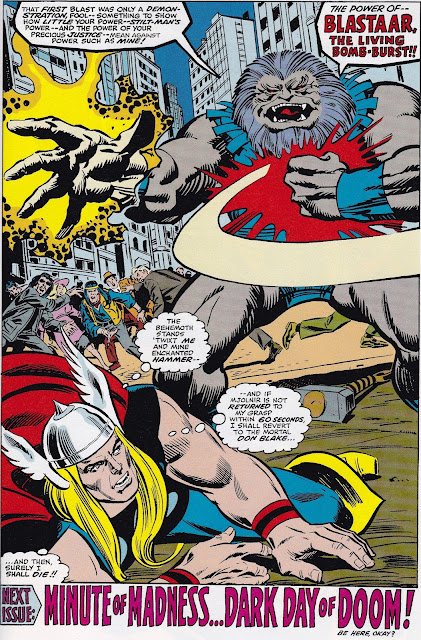
 If you're stopping by for the first time, back in April we had a fun conversation about mismatches in comics -- and a couple of weeks ago we checked in on one, when Daredevil was pitted against ol' Jade Jaws himself. If you're in a hurry today, I'm going to save you some time and just say this comic was "average". It wasn't horrible, but it certainly in no way distinguished itself in any positive light beyond expectation. I've been reading and have provided the scans from the Gods, Gladiators, and the Guardians of the Galaxy! trade (recommended for the reprints of Thor Annual #s 5 and 6). Here, then, are the details:
  Day’s
armor has been specially augmented for a job: steal cargo from a messenger helicopter
and return it to the electronic voice. For the job, Day’s armor has been
adamantium plated and loaded full of gas, concussion blasts, etc. But in the
middle of the heist the Stilt-Man is accosted by Thor. In a match that lasts far
longer than it should, Thor is victorious. His prize, though? A challenge from
Day’s co-conspirator – Blastaar!
Day’s
armor has been specially augmented for a job: steal cargo from a messenger helicopter
and return it to the electronic voice. For the job, Day’s armor has been
adamantium plated and loaded full of gas, concussion blasts, etc. But in the
middle of the heist the Stilt-Man is accosted by Thor. In a match that lasts far
longer than it should, Thor is victorious. His prize, though? A challenge from
Day’s co-conspirator – Blastaar!