Showing posts with label Bucky. Show all posts

Monday, August 22, 2016

Comin' In On a Wing and a Prayer: Batman & Captain America


Batman/Captain America (October 1996)
"Batman & Captain America"
John Byrne

Doug: It's hard to believe this, as well as many of the other latter-day wave of DC/Marvel crossovers, is 20 years old. Seems like only a few months ago I eagerly awaited this offering to reach my 30-year old paws. Even in the mid-90s, if John Byrne was involved, a project was still going to be big news. But... did this disappoint then, and what about now as seen through the eyes of a curmudgeonly middle-aged school teacher?


No, in answer to the first question, it did not disappoint then. John Byrne's one of those guys who "gets" comic book history. Well, for the most part (the Vision debacle, for which he shall never be forgiven on this space, aside). This book is one big homage, or love-in, or whatever else you want to call it with the Golden Age of these two lead characters. Right from the Batman's first appearance, we can see that Byrne is emulating the style of Dick Sprang, mostly fondly remembered for illustrating the adventures of the Dark Knight Detective in the 1950s. But here I go again, getting ahead of myself. Of course we first need to give you that nifty little plot summary called the 100-Word Review:

Toward the end of the War, Captain America and Bucky are ordered Stateside in order to investigate millionaire Bruce Wayne, believed to be secretly bankrolling sabotage of the Gotham Project (known to history as the Manhattan Project). Batman and Robin are tracking down the Joker, who has been stealing secrets of the Project. During Cap’s surveillance of Wayne, he and Batman learn one another's identities and collaborate to find the Joker. They find that the Joker and the Red Skull are themselves collaborating, but the unpredictable Joker soon turns on the Skull – and that means war of another kind!


If you've never laid eyes on this book, it's a 64-page prestige format graphic novel. And it looks great, which brings us to...

The Good: Yes, it does look great! The art is splendid throughout and the coloring (credited to Patricia Mulvihill) is phenomenal. I don't know that I'm qualified to discern or discuss coloring innovations of the 1990s, but it's fairly obvious that Mulvihill was able to employ then-modern computer coloring techniques without losing the four-color charm that many of us cling to. 

Byrne's pencils are magnificent. Some criticisms (maybe just of mine) of Byrne in this period are that his art had become flat, or scratchy, or that his figures' torsos were sometimes oddly elongated. None of that is here. In fact, if you ask me to compare eras of Byrne's career, I'd gladly put this alongside his work in the Claremont/Byrne/Austin heyday of the Uncanny X-Men or his collaboration with Dick Giordano in the Man of Steel limited series. It's that good. 

His writing is spot on as well. I mentioned at the top the homages to Dick Sprang's art. Byrne captures the spirit of the era in his writing as well. It's not over-the-top sappy or dated in any negative way. But you can just hear Cap or the Batman talking "that way" if you were watching this on film at a Sunday matinee. The inclusion of Sgt. Rock and Easy Company, when Sgt. Fury and his Howling Commandos would have been included, was a nice touch. Great job of further blending the universes.

There are a few twists in the story that caught me off guard when I read this the first time twenty years ago, and again a couple of weeks ago when I re-read it. That the Joker would double-cross the Red Skull because the Skull was a Nazi seemed strange -- was it the racism, the world conquest, or the supreme egomania that turned off the Clown Prince? It was never stated, but the Joker's seeming patriotism struck an odd note. I'm not saying it was bad... not at all. In fact, it was good because it was so unexpected.


In addition to the wonderful splash of the Batcave, late in the story there is (of course) a perilous trap, timed to kill Batman and Bucky (the crossover with the sidekicks was fun). It definitely hearkened to the days of the cliffhanger endings popular in the serials of the 1940s as well as to the 1966 Batman television series.

Byrne gives a "thanks" to Roger Stern for the epilogue of the story. It's a nifty "What If?", as 20 years after the War Batman and Robin are patrolling the ocean for any signs of the Joker... Junior. "Jr.", huh? Well, this ain't yer daddy's Batman and Robin. Nope -- this is Dick Grayson wearing the mantle of the Bat and Bruce Wayne, Jr. as Robin. And as they pilot the Bat-sub, what's in that ice floe they find up ahead? I think you know what (or who) it is...


The Bad: I guess if I have one complaint it's that Bucky got a little short-shrifted in this story. He has a moment here and there, but largely it's Robin who does the more-heroic stuff. Bucky sort of comes off as a whiner, which I felt was interesting given that I'd have assumed Bucky to be older at that time than Robin -- maybe a little more mature. Too, and if we are to believe the Winter Soldier retcon (which obviously wasn't a thing yet when Byrne penned this story), I'd have liked to have seen Bucky as a bit more take-charge. But then, and as I've said, whenever I was reading the Invaders I never thought of Bucky as carrying out any "collateral damage".

Oh, and another thing -- when the Joker stole the atomic bomb, Fat Boy, and it went off in the Atlantic after our heroes worked their (lucky) magic, what are we to assume? In our reality, the bombs dropped on Japan were nicknamed Fat Man and Little Boy. So in this story was there only one bomb, and if so, was the atomic destruction of Hiroshima and Nagasaki not to pass? This is in no way a situation that ruins this story for me. Far from it. But it just left me to wonder. Sooooo many universes! Someone should write a Crisis...


The Ugly: Nada.

Check this out if you're able. It's been reprinted in one of the Crossover Classics volumes, and can probably be found at your LCS or online for only a buck or two. It was a nice half hour diversion, and one I'm glad that after all these years I read again.

Monday, October 5, 2015

Arc of Triumph... Phoenix Rising?


Doug: This one comes up around the BAB periodically, so we're going to use it as a launching pad for a larger discussion. As I've mentioned, I've been reading Ed Brubaker's run on Captain America from around 10 years ago. Previously having stated my disdain for the resurrection of Bucky Barnes, I've been converted. Given Brubaker's deft storytelling and "plausible" explanation (hey, it's still a funnybook) for Bucky's reappearance, I went to the Dark Side. But as I've also said, I've taken this with a hefty grain of "What If?" Many of you have remarked that there are certain deaths that simply should not be undone -- Ben Parker seems to top that list. So given today's story arc within the broader context of deaths in comics, we'd like you to expound on this as an issue. As another nugget for starting us out, why is it that long-time Cap fans just assume the Red Skull is going to pop again soon, regardless of how he met his "last" demise. Why is that OK?


Friday, March 6, 2015

All the Young Dudes

Doug: Today I'm going to ask you to think like a 12-year old. For many of us, that's not all too difficult. What I'm looking for is a mental trip back to your formative years, about the time you started "collecting" comics -- that era when you became not only aware of what books and characters you liked, but why you liked them.

Doug: It's long been know around here that I was (and am, I guess) a team book guy. So it's pretty logical that Superboy and the Legion of Super-Heroes would be one of my monthly go-to's. And while I thought it was really cool that it was a club of super-powered teenagers, by the time I was reading it Mike Grell and James Sherman were doing the art chores. I hate to say it (boy, do I hate to say it!), but I wasn't going to junior high school with any young ladies that looked like Saturn Girl or Princess Projectra! Nor did I have any friends whose older sisters looked like that! So my point is, although the characters were supposed to be "my age" or slightly older, I didn't identify with them as such. I can say the same thing about Johnny Storm, Peter Parker, and the X-Men (granted, the All-New, All-Different team was supposed to be in their early 20s).

Doug: Now what about you? When you were a kid did you gravitate to the youngsters? Were Bucky and Toro favorites of yours in the Invaders? How about Robin (probably close to 19 or 20 by the time most of us were reading Batman Family)? Did you buy Nova because he was a teen, or because he had a cool costume? Was the inclusion of characters specifically designed to appeal to youngsters a spot-on marketing strategy from the Big Two?


Monday, February 2, 2015

Arc of Triumph...? Captain America 1-14 -- the Winter Soldier


Doug: Welcome back to one of the things we do best around here -- talking about comics! As you may recall, back around the second week of January we got into a little discussion of "The Winter Soldier" arc that ran in Captain America (2005) 1-9 and 11-14. I received Captain America, volume 1: Winter Soldier Ultimate Collection and loved it. I literally read the entire 13 issue arc in one evening. And right after I finished, I emailed Karen. Here is the conversation that took place over the next several days -- which is also a look inside the editorial room:

Doug: Have you read the Winter Soldier trade (Cap 1-9 and 11-14)?

Karen: Pretty sure I have those Cap comics. Do you have some sort of idea you are cooking, Mr. Wadley?

Doug: No, not really. I got the deluxe tpb for Christmas, and sat down and read all 13 issues in one sitting last night. I was prepared to sulk about it, as you know my feelings about meaningful deaths in comics. But wow...
Ed Brubaker deserves every accolade that's come his way. Cap was a bit too much like Batman to suit me, but they rationalized it by saying this was right after Disassembled. Bendis makes me mad, too.

I thought the book was better than the movie, as they say.

Karen: I'm glad that you were able to enjoy it. It's so rare with new books. I had the same feeling as you. I wanted to be upset -don't bring back Bucky! -but it was handled so well. It's been years since I read it but overall I recall feeling it was one of the best Cap storylines.

I honestly think that "Captain America: The Winter Soldier" may be the best made Marvel film - the story holds together better than "The Avengers" to me, although Avengers might be more sheer fun or wow factor.

I was contemplating going to the comic shop to try some new comics but I just know I will be disappointed. I read that Black Bolt and Medusa have a son now...there are so many things I am curious about but every time I pick up a new book, I am put off by the art and the characters behave such that I can't recognize them. Oh well, as they say, we'll always have Paris!


Doug: I thought Steve Epting's pencils were outstanding, and I liked the guy who did the WWII flashbacks even better. It's too bad that the modern coloring made it all so dark. I do miss the brightness of our four-color wonders. I even liked the Jack Monroe fill-in penciled by Jean Paul Leon, and I had not cared for some of his work back in the day. But I am with you -- I have virtually no interest in today's fare. But I do think I'll pick up the next volume in this Brubaker series. Not sure I'll get the third, which was "Civil War"... *:P tongue

I agree that the Winter Soldier movie was well done, and for the Marvel movie converts it was great. For long-timers like us, Brubaker's story had a much better reveal that softened the impact for us older fans. His rationale for the events that led up to Bucky's reappearance were really good and in the comic book world "made sense". 

Karen: I think the biggest problem for the Cap films is that the sense of loss for Cap regarding Bucky was not as deeply felt as it was in the comics. I mean, as readers we'd seen Cap suffer for DECADES over Bucky's death. It was considered to be the death that could not be erased. It certainly informed Cap's character so much in the early years of his Silver Age revival. He was a walking ball of guilt. No matter how talented the writer, director, or actor, you can't take all of those years of stories and character development and roll them up into the tail end of one film and then the bulk of another. I also think that some of the impact of Bucky's death is dulled by the fact that he was a full-grown man, not a kid, in the films. As an adult, he is thoroughly responsible for his actions. In the comics, although Bucky is far more capable than any kid we might know, he IS still a kid, and it makes Cap's culpability in his death more tangible, and his guilt all the more real. In the films they had to switch the focus more to the characters' friendship and it was still very moving but not nearly as powerful as the sort of surrogate father or big brother role that Cap was to Bucky in the comics.

I am wary of them bringing the "Civil War" stuff into the films. Can we let the heroes be friends and not have to have them fight each other? Let them be morally ambiguous in the comics.

Doug: What did you think of Brubaker having Cap tell Sharon that Bucky took care of a lot of the dirty work, i.e. murders, sabotage with collateral damage, etc.? I mean, it would be naive to assume that sort of thing didn't happen -- shoot, how many pilots lost their lives to the Torches and Namor? But to come right out and say it sort of took me aback. Talk about stuck in the Bronze Age. But then, earlier today I was reading the Steranko issues and Bucky is running around with a machine gun. Those issues were printed in 1968, so Stan was apparently comfortable with at least the implication that Bucky was kicking some serious tail.

I also found it interesting that they specifically tagged Bucky's age at 16 when he and Steve Rogers first met. Then Cap remarked that Bucky was almost 21 when he died. At least in my imagination, I'd have but the parameters closer to 12-16. It certainly made more sense to age him up a bit.

What did you think of, if you recall, the notion that Cap's only been thawed out for a decade? Meaning, in the 21st century??

Karen: I re-read the whole thing. Man, that is good stuff. You're right, it's a much harder Cap than we've seen before, but they do indicate that Cap's been through some things -like Hawkeye's death -that have really shaken him up, so I can accept that. The art is exceptional, although I don't really like the way his scale mail is drawn -it looks too thick. I enjoyed the flashbacks to WWII. I also liked Brubaker having Cap praise the French resistance -I recall back then (2005) a lot of folks were critical of the French, calling them cowards (Mark Millar over in Ultimates had his Cap say "this A on my head doesn't stand for France") so it was refreshing to see a more mature response. And it fit with Cap's experience too.

Regarding Bucky "doing the dirty work" -at the time it struck me as odd that they would have a youngster do those sort of things -actually, it still does. If they wanted to say that Bucky was armed like any other soldier because he didn't have the benefit of the Super-Soldier Serum, that would have made more sense to me.

I am sure they upped Bucky's age to make readers more comfortable with the idea that he was going around offing folks. It's perhaps a bit more palatable when he's 16-21 than say 13-18. But in my head, when I was reading the Invaders, I always saw him as a kid about 14 years old. Really, if you put him at 16, well, he's not that far away from enlistment age. Heck, my friend's father lied and enlisted in the Korean War when he was 17.

I think Marvel has decided that all of their 'modern' history (since the FF) is condensed into a 10-12 year period, which of course moves along as time passes. So at some point, Cap will have been thawed out 100 years after his war ended! My husband and I were talking about this the other night (we do have such wonderful conversations), that when Marvel first brought Cap back, the War had only been over for less than 20 years. Roll that around in your mind! Really, that's not too bad of a gap to have to overcome. If you'd been frozen in 1995 and woke up now, sure, it would be traumatic at first, and there's the whole issue of loved ones aging, but as far as the differences in society and technology, and adapting to it, not too  tough. But if it was 70 years, well, that's really a leap. I think anyone trying to  recover from that would be pretty psychologically hamstrung. Marvel can disregard Mr. Fantastic's and the Thing's WWII records, they can change Iron Man's origin so he is injured in Afghanistan instead of Vietnam, but taking Cap out of World War II seems impossible (and a bad idea). So I think they are stuck with it.

Do you like Cap with more of an espionage angle than a super-heroic one? 

Doug: That scene in the Ultimates stands out -- you're right. The French were taking a beating in the post-9/11 world.

I think I like Cap in both the superhero and super-spy realms. It makes sense that he'd be a super-spy, as after all he was created as the ultimate government agent.
As I said earlier, I really enjoyed Brubaker's portrayal of Cap, even if his personality did stray a bit toward Milleresque Batman.

I also thought they did an excellent job with the Falcon, really showing the respect and friendship that existed between Sam Wilson and Steve Rogers. And I had to check my Marvel chronology when Iron Man was so chummy with Cap. Wow -- would that unravel quickly. Tony Stark was actually a very accommodating individual in this story.

Brubaker and Epting crafted such a page-turner, that I've ordered the next two "ultimate collections" in the line -- these trades are nice, as they reprint material from smaller, previously issued books. I think in Red Menace and The Death of Captain America, trades #s 3-8 are collected!

Doug: A couple more thoughts:

I have been reading more in that Marvel Pocket Book that I recently purchased. It reprints Cap #s 111-119 (it does not reprint the first Steranko issue, curiously) and contains the stories when Rick Jones was trying hard to be Bucky. It's pretty painful, both in the way Rick goes about it and in the way Cap trains him and then acts/reacts toward him. I have to think that Stan intended for that to be an experiment only. Now, whether or not the Falcon was on the radar months ahead of time I cannot say; it would also seem that the Rick Jones/Captain Marvel relationship was percolating behind the scenes. But the Bucky revival seemed destined to fail.

But it's interesting to read those stories right after having read The Winter Soldier. Not only is there a ton of interplay between Cap and SHIELD (and notably with Agent 13), but AIM is in there, too. So the whole espionage angle is on full display. And of course the Red Skull is there with the Cosmic Cube. So just by coincidence, I'm reading what turns out to be similar material, but written 45 years apart!
 

Monday, September 29, 2014

What's So Golden (or Silver) About... Young Men 25?


Young Men #25 (February 1954) -- cover by Joe Maneely or Carl Burgos
"The Return of the Human Torch" -- Hank Chapman-Carl Burgos
"Top Secret" -- Scripter Unknown-John Romita, Sr.
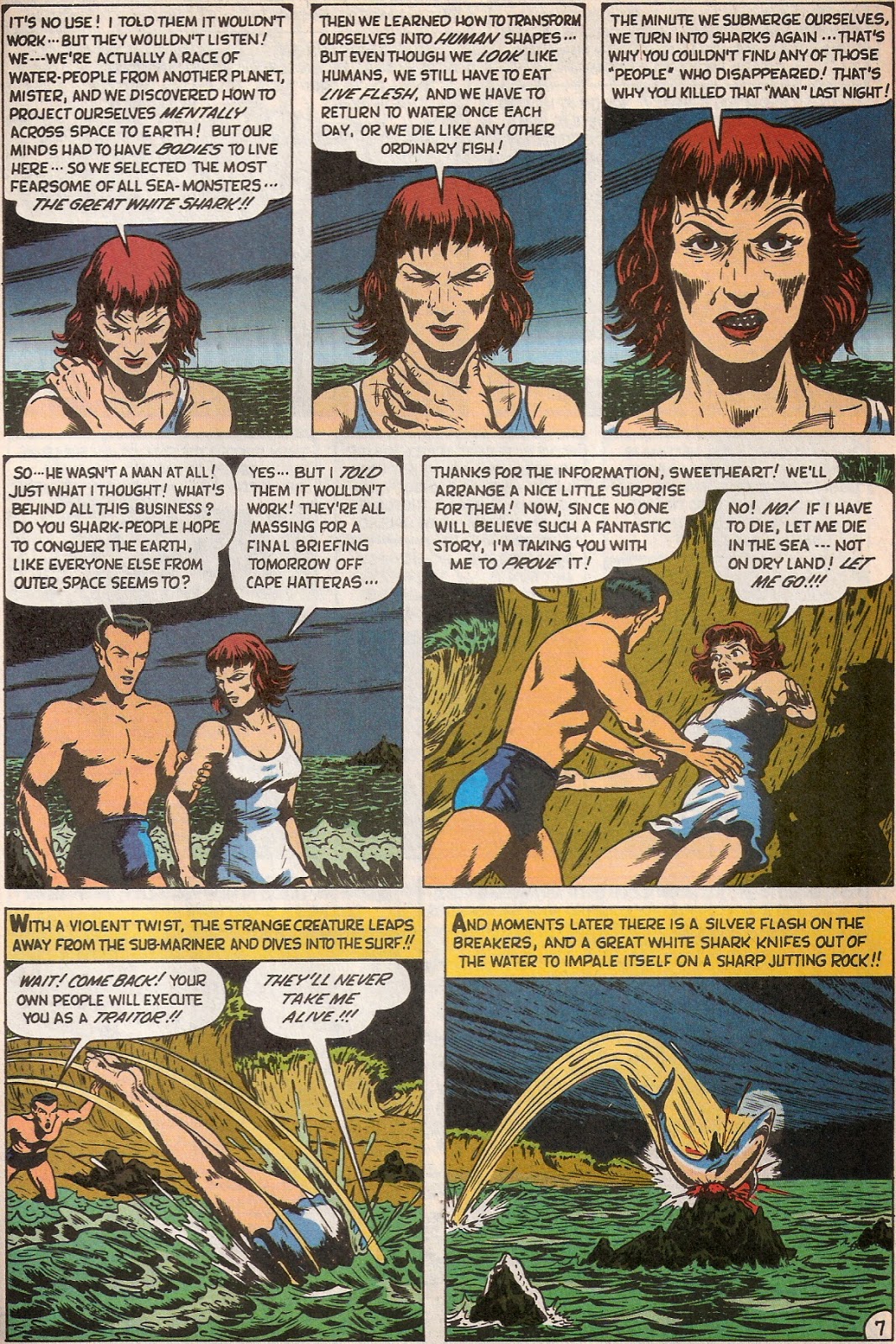
"The Shark People" -- Scripter Unknown-Bill Everett

Doug: Did any of our readers secure the wonderful package of reprints that were for sale through the JC Penney Christmas catalog back in 1994? I actually snagged this set in a comics/sports memorabilia store in Anderson, IN maybe a year or so after that. From the Grand Comics Database, and speaking specifically of today's issue:
One of the 1994 JC Penney Marvel Vintage Pack reprints. These are second printings of Marvel comics from the 50's-70's. There are a total of 15 different comics in the set:

Amazing Adult Fantasy #13; Amazing Spider-Man Special [Annual] #5; Avengers #88; Captain America #109; Fantastic Four #66 & #67; Incredible Hulk #140; Sgt. Fury #13; Sub-Mariner #8; Thor Special [Annual] #2; Tomb of Dracula #25; X-Men #28, #62 #63; and Young Men #25.

Three issues are reprinted from reprints: Fantastic Four #66 is reprinted from Marvel's Greatest Comics #49; Sgt. Fury #13 is reprinted from Special Marvel Edition #11; and X-Men #28 is reprinted from X-Men #76.

This set of 15 comics was available through the 1994 JC Penney Christmas Catalog, for $14.99 plus shipping. The front covers of these comics look exactly like the originals, but inside, contain advertisements from 1994, except for Young Men #25, which has all the original inside ads. All of these reprints have the same back cover Stridex ad. "Second Printing" appears at the end of the indicia.

[Publication information from Roger Perez, STL COMICS web site, http://stlcomics.com/gallery/jcpenney_stridex/]
I'd strongly encourage you to visit the link just above. There were actually two other reprint sets of this nature, but the one we're dealing with today is by far the coolest (in this Bronze Age Baby's opinion).

Doug: It's strange how the creator credits for Young Men #25 are so sketchy, even down to the cover of the book. But nowhere could I find any hint that Stan Lee was the writer on any of the three stories we're going to examine. But it would be year's before readers could get their eyes on the names of those who crafted our favorite books. So armed with the limited information we have -- and I'm thankful we at least know who the pencilers were -- let's trudge ahead. But first, your mission (should you choose to accept it) is this: whenever I pick these decades-old books for some old school fun, it's usually with a Frederic Wertham-like sensationalism in mind. But as this issue would have seen print on the cusp of the DC Comics Silver Age, I think it behooves us to see if these three tales are more one-foot-in-WWII, or one-foot-in-the-Cold-War.

Doug: First up in the book is an 8-pager featuring the Human Torch and Toro. Of the three stories, this was probably most like the Golden Age stories. The artist is Carl Burgos, creator of the Torch, so I thought that was nice that after around a decade he was called back for the revival of Timely's Big Three (we'll see Sub-Mariner creator Bill Everett on the art chores in our third story).  Burgos's art had certainly evolved by the time this saw print, although I couldn't help but feel that this story was just an extension of what we'd seen in the Torch's first appearance. This is a gangster story, mashed right into an episode of The Twilight Zone (which would not premiere on American television for another five years!). There's been a spate of robberies around "the big city", all carried out by very young thugs. In fact, after some investigation, it turns out that all of the bad guys are 20 years old! The Torch and Toro arrive on the scene mid-crime and create a little havoc. After some gunplay and a little flame-spitting (has Johnny Storm ever done that?), one of the goons grabs a dame (Golden Age talk, you know) and puts his piece to her head. The Torches are forced to comply with an order to get into the bank's safe. The bad guys figure that since it's soundproof it must be air proof. And, since it's on a timed lock, the Torches will suffocate and that will be the end of them. By the way, no mention was ever made in this story that the Torch is an android -- a storyline that was abandoned not long into the character's run, from what I understand.

Doug: Of course the Torches flame their way out of the safe by melting through the thick door. A hasty pursuit later and the good guys have the bad guys corralled and dropped off at the local precinct. But the chief tells the Torch that he almost has no room for all of the young criminals. And he can't figure it out -- they are all young, none are professional gangsters, and they all seem to like being in jail! The Torches have no answers, so head back out on patrol. Flying through the night skies, they pass over a senior living home, where Toro's Uncle Julius was staying. But as they get closer, they see that it is boarded up. A quick investigation shows that it had to close for business due to no new old people! What?? The Torches do some further fact-finding and note that there don't seem to be very many old people in town anymore. This is going to require some undercover work.

Doug: Back at the police station, our heroes are outfitted in "old guy" clothes and some make-up and hit the streets. It isn't long before a young man stops the two "oldsters" and asks them if they'd like to be young. The fact is, he says, he was 70 years old only last week -- and now he's 20! The disguised Torches want to know more, so go along with their new ally. Soon they are on the outskirts of town in a large mansion. A Doctor Markov (gotta love that Soviet bloc-sounding name in these Cold War years) tells the assemblage -- mostly older men -- that he can give them the vitality of a young man. In exchange, all they have to do is promise to rob and steal for him, and be willing to go to jail. The benefit of this scheme is, they are told, that as first-time offenders they won't be sentenced to more than five years behind bars. Once released, they will have the life of a 25-year old ahead of them! The old men begin to clamor to be first. Among those present is Toro's uncle. A few of the men go through the transformation, and then it's the Torches turns. Jim Hammond allows himself to be strapped into the machine, but right before the switch is thrown, he flames on and goes for the doctor while Toro moves against the young hood who brought them to the mansion. But as Toro flames on, the goon calls him his nephew! The guy they'd met on the street is Uncle Julius! The Torch binds Markov into the machine and threatens to do the switch on him, unless he fesses up to why he wants the guys to do the crime. Turns out that the men will only be 20 years old for 30 days -- after that, they turn to dust! Upon hearing that, Toro's uncle loses it and fires his gun. Despite a warning to stop unless he hits the high-voltage machine, one more bullet is fired -- and the place goes up. And up and away go the Human Torch and Toro, safely removed from the explosion.

Doug: The Captain America story was the weakest of the three, but seems a novelty due to the pencils of John Romita. The Jazzy One wasn't all that jazzy here, but you can see some flashes of the sort of work he'd do on Amazing Spider-Man a little over a decade hence. This iteration of Captain America is of course that of the commie-smasher. The gist of this story is that the Americans have developed an atomic cannon, and they need to keep its secrets from falling into the hands of spies. Bucky tells "Prof." Steve Rogers that Captain America is being paged through the newspapers, so Cap and his young sidekick enter our story in an effort to thwart the so-called Executioner (no, not that big Asgardian oaf). Top scientist Jim Slade is the only guy who knows the secrets of the firing pin for the cannon. After a greeting with Cap and Bucky, Slade declares that he's off to Las Vegas to meet his girl. After his departure, Cap is shown a picture of the lady -- and immediately recognizes her as Lupa Lupoff, Red spy!

Doug: Our heroes head to Vegas to stop the shenanigans that they know are coming. Trouble is, they're too late, as Lupoff and her assistant have drugged Slade. The good guys arrive to find Slade being driven away. They attack, but a little gunplay ensures that Slade is lost to them at this time. Cap beats up a couple of toughs, and they remark to each other how they fear for their lives at the hands of the Executioner, because they've failed to stop Cap. But, just down the street there's a booby trap, and two other guys are able to detonate a bomb, potentially killing the Star-Spangled (not yet) Avenger! We cut then to the desert, near where an A-bomb test is about to go off. Slade's strapped to a cactus, while Lupoff and her dude-friend interrogate him for the firing pin secret. He basically tells them to take a flying leap. But then they, too, begin to worry about the Executioner should they fail to extract the secret from Slade. But just then Bucky arrives and takes out the dude. But Lupa's having none of it, and pistol whips James Barnes.


Doug: Now tied up with Slade, it looks like it's curtains -- until Captain America arrives to save the day! Turns out his shield had saved him from the blast. Cap tears into Lupa's man, and then in the melee Lupa turns her gun on the guy and kills him! With his dying breath he looks at his woman and says that she is the Executioner! And she is -- punishing those who fail, including herself as she takes her own bullet. With the threat now ended, the boys regroup to watch the A-bomb test. Cap says, "A glorious sight... when it's on our side in the struggle for world peace!"


Doug: Bill Everett's art in the Sub-Mariner feature is the most sophisticated in this book -- it's just beautiful. The crime set-up is that people are jumping into or falling into the ocean, with many bodies washed ashore horribly mutilated. It looks to be shark attacks. We see a crowd scene, where the denizens of Battery Park await the Staten Island ferry. Suddenly a woman pushes through the crowd and leaps into the water. A man goes in after her, but surfaces with nothing but her clothes -- no other sign of the woman. The police are dumbfounded, as this has become a trend. In an apartment on the East side, Betty Dean and Namor, the Sub-Mariner, read the papers. Betty tells Namor of the goings on. Namor decides, because it doesn't all fit, that he will investigate.

Doug: Later that evening, Namor is down on the docks by the river. He finds a bum, badly disfigured. Namor calls the authorities (there is no sign in this story of Namor's past problems with the surface world) and talks to the detective that shows up. The guy insists that a shark did it. Namor dives into the water to check it out, but decides that the water is too cold for sharks. However, out in the ocean a small pleasure vessel is capsized -- and the men aboard are eaten alive. Later, a Coast Guard boat picks up the wreckage, and later after that several bodies are found on shore. Namor is there again to investigate, but says he's still stymied. A weird-looking guy on the beach offers a hypothesis about the sharks, but Namor casts it away. That night, Namor walks the beach, looking for any clue he can muster. Suddenly the same strange man from that afternoon appears, removes his clothes, and walks into the ocean. Too offbeat for the Avenging Son, Namor dives in after him. Namor finds no sign of the man beneath the waves, but he very soon encounters a Great White shark. The beast bears down on Namor, but the crown prince is too fast -- he grabs the lower jaw of the fish and breaks it, King Kong style! You might have guessed -- soon after, the police find the body of a man washed ashore, his jaw horribly disfigured. I had to chuckle a bit, as the cop on the beach remarked about the horrible death the guy must have had. Namor says that before they call it a murder, there should be some further investigation. But later in the same panel, Namor suggests that they can file it as a homicide. Strange doings -- was the Sub-Mariner indicting himself in the man's/shark's demise?

Doug: Later in the week, Namor is again on the beach at night looking for clues. A woman suddenly emerges from the waters. She's startled when she sees Namor, who hints at a theory he's developed about these strange goings-on. She's way too apprehensive, though, and turns on Namor. She lunges for him, but he evades and pins her to the ground. Letting her back up, she then narrates (in a whole lot of words) the explanation for our mystery, followed by its resolution -- you can find these panels at the bottom of the post. Too many art samples today, and to be honest -- I just couldn't get them to fit nicely together!

Doug: So where does this fit into this gray area between the Golden and Silver Ages? There are many elements of the 1940's -- teen sidekicks, lots of gunplay, and some serious violence (a woman is pistol-whipped in the Human Torch story). But the science fiction angles in both the Torch and Sub-Mariner tales place this a bit more toward the Silver Age. Of course, Cap's Red Scare-centered adventure falls right in between. I'd say this, though -- compared to the first few DC stories, including the Flash revival and subsequent stories, there's a lot more EC-type storytelling in Young Men #25 than we'll see only a short time later. Maybe that's why the revival of the Timely super-heroes didn't take off -- what is told here (and I'll have to assume in the other magazines that bore these new adventures) really doesn't require the presence of super-heroes for any resolution. The mad scientist in the first story could have just as easily been defeated by a Dick Tracy-type of character, and that holds true for the Cap tale. Namor, of the three, seemed most integral to the actual yarn that was spun. And what of the Comics Code Authority? Well look very closely back up at the cover -- notice the tiny star near the top left side of the book. In that little shape it says, "Conforms to the Comics Code". I guess as long as we don't have zombies or werewolves, we're good...


Tuesday, October 8, 2013

Face-Off: Kid Invaders Taking On Teen Titans!


Doug: Simple one today, friends.  In the battle of sidekicks, who would win a tussle between Robin, the Boy Wonder, and Bucky Barnes?  And, does this junior fire vs. water brouhaha live up to battles seen by the older generation?  Who ya got?  And, if you decide you'd like to delve further into match-ups involving Golden Girl or the Human Top (c'mon -- you remember the Kid Commandos, don't you?), feel free!


Friday, August 2, 2013

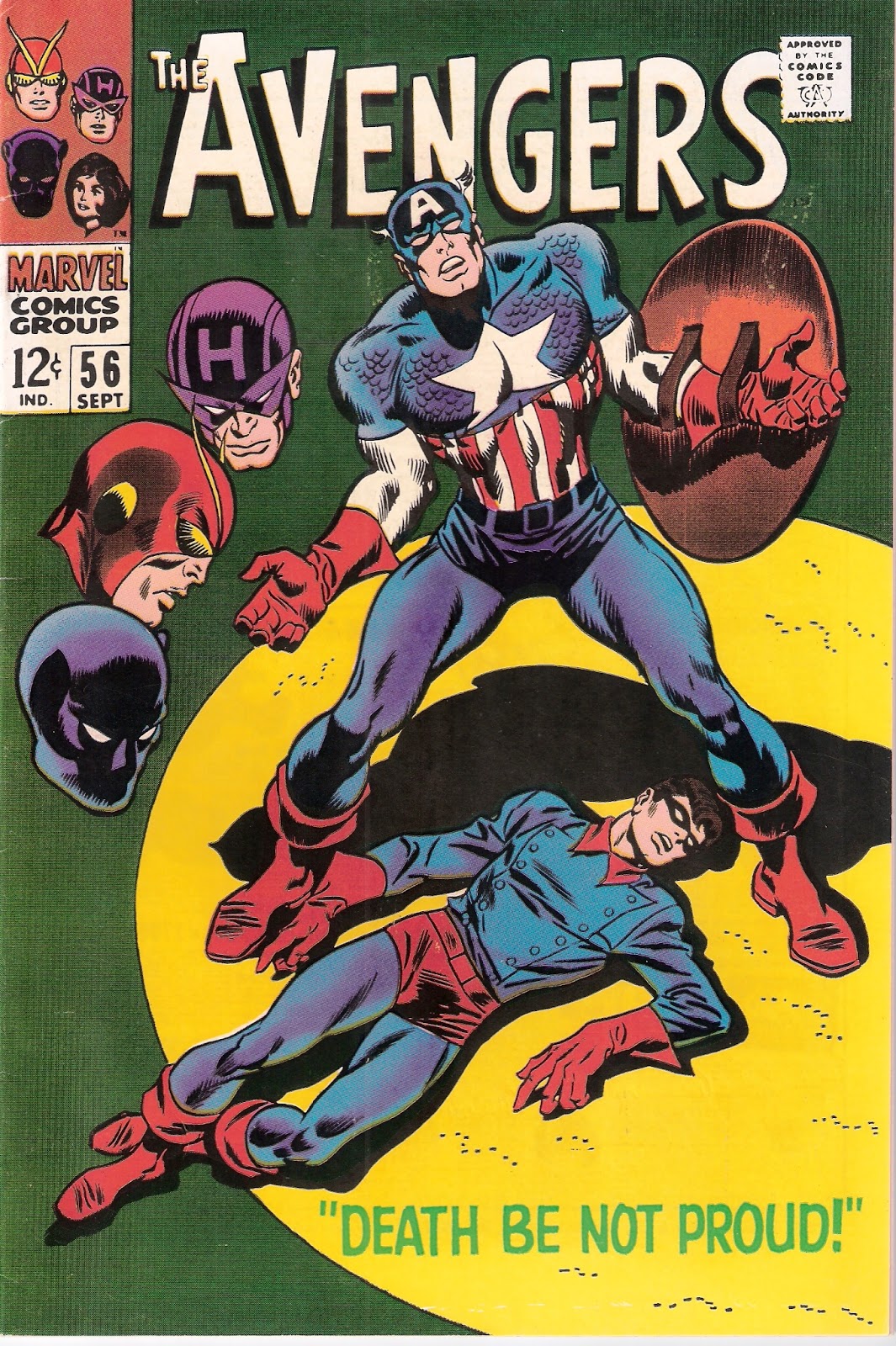
Doug's Favorites: Avengers 56

Avengers #56 (September 1968)
"Death Be Not Proud"
Roy Thomas-John Buscema/George Klein

Doug:  A couple of weeks ago Karen queried why we hadn't done a "Favorites" post in quite some time.  No good answer, then or now.  So hey -- let's do one!  Today's review is of a comic that was among my first few Avengers -- the copy I originally had was without a back cover and was a little dinged up throughout.  However, its significance was immeasurable -- this was my introduction to the Silver Age art of John Buscema, who would have been seen by me in Avengers #152 and the Fantastic Four (during the Galactus/High Evolutionary arc) at approximately the same time as my acquisition of this book.  I'm not sure where I got it, and have since replaced the beat-up copy (today's cover image is a scan of the cover of my copy).  I feel this is a really strong done-in-one (OK, admittedly it does segue into Avengers Annual #2, but reading that book is not essential in my estimation for enjoying this issue) -- wonderful art, characterization, and certainly sentimental.  What a great launching pad for my true appreciation of Big John Buscema.

Doug:  We open with a great splash of the drastically pared down roster of Goliath and the Wasp, Hawkeye, and the Black Panther on a bridge with Castle Doom looming in the background.  The use of the bridge to frame the story's title is just an excellent visual.  And like all things Buscema, there is endless dynamism among our four heroes, despite the fact they've paused before entering the castle.  They've come to Latveria to answer a distress signal, allegedly from Captain America.  Cap had been absent from the roster for a few issues, so there was some doubt on the part of the team as to what exactly they were getting into.  Goliath decides it would be best to avoid the front door, so hoists T'Challa in a maneuver that we Bronze Age Babies know only as a "fastball special".  Once on the ramparts, T'Challa steals inside and lowers the massive drawbridge.  Once inside, Goliath shrinks back to his normal 10-foot height and the team begins to progress.  However, before they can even take a step, T'Challa warns Goliath to freeze -- and then a mine goes off.  As the Panther was brand new to the team, this story served as a bit of a transitional time for him -- he had to prove his worth to everyone, notably Hawkeye.

Doug:  Now into the inner chambers of the castle, the team is led into the dark by T'Challa.  He hears a rustling behind a drape ahead, and attacks.  To everyone's surprise, the Panther comes flying right back past his teammates!  Goliath moves menacingly toward the now fallen drape, but is stopped from pummeling it by a familiar voice -- that of Captain America!  Cap tells that he issued the call for assistance to come to Castle Doom because he had recently found out about a time machine once used by Doctor Doom in an adventure with the Fantastic Four.  Cap became convinced that he could use it to return to that fateful day in 1945 when he and his partner, Bucky Barnes, faced off against Baron Zemo... the day that Bucky died.  But did he?  Cap recalled the explosion of the drone, and of being tossed far away from it.  But what of Bucky?  If Cap survived in the ice for almost 20 years, why couldn't Bucky?  And yes, this story is canon as far as I'm concerned -- that recent stuff?  Not on this guy's radar.


Doug:  The team relocates to the room that houses the time platform.  Between Hank's inspection and Cap's conversation with Reed Richards just days earlier, they figure out how to operate the device.  The Wasp is instructed to stay behind and operate the time machine, with the warning that she must sequence a series of buttons, at regular intervals --this issue features one of the most sexist portrayals of Jan that we've seen since the days of Tales to Astonish.  Sheesh -- she couldn't even rate a spot among the cover's floating heads!  And then something curious happens -- the team stands on the platform and is sent to the past.  However, a) the platform does not ascend through their bodies as we usually see it, and b) when they emerge in 1945 England they are wraiths.  If this was truly the second appearance of the time platform (the first having been in Fantastic Four #5), there's a piece missing, as the FF had materialized in solid form in Blackbeard's time.  Anyone with insight on this dilemma is encouraged to bring me to a state of enlightenment.


Doug:  Once in the past, the team has landed right at the center of controversy.  They spy Baron Zemo entering a hangar used by the Americans and carrying some sort of lockbox.  Zemo remarks that he feels as if he is being watched, a funny feeling on which he'll remark a few more times throughout the story.  The Avengers phase right through the wall (shades of what's coming in the very next issue, hmm?) and see Zemo fire a gun of some kind into the now-opened box.  Suddenly a giant (and an ugly one at that) emerges, almost zombie-like.  The Avengers marvel at this event, and watch Zemo's next move.  But before the Nazi can do anything, who should burst through a window but Captain America and Bucky?!  Fearless as always, Cap launches himself right into the giant android, while Bucky rolls Zemo.  Zemo commands the monster to kill his adversaries, and our heroes don't fade from the challenge.  But the onslaught gives the Baron time to reappropriate his weapon, and turn it on Cap.  However, Cap's shield gives Zemo his second trip onto his backside.  Bucky decides to tackle the giant alone -- bad call.  Shrugged off and dazed, Cap rushes to his partner's side.  This gives Zemo the opportunity to knock the Star-Spangled not-yet-Avenger out.

Doug:  Zemo now holds all of the cards, and his plan to steal the drone from the Americans appears to reach imminent fruition.  Cap and Bucky's costumes are removed and replaced with GI uniforms.  Zemo's logic is that 1) he hates their garish patriotic look, 2) Captain America was responsible for the incident that grafted Zemo's mask to his face, and 3) with the plan to program the drone to fly right into Berlin and land in front of the Fuehrer, America's greatest heroes will arrive unmasked and as defeated adversaries, strapped to the object of Zemo's thievery.  However, and you know this -- "as fate would have it" -- the Wasp suddenly becomes smitten with drowsiness and a finger falls onto the wrong button.  Unexpectedly, the Avengers materialize right in the hangar, 1945!

Doug:  Cap wastes no time in moving toward Zemo.  He grips his wrist, hard, and jerks the gun down.  But before it can be totally removed from Zemo's grasp, a ray is fired again into the mysterious metal box... and another giant android emerges!  And what's going on outside the hangar, you might ask?  Uncle Sam's boys mobilize, and they want to know what all the commotion's about near the top secret drone.  As they head toward that building, one of the giants comes flying through the wall, followed closely by Goliath.  The boys in Army green are about beside themselves.  Hank tells them to cool it -- he can't explain, and they wouldn't get it anyway.  But while he's dealing with that, the android recovers and attacks.  Back inside, the Panther takes on the giant's twin -- sort of.  And what of Hawkeye?  He launches a blast arrow into the face of the android -- to no avail.  But who needs trick arrows when Captain America is around?  Ever the champion, Cap attacks the giant from behind, bending it backwards.  T'Challa offers his best punch, and cracks the control panel in the android's chest.  Almost simultaneously, Goliath makes the same discovery and knocks the second giant out of action.  Of course, the soldiers want answers, and Goliath tries to hold them off -- but suddenly he begins to phase out!

Doug:  Back inside the hangar, Cap also begins to phase out.  Knowing he won't get another chance to defeat Zemo in this context, and throwing all caution and common sense to the wind, Cap whips his shield at his historical self.  The mighty disc slashes the ropes holding the WWII Cap and Bucky to the drone.   Not to lose out at this point in the game, Zemo lunges for the control panel, starting the flight sequence for the drone.  Cap and Bucky divert their attention from their Nazi assailant and turn instead toward stopping the drone's take-off.  Commandeering a nearby motorcycle, Cap and Bucky race after the plane and get close enough that they are able to launch themselves off a ramp and onto the plane.  As Bucky latches on and begins to climb toward the cone, Cap begins to fall away, yelling at his young partner to also let go -- the thing could have been booby-trapped by Zemo!  Bucky notices a fuse, but it's too late -- the drone explodes.  Cap is thrown away from it, and as we know into the sea.  Bucky?  Our Captain America is sure -- Bucky died in the blast.  In the hangar, the wraith of our Cap makes one last lurch toward Zemo, causing the criminal to shudder.


Doug:  Our story concludes with the 1940's GI's looking at the fallen androids in disbelief, and Zemo firing his gun at the giants from a distance -- vaporizing them.  In the confusion, the Nazi was able to escape in a V2 rocket, and no one would know of the murder he'd just committed.  Back in Castle Latveria, the Wasp welcomes the boys back.  The mood is solemn, however, and Cap is allowed to move away from the group to be with his thoughts.  As Cap goes forward, he'll always mourn the loss of Bucky Barnes.  Yet in time, he'll welcome new partners, like Rick Jones, and the Falcon!

Doug:  If there's one thing you get from Roy Thomas-scribed comics, it's a better vocabulary!  Everyone knows he was an English teacher from Missouri, and his love of literature is well-known.  But how about Hank Pym using the term "Brobdingnagian" to describe Zemo's giant?  It means, for those of you not in the know, marked by tremendous size.  Whew...!  Not a word I've added to everyday usage.  But overall, even back in 1968 Roy's love of the Golden Age and of potential exploration of the era was coming to the fore.  We'd of course see this over and over again, with the creation of the Invaders in Avengers #71 and other WWII-era heroes in the endgame to the Kree/Skrull War.  And you know I'm going to gush on the art.  Every panel in this book oozes action.  The camera angles are varied, the anatomy and facial depictions are top-notch, and it just has the fingerprints of a master all over it.  Some have remarked that John Buscema would reach his zenith when inked by Tom Palmer; I'd argue that George Klein is certainly doing no harm on these pages.  The lines are light where appropriate, and firm when required.  It's a slick production throughout, just beautiful.  So it's a favorite for all of the above reasons, but mostly as a window for this young reader to WWII-era stories, a fun but limited line-up of heroes (boy, ol' Hawk did virtually nothing in this story), and of course the pretty pictures, my introduction to Buscema's Silver Age output.  Twenty minutes perfectly spent, friends.
Related Posts with Thumbnails