Showing posts with label Jim Steranko. Show all posts

Thursday, April 14, 2016

If I Had a Buck... The Many Artists of Captain America


Martinex1: Captain America's costume has not changed much over the years that he has worn it.  Sure there were some more noticeable fashion updates in the past decade, but for the most part our star-spangled Steve Rogers has been known for his red, white, and blue, for his stars and stripes, for his winged head and his pirate boots, for his chain mail and his shield.   

It is interesting to see how different great artists depicted the American hero. So this $1 Challenge has a simple premise; here are 14 covers with Cap in charge, but all handled by different artists. Pick your favorites and discuss why that is.   There were so many great covers to choose from, so if you have a favorite you'd like to share, be my guest.

These are all in the Quarter Bin, so get a bang for your buck... four comics, four colors, four quarters...what can be better? 

Captain America #109; Jack Kirby.
Captain America #110; Jim Steranko.
Captain America #132; Marie Severin.
Captain America #140; John Romita.
Captain America #183; Gil Kane
Captain America #222; Ernie Chan
Captain America #225; Frank Robbins
Captain America #230; Ron Wilson
Captain America #241; Frank Miller
Captain America #254; John Byrne
Captain America #260; Allen Milgrom
Captain America #263; Mike Zeck
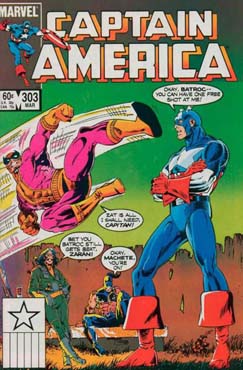
Captain America #303; Paul Neary
Avengers #340; Ron Lim (Okay this is a great Wasp cover too, but it is one of my favorite Cap covers of all time).


Monday, August 10, 2015

Guest 100-Word Reviews - Four DC anniversary books, Favorites Then and Now


Doug: Edo Bosnar is a good sport, and one not to be deterred by my silly word games. Just when we all thought (did anyone still really care?) the 100-Word Review had gone to blog heaven, Edo stepped up to the plate and performed not one, but FOUR 100-Word Reviews on some books of his choice. Thanks, friend! Onward...


Edo Bosnar: For a while, in the early 1980s, DC really put out all the stops for their various anniversary issues. The last three reviewed here in particular are really nicely packaged, with engaging stories and a number of artists, and absolutely no advertisements. They really were special issues in every sense of the word. I also included a personal favorite from 1978:


Showcase #100 (May 1978) 
Writers: Paul Kupperberg and Paul Levitz
Art: Joe Staton


Think of this as a dry run for Crisis on Infinite Earths. The intention was to have every character who ever appeared in Showcase to make an appearance in this issue, if only for a single panel. They all get together to deal with a menace that is apparently ripping apart the fabric of time itself (which is why the historical, .e.g. Bat Lash or Anthro, and futuristic heroes, like Space Ranger, appear). It gets a bit silly at places, but it’s still an engaging story with a satisfying conclusion – in which two unlikely, non-powered heroines basically save the day.


Detective Comics #500 (March 1981) 
Writers: Alan Brennert, Len Wein, Mike Barr, Walter Gibson, Paul Levitz and Cary Bates
Artists: Dick Giordano, Jim Aparo, Walt Simonson, Jose Luis Garcia-Lopez, Tom Yeates, Joe Kubert Carmine Infantino and Bob Smith


While the focus is obviously on Batman in the seven stories included in this book, there’s one each featuring Elongated Man, Hawkman (who had back-up stories in Detective in the 1970s) and Slam Bradley, who debuted in Detective’s first issue and continued to appear in it until almost 1950. The latter story also has guest appearances by a number of back-up characters like Captain Compass, the unfortunately named Pow Wow Smith (yes, he’s Native American) and Christopher Chance. A special treat is a Batman prose story in the middle written by Walter Gibson, creator of pulp action hero The Shadow.


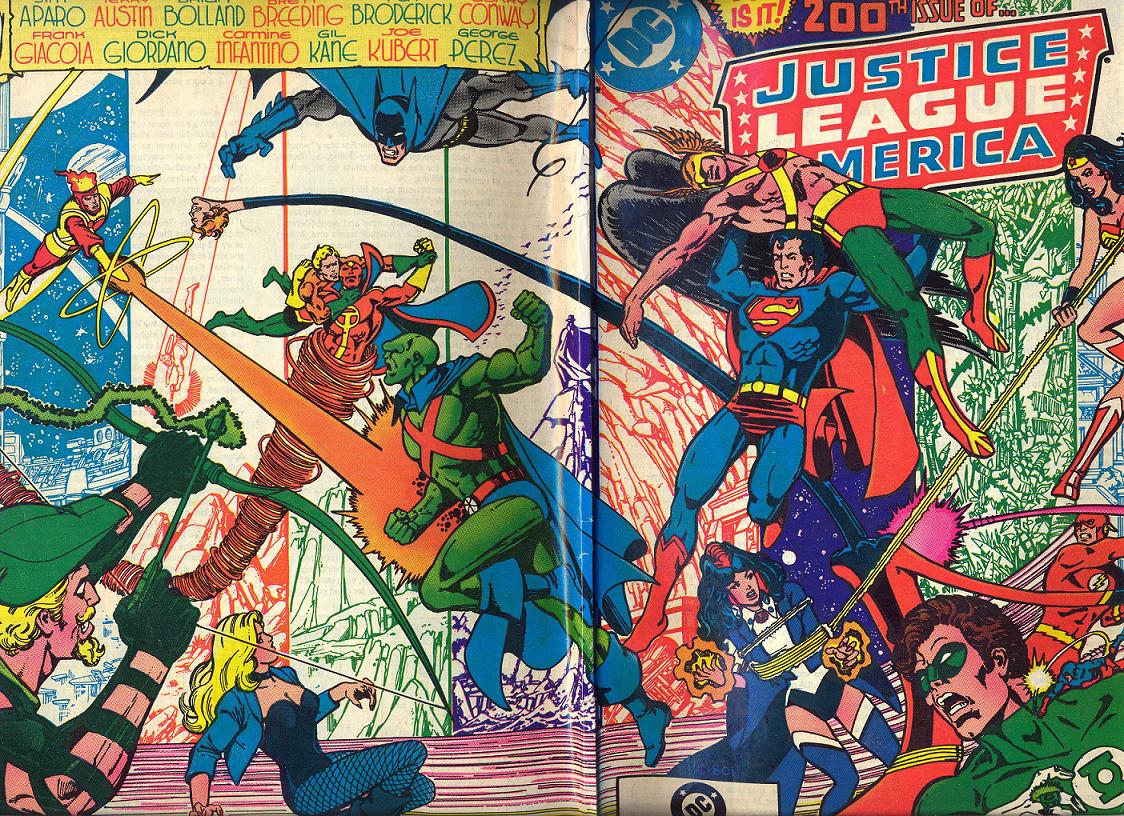
Justice League of America #200 (March 1982)
Writer: Gerry Conway
Art: George Perez, Brett Breeding, Pat Broderick, Terry Austin, Jim Aparo, Dick Giordano, Gil Kane, Carmine Infantino, Frank Giacoia, Brian Bolland, Joe Kubert


This is just so much awesome between the spectacular wraparound cover by Perez. The would-be alien conquerors from the JLA origin story are back: they take mental control of the founding members, who seek out the meteors in which the aliens originally arrived, now hidden all over the world, so they can resume their diabolical plan. The newer members go out to stop them, with each confrontation drawn by a different artist/artists. The original JLAers always manage to  prevail, but they come to their senses eventually, and ultimately the days is saved through superior teamwork between members old and new.


Superman #400 (October 1984)(cover by Howard Chaykin)
Writer: Elliot S! Maggin
Art: Joe Orlando, Al Williamson, Frank Miller, Marshall Rogers, Terry Austin, Wendy Pini, Michael Kaluta, Kelly Adler, Klaus Jansen, and Jim Steranko
Also included: An introductory text piece by Ray Bradbury, and tribute pin-ups by a number of other notable artists, including Wil Eisner, Mad Magazine’s Jack Davis, Leonard Starr (of Little Orphan Annie fame) and Moebius


Under the title “The Living Legends of Superman,” this one consists of a number of brief stories set in the future (sometimes in alternate realities) that examine what Superman has come to mean to human society. This is essentially Maggin’s love letter to his favorite character, but it never gets sappy or overly sentimental. The sections drawn by Kaluta and Pini are particularly interesting, since neither of them normally drew superhero stories. The last section, written and illustrated by Steranko, examines the progress of the illustrious Superman lineage into the far future and, well, up to the end of time.

Thursday, March 5, 2015

Guest Review - Chandler: Red Tide


Welcome to our second guest post! This past Monday Mike W. walked us through one of his favorite story arcs of the early 1980s, a tussle featuring the Justice League and Justice Society against a revamped Secret Society of Super-Villains. Today we have a Bronze Age reading of a different stripe -- an illustrated novel. Your host for this literary excursion is Edo Bosnar.


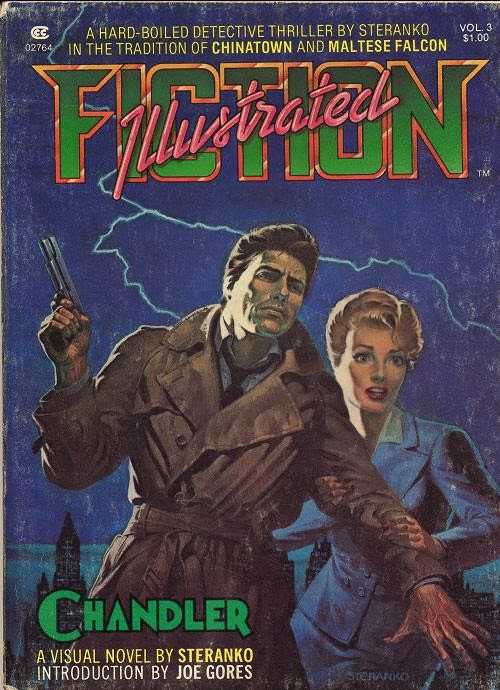
Chandler: Red Tide (Byron Preiss Visual Publications and published by Pyramid Books, 1976)

Edo Bosnar: A big part of what we call the Bronze Age in comics was the experimental stuff. Not just the often trippy or off-the-wall stories in mainstream superhero comics by guys like Jim Starlin or Steve Gerber, but also the various innovative projects being published by someone other than Marvel or DC. An example of this is the Fiction Illustrated series launched by Byron Preiss in the mid-1970s. These were supposed to herald a new age in graphic storytelling. You can see the entirety of one of these offerings, Starfawn, over at Diversions of the Groovy Kind. Another, and perhaps the best remembered, is Chandler: Red Tide by the legendary Jim Steranko.


It’s a hard-boiled/noir detective story set in New York the early 1930s, featuring a P.I. named Chandler (an obvious homage to Raymond Chandler). Steranko did pretty much everything but the coloring in this, i.e., he wrote the story, drew all of the illustrations and very meticulously designed the whole package.


I’m not going to do a full review of the story, since it is a novel, or rather, a novella. Whatever the matter, a full rundown would be too time-consuming. Needless to say, it’s got all of the elements of a classic hard-boiled crime novel in the style of Chandler or Hammett: a tough private detective drawn into a bizarre murder case (a guy comes into his office saying he’s got 72 hours to live because he was poisoned, and wants the detective to find his murderer), and on the way there are intrigues involving organized crime and uncooperative police officers, a few plot-twists, including a bit of shocker at the end, and, of course, a femme fatale.


What I really want to do here is just highlight the book itself. Steranko wanted to make this look like something that’s halfway between a comic book and a standard prose novel. As you can see, there are pictures all the way through, and under each there are always exactly 13 lines of text, so it has a very uniform and well-ordered look throughout. Some of my favorite pages are those in which each of the panels forms an entire “splash” image. Like this flashback sequence:


And this scene in which Chandler rekindles a relationship with an old flame:


It’s notable that Steranko really made an effort for this to be a genuine juxtaposition of words and pictures, rather than the sequential images with narration and/or dialogue inside the pictures that you get with comics. This actually sets it apart from the only other Fiction Illustrated title I’m familiar with, the above-mentioned Star Fawn, which does have occasional dialogue bubbles as in standard comic books.


I think Steranko mostly succeeded in his aim, as this is a really cool-looking book. The story, while nothing spectacular, is solid. It’s too bad he didn’t do a few more of these, just as it’s unfortunate that these didn’t catch on and become more popular. Preiss and a few others did make some later, similar attempts (most notably with Howard Chaykin), and while well-liked by fans and cult favorites now, they ultimately didn’t set the world on fire. All in all, this is an interesting relic of a time when a number of creators were trying to stretch the limits of what comics and graphic storytelling could be.


By the way, my copy is the original pocketbook format printed on newsprint-type paper, which I purchased online pretty cheaply about 6-7 years ago. Apparently there was also a deluxe edition, which was 8” x 10” in format and printed on higher-quality paper – the few times I’ve checked (e.g. on eBay), copies of that, when offered at all, are never listed for less than a $100. Ouch. Unfortunately, it doesn’t look like we’re going to get some nice, new deluxe reprint, either: a few years ago, several comics-related websites posted announcements that Chandler would be reprinted by Titan Books, but so far nothing has come of this.

Thursday, December 18, 2014

BAB Book Review: Marvelous Mythology


Doug: Today you'll be able to find some thoughts on the very-soon-to-be-released history of Marvel Comics, Marvelous Mythology: How the World's Greatest Super-Heroes Were Created by Todd Frye. If you recall, in a post a couple of weeks ago I mentioned that Todd had reached out to the BAB through our email account. He requested that we review his book and then hopefully give it a plug on our blog. To be honest, Karen and I have been solicited for such things in the past, but I'll say personally that I don't think I've been offered a book that was in my wheelhouse such as today's tome is.

Doug: Those of you who have been patronizing our blog for many years know that I usually frame my reviews in a "The Good, the Bad, and the Ugly" manner. Trouble is, Todd's book didn't really fit into that mold. But unless you think I'm on the take today, or that Todd's written the be-all-and-end-all of Marvel history, I'll state truthfully that I did have some concerns about the book and even a correction. Those were dealt with through email, and quite cordially. So today we're going to try something new, and that's to welcome an author onto the blog for a sit-down about the contents and creative process of his book. The interview you're about to read was carried out December 15-16, and was approved for publication here by myself and Todd Frye. Enjoy! And of course, as all good BABers do, leave a question or comment at the bottom!

Doug: Todd, you've written the about-to-be-released book, Marvelous Mythology: How the World's Greatest Super-Heroes Were Created (Action Figure Publishing 2015). I guess the first question would be "Why did you write this book?" 

Todd: Money. …..Oh, you want a more meaningful answer. Um… well, the truth is, I wanted to see if I could do my own take on a sort of informal history of how the Marvel characters were created. Not simply how they were created, as in how the artists and writers thought them up, so much as how they fit into the context of the time, what superhero comics were like in the early 60’s, how all of the new characters being introduced fit into the new Marvel universe, that sort of thing.

The book is chronologically ordered, so as each character is introduced, hopefully readers will get a picture of how the Marvel universe looked at each point in time. I think it’s relevant to see how it all fits together in the early stages, like puzzle pieces.

Doug: Give us a bit of background on your comics reading/collecting past -- when did you get into comics, and do you consider it now (or then) a hobby? Are you into the newer stuff, or stuck in the past like many 40- and 50-somethings? 

Todd: Well, I was born in 1966, so I grew up in the 70’s basically. 1974 was the year I really started collecting comics as a kid. And what a year it was… that was when Marvel and DC were both doing their experiments with different sizes and shapes of books, like Marvel’s Giant Sizes and Treasury Editions, DC’s 100-Page Giants, and so forth. But you also had great reprint comics like Marvel Tales, Marvel’s Greatest Comics, Marvel Triple Action… so in addition to the regular, new comics that were coming out, thanks to the reprint titles I got to read a lot of the ‘classic’ stories too.

I don’t really collect any more, even though I have a few collected editions and bound copies here and there. My comics reading is mainly stuck back in the 60’s and 70’s. Not completely, though: I think Alan Moore is a genius, and I pick up just about anything he does. Also the Hernandez Brothers, who I got to meet at a con several years ago. But for the most part newer books just don’t interest me. Maybe it’s the art styles… I know I don’t respond to it the way modern kids do. Anyway, I know there’s probably a ton of brilliant comics being published, but I just don’t have the energy to wade through all of it to find the good stuff.

Doug: At the end of your book, you list several other books as resources for your research, such as Mark Alexander's Lee & Kirby: The Wonder Years and Sean Howe's Marvel Comics: The Untold Story. What separates Marvelous Mythology from those other books? Why should a reader come to you first? 

Todd: Good question. Well, in many ways each of those books had a different focus, even though the subject matter certainly overlapped. My main concentration was on the origins of the Marvel universe, going forward slowly from the beginning as each new character was introduced, and as each new important story or issue or concept was released to newsstands. It was never really meant as a history of Marvel Comics as a publisher, so much as telling the story of the beginning of that fictional universe. I also meant it as a book that could be enjoyed by people who don’t necessarily read the comics – after all, the movies are bringing in a LOT of new fans, and I wanted to make the story accessible to them without bogging them down in the minutiae of historical record.

Why might readers come to my book first? I would say that – to me, anyway – my book concentrates on ‘the good stuff,’ the character introductions and important moments in early Marvel history, rather than having that be just a part of a larger narrative that might be forced to cover less interesting topics also.

Doug: As I read, I noticed that there are no creator interviews. Was this intentional from the beginning of the project, or did you get stymied early on in trying to reach Silver and Bronze Age creators and shift your direction? 

Todd: No, I didn’t really try to interview anyone… that kind of ‘journalistic’ writing style just doesn’t interest me. I thought about reaching out to a few people, but I knew that each link in that chain would make writing the book take just that much longer. Besides, good interviews with all of these people, or at least most of them, already exist by the dozens. Also, whenever possible, I tried to let the printed comic stories speak for themselves. After all, if you’re going to try and survey the fictional Marvel universe, it might be best to go back to the original source material, just as if you were a kid buying the comics off the newsstand back in the day.

I guess I could have written a different type of book. Well, sure I could. But I’m contrary, I have to do things my own way.

Doug: Readers might be interested in knowing that there are no images or graphics in the book. Since the Internet gives us almost instant access to any picture, cover, etc. I did not at all feel like it detracted from your writing. But it would interest me to know if you did pursue any rights permissions, and if so what you encountered? 

Todd: I didn't pursue that sort of thing. Like with trying to contact possible interview subjects, I just figured that it would be endless waiting and red tape to try to license any images, and possibly more money than I was willing to spend, too. Just as the manuscript was being finished up, though, I did discover a couple of images of Jack Kirby that are in the public domain. But they wouldn't really have added anything substantial to the book. Like you said, readers have a vast array of online tools they can use to seek out images.

In a perfect world, I would have had color illustrations, full panels and covers and original art. But just thinking about negotiating with Disney's lawyers for all of that stuff makes my head spin.

Doug: Ha! Fair enough. As you originally envisioned the project, did you finish what you set out to do? For example, one of the things I thought of as I read was an analysis of those areas you feel the Marvel Universe is better or (insert whatever other adjective you want) so on from other companies' pantheons -- most notably DC's. Was there any interest in doing a comparison/contrast with other characters? 

Todd: Okay, those are two separate questions. Um, the first one… I guess I didn’t really have as clear a vision in mind when I started as I thought I did, because I was actually about two and a half chapters into an earlier version when I realized that it wasn’t quite working. I was using too much detail, and listing each title that the company was publishing in chronological order… which got to be silly, because they had a lot of two-issue funny animal series, things like that, which was just a nightmare to catalog. Also, an average reader just couldn’t possibly care about such things. So I threw most of that out and then had a clearer idea of what I wanted to write, which I did.

As to comparing Marvel characters and stories to those of other companies and such… I think that to understand Marvel’s impact on the world of comics in the early 1960’s, and on the larger popular culture later in the decade, you have to kind of… contrast what the company was doing, versus what everyone else was doing. Marvel superhero comics really were radical for their time, in that they just had a lot of what I guess you could call ‘realism’ in them. People quarreled, they had girlfriend and money problems, that sort of thing. Most of the time before that, superheroes were just defined by whatever stories they were in, or whatever villain they fought. They were really two-dimensional, or at least I think so. Marvel made them more interesting by making them more human.

Doug: Was it difficult to write the book and think only of the characters? Readers might be interested to know that you mention from time-to-time what was happening at Marvel Comics, and perhaps how business practices and personnel may have shaped the budding mythology. Can we really separate Conan, from say - Roy Thomas? Or does Roy's increasing status/stature in the company need to go hand-in-hand with a discussion of Conan? 

Todd: Yeah, like I said, I wasn’t really trying to do a history of Marvel as a publisher, but at a certain point it would be silly to try and talk about these characters being created without talking about Stan Lee and Jack Kirby. Or about Ditko or John Romita if you’re talking about Spider-Man. Especially Lee and Kirby, though… I might get yelled at, but I would say that a good… 85%?… of the important early stuff came just from those two men. And to get a good overall picture, it’s important to know what their working relationship was like, or how the comics were done 100% by freelancers for a long time, how they were limited to publishing only eight titles a month, that sort of thing. Because it all had an effect on what got published.

As far as separating an important character from his creators… well, yes, it’s good to know these things. Giving Spider-Man as an example, John Romita’s smooth art style went a long way toward making the character more approachable to readers later in the 1960’s, I think. Ditko’s weird, unique art style may have been important early on – and he certainly was responsible for so many of Spider-Man’s cool enemies – but I think Marvel needed a Romita on board to take the character’s popularity further, where it needed to go. And now he’s the company’s most important superhero.

Doug: You do a nice job of surveying many key literary events throughout the growth of the Marvel Universe. Did you read all of these comics? And if so, what sort of access do you have to classic comics? 

Todd: Thanks. I really did sit down and read nearly every Marvel superhero comic from 1961 to about 1964… and a goodly number of issues beyond that. Most of them were in reprints. I also have a local friend who has a killer collection of old issues… If you’re willing to spend the time and a little money, you can usually get your hands on darn near every story they published. The ‘Essential’ volumes, for example, provided a nice, cheap way of accessing a lot of material. But then you have to put them all in chronological order, which can be a nightmare…

There were a LOT of stories that I only read for the first time while writing this book… like the first appearance of Ant-Man, the first two Fantastic Four annuals, and so forth. Some of it wasn’t as good as I’d hoped – like, now that I think about it, the return of Captain America in Avengers #4. What a mess that issue was! But some of them astonished me by how good they were… again, like those first two Fantastic Four annuals. Kirby really outdid himself with those. And when Thor got going in the mid-to-late 60’s, like when the living planet Ego was introduced… those stories just knocked me out.

Doug: I enjoyed your style of moving from topic to topic -- you sort of built in some cliffhangers either from section to section or even between chapters. Did you sort of "story board" the project, or does that type of narrative style come to you naturally? 

Todd: I wish I’d put a bit more of that stuff in, to be honest. It does kind of come naturally, though. It helps if you know what you’re going to write about next, as opposed to what you’re working on at the moment. Then you can kind of see where two subjects are going to connect, so you can write a little transition between them. I noticed as I was working on the book that that sort of thing was getting easier as I went along, I guess as I got more comfortable writing it. Of course, I also knew the later source material better than I knew the early stuff.

Also, there were some storylines that I was chomping at the bit to write about. You know, it’s toward the end of 1965, and you’re thinking, ‘Oh boy! Galactus is going to show up soon!’ Or, ‘I finally get to talk about Mary Jane Watson.’ That sort of thing. I was anxious to start talking about my favorite stuff, which is only natural, I guess.

Doug: Winding it down here... So what's your favorite era of Marvel Comics? Does that contrast with an era you feel is most important? 

Todd: As far as ‘most important,’ I would have to say that the years 1962 and 1963 were, because you had so many great characters and titles starting up. Of course, you could also argue that many of the best storylines and such didn’t start showing up until a few years later. Also, like I talk a little about in the book, it took time for Stan Lee to work through a lot of his sort of bad writing habits in the early era. He had been doing run-of-the-mill comics for so long, and now he had to start upping his game. But either way, I don’t think there’s much argument, that if we’re talking about Marvel Comics, the 1960’s were by far the most important period.

It’s also my favorite era, even though by the time I was growing up, it was all in the past. My favorite title is Amazing Spider-Man, and reading those great stories reprinted in Marvel Tales month after month… it was heady stuff. John Romita’s art was just gorgeous, and Stan Lee was at the absolute top of his game. Kirby’s work on FF and Thor was unbelievable. And I just love the Don Heck era of The Avengers where the team consisted mainly of Cap, Hawkeye, Scarlet Witch, Quicksilver, and Hank Pym. It was all so much fun. 

Doug: You wrap the book up with the All-New, All-Different X-Men. Why? Is that a personal break line for you?

 Todd: Good call, it is kind of a personal break for me. I lose interest in Marvel's output starting in the early 1980's. And frankly, from the standpoint of what the book was meant to accomplish, a lot of what happened from that time forward would be irrelevant. I had to include the modern X-Men - I mean, Wolverine, Storm, Nightcrawler, etc., simply because of the characters' popularity thanks to the films. That's also the reason I included material about the Guardians of the Galaxy. After all, the book is supposed to be concerned with characters that readers might want to know about.

I realize I left some things out, especially characters that will soon appear in feature films: Deadpool, a lot of those later X-Men characters like Cable, for example. I didn't go into Frank Miller's era on Daredevil, and how it coincided with how a lot of 80's comics took a darker turn. But much of that is just outside the scope of the book. It was always meant to concentrate on the 'classic' Marvel characters, the ones who mainly started appearing in the early 1960's. The further out from that you go, in my opinion, the less relevant things become, at least in the context of the book.

Doug: In closing, I'd again state that it was an easy read -- very accessible, I think novice-friendly. But there's enough in the book to keep even well-studied fans interested. So here's your chance to blow your own horn one last time -- 

Todd: Thanks so much for your kind words. I’m glad you like it. I tried hard to make it accessible to as many readers as possible, and of course there should be plenty of meat there for the die-hard comics fans, especially classic-Marvel fans. Also, thanks for the opportunity to talk with you! It’s been fun.

I should mention that the e-book version comes out on December 20th through the usual places, while the paperback is available on January 20th, although of course you can pre-order at Amazon. I’ll also be selling copies directly from the book’s website at MarvelousMythology.com, where everyone can also read the first chapter for free.

Now, if everyone reading this would buy ten copies to hand out on street corners, I can finally start buying the name-brand Ramen noodles instead of the store-label variety…


Related Posts with Thumbnails