Doug: Welcome to the fourth Super Blog Team-Up! This is the third entry
from your pals at the Bronze Age Babies, and we're excited to have been
asked again for a contribution. The SBTU just keeps getting bigger and
better, too -- be on the look-out below for links to new members of our
comics coalition! Karen and I will be sending some
mini-reviews your way today, all fully-integrated to today's SBTU theme of
team-ups. But here at the BAB, we thought we'd turn things just a bit
upside down, and feature team-ups of our favorite heroes... alongside
some of their major villains! And not only will you get to check out
some fun stories, but we'll also feature some wonderful Bronze Age art from the likes of Big John Buscema, Jim Aparo, and Jim Starlin (with a little Silver Age Jack Kirby for good measure)! So enough of this introductory stuff -- let's get down
to business -- and do we have a whopper of a post for you today! Better take a deep breath...
<<<<<<<<<<<<>>>>>>>>>>>>
Fantastic Four #116 (November 1971)
"The Alien, The Ally, and... Armageddon!"
Archie Goodwin-John Buscema/Joe Sinnott
Karen: This was one of the first FF's I had, and it might have been my introduction to Dr. Doom, although that could have also occurred via Marvel's Greatest Comics. Whatever the case, it was this issue that made the single greatest impression upon me concerning the nature of the good Doctor's personality. The FF have been battling an alien being known as the Overmind. In the previous issue, the Overmind, who is the sole survivor of his alien race, and imbued with all the power of his people, used his tremendous psychic powers to take possession of Reed's mind and turn him against the rest of the team. Without their leader, the remaining three members of the FF are left feeling hopeless -what should they do?
Karen: This issue picks up with Sue, Ben, and Johnny, still stunned, trying to figure out not only how to stop the Overmind from taking over the world, but how to save Reed as well. Oddly enough, Johnny emerges as the leader! Yeah, 43 years later and I'm still not buying that. He and Ben grab a doohickey from Reed's lab and use it to track Reed, telling Sue to stay behind and monitor them, and act as a reserve. Yes, that was still a woman's place back in 1971. Ben and Johnny finally locate Reed and the Overmind in a wrecking yard. The alien giant has been hammering away at the FF's leader, assaulting him mentally and physically as he still resists his domination. Reed tries to mask thoughts of his family from the being but is ultimately unable to keep them hidden. Just at the breaking point his team-mates arrive and attack, but the Torch's flame and the Thing's pile-driving fists prove no match for the being.
Doug: By this time, if we
look at real time, the FF had been doing their thing for 10 years. I
thought that given Ben's military service as one of the hotshot test
pilots, and having been such a close friend of Reed's for so many years,
that Archie Goodwin really sold the other three short here. But then,
it was all set-up, right? I haven't read the preceding issues (at least not in so long that I can remember them), but there was a real sense of defeat here. The Torch and the Thing were pretty ineffective. In that regard, Goodwin's crafted quite a bit of suspense. Too bad the cover gave it away...
Karen: Seeing Ben and Johnny hopelessly out-classed, Sue flies to the scene on a jet cycle, but her force fields prove useless. Ben and Johnny are defeated (in a stunning full-page takedown by Buscema and Sinnott) and then the Overmind controls Reed and sends him after Sue. She is only just able to fly off again and evade him. Sue desperately seeks help from the heroes she knows, including the Avengers,but no one is available. Meanwhile, in the streets of the city, the Overmind's power radiates, causing people to go mad and attack one another. Frightened and alone, Sue pauses on the edge of a river to gather her thoughts.  Suddenly, her nanny, the sorceress Agatha Harkness, appears, and suggests she drop her prejudices and go to an unlikely source: Dr. Doom! Sue reluctantly heads to the Latverian Embassy, where she finds Dr. Doom has been monitoring the situation, and only regrets that it was not he who ended the FF. Sue then gives him a verbal slap in the face: "The Dr. Doom I remember might be ruthless and cold, but he had honor and nobility too. Instead, I encounter posturing and pettiness - or perhaps just a man a little afraid." This gets under Doom's skin, who responds, "Many demons rule Victor Von Doom, but not those of pettiness or fear! Very well. I am with you!"
Doug: I thought it was an awesome tie-in when Jarvis told Sue about the absence of the Avengers, which was due to the Kree/Skrull War! And hey -- with folks like Agatha Harkness and the Watcher around, who'd ever need to come up with an original idea? But while Miss Harkness came across as a woman in charge, for me her witch-like qualities do not place her in the same category as a woman that I'd put Sue. And in this scene, Sue came off as a product of Stan Lee-weakness. I also wasn't buying that Doom would be at the Latverian embassy in Manhattan. Seriously -- how many embassies around the world are hang-outs for any world leader? But Sue's remarks to Doom that challenged him were wonderful -- desperate, but a sure sign of strength we'd just been led to believe that she did not possess.
Karen: After stopping at Reed's lab to pick up a gizmo, Sue and Doom return to the site of the battle to recover Ben and Johnny, who come to ready to rumble with Doom. They're not too happy about the situation but agree to work with him -for now.
Suddenly, her nanny, the sorceress Agatha Harkness, appears, and suggests she drop her prejudices and go to an unlikely source: Dr. Doom! Sue reluctantly heads to the Latverian Embassy, where she finds Dr. Doom has been monitoring the situation, and only regrets that it was not he who ended the FF. Sue then gives him a verbal slap in the face: "The Dr. Doom I remember might be ruthless and cold, but he had honor and nobility too. Instead, I encounter posturing and pettiness - or perhaps just a man a little afraid." This gets under Doom's skin, who responds, "Many demons rule Victor Von Doom, but not those of pettiness or fear! Very well. I am with you!"
Doug: I thought it was an awesome tie-in when Jarvis told Sue about the absence of the Avengers, which was due to the Kree/Skrull War! And hey -- with folks like Agatha Harkness and the Watcher around, who'd ever need to come up with an original idea? But while Miss Harkness came across as a woman in charge, for me her witch-like qualities do not place her in the same category as a woman that I'd put Sue. And in this scene, Sue came off as a product of Stan Lee-weakness. I also wasn't buying that Doom would be at the Latverian embassy in Manhattan. Seriously -- how many embassies around the world are hang-outs for any world leader? But Sue's remarks to Doom that challenged him were wonderful -- desperate, but a sure sign of strength we'd just been led to believe that she did not possess.
Karen: After stopping at Reed's lab to pick up a gizmo, Sue and Doom return to the site of the battle to recover Ben and Johnny, who come to ready to rumble with Doom. They're not too happy about the situation but agree to work with him -for now.  The Overmind and brainwashed Reed are wreaking havoc in the city, when this new Fantastic Four finds them. Doom directs the Torch and Thing to attack the Overmind and divert him, while Doom approaches directly, striding through flames in a rather dramatic entrance ("Turn your eyes from the Torch, Overmind -Doom approaches!"). He uses the device he took from the lab -a psionic refractor -to send the Overmind's mental bolts back at him Although Doom takes credit for the gizmo, it was something Reed had already begun work on. Perhaps they can share the patent? It works well enough, and for a while, they have the big alien on the ropes. But then the Overmind brings Reed into play, attacking Sue. Without her force field to shield him, Doom's psionic refractor is quickly destroyed, and his armor is badly damaged. The Torch and Thing are knocked out too. Doom fights on, but is soon dropped. Reed finally snaps out of it when he realizes he's close to killing Sue, but he passes out from exhaustion.
Doug: How much memorizing do you suppose Doom did while in Reed's laboratories? What did you think when Sue was so easily ordered around? I understand that she had little bargaining room, but there were parts of this plot I simply could not abide. While I know I have the hindsight of history on my side, in the scene where Reed was attacking Sue, I kept looking at it and adding in what would happen with Franklin several issues hence and thinking to myself that it was no wonder Sue left and went to hang out with Namor!
The Overmind and brainwashed Reed are wreaking havoc in the city, when this new Fantastic Four finds them. Doom directs the Torch and Thing to attack the Overmind and divert him, while Doom approaches directly, striding through flames in a rather dramatic entrance ("Turn your eyes from the Torch, Overmind -Doom approaches!"). He uses the device he took from the lab -a psionic refractor -to send the Overmind's mental bolts back at him Although Doom takes credit for the gizmo, it was something Reed had already begun work on. Perhaps they can share the patent? It works well enough, and for a while, they have the big alien on the ropes. But then the Overmind brings Reed into play, attacking Sue. Without her force field to shield him, Doom's psionic refractor is quickly destroyed, and his armor is badly damaged. The Torch and Thing are knocked out too. Doom fights on, but is soon dropped. Reed finally snaps out of it when he realizes he's close to killing Sue, but he passes out from exhaustion.
Doug: How much memorizing do you suppose Doom did while in Reed's laboratories? What did you think when Sue was so easily ordered around? I understand that she had little bargaining room, but there were parts of this plot I simply could not abide. While I know I have the hindsight of history on my side, in the scene where Reed was attacking Sue, I kept looking at it and adding in what would happen with Franklin several issues hence and thinking to myself that it was no wonder Sue left and went to hang out with Namor!
Karen: As you mentioned before, Sue at this point was still being written as a helpless, frightened girl, rather than a strong, independent woman. It's a bit hard to swallow today. No one is left to oppose the Overmind -or so it would seem. As he exults in his victory, a ball of light crashes to Earth before him. A figure emerges -it is the Stranger! He explains that he is the last survivor of his world too, and the sum of its power -and his world was enemies with the Overminds'. He zaps the Overmind, shrinking him down to an infinitesimal size, where he can rule a dust mote! The Stranger departs unceremoniously, and the FF is left wondering what happened. Doom says a cosmic drama unfolded, and they played their parts. But when they meet again, it will be on his terms -and not as allies!
Doug: Deus. Ex. Machina. But I did like it. I was sort of like Ben and Johnny, "Wait, what just happened?!" said I to myself. The Stranger has been one of those characters so sparsely used that he's always mysterious, and always makes a big impact when he's on the scene. But that get-up...
Karen: I have to admit, the end was a bit of a letdown. What I really like about this story is that it always left me with the feeling that if just a few things had gone differently in his life, Victor Von Doom might have turned out to be one of the greatest heroes the world had ever known. But instead, his colossal ego led him down a much sadder path. Although a villain, there is much that is tragic about him.
Doug: Agreed. I'd have liked to see this story actually play out into a five or six issue yarn where we could get a look into Doom's heart. Is there any altruism in the man, or is he really so self-focused that he is incapable of doing right by others? Overall there was much to like about this issue, but I'm still stuck on some of the characterization deficiencies I noted for members of the first family.
<<<<<<<<<<<<>>>>>>>>>>>>
The Brave and the Bold #111 (February/March 1974)
"Death Has the Last Laugh"
Bob Haney-Jim Aparo

Doug: If you're new to our blog, these
Brave and the Bold
reviews usually fall under the heading of "That Zany Bob Haney". Today,
I think you'll agree that we're tripping on Earth-H in this issue. We
open at the home of the Norton family, where every person has been
murdered. A Joker card marks the crime as that of the Batman's most
dangerous foe. And suddenly Batman snaps; snaps as we've never seen him
before. I thought this seemed a departure from the usual stone-cold
demeanor we've grown accustomed to, but let's see this through. Commissioner Gordon urges Batman to calm down and to keep things from
getting personal. There are clues to be analyzed, and some of those do
not point to the Joker -- but maybe to a frame-up. Chief among the
missing "signature clues" is the lack of a hideous grin on the visage of
the deceased. Right from the get-go, Bob Haney gives us a Batman and Jim Gordon relationship not unlike Frank and Marie Barone...

However, a short while later at the morgue, the dead
family members suddenly do exhibit said grin! But for the first time,
the good guys find that the bodies had been injected post mortem with a
chemical that caused the facial muscles to constrict into the grin. But
whoever did that had to still be in the facility! A short chase by the
Batman netted him a big konk on his noggin, and a fleeing assailant. Now
the Batman was really ticked, and he took it out on every street thug
he could find, looking for any lead as to the Joker's whereabouts.
Doug:
The next day Gordon received a call from crime boss Rizzo who offers
Batman a tip, with a catch. Leave all the goons alone (because after all -- it's bad for business when a guy like Rizzo has a bunch of spooked thugs working for him!), and he can have
the Joker. Soon Batman's at Gotham's waterfront, where sure enough he
finds the Joker's hide-out. But a clue there makes him hustle to the
Turkish Baths (man, in a town the size of Gotham, they have
everything!) -- where a short time later he finds the Joker in the
mists, with a gun drawn! As the Batman lunges forward to strike the clown's arm, the Joker's gun
fires harmlessly.

But his would-be target, Burt Slade (underworld hitman
extraordinaire), pulls a piece of his own and wings the Batman.
Doug: Batman ended up in the hospital; Gordon gave him (and the orderlies) strict instructions to take it easy. Well, a
short time later Batman is with the Gotham City Harbormaster, wanting
to know the Joker's whereabouts on the night of the Norton murders. And
wouldn't you know it -- the Clown Prince of Crime has an alibi! It seems
that when the Nortons were murdered, the Joker was on a barge, disguised as a hired hand. So who, then killed the family? Gordon and Batman get together and decide that Slade must be
their guy -- and that maybe the Joker is out to nail him for sullying
the Joker name with the playing card, etc.
Doug: Batman
needs to bring Slade to justice, but knows that if the Joker gets to
him first, there'll be no chance. So the only choice (ah, that Zany Bob
Haney) is to team up with his mortal enemy. Now you just don't send a
call or a text the Joker's way... Nope. You contact that fiend through
spray paint. That's right -- Batman hires the "Graffiti Gang" to
literally paint the town red, and soon it pays off. The Joker uses a
payphone to ring the Batman in Gordon's office. The Joker agrees to work
with the Batman, with the insurance that there won't be any tricks or
police. The Joker uses a botched attempt by Batman to corral Slade as a
golden opportunity to mock his former adversary. But another tip gives
the Batman a chance to redeem himself. I think we all know how this is
going to end -- with one humongous double-cross. And it does. Batman is
lured to a dry lock in the outskirts of Gotham. Slade's there all right
-- and so is the Joker! Yep... the Joker really had killed the Nortons,
but set this whole thing up in such a way as to frame Slade (secretly
working with the Joker) and make the Batman helpless but for the Joker's
aid. Even Rizzo's phone tip was part of the charade. And now here stood
the Batman, with the lock set to open! Of course he uses his strength
and acrobatics to free himself from the torrent. Slade's taken out with a swift kick, and the Joker is too
-- but after getting behind the wheel of the Batmobile! Darn thing wouldn't start,
though. Oh yeah -- that's because the Joker didn't know the ignition was
triggered by keying in the word "Batman" using the push buttons on the
radio!

Doug: If you're not familiar with Bob Haney's
and Jim Aparo's run on Brave and the Bold, this is pretty typical of
what we've looked at through the years. I personally don't always care
for my heroes being played as dolts -- or a "Bat-Sap" if you will. But
Haney's so good at crafting these weirdly enjoyable tales that I usually
give him a pass. Jim Aparo's art is solid as always -- he probably
draws these characters second only to Neal Adams in my book.
<<<<<<<<<<<<>>>>>>>>>>>>
Tales of Suspense #s 66-68 (June-August 1965)
"The Fantastic Origin of the Red Skull!"
"Lest Tyranny Triumph!"
"The Sentinel and the Spy!"
Stan Lee-Jack Kirby/Chic Stone/Frankie Ray
Doug: Although these stories were published a year before I was born, I think the decision to run the
Tales of Suspense Cap feature as a sort of "Untold Tales" was brilliant. While Cap moped around in the
Avengers
and other stories here in his own mag, readers could get a peek into
that WWII past that framed the man they were reading about in the
present. Some of you may ask, "But Doug and Karen, this is a Silver Age
yarn!" Why yes it is -- but young Doug came to this first in the pages
of the very Bronze
Bring On the Bad Guys trade paperback for Christmas in 1976. Thanks, Mom!
Doug:
In the first part of this 3-issue tale, Captain America and Bucky have
been captured by the Nazis. They've been separated, with Bucky in
general detention. Cap, on the other hand, is in the hands of his
greatest enemy -- the murderous Red Skull! With Cap bound, the Skull
narrates his backstory. Periodically during the conversation Cap is able
to attack his nemesis, but the Skull always regains the upper hand.

Finally, near the end of the Nazi's monologue, the Skull finds that Cap
can muster no further resistance -- he has succumbed to a drug given him
by one of the Skull's Nazi doctors. In a scene we never thought we'd
see, Cap returns the Skull's "Heil Hitler" salute. Our guy, is now a bad
guy.
Karen: It's pretty jarring to see Cap saluting the Skull and saying, "May the power of the Reich last a thousand years!" But prior to his brainwashing, I enjoyed Cap verbally bashing the Skull every chance he got. When the Skull relates the miserable conditions of his childhood and how it drove him to a life of crime, a hard-boiled Cap just says, "Lots of people had tough lives! My early years were no bed of roses either! But I don't waste time telling sob stories!"
Doug: Cap's resistance to the Skull was very similar to a setting we'd see much later -- the "
Under Siege" storyline in the Avengers, when Baron Zemo had Cap bound while those he loved were tortured.
Doug: In the second installment, Cap trains with a
group of SS soldiers. He is of course far advanced in combat to
anything they can do. Near the end of the drill the Red Skull enters the
room and receives deference from our hero. The Skull hands Cap a pistol
and asks him to shoot a portrait of America's "leading military
official". Cap nails it. Elsewhere, Bucky is brought before a brick wall
with several other prisoners. Facing a firing squad, Bucky remains
defiant to the end. But the commanding officer had ordered his goons to
fire blanks -- mind games! Bucky knows what to do, and attacks. So do
his fellows, and before long the prisoners have the upper hand on their
captors. Back to Cap's story, we look in on Adolf Hitler himself,
undressing one of his adjutants. Suddenly from a secret bookcase emerges
the Skull, and shortly behind him -- Captain America! Hitler must have
thought back to the pop on the jaw he got from Cap in
March 1941,
because he's terrified. But the Skull shows that he has Cap firmly
under his control, and Hitler calms down. Until he tried to return the
favor to Cap's chin -- and gets his knuckles bruised on the
star-spangled shield!
Karen: The confrontation with Hitler is so weirdly comedic. The Fuhrer crouches behind a chair, pleading with the Skull, asking how he could do this to his "lovink fuhrer?" On one hand, clearly Lee and Kirby want to belittle Hitler and show him as nothing but a craven, pathetic worm. On the other hand though, seeing this mass murderer being played as a clown is somewhat disconcerting. One thing I find odd about this story is that at no time do we see Cap struggling to break free of the Skull's control, but then, because these were very short stories, they probably didn't have time to develop that.

Doug: I think you hit on an important point when you remark about the depiction of Hitler here. There's a real Golden Age vibe to this, isn't there? Of course, that's the setting of the story, but Lee/Kirby play it as if it were written during those times when comics were also war propaganda.
Karen: I think you're right. Perhaps Lee/Kirby just slipped back into old habits?

Doug: Later, Bucky eavesdrops on a
couple of paratroopers, and is able to capture one and take his
uniform. The Nazis are going to drop Cap right into Allied HQ, where our
guy will assassinate the Skull's target. Bucky ends up seated right
across from Cap on the plane, but Cap doesn't recognize him. Bucky does
all he can to disrupt the plan, but our second chapter ends with Cap
leveling a pistol and the American commander. But when he hesitates, a
Nazi accomplice puts his own hand over Cap's, and pulls the trigger! But
fear not, effendi -- as we open the third issue we see that Cap has
overcome the drugs that had placed him under the Skull's control and has
raised the gun away from the American general. A scrum commences, but
you know how it ends already -- with the good guys on the winning team.
So does this work? I think in the original 10-page installments, yes --
very much so. This would have dragged out over three months, so there
would have been some heightened suspense for the reader. But even when
read as one super-sized story, it's still quite good. Jack Kirby always
poured his energy into his drafting, and Stan's Nazi dialogue is a real
hoot. For the young reader who would have plunked down a dime and two
pennies at the drug store, this had to have been a blast!
Karen: Because of the abbreviated format, it's definitely a bit rushed, but taken as an action-adventure story, without a focus on character, then it's a fun little trip. I get a kick out of the way Kirby manipulates the Skull's face (a mask!) to show such a variety of expressions. It would have been interesting to see more interaction between Cap and the Skull post-brainwashing, to have them actually go out on a mission together. This might be the weakest of the team-ups here but just the chance to see Cap 'sieg heiling' is a gas.
<<<<<<<<<<<<>>>>>>>>>>>>
Warlock #10 (December 1975)
"How Strange My Destiny!"
Jim Starlin
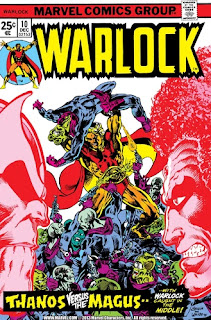 Karen: I reviewed the conclusion to this tale almost two years ago, but Thanos is too good a villain not to bring back for this special hero/villain team-up post!
Karen: The situation: Warlock is determined to destroy the Magus, a religious tyrant who it turns out is a possible future version of Warlock! He has teamed up with the mysterious Gamora (deadliest woman in the whole galaxy), to achieve his goal. But they've proved no match for the Magus, who plans to put Warlock on the path that will lead to his transformation into his future self. Therefore, Gamora's master, Thanos, shows up to get directly involved! He says he knows how to defeat Warlock's foe. And that's where issue #10 starts.  Before the Magus can call a mysterious being named the In-Betweener, who will start Warlock's change, he orders 25,000 Black Knights, his holy warriors, to attack Warlock and his comrades. Thanos quickly takes charge of the situation, as Warlock has essentially curled up into a fetal position. He shakes Warlock out of his paralysis and gets the group fighting.Despite their raw power, the sheer number of knights drives them back. Thanos holds the line as Warlock blasts an escape route for them through the floor into the holy palace's sub-basement. All escape except for Thanos, who gets trapped up above.
Karen: Despite Gamora's pleas, Warlock insists they must move on. They reach caverns under the palace and find the Matriarch, former aid to the Magus, who has been left for dead here after betraying her former leader. Warlock speaks with her briefly and she dies, and it leaves him feeling confused. Frustrated, he cries out, why must life be so cruel? A voice responds, "Because that is the way of life." It is Thanos. He says that because Warlock has chosen the path of the living, he has to pay its price, which is pain.

Karen: Next up, Starlin provides the reader with a two-page interlude, an introduction to Thanos presented by the Kree Captain Marvel. Returning to our tale, Thanos teleports the group back to his space ark. Warlock may be confused, but he's smart enough to ask why Thanos is helping him. Complicated as always, Thanos explains that he has certain plans, and some of them involve Warlock's soul gem. He has also seen that the Magus may oppose him, and has taken measures to stop him. One of these was creating Gamora, who was temporally-hidden from the Magus initially, because she was actually pulled from the Magus' future! But the Magus' god-like awareness was able to overcome her camouflage. Now they must pursue a different plan -Warlock's suicide!

Karen: While this is going on, the Magus is informed that Thanos is now with Warlock. He realizes that as a worshipper of death, Thanos would naturally oppose him. He locates Thanos' ship, and is at first unconcerned -until he realizes the mad titan has a time machine (a 'time probe')! After seeing this, he calls all his forces and they prepare to invade. Back on the space ark, Warlock concedes that Thanos is right -the only way to truly stop the Magus is to prevent him from ever coming to be -he must destroy his own soul!
Karen: This was cosmic comics as done by the master, Jim Starlin!Thanos and Warlock have been allies, enemies, and everything in between over the decades. But in this first encounter, Thanos decidedly holds the upper hand over a mentally and morally exhausted Adam Warlock.
<<<<<<<<<<<<>>>>>>>>>>>>
Doug: It would seem silly on our parts to send you packing without putting a bow on this SBTU package, ya think? In the comments section we'd of course like to hear your thoughts on the issues we've covered today, but also some suggestions of other hero/villain team-ups you've loved in the past. And generally speaking, do you think such storylines work, or are they merely novelties?
Karen: It seems like it breaks down to the hero either choosing to team up out
of necessity, or the hero being duped in some sense. But the villain
always seems firmly in the driver's seat -even in the FF one, Doom could
have said no. So regardless of the situation, are the heroes always
more reactive and the villains always more proactive?
Doug: The Cap story seems to stand apart from the other three in that Cap was certainly an unwilling participant. In the FF and Batman stories, the heroes were desperate so yes -- the baddies definitely had all the cards. In the Warlock tale Thanos actually involved himself. You know, in all four stories it ends up that the villains are playing the heroes!
Karen: Well, I've heard it said that a really 'good' villain actually considers himself to be the hero of the story -that from his perspective, everything he does is right and correct. Certainly, Doom feels that way. The Skull likely does too, considering himself above mere morality. Thanos probably doesn't care about anything other than achieving his goals. And the Joker? Who can say?
<<<<<<<<<<<<>>>>>>>>>>>>
Please patronize our partners in this great day of comics blogging! You can jump to any of their great sites by clicking the links below:
Longbox Graveyard: Thing vs. Thing
Superior Spider-talk: Spider-Man and the Coming of Razorback!?
The Daily Rios: New Teen Titans/DNAgents
The Middle Spaces: Super Hegemonic Team-up! Spider-Man, Daredevil & 'The Death of Jean DeWolfe
Chasing Amazing: Spider-Man/Spider-Man 2099 Across the Spider-Verse: A Once in a Timeline Team-Up
Retroist: Doctor Doom/Doctor Strange
Fantastiverse: Superman/Spider-Man
Mystery V-Log: The Avengers #1
In My Not So Humble Opinion: Conan/Solomon Kane
The Unspoken Decade: Two Wrongs Make a Right -- the Punisher Meets Archie!
Flodo's Page: Green Lantern and the Little Green Man
Between The Pages: World's Finest Couple: Lois Lane and Bruce Wayne
You can also get to another site with all of these links by clicking here.