Showing posts with label Secret Society of Super-Villains. Show all posts

Monday, July 11, 2016

Laughing His Way Into Cancellation - The Joker 9


The Joker #9 (September/October 1976)
"The Cat and the Clown"
Elliot S! Maggin-Irv Novick/Tex Blaisdell

Doug: There might be a reason this was the last issue of The Joker. Or, maybe the story was written as is because the creators already knew. So who killed what is perhaps moot -- this still isn't what you'd call a Bronze Age gem. And it should be -- the cover is great, and darned if Mike W. Barr, Alan Davis, and Paul Neary didn't have some fun with this same concept. Not so much here.

Maybe we've had this discussion before -- over seven years, I'm guessing that we have -- but let's start with it here. It is very difficult to publish an ongoing series where the protagonist is a mass murderer or some other evil-doer preoccupied with world conquest. In my mind, the only way to make it work is to feature a hero as foil to the bad guys. Had the DC Implosion not occurred, Secret Society of Super-Villains might have succeeded. It was genius to take a character largely unknown to then-current readers (Captain Comet) and make him the steady hero throughout most of the series. It also seemed a nice decision to include various heroes as team-ups, including Kid Flash and Hawkgirl. But this Joker-headlined comic seemed a tougher sell. The bad guys who populated SSoSV were more bent on outwitting their primary nemesis (in most cases, the Flash) and less on widespread property destruction or loss of life. One cannot say that about the Joker. In this issue, the last in the series and pretty goofy all the way around, at least three deaths are featured and the last of them is of a quite malicious nature. Even Catwoman's appearance, and she's much more sympathetic, does not soften what's gone on once you sit back and think about it. And obviously this title could not have featured any of the Bats in that foil role, as that would have made it just another Bat-book.

100-Word Review:Benny Springer is a Hollywood legend for playing Buster Keaton-type comedy roles. Just as popular as Springer, however, is his cat Hiawatha. The two are to star in a new motion picture, “The Clown and the Cat”, but Springer is knocked unconscious by a disguised Selina Kyle. Little did she know, though, that she’d captured the Joker masquerading as Springer. Already confused? The Joker leaves a trail of bodies on his way to Catwoman’s lair, where he ends up fighting… himself? Springer becomes the Clown Prince’s doppelganger and the two clowns fight nearly to the death. Of course the bad guys lose.


The Good: I've always felt that Irv Novick was an able penciler of all things Batman. I liken him to Aparo and Adams, but a few steps below. Perhaps a more apt comparison would be to Dick Giordano. We primarily think of Giordano as an inker, but when you've seen his pencils of Batman... similar to Novick's in my mind's eye. I cannot speak much to the inks of Tex Blaisdell. We've encountered his work before over Dick Dillin and Bob Brown. A far cry from "lush", he's in the Vinnie Colletta camp; maybe not that feathery, though. So while I seem to be making excuses for these creators (if you like that, then you'll like this, only not as much), there was merit to the pictures. It's just that they didn't have much to go with because...

The Bad: Elliot S! Maggin's script. As I said above, it's like everyone knew (and I'm sure they did) that this book was on its way out the door. This story seems cobbled together quickly and with not much care. I've argued, maybe unfairly at times, that Silver and Bronze Age DCs were written for 10-year olds. Having been one of those myself (and this would have been on the stands right around the time I turned 10), I don't know if I'd have liked this story. First of all, it's really confusing near the front when Catwoman kidnaps Benny Spencer. At the same time, the Joker is impersonating Spencer, and we see Catwoman out of costume (assaulting Springer... er, the Joker in disguise) and in costume (kidnapping Springer and his cat from the movie studio's screening room). How did this shake out? I read it three times, for detail, and couldn't get it down. No way I'd have made sense of it as a youngster. NOTE: In fact, on the fourth read while preparing the scans, I'm not sure now if it was Selina Kyle who ambushed the Joker. But if it wasn't, then that plot point is even more vague. What's more, the intentions of both the Joker and the Catwoman are pretty lame: Catwoman kidnapped Spencer and his cat (emphasis on the cat as part of the crime) in order to hold them for ransom. The Joker wanted Spencer out of the way so that he could impersonate the actor and then star in a movie. Yeah, OK...


 Additionally, and also as I mentioned above, there's a body count in this book. Two studio guards and a captured henchman of the Catwoman's all succumb to the Joker's laughing death serum. What's more, they all die on screen. That gives me pause, as I'm back to the "written for a 10-year old" notion: Did DC's editorial staff think that was OK? It's certainly not in line with Marvel's "flat of the blade", which we've also discussed. If the deceased died with a smile, does that mean the Comics Code was bypassed? These are legitimate questions that I have.

One knock on the art is that Catwoman only once appears drop-dead (haha) gorgeous. She seems like a character who should always be drawn as beautiful. She also is written with some pretty clunky dialogue. During the "battle of the Jokers", she sits to the side and watches the skirmish play out. She thinks to herself, using words like "interesting", "most fascinating", "absolutely wild", and "far out"... those just seemed like odd choices for her.


The Ugly: Overall, this book is not very good. I really thought the cover implied a fantastic adventure inside. What I got was farcical at best. It wasn't horrible, in that I don't think I'd have requested a refund of my three dimes. But it certainly didn't advance my love of the Batman mythos. And there were just enough stupid plot points that added to my displeasure, notably during the story's climax when Springer said he gave his cat a signal to behave a certain way. You'd have to read it -- the situation was quite complex, in that the cat would have had to ignore all his instincts and behave in a counter-intuitive manner. I wasn't buying it. 

In the interest of ending on a positive note, please see my review of The Joker #4, where I go on in a sunshiney light about Elliot S! Maggin's storytelling. Which further makes this issue disappointing (oh, shoot -- I did end on a negative.).

Monday, March 21, 2016

Play That Funky Music... Secret Society of Super-Villains 8


Secret Society of Super-Villains #8 (July/August 1977)
"Let the Villain Fit the Crime"
Gerry Conway-Rich Buckler/Bob Layton

Doug: I don't know -- maybe Grodd could just drop his left arm really hard and break his own way out of Kid Flash's whirlwind trap? It has been many a moon since we looked in on DC's version of the Masters of Evil (and that might be a stretch); in fact, it was almost six full years ago that I reviewed SSoSV #7! And since that was the first issue of that mag that I owned, all this time later (and now in possession of both hardcover volumes of the collected issues) I've decided to review the next installment. Secret Society of Super-Villains would have been on my "pull list", had we known of such things in the Bronze Age. In the summer of '77 DC had the attention of 11-year old me with the Teen Titans revival, this mag, the Legion of Super-Heroes, the Batman mags (including Batman Family), Green Lantern/Green Arrow, and the All-Star Comics revival. It was a great time to have a foot in the universes of the Big Two! And today's fare is a fun little romp that probably leaves me feeling like I've had a snack as opposed to a full meal. As I did with my review of Silver Surfer: Judgment Day two weeks ago, I'll lead with a 100-word review of the plot and then go right into my now-typical format of The Good, The Bad, and The Ugly. Onward, then...

Captain Comet, thinking he’s found the Secret Society’s HQ, attacks. Apparently Luthor had lied about the location, and the Society plots elsewhere. There’s a crystal meteorite of some power that they want. Funky Flashman is driving this train, to the resentment of the villains. Kid Flash gets involved when a local tough steals the prism from a museum, which in turn gets the Society involved. Captain Comet comes to the rescue, but in the fracas Star Sapphire wrests the bauble from our heroes. The good guys make another play, but in the end lose the meteorite a second time!

The Good: This was a fun comic, really holding up well over the decades. Now, you must understand that part of that stems from what it is -- it's designed to be a romp. C-list bad guys and second-rate heroes? You really weren't expecting the Galactus trilogy, were you? Well neither was I and that's why I had a great time re-reading this after all these years. Gerry Conway's script wasn't overly complex, but I want to stop short of saying it was "written for a 10-year old" as we often have said about DC Comics through the years. I'll stop short, because after all I was 11 when this saw the light of the spinner racks! It's just a neat little chase story, with the bad guys -- dubious collection of fiends that they are (the Wizard, Copperhead, Gorilla Grodd, the Trickster, Star Sapphire, and Funky Flashman) -- a step ahead of our heroes, Captain Comet and Kid Flash. Longtime readers know I'm in the Kid Flash fan club -- in fact, I'm on record as stating that this character design is among the best of the Silver Age, and certainly up there with the best costumes of any derivative hero/heroine. So when I saw "my guy" on the cover of this mag, well.. "this cover made me buy this comic book", so to speak. In the end I got what I expected -- no more, no less -- and I think that's why it was a somewhat satisfying read.

The art team of Rich Buckler and Bob Layton also turns in some solid work. The book is well-paced, and the fight choreography is action-packed. The guys do a nice job of changing the camera angle often, and the facial expressions throughout the book are noticeable -- two of my favorites in the book appear in the scans toward the bottom of this post. The story is laid out in a variety of panel grids in between pages with angular panels. There are no splash pages other than the first, and there is only one extra-large panel, provided for effect at the climax of the story (see bottom of post). The artists also provide some nice panels of Kid Flash using various aspects of his super speed -- in the sample attached to this text you'll see Layton emulate Vinnie Colletta as Kid Flash vibrates through a wall. I especially liked the way Grodd is drawn -- although a "gorilla", he looks more like what Joe Kubert drew as an "ape" in his Tarzan strip. I think this comes through in the panels I provided at the top of the post. Works for me.

The Bad: I got nuthin'. There really isn't anything for me to say in this category. However...


The Ugly: Funky Flashman. I wrote this on February 14 (no, I was not slighting my bride to spend time with you folks -- she was out of town most of the day!), and shortly after reading the story I tweeted at Gerry Conway and asked him about the general reception of Funky Flashman. I remarked that it seemed mean, and particularly when viewed through the lens of all these decades of Stan Lee vs. Jack Kirby. Conway stated,


Yet Conway wrote Flashman as Kirby intended the character to be "heard". I didn't press the issue in that regard -- I wouldn't denigrate Gerry Conway for staying faithful to a Jack Kirby creation, regardless of axes ground elsewhere. In some way had he changed Flashman's "voice" that might have been worse. What I'd encourage you to do, though, is to go sift through Conway's Twitter feed (@gerryconway) from Sunday, 2/14/16, as a lengthy conversation blew up that came to involve several fans as well as pros Kurt Busiek and Scott Edelman. It was fascinating to sit and watch as my original query took on a life of its own, with Martin Goodman, the Marvel Method, and office and corporate politics all coming under scrutiny. And I should remark that there wasn't any overt Stan-bashing in this particular story; I raised the issue with Conway simply because of the very existence of the character.

How'd you like to be cruising down the highway and look over and see that van??

Doug: Hey, if you're a SSoSV fan, I'd really encourage you to get yer mitts on the trades or hardcovers (two volumes) that collect the entire series and periphery titles. You can usually snag them on the cheap, and as I've said, these stories are fun little diversions. I liked this then, and I've found that I can like them now -- we cannot always say that about our Bronze Age memories!


Thursday, November 12, 2015

Suggestion Unboxed - Appreciating the Underappreciated


Doug: You may recall that back on October 9, in the midst of a fit of non-creativity, we solicited readers' thoughts on post ideas. What we got was amazing, and we've already mined that one-day flurry of brainpower for several good days' conversations. Today I'm pulling two thoughts from the same comment. Both were in a cornucopia (seasonal reference there) of offerings from Martinex1, and since they are related I am putting them together in the same post. I'll take the liberty of leading off with some thoughts of my own. Many thanks again to all -- and this isn't the last time we'll be doing this, so if you took a penny for your thoughts, you'll yet be further rewarded.

Mike S. (Martinex1): Under appreciated comic book artists and writers (no Kirby, Byrne, Lee, Claremont here...).

Mike S.: Under appreciated heroes and villains. If you were in charge who would you give a title to?

Doug: In answer to the first question, I've always enjoyed the inks of John Severin and Sam Grainger. Certainly Severin was a star in his own right in the 1950s, but most Bronze Age fans will remember him best as the inker over Herb Trimpe on early issues of the Incredible Hulk. Severin brought a polish to Trimpe's pencils that really did give it that throwback look to the period right before the Marvel Age dawned. Great pairing. Grainger worked into the 1970s and shows up all over the Marvel Universe. I most fondly recall his inks over a young Sal Buscema in those turn-of-the-Age Avengers tales. Again, Grainger really polished Sal's work and gave it a rich texture. Grainger also inked Dave Cockrum in the first issues of the All-New, All-Different X-Men.

Doug: As to underappreciated characters, count me among anyone who digs Kid Flash. While I don't know if Wally West could have carried his own series, he was always a favorite of mine in the Secret Society of Super-Villains and the Teen Titans revival.  Oh, and you want an underappreciated villain? I always thought the Gladiator had a great look. The whirling blades on his wrist seemed dangerous enough, but especially to him! I enjoyed his appearances in Daredevil and wished he'd crossed over into the Peter Parker or Nova books (for examples).


Monday, March 2, 2015

Guest Review - Justice League of America 195-197


Doug: Today the Bronze Age Babies are most pleased to bring our readers an Arc of Triumph...? guest review, featuring the events of Justice League of America #s 195-197, by M.S. Wilson.

M.S. Wilson: Welcome to my review of Justice League of America #195-197, which features a new version of the Secret Society of Super-Villains. This is one of the annual JLA/JSA team-ups that ran in Justice League in the Silver and Bronze ages, and it’s one of my favorites. I read this when I was nine and I loved how the bad guys seemed to be winning through the first two issues, but the heroes turned things around (with a little help) in the third. These comics were also my first introduction to some of the Earth-2 villains; I was familiar with the JSA members from previous team-ups and the All-Star Comics revival, but some of these villains (Monocle, Mist, Rag Doll) were new to me.


Justice League of America #195 (October 1981)
"Targets on Two Worlds!"
Gerry Conway-George Perez/John Beatty (cover by Perez

M.S. Wilson: The story begins in JLA #195, with over half of this issue dealing with the “recruitment” process, showing the gathering of two sets of villains, one on each Earth. We start on Earth-2 with the Monocle, now retired from villainy. This scene actually addresses the old question about why super-villains don’t turn their talents toward legitimate ends instead of crime; apparently the Monocle has used his knowledge of laser optics to build a successful company and make a lot of money. But I guess being rich isn’t all it’s cracked up to be, as we see him complaining (aloud, even though he’s alone) that he’s bored and feeling nostalgic for his life of crime. Conveniently, a mysterious figure has a great way to relieve his boredom ... get back into crime!

The recruitment drive continues on Earth-1, with Signalman escaping from a hospital. The coincidences really pile up here, as Signalman escapes by climbing down the big neon sign outside, shorting out letters as he goes; luckily for him, the name of the hospital is St. Ignatius Loyola, so he’s able to spell SIGNAL. Anyway, he’s picked up by Killer Frost, who seems to be in charge of recruiting on Earth-1, and invited to join the Secret Society. The scene shifts back and forth between the two Earths as we see more bad guys join the team. On Earth-2, Psycho Pirate breaks out of jail (why is he kept in a regular cell, where anyone can see him? Shouldn’t he be kept behind some kind of opaque barrier?). On Earth-1, Cheetah almost gets assaulted by three guys (they said they only wanted a kiss, but the art makes their intentions pretty clear), but she slices them up before joining Killer Frost. Back on Earth-2, Rag Doll robs a bank (after mailing himself to the manager in a box!), and gets help with his escape from Psycho Pirate and Monocle, as well as the mysterious figure who’s been assembling the Earth-2 villains. He’s shown to have a hairy paw... now who could that be?

On Earth-1, Killer Frost and friends talk Floronic Man into joining them (and he gets an angst-ridden speech about how he’s no longer human but not fully vegetable-matter either, so he feels like a freak). On Earth-2, the Mist kills a couple of his old gang members in revenge for letting him go to jail alone. He is asked to join the Secret Society immediately afterward, by a large, furry, apelike... actually, I’m not sure why they’re drawing out the mystery of the new Society’s leader; it’s revealed in this same issue. I guess Gerry just wanted it to seem more dramatic. Anyway, back on Earth-1, the four villains go to a secret base and meet Brainwave, who’s using his illusion powers to look young and buff instead of his usual short, bald, wrinkly self. They travel through a dimensional transporter to Earth-2 (remember when it used to be difficult to transport between the Earths?) and meet the leader of this little conspiracy, who turns out to be ... the Ultra-Humanite! Since Signalman doesn’t know who that is, Mist helpfully recounts to him (and us) Ultra’s history: his longstanding enmity with the Earth-2 Superman, his ability to switch his consciousness into other bodies, and the fact that his latest mind-switch was into the body of a gigantic albino ape; Irwin Donenfeld would be proud! The newly furry Ultra-Humanite explains that each of the super-villains he’s chosen has a counterpart, a favorite enemy, and if these ten particular superheroes are sent to Limbo, it’ll cause a cosmic imbalance, eliminating ALL superheroes from either Earth-1 or Earth-2. The villains, figuring they have a 50/50 chance of ridding their world of all its superheroes, agree to Ultra’s plan.

Finally, we see the stars of the book, the JLA and JSA, at one of their annual reunions. There are a few character bits, and some of the heroes express surprise that nothing has happened to disrupt this year’s meeting. After everyone has left (I find it fascinating that the JLA Satellite exists only on Earth-1, but can beam the JSA back to Earth-2; was this ever explained? Maybe Dr. Fate had something to do with it), Black Canary is left alone on monitor duty. The Mist exploits a security bug in the transporter and sneaks aboard the Satellite to attack BC. He beats her by turning himself intangible, which is a new power for him (he could previously turn transparent, but was still solid.) On Earth-2, Monocle takes out Hawkman with a remote-controlled monocle. And back on Earth-1, Cheetah attacks Wonder Woman near the Washington Monument and really pounds her. Apparently Cheetah blames Wonder Woman for (supposedly) leaving her to drown in WW #275, and she’s a little miffed about it... or maybe a little psychotic. So the bad guys have successfully taken down three of the ten superheroes that they’re gunning for. At the end of this issue we see Ultra-Humanite gloating to himself, and we find out that it isn’t a toss up as to which Earth will lose it’s superheroes ... it’s definitely Earth-2, and Ulty knew that all along. The leader of a group of super-criminals has his own agenda? I’m shocked!


Justice League of America #196 (November 1981)
"Countdown to Crisis!"
Gerry Conway-George Perez/Romeo Tanghal (cover by Perez and Dick Giordano)

In JLA #196, the villains continue taking down the superheroes of two Earths one by one. Psycho Pirate beats Hourman; of course, Hourman is smart enough not to look directly at Psycho Pirate, so PP needs a little help from one of Ultra-Humanite’s devices, a psycho prism. It reflects PP’s sleepy-face all over the room, so Hourman can’t avoid seeing it, and promptly goes night-night. Signalman uses flashing lights to turn a crowd against Batman (although the post-Crisis Batman might have just pounded them all into submission.) Rag Doll gets Flash (Jay Garrick) with an explosive, while Floronic Man takes out Atom (Ray Palmer) with some soporific pollen. Brainwave takes down Johnny Thunder (and his T-Bolt) by luring him to a clothing store (where Johnny almost updates his look!) Firestorm is beaten by his own overconfidence when Killer Frost brings the ceiling down on his head. Finally, Ultra-Humanite lures Superman (of Earth-2) to a zoo, where he surprises Supes by shooting Green Kryptonite spray from a device on his chest. At the end of this issue, the beaten heroes are put in a centrifuge and sent to Limbo. The first time I read this, I was surprised that the villains’ plan actually worked; I couldn’t wait to see how the heroes got out of this mess. 


Justice League of America #197 (December 1981)
"Crisis in Limbo"
Gerry Conway-George Perez/Keith Pollard/Romeo Tanghal (cover by Perez and Mike DeCarlo)

And get out of that mess they did, of course, in JLA #197. As this issue begins, the superheroes are sent to Limbo and the plan actually works; Earth-2 starts to twist and deform around them before “snapping back” to normal. The Earth-1 villains realize immediately that Ultra-Humanite knew banishing the heroes would eliminate all the remaining superheroes from Earth-2 only; he’d let them think there was an equal chance to affect Earth-1 because he’d needed their cooperation. But before they can do anything, they’re transported back to Earth-1, and when they try to return, the transporter device blows up. Killer Frost shows some leadership by slapping down Signalman and Floronic Man, and coming up with a plan to get back to Earth-2 to get revenge against Ultra-Humanite for using them (her strength here is undercut somewhat when she reveals her main motive for villainy is “I want power! Power to punish men for spurning me!” Yes, she’s a super-villain because she can’t get a boyfriend. One step forward, two steps back.). Anyway, they go to Coast City and capture Green Lantern (Hal Jordan)... rather easily, I have to say. They also seem to know a lot about the Satellite transporters, including their locations in various cities. You’d think the JLA might change the locations regularly to avoid something like that. Anyway, they use the unconscious Green Lantern to beam to the Satellite, where they take down Elongated Man (also rather easily, it must be said.)

Back on Earth-2, the villains are enjoying a world with no superheroes (I’m wondering if eliminating the superheroes from Earth-2 also got rid of other super-villains? We don’t see any others here... and what about non-powered heroes like Robin or Huntress? Apparently they were eliminated too? I guess it doesn’t pay to examine these things too closely.). Monocle and Rag Doll are having fun messing with the cops, Psycho Pirate and Mist rob a “collector’s convention”. There’s no mention of comics, but there is a shout-out to Star Trek fanzines; the villains steal jewels, which apparently are exhibited at conventions on Earth-2. Brainwave uses his powers to... basically rape an actress? That’s the implication, anyway. And Ultra-Humanite decides to take over the United Nations... no thinking small for him!

Meanwhile, the Earth-1 baddies have used the JLA transporter to go to Limbo (which it can do, apparently) and rescue the heroes. That’s right, the heroes only survive this because they’re rescued by the bad guys; let that sink in for a minute... the only reason these heroes win is because of the villains’ sour grapes. Killer Frost even says: “If we can’t have a world without heroes, neither can anyone else!” Who’d have thought pettiness could come in handy? Of course, the heroes immediately pound their rescuers (there’s gratitude for ya!) and head for Earth-2 to set things right. They somehow take the whirling centrifuge with them (or maybe it stays in Limbo and just creates a vortex, I’m not sure) and toss all the bad guys into the dimensional vortex, banishing them to Limbo. Earth-2 reality goes back to normal (without all the weird visual effects, which Superman mentions in passing) and the villains are all banished to Limbo, where they have a few things to discuss with Ultra-Humanite. Apparently banishing these ten villains has no effect on the cosmos, nor do the superheroes seem to care overly much.

I liked this arc when I was a kid and still do, although some of the plot holes are more obvious to me now. The villains seem much more competent here than in the usual comics story; in fact, they technically win here. If not for the Earth-1 villains rescuing the heroes from Limbo, Earth-2 would’ve been hero-less and taken over by bad guys. That sort of role-reversal blew me away as a kid. One thing that always bothered me was how the villains defeated the heroes so handily in the first two issues, but were soundly trounced in only a few pages at the conclusion. The way the villains paired off against their “usual” foes was a little strange too (although in Limbo they mixed things up a bit more.) In hindsight, this arc would’ve been perfect for an “Acts of Vengeance” type story, with the villains taking on heroes they weren’t normally used to fighting. But overall, I love this story; it introduced me to some new villains, the story is different from the usual fare, and the art is great. There’s even a cool centerfold in #195 featuring the JLA on one side and the JSA on the other ... what’s not to love?


Tuesday, January 27, 2015

Readers Reflect: the Open Forum - Team Books and Arch-Villains!


Karen: If you missed your chance with our previous readers' Open Forum, here is your second chance. Remember, the Open Forum is a place for more involved, broader discussions. For example, we've covered things like the transitions from the Silver Age to the Bronze age (and recently the Bronze to the modern age),  comic book collecting and selling, the nature of comic book creator legends, and so on. So grab your bubble pipe and strike a pose, and give us some meaty topic(s)!


Thursday, September 4, 2014

Please Allow Me to Introduce Myself...

Doug: Anyone up for more comic book covers? As we did last time, we're going to present several covers in a genre, and then you nominate others -- next week we'll do it again and show off our readers' suggestions! So today -- face-off covers!

NOTE: This post was updated on May 5 2020. When I came to it, I'd had 15 covers as samples; I regret to inform that there was no way I could recall which covers I'd shown. However, I can be reasonably sure that these six would have been among them. I apologize for any inconvenience. -Doug


Friday, January 17, 2014

BAB Classic: Nothing Ends a Relationship Like Cancellation!


NOTE:  This post was originally published on 2 November 2009

Doug: Today we'd like to take a look at some of the titles and characters we enjoyed as kids, but for one reason or another (generally the lack of the almighty dollar flowing into Marvel's or DC's coffers) they didn't last more than 2-3 years. And even within that timeframe, bi-monthly publishing, the dreaded deadline doom, rotating artists, etc. often made following these lovable titles difficult. Yes, we're talking about short-lived series, and why we liked them!

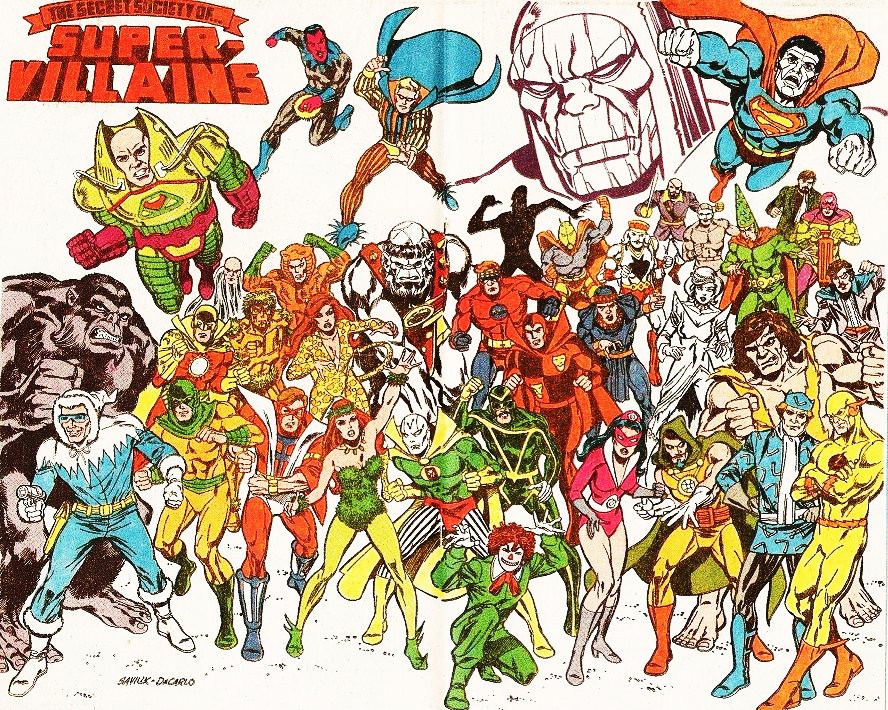
Doug: Three titles that I was somewhat fond of but that ended before I was done with them were Super-Villain Team-Up (17 issues -- I only recall that there were 15; I've only recently discovered the last two books, and here's why: #15 was published in November '78, but #16 didn't see the stands until May of 1979 and #17 was well after that, in June, 1980), The Champions (again, 17 issues, but more if read in continuity when Avengers #163 and an Iron Man Annual, plus Peter Parker #16-17 are factored in -- see the Champions Classic tpb's for the full bibliography), and DC's The Secret Society of Super-Villains (15 issues, but again more, if some Super-Team Family, et al. quarterlies are included).

Doug: I enjoyed SVTU because of the dynamic of Doom and Namor. Namor was such a confusing character to me as a youngster. Coming to the Marvel Universe largely after Tales To Astonish and Namor's solo book had passed on, my exposure to the character was in the FF story running through FF #'s 147-149. I was just always a little confused about whether Namor was a hero or a bad boy. I liked the introduction of the Shroud in SVTU, and felt there were possibilities for further exploration of him. Right when the title began to wane (and apparently was deep-sixed) was when I thought it was reaching it's potential -- Namor was gone and Doom was "teaming-up" with Magneto, and then the Red Skull. It had become a true team-up book. And then it ended. The two additional stories later (#'s 16-17) teamed the Skull with the Hate Monger.

Karen: Like you, I really enjoyed SVTU and had no idea issues 16 and 17 existed! Once they got away from the Doom-Namor relationship, I wasn't quite as interested. But it was a great book when it started, and very typical of the almost 'experimental' types of product Marvel was willing to put out in the 70s. I liked Steve Englehart's work on the title, and also wish that the Shroud had gone on to better things. He was a lot of fun - an amalgamation of the Shadow, Batman, and who knows what else!


Doug: The Champions was offbeat, but a nice smorgasbord of Avengers, X-Men, and the Ghost Rider (way before he was so over-exposed! -- back then he was just creepy). The art, while handled by George Tuska, Don Heck, and later a young John Byrne was usually good enough (best under Byrne's run, although I did sometimes enjoy Tuska's distinctive style) and the stories were fresh due to the orientation to the West Coast as opposed to NYC. The villains were fun -- some a little campy. The opening arc, with the Greek gods was good, and the introduction of Rampage and Swarm plus the stories with the Crimson Dynamo, Titanium Man, and the Griffen were good. I enjoyed the issues with Black Goliath and the Stilt-Man and the last story with the Sentinels evoked excitement due to the strong classic X-Men tie-in. Overall, and I said this above, the title could have gone on longer with some deeper characterization exploration and perhaps a tweaking of the line-up here or there.

Karen: I was always a sucker for team books, and Champions was no exception. Although I didn't think there was any real chemistry here, I did enjoy the later issues with John Byrne's art, and I thought they had potential.

Doug: As a kid I always identified with kid heroes and as a fan of the original Teen Titans series (when it picked back up after having been on hiatus for a few years -- this would be around issues #'s 47-53) I was excited to see Kid Flash starring in The Secret Society of Super-Villains. Captain Comet, while largely unknown to me, seemed pretty cool, and the inclusion of the Flash's Rogues Gallery (and other baddies, like Star Sapphire) made for a fun book month-to-month. The art was always steady (again, by Rich Buckler at times) month to month, if I recall. It's, again, one of those books that just seemed to stop showing up on the newsstand. And at the time this then-12 year-old couldn't help but wonder "why?".

Karen: How about Warlock?? That was one of my favorites! I still pull out my ragged copy of Marvel Two in One Annual #2 every so often to read that fantastic coda to the whole Warlock/Thanos saga. Truth be told, I sort of wish they had left those two characters there. I never felt anything that came after really measured up to that story. I recently picked up the Marvel Masterworks edition that has Marvel Premiere 1 and 2, Warlock 1-8, and Incredible Hulk 176-178. There's a very nice intro by Roy Thomas where he basically says the plan was always to write the character as "Jesus as a superhero". I was lucky enough to exchange some email with Mr. Thomas and get some more info about how Warlock was 'born'. Thomas planned to have the character around for about three years, then he would die, but be reborn. To be honest, I still can't believe none of the higher ups at Marvel didn't balk at the series, particularly the Hulk issues where we see the Last Supper and crucifixion! I guess things were different back then!

Karen: If nothing else, Warlock is a character that seems to be constantly transforming into a different character (via his cocoon). I've also found it bizarre, the leap from that Christ-Warlock to anti-church Warlock. But then again, he was facing a version of himself (Magus) that was so corrupt and evil, Warlock would rather die than become that! After his experiences with the Church, Magus, and Thanos, is it any surprise he went from idealist to pessimist?

Karen: Roy Thomas admits he was heavily influenced by Jesus Christ Superstar, at least the soundtrack. If I remember correctly, the musical Godspell was also out around that time. In fact, the early 70s were the era of the Jesus Freaks, and 'born-again' entered the language.The Hulk stories are really a trip; Hulk becomes an unwitting Judas, and goes bananas during the Last Supper of Warlock and his disciples. This brings the Man-Beast's (aka Satan's) soldiers, and they capture Warlock. He is crucified, while shouting, "High Evolutionary! Why have you abandoned me?" ! Hulk takes off with Warlock's body, which is back in his cocoon. Of course, three days later, he bursts free and sets things to right. then he takes off for space....where Jim Starlin found him.


Doug: Were Pip and Gamora part of this tale? As a kid I always knew of Warlock, had some Avengers and the aforementioned Marvel Two-In-One Annual with him guest-starring, but don't know much about him even today outside of the excellent article you wrote for Back Issue #34...

Karen: Pip and Gamora came about when Starlin started his series. Honestly, the only pre-Starlin Warlock books I could recommend would be Marvel Premiere 1 and 2, which are fairly interesting, what with introducing Counter Earth, and having some nice Gil Kane art; also the Hulk issues are just fun for the sheer audacity of doing the whole Christ story in comics form. Warlock 1-8 are OK but not really that interesting. The first couple of issues have Gil Kane art and are at least nice to look at. But the religious connections are heavy-handed and, at least today, seem pretty ridiculous. But if you are looking for a comic that really feels like a 70s product, it's this book. The youth movement, anti-government sentiment, groovy styles - it's all here.

Doug: Did you ever read The Man Called Nova? I got in on the first issue, and if memory serves at one time had the complete 25-issue run. It started out very well, with solid art by the brothers Buscema, but really tailed away for me when the pencilling went over to Carmine Infantino. While his Silver Age DC stuff is amazing, by the mid- to late-70's his skills had really declined. I also enjoyed the conclusion of the Nova story that ran in the pages of the Fantastic Four -- especially the battle between the Sphinx and Galactus! Don't mess with the Big G, baby!

Karen: Of course I read Nova! I actually started with issue 2 - I had to convince my mom to take me to a "head shop" to get it! I would agree with your estimation - good at the beginning but it dramatically tapered off in quality. I've never been an Infantino fan so I felt his pencils hurt the book. But I enjoyed Marv Wolfman's attempt to sort of re-create the early days of Spider-Man (teenage hero with problems) in a new book, in a new decade.
Doug: So, lots of angst among we young comics buyers of yesteryear. How about you, Faithful One? What were the series that ended before you were done loving on them?

Related Posts with Thumbnails