Showing posts with label Joe Kubert. Show all posts

Saturday, August 13, 2016

"In the Conversation for Greatest of All Time"

Doug: I have an anecdote I've been wanting to share for the better part of a month, and various real-life tasks and events (well, and writing comic book reviews) have conspired to keep me from bringing this to you. It's Friday evening as I write this, and I will alternate my attention between this post and the Olympics coverage.

Back in mid-July, as I've done for the past six summers, I helped with the facilitation of two national teacher conferences at the United States Holocaust Memorial Museum. During one of the sessions at the English/language arts conference, teachers from around North America were discussing whether or not they'd use Art Spiegelman's Maus with middle school/junior high-aged students. Several voiced concern that the material was a bit too mature for that audience. One of the young teachers in the room raised her hand and remarked that her husband was an artist, and his grandfather had written a graphic novel that fit the bill. I was in the back of the room observing the session, but you know my ears perked up -- face it, it's not just anyone who can say their grandfather wrote a graphic novel. She went on to say that the graphic novel that she has successfully taught from was called Yossel. The author? Joe Kubert. I about fell off my chair.

When the session ended I approached the young teacher who'd offered the suggestion to her fellows. I just wanted to express to her, and to her husband, how much joy their grandfather had given me, really since the time I was six or seven years old. She was very grateful, and said that she had never actually met Kubert but had heard so many things about him. She added that her father-in-law, Joe's son-in-law, would be at the conference on the next day and would I like to meet him. I agreed, and later was able to express many of my same sentiments. It was a wonderful conversation, and everything I'd ever heard about Joe Kubert as a human being was confirmed by his son-in-law.

Yesterday marked four years since Joe Kubert's passing (it is the same date, in some crazy comic cosmic twist of fate that Mark Gruenwald and Mike Wieringo passed as well). One of the things I wanted to say to Joe Kubert's family was that Joe was a treasure; the man is in the conversation of the greatest artists of all time in the comics industry. They appreciated that so much.

http://comicsalliance.com/joe-kubert-rip-passes-away-hawkman-sgt-rock-legendary-artist-age-85/
When I returned home from Washington, DC, and I've mentioned this, the Jack Kirby's Thor Artist Edition was waiting for me. On the first day I was able to look through the book with some degree of detail, I was also telling my wife the Kubert story. But when I got to the last pages of the Kirby book I had to add on. Near the end of the last text piece in the book was the date Jack Kirby died: February 6, 1994. I shrugged, and said aloud that I remember exactly where I was when I heard that he'd died. There aren't many figures in comics history who would merit mention on a national radio newscast, but Kirby did. I was about to get out of the car with our oldest son, then 2 1/2 years old, to leave him at childcare before I headed to school. It's one of those types of dates that gets burned into the human mind. I told her that the artist of the book I had was one of the greatest creators ever.

http://www.hqfan.com.br/2015/06/top-criadores-de-quadrinhos-que-foram.html
I sat at the desktop computer in our living room some 14 years ago when I found out that John Buscema -- my all-time favorite penciler -- had died. Place, time, setting -- I'll never forget.

So that brings us to this weekend's conversation, and it's multi-faceted. First off, maybe the important question is "how does a creator make your list of all-time greats?" Is it pretty objective? For example, I don't have a tremendous amount of experience with the work of Alex Toth, but I'll accept the opinions of those who say he's in the conversation. Same with Frank Frazetta. For both men, a large chunk of their important output was before my fandom. Or, is your all-time list populated by your personal favorites?

For me, I would have to say that people like Kirby, Kubert, Toth, Jack Davis, Frazetta, John Severin, and others are pretty much pillars of the industry. But can I add Buscema, Neal Adams, Wally Wood, and even John Romita to the mix?

What about you?


Saturday, March 26, 2016

The Return of Tarzan -- Dueling Pencils


Edgar Rice Burroughs' Tarzan of the Apes #156 (February 1966)
Gaylord DuBois-Russ Manning

Tarzan #s 219, 220, 221, 222, and 223 (April, June-September 1974)
Joe Kubert

Doug: A long time ago I got the crazy idea to showcase one Conan story, "The Tower of the Elephant", but drawn by two Bronze Age masters: Barry Windsor-Smith (inked by Sal Buscema) and John Buscema (inked by Alfredo Alcala). People got a kick out it then, and lo and behold if the crazy idea didn't hit me again. Today we'll also look at the work of two masters, this time Russ Manning and Joe Kubert, both men inking their own pencils. Manning and his scribe, Gaylord DuBois, adapted the ERB tale "The Return of Tarzan" in a single issue; Joe Kubert took five issues (!) to tell his version. Today we'll check out a 100-Word Review of the basic plot, so those not in the know can consider themselves... in the know. Then we'll look at some key scenes as told by these two wonderful artists. Enjoy!

Thrown overboard from a steamer, Tarzan swam toward the African coast. As fate played out, he took shore a short distance from the cabin where he was born. Searching for arms, he encountered a Black warrior and saved the man from Numa, the lion. Welcomed to the tribe, Tarzan soon became their chieftain. Tarzan led his troops in search of a lost city – Opar! There he found danger in the form of the 50 Frightful Men and La, their high priestess. He also found gold beyond imagination, which he later plundered for his own benefit. And he won Jane’s heart…
Doug: I have to say that 100 words wasn't really enough to do the plot justice, but darned if that ellipsis didn't land after the 100th word - nailed it! Joe Kubert spent 2 1/2 issues to get to the spot where DuBois and Manning began their adaptation. Kubert gave quite a bit of backstory in regard to Tarzan's "rejection" by Jane Porter in her favor toward William Cecil Clayton, Tarzan's cousin and Lord Greystoke. Tarzan's friend, Lt. D'Arnot had gotten Tarzan a position as an international spy (just suspend your disbelief, OK?), and our hero encountered a certain Nikoklas Rokoff. Rokoff was a dangerous Russian criminal intent on all manner of do-badding. It was Rokoff and his assistant who assaulted Tarzan unawares on the ship's deck. But before that had happened, Tarzan had by chance met Hazel Strong, the best friend of Jane Porter. What a coincidence - to be sailing near the southern tip of Africa with an American woman from Baltimore who just happens to be friendly with the forbidden fruit of your dreams. Man... And then when she tells that Jane doesn't want to marry Lord Greystoke but some Tarzan fellow she'd met in the jungle... Of course, being chucked into the sea sort of put all that on the back burner.

Doug: I'm going to choose several examples of Manning and Kubert telling the same parts of this story. I think you'll see how illustrative Manning's work was, and how raw Kubert's was. Manning's work sort of feels like the Ron Ely Tarzan television show; Kubert's feels more like the Christopher Lambert film, Greystoke: The Legend of Tarzan, Lord of the Apes. I'd also say that Manning's women evoke the glamour girls of 1940's Hollywood. When necessary, I'll tell you what's going on, or where the two men parted company in just how they told this story. You can imagine that with Manning using 24 pages and Kubert exercising his prowess over 90 pages there were some differences. However, what really interested me were some details that I felt were important to the story that Kubert skipped altogether, and how each penciler put certain events in a different order. Doing this post makes me want to reread the Burroughs novel!

Scans today are coming your way from the Tarzan Comics Library, Volume One (Dark Horse Comics 1999) and Tarzan: The Joe Kubert Years, Volume Two (Dark Horse Comics, 2006).

Manning gets after it right away; it took Kubert almost three full issues to get to this scene below!

Interesting how the creators handle this scene with the lion. In the Manning issue Tarzan loses his balance and needs to be saved by the African; Kubert has the ape-man ever dominant. We can infer that Tarzan intended to kill the African for his weapons, but Kubert's jungle lord thinks to himself that he could never kill to steal -- Kubert's scene shows a more skillful and noble Tarzan.


Here, Tarzan -- apparently no environmentalist, agrees to go on an elephant hunt with his new friends. Kubert presents the scene as a rogue elephant has endangered the compound and must be dealt with.


In both stories, Tarzan learns of a lost city filled with gold. A member of the Waziri tells him the rumors, so Tarzan selects 50 strong warriors to accompany him on his search. However, stereotypical "savage" superstitions get in the way of the mission.


I'm always digging the 50 Frightful Men -- Burroughs painted such a picture in my mind that artists' renditions always fall a little short in comparison to the way I'd originally "seen" these brutes... sort of like the Seven Dwarfs as craggy cave men.


La. I think Manning got it "right" moreso than did Kubert. Of course, many artists have tried their hand at depicting the high priestess -- click here. In the scene below, Tarzan protects La from a mad suitor.


The great escape. This is another scene that Burroughs did a great job of painting for me. It's interesting that Manning has Tarzan find the gold right away; in Kubert's version Tarzan leaves to meet up with the Waziri and then comes back and discovers the gold later.


Of course, what would a Tarzan epic be if there wasn't a scene where Jane Porter fell into mortal danger? Here she is captured by the 50 Frightful Men and taken to Opar. Again, Manning and Kubert tell this scene a bit differently, and spaced differently in the order of events.


William Cecil Clayton, deceiver of many, meets his ending -- and title of Lord Greystoke:

Tarzan weds his lady. Jane nee Porter becomes Mrs. John Clayton, Lady Greystoke.


I hope you enjoyed our joint tour of these two tellings of The Return of Tarzan. I found it fascinating as I read each story how the creators chose to tell certain parts, to take artistic liberties with Burroughs' original writing, and even to reorganize major plot points. I hope you had a good time looking at the samples I've provided today.


Doug: I actually saw this on Thursday (3/24/16), but didn't want to hijack Martinex's $1 Challenge. Those of you who have found pleasure in my various reveals of the IDW Artist Editions may recall that I've pre-ordered the Jack Kirby's Thor book that is supposed to ship in May. Here's a link to a site offering glimpses of the book -- spectacular stuff! 

Wednesday, November 11, 2015

Thank You to Those Who Serve


Doug: To all who serve and have served, the Bronze Age Babies say "thanks" on this Veterans' Day (formerly Armistice Day in commemoration of the end of World War I). Joe Kubert's Sgt. Rock perhaps says it best:

https://biffbampop.files.wordpress.com/2015/01/kubert-blueribbon.jpg

Saturday, October 17, 2015

#Inktober - Joe Kubert's Jungle Lord


Doug: We're now 60% through our celebration of #Inktober. So far we've featured a couple of the masters inking themselves in John Buscema and John Romita. Today we finish that trend with a look at Joe Kubert's DC Comics revival of Tarzan of the Apes. While you won't find a lot of the pencil lines that were featured in the previous two posts, I hope you'll still appreciate the natural beauty of Kubert's work. There's a reason he's considered among the best ever.

Next weekend we'll look at some Spider-Man pages penciled by Romita, Gil Kane, and Mike Zeck, all under the influence of various inkers. After that? I got nothin'... yet.


Monday, August 10, 2015

Guest 100-Word Reviews - Four DC anniversary books, Favorites Then and Now


Doug: Edo Bosnar is a good sport, and one not to be deterred by my silly word games. Just when we all thought (did anyone still really care?) the 100-Word Review had gone to blog heaven, Edo stepped up to the plate and performed not one, but FOUR 100-Word Reviews on some books of his choice. Thanks, friend! Onward...


Edo Bosnar: For a while, in the early 1980s, DC really put out all the stops for their various anniversary issues. The last three reviewed here in particular are really nicely packaged, with engaging stories and a number of artists, and absolutely no advertisements. They really were special issues in every sense of the word. I also included a personal favorite from 1978:


Showcase #100 (May 1978) 
Writers: Paul Kupperberg and Paul Levitz
Art: Joe Staton


Think of this as a dry run for Crisis on Infinite Earths. The intention was to have every character who ever appeared in Showcase to make an appearance in this issue, if only for a single panel. They all get together to deal with a menace that is apparently ripping apart the fabric of time itself (which is why the historical, .e.g. Bat Lash or Anthro, and futuristic heroes, like Space Ranger, appear). It gets a bit silly at places, but it’s still an engaging story with a satisfying conclusion – in which two unlikely, non-powered heroines basically save the day.


Detective Comics #500 (March 1981) 
Writers: Alan Brennert, Len Wein, Mike Barr, Walter Gibson, Paul Levitz and Cary Bates
Artists: Dick Giordano, Jim Aparo, Walt Simonson, Jose Luis Garcia-Lopez, Tom Yeates, Joe Kubert Carmine Infantino and Bob Smith


While the focus is obviously on Batman in the seven stories included in this book, there’s one each featuring Elongated Man, Hawkman (who had back-up stories in Detective in the 1970s) and Slam Bradley, who debuted in Detective’s first issue and continued to appear in it until almost 1950. The latter story also has guest appearances by a number of back-up characters like Captain Compass, the unfortunately named Pow Wow Smith (yes, he’s Native American) and Christopher Chance. A special treat is a Batman prose story in the middle written by Walter Gibson, creator of pulp action hero The Shadow.


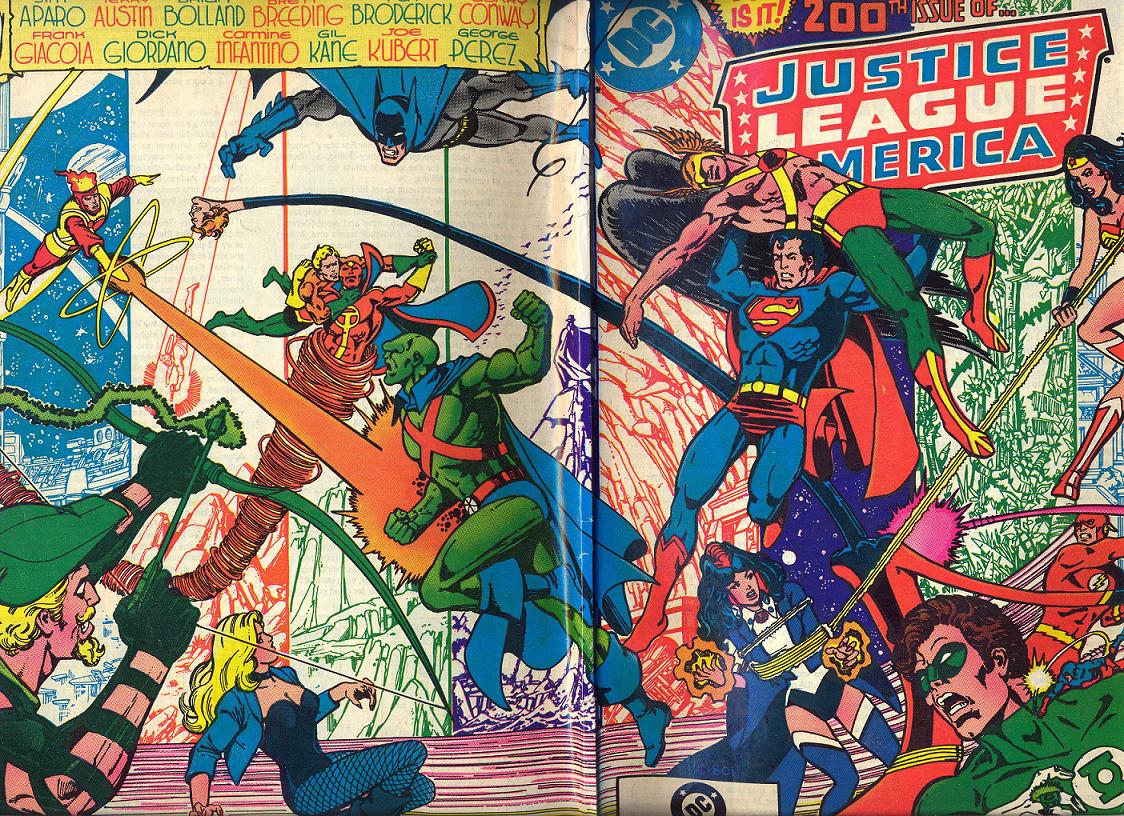
Justice League of America #200 (March 1982)
Writer: Gerry Conway
Art: George Perez, Brett Breeding, Pat Broderick, Terry Austin, Jim Aparo, Dick Giordano, Gil Kane, Carmine Infantino, Frank Giacoia, Brian Bolland, Joe Kubert


This is just so much awesome between the spectacular wraparound cover by Perez. The would-be alien conquerors from the JLA origin story are back: they take mental control of the founding members, who seek out the meteors in which the aliens originally arrived, now hidden all over the world, so they can resume their diabolical plan. The newer members go out to stop them, with each confrontation drawn by a different artist/artists. The original JLAers always manage to  prevail, but they come to their senses eventually, and ultimately the days is saved through superior teamwork between members old and new.


Superman #400 (October 1984)(cover by Howard Chaykin)
Writer: Elliot S! Maggin
Art: Joe Orlando, Al Williamson, Frank Miller, Marshall Rogers, Terry Austin, Wendy Pini, Michael Kaluta, Kelly Adler, Klaus Jansen, and Jim Steranko
Also included: An introductory text piece by Ray Bradbury, and tribute pin-ups by a number of other notable artists, including Wil Eisner, Mad Magazine’s Jack Davis, Leonard Starr (of Little Orphan Annie fame) and Moebius


Under the title “The Living Legends of Superman,” this one consists of a number of brief stories set in the future (sometimes in alternate realities) that examine what Superman has come to mean to human society. This is essentially Maggin’s love letter to his favorite character, but it never gets sappy or overly sentimental. The sections drawn by Kaluta and Pini are particularly interesting, since neither of them normally drew superhero stories. The last section, written and illustrated by Steranko, examines the progress of the illustrious Superman lineage into the far future and, well, up to the end of time.

Related Posts with Thumbnails