Showing posts with label Doug Moench. Show all posts

Thursday, October 27, 2016

It's Another Open Mic Night on the BAB


Doug: I was looking ahead in the queue and noticed nary a thing scheduled for today. Can't have that... So today why don't we have a little potpourri, a bit of a smorgasbord if you will, of conversation topics? It's Open Mic today, so whatever you've been wondering, worrying, or pontificating about, bring it before the throngs of BAB readers, won't you? I'll start --
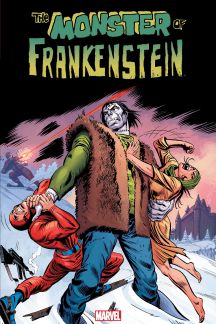
I've been back into the Monster of Frankenstein trade that reprints that character's Bronze Age appearances. I'd gotten about halfway through it last year when the Halloween season ended. It was shelved until this year and I have to say it was worth the wait. When I left off I had just gotten into the B&W reprints from Marvel's Monsters Unleashed mag. Wow. I've said it several times before and will again -- I most regret, in all the Bronze Age offerings, missing out on the Marvel magazines. The art by Val Mayerik is phenomenal. He was very Wrightson-like in his detail, and the format really suited his style. Doug Moench was the author of those tales and successfully created the mood necessary for stories of that ilk. I've just gotten back into the color section, with a reprint of Giant-Size Werewolf by Night #2. Don Perlin and Vinnie Colletta were the art team, and while it was a jarring difference from the previous several stories, it wasn't horrible. The trade concludes with a couple of Marvel Team-Ups, so that should be fun.

I recently recorded and watched Logan's Run. It had been many years since I'd seen the entire picture. I had forgotten how quaint the special effects were, and the morality lesson in the dialogue toward the end. Maybe you've forgotten all that, too. But I know, if you were a red-blooded boy when it first ran back in the mid-70s, the one thing you did not forget was Jessica-6: Jenny Agutter. It's tough to believe that it's been 40 years since Logan's Run was in the theaters. Ms. Agutter is forever frozen for us as a 30-year old "runner" (she was actually 24 in 1976). Thank you, celluloid. 

Lastly, I've been digging the Billy Joel channel that's been playing again on Sirius-XM channel 18. As you may recall, my wife and I saw Joel at Wrigley Field back in August. I'm a sucker for covers, and there are a few that play in rotation on that channel. I also enjoy the narrative portions where Joel sits at the piano and discusses his homages to certain songs from the past in his own hits. Speaking of covers, one of the albums that's been in my own personal rotation over the past few weeks is The Smithereens Covers. There are 23 cuts from a plethora of artists -- all times, all genres. It's a lot of fun. The Billy Joel channel also features a bunch of live Joel, and that has also brought me several times back to the Deluxe Edition of The Who: Who's Next. There are 29 tracks on the album, about half of which are live versions of well known Who hits. Money.

OK -- I've been varied. Your turn. What's on your mind?


Monday, October 17, 2016

Clap for the... Man-Wolf - Creatures on the Loose 30


Creatures on the Loose #30 (July 1974)
"Full Moon, Dark Fear!"
Doug Moench-George Tuska/Vince Colletta

Doug: We're about to let October sneak away without much Monster Mayhem. Pretty uncharacteristic on the BAB, huh? I'll do my part today with a review of the first solo outing of John Jameson, the Man-Wolf. You may recall that the character debuted in Amazing Spider-Man #124 (September 1973), and the story finished an issue later. He next menaced our favorite Web-Spinner in Giant-Size Super-Heroes #1 (June 1974), and then won this ongoing series the very next month. Again, it's strange to see a so-called "super villain" as a headliner, but with all of Marvel's other monster-type mags at the time, this seemed fitting. Fitting, particularly if Spider-Man might cameo for marketing purposes. He did, of course, but the series was more notable for the George Perez art that came our way after a few issues of George Tuska.

Short plot summary, you said? Sure! Here -- have a 100-Word Review:

Our tale opens with a raging Man-Wolf crashing through an upper floor window. Immediately we flash back to a time when John Jameson and his father, Daily Bugle publisher J. Jonah Jameson discussed John’s situation concerning the moonstone that had become grafted to his neck. We’re told that John becomes a werewolf when the moon is full, and sure enough… Back in the present, the NYPD hires former CIA agent Simon Stroud to solve the “werewolf problem”. With clues garnered by the police, Stroud confronts JJJ, and begins to track the younger Jameson. Their encounter ends atop the Statue of Liberty!


The Good: I chose today's review strictly on its monster merits. Truthfully, I had no idea about the level of satisfaction I'd have upon completion. It was not a waste of my time. If I can open this secton with a general comment, it's that the story was all set-up for the most part. Spider-Man actually did not appear, and thus the purpose of the events in between these covers was the creation of a storyline and new supporting cast of characters. In that regard, it's a simple story with really no surprises. But as I said, that was OK.

The character of Simon Stroud seemed a bit bold for being former CIA. Let's just say that if he was a spy of any caliber, he forgot what he learned. He's brash, a real "warhawk" in terms of hunting werewolves, and he's certainly not afraid to be dangerous in public. But it's this over-the-top sort of guy who fits right into the Bronze Age, when we all agree comics might have been a bit more brash, like Stroud. I'm guessing in a "Fugitive" sort of way, Stroud made for a good antagonist. We're also reminded that John Jameson has a lady friend, his fiance' Kristine, but we only see her in a portrait smashed by the Man-Wolf.

I'm going to slot the art in this category, not because it was great, but because I got what I expected. It seemed in the mid-70s more often than not George Tuska was paired with Vinnie Colletta. Vinnie's feathery touch really didn't do Tuska any favors, as the penciler by this time perhaps needed a stronger line. I thought the art on humans and objects was pretty good, but the Man-Wolf seemed to lack something, maybe around the ears. Not bad, just not quite as the team of Gil Kane and John Romita first imagined the character.

In the spirit of Dick Sprang and those huge Silver Age Batman backdrops, the Statue of Liberty was a nice scene for the climactic battle.

The Bad: So Stroud was a good character for this story, said I, and I'll stand by that. But he's a loud guy, and by that I mean what I also alluded to above -- there doesn't appear to be any sizeable amount of stealth in this fellow. I just felt that scribe Doug Moench might have given him a different background than ex-CIA.

I wasn't sure what to make of JJJ. He was written sympathetically, and that's not the first time (or last) it would happen. But for there to be only one panel of his bravado, his megalomania... it almost seemed like I got short-changed.

The Man-Wolf presents a problem akin to Man-Thing -- a protagonist who does not speak. And similar as well to the muck monster, there's nary a thought balloon either. This is the only solo Man-Wolf adventure I've ever read, so if this changes later I'd appreciate being informed. I guess it can work. But honestly, when the Man-Wolf was on-camera here, he was just running amuck. Nothing else. That could get boring in a hurry.


The Ugly: You know I'm usually at a loss to put anything in this section. It's not often I strongly dislike any elements of the comics I read. But in the era at hand, I've come to really notice some of the cartoony faces Tuska draws. In a humor mag I'd probably laud them as caricatures. But in a horror story it's an odd mix -- terror from the fangs of the Man-Wolf, yet goofy-looking mugs on other characters.


I'd welcome any thoughts from our readers who were able to go beyond this issue, deeper into the Creatures on the Loose Man-Wolf series. Karen reviewed a couple of these stories several years ago. I'd be especially interested in thoughts on the art of a very young George Perez, and I thank you in advance.


Saturday, June 11, 2016

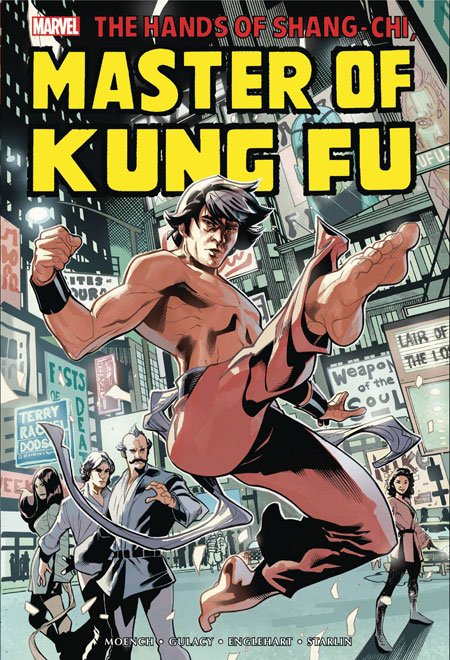
The Collected Works of Shang-Chi, Master of Kung Fu


Karen: We have frequently spoken here of our frustrations about not being able to get reprints/trade paperbacks of Master of Kung Fu. Marvel has had legal problems with reproducing the original issues of the series due to the appearance of the Sax Rohmer Fu Manchu characters in the stories. But something has been worked out with the Rohmer estate, and Marvel is publishing Master of Kung Fu in omnibus form! In fact, there will be four of them reprinting the entire run. Volumes 1-3 will reprint the Master of Kung Fu series, along with Giant Size and Annual issues and other assorted stories, and a fourth volume will print the black and white magazine Deadly Hands of Kung Fu. Based on Amazon's listings, volume 2 should be out in September, and  the Deadly Hands omnibus (which is not using the same numbering as the MOKF volumes) will be out in November. I'm not sure when volume 3 of MOKF will be out but presumably after that.

Karen: While this might not be the ideal format for everyone, at least we are getting the stories collected. It seemed like it might never come to pass, so it's a pretty big deal.


Karen: The first omnibus debuts this Tuesday, the 14th. The MSRP is $125, but In-Stock Trades is selling it for $68.75! Below is a description of what is in volume one:

SHANG-CHI: MASTER OF KUNG FU OMNIBUS VOL. 1 HC

Written by STEVE ENGLEHART, DOUG MOENCH, LEN WEIN & MORE
Penciled by JIM STARLIN, PAUL GULACY, AL MILGROM, KEITH POLLARD, JOHN BUSCEMA, SAL BUSCEMA, ROSS ANDRU & MORE
COVERS BY TERRY DODSON & JIM STARLIN

One of the most groundbreaking Marvel Comics of all is collected for the first time! Born to be the world’s most fearsome fighter, Shang-Chi’s life takes a major turn when he discovers the truth about his father, the villainous Fu Manchu! So begins the epic story of the Master of Kung Fu! On a quest to end the reign of his pernicious patriarch, Shang-Chi pits his deadly hands and furious feet against incredible foes like Tiger-Claw, Razor-Fist, the mysterious Midnight — and even the macabre Man-Thing! But will his mastery of martial arts be enough in a throwdown with the Amazing Spider-Man? Collecting SPECIAL MARVEL EDITION #15-16, MASTER OF KUNG FU (1974) #17-37, GIANT-SIZE MASTER OF KUNG FU #1-4, GIANT-SIZE SPIDER-MAN #2 and material from IRON MAN ANNUAL #4.

696 PGS./Rated T…$125.00
ISBN: 978-1-302-90129-5
Trim size: oversized


Wednesday, January 25, 2012

Discuss: Comic Creator Names


Karen: J.A. Morris' recent posting of a link with an interview with Joe Sinnott made both Doug and I realize we had been mispronouncing his last name our entire lives! Turns out the emphasis is on the first syllable. This got us to thinking about other comic book creators' names we've mispronounced or been utterly clueless how to pronounce. I'll get it rolling with this one: writer Doug Moench. For years I pronounced it "Mench" until I heard it spoken as "Monk" at a convention.

Doug: Yeah, I always read that as "Munch". When Karen told me the other day that it was "Monk", that was news to me! Here's one, and I think I read this in Back Issue: I always thought it was Len "Wine", but it is really Len "Ween". Spelled W-e-i-n, what would you think it was?

Karen: I thought it was like "Wayne" until a few years ago! How about Bob McLeod? I think it's pronounced "McLoud" but I might be wrong. And hey, what about Bill Sienkiewicz? I saw it spelled out phonetically once but before that, I had no idea.

Doug: Is it Sin-kay-vich, with the accent on the second syllable? Seems to me that I, too, either saw the phonetic spelling or heard it once. Well, how about a couple of BAB faves, the Buscema brothers? When I was but a wee lad, I pronounced it Busk-e-ma (accent on the first syllable), but I'm thinking it's Byoo-see-muh, with the accent on the second syllable. Of course as we're going through this, our readers should feel free to correct us -- obviously this post is not about us feeling smug!

Karen: I actually did not know how to pronounce Buscema until I interviewed Gerry Conway for Back Issue and he said 'Byoo-sem-uh' -well, at least, that's how he pronounced it!

Doug: Oh ho! Then my emphasis is all wrong -- sounds to me (the way I read it) that the accent goes on the first syllable. See, who says this blog isn't educational? How about one more? Moving ahead to the very end of the Bronze Age -- maybe even a bit beyond -- we come to Jackson "Butch" Guice. When he took over the Flash revival, I assumed his name was pronounced "Goo-chee". Nope. Then I thought it was "Gice". Nope. It is pronounced "Gwice", like "ice" with a hard G and a W in front. Hmmph.

Doug: Up to you now, kids -- how many have shared our name-butchering travails? Are there other creators you get tongue-tied over? Let us know!


Friday, September 9, 2011

Could the FF Stave Off Cancellation? Shogun Warriors #19


Shogun Warriors #19 (August 1980)
"The Giant of Manhattan!"
Doug Moench-Herb Trimpe/Mike Esposito

Doug: Now here's one off the eBay reader lot pile that I have absolutely no interest in. I did own one Shogun Warrior toy, but he was only to provide a challenge to my Megos. Runs in my mind that he may have been a stand-in for Galactus at some point... But really -- there are no pre-conceived notions about this book. It's maybe only the second or third copy of this title I've ever held in my hands, and the first I've owned. So, this will be a tabula rasa review, my friends!

Doug: We open with a splash of the giant robots in flight and I'll say this -- had I come to this as a 14-year old the vocabulary on the page would have driven me away. Wow -- not what I'd call a jumping-on point. Fortunately, upon further examination of the page I settled in on the text box at the top. Man, I miss those! After that brief foundational reading I felt like I was good to go. So the Shogun Warriors are on the fast move, apparently to get ahead of some menace. We then shift to space, where a dude called the "primal one" is addressing some "drones" who failed to stop the Shogun Warriors earlier. The goal being stated is to strip Earth of its advanced technology, which has outstripped its morality. Seems fair enough -- who could argue that, even today? So then another ship arrives, commanded by "Captain Cymell" -- and she's no looker in the face department, that's for sure! Intergalactic Mrs. Humpty Dumpty if you ask me... Since both of these beings represent the Charter Federation, an alliance is formed.

Doug: Back on Earth, the three pilots of the Shogun Warriors meet at the Oceanography Research Center. They discuss the impending conflict with the "primal one", and that they know that once the Shogun Warriors are destroyed, it's Reed Richards who will be targeted next. Back in space, at the protest of Captain Cymell, the "primal one" (seriously, every time they mention this character, the name is in quotes. Is it a joke?) unleashes the Gigantauron, a planet-destroying starship. And guess where it's headed? The "primal one" boards the ship by osmosis, and augments it with his life-force. This probably isn't going to be good.

Doug: Cut then to the Baxter Building, where in an all-too-familiar scene the team we know and love as the Fantastic Four works on a giant contraption: Ben supports it, Reed stretches around it working, Johnny is off on the side welding something with his finger, and Sue is useless. Nothing new here. Suddenly the building begins to quake. Johnny looks outside in time to see a giant robot -- the Shogun Warrior Combatra -- about to land on the roof. Hustling out the window, the Torch is soon joined from the elevator by Ben. Naturally they engage without asking questions, only to be rebuked by Reed. The Warrior's pilots then descend, and debrief the FF. Back on the Gigantauron, the "primal one" uses a sensor to track the human pilots to New York City. And how convenient -- they just happen to be in the company of Reed Richards!

Doug: In a scene we've witnessed in just about every sci-fi invasion film, the Gigantauron reaches Earth and slowly blots out the sun as it descends over NYC. Suddenly shifting from a horizontal descent to one that is vertical, we see that the enormous ship is actually an enormous robot, now standing in the harbor. The Gigantauron way out-sizes Combatra -- it's easily 10x larger. The Shogun pilots inform the Four that Combatra is able to separate into five components, each a more powerful weapon than the composite. Reed and Sue volunteer to be the other two human pilots, while Johnny is given responsibility for recognizance and Ben is asked to assist the Air Force in the monitor room.

Doug: As the battle begins, the giant fires lasers at the smaller ships, which seem to buzz around like flies. Of all people, it's Sue who suddenly gets the idea of the day -- to use her ship to plunge into the ocean and use it as a wedge to topple the construct. Since it must operate on some sort of gyro-stabilizer (huh? Sue came up with this??), throwing the thing off-balance may be the solution. However, as she begins the process, the giant lifts its leg and steps right over Sue's ship -- we're led to believe that even her forcefield wasn't enough to save her or her ship. Johnny manages to burn a hole in the side of the Gigantauron, allowing Shogun pilot Genji to pilot her ship inside -- to find the gyro herself. But the hole seals itself behind, and Johnny is kept out. Once inside, Genji ejects and now repeats a scene we've seen twice in the pages of the Avengers: minute hero tracking through a body to find the "cure". As this happens on page 27, you can bet she gets it right. Yep -- big robot fall down, hard!

Doug: Genji gets out, the "primal one" escapes, and Sue surfaces, unharmed. All's well that ends well. Trouble for this reader is that the Gigantauron was billed as a "planet-destroyer", yet succumbed all-too-easily to attack and defeat. That's not so believable. Additionally, the story just seemed to end. No discussion on what is now going to happen to 100's of tons of interstellar technology/refuse. The story just... ended. By the way, this was the penultimate issue of the title -- not sure that had anything to do with it. So, while I'd definitely call this story "average", it wasn't horrible. I'd think for younger readers who could handle some of the vocabulary, and who had the toys on which the title was based, this was probably pretty cool. Doug Moench is a pretty strong writer, so I'm going to say that any short-comings were on the subject matter and not necessarily on him. And what of Herb Trimpe's art? Man, we got on him hard on the Super-Villain Team-Ups he penciled. But here? He's actually pretty good -- don't know how much of that is due to the influence of inker Mike Esposito; Trimpe wasn't exactly aided by the inkers assigned him in SVTU. But it wasn't a bad book to look at. Overall -- certainly not wasted time. My appetite isn't whetted for more, but it was a decently-spent 20 minutes.

Wednesday, October 13, 2010

BAB Two-In-One: Cat Fight! and Frankie's Back to the Future


Doug: I'm talking Daredevil again this time, kiddie-winkies, in the conclusion of the Owl story that we looked at last week. Today's fare is Daredevil #117, cover-dated January 1975. This month Chris Claremont worded over a Steve Gerber plot, while Bob Brown returned to the pencilling and was inked by Vinnie Colletta.

When last we saw our heroes, the Owl and his henchmen had disabled DD and the Black Widow. We open this month's installment to find them strapped to lab tables. As the Owl begins to drain Daredevil's mind (which will leave him in a v
egetative state), the Widow suddenly finds the strength to burst her bonds -- which, by the way, happened to be made of 1/2" steel. Hmmm... OK, suspension of disbelief kicks in. Next, she fires a Widow's sting at the Owl's machinery, disabling the machine. Somehow bursting her other bond, she then makes short work of the Owl's muscle. But, after recovering, the Owl grabs his pistol and holds it to DD's head. Wanna make a deal, Widow?

Tasha takes the deal: Go to an address and kidna
p the lady of the house. Well, the address happens to be a penthouse apartment, and the lady, even though asleep, isn't going easily. Some lingerie wrestling ensues, albeit in silhouette (no details, Vinnie?), and our sleeping beauty turns out to be none other than Shanna the She-Devil! The Widow takes Shanna back to the Owl's lab, where Shanna feigns unconsciousness. The Owl wanted Shanna because she's an animal expert. As the Owl gloats, he orders Tasha to place Shanna on the same table where he'd tried to mindwipe DD earlier. Say what? I thought the Widow had destroyed it? Anyway, as the Widow hands Shanna over to one of the Owl's heavies, a net drops from the ceiling on the Widow; that's all the cue Shanna needs as she goes into action. The first thing she does is free DD (popping the steel as easily as Tasha did), and it's game on!

The Owl releases some gas (no, not like that), which greatly disturbs the two ladies. It doesn't seem to affect DD, though, and he is able to wallop the Owl. But the Owl is able to escape and take the battle to the air. But Daredevil is still without his billy club (lost in issue #115 in battle against the Death-Stalker), so it's a short-lived pursuit. But like a dope, the Owl flies back within range and DD takes him down. Then it's back to the ladies. As the story concludes, Daredevil and the Widow have a heart-to-heart, kiss, and part ways.
It's the beginning of the end for them as a couple.
Claremont's words are sometimes off in this story. It's a bit of a comedown from Gerber last issue. And while I generally enjoy Bob Brown on characters like Daredevil, his art is inconsistent -- at times the Owl looks like he was rendered by Gene Colan, but at other times there's some George Tuska-like lines. I'd also say that ol' Bob had a strange viewpoint on women's breasts -- talk about defying gravity!! Maybe he saw all women as wearing those super-pointy bras that were popular in the 1960's... even when they sleep, as seemed to be the case for Shanna! You might also say it looks like he was drawing the old L'eggs containers! And as for Vinnie Colletta -- scratchy like he'd never been before. The inks in this issue really don't help Bob Brown. I am presently about halfway through the TwoMorrows book The Thin Black Line, which is a biography of Colletta. Many of the faults discussed are present here. But hey -- overall this was a good Daredevil story, from "my" era.


Karen: Howdy folks, I'm back with yet another Marvel monster. This time it's none other than the Frankenstein Monster, from the 12th issue of his self-titled book, cover-dated September 1974. This issue marked the transition of the Monster from 19th century to modern times. A good move or not? I suppose it depends on your point of view. According to comments in the letters page, the move was made in order to make it easier for readers to relate to the series. But, as would later be mentioned in the same letter column, the move also made many more guest-star and cross-over options available! We would later see such ridiculous fare as the Monster teaming up with Spider-Man, and appearing as one of the Legion of the Unliving in Avengers. Whatever the reasons, the Monster had joined the 20th century, with a little help from Doug Moench, Val Mayerik, and Vince Colleta (did he ink everything back in the 70s?).

Karen: As we join our undead
goliath, he's just been shot by Vincent Frankenstein, a relative of the original who wanted to carry on the family business. He in turn was shot and killed by a maid(!). I'm sure it made more sense if you read the entire story, but unfortunately I don't have that issue, so we're going to have to deal with it. So, justice served, the Monster staggers off to die, and he's not unhappy about that. After an messy encounter with some wolves, he stumbles off a glacier and winds up in the freezing waters below. In a tip of the hat to Capt. America -or was it just a lack of imagination? - our buddy is frozen solid, while the decades go flying by. This being the early 1970s, this is depicted by showing war after war, culminating finally with man's landing on the moon. I think this must have been cliched even in 1974. Frankie doesn't have the honor of having the Avengers thaw him; instead, he is discovered by the crew of an oil freighter. He's hauled aboard, block of ice and all, and found to be in state of suspended animation.
Karen: One of the crew schemes to make some money off the unfortunate creature. He plans to take the Monster to his brother, who runs a traveling carnival -hoo boy, cliche upon cliche! He and his brother sneak the Monster ashore and install him (still in suspended animation) in the freakshow. It is there that he is seen by Derek McDowell, "brilliant young neurosurgeon", who recognizes him as Frankenstein's creation. So it seems like we're all set up for some interesting events when we turn the page and -poof! We get a four-panel recap of events which took place in the magazine Monsters Unleashed issues 2,4, and 6! What the heck? And I thought modern cross-overs were bad! Seriously, this stopped me dead in my tracks while reading. We're told that the Monster escaped the freakshow, was taken to McDowell's lab, where eventually the Monster killed McDowell and then began wandering the streets. And that's where he is at the end of this issue.

Karen: Talk about a let-down. I thought the story started well. The Monster's desire to end his existence was touching and while I was unprepared for the jump forward to the present, I could even handle that. But the Monster stopped being a character in the story about mid-way through. Then we have the cobbled together ending -I suppose they must have made the move to modern times in the magazine first, and then used the comic to explain it? I'm fairly confused. If anyone has read those old monster mags, I'd love to hear what the deal was. I thought the art on this issue was pretty good; Mayerik seemed to have a real feel for the Monster, although I would prefer a more "moody" inker than Colletta. His thin lines do no favors to the pencils.

Wednesday, April 28, 2010

BAB Two-In-One: Simians in White Sheets and Dead Guys Fighting

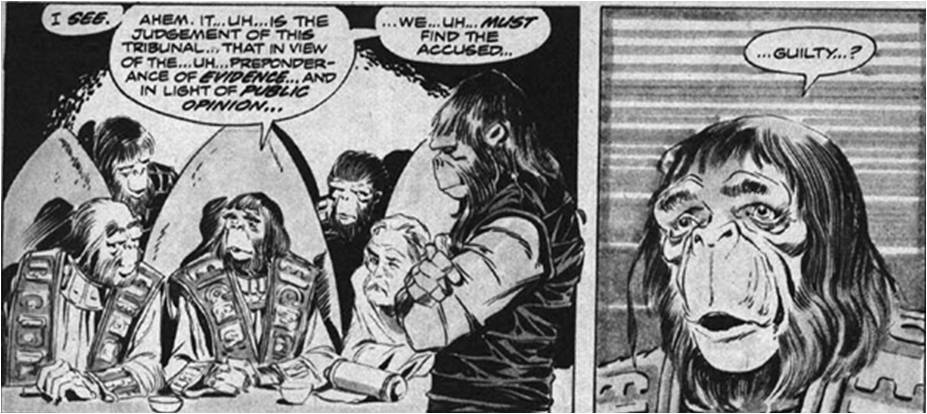
Doug: Marvel Magazine time, kids. Today we're looking at the first issue of Planet of the Apes, the black and white extravaganza that celebrated all things Ape in the early 1970's.
There are numerous articles about the films, and the magazine kicks off with a long explanation from Roy Thomas concerning Marvel's acquistion of the license. I'll examine the first comic story (which is actually the first part of a multi-part serial), with a fine creative team of Doug Moench and Mike Ploog. There is a second comic story that adapts Planet of the Apes, with art by George Tuska. This beauty was on the shelves at the supermarket in August, 1974.

The protagonists of this story are two teens -- a young human named Jason and a chimp named Alexander. They are just out of class and on their way to the village square to hear a message from the Lawgiver. This story, we find, takes place after the events of the fifth film in the Apes series, Battle for the Planet of the Apes. The Lawgiver, as you might suspect, preaches a message of peace and harmony among the "races". He then drops a bomb by informing the gathered public that he is leaving for an undisclosed amount of time. His place as magistrate is handed on an interim basis to Xavier; the lads are less than thrilled. This is a society dominated by apes, despite the former message, and it shows in the dialogue between our two leads -- there is much tension. The boys attempt to follow the Lawgiver to see which direction he heads, but they quickly lose him. They part ways, and Alexander heads to his house.


But when he get there, he's alarmed to find his father prone on the floor, beaten, and his mother cradling his head. She exclaims that gorillas in white hoods were there and carried out the violence, calling him a human lover and a traitor to the ape cause. Alexander's mother said that their parting words were that all humans were to be subjugated, or killed. She implores Alexander to run and warn his friend Jason. However, as Jason will soon learn, his parents received the latter sentence in a deadly inferno. Jason pursues as the villains ride away, but he is unable to keep up with the horses. He is exhausted, and filled with hatred for those "beasts".


With tensions between Jason and Alexander now higher, the two nevertheless strike a pact to ally and bring the hooded murderers to justice. Cut now to the encampment of the ape "klan", where the perpetrators return and we discover that they were on an initiation mission designed specifically to kill Jason's parents. We also find that the leader is none other than Brutus, the Lawgiver's peace officer. Brutus, the prejudiced, hateful peace officer. As Jason and Alexander have stumbled upon the camp, along with Brutus' wife, they are engaged by hooded miscreants and captured. Jason is eventually framed for the murder of Brutus' wife, a murder which Brutus himself commits when his wife rejects his offer to rule at his side over an ape-dominated society.


The remainder of the story shows Jason on trial for the murder charges. Xavier presides, and his ineptitude shines through as all that he learned of peace and harmony from the Lawgiver is brushed aside by Brutus' strongarm tactics. Jason is sentenced to prison ahead of his impending hanging. However, he is broken out by Alexander, and the two decide that they must trail the Lawgiver... into the Forbidden Zone.


Wow -- what a great story! Moench really nails the tensions between the apes and humans, playing directly off the tone from Battle. And Ploog's art is perfect. He really nails the look of the apes, and his backgrounds and landscapes evoke the best of the Apes films. This was a true winner from Marvel as the company expanded into the arena of black and white magazines -- seek it out, effendi!


Karen: I dug deep into the long boxes for this one. It's Frankenstein Monster #9 (March 1974), with the battle everyone's been waiting for: The Frankenstein Monster vs. Dracula, lord of Darkness! Brought to you by Gary Friedrich and John Buscema.

This issue is the second (and concluding) part of a two part story. While I don't have all the details, it's not too hard to comprehend. Frankie is in Transylvania, where he's
apparently gotten into trouble with both Dracula and the angry villagers (aren't they always angry?). As we begin this story, the big old lug is being burned at the stake! He's not even fighting back, as the Monster wants to die. But then a cream breaks the night and the villagers realize that while they were setting Frank on fire, Drac has taken advantage of the situation and attacked a woman. The villagers then turn their anger towards Dracula.

Although the Monster wants to end his life, he can't stand by while someone's in trouble -and he also wants to rid the w
orld of Dracula. So he busts loose and heads off to find Drac, only to have the villagers accost him again. He shakes them off and tells them, "I want nothing more than to end my wretched existence...but if you allow me...I will do one good turn for mankind before my death - though I am not at all certain you deserve it!"
Frank heads for a cave that is Dracula's lair. Inside is a beautiful gypsy girl that he met in the previous issue. She had been kind to the Monster when no one else was. Unfortunately, she has been turned into a vampire by Dracula, and attacks the Monster. Although it pains him to do so, the Monster ends her unlife with a stake to the heart.

Who should arrive then but Dracula? He wants to bite the Monster and convert him into a slave. Although Dracula is far more powerful than the Monster, it seems the Monster's hatred for Dracula is so great it gives him a tremendous burst of strength. He tosses Dracula to the entrance of the cave, where the sun is now conveniently rising. As the terrified vampire tries to crawl back into the cave, the Monster grabs two pieces of wood, making the sign of the cross. Dracula recoils, and as his flesh begins to be consumed by the rays of the sun, the Monster forcefully stakes him through the heart, leaving nothing but a skeleton. It is at this moment that we get a surprise visitor -a man who says his name is Vincent Frankenstein!

This was a fun read, a book I haven't seen in many years. It was also a short one, as the book also contains a 4 page horror reprint (the source is not identified). I felt that Buscema's art seemed rushed in places - particularly towards the end, with the fight between the Monster and Dracula. We got a couple of pages with just three panels on them, which looked very odd. Also, a lot of close-ups with no background detail. It's not terrible work by Buscema but far from his best. The inker was John Verpoorten, and it's a decent if workmanlike job. The cover is pretty eye-catching, or at least was to me as a 9 year old! I'm not sure who did it; the Grand Comic Book Database guesses possibly Ron Wilson, but I doubt that. It may be Buscema layouts. The heavy inks remind me of Tom Palmer, but I really don't know who it was.

I do wish Marvel had kept the Monster in the past (as he is here, sometime in the late 1800s). They had a number of characters that started out in other time periods (alternate future characters like Deathlok or Killraven) that wound up making appearances in the regular Marvel universe, and I never really thought that was a good idea. For
the Monster, seeing him running around with Spider-Man never felt right. He is ideally suited to "the old world" -I mean, how else are you going to get the angry villagers?

I do like the characterization of the Monster: he's hardly a brute or unfeeling. He's a sympathetic character, with a good heart and heroic qualities. Actually, the Monster was the prototype for many a Marvel hero -the misunderstood monster! How would the Thing have fared if he'd been in 19th century Europe, rather than metropolitan New York of the 1960s?
Related Posts with Thumbnails