Showing posts with label Gerry Conway. Show all posts

Monday, August 1, 2016

The Kids Are All Right - All-Star Comics 59


All-Star Comics #59 (March/April 1976)
"Brainwave Blows Up!"
Gerry Conway/Paul Levitz-Ric Estrada/Wally Wood

Doug: It's high time we returned to this series, as for many of us its appearance signaled an entry point to the JSA and DC's legacy heroes. For the first year or two of the All-Star revival I was hooked; this magazine was on my "to buy" list, when I could find it. We've only been here once before, in my review of the inaugural issue (that introduced Power Girl to Earth-2 continuity, and four years ago!); however, we had a great response to a query about the Justice Society of America near the end of June. That made me think that this book has some traction with our readers -- so here we are!

Doug: Before sitting down to pen today's post, I felt it prudent to read my thoughts on All-Star Comics #58 (linked above). In that review I voiced my general prejudice against 1970s comics from the Distinguished Competition, saying that it was written for a 10-year old, "like a Bronze Age DC". And while I reached the conclusion that it's existence as such ended up being OK by me, I must report that I was again awash in that sentiment as I read today's fare, four years later. Truly, the entire time I was reading this comic I attempted to remember how I might have encountered the plot and pay-off as a 9 1/2 year old near the New Year of 1976. But enough of me -- let's give you some information so that you might formulate your own opinions.

100-Word Review: BrainWave fantasizes about destroying the JSA, as a rumpled old man stands by his side, convinced the two of them can rule the world. Elsewhere, Flash, Wildcat, and Power Girl leave the JSA HQ to follow her lead to BrainWave. But continuing the previous issue’s disasters, three teams of JSAers confront volcanoes, earthquakes, and gas leaks. In each case a member of the Super Squad (the young newcomers) saves the day. In the end, BrainWave and his ally, Degaton, are defeated in space, averting a plot to pull the Earth from its gravitational orbit. Power Girl wins it for the JSA!

There's no need to flesh that out -- it's really the basic plot of the story. But, for some nitty gritty, let's head to our spectrum of praise:

The Good: I'll lead this section by continuing a positive comment from the previous issue's review and that's the inks of Wally Wood. Ric Estrada is certainly competent, but WOW if Wood doesn't polish the pencils in this ish. At times you, like me, might find the figures to be a little stiff. But Wood's lush inks really add some pop to the panels. I'd also mention that the coloring in this trade (Justice Society, volume 1) is wonderful. The paper is basically newsprint, although of a higher quality than what we read from in the Bronze Age. But the colors are really vibrant.

I liked the three youngsters who are invading the space of the "old guard" JSAers. As I've remarked many times, when I was a kid I related to kid characters. Bucky & Toro, the Teen Titans, the Legion, etc. -- all of those (and others) were among my favorites. So that Power Girl, the Star-Spangled Kid, and the almost-adult Robin were shaking things up (soon to be joined by a young 20-something Huntress) was fine by me.

The Bad: Unfortunately, my praises of this story seem short. It was not a horrible book, not a waste of my time. But I can't say that my life has been enhanced by having completed the reading. Maybe my feelings are actually a praise after all... if one gets out of something what they had assumed ahead of time to be a particular level of satisfaction, then that should be a success, right? 

I find Wildcat to be annoying. I have always found characters who are written as possessing below-average intelligence to be troubling. Oh, it's not that I have a profound issue with my brothers and sisters who might be in that boat. Rather, it's the stereotypical "voice" such characters are given. Wildcat has it. Sometimes Ben Grimm has it (particularly in cartoons and motion pictures). Wolverine's voice in the 1990s X-Men cartoon trended that way. For whatever reason, that "punch drunk palooka" personality grates on me (and yes -- I know that Wildcat's alter ego, Ted Grant, is a boxer). Maybe it's just me.

I did not own this book as a child. In fact, preparing for this post was the first time I'd read it. But whereas I could get by the whole BrainWave thing in the first issue, the introduction of Degaton (who I know of) would have gone right by me as a kid. Now, I read this and am like, "Oh, wow! That must have been cool for those who were into the JSA!" But as a 9- or 10-year old 40 years ago there would have been zero payoff with the Degaton reveal. Zero. So while Gerry Conway might have felt he'd done us all a good service, I was not the intended audience then for such a gift.

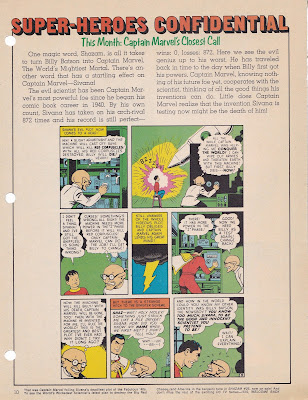
Lastly, and maybe I'm just showing my ignorance, but I thought when BrainWave transformed from his new body to his usual appearance he looked an awful lot like the Captain Marvel villain Sivana.


The Ugly: I've not much to say here, other than the scene depicted on the cover of this magazine is literally one panel on the inside. Here -- see above? Not sure how great that is from a marketing standpoint, but then at least it happened. How many times were we flat-out deceived by comics covers through the years?

In closing, I would highly recommend the Justice Society trades (volumes 1 and 2), as well as the Huntress: Dark Knight Daughter tpb. While every story contained within the covers of these books isn't of the home run variety, there are certainly plenty of smiles to be had. Nostalgia is a powerful things, and you'll have an abundance of it if you get your mitts on these books.


Friday, May 13, 2016

Guest Review - "We Wouldn't Want You to Miss Your Own Execution" - Batman 353


Doug: After a week off due to Civil War festivities, Thomas F. is back with another review. Today he has a treat planned for us: a late Bronze Age Batman book featuring the Joker with art by Jose Luis Garcia-Lopez. And who can get enough Garcia-Lopez? Not us!

Batman #353 (November 1982)
“Last Laugh”
Gerry Conway-José Luis Garcia-López/Dan Adkins
Colorist: Adrienne Roy


Thomas F.: This is a slightly shorter tale than usual—only sixteen pages as opposed to the conventional twenty or twenty-two (in fact, just as many pages’ worth of space are allocated to the promotional Masters of the Universe insert—which looks pretty good by the way, with art by Curt Swan and a Superman appearance in Eternia!). As a result, writer Gerry Conway must perforce concentrate more on the plot than on characterization, because he has to wrap up this “done-in-one” story fairly quickly. On Bat-tales that spread out over several issues, Conway is better able to flesh out his characters, making them more complex and defined. Not so this time around, regrettably, with the exception of the secondary characters, who are token henchmen in any case and don’t warrant any depth.


José Luis Garcia-López filled in as guest-penciler for this issue, and the result is superb. Dan Adkins inked the interior story, but JLGL inked his own cover. Adkins did a decent job; his strong inks complement and vividly enhance JLGL pencils. Incidentally, JLGL was the primary promotional illustrator for DC—it was his version of Batman, Superman, Wonder Woman, etc. that was featured on popular merchandise, from t-shirts to lunch boxes to bed sheets, etc. JLGL also created DC’s 1982 Style Guide, a thick handbook containing a plethora of character summaries and stock artwork of superheroes in archetypal poses. In the Eighties, other illustrators on the DC payroll—especially newbies—invariably referred to the Style Guide as if it were a religious tract.


JLGL’s Batman looks bright, athletic, and energetic. The only downside to JLGL is that his Batman doesn’t appear as dark and grim as he should be. I find that other Bat-artists render a darker, more menacing version of the Caped Crusader. JLGL’s Batman just doesn’t look like a night-time stalker of evildoers; he’s a bit too squeaky-clean.
 

As a side note for interested Bat-fans, this late Bronze Age Joker story was reprinted in Batman: King Tut’s Tomb, a trade paperback volume released in February 2010. It collected “A New Dawn,” the multi-part tale from Batman Confidential #26 to #28. More importantly, two other early Eighties Bat-tales illustrated by José Luis Garcia-López were also added—specifically, “A Cannon for Batman” from The Brave and the Bold #171, and “The Mystery of the Mobile Museum!” from The Brave and the Bold #164. JLGL fans might want to get their hands on it for these three reprints themselves.

The story opens with the Joker engaging in target practice with a crossbow, using life-sized posters of Batman as his target. Once the Joker feels he has sufficiently honed his skills, he exits the room to confer with his hoodlum associates. 
The Joker’s current hideout is the historic Tatch Hotel, now out of service and a condemned building. In an irreverent tone, the Joker announces to his henchmen that he has returned and claps his gloved purple hands for attention, but one them, a gambler named “Craps” who is enjoying a lucky streak with his dice, openly ignores him and continues playing.


The Joker jovially chides him for his momentary lapse of respect, squirting Craps with water from the toy flower pinned to his suit. Craps recoils, thinking that the liquid is deadly, but then realizes the liquid is harmless and calms down. The Crown Prince of Crime lulls Craps into a false sense of security by saying: “Thought I was going to use the poison flower-squirter, eh Craps? Silly man. That would have been boorish … I try never to use the same joke twice.
Then the Joker, feigning forgiveness, shakes Crap’s hand, and a live snake uncoils itself from around Joker’s arm and sinks its fangs deep into Crap’s wrist.

Craps has just enough time to shriek out in horror before the snake’s rapid-acting venom takes effect, killing him. Somehow, the snake’s venom contained some of the Joker’s brand of lethal poison, because as Craps is lying on the ground, his lips can be seen twisted into a ghastly Jokeresque rictus grin.


It occurs to me that the Joker’s homicidal tendency to murder his own goons should make them reluctant—if not outright unwilling—to work for him. After all, no doubt word has spread throughout the underworld that working for the psychopathic Joker is likely to have lethal consequences. The Joker often haphazardly discards his subordinates as casually as one would toss away a chewing gum wrapper. In fact, the Joker is just as likely to kill one—or all—of his own cohorts as one of his enemies. And yet, the Joker apparently has no trouble recruiting hoodlums.
Perhaps the prestige of working for Batman’s archfoe and Gotham City’s public enemy number one, plus access to the Joker’s limitless funds, are enough to tempt Gotham’s hoods into taking a chance, however hazardous it may be.

Next, the Joker orders another thug named Leo to “clean up.” The compliant hood takes careful aim with a shotgun and swiftly dispatches the venomous snake. Now properly humbled, the Joker’s assembled gangsters pay close attention as he begins to unveil the details of his latest plan. The Harlequin of Hate shows his cronies the front page of a newspaper, “The Gotham Post.” (Or is it “Press?” It’s not possible to tell, because the Joker’s fingers are partially obscuring the title). On the cover there is a photograph of Gotham City’s General Station, and the caption above the image informs us that the landmark subway terminal is scheduled for demolition. 
At this point, the focus switches to a subplot that has no bearing on the main story being recounted here, although it is intriguing. It involves a former Gotham City councilman, Arthur Reeves.
 
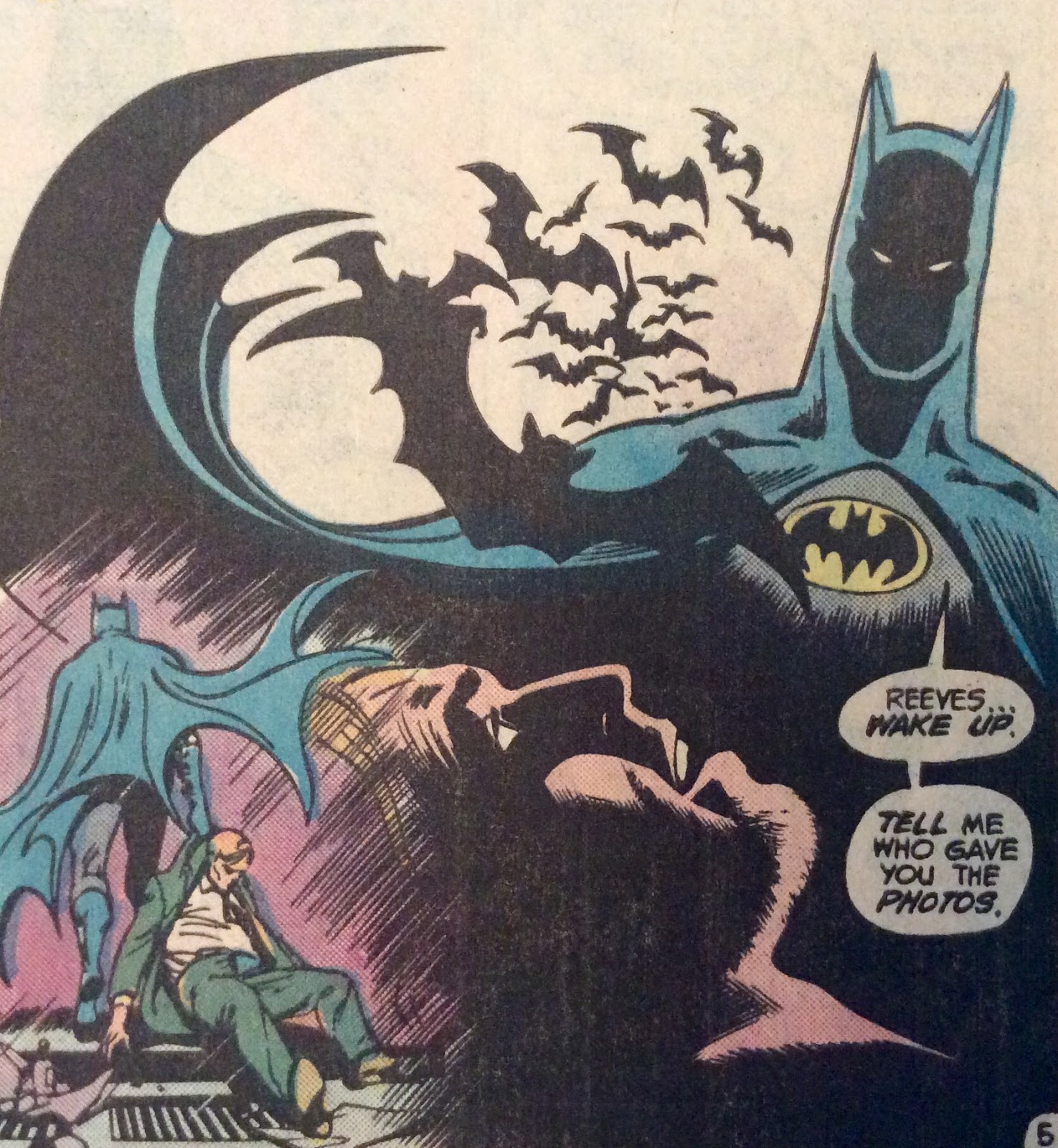
The terrified ex-politician is briefly pursued on foot by Batman, who uses a batarang with a cord attached to trip him up. Once in Batman’s clutches, the Caped Crusader compels Reeves to admit that top crime boss Rupert Thorne was the one who supplied him with doctored photographs that “revealed” Batman was actually a leading Gotham gangster. After confessing, nearby lights blaze on, and we see that Reeves’ admission has been overheard by Robin and the recently fired Commissioner Gordon. (Gordon had been dismissed from his position by corrupt Mayor Hamilton Hill, one of Thorne’s conniving stooges). Robin takes Reeves away, and Batman and Gordon discuss the underhanded political schemes afoot at city hall.

The following day, live at the historic Gotham Central Station, television newscaster Olivia Ortega explains in front of rolling cameras that the historic landmark is to be “torn down in the name of progress.”


On site, we see Bruce Wayne musing to himself about how photographer Vicki Vale asked him to meet her there, where she will be snapping shots of the event for her employer, Picture News Magazine. Bruce ponders to himself about how Vicki seems moody and withdrawn, and he wonders what is nagging at her.


Again, unrelated to the present story, we learn that Vicki—in flashback form—is brooding about how she witnessed a clash between crime boss Rupert Thorne and her publisher, Morton Monroe, and how the upshot of the unpleasant dispute resulted in Monroe putting a bullet through his own head.


Back to the present: a technician sporting a hardhat explains to newscaster Olivia Ortega how it is the city’s intention to preserve the façade that adorns Gotham Central Station. Explosives affixed to the façade will be set off in sequence in a controlled demolition by a special “computer-controlled fuse.” The technician further explains that the detonation will “pop” the façade off its perch onto “waiting air mattresses” so as not to damage it. To demonstrate, he moves to the control panel and presses a large red button. To his bewilderment, nothing happens. Examining his equipment, the technician discovers the main computer is missing, but on a monitor can be seen the image of a clown. Standing nearby, Bruce Wayne instantly recognizes it as “the sign of the Joker.”

This segment of the story brings to mind the early Eighties fascination with the personal computers that were then all the rage in America and widely available to the average citizen—the Apple, Atari, and Commodore, et al. And of those who were keen on electronics, who can forget the IBM PC, which had just recently exploded onto the market in August 1981. So absorbed with the novelty of personal computers were the masses that the major villain of the 1983 movie Superman III was a supercomputer gone rogue.

Fifty minutes later, the scene cuts to Wayne Manor, where Alfred Pennyworth is wondering why Batman wasn’t informed that the Joker had escaped from Arkham Asylum, which is standard police procedure. Bruce Wayne clarifies that with Gordon no longer Commissioner, Batman has been kept out of the loop by the new corrupt city officials.


It seems that the Joker is always escaping from Arkham—what agency is responsible for the subpar security measures in effect there? Granted, the Joker is an evil genius and fiendishly cunning, but it occurs to me that whatever agency is in charge needs to drastically overhaul their equipment and personnel.

A land purchase search conducted on the terminal in the Batcave reveals that ten acres of land on the Palisades in New Jersey were bought by a Mr. Harlan Quinn, and only an obtuse reader would fail to realize the buyer’s true identity. Speeding out of the Batcave in the Batmobile, Batman reaches the Palisades an hour later, where he reasons to himself that since the Joker purloined a “demolition-computer from a construction site,” the Crown Prince of Crime intends to carry out his own personal demolition project.

After scouting around the Palisades, Batman finds sticks of dynamite planted in strategic positions along the cliff’s edge, connected to a remote-controlled fuse. Suddenly, Batman is started by a sound behind him, but as he whirls around, the Joker fires his crossbow, and before Batman can react, a drug-tipped arrow strikes him in the chest, rendering him unconscious.

Why the Joker chose to add a medieval weapon to his deadly arsenal is anyone’s guess. If the Joker were more practical he would have used a lethal arrow, and would thereby be rid of his archnemesis once and for all. Of course, such a death would not be as elaborate or grandiose as what the Joker has planned, but it would do. The Dark Knight awakens to the sound of the Joker’s mocking voice, only to find himself strapped down to the edge of a cliff.

While Batman is helpless, the Joker takes the opportunity to gloat about his megalomanical plan (something virtually all of comicdom’s insane villains tend to do when they perceive they have the upper hand). The Joker explains his intention: to use carefully-positioned explosives to carve out a gigantic Joker-head on the edge of the cliff, not unlike the sculpted heads of the four presidents on Mount Rushmore. This will create a larger-than-life monument of the Joker’s image for posterity. In his usual gleeful, maniacal way, the Joker informs Batman that he will become a permanent addition to the new structure, as he will be buried under tons of rocky debris once the charges detonate.


Elated, the Joker moves away with his henchmen to the computer screen, where he views a computer-simulated image of the detonation’s aftermath. “Lovely, just lovely!” the Crown Prince of Crime croons to himself. He muses about how Gotham’s citizens will react the following day when they rise to see an enormous Joker’s bust peering down at them.


Meanwhile, with his adversaries no longer paying attention to him, Batman tugs and strains at his bonds. He manages to fray the heavy rope against a rough section of the rock, and succeeds in freeing a hand. And with his free hand, he clicks a handheld signal jammer.
 
 
In front of his paid cronies, the Joker pushes down the red trigger button, but to his chagrin discovers that it doesn’t work. Suddenly Batman appears, free of his bonds. He reveals that he anticipated the Joker would put the stolen computer to fiendish use, and devised a special signal jammer that would effectively nullify the Joker’s computer signal.

Then a frustrated Joker utters some of his worst dialogue of the story: “Cleverness is a highly overrated virtue, Detective! Cleverness can make you dead!” The Joker’s thugs charge the Caped Crusader, who hurls one brute over his head, and knocks out the others with a flurry of haymakers and uppercuts. The Joker stands by, ready with his crossbow, but his men are directly in his line of fire. He shouts that he is out of drug-laced arrows and left with nothing but “stainless steel points.” He fires a lethal arrow at Batman and miraculously manages to hit Batman’s signal jammer, destroying it and triggering a reaction that sets off the explosives. (This is probably the least plausible scene in the story, since the signal jammer had been stored away on Batman’s utility belt for safekeeping—it looks like a one-in-a-thousand shot).

Everyone topples off the cliff into the river. In the water, Batman seizes the Joker to prevent him from drowning. (Yet again Batman bothers to save this homicidal murderer of hundreds). Suddenly Batman turns about, only to receive a nasty shock: the Joker’s monument is a success! Beside himself with joy, the Joker chortles that he won after all, but Batman tell him to take another look.

 
And to the Joker’s dismay, his glorious bust crumbles into thousands of pieces. Apparently, the destruction of Batman’s signal jammer caused the Joker’s explosives to explode out of sequence, upsetting the delicate procedure. In the background, a police boat arrives, carrying armed officers ready to haul the Joker away and pull out the other survivors. 
This was a fairly light Batman vs. Joker tale, typical of what I was accustomed to from DC as a child growing up, and full of the Joker’s malicious mirth. Still, it’s inexplicable how Batman can at times be “chummy” with him. The Joker’s scheme was an ambitious one, but pointless. Even if he had succeeded, the authorities would have unquestionably taken it upon themselves to destroy the Joker’s façade afterward anyways. I can’t help but find the Joker appealing, though—he has the horrifying charisma of a psychopathic cult leader, and one cannot help but be simultaneously repelled and attracted to his peculiar brand of chaos.

Monday, March 21, 2016

Play That Funky Music... Secret Society of Super-Villains 8


Secret Society of Super-Villains #8 (July/August 1977)
"Let the Villain Fit the Crime"
Gerry Conway-Rich Buckler/Bob Layton

Doug: I don't know -- maybe Grodd could just drop his left arm really hard and break his own way out of Kid Flash's whirlwind trap? It has been many a moon since we looked in on DC's version of the Masters of Evil (and that might be a stretch); in fact, it was almost six full years ago that I reviewed SSoSV #7! And since that was the first issue of that mag that I owned, all this time later (and now in possession of both hardcover volumes of the collected issues) I've decided to review the next installment. Secret Society of Super-Villains would have been on my "pull list", had we known of such things in the Bronze Age. In the summer of '77 DC had the attention of 11-year old me with the Teen Titans revival, this mag, the Legion of Super-Heroes, the Batman mags (including Batman Family), Green Lantern/Green Arrow, and the All-Star Comics revival. It was a great time to have a foot in the universes of the Big Two! And today's fare is a fun little romp that probably leaves me feeling like I've had a snack as opposed to a full meal. As I did with my review of Silver Surfer: Judgment Day two weeks ago, I'll lead with a 100-word review of the plot and then go right into my now-typical format of The Good, The Bad, and The Ugly. Onward, then...

Captain Comet, thinking he’s found the Secret Society’s HQ, attacks. Apparently Luthor had lied about the location, and the Society plots elsewhere. There’s a crystal meteorite of some power that they want. Funky Flashman is driving this train, to the resentment of the villains. Kid Flash gets involved when a local tough steals the prism from a museum, which in turn gets the Society involved. Captain Comet comes to the rescue, but in the fracas Star Sapphire wrests the bauble from our heroes. The good guys make another play, but in the end lose the meteorite a second time!

The Good: This was a fun comic, really holding up well over the decades. Now, you must understand that part of that stems from what it is -- it's designed to be a romp. C-list bad guys and second-rate heroes? You really weren't expecting the Galactus trilogy, were you? Well neither was I and that's why I had a great time re-reading this after all these years. Gerry Conway's script wasn't overly complex, but I want to stop short of saying it was "written for a 10-year old" as we often have said about DC Comics through the years. I'll stop short, because after all I was 11 when this saw the light of the spinner racks! It's just a neat little chase story, with the bad guys -- dubious collection of fiends that they are (the Wizard, Copperhead, Gorilla Grodd, the Trickster, Star Sapphire, and Funky Flashman) -- a step ahead of our heroes, Captain Comet and Kid Flash. Longtime readers know I'm in the Kid Flash fan club -- in fact, I'm on record as stating that this character design is among the best of the Silver Age, and certainly up there with the best costumes of any derivative hero/heroine. So when I saw "my guy" on the cover of this mag, well.. "this cover made me buy this comic book", so to speak. In the end I got what I expected -- no more, no less -- and I think that's why it was a somewhat satisfying read.

The art team of Rich Buckler and Bob Layton also turns in some solid work. The book is well-paced, and the fight choreography is action-packed. The guys do a nice job of changing the camera angle often, and the facial expressions throughout the book are noticeable -- two of my favorites in the book appear in the scans toward the bottom of this post. The story is laid out in a variety of panel grids in between pages with angular panels. There are no splash pages other than the first, and there is only one extra-large panel, provided for effect at the climax of the story (see bottom of post). The artists also provide some nice panels of Kid Flash using various aspects of his super speed -- in the sample attached to this text you'll see Layton emulate Vinnie Colletta as Kid Flash vibrates through a wall. I especially liked the way Grodd is drawn -- although a "gorilla", he looks more like what Joe Kubert drew as an "ape" in his Tarzan strip. I think this comes through in the panels I provided at the top of the post. Works for me.

The Bad: I got nuthin'. There really isn't anything for me to say in this category. However...


The Ugly: Funky Flashman. I wrote this on February 14 (no, I was not slighting my bride to spend time with you folks -- she was out of town most of the day!), and shortly after reading the story I tweeted at Gerry Conway and asked him about the general reception of Funky Flashman. I remarked that it seemed mean, and particularly when viewed through the lens of all these decades of Stan Lee vs. Jack Kirby. Conway stated,


Yet Conway wrote Flashman as Kirby intended the character to be "heard". I didn't press the issue in that regard -- I wouldn't denigrate Gerry Conway for staying faithful to a Jack Kirby creation, regardless of axes ground elsewhere. In some way had he changed Flashman's "voice" that might have been worse. What I'd encourage you to do, though, is to go sift through Conway's Twitter feed (@gerryconway) from Sunday, 2/14/16, as a lengthy conversation blew up that came to involve several fans as well as pros Kurt Busiek and Scott Edelman. It was fascinating to sit and watch as my original query took on a life of its own, with Martin Goodman, the Marvel Method, and office and corporate politics all coming under scrutiny. And I should remark that there wasn't any overt Stan-bashing in this particular story; I raised the issue with Conway simply because of the very existence of the character.

How'd you like to be cruising down the highway and look over and see that van??

Doug: Hey, if you're a SSoSV fan, I'd really encourage you to get yer mitts on the trades or hardcovers (two volumes) that collect the entire series and periphery titles. You can usually snag them on the cheap, and as I've said, these stories are fun little diversions. I liked this then, and I've found that I can like them now -- we cannot always say that about our Bronze Age memories!


Monday, September 7, 2015

Guest Reviews - Crisis on Earth-Prime!


Doug: We hope our friends in the States are enjoying their Labor Day off. Our pal from north of the border, Mike W., is along to walk us through a fun Justice League of America summer team-up romp. Take it away, Mike!


M.S. Wilson: Since my last Justice League of America review (from #195-197) was so well-received, I thought I'd try another one... but with a couple of extra parts this time. This is a review of the 5-part crossover "Crisis on Earth Prime", which spanned JLA #207-209 and All-Star Squadron #14-15. I was reminded of this crossover a while back when someone (possibly Edo) mentioned it as being one they liked. I remember liking it too, but it's been years since I read it, so I was interested to see if it holds up. I'm a big All-Star Squadron fan, so I'm predisposed to like this. Enough talk, let's get reviewing!
 Book One: Justice League of America #207 (October, 1982)
"Crisis Times Three"
Written by Gerry Conway; Art by Don Heck and Romeo Tanghal
 We start out with five members of the Justice Society (Dr. Fate, Starman, Green Lantern, Huntress, and Power Girl) getting ready to beam to Earth-1 for their annual get together with the JLA. Five JLA members (Superman, Hawkman, Firestorm, Aquaman, and Zatanna) eagerly await the arrival of their friends (and we learn that Firestorm still has the hots for Power Girl). But something goes horribly wrong! (Hey, it's a JLA/JSA crossover... something always goes wrong.) Instead of the JSA materializing on the satellite, the Leaguers are shocked to see their old foes the Crime Syndicate (and we get a splash page that's a rip-off -- I mean homage -- of X-Men #100, with the teams facing off against each other). Since Firestorm hasn't met them before, he (and any new readers) are treated to a brief history of the Crime Syndicate: They're from Earth-3, where there are no superheroes but only super-villains; they fought the JLA before and were trapped in Limbo. But now they're out and make short work of the JLA. This seems like one of those DC fights where the good guys lose because it moves the plot forward; I'm sure when it's time to wrap up the story, the Leaguers will mop up the floor with the bad guys. Anyway, the Syndicate smashes a hole in the satellite and send Superman and Zatanna tumbling into space; they then repair the hole in the satellite and steal the JLA rocket plane to go conquer Earth-1. I'm no scientist, but I'm pretty sure a gaping hole to outer space would cause explosive decompression and pull everyone into space... maybe they have one of those Star Wars force fields that allows people to stand in open docking bays. The Syndicate mentions (several times) that they were betrayed by someone named Per Degaton ... now, who could that be? Any fans of All-Star Squadron are way ahead of me.
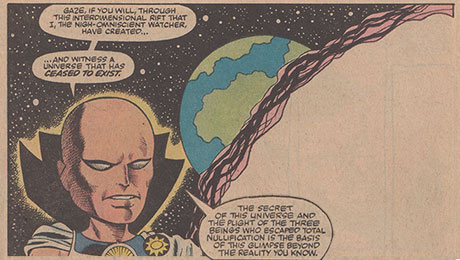
We next find out what happened to the missing JSA members; logically enough, they're in the inter-dimensional stasis bubble that previously housed the Crime Syndicate. We get more exposition about the Syndicate, including a recap of their previous appearances, as the JSA work on an escape plan. It doesn't take them long to bust out and Green Lantern says he knows how to get back home (something to do with a rip in the dimensional fabric, blah, blah, comic book science, blah, blah). But instead of ending up on Earth-2 (or Earth-1 for that matter), they find themselves on another Earth -- one that's been devastated by what seems to be a nuclear holocaust. It looks like they're in New York City... the Empire State Building seems to have broken in half, but the antenna tower on top is surprisingly intact! They're attacked by some mutated plants, which they defeat easily. GL uses his incredible plot device -- I mean ring -- to deduce: (1) that they're on Earth-Prime, a world with no superheroes i.e. our world; (2) that the nuclear holocaust happened decades ago; and (3) that the holocaust was caused by... Per Degaton! That is one handy ring.
Back above Earth-1, Superman saves Zatanna (miraculously, of course) and the JLA decide to use the trans-matter cube to go to Earth-2 and look for the missing JSA members. I guess it never occured to them to look in Limbo, where the Syndicate were imprisoned? Firestorm is shown to be reluctant to use the trans-matter cube -- seriously, he's like Dr. McCoy -- but hasn't he used it before? I'd swear he's been to Earth-2 before. Anyway, they go to Earth-2, but JSA headquarters is a shambles and, according to a wall calendar, has been abandoned since 1942. They go outside and all the cars and fashions are straight out of the 1940s, but they quickly realize they're in the present (1982), but a present far different from the one they expected. They soon figure out Per Degaton is behind the altered history (the gold statues of him on every corner kinda give it away) and are attacked by some of Degaton's thugs. After a quick fight, they go back into JSA headquarters and Superman and Firestorm combine powers to travel back in time (another of those plot convenient abilities that's never seen again). We're also reminded that Firestorm is the young, hip member of the team when he references Rick Springfield... in 1982, nobody was hipper! When they get back to the 1940s, the JSA headquarters is intact, so they know whatever Degaton did to change history hasn't happened yet. They hear someone at the door and eagerly anticipate meeting a young, dynamic JSA (in Zatanna's case, she seems very eager), but when the door opens they're shocked to see... the All-Star Squadron! Wait, who? We'll find out in part two! (Actually, part two tells the parallel story of the All-Star Squadron leading up to this moment, so we'll have to wait even longer to see the fantabulous first meeting between these two teams).
 
 
Book Two: All-Star Squadron #14 (October 1982)
"The Mystery Men of October" 
Written by Roy Thomas; Art by Adrian Gonzalez and Jerry Ordway
This issue starts with twelve members of the All-Star Squadron giving Nazi salutes to Per Degaton and then trying to kill each other. Professor Zee (Degaton's boss from All-Star Squadron #3) shows up to remind the Squadron that Degaton is a bad guy; the heroes quickly turn on him and... Degaton wakes up. Yes, he was just dreaming (at least Patrick Duffy wasn't in the shower), but the dream has restored Degaton's memory of his two previous defeats. That's right, last time Degaton was defeated, Roy Thomas used that old cliche of having everyone (hero and villain) forget everything that happened. Well, I'm sure he and Gerry will find a much more clever way of ending this story.
 
Anyway, now that Degaton has regained the memory of being ignominiously defeated (twice), he immediately starts working on a new scheme. I'm sure this one will work out much better. He kills Professor Zee (well, that's new at least) and uses the Professor's time machine to go from 1947 (his present) into 1982 (his future) to get weapons so he can go back and conquer 1941 (his past)... got all that? But there's a glitch and he winds up in 1982 on Earth-Prime (aka our Earth). He realizes there are no superheroes there and figures it's a great place to steal weapons. But back in his time machine, he's caught in a timestorm and ends up in Limbo. He rescues the Crime Syndicate from their stasis bubble and we get another recap of their history. Degaton asks the Syndicate to do him a favor since he busted them out, and they agree. He takes them to 1962 (on Earth-Prime) and has them steal the missiles from the Cuban Missile Crisis (and Roy Thomas gets to be a schoolteacher again as he gives us a rundown of the real life Cuban Missile Crisis). They get the missiles, which leaves the United States and the Soviet Union hurling accusations at each other over the "missing" nukes; this explains the devastation found by the JSA on Earth Prime in JLA #207. Naturally, the Crime Syndicate betrays Degaton, but he was expecting that (would you trust people who call themselves the Crime Syndicate?) and as soon as they touch him, they're hurled forward to a random Earth in 1982. Degaton doesn't know which Earth, but we do, since we already saw the Syndicate appear on the JLA satellite on Earth-1. Now that Degaton has a bunch of nukes, he's ready to go back to Earth 2's past and take over the world. And speaking of Earth-2 in the 1940s...
 
We next see Liberty Belle, Johnny Quick, and Firebrand getting out of a taxi in New York. They're immediately attacked by a goofy-looking guy calling himself Nuclear the Magnetic Marauder. Robotman and Commander Steel show up to help, but they probably aren't the best choice to go up against a guy who controls magnetism. After a short fight, Nuclear gets away and the All-Stars continue on to JSA headquarters. Nuclear is seen again in All-Star Squadron in a couple months, but he's not exactly a classic villain. It feels like this issue was running short and they needed to fill up a few pages. When the Squadron members get to the JSA meeting room, who do they find? Yes, it's the five JLA members from Part One. So, we end with the same scene, but get two different paths leading to it. It's actually a neat idea and it's executed pretty well, tying Degaton, the Crime Syndicate, and the nuclear holocaust on Earth-Prime all together. Gerry and Roy are listed as plot consultants in each other's books, so they were obviously working closely to tie everything together. So, in the next issue we'll see the long-awaited confrontation between the JLA and the All-Star Squadron... unless they decide to take a side trip to Earth-C to bring in Captain Carrot and the Zoo Crew!
 
Book Three: Justice League of America #208 (November 1982)
"The Bomb-Blast Heard Round the World" 
Written by Gerry Conway; Art by Don Heck and Sal Trapani

We start off with something we've already seen twice -- the confrontation between the JLA and the All-Star Squadron in JSA headquarters on Earth-2 in January 1942. We get the usual misunderstanding fight (remember, Gerry and Roy both worked at Marvel for years), but it's soon settled and the two teams compare notes and recap the previous two parts of this crossover. Firestorm also tries to make time with Firebrand, but things don't really work out. The Squadron gets a call from President Roosevelt and they all head to the White House to see him. Most of the JLA members are quite impressed; in fact, Zatanna seems very taken with FDR. I'm not sure if Gerry's trying to write Zatanna as being kind of "man-hungry", but that's the way it comes off to me. I know later on he writes her as (almost literally) salivating over Dale Gunn, but this characterization seems a little weird to me. Or maybe I'm reading too much into it. Anyway, the meeting is interrupted by Degaton (on one of those futuristic projection television devices... Japanese-made, no less), and he tells them -- and the rest of the world -- that he has nukes from the future and intends to demonstrate their devastating potential the next day on some random targets. The heroes realize this is the turning point that leads to the future where Degaton is master of the world, and they vow to stop him and restore history.
We now check in with the JSA members in the nuclear devastation of 1982 Earth-Prime. They track some "human" readings with Green Lantern's ring, but find only mutated freaks. After a short fight, they find a normal (relatively speaking) human and Dr. Fate absorbs his memories, learning about the Cuban Missiles disappearing. Fate senses a psychic residue and realizes Per Degaton was behind it all. Back on Earth-2 (1942), the All-Stars and the JLA watch Degaton's nuke demonstration in the middle of the ocean. The Squadron members are shocked by the power of the warhead and realize Degaton could potentially destroy the world. Suddenly, the missing JSA members appear in their time-bubble above the ocean. They're unconscious, but the JLA and All-Stars grab them and take them aboard the observation ship. Speaking of observation, Per Degaton is watching them from a jetliner, which he also stole from the future apparently (along with a communications satellite and whatever else is needed for the plot to advance). Degaton gloats about the stranglehold he now has on the world and plans his conquest, along with the destruction of the All-Star Squadron. Will he succeed? We'll have to wait until next issue to find out.
Book Four: All-Star Squadron #15 (November 1982)
"Master of Worlds and Time" 
Written by Roy Thomas; Art by Adrian Gonzalez and Jerry Ordway

We start this issue with Per Degaton still watching the first gathering of the three teams (JLA, JSA, and All-Star Squadron). He's still confident he can take over the world and eliminate all of them in the process. We get a flashback explaining how the JSA happened to show up here -- Dr. Fate, Green Lantern, and Starman combined powers to get off of Earth-Prime and Degaton's nuclear demonstration drew them to this exact time and place... or something like that. GL refers to "your Earth" when talking to the All-Stars, but aren't they both from Earth-2? These particular JSAers are from the future, but it's all Earth-2 as far as I know. Anyway, the three teams tell Roosevelt what's going on and Degaton sends another threat to the world, saying he has another two dozen nukes and will use them against any nation that doesn't turn over supreme power to him. Roosevelt tells the assembled heroes that he'll do what Degaton asks if they can't get rid of all the nukes.
They split into smaller teams (which is a staple of these crossovers). Superman, Dr. Fate, and Robotman attack Degaton's satellite up in space. But Degaton left a surprise for Superman--some green kryptonite! Robotman learns not to open unlabeled lead boxes, but before he can remedy his mistake, Ultraman (from the Crime Syndicate) shows up (getcha scorecards, you don't know the players without a scorecard!). Yes, apparently the Syndicate is working with Degaton again, even though last time we saw them (on Earth-1 in 1982) they were mad at him for double-crossing them. Robotman almost sacrifices himself to save Supes from the green-K, and Supes (after pounding Ultraman) returns the favor by yanking Robotman out of the atmosphere before he burns up. Fate does his usual magical mumbo-jumbo.
 
We next see Aquaman, Starman, and Liberty Belle over the ocean south of Japan. Liberty Belle worries about what would happen if Degaton (or anyone) used nukes. Aquaman and Starman decide not to tell her how WWII is going to end. They track the nukes to an island and get jumped by Superwoman. She's beating them until Aquaman gets a couple of blue whales to smash into the island, flooding the facility and (I guess?) destroying the missiles. During the fight, Starman warned Superwoman that using his cosmic rod might set off the nukes, but apparently thousands of tons of seawater pouring in on them is just fine. Starman does give Liberty Belle a small spoiler by mentioning Jimmy Doolittle's Tokyo raid, but he covers by saying he was talking about Doctor Doolittle ... and Libby apparently buys it. People were so innocent in the 40s.
 
Meanwhile, in the Midwestern United States, Hawkman, Huntress, and Johnny Quick search for more nukes. Huntress steadfastly refuses to give Johnny any clue about what happens in the future, but still manages to slip up a couple of times. They find the missiles hidden in grain silos (of course) and are attacked by Power Ring. He says the Crime Syndicate have been planning to double-cross Degaton the same way he did to them ... I think we all saw that one coming, didn't we? Huntress knocks out Power Ring quite easily (thus making the parallel between him and Hal Jordan complete), but his ring still launches one of the nukes. Johnny and Hawkman catch it and defuse it, as well as the others still in the silos. On the final page, we see Per Degaton freaking out about the Crime Syndicate betraying him (well, I guess someone was surprised by it), but he boasts that the rest of the missiles will never be found ... and even if they are, he has an ace up his sleeve. What could it be? We'll see in the final chapter.
 
Book Five: Justice League of America #209 (December 1982)
"Let Old Acquaintances Be Forgot..." 
Written by Gerry Conway; Art by Don Heck 
We open with the three successful teams from last issue returning to the White House to tell Roosevelt they've found most of the nukes. But as long as Degaton still has some left, the world still isn't safe. We then get a quick recap of the overall story so far. There's also an interesting aside as Roosevelt is shown pondering the ethics of the Manhattan Project. We next see Geneva, Switzerland where Firestorm, Power Girl, and Commander Steel are looking for the last three nukes. They're confronted by the mayor, who I can only assume came through Degaton's time machine since he's dressed like someone from the 1800s. They're attacked by some of Degaton's thugs and Power Girl is pounded by Johnny Quick (the Crime Syndicate guy, not the All-Star). Quick accidentally launches the missiles before Firestorm takes him out and the three heroes have to disable the nukes, which they do, of course. A couple of them are shown exploding, but I'm assuming (hoping!) the nuclear warheads were disabled so half of Europe isn't covered by fallout. I'm not sure how Power Girl could get into Europe... at this point, I thought Hitler had the Spear of Destiny, which turned any super-powered person into a Nazi (that was Roy's explanation for the obvious question of why the superheroes didn't just go to Europe and end WWII within a day or two). Maybe Power Girl wasn't affected because she's from the future? It can't be because she's Kryptonian (which she still was, at this point), because the Earth-2 Superman was affected by the Spear in other stories.
 
Anyway, back in Washington the rest of the heroes are relieved that all the nukes are accounted for. But three of the heroes haven't been seen yet. Zatanna, Green Lantern, and Firebrand are at Professor Zee's lab, trying to convince him that his bumbling assistant Per Degaton (who's absent today) will use the Professor's time machine to wreak havoc in the future. The Professor says his machine isn't working yet, but GL and Zatanna fire it up and program it to send them to Cuba in 1962 so they can stop the theft of the nukes before it starts... even though it's already happened! A few issues ago, Superman said something about the timestorm (which Degaton mentioned in All-Star #14) affecting probability, so the heroes would actually be able to change events that had "already happened". Well, if Superman said it, it must be true. Also, the missiles were stolen from Earth-Prime's 1962, so I guess the Professor's time machine can cross dimensions too... or maybe that was part of GL and Zatanna's programming? I guess in this case, we can truly use "a wizard (witch) did it" as an explanation.
 
The rest of the heroes track Degaton to his hideout, which turns out to be the site where the Pentagon will soon be built. You gotta admit, Degaton's got style. The heroes make short work of Deggie and his minions, despite the futuristic weapons he's equipped them with. Owlman -- the last Crime Syndicate member -- being a master tactician, decides to run away, but Huntress pounds him. In 1962 Earth-Prime Cuba, the three heroes beat the Crime Syndicate quite handily, which harks back to my earlier comment about plot convenience: is this really the same Crime Syndicate that took out (or will take out) five Justice Leaguers, including Superman? Degaton is with the Syndicate and tries to flee, but Zatanna knocks him out. She and GL combine their powers again and send the Syndicate and Degaton back where they belong, which instantly reverses everything that happened... and  everyone forgets the whole damn story. Arrrrggghhhhh! They did it again! I can see the logic (Degaton didn't steal the missiles to begin with, so none of it ever happened, so nobody can remember something that didn't occur), but I hate when they wipe out the whole story like that; it makes me feel like reading it was all just a big waste of time, since none of it "really happened". That's my main complaint about Infinity Gauntlet/War/Crusade/Whatever... everyone's memory is wiped at the end, so what was the point? But at least those stories still happened, even if no one remembers... this story has been retroactively wiped from existence. And who knows what sort of dangerous precedent that might set for DC?
We get a few pages of wrap-up, showing everything back to normal. Of course, some characters have "lingering feelings of doubt", but that's par for the course with this type of story resolution. We see the full JLA/JSA reunion, where some of the heroes marvel that nothing happened this time around and Batman says another crisis was "against the odds". It also looks like Firestorm might actually get somewhere with Power Girl (speaking of dangerous precedents). And that's the end. Overall, it was a pretty good story; the plotline got a little convoluted, but it's not as hard to follow as I remembered -- though it comes close in a few places. It was well done in general, with most of the story making sense, though the "everybody forgets because it never really happened" ending still bugs me. The art is good--I always liked Gonzalez/Ordway on All-Star Squadron, and Heck's stuff looks better than usual here. So, all in all, I'd say it's worth reading, as long as you don't mind a few time travel convolutions and a bit of a cheat ending. But if we let things like that bother us, we'd all have given up on comics years ago!

Related Posts with Thumbnails