Doug: Welcome to another guest post. Today Edo Bosnar is back with a review that's just a bit off the beaten path, at least as far as what we've traditionally done here at the BAB. Sit back and enjoy -- as I remarked a couple of weeks ago, it's high time we enjoyed the work of one of the masters, Carl Barks, at this place.
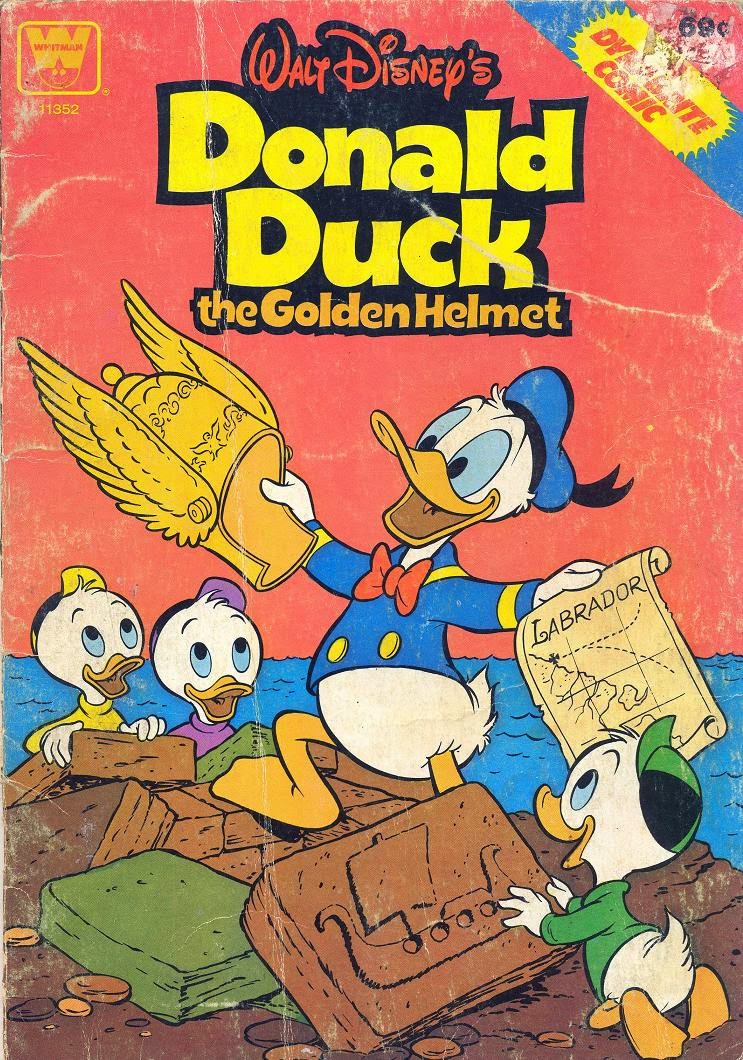
Walt Disney's Donald Duck & the Golden
Helmet (December 1978)
Carl Barks
Edo Bosnar: Like
pretty much everybody that frequents this blog, I was and am a super-hero guy
first and foremost, but I think I’ve mentioned a few times in the comments that
I had an Archie and funny animal phase that lasted for about 2 1/2 years
(from roughly the ages of 9 to 11). At the time, I really cut down on
super-hero comics in favor of these two genres. And the funny animal comics I
liked best by far were the Disney ducks, i.e., Donald, Uncle Scrooge, etc., which
were being published by Gold Key at the time.
So I still have many fond memories of reading stuff like this. And the interesting thing is, even after I had stopped actually buying comics featuring the Disney characters, I often found myself digging out some of those comics and re-reading them well into my teens (something I never did with my old Archie comics). It was only much, much later that I learned that many (most, actually) of those “duck tales” I liked so much were written and drawn by a guy named Carl Barks, whose fans literally span the entire globe and who is considered by many to be one of the greatest comics creators, ever.
And a few of my favorite Disney comics at the time were published by Whitman, under the Dynabrite imprint. The back cover showed some of the other titles that were available at this time (1978).
So I still have many fond memories of reading stuff like this. And the interesting thing is, even after I had stopped actually buying comics featuring the Disney characters, I often found myself digging out some of those comics and re-reading them well into my teens (something I never did with my old Archie comics). It was only much, much later that I learned that many (most, actually) of those “duck tales” I liked so much were written and drawn by a guy named Carl Barks, whose fans literally span the entire globe and who is considered by many to be one of the greatest comics creators, ever.
And a few of my favorite Disney comics at the time were published by Whitman, under the Dynabrite imprint. The back cover showed some of the other titles that were available at this time (1978).

I
also remember having Mickey Mouse and the Beanstalk, Uncle Scrooge: The Golden
Fleecing (also featuring stories by Barks) and the Bugs Bunny book mentioned at
the bottom – and no, I didn’t have, nor ever even saw the Star Trek books. A
few years back, I scored a cheap and rather battered copy of this one I’m
reviewing here, which was only in slightly better shape than my long-lost
original.
I hope this review will convey why these Barks stories are so loved by so many comics fans worldwide. The thing to note is that instead of doing “funny” animal stories interspersed with (often not very funny) gags and then a punch line ending, Barks basically wrote full-on adventure stories for young children. He’s often been compared to Jack London and similar writers, which is fair I think, because he was in fact writing for the same audience. And he was undaunted by the fact that his main characters were talking, partially-clothed ducks and other animals.
The main story in this book, “The Golden Helmet,” was originally published in 1952. What I’m going to do is just do a rundown of the set-up, because it’s kind of
complicated, but also illustrates (pun intended?) the way Barks crafted his
stories. It starts out with Donald bored at his job as a museum security guard.
He hears some strange noises coming from the Viking ship he’s daydreaming
about, so he climbs inside and finds some scowling, grumpy guy with a
flashlight tapping on the planks.
What I’m going to do is just do a rundown of the set-up, because it’s kind of
complicated, but also illustrates (pun intended?) the way Barks crafted his
stories. It starts out with Donald bored at his job as a museum security guard.
He hears some strange noises coming from the Viking ship he’s daydreaming
about, so he climbs inside and finds some scowling, grumpy guy with a
flashlight tapping on the planks.
Wondering what the guy was up to, Donald ends up poking around the ship himself until he comes across a loose peg that’s attached to an old deerskin map. He takes it to his boss, who tells him the map was made by a Viking named Olaf the Blue, who landed on North America years before Eric the Red, and left a golden helmet at a specific site in Labrador to prove this, and his claim to the land. All this time, the scowling guy was outside of the office eavesdropping – this is what he was looking for!
The curator is elated by this great historical discovery, and he’s about to organize an expedition to Labrador, when the scowling guy, named Azure Blue, bursts into the office with his aptly-named lawyer, Sharky. He claims to be the
descendant of Olaf, while Sharky presents them with a document about a medieval
pact among the rulers of Europe drafted at the time of Charlemagne, whereby
“any man who discovers a new land beyond the seas shall be the owner of that
land, unless he claims it for his king.” While all of this is fanciful, I think
it was a nice touch that Barks mentioned actual historical figures while
spinning his tale – I know when I first read it I appreciated the references to
names that appeared in my history textbooks at school, like Eric the Red and
Charlemagne.
He claims to be the
descendant of Olaf, while Sharky presents them with a document about a medieval
pact among the rulers of Europe drafted at the time of Charlemagne, whereby
“any man who discovers a new land beyond the seas shall be the owner of that
land, unless he claims it for his king.” While all of this is fanciful, I think
it was a nice touch that Barks mentioned actual historical figures while
spinning his tale – I know when I first read it I appreciated the references to
names that appeared in my history textbooks at school, like Eric the Red and
Charlemagne.
The curator is alarmed because the law was never repealed, meaning that if Azure finds the Golden Helmet which proves Olaf’s claim to all of North America, as his direct descendant he will become the ruler of the continent! Hmm… really?
The curator astutely asks how Azure can prove his lineage, to which the lawyer responds with what will become the most oft-repeated of his many wonderful legal maxims in this story, “Flickus, flackus, fumdeedledum” meaning, for those of you who don’t know, erm, Latin, “How can you prove he isn’t?”
Azure grabs the map, and sets off to find the helmet that will secure his apparent claim to the title over North America.
The curator and Donald discuss their next move. Donald says he’ll pop Azure over the head with his club, which the curator dismisses, because he “might miss,” and so suggests a better plan. The curator redraws the map from memory and tells Donald he’ll have to travel to Newfoundland himself to beat Azure to the helmet. He pulls some money out of the museum’s safe to finance the expedition.
I hope this review will convey why these Barks stories are so loved by so many comics fans worldwide. The thing to note is that instead of doing “funny” animal stories interspersed with (often not very funny) gags and then a punch line ending, Barks basically wrote full-on adventure stories for young children. He’s often been compared to Jack London and similar writers, which is fair I think, because he was in fact writing for the same audience. And he was undaunted by the fact that his main characters were talking, partially-clothed ducks and other animals.
The main story in this book, “The Golden Helmet,” was originally published in 1952.
What I’m going to do is just do a rundown of the set-up, because it’s kind of
complicated, but also illustrates (pun intended?) the way Barks crafted his
stories. It starts out with Donald bored at his job as a museum security guard.
He hears some strange noises coming from the Viking ship he’s daydreaming
about, so he climbs inside and finds some scowling, grumpy guy with a
flashlight tapping on the planks.Wondering what the guy was up to, Donald ends up poking around the ship himself until he comes across a loose peg that’s attached to an old deerskin map. He takes it to his boss, who tells him the map was made by a Viking named Olaf the Blue, who landed on North America years before Eric the Red, and left a golden helmet at a specific site in Labrador to prove this, and his claim to the land. All this time, the scowling guy was outside of the office eavesdropping – this is what he was looking for!
The curator is elated by this great historical discovery, and he’s about to organize an expedition to Labrador, when the scowling guy, named Azure Blue, bursts into the office with his aptly-named lawyer, Sharky.
He claims to be the
descendant of Olaf, while Sharky presents them with a document about a medieval
pact among the rulers of Europe drafted at the time of Charlemagne, whereby
“any man who discovers a new land beyond the seas shall be the owner of that
land, unless he claims it for his king.” While all of this is fanciful, I think
it was a nice touch that Barks mentioned actual historical figures while
spinning his tale – I know when I first read it I appreciated the references to
names that appeared in my history textbooks at school, like Eric the Red and
Charlemagne.The curator is alarmed because the law was never repealed, meaning that if Azure finds the Golden Helmet which proves Olaf’s claim to all of North America, as his direct descendant he will become the ruler of the continent! Hmm… really?
The curator astutely asks how Azure can prove his lineage, to which the lawyer responds with what will become the most oft-repeated of his many wonderful legal maxims in this story, “Flickus, flackus, fumdeedledum” meaning, for those of you who don’t know, erm, Latin, “How can you prove he isn’t?”
Azure grabs the map, and sets off to find the helmet that will secure his apparent claim to the title over North America.
The curator and Donald discuss their next move. Donald says he’ll pop Azure over the head with his club, which the curator dismisses, because he “might miss,” and so suggests a better plan. The curator redraws the map from memory and tells Donald he’ll have to travel to Newfoundland himself to beat Azure to the helmet. He pulls some money out of the museum’s safe to finance the expedition.
Donald then runs home to tell his rather phlegmatic nephews, Huey, Dewey and Louie, that they’re going to Labrador.
That’s basically the set-up, which I think illustrates Barks’ storytelling style and also highlights the differences between these comics specifically aimed at children and the more ‘sophisticated’ fare to which those of us reading super-hero comics were accustomed –
 one of the things that I actually recall
wondering about as a kid, and found even more amusing as an adult, is that
neither Donald nor the curator ever at any point even entertain the notion of
contacting the authorities in the US or Canada. But Barks didn’t let details
like that bog him down while trying to tell a good adventure story, and
besides, Donald Duck (and his nephews) are supposed to be the heroes, not some
random American G-men or Canadian Mounties.
one of the things that I actually recall
wondering about as a kid, and found even more amusing as an adult, is that
neither Donald nor the curator ever at any point even entertain the notion of
contacting the authorities in the US or Canada. But Barks didn’t let details
like that bog him down while trying to tell a good adventure story, and
besides, Donald Duck (and his nephews) are supposed to be the heroes, not some
random American G-men or Canadian Mounties.The meat of the story is the race between Donald and his nephews and Azure and his lawyer
 (and the curator, who also decided to head up to Labrador himself – as
curators do), with all kinds of mishaps, obstacles and twists and turns along
the way, involving, among other things, a polar bear, icebergs, and fights over
who will claim the Golden Helmet once it’s found.
(and the curator, who also decided to head up to Labrador himself – as
curators do), with all kinds of mishaps, obstacles and twists and turns along
the way, involving, among other things, a polar bear, icebergs, and fights over
who will claim the Golden Helmet once it’s found.Suffice it to say, everything works out, and in the end, Donald is back to his security job in the museum, with something of a new outlook on life. I hope the scans I provided also convey how rich the art is; even though these are kids' comics featuring talking animals,
 I love all of the little details in the panels, and
also the facial expressions of the various characters.
I love all of the little details in the panels, and
also the facial expressions of the various characters.This particular book includes two more Barks stories, one called “The Lost Peg Leg Mine,” which is another adventure that features Donald, his nephews and Uncle Scrooge, and a shorter one called “The Dogcatcher,” which is more of a gag story, the kind that’s more typical of funny animal comics.
All in all, this Dynabrite reprint book is a good little package: 50 full pages of comics printed on high-quality paper with a cardstock cover and no ads, all for 69 cents. I highly recommend it and similar reprint books from the 1970s if you like the Disney ducks and/or the work of Carl Barks (for those of you living in North America, I think it’s pretty easy to find reasonably priced or even cheap copies of these, as an alternative to those very pricey Fantagraphics hardcover reprints of Barks’ work that have been published more recently).