Showing posts with label Crisis on Infinite Earths. Show all posts

Saturday, February 6, 2016

BAB Classic - Continuity, Part Two: It Takes a Crisis... or Does It?


This post was originally published on February 10, 2010. 


Doug: Since we had such a nice conversation on part one of this old series, why not finish it up this weekend? Enjoy.


Doug: Hey, back for another installment of continuity conundrums. Today we'll focus on DC's mid-80's answer to housecleaning, Crisis on Infinite Earths and the reboots that came in its wake.

Karen: As I mentioned last time, some retroactive changes can be a good thing. Going back to the Byrne Superman, I never liked the idea that there was no Superboy. Now decades later, Superboy has been quietly inserted back into continuity. It may still leave us wondering exactly what stories have or haven't taken place, but what felt like a wrong has now been righted. And speaking of Superboy, would any discussion of continuity be complete without some comments on the original arch-enemy of continuity, Crisis on Infinite Earths?

Doug: It was an adjustment that took me many years to, well, adjust to! And I think what made it worse was the fall-out that affected my fave DC book, the Legion of Super-Heroes. Although Superboy had not been in the book for some time, the removal of him as the inspiration for the team's existence in the first place seemed to cause the book to creatively wander in the years after the Crisis. Shoot, one could argue that it's still trying to return to it's pre-Crisis heydays. While I'm not presently a reader, I did enjoy some moments here and there in the 1990's.

Karen: Although ostensibly designed to streamline the DC universe and make it more accessible, this razing of years and years of material seemed to gut the DC universe and leave readers everywhere mystified as to what now was and was not in continuity, with the Legion and many other titles.

Doug: I'll go back to a point I made last time -- I really never felt like continuity was an issue at DC. Sure, I understand the powers that be wanted to move away from all of the Kryptonite colors, they wanted to de-power Superman, the Earth-1, Earth-2, etc. stuff was confusing for newer readers. But when you look at the 25 years since the Crisis and what a mess that ended up becoming -- and to some extent is still a mess with DC moving from one event to another (just like Marvel) -- one has to question just how wise the Crisis was in the first place. DC seemed to take what was uniquely its own (the multi-Earth DC universe) and just chuck it out the window.

Karen: Doug, I think I would agree that Silver Age DC didn't worry too much about continuity, but certainly by the 80s, DC was fairly steeped in it. If you think about it, Crisis was not so much about cleaning up continuity -which is to my mind a linear progression - than taking multiple parallel paths and combining them into one. But that combination -forcing all those universes into one - did result in continuity issues. The initial problem was not one of continuity, as each universe had its own distinct continuity. To be honest, I never understood why they thought readers would be so confused by the multiple universes. I was a casual reader of DC but completely understood that the Justice Society was on a different Earth than the Justice League, that there were two Supermans, two Batmans, etc. As a matter of fact, I liked the idea a lot!


Doug: Agreed on your last point -- to me, that was a part of the DC Universe that was very charming. In those pre-Crisis days, the Earth-One and Earth-Two characters could interact and they'd be the same age. However, over at the House of Ideas in the 1970's the Invaders became a popular series, so some of the characters from that series started to pop up in the then-present; I just wasn't buying that Bob Frank (the Whizzer) could all of a sudden show up and be any sort of factor in battle at the approximate age of 70! Marvel's reality-based stories, which we discussed last time, virtually forbade any mingling amongst their Golden, Silver, and Bronze Age characters. So advantage to DC on that point. Then they changed it...

Doug: Not only did DC destroy much of their history, but at least for the immediate future they wiped out a whole bunch of characters. Now admittedly, many of them were just chaff, but I'm sure there were fans attached to them. However, besides death and taxes, the third thing in life that's guaranteed is that due to American copyright laws any comics fan can rest assured that their faves will pop up every seven years or so.

Doug: So, weird alien Supergirl, Wally West Flash? Anyone bothered by those things? I certainly didn't care whether Wally was the new Flash, but I didn't understand how removing Superboy from the new DC meant that Supergirl also had to be removed. I only read the first couple of issues of Peter David's Supergirl series; of course the character originated in the pages of John Byrne's Superman revamp. I quit due to a) economics and b) just really didn't care. I enjoyed Byrne's little homages to the recent-past: Luthor's battlesuit, the return of Supergirl, etc. But like you, Karen, the complete overhaul of the Super-mythos didn't set well with me. And shoot, I'm on record as saying I was never a Superman fan -- I was a Superboy fan!

Karen: The Supergirl revision was one of the worst "rethinkings" ever.
Doug: And what about when out-of-continuity stories become in-continuity? I think Jason Todd's fate as Robin was sealed the second Frank Miller wrote Alfred's comment to Bruce Wayne "after what happened to Jason" back in the pages of The Dark Knight Returns. Additionally, we've seen both Magog and the Kingdom Come Superman enter current JSA continuity. Good or bad? I guess it was nice as it was -- not sure the leap into the mainstream was necessary.

Karen: Yes, I have some concerns about Kingdom Come now becoming a part of the regular DCU. Is DC dooming itself now to go down a certain path? I suppose the exact outcome of KC can be avoided but I just don't know that it was wise to incorporate any of that stuff.

Doug: Good point -- as much as we've discussed writers' hands being tied by certain events, how about apocalyptic events set far in the future? It would seem to me that writers would have to be constantly thinking about getting their ducks in a row.


Doug: Which brings us to next time, when we'll discuss certain events that various writers/editors keep coming back to, as well as out-of-continuity stories that work just fine as standalones. See ya then!

Saturday, January 30, 2016

BAB Classic - Continuity, Part One: Decry it or devotion to it?


This post was originally published on February 5, 2010

Doug: We're re-running this post, as it ties in with a conversation we had about a week ago. There are two other parts in this series if you feel like spelunking.


Doug: I've been reading a few of our esteemed Bronze Age colleagues' blogs, and have noticed repeated aversions to that comic universe foundation known as Continuity. Karen and I would like to toss forth our evaluations and opinions and we certainly welcome comments at the conclusion of this post, which might further this as a discussion.

Doug: I suppose at the root of the problem is that word "universe". Once a creative team and/or editorial staff begins to craft real-life events for the protagonist and his/her supporting cast, things inevitably are set up to become sticky later on. This fictional realm where the title's cast, or as in the case of Marvel and DC (et al.), titles and casts, dwell now has moments frozen in time. This predicament is the main point of separation between the comic strip and the comic book.

Karen: Marvel had the relative luxury of being new to the scene, whereas DC was carrying around baggage from the last 20+ years. Marvel could do whatever they wanted - because as many of those early writers and artists have noted, they never thought these characters would be around so long! Marvel essentially created the comics continuity fever that most of us grew up with, by creating a fully integrated universe. We saw that the characters interacted with each other. Past events would be referenced repeatedly (remember all the footnotes the comics used to have?). Marvel built a sense of reality and history that had rarely been seen outside of such universe-building works like Lord of the Rings. 

Doug: It's funny to me, re DC. Of course at some point in this conversation Crisis on Infinite Earths will be brought up, but I'll be quite frank -- I never thought (as a kid) that continuity was anywhere close to a big deal at DC. Marvel, sure -- continued stories, characters and villains crossing over all the time, big events (and I mean pre-1980's big events, like one of the FF's break-ups or an Avengers line-up change -- not the marketing junk)... DCs mostly contained one-and-done stories, and it never seemed like they were referenced later on. Even when villains popped up after a few years' hiatus I couldn't see that the new story built off of anything from before.
Doug: So concerning Marvel, it's hard to imagine that what was once the best thing about The Amazing Spider-Man has become the worst. As soon as Stan Lee and Steve Ditko chose to have Peter Parker graduate from high school (ASM #28), Peter entered our world and was marked by time. Now characters in the Marvel Universe could age. Charles Schultz's Peanuts gang didn't; over at DC Dick Grayson had been ~15 for over 20 years. Spidey was now unequivocally 18, and off to college. So Pete and the rest of the characters began to age, to experience life, and then to die.

Karen: I think Stan Lee had it right when he said the goal for Marvel was the illusion of change. Changes in relationships, powers, costumes - all of these contribute to the feeling of excitement and newness but don't really affect the main character in any significant way. Going with our Spider-Man example, even the death of Gwen was not an event that altered the Spider-Man universe in such a way that the basic core of the character was altered or violated. It did however bring an element of reality heretofore unseen in comics, and allowed the readers, many of whom were probably young men themselves, to relate to and grieve with Peter. But the basic concept of Spider-Man was unchanged. 

Doug: Well since you brought it up, perhaps no events are as hallowed in the Bronze Age as the deaths of Gwen Stacy and the Green Goblin in June/July 1973. Both were surprises when they happened, and both carried enough weight that one felt that a chapter had closed in the life of Peter Parker. But then, only 14 months later there was a new Green Goblin, and as 1975 dawned there were hints that there would be a new Gwen Stacy.

Doug: Why? Sales would be the obvious answer. Fixing what many fans felt was a gross injustice? Maybe - but even that quasi-noble gesture oozed potential dollars. And I guess if we use this as a microcosm of the continuity question, we have to dwell for a moment on any publisher's ultimate goal: to turn a profit. In a perfect world, publishers would remain benevolent, always producing magazines within whose pages characters always behaved as we expect them to and change could be unexpected but would remain logical. 

Karen: Peter's growth as a character continued as he got a job and got married. Personally I liked the idea that Peter was still growing, although perhaps at a rate of 1 year for every 5 real-time years. I didn't mind him being married -although I do think it was a mistake for Mary Jane to be a super-model. That took Peter out of the everyman role he should rightfully occupy in the Marvel Universe. It would have made much more sense for Mary Jane to be a struggling actress/model. But despite this, by the time the 2000s rolled around, Spidey had a rich history.Karen: However, that rich history can also be like an anvil around one's neck. New writers may feel constricted by what stories they can tell. And by having any of the characters progress in age, the inevitability of adulthood, old age, and death starts to come into play. You almost have to commit to it fully, ie. have characters age, perhaps much more slowly than in real life, but eventually wind up hanging up their fighting togs and/or passing the mantle to someone else. But is that really what fans want? Can we imagine anyone else besides Peter Parker as Spider-Man? DC has made Dick Grayson the new Batman, but is there any doubt that Bruce Wayne will return to that role? 

Doug: No, no doubt at all. By and large, Batman, Superman, and Wonder Woman are untouchable. But one could argue that where it appeared that the entire second-tier of DC characters were allowed to move on with others taking up the mantle of Green Lantern, Flash, Green Arrow, etc., even those changes have been reversed or at least diminished historically by the returns of Barry Allen, Hal Jordan, and Oliver Queen. 

Karen: I realize I am primarily a Marvel fan, so I am sure hard-core DC fans would disagree with me, but I saw little personality at all in characters like Hal Jordan or Barry Allen. Many of these DC characters seemed almost interchangeable. I'm honestly surprised there was so much clamor for their return! And so now DC has multiple people running around with the same name. Those seem like characters where the passing of the torch really could (and I think did, particularly with Wally becoming the Flash) revitalize a title. I'm still surprised that Barry was brought back, although I do think that Geoff Johns has managed to give Hal Jordan a personality now. 

Karen: But getting back to the limits of continuity - apparently the Marvel writers felt that Spidey's situation, which had been crafted over decades by numerous creators, had become unwieldy. And so we got the biggest cop-out in comics: Brand New Day. It was bad enough that they used this deus ex machina to remove the marriage; but then they went several steps further and also used it to alter his entire history. Somehow, vast chunks of Spider-Man history were magically removed, so that Marvel could send Peter back to the Coffee Bean and relive his life. 

Karen: Brand New Day was a complete disregard of not only continuity, but of Marvel's status as the 'reality-based' comics company. Marvel has always taken pride in the fact that they brought a sense of realism to comics. One might have expected them to end the marriage in a realistic fashion - say by divorce or even death. Instead, they just decided one day to revert the series to about 1975 and not make any effort to actually have it make sense. 

Doug: I'm very happy to report that my mind was not polluted by any of the Spider-events of the past 12-15 years or so. I got out way back during the second clone saga, which was just a complete train wreck. It was so bad, as was much of what Marvel was producing in the 90's, that one has to wonder exactly what was going on in those editorial meetings. It wasn't creativity -- no, no -- my guess is the VP in charge of marketing was running each and every editorial meeting. All style (and that's debatable) and no substance. Or at least no substance that made sense.

Karen: This is probably the biggest violation of continuity that I am aware of. DC on the other hand, seems to be fond of continually 'ret-conning' their characters' stories, so much so that I don't even know who the original founders of the Justice League are supposed to be now. It seems as if much of John Byrne's revamp of Superman has gone out the window, which I can't say I mind. But for a casual DC reader like myself, the events of all the "Crises" have only made things more confusing than ever. Back before the original Crisis on Infinite Earths, I had a pretty good grasp on the multiverse and who was on what Earth. Now? No idea.

Doug: Sounds like a nice segue way to Part Two -- catch ya then, friends! 

Monday, December 21, 2015

I'm Looking at the Man in the Mirror -- JLA: Earth 2


JLA: Earth 2
(the Deluxe Edition)(2013; originally (c) 2000)

Grant Morrison-Frank Quitely


Doug: I wish there was such a thing as a graphic novel library. Sure, I know some libraries carry a nice selection of such things, but my local public libraries are not very large, and I am pretty certain that if the two local colleges have any such selections it's minimal as well.


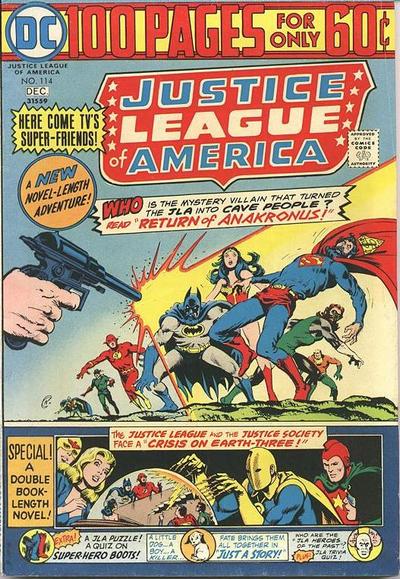
No, I'm talking about going into one of the super-nice LCS and being able to check out or even rent their wares. I'd have done so with the book we'll be discussing this day. I've had my eye on it since, well -- it's release 15 years ago (and that is mind blowing, etc.). I first encountered the Crime Syndicate as an 8-year old, reading a reprinted tale lurking within the pages of Justice League of America #114 (Nov/Dec 1974), and liked them from the start. Last month I was able to score a copy of the edition I've pictured above on the Black Friday sale at cheapgraphicnovels.com. I paid only $6 for a paperback copy and I'm glad I now own it, but thankful that I didn't pay full price. I really do think it's the sort of book I'd read more than once; the pictures are pretty and the story was thought-provoking. It's not the best Justice League story I've ever read (the Paul Dini-Alex Ross big book might be...), but it was pretty good -- particularly for its publication date.

Doug: I guess DC has gone through 2-3 reboots since this story originally saw the light of day. I'm not really up on all that, but was struck by author Grant Morrison's theories on the then-forbidden fruit of the multiverse. Here Morrison gives a different take on the Marvel concepts of Counter-Earth, or the Earth of the Squadron Supreme, and the DC notion of Earths that vibrate at different frequencies. In Morrison's tale, the Crime Syndicate of Amerika inhabits what they call "Earth", which is part of an anti-matter universe. There everything is wrong -- Benedict Arnold is on currency, there are monuments built to Adolf Hitler, and crime is normal and even upheld. Ultraman rules the planet like a god with the assistance of his partners: Owlman, Superwoman, Power Ring, and Johnny Quick. Each of them uses their powerset to bring havoc to the citizens of the planet. For those scoring at home, these characters used to inhabit Earth-3, with the Justice Society of America hailing from Earth-2 and of course "our" world being Earth-1. Here, the hero of Earth is one Alexander Luthor, complete with that awesome green and purple battlesuit.


Doug: Luthor "escapes" the confinement meted out by Ultraman and makes his way to our Earth, a place that Ultraman will later call "Earth 2". The basics of the plot, without any exhaustive recollection here, is that Luthor has been wanting for quite some time to overthrow the Crime Syndicate. He's come to our planet to enlist the aid of the Justice League. Superman and his six pals are of course skeptical, but this Lex wins them over. After Luthor explains his plans, the JLA meets to decide if they should go through with this jump to the anti-matter Earth. Conveniently, it is decided that J'onn and Aquaman should stay behind on our Earth -- you see how that sets up a one-to-one fight with the Crime Syndicate. But, you'd be wrong, as that never materializes! And I think that's where Grant Morrison scores with this story. There are quite a few things that you might think are going to happen, but then it doesn't come off that way. Conversely, there are some lines of dialogue and/or plot details that give the reader pause.


Doug: Ultimately the JLA is faced with defeat; not at the hands of the Crime Syndicate, but a philosophical resignation to Morrison's posit that good cannot exist against abject evil (the contrary notion also true). And here I found myself putting the book down for a few seconds to ponder that. Although by now almost 15 years old, I wondered if Morrison had any idea how much more negative our world would become and the pessimism that sometimes seems to permeate our feelings, our perceptions. Morrison wrote pre-9/11, pre-War on Terror, pre-Great Recession... but his extreme position of pure good cannot triumph over pure evil (simply put, there's no reference point for an inroad) sure seems a topic for discussion in 2015, almost 2016. This wasn't the sort of book I'd expected when I cracked open the cover.


Doug: Frank Quitely's art is some sort of cross for me between that of Ed McGinnis and later Frank Miller. I draw those comparisons due in large part to McGinnis's affinity for chunky (read: thick) forms and Miller's faces. I find Quitely's art pleasing, and certainly fitting for the story. The coloring, for being "modern" is OK. I think from some of the scans I've provided you can see that it's not muddy, but does have some brightness here and there. Everyone's costumes seem to look "right".

Doug: My edition of the book comes with over 20 pages of goodies, notably Morrison's pitch for the project. What's cool about that is the fact that at some point Quitely doodled the heck out of the script, so there are some really cool thumbnails. There are also character designs.and Quitely's "storyboards" for much of the graphic novel. I always enjoy those "DVD extras" in the back of a trade or hardcover. Nice bonus. So if like the JLA, if you yearn for those multiverse days of yore, then I'd urge you to check this out. And who knows -- you might even be able to borrow a copy.


Wednesday, July 22, 2015

Comic Events When They Actually Meant Something!

Karen: I have to 'fess up -originally this post was going to be a piece of shameless self-promotion. It was going to be a 'Bronze Age Babies Bulletin' that plugged the new (and super-cool) Back Issue! # 82 featuring Bronze Age Events, on sale soon from Twomorrows Publications in print and digital format (you can get it here). In this issue, I get to discuss the glory of the Avengers-Defenders War (or Clash, if you prefer) with such greats as Roy Thomas, Sal Buscema, and most of all, Stainless Steve Englehart! It is always a blast to have the chance to interview folks who had such a tremendous impact on my youth. As the theme of the issue is events, there are also articles on the great JLA/JSA  team-ups, Crisis on Infinite Earths, Secret Wars, the Infinity Gauntlet, and more.

Karen: But thinking about all those great old Bronze Age comic events made me want to do more than just a plug for the issue. It made me want to discuss what made events so much more special and exciting back in those days. It seems like now, all we have are events. Certainly the Big Two shape their entire comics line around a major event (or two) that typically lasts the entire year, and this happens every year, and has for some time now. The Event unfolds in its own book, touches most of the other titles in the line, and also gives birth to ancillary titles. Look at  Civil War - according to an article on IGN, it encompassed 93 individual comics. 93! This wasn't an event, it was a major financial commitment.
Avengerin' and Defenderin' cover by John Byrne

Karen: It seems to me there are a couple of things that really distinguish the events of old from today's "mega-events." One is that events used to actually feel significant. It's like that saying -"when everyone's special, no one's special." The same could be said for comic events. They used to be something that happened occasionally, and in a more organic way. 

Karen: I know when I worked on my article on the Avengers-Defenders War, I recalled that at the time the books came out, it felt really important -a cross-over like that, between two team titles, was a real first. Also, like the JLA/JSA extravaganzas, it  was a summer event, unfolding over the school vacation months of 1973, which lent it even more of a special air. In fact, writer Steve Englehart wanted to do something special for that summer, since Marvel wasn't producing any annuals that year. So as a young reader, it was a great treat while you were on school break -assuming you could find all the issues on the newstand!

Karen: The other thing that makes the earliest events stand out is that they were put together with a sense of sincerity -there was a desire to do something extra-special, something that would thrill the fans, something that would be fun. Certainly that was the case with the JLA/JSA meet-ups each year. Those annual events were eagerly awaited by comics fans each year, initially featuring just the two teams, later expanding to sometimes include other groups like the Legion of Super-Heroes, the Freedom Fighters, the Seven Soldiers of Victory - hey, the more the merrier! These issues really gave fans some bang for their buck -or 15 cents, whatever the case might be. Likewise, the Avengers-Defenders War took Marvel's two biggest teams at the time and pitted them against each other in one-on-one (or two-on-one) match ups, just because it would be a hoot. There really wasn't an ulterior motive at work. Similarly, the Marvel annuals, while hit or miss, sometimes fell into this category as well, providing fun and sometimes important events, like Fantastic Four Annual #6, with a battle against Annihilus and the birth of Franklin Richards; or the one-two combo of Avengers Annual #7 and Marvel Two-In-One Annual #2, with the huge smack-down of the Avengers, Captain Marvel, Warlock, The Thing, and Spider-Man versus Thanos. Now those were events -and they only lasted an issue or two!

 Karen: We can see the seeds of today's bloated mega-events in the later Bronze Age events. Crisis on Infinite Earths was not only a 12 issue series but it crossed-over to numerous titles (don't forget the red skies!), and of course, had a massive (some might even say devastating) impact on the entire DC line. Secret Wars had less of an impact on titles and characters -the black Spider-Man costume which later became Venom was probably the most lasting effect -but of course, the mini-series genesis was in a toy tie-in, not exactly the most noble of purposes. At this point, the events became bigger and also began to serve purposes other than just being a cool thing to do for the fans. The companies soon realized that the fans would dutifully buy up all the issues connected to the event, and before long, we were plagued with things like The Mutant Massacre and Invasion! With few exceptions, the event became more about money and less about someone coming up with a neat story idea.

Karen: And that's how we got where we are today, with the perma-event situation. Since I'm no longer a regular comics reader, I don't feel the pain like I once did, but I still sympathize with those who try to keep up with it all. I can't help but think that the impact of these events is far less when something huge and universe-shattering occurs every single year. Me, I still get a thrill when I see the Avengers and Defenders go at it, or Spider-Man working up his nerve to face Thanos. And I didn't have to buy 32 issues to understand the whole story.

Monday, September 22, 2014

The Greatest Hero of Them All - Legion of Super-Heroes 38


Legion of Super-Heroes (Volume III) #38 (September 1987)(cover by Bill Sienkiewicz)
"The Greatest Hero of Them All"
Paul Levitz-Greg Laroque/Mike DeCarlo/Arne Starr

Doug: That's a worthy cover by Bill Sienkiewicz, don't you think? It certainly has the majesty due an icon, and the color palette seems fitting as well. If there's one thing I can say based on the comments of the past three weeks (and they've been a bit weak in number, don't you think? C'mon -- help a brother out! These things take a few hours to craft!), it's that we stand unanimously on the error that was the decision to usher in the Crisis. Some of you have remarked that DC had a unique thing going with the multiverse as it was; others have stood specifically with Karen and I in our disdain for the divorcing of Superboy and Supergirl from Legion lore. But whatever our collective beef, this has been an emotional trip down memory lane. Let's see how the Legion creators finish it off.


Doug: When last we left our heroes, Superman had defeated the more-powerful Superboy. He'd done it due largely to the fact that Superboy's heart just wasn't in the fight. Having been raised by the Kents with strong Midwestern values (I always wonder if that's a glorification of the region where I've lived, or a flat-out knock on everywhere else), there was simply no way that Superboy could be a part of any heinous plots or crimes hatched by the Time Trapper. So now the Teen of Steel and four of his Legion teammates rocket through the time stream in a Legion time bubble. Along the way we get a basic recap of this adventure, some theories laid down by Brainiac-5, and then "the rest of the story" from Superboy himself. He narrates a tale that those of us who read Crisis On Infinite Earths way back when will recognize -- skies lit red, anti-matter moving into and around a planet. In this case, Earth. But not our Earth -- Superboy's Earth, part of the Time Trapper's pocket universe. Superboy tried every power he had and every strategy he knew. And just when he was about to sacrifice himself in a heroic effort by flying into the heart of the anti-matter, the Time Trapper appeared.


Doug: The Time Trapper offered Superboy a deal -- ally with him, and Superboy's Earth would be spared. And then the Trapper narrate his side of the story, as it continued. In the gymnasium of Smallville High School the Trapper held Ultra Boy, Cosmic Boy, Night Girl, and Mon-el hostage (all still in stasis from their zapping in LoSH #37). The Trapper says that every event we've seen over the past three weeks was orchestrated by him. Indeed, since the Legion first attempted time travel (see Adventure Comics #247 if you don't know to what he's referring), they have lived on his terms -- always journeying to a time and space of his creation. In other words, even if accurate history books of Superboy's exploits would have existed, they'd never have existed in our reality. We then get a one-page interlude with Wildfire and Dawnstar -- she is none too happy with Wildfire's change in appearance, much to Drake's dismay.


Doug: Back in Smallville, the time bubble approaches the high school. Brainy had created a phony stasis ray that Superboy could use to incapacitate the Legionnaires temporarily -- by intense concentration, the young heroes could break its bonds when action demanded. Superboy burst through the sidewall of the gym with the bubble. The Time Trapper was ecstatic. Superboy offered his teammates to his "ally", thinking to himself that he was going to defeat the Trapper once he was certain the anti-matter threat had been permanently removed. But he felt more confident now, knowing that this teammates were with him. But when Superboy said the deal was over, the Trapper scoffed at him... and then caused a very large gun to appear. A gun which Superboy should now use to slay his eight friends. After all, the Trapper mused, as true heroes they surely wouldn't mind sacrificing themselves to save the planet Earth. And of course you can guess Superboy's response -- he crushes the gun in his bare hands, forming it into a ball and hurling it at the Time Trapper. And the Legion breaks free of their trance!


Doug: The Time Trapper rose to meet the Legion, growing his form to Colossal Boy-proportions. Superboy and Sun Boy attacked, but were repelled. The Trapper gloated that he was entropy incarnate, the dark ending of time itself. The Legionnaires mounted the best offensive they could, and it got a little better when Brainy figured out that he could use the stasis ray of his own crafting to free the first four that had been trapped by Superboy's ray. So now nine super-teens rallied against an unbeatable foe. Superboy launched a violent attack that only resulted in destroying the machine that held Earth together against the anti-matter. Now with that safety net gone, the focus shifted from the Time Trapper to saving lives outside Smallville High School. And then, in the midst of this suspense, we get another one-pager, this time showing mopey Polar Boy doubting his leadership abilities while being comforted by Dream Girl. Who cares??


Doug: All of the Legionnaires headed outside, sans Superboy, Ultra Boy, and Mon-el -- the power trio. Those three took to the very skies, attempting to halt the advance of the red skies. The Time Trapper stood atop the high school, mulling over his plan and other-worldly events conspiring against him. He settled back to the ground to goad Brainiac-5. The Trapper reiterated that this Earth was never that of the Legion's past, but only a sliver of reality. Brainy threw a forcefield around the Trapper in a vain attempt to hold him. Brainy pressed him -- would the 30th Century survive? Sure -- your 30th Century, said the Trapper. But not this one. And as a true hero, Brainiac said to think again. The Time Trapper laughed loudly and vanished.


Doug: Cosmic Boy implored Brainy to figure out a way to save the day, but Brainy balked. The technology and power sources were beyond him. He didn't have the right supplies to fix what had been broken in the fight. But in the sky, Superboy suddenly had an epiphany -- he could fix what was wrong! Streaking past his teammates and straight to the containment device, Superboy attached himself to it as a living conductor -- he was attempting to allow it to repair itself by running all the energy through himself. With his teammates begging him to stop, the Teen of Steel used his super-breath to repel Mon-el and Ultra Boy. Sun Boy remarked that he felt like the team was being pulled back -- even transported away, to their future. As the Earth groaned, the residents of Smallville could tell that the end was nigh. Lana, Pete, Ma and Pa Kent -- all of them knew something was not right. Ultra Boy and Mon-el could hardly contain themselves as they watched their "brother". But you know what? He did it. Superboy saved his Earth. Instruments showed that the Earth was moved away from the anti-matter -- Superboy's universe was healthy, alive. The Legionnaires quickly grabbed his limp body, Brainy ordering everyone into the time bubble so that he could examine young Kal in the multi-lab back in the 30th Century. Superboy muttered to Brainy, asking if Earth was OK. Brainy assured him that it was. And as everyone got into the bubble and Blok readied for take-off, Superboy moved back outside and slammed the door shut!


Doug: Hoisting the bubble on his shoulders, Superboy flew it under his own power into the time stream, all the way to the Legion's time. As they passed through the final year, the Legionnaires burst out of the bubble, catching Superboy as he fell away from the strain. Mon-el caught him and flew like lightning toward the multi-lab. As they sped, Superboy mustered one more breath, and asked Mon-el to take care of the Earth for him. And then he died. The Legion assembled for the funeral some time later. The White Witch reported that she could not find Superboy's Earth, but that she knew it was fine. And then the team met in their hall of fallen heroes, among the statues that memorialized Supergirl, Ferro Lad, the first Invisible Kid, Chemical King, and Karate Kid. Now another statue joined those ranks -- that of Kal-el, Superboy.


Doug: I think Paul Levitz wrote a touching story that was a bit more emotionally-charged toward sadness than Alan Moore's "Whatever Happened to the Man of Tomorrow" 2-parter. Moore's story seemed to want to shock, almost as if he was mad at this turn of events in the DCU and wanted to take everyone else down with him. Here Paul Levitz pulls on our heartstrings with the heroism of Superboy, and the void we know he will leave in the lives of Mon-el and the rest of the Legion. But did you catch the "out" there at the end of the story? The White Witch said that while she couldn't find that Earth, she knew it was OK. But aren't all serialized stories written with that sort of a fail-safe? But I'm still left wanting here. How did Superboy die? Where did the pocket Earth really go? Where did the Time Trapper go? How did the Legion journey back to the pocket Earth without creating a divergent timeline that would have led to a Legion of Super-Heroes in the pocket universe? And someone please help me with this -- how could Kara and Kal-el exist together in the 30th Century, with Kara always believing that Kal was the teen version of her older (to her) cousin? Was the pre-Crisis Superboy "real" on the same Earth on which Kara arrived to?

Doug: Yeah, that multiverse thing was a lot simpler. Give me Mr. Tawky-Tawny on Earth-S any day...


Monday, September 15, 2014

The Greatest Hero of Them All - Action Comics 591


Action Comics #591 (August 1987)
"Past Imperfect"
John Byrne and Keith Williams

Doug: I was in a Twitter conversation with some of our followers a couple of weeks ago and we were discussing this series. The other guys remembered it, and we turned the talk shortly to Alan Moore's "Whatever Happened to the Man of Tomorrow?" I think you'll also get a sense of one particular scene from that tale, as we move through this one. Coming just about a year after Moore and Curt Swan bid farewell to the pre-Crisis Man of Steel, in this issue John Byrne would basically bid adieu to the Boy of Steel. Let's check it out.

Doug: When last we saw our heroes, Superman had been in fierce combat with some teenagers unknown to him. He'd fought four members of the Legion of Super-Heroes in a quarry outside Smallville. The heroes from the future had landed there after an adventure involving Superboy going rogue on them and paralyzing four of their teammates. Mistaking the Man of Steel for his younger self, the Legion took it to him largely out of self-preservation (with more than a hint of revenge). But as cooler heads eventually prevailed and explanations were given, the Boy of Steel did show up -- with his time-stasis ray. And he zapped these good guys as well! So we pick it up there with Superman and the four Legionnaires frozen. Superboy tells them that the Legionnaires must die, so that the universe may live! He hops down from the roof upon which he was perched, and explains to everyone that they won't be permanently harmed. He says he's taking them to his "master"... all except Superman. Superboy gets close to him and comments that this is not the Superman he will become. And then he piles up his teammates and flies away.

Doug: Superman feels his muscles slowly begin to "thaw", and recognizes that the stasis effect must have lasted quite a bit shorter than Superboy intended. Chance? Fate or not, Superman takes off after his younger namesake. It's only moments later that he spies the Boy of Steel with the Legion's time bubble, picking up speed. John Byrne really uses this issue to differentiate the old Superman mythology from the "new" and revised mythology. Superman thinks to himself that he must hurry -- the super-teens had told him of Superboy's strength and speed. Light speed. Superman thinks to himself that there's no way he could do that himself. As he gains on Superboy Superman knows what is about to happen -- Superboy will eventually reach a velocity whereby he can break the time barrier, and while pushing the time bubble. Superman gets just close enough to grab an adolescent-sized red boot, and hold on for dear life! As he worries about blacking out from the strain, something happens -- an explosion in the time stream!

Doug: Superman loses his grip on Superboy's boot and plummets to Earth. But Earth-when? Wouldn't you know it -- he lands back in Smallville, near where Pete Ross has been keeping vigil. Pete rides his bike over to the crater made by Super"boy", and calls to his friend Clark. We cut to outer space, where Krypto the Super-Dog is chasing meteors while going over the rationale for such activity in his Super-Dog brain. But the canine is distracted by his keen senses -- his master needs his help, and now! So off toward Earth rockets Superboy's dog. Sceneshift again to the end of time, where the Time Trapper is simply beside himself with the glee of his impending victory. And in that state of euphoria, the Time Trapper pats himself on the back at the genius of his plan -- the Pocket Universe (reproduced below for your scrutiny).


Doug: Back in Smallville, Pete helped Clark out of the crater he'd made when he'd fallen to Earth. But Pete can't get over how big his friend is, and asks him if he was exposed to Red Kryptonite. Superman thinks to himself that he's no idea what Red Kryptonite is... Superman looks at Pete, and thinks to himself that the kid sure looks like Pete, but everything is off a bit. There's no way Pete Ross ever knew about Clark Kent's super powers, and this Smallville doesn't look like it should. Pete walks his friend through the downtown area, saying he'll take him home. But Superman knows that the Kent homestead is a farmhouse, 20 miles away! They eventually make it to a small two-story -- the home of Jonathan and Martha Kent! But upon entering, the Kents are shocked and ask Pete just why he's brought Superboy to their home. Pete says not to worry, there's no time for charades -- he's known about Clark for years. Superman must feel like he's on drugs, because even though the Kents don't look quite like his parents, they "feel" like them. But in the midst of all the confusion, it's about to get worse. Suddenly a voice rises from stage left -- Superboy has found Superman. And as before, he's not happy.

Doug: I guess Superboy wasn't too concerned about his father's roof, because with one punch he launches Superman right through it and into the nighttime sky! Superman is still ascending when Krypto flies by. The dog wheels, heading back to help his master when he gets a good look at the human projectile. Dog and man have an interesting meeting of they eyes and senses. Superboy, though, is about to clear things up as he flies right past his dog and into Superman's gut. For the third time in this story, Byrne draws a line between old and new. First it was speed, then colored Kryptonite, and now it's strength. Despite the fact that Superman is nearly twice his age, Superboy brags that he is the stronger of the two. But Superman says that experience is on his side, and puts a move on Superboy that allows him to create separation. But Krypto is having none of it, and latches onto Superman's cape (what did Jim Croce say about that?). But as the dog tries to rend it, Superman gives a big tug of his own; the cape rips and Krypto goes spinning off into the distance, shocked that the fabric gave way (#4).

Doug: As the two Kryptonians battle in the sky, Krypto uses his X-ray vision to analyze the Super-imposter. And sure enough -- Krypto learns that he is indeed bona fide. Knowing then that there is only one way to save Superboy from a Superman, Krypto flies to the Kent house and to Superboy's cellar laboratory. Behind a secret panel, Krypto locates samples of all the known colors of Kryptonite, each with its own unusual properties. Using his paw, he pops open the lid of the Gold Kryptonite; John Byrne had now given readers a coda to the punch-to-the-gut ending of the Dog of Steel written just a year earlier by Alan Moore. Soon Ma and Pa Kent heard barking coming from the cellar. Lifting the doors, they found Krypto -- acting like a normal dog. Pa quickly deduced what had happened, and understood what Krypto must have intended.


Doug: Racing to the area below the battle, Pa Kent urged Superboy to fly clear so that he could play the ultimate trump card -- a container with nuggets of every known color of Kryptonite. But Superman landed and took the container from Pa's hand. Nothing in that cylinder was going to harm this Man of Steel (#5). Superboy is aghast that his enemy now holds the key to his (Superboy's) weakness. But Superman says wait just a second -- Superboy wanted it to play out like this.


Doug: Pa asks his son if all of this is true. Superboy confesses that he wanted Superman to beat him, so that he wouldn't have to betray the Legion. Superman says he knew that young Clark's heart wasn't in any of the goings-on, and that once he met the Kents he knew for sure that Superboy would never do anything to harm his friends. It's a big group hug, and then Superman says it's time to get after the Time Trapper. But the newly-revived Legionnaires say "uh uh" -- Brainiac says they cannot risk Superman getting killed by the Time Trapper, or lost at the end of time. He must remain in the 20th Century so that he can be its champion, ensuring that the Legion's future will eventually come to fruition. So a short time-hop later, and Superman exits the time bubble, safe and sound in 1987. And off the Legion goes, into the timestream and into the pages of Legion of Super-Heroes #38 (next Monday!).


Doug: I have a real split personality on this story. Part of me wants to love it, to regain the excitement that was DC Comics back from 1985-88 or so. But the other part of me looks at the tremendous collateral damage of the Crisis -- Barry Allen, Kara Zor-el, and of course Superboy and the Legion of Super-Heroes. It certainly helps here that John Byrne has held our hands through these middle chapters, and indeed wrote the explanation of the Pocket Universe. I'm totally betrayed by the very notion of such a thing. Talk about a Bobby Ewing shower scene! Overall, the result of the decision to use the Pocket Universe as the out was just one huge corporate kick in the groin to readers/fans of the Legion, many of whom had been with the teens from the future since the dawning of the Silver Age. And you know what? What did all this end up being for? Eventually there were enough special stories, Elseworlds stories, new Supergirls, etc. that most of what the Crisis wrought has been put back in one fashion or another. And you know what I saw on Twitter last week? DC is considering a Crisis for their New-52 Universe. Imagine that...

Monday, September 8, 2014

The Greatest Hero of Them All - Superman 8


Superman (Volume II) #8 (August 1987)
"Future Shock"
John Byrne and Karl Kesel

Doug: That John Byrne fella could draw Superman, couldn't he? But what kind of guy would put Clark Kent in pants held up by a belt with a monogrammed buckle, as Byrne showed us on the splash page? Hey, if that's the worst thing that happens in this story, I think we'll be OK. For those of you not here last week, we began a 4-part review of the last Superboy story -- at least as it concerns the pre-Crisis Superoby. The Legion, in an effort to take their ongoing war with the Time Trapper right to the source instead ended up in 1950s Smallville where they encountered The Greatest Hero of Them All. But their teammate did not offer to help them -- instead, he used a time-stasis ray on Mon-el, Ultra Boy, Cosmic Boy, and Night Girl to imprison them. He barely missed using it on Brainiac-5, Sun Boy, Blok, and Invisible Kid -- all of whom escaped into the time stream. Their time bubble, by the way, looked like it was heading for 1987. Hmmm...

Doug: We open in Smallville, Kansas in the "present". Clark Kent is uprooting a tree to the astonishment of Lana Lang. Lana remarks that even though she's known for years that Clark is Superman, it still amazes her. Byrne uses the first three pages of the story almost as a primer for anyone who'd been living under a rock for the previous year, through the Man of Steel mini-series and the first seven issues of the Superman re-numbering. We get some backstory on the Clark Kent disguise (establishing firmly that Superman is real and Clark is fake), Superman's powers (he's using super-strength and heat vision to set posts for a fence for Lana), and Clark's life in Smallville. But as Clark, Lana, and the Kents enjoy a picnic basket, Clark suddenly bolts from the scene, sensing trouble on the other side of town.

Doug: Clark changes to Superman at super-speed (but having been shirtless, where did he get his costume?), and arrives at the abandoned Simonson Limestone Quarry in seconds. He quickly locates the disturbance -- a large clear bubble and four "aliens". Two of the "guests" are not human. But in the previous scene, Clark had experienced trouble with the reliability of his heat vision. As he surveys the situation, it inexplicably goes off, scattering the unknown visitors. Of course on the ground, the Legionnaires think they are being attacked by Superboy. And Sun Boy returns fire -- literally! Byrne uses a thought balloon to tells us that a) Superman is stunned by the intensity of the heat and b) he has no idea who his assailants are. Brainiac cautions Sun Boy to tune it down -- there's no way Superboy would try to harm them. But Sun Boy, addressing their nemesis as Kal-el, says to tell that to the four teammates they left in the 1950s. Blok decides that Super"boy" is circling for another attack, and lifts a limestone column hard and fast. Superman knows that if he doesn't do something with it, it will land in the middle of town. So he does what a Superman can do -- he shatters it with a single punch. The Legion uses it as a distraction and flies up to meet their "crazed" teammate. Superman is thrown off guard when Invisible Kid does his thing, and Blok uses the moment of hesitation to drill Super"boy" from above. Superman hears the name called, and is again a little mixed up.

Doug: Blok drives Superman into the ground. All of this is happening so fast, that while Brainy is calling to Sun Boy that they are making a terrible mistake, Dirk's already on the way down to help Blok. While Superman strikes Blok, he recalls meeting a Superboy near the end of the Crisis. That Superboy was from "Earth-Prime", and here's where I'd like to take a time-out from the blow-for-blow description of this issue and interject some comments from John Byrne, and from Paul Levitz. Rather than re-type a half of a page from a full-sized magazine, I am taking the liberty of providing a scan from Jim Ford's article, "Too Much Time on My Hands: The History of the Time Trapper", published in Back Issue! #68 (October 2013). All rights are reserved to Ford and to TwoMorrows Publishing.

Doug: For my money, this was all very poorly imagined, executed, and bordering on plain ol' stupid. As Superboy had never existed on Earth-2, and as the Legion was going to be kept around (although from the post-Crisis onward, endlessly rebooted), I failed then and do now to see the necessity of this "housecleaning". While DC through the years has had many corners of their universe supported by rabid fan support, the Legion seemed to hold an almost cult-like loyalty among its adherents. This seems to have been a kick in the teeth and a "We don't care" from editorial toward longtime Superman and Legion of Super-Heroes fans.

Doug: So back to our little tussle... Sun Boy in particular was tired of the battle, so warned Blok to get out of the way as he was about to unleash the full intensity of his power on Super"boy". But he didn't reckon on the speed of this Superman, who easily dodged to his right. But Superman knew this was a powerful enemy, and noticed that the heat was much higher than when they'd been outside; he questioned his invulnerability. But as he gathered to knock Sun boy out of the battle, Brainy put up a forcefield from off stage. It was strong enough to repel the Man of Steel, but more importantly it gave a moment of breathing space for Brainiac to get everyone's attention and call a halt to the fisticuffs. Once the dust cleared, it was clear to the Legion that this was Super"man" they'd been mixing it up with. And so explanations began, as Brainiac-5 narrated the history with which we are all familiar -- best known to us as the events of Adventure Comics #247. Brainy continued to tell tales of Superboy's heroism through the many adventures of the Legion in the 30th Century. He concluded his remarks with the Legion's visit, albeit mistakenly, to what they thought to be Superboy's Smallville (reviewed last week). The last 2 1/2 pages of Brainy's recount have the same script as Legion #37, but with Byrne's art replacing Greg LaRocque's pencils. As Superman begins to grasp all that has been told him, he marvels at the fact that this "Superboy" could actually be more powerful than he, and could time travel alone and unaided.  And just then...

Doug: The five heroes are bathed in a red ray, and we recognize that as the time-stasis ray Superboy had used on the other four Legionnaires. Yep -- it is. Superboy now stands atop a building in the quarry, the ray apparatus in his left hand. He again states his regret at his actions, but tells the assemblage that for the fate of the universe, the Legion must die! To be continued.


Doug: I thought it was interesting that a fair portion of this book was a recap of the previous chapter. I suppose we can infer that John Byrne's Superman revamp was selling off-the-charts, while the Legion of Super-Heroes was perhaps middling on the sales charts? Another factor definitely would have been the Legion's status as a direct sales only title -- accessible to a much smaller readership. Whatever the case, I didn't really feel cheated, because Byrne's art was at the top of its game in this era under the inks of Karl Kesel. As I've gone on record several times in the past stating that I really don't care for Byrne's latter Fantastic Four work, his art on Superman perhaps refocused his mind. His figures seemed full again (as in the X-Men days), and not slight and spindly. This was really impressive work. I think the story here is really intriguing -- not saying that the result won't end up being disappointing, but at least halfway through it is definitely holding my interest. Next week it's Superboy vs. Superman, and then we'll conclude the month back in the Legion book with The Greatest Hero of Them All.


Related Posts with Thumbnails