The Spectacular Spider-Man #2 (November 1968)
Stan Lee-John Romita
NOTE: This post was originally published on September 18, 2009.
Doug: I think it's important to take a look at one more Spider-Man story before we head into the so-called "drug issues" that were released in Amazing Spider-Man #'s 96-98 from May-July, 1971. Once Marvel got out from under the terrible distribution deal that Martin Goodman had negotiated with National Periodical, that allowed Marvel to only release a small number of books each month, the company was able to aggressively target market shelf space not only for comics, but for magazines as well.
Doug: The Spectacular Spider-Man experiment, although a sales figure failure at the time (it's funny how the 35c price tag now seems so small -- but at nearly three times the normal cost of a comic book I suppose it was outrageously expensive!), is significant more for the story that was told in the second issue. Why? Because of the use of psychedelic drugs.
 Doug: The story kicks off with several familiar cast members at the New York Executive Club watching a slideshow conducted by Captain George Stacy (The Spectacular Spider-Man #2 takes place at the same time as the ASM #'s 66-67 Mysterio story that was in the spinner racks in Nov-Dec 1968). Stacy relates that the Goblin's identity, despite his apparent death at the hands of Spider-Man, remains a mystery. Norman Osborn, in attendance with his son Harry, begins to perspire, eventually bolting from the room in a frenzy. At this point in the story, Stan and Jazzy Johnny provide a lengthy recap of the events of ASM #'s 39-40. For those of you who have not seen this magazine (or who didn't even know it existed!), keep in mind that the Goblin didn't appear in ASM between that 40th issue and the "drug issues" that began with #96.
Karen: I read this from the reprint in Amazing Spider-Man Annual 9. Despite the fact that Spectacular Spider-Man 2 was published in color, I'd swear that the inking on this was done with the intent of it being published in black and white. The inks are heavy and there seems to be an emphasis on contrast not typically seen in color books. Maybe I'm just seeing things though!
 Doug: Harry is obviously distraught, and Peter is concerned -- of course not only for Harry, but for what he now fears is inevitable: a renewed clash with the Green Goblin, who knows Peter is Spider-Man! After more recapping of ASM #40, we see Osborn in a hospital bed with visions of the Goblin and Spidey swirling about his head. Then suddenly, he sits bolt upright and exclaims, "I AM THE GOBLIN!" Osborn dresses himself and bursts past the portable screen around his bed, knocking Harry off a chair and brushing past his doctor. As he stalks out of the hospital, he mutters that his mind is clear, and he knows what he must do.
 Doug: Osborn makes his way to one of his many hideouts around the city and once again dons the costume of the Green Goblin -- revenge, he says, is what Spider-Man can now look forward to!
 Doug: The story then cuts away to Peter and his friends, notably the ever-beautiful Gwen Stacy. I'll tell you -- when I read Spider-Man stories from this era, I just feel good. While I recognize that what Stan Lee was doing with Jack Kirby over in the Fantastic Four is the pinnacle of Silver Age comics, the collaboration between Stan and John Romita within the Spidey-universe of characters and villains isn't far behind. Just to revisit this comic, which due to its condition I haven't had out of the bag in years (I would grade my copy as G-VG -- it was well-loved before I ever laid hands on it), is a treat. At any rate, obviously Gwen and her dad are still alive, and Mary Jane was still the happy-go-lucky party girl. Great times. Anyway, Peter is dismayed when Harry tells him that Mr. Osborn would like to have Harry and MJ and Gwen and Peter to a little dinner party at the Osborn residence, to celebrate Norman's "release" from the hospital. Uh oh...
Karen: I sort of see ASM in this time period as the flip side to the Lee/Kirby FF. The FF dealt with things on a cosmic scale, their identities were public knowledge (in fact they were celebrities) and with a couple of exceptions, they had plenty of money. Then we have Peter, whose problems are all very much centered around himself -even his enemies in many cases are more of a threat to him than the public at large. In this story he is terrified that Osborn will use his knowledge of Peter's secret identity to bring harm to him or his loved ones. It's not about the Goblin going on a rampage - it's about the Goblin ruining his life!
 Doug: Pete swings by Gwen's place to pick her up and has a little conversation with Captain Stacy. I don't know how many people were shocked at the conclusion of ASM #90 when Stacy called Spidey "Peter", but Stan had certainly planted those seeds along the way. After leaving the Stacys', Pete and Gwen head over to the Osborns', where Harry greets them at the door. Romita gives us a great-looking MJ, although sans her long hair. The teens move into the dining room where Norman Osborn greets them. It's pretty much downhill from here for Peter! By the way, it was mentioned above that this scene was used in the first Spider-Man film -- compare for yourself!
Karen: Boy this scene - heck, much of this story - really was incorporated into the first Spider-Man film. Of course, director Sam Raimi is a big fan of the Spidey comics from this era.
 Doug: The tension begins to build as Osborn can't contain his madness. Pete excuses himself from the room and tosses a web ball into the fireplace, creating a smoky diversion. As everyone exits the house, Peter changes to Spider-Man and Osborn races to one of his hide-outs. As he leaves, Osborn calls back to Peter that he won't have to look for him -- he'll meet him at his aunt's house! Of course Spidey makes a bee-line out to Forest Hills and engages the Goblin -- who has a new gadget on his glider! They battle furiously (how did this not wake the neighbors??) until Spidey unseats the Goblin from his glider. When he has the opportunity to finish him, of course Peter pulls back. He flees instead, hoping to draw the Goblin after him.
 Doug: Osborn follows Spidey, but this time he doesn't attack physically -- instead he launches a pumpkin bomb. He exclaims, "But, just to make certain that you don't accidentally evade me... My harmless-looking Psychedelic Pumpkin will root you to the spot!"
  And then the gas dispels, leaving Spidey indeed paralyzed and now subject to his worst nightmares.
Karen: The use of the 'psychedelic' bomb was probably the least interesting thing in this story to me, as it reminded me too much of the kind of tricks Mysterio had played on Spidey. But of course I'm reading this many years later - it was probably more novel at the time.
 Doug: Spider-Man's spider-strength allows him to regain his sanity. But knowing that despite Osborn's increased strength he doesn't also possess Peter's amazing recuperative powers, he is able to jerk the Goblin again off the glider, pummel hm for a few minutes, lurch for the bag of tricks, and then unleash another psychedelic bomb right in Osborn's face. The hope was that Osborn would face his worst fears and that his mind would close to those ideas (including Peter's secret identity). Spidey's gamble pays off, and Osborn is subdued into a wimpering mass of mental instability.
 Doug: After defeating Osborn, Spider-Man changes back to Peter Parker and assists Osborn to the hospital. He phones Aunt May, and alludes to the fact that he's out of danger. Of course, that terrifies her to think that Peter had been anywhere near danger; Pete is able to side-step the potential disaster, and he eventually meets up with Harry, MJ, and Gwen. Trouble averted, and a happy ending as Pete and the girls walk off into the sunset!
Stan Lee-John Romita
NOTE: This post was originally published on September 18, 2009.
Doug: I think it's important to take a look at one more Spider-Man story before we head into the so-called "drug issues" that were released in Amazing Spider-Man #'s 96-98 from May-July, 1971. Once Marvel got out from under the terrible distribution deal that Martin Goodman had negotiated with National Periodical, that allowed Marvel to only release a small number of books each month, the company was able to aggressively target market shelf space not only for comics, but for magazines as well.
Doug: In 1968 a magazine-sized comic entitled The Spectacular Spider-Man was released. The first issue was written by Stan Lee with pencils/inks/wash by John Romita and featured Spidey against a corrupt politician who had built a giant monster to crush his foes. From the marvelmasterworks.com website:
Spectacular Spider-Man #1 is a rock solid, 64-page extravaganza, including a painted cover and 53-page feature story done in black and white tones by ace artist John Romita! The story pitted Spider-Man against a wicked candidate for high office, Richard Raleigh, who would stop at nothing to get total power! Normally, this would mean stuffing the ballot box or recruiting dead people to vote for you, but in Raleigh's case, it meant employing a mad scientist to create a giant, lumbering Frankenstein-like monster to destroy all his foes! (And if you think that Raleigh's foes will eventually include Spider-Man, no need to renew that MMMS membership card!!!).
This magazine, in particular, is a wonderful showcase of a different side of Jazzy John's repertoire. The black and white tones really add a sense of depth and moodiness that is rarely seen in the more sunny, bright color comics. His girls are still as gorgeous as ever, though, with some tremendous panels of Gwen and MJ included in the mix. This story was later refashioned into the regular continuity of Spider-Man in 1973's Amazing Spider-Man #116-118, with John's art colored for the first time and some story elements adapted by writer Gerry Conway. (Look for this story arc to show up in Spider-Man Masterworks 12-13 or thereabouts!).
Spectacular Spider-Man #2 was an even more amped up tale, and this time in full-color! An out-and-out classic, it is a pinnacle moment in the long history between Peter Parker, Norman Osborn and their super-powered alter egos! Many grace notes from the first Spider-Man movie have their origin in this story, including the time that Norman Osborn invites Peter and his friends over for dinner - not sure what the kids dined on that night, but Norman sure did serve up some weird suspense for desert! This issue is adorned with another gorgeous painted cover, and the comic concludes with a neat little bit of trivia: a next issue advertisement for a next issue that never came! (Above, from the review for Marvel Masterworks: Amazing Spider-Man, Volume 7).
Doug: The Spectacular Spider-Man experiment, although a sales figure failure at the time (it's funny how the 35c price tag now seems so small -- but at nearly three times the normal cost of a comic book I suppose it was outrageously expensive!), is significant more for the story that was told in the second issue. Why? Because of the use of psychedelic drugs.
 Doug: The story kicks off with several familiar cast members at the New York Executive Club watching a slideshow conducted by Captain George Stacy (The Spectacular Spider-Man #2 takes place at the same time as the ASM #'s 66-67 Mysterio story that was in the spinner racks in Nov-Dec 1968). Stacy relates that the Goblin's identity, despite his apparent death at the hands of Spider-Man, remains a mystery. Norman Osborn, in attendance with his son Harry, begins to perspire, eventually bolting from the room in a frenzy. At this point in the story, Stan and Jazzy Johnny provide a lengthy recap of the events of ASM #'s 39-40. For those of you who have not seen this magazine (or who didn't even know it existed!), keep in mind that the Goblin didn't appear in ASM between that 40th issue and the "drug issues" that began with #96.
 Doug: Harry is obviously distraught, and Peter is concerned -- of course not only for Harry, but for what he now fears is inevitable: a renewed clash with the Green Goblin, who knows Peter is Spider-Man! After more recapping of ASM #40, we see Osborn in a hospital bed with visions of the Goblin and Spidey swirling about his head. Then suddenly, he sits bolt upright and exclaims, "I AM THE GOBLIN!" Osborn dresses himself and bursts past the portable screen around his bed, knocking Harry off a chair and brushing past his doctor. As he stalks out of the hospital, he mutters that his mind is clear, and he knows what he must do.
 Doug: Osborn makes his way to one of his many hideouts around the city and once again dons the costume of the Green Goblin -- revenge, he says, is what Spider-Man can now look forward to!
 Doug: The story then cuts away to Peter and his friends, notably the ever-beautiful Gwen Stacy. I'll tell you -- when I read Spider-Man stories from this era, I just feel good. While I recognize that what Stan Lee was doing with Jack Kirby over in the Fantastic Four is the pinnacle of Silver Age comics, the collaboration between Stan and John Romita within the Spidey-universe of characters and villains isn't far behind. Just to revisit this comic, which due to its condition I haven't had out of the bag in years (I would grade my copy as G-VG -- it was well-loved before I ever laid hands on it), is a treat. At any rate, obviously Gwen and her dad are still alive, and Mary Jane was still the happy-go-lucky party girl. Great times. Anyway, Peter is dismayed when Harry tells him that Mr. Osborn would like to have Harry and MJ and Gwen and Peter to a little dinner party at the Osborn residence, to celebrate Norman's "release" from the hospital. Uh oh...
 Doug: Pete swings by Gwen's place to pick her up and has a little conversation with Captain Stacy. I don't know how many people were shocked at the conclusion of ASM #90 when Stacy called Spidey "Peter", but Stan had certainly planted those seeds along the way. After leaving the Stacys', Pete and Gwen head over to the Osborns', where Harry greets them at the door. Romita gives us a great-looking MJ, although sans her long hair. The teens move into the dining room where Norman Osborn greets them. It's pretty much downhill from here for Peter! By the way, it was mentioned above that this scene was used in the first Spider-Man film -- compare for yourself!
Karen: Boy this scene - heck, much of this story - really was incorporated into the first Spider-Man film. Of course, director Sam Raimi is a big fan of the Spidey comics from this era.
 Doug: The tension begins to build as Osborn can't contain his madness. Pete excuses himself from the room and tosses a web ball into the fireplace, creating a smoky diversion. As everyone exits the house, Peter changes to Spider-Man and Osborn races to one of his hide-outs. As he leaves, Osborn calls back to Peter that he won't have to look for him -- he'll meet him at his aunt's house! Of course Spidey makes a bee-line out to Forest Hills and engages the Goblin -- who has a new gadget on his glider! They battle furiously (how did this not wake the neighbors??) until Spidey unseats the Goblin from his glider. When he has the opportunity to finish him, of course Peter pulls back. He flees instead, hoping to draw the Goblin after him.
 Doug: Osborn follows Spidey, but this time he doesn't attack physically -- instead he launches a pumpkin bomb. He exclaims, "But, just to make certain that you don't accidentally evade me... My harmless-looking Psychedelic Pumpkin will root you to the spot!"
  And then the gas dispels, leaving Spidey indeed paralyzed and now subject to his worst nightmares.
Karen: The use of the 'psychedelic' bomb was probably the least interesting thing in this story to me, as it reminded me too much of the kind of tricks Mysterio had played on Spidey. But of course I'm reading this many years later - it was probably more novel at the time.
 Doug: Spider-Man's spider-strength allows him to regain his sanity. But knowing that despite Osborn's increased strength he doesn't also possess Peter's amazing recuperative powers, he is able to jerk the Goblin again off the glider, pummel hm for a few minutes, lurch for the bag of tricks, and then unleash another psychedelic bomb right in Osborn's face. The hope was that Osborn would face his worst fears and that his mind would close to those ideas (including Peter's secret identity). Spidey's gamble pays off, and Osborn is subdued into a wimpering mass of mental instability.
 Doug: After defeating Osborn, Spider-Man changes back to Peter Parker and assists Osborn to the hospital. He phones Aunt May, and alludes to the fact that he's out of danger. Of course, that terrifies her to think that Peter had been anywhere near danger; Pete is able to side-step the potential disaster, and he eventually meets up with Harry, MJ, and Gwen. Trouble averted, and a happy ending as Pete and the girls walk off into the sunset!
Doug: While this is a great story, how does it fit into our discussion of the Code, and how does it fit into the time that it saw publication -- 1968 -- fully three years before the revision of the Comics Code Authority? I think the main issue here is not only the drug use, but that Spider-Man intentionally chooses to subject another person to the mind-altering powers of psychedelic drugs. This is not drug use by a person acting as a free agent -- as we'll see from Harry Osborn, or as Roy Harper was shown to do in the pages of Green Lantern. No, to me this is different. There's no way Peter knew what the outcome of his actions would be. I wonder how much research Stan had done into LSD before writing this story? And what's the message here? Surely that drugs can mess a person up. But, in the whole scheme of things, are the issues raised here much different than Zatanna's mind-wiping of Dr. Light, as revealed in the DC mini-series Identity Crisis?
Karen: You know, I doubt that Stan even gave it a second thought. Sure, we can look at it objectively and say that Peter is committing an ethically troubling act. But if you put yourself in Peter's shoes - which I am sure Stan did -then what other options does he have? He doesn't want to kill Osborn, but on the other hand, the man is too much of a threat to let him go unchecked in some manner. I suppose it was the best option available to Peter, though as you say, he had no way of knowing what the gas would actually do to Osborn. I don't think there's any real message here - the gas was just a convenient way for Stan to put the Goblin in hibernate mode, as it were!
Karen: You know, I doubt that Stan even gave it a second thought. Sure, we can look at it objectively and say that Peter is committing an ethically troubling act. But if you put yourself in Peter's shoes - which I am sure Stan did -then what other options does he have? He doesn't want to kill Osborn, but on the other hand, the man is too much of a threat to let him go unchecked in some manner. I suppose it was the best option available to Peter, though as you say, he had no way of knowing what the gas would actually do to Osborn. I don't think there's any real message here - the gas was just a convenient way for Stan to put the Goblin in hibernate mode, as it were!


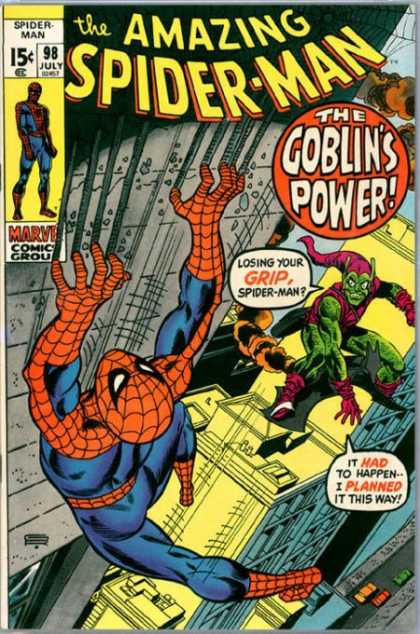


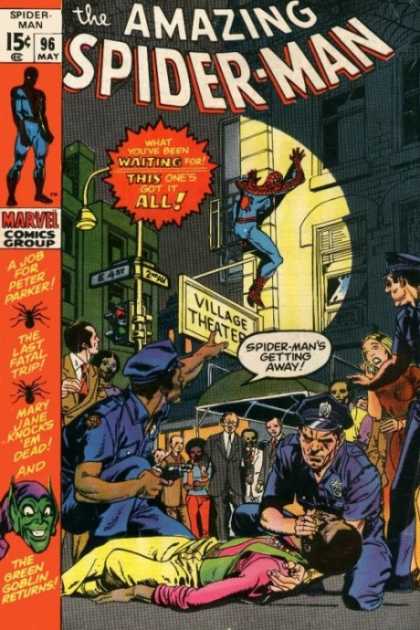




 Doug: In their biography of Stan Lee, Stan Lee and the Rise and Fall of the American Comic Book, authors Jordan Raphael and Tom Spurgeon discuss the "drug issues":