Showing posts with label Dan Adkins. Show all posts

Friday, July 1, 2016

Who's the Best... Doctor Strange Artist?


Redartz: With the Doctor Strange film coming up before the year is out, it seems appropriate to pay some love to the remarkable array of great artists the good Doctor has been blessed with...

Steve Ditko
Gene Colan
Dan Adkins


Frank Brunner
Marshall Rogers
Michael Golden


Paul Smith

Friday, May 13, 2016

Guest Review - "We Wouldn't Want You to Miss Your Own Execution" - Batman 353


Doug: After a week off due to Civil War festivities, Thomas F. is back with another review. Today he has a treat planned for us: a late Bronze Age Batman book featuring the Joker with art by Jose Luis Garcia-Lopez. And who can get enough Garcia-Lopez? Not us!

Batman #353 (November 1982)
“Last Laugh”
Gerry Conway-José Luis Garcia-López/Dan Adkins
Colorist: Adrienne Roy


Thomas F.: This is a slightly shorter tale than usual—only sixteen pages as opposed to the conventional twenty or twenty-two (in fact, just as many pages’ worth of space are allocated to the promotional Masters of the Universe insert—which looks pretty good by the way, with art by Curt Swan and a Superman appearance in Eternia!). As a result, writer Gerry Conway must perforce concentrate more on the plot than on characterization, because he has to wrap up this “done-in-one” story fairly quickly. On Bat-tales that spread out over several issues, Conway is better able to flesh out his characters, making them more complex and defined. Not so this time around, regrettably, with the exception of the secondary characters, who are token henchmen in any case and don’t warrant any depth.


José Luis Garcia-López filled in as guest-penciler for this issue, and the result is superb. Dan Adkins inked the interior story, but JLGL inked his own cover. Adkins did a decent job; his strong inks complement and vividly enhance JLGL pencils. Incidentally, JLGL was the primary promotional illustrator for DC—it was his version of Batman, Superman, Wonder Woman, etc. that was featured on popular merchandise, from t-shirts to lunch boxes to bed sheets, etc. JLGL also created DC’s 1982 Style Guide, a thick handbook containing a plethora of character summaries and stock artwork of superheroes in archetypal poses. In the Eighties, other illustrators on the DC payroll—especially newbies—invariably referred to the Style Guide as if it were a religious tract.


JLGL’s Batman looks bright, athletic, and energetic. The only downside to JLGL is that his Batman doesn’t appear as dark and grim as he should be. I find that other Bat-artists render a darker, more menacing version of the Caped Crusader. JLGL’s Batman just doesn’t look like a night-time stalker of evildoers; he’s a bit too squeaky-clean.
 

As a side note for interested Bat-fans, this late Bronze Age Joker story was reprinted in Batman: King Tut’s Tomb, a trade paperback volume released in February 2010. It collected “A New Dawn,” the multi-part tale from Batman Confidential #26 to #28. More importantly, two other early Eighties Bat-tales illustrated by José Luis Garcia-López were also added—specifically, “A Cannon for Batman” from The Brave and the Bold #171, and “The Mystery of the Mobile Museum!” from The Brave and the Bold #164. JLGL fans might want to get their hands on it for these three reprints themselves.

The story opens with the Joker engaging in target practice with a crossbow, using life-sized posters of Batman as his target. Once the Joker feels he has sufficiently honed his skills, he exits the room to confer with his hoodlum associates. 
The Joker’s current hideout is the historic Tatch Hotel, now out of service and a condemned building. In an irreverent tone, the Joker announces to his henchmen that he has returned and claps his gloved purple hands for attention, but one them, a gambler named “Craps” who is enjoying a lucky streak with his dice, openly ignores him and continues playing.


The Joker jovially chides him for his momentary lapse of respect, squirting Craps with water from the toy flower pinned to his suit. Craps recoils, thinking that the liquid is deadly, but then realizes the liquid is harmless and calms down. The Crown Prince of Crime lulls Craps into a false sense of security by saying: “Thought I was going to use the poison flower-squirter, eh Craps? Silly man. That would have been boorish … I try never to use the same joke twice.
Then the Joker, feigning forgiveness, shakes Crap’s hand, and a live snake uncoils itself from around Joker’s arm and sinks its fangs deep into Crap’s wrist.

Craps has just enough time to shriek out in horror before the snake’s rapid-acting venom takes effect, killing him. Somehow, the snake’s venom contained some of the Joker’s brand of lethal poison, because as Craps is lying on the ground, his lips can be seen twisted into a ghastly Jokeresque rictus grin.


It occurs to me that the Joker’s homicidal tendency to murder his own goons should make them reluctant—if not outright unwilling—to work for him. After all, no doubt word has spread throughout the underworld that working for the psychopathic Joker is likely to have lethal consequences. The Joker often haphazardly discards his subordinates as casually as one would toss away a chewing gum wrapper. In fact, the Joker is just as likely to kill one—or all—of his own cohorts as one of his enemies. And yet, the Joker apparently has no trouble recruiting hoodlums.
Perhaps the prestige of working for Batman’s archfoe and Gotham City’s public enemy number one, plus access to the Joker’s limitless funds, are enough to tempt Gotham’s hoods into taking a chance, however hazardous it may be.

Next, the Joker orders another thug named Leo to “clean up.” The compliant hood takes careful aim with a shotgun and swiftly dispatches the venomous snake. Now properly humbled, the Joker’s assembled gangsters pay close attention as he begins to unveil the details of his latest plan. The Harlequin of Hate shows his cronies the front page of a newspaper, “The Gotham Post.” (Or is it “Press?” It’s not possible to tell, because the Joker’s fingers are partially obscuring the title). On the cover there is a photograph of Gotham City’s General Station, and the caption above the image informs us that the landmark subway terminal is scheduled for demolition. 
At this point, the focus switches to a subplot that has no bearing on the main story being recounted here, although it is intriguing. It involves a former Gotham City councilman, Arthur Reeves.
 
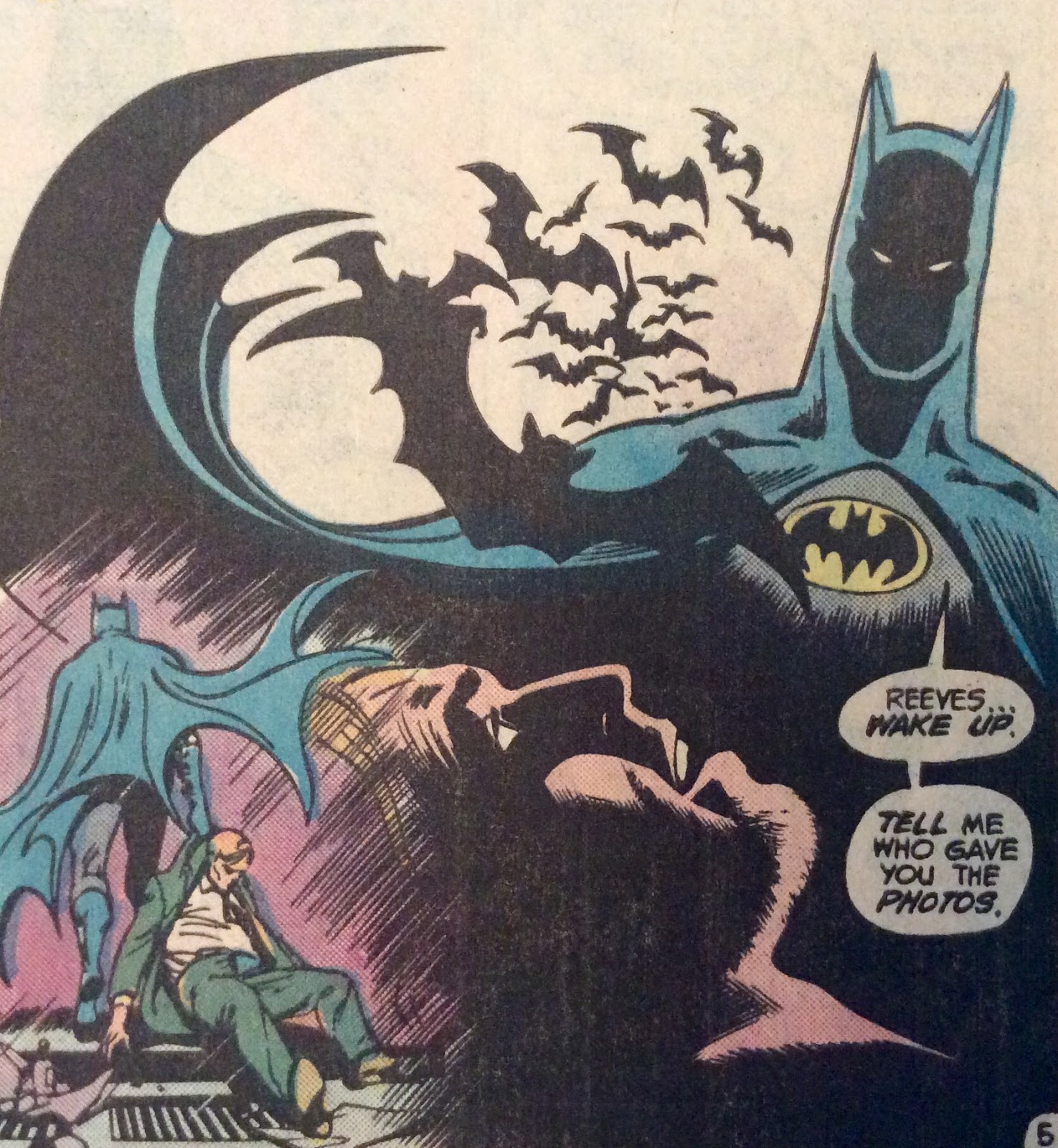
The terrified ex-politician is briefly pursued on foot by Batman, who uses a batarang with a cord attached to trip him up. Once in Batman’s clutches, the Caped Crusader compels Reeves to admit that top crime boss Rupert Thorne was the one who supplied him with doctored photographs that “revealed” Batman was actually a leading Gotham gangster. After confessing, nearby lights blaze on, and we see that Reeves’ admission has been overheard by Robin and the recently fired Commissioner Gordon. (Gordon had been dismissed from his position by corrupt Mayor Hamilton Hill, one of Thorne’s conniving stooges). Robin takes Reeves away, and Batman and Gordon discuss the underhanded political schemes afoot at city hall.

The following day, live at the historic Gotham Central Station, television newscaster Olivia Ortega explains in front of rolling cameras that the historic landmark is to be “torn down in the name of progress.”


On site, we see Bruce Wayne musing to himself about how photographer Vicki Vale asked him to meet her there, where she will be snapping shots of the event for her employer, Picture News Magazine. Bruce ponders to himself about how Vicki seems moody and withdrawn, and he wonders what is nagging at her.


Again, unrelated to the present story, we learn that Vicki—in flashback form—is brooding about how she witnessed a clash between crime boss Rupert Thorne and her publisher, Morton Monroe, and how the upshot of the unpleasant dispute resulted in Monroe putting a bullet through his own head.


Back to the present: a technician sporting a hardhat explains to newscaster Olivia Ortega how it is the city’s intention to preserve the façade that adorns Gotham Central Station. Explosives affixed to the façade will be set off in sequence in a controlled demolition by a special “computer-controlled fuse.” The technician further explains that the detonation will “pop” the façade off its perch onto “waiting air mattresses” so as not to damage it. To demonstrate, he moves to the control panel and presses a large red button. To his bewilderment, nothing happens. Examining his equipment, the technician discovers the main computer is missing, but on a monitor can be seen the image of a clown. Standing nearby, Bruce Wayne instantly recognizes it as “the sign of the Joker.”

This segment of the story brings to mind the early Eighties fascination with the personal computers that were then all the rage in America and widely available to the average citizen—the Apple, Atari, and Commodore, et al. And of those who were keen on electronics, who can forget the IBM PC, which had just recently exploded onto the market in August 1981. So absorbed with the novelty of personal computers were the masses that the major villain of the 1983 movie Superman III was a supercomputer gone rogue.

Fifty minutes later, the scene cuts to Wayne Manor, where Alfred Pennyworth is wondering why Batman wasn’t informed that the Joker had escaped from Arkham Asylum, which is standard police procedure. Bruce Wayne clarifies that with Gordon no longer Commissioner, Batman has been kept out of the loop by the new corrupt city officials.


It seems that the Joker is always escaping from Arkham—what agency is responsible for the subpar security measures in effect there? Granted, the Joker is an evil genius and fiendishly cunning, but it occurs to me that whatever agency is in charge needs to drastically overhaul their equipment and personnel.

A land purchase search conducted on the terminal in the Batcave reveals that ten acres of land on the Palisades in New Jersey were bought by a Mr. Harlan Quinn, and only an obtuse reader would fail to realize the buyer’s true identity. Speeding out of the Batcave in the Batmobile, Batman reaches the Palisades an hour later, where he reasons to himself that since the Joker purloined a “demolition-computer from a construction site,” the Crown Prince of Crime intends to carry out his own personal demolition project.

After scouting around the Palisades, Batman finds sticks of dynamite planted in strategic positions along the cliff’s edge, connected to a remote-controlled fuse. Suddenly, Batman is started by a sound behind him, but as he whirls around, the Joker fires his crossbow, and before Batman can react, a drug-tipped arrow strikes him in the chest, rendering him unconscious.

Why the Joker chose to add a medieval weapon to his deadly arsenal is anyone’s guess. If the Joker were more practical he would have used a lethal arrow, and would thereby be rid of his archnemesis once and for all. Of course, such a death would not be as elaborate or grandiose as what the Joker has planned, but it would do. The Dark Knight awakens to the sound of the Joker’s mocking voice, only to find himself strapped down to the edge of a cliff.

While Batman is helpless, the Joker takes the opportunity to gloat about his megalomanical plan (something virtually all of comicdom’s insane villains tend to do when they perceive they have the upper hand). The Joker explains his intention: to use carefully-positioned explosives to carve out a gigantic Joker-head on the edge of the cliff, not unlike the sculpted heads of the four presidents on Mount Rushmore. This will create a larger-than-life monument of the Joker’s image for posterity. In his usual gleeful, maniacal way, the Joker informs Batman that he will become a permanent addition to the new structure, as he will be buried under tons of rocky debris once the charges detonate.


Elated, the Joker moves away with his henchmen to the computer screen, where he views a computer-simulated image of the detonation’s aftermath. “Lovely, just lovely!” the Crown Prince of Crime croons to himself. He muses about how Gotham’s citizens will react the following day when they rise to see an enormous Joker’s bust peering down at them.


Meanwhile, with his adversaries no longer paying attention to him, Batman tugs and strains at his bonds. He manages to fray the heavy rope against a rough section of the rock, and succeeds in freeing a hand. And with his free hand, he clicks a handheld signal jammer.
 
 
In front of his paid cronies, the Joker pushes down the red trigger button, but to his chagrin discovers that it doesn’t work. Suddenly Batman appears, free of his bonds. He reveals that he anticipated the Joker would put the stolen computer to fiendish use, and devised a special signal jammer that would effectively nullify the Joker’s computer signal.

Then a frustrated Joker utters some of his worst dialogue of the story: “Cleverness is a highly overrated virtue, Detective! Cleverness can make you dead!” The Joker’s thugs charge the Caped Crusader, who hurls one brute over his head, and knocks out the others with a flurry of haymakers and uppercuts. The Joker stands by, ready with his crossbow, but his men are directly in his line of fire. He shouts that he is out of drug-laced arrows and left with nothing but “stainless steel points.” He fires a lethal arrow at Batman and miraculously manages to hit Batman’s signal jammer, destroying it and triggering a reaction that sets off the explosives. (This is probably the least plausible scene in the story, since the signal jammer had been stored away on Batman’s utility belt for safekeeping—it looks like a one-in-a-thousand shot).

Everyone topples off the cliff into the river. In the water, Batman seizes the Joker to prevent him from drowning. (Yet again Batman bothers to save this homicidal murderer of hundreds). Suddenly Batman turns about, only to receive a nasty shock: the Joker’s monument is a success! Beside himself with joy, the Joker chortles that he won after all, but Batman tell him to take another look.

 
And to the Joker’s dismay, his glorious bust crumbles into thousands of pieces. Apparently, the destruction of Batman’s signal jammer caused the Joker’s explosives to explode out of sequence, upsetting the delicate procedure. In the background, a police boat arrives, carrying armed officers ready to haul the Joker away and pull out the other survivors. 
This was a fairly light Batman vs. Joker tale, typical of what I was accustomed to from DC as a child growing up, and full of the Joker’s malicious mirth. Still, it’s inexplicable how Batman can at times be “chummy” with him. The Joker’s scheme was an ambitious one, but pointless. Even if he had succeeded, the authorities would have unquestionably taken it upon themselves to destroy the Joker’s façade afterward anyways. I can’t help but find the Joker appealing, though—he has the horrifying charisma of a psychopathic cult leader, and one cannot help but be simultaneously repelled and attracted to his peculiar brand of chaos.

Monday, December 28, 2015

Why Can't We Be Friends? Tales to Astonish 100


Tales to Astonish #100 (February 1968)
"Let There Be Battle!"
Stan Lee-Marie Severin/Dan Adkins

Doug: You don't mind if I submit Exhibit A in the conversation of "The Cover Was Way Better Than the Book", do you? Today's review has as its subject a comic I've long wanted to read -- the cover does it for me, right? About a year ago I picked up the second paperback volume of the Marvel Masterworks Incredible Hulk. I now have reprints of the original 6-issue series as well as the entire Tales to Astonish run. What I'd love to do is get my hands on affordable reprints of the Hulk ongoing that commenced during Marvel's expansion on the cusp of the Bronze Age. Anyway, I read this story around a week ago in preparation for today's presentation. I think we have a case here of the cover being so enticing that it really would be tough for the interiors to hold up. So why...?


Doug: To begin, my judgement of the book is framed not by any first impression. The title is typical late-Silver Age bombast from Stan Lee, and the splash page is interesting if overly crowded by text boxes (a whopping seven of them -- count 'em!). Hey, here's a great comic book question for you, that sort of ties into current events: You know how there's political talk that Americans (and citizens of other nations, too) have ceded some of their civil rights in the post-9/11 world, what with all of the surveillance cameras that permeate our public spaces? That cannot be a 21st century phenomenon, can it? Here we see Namor checking out the Hulk in the American southwest, and you know Dr. Doom, Reed Richards, the Avengers, and lord knows who else were always on some visi-screen creeping on a guy (good or bad). My impression of this mag was really carved out by the first half of the story. It's just such a fabricated story -- it certainly smacks of "Hey, it's our 100th ish, and what would you think of having the stars of both halves of the book tussle in a full-length brouhaha?!" Let me give those of you who've not read it a few specifics --

Doug: Namor decides to ally with the Hulk, basically because he'll be twice as menacing with the Green Goliath beside him. He swims off in search of ol' Greenskin, but encounters an experimental hydrofoil that fires on him. Game on. The ship's crew radios their "master", and we don't have to wait to see who it is -- it's none other than the Puppet Master. And what a rendition of Phillip Masters Mirthful Marie Severin gives us! Wow, man -- imagine if Mr. Clean, Lex Luthor, and Wilson Fisk somehow had a child (I know...blech!!). And to make it worse, the get-up he wears, with the big "P" on the front. Oh, my. So Masters is mad that Namor mixed it up with the sailors and ended up wrecking the hydrofoil he was in the process of stealing. Revenge, revenge, revenge -- because that's what super-villains do. Masters decides, since the Hulk is on the news, that he'll craft a puppet of that beast and use him to pay back the Sub-Mariner. So long story short, this is how our two combatants are brought together. The cover touts this yarn as an epic 22 pages (double-sized from the usual 10-pagers enjoyed by Hulk and/or Sub-Mariner fans); Namor and the Hulk fight for 16 of those pages! If I was 10, I'd be beside myself. But as a stodgy middle-aged connoisseur of slugfests, not so much. I should mention that as the Puppet Master gains control of the Hulk, Rick Jones gets mildly knocked around by the purple pantsed one. This of course continues the running subplot of "Thunderbolt" Ross and Major Glenn Talbot needing just one more reason to persecute the Jade Giant.


Doug: OK, so what was not to love? Severin's art was fine. She was never one of the top shelf talents in Marvel's bullpen, at least to my eyeballs. But she was solid and steady -- certainly capable and she delivered the goods here. The fight scenes have some power, emotion, and even a little tension. A criticism I'd make is that she draws the Hulk on the small side -- in fact I'd argue that she draws him smaller here than even the Thing should be drawn. If the accepted tale-of-the-tape for Monster-Banner was 7 feet tall and 1000 pounds, then this Hulk looks closer in size to his alter ego. She also does a nice job of conveying that Namor is generally out-classed by his adversary, and thus does a good job of changing locales of the battle, being sure to incorporate some water scenes. Her various facial expressions are nicely rendered.


Doug: So it's not Marie. It must be Stan's script then. And here is where I think my problem rests. We have a 22-page story with a 10-page plot. I really think that this possibly could have been designed for one half of the book and then Stan decided to fill it out to a cover-to-cover clash of titans. I'm not keen on the Puppet Master as the catalyst, either. C'mon -- a grade-Z baddie? Why bother? All Namor would have to do is look at the Hulk wrong and they'd start fighting. So that the Puppet Master was employed didn't get it with me. Stan's script overall just wasn't up to his Silver Surfer, or Fantastic Four or Amazing Spider-Man that he'd have been writing at the same time. Nope -- this effort seemed like it came from a guy who viewed the assignment as perhaps down his list of things to do. So while this wasn't the worst story I've ever read, I think I'm just so colored by my expectations of the potentiality.

Doug: But that's a sweet cover, isn't it?

Monday, November 23, 2015

War Games and Redemption - Detective Comics 492


Detective Comics #492 (July 1980)(Cover by Jim Aparo)
"Vengeance Trail" and "Chapter Two: At War With General Scarr"
Cary Burkett-Don Newton/Dan Adkins

Doug: Our pal Edo Bosnar, he of the frequent comment and occasional guest post, has long advocated the artistic talents of Don Newton. Upon his repeated recommendations I purchased (via eBay - sweet deal on a new but shelf-worn copy) the Tales of the Batman: Don Newton hardcover. I'll be scanning from that source today. The book contains 22 long and short Batman stories, and I have to declare that I really like what I've seen so far from Newton. The artist unfortunately met an early demise, passing away in 1984 at the age of 49; his comics career had lasted only a decade, and we're worse off for it. For those of you who are fans of Michael Golden, I think you'll see a little Golden in the scans I'll present today; I sometimes get an Alan Davis vibe as well. I chose this particular issue because of the presence of Batgirl. I know many readers eschew the derivative characters and/or sidekicks, but I've always been a sucker for the likes of Supergirl, Batgirl, and Kid Flash. So bear with me -- just sit back and enjoy the pretty pictures.

Doug: There are certain characters of a Spartan demeanor -- can't break 'em. Alfred Pennyworth would fall into that category. But it's a tearful Alfred who awakens Bruce Wayne on a sunny morning. Alfred weeps over a copy of one of the Gotham dailies and tells his employer to look at the headline. "Batgirl Slain by Assassain" is splashed across the top, with a photo of the heroine lying face down on the sidewalk. Bruce grabs his Batman costume and heads for the cave; Alfred just holds his head in his hands. Once down below, Batman phones Commissioner Jim Gordon to offer his condolences over the loss of his daughter and to get intelligence on the investigation. Gordon ask him to come to the house -- there's something he should know. But a few moments hence, Batman enters to find that Barbara Gordon (Batgirl) is very much alive!

Doug: Batman knew it all along, as Gordon's voice betrayed the truth. Batgirl relates her story of coming into contact with an assassin who was gunning for her. The newspaper had detailed that Batgirl had been blasted by automatic gunfire and had fallen 18 stories to her death. The reality was that there was a Batgirl dummy hanged from a flagpole that hung out from the building. Batgirl had taken fire and had been knocked over the precipice, but despite her wounds she'd managed to catch the flagpole. Pulling a knife from her utility belt, she cut the dummy loose and it fell the remaining 15 stories to the pavement. She crouched in the shadows as the gunman peered over the rooftop, assured that his work was done. Cary Burkett wrote this story, and I have no record with his work. But it seems silly that, since the gunman had hung the mannequin to lure Batgirl into the open, he'd perhaps have assumed that maybe it wasn't the real Batgirl laying in a pile beneath him? By the way, we'll learn in chapter two of this story that the gunman had actually taken a little girl hostage, and that's what had initially interested Batgirl. It's an important detail that would have worked much better here at the beginning of the story. I had hoped to not have to go to my "Oh, but this is a Bronze Age DC" place. I'm going to try hard to stay out of it.

Doug: The real shocker comes at the conclusion of Batgirl's story when she tells the Dark Knight that she's through -- that she could have died has proven to her that crimefighting as she's been doing may not be for her. Batman is bewildered by her stance, and Batgirl storms out at the pressure she feels she's getting from both Batman and her father. The two men are left alone, and I must say I was surprised at Gordon's take: he tells his old friend that he supports his daughter. After all, he never would have chosen this life for her. We then scene shift to downtown Gotham, where a General Scarr is holding court with a bunch of nasties. Although we've not heard of him prior, Scarr is apparently a bigtime crime boss in Gotham City. His Agent Cormorant is receiving a medal for killing Batgirl; some of the assembled toughs think it's silly to go on like this, but they seem to tolerate Scarr's eccentricities. The group moves to the planning room, where they plot against the revenge mission they know the Batman will soon undertake. There's a trap laid, and they can't wait.


Doug: Batman found a tag in the Batgirl costume worn by the dummy, and follows it to the shop from which it was sold. As usual, he's operating under cover of the night, and uses no light as he enters the shop. Moving silently through the store, he doesn't see Scarr's men hiding. Back at the Gordon household, Barbara is in her father's study holding some of the memorabilia from his police career. Gordon enters and they have a conversation about his career. In the exchange, Gordon says, when asked about the constant danger, "Frankly, there were times when I felt I couldn't take the chance any longer! I guess I thought about what would happen if everyone gave up -- if nobody was willing to take the risks to fight crime! Somehow I felt that if I didn't do my part to help people, then I couldn't expect anyone else to!" You see right where this is heading, right?

Doug: The Gordons' conversation continues as we're taken back to the costume store. Gordon's narration of his admiration for the Batman, his training, his perseverance, is side-by-side with the attack by Scarr's goons. They open fire with machine guns, and the Batman barely avoids the first bullets. But as Gordon says, he's no normal man and takes the battle right at his assailants. Newton's choreography in this scene is fantastic, with a great blend of emotional close-ups and drawn back action panels. The colorist (Adrienne Roy) also does a great job in this sequence. Of course the Batman beats the odds, and his victory comes as Gordon tells Barbara that Batman defines what a hero is and does. Batman grabs one of the bad guys, the only one who is still conscious, and gets information from him that Scarr is behind things. Batman calls Gordon to inform him, and Gordon leaves the house. Barbara stands at the window, lamenting that she cannot now even fight her own battles.

Doug: We cut then back to Scarr's headquarters, where his men from the costume shop are back on their feet and reporting that they'd let the Batman get away. Scarr's hearing none of it, though, and has Cormorant put a gun to the head of one of the men, dressed in a knight's suit of armor. Scarr orders the man to remove the helmet, and it's revealed that the Batman had actually gotten into a costume (as many of the men had done for the initial ambush at the costume store) and had left the shop with Scarr's own men! Scarr asks him if he doesn't think that this "Trojan Horse" ploy isn't a bit old? Scarr goes on a rant about how smart he is -- Batman counters with the truth: Scarr never made it past private! Scarr tells the tale his way, narrating a blah blah blah of how his superiors never respected his talents, etc. In his mind, the army even tried to kill him in a combat drill -- the source of his facial scar. So he deserted, and swore he'd build up his own army. This is apparently how he came to be a crime lord in Gotham City, although again -- even the Batman had only heard mention (he says) of this guy before this issue. Part One of the story ends with Batman's hands chained above his head, his feet dangling inches from the floor. And oh yeah -- there's a firing squad awaiting Scarr's orders!


Doug: Part Two commences with Batgirl on the rooftops, her arm still in a sling. She tries to swing between rooftops, but has no balance with only one useful arm. So she does what only Spider-Man would do -- she hits the pavement and hops into an idling cab. She asks the driver to take her to the Krak de Chevaliers building. When she's been working the case earlier, she'd noticed a security passcard in the shirt pocket of Cormorant. It's really the only clue she has to go on, and hopes it pays off. Arriving at her destination, she's met by a security guard, but a right uppercut takes care of his diversion. Grabbing an elevator, Batgirl begins to ascend toward the floors where she'd heard a ruckus. Upstairs... ruckus indeed! The Batman is doing his best to swing away from the gunfire that's meant to kill him. He manages to use his legs to grab Scarr, who had ventured too close (idiot). As the two men swing about, we learn that the Batman had palmed a lock pick as the men were binding his hands. He drops Scarr at the moment his hands come free, so you know it's game on. You'd think these thugs would know.


Doug: Scarr makes tracks, fast, to a control room where he seals himself. Before Batman can get out of the "execution room" the doors all slam shut. Soon sliding panels open to reveal miniature tanks, firing real shells! Moments later, fighter planes enter the mix and Batman is ducking and dodging for his very life. In a separate viewing room Cormorant is watching the festivities. We see Batgirl enter the room through a door left ajar. But she's filled with self-doubt and wonders to herself if she'll be able to attack the man who thought he'd killed her. And that ends up being her ace -- Cormorant turns to meet her and he's so freaked out that she's alive that he falls to his knees, begging for mercy. Batgirl uses her good hand to smash Cormorant's face against a wall. Minutes later she uses an acid vial in her belt to burn through the lock on the door behind which Scarr is gleefully watching the mechanical attacks on Batman. Batgirl also dispenses a little manual justice to Scarr, and it's mission over. Batman is freed from his "danger room" and Commissioner Gordon and his men arrive to clean up the mess. Scarr tosses an insult Batgirl's way as he's hauled away, but Batman turns it into a compliment, helping to restore Barbara's confidence.


Doug: While this wasn't a horrible Batman story, it wasn't the greatest. The art definitely carried the day. I did enjoy the inclusion of Batgirl, although when I sat down to read it she was not treated as I'd thought she would be. The character was, however, redeemed at the end of the tale, and it was refreshing to see someone other than Batman save the day (although he certainly did his share of extraordinary things). I think the other thing worth mentioning is the length of the story. At 25 pages, it's indicative of the value the reader received when purchasing a Dollar Comic. The original material ran five pages longer than a typical story, and there were three more yarns included (also all new, to the best of my knowledge) -- a "tales of Gotham" story and adventures featuring Man-Bat and Robin. Talk about 60 minutes of pure joy!

Wednesday, February 18, 2015

If There's an Original Art Heaven, This Must Be It - A BAB Book Review


Doug: Wow. Just WOW! If you've been around here for the past week, you know I've discussed my sales of original art and the income said sales netted. You'll also recall that I decided to treat myself to a couple of purchases that ordinarily would fall waaaaaaaayyyy outside my budget. But hey -- when a guy comes into $6000, what's he to do? That's right: scoop up a couple of IDW's Artist Editions, that's what! And I did. Last Saturday I remarked during our conversation about all of the cool John Buscema art with which I've recently parted company that my order from InStock Trades arrived that very afternoon. I was like a kid on Christmas morning! And today I want to tell you and show you (to the best of my ability) what I bought. I'll be using straight photography from my iPhone today, as I did not want to incur a hernia trying to lift these tomes onto a scanner.


Doug: We briefly batted around some ideas about shipping in last weekend's conversation. Let me tell you -- the boys in Memphis who packed my books left no doubt that those babies would get here safe and snug. I've included several photos of the packaging, just because I was so overwhelmed at the care. That photo above to the right is the bottom quarter of the Gil Kane box, and I'd say there was a good 4" of static-free packing peanuts between it and the top of the box. The John Buscema box, resting just below the Kane box, itself sat on an inch of packing peanuts. Soft landings, to be sure!


Doug: Even the interior boxes are reinforced, as you can see a cushion around three sides of each volume. The design guys at IDW just did a fantastic job here. Obviously the labels on the outside tell the warehouse folks what to pull, but it's not an unattractive box to use henceforth for storage. And I am pretty sure that will be necessary, as these books are massive and heavy! Each book's tale of the tape goes like this:
Gil Kane's Amazing Spider-Man (216 pages) - 12.5" x 17.25" x 1.25" (it is seriously a thick book!)
John Buscema's Silver Surfer (144 pages) - 12.5" x 17.25" x 7/8" (looks like a 98 lb. weakling next to the Kane volume!)
Doug: The art directors at IDW really made each of these books seem top-shelf with the outer color schemes on the covers that carry over into the frontispiece and table of contents pages. I've included a couple of looks below:


Doug: Here are the contents of each book:
Gil Kane: Amazing Spider-Man 96, 97, 98, 99, 100, 101, 102, 121 (all complete), and pages from 89 (10 pages of Spidey vs. Doc Ock), 92, 103, 104; 96, 101, 131, 149 (covers), John Romita's covers to 121 and 122 are included because of their significance to this compilation, and 122 (pages 1 and 23).
John Buscema: Silver Surfer 5, 6, and 8 (all complete -- issues 5 and 6 were double-sized at 39 pages apiece), and pages from 1 (3 pages, including the transformation sequence from Norrin Radd to the Silver Surfer), 7 (1 page), 9 (3 pages with the Ghost and Mephisto), 12 (1 page), 13 (3 pages), 14 (10 pages with Spider-Man), 15 (5 pages with the FF), and 16 (splash); 1, 2, 2 (unpublished), 9, and 10 (covers).
Doug: You may be asking yourself "How did they get all of this original art, and what happened if they couldn't?" In the Gil Kane book there are a few pages that are photocopied from some other source -- it's clearly noted at the bottom of the page that the original art was unavailable so a scan was used. That thought occurred to me as well, just based on the Avengers page I sold a couple of weeks ago. No one would have had that to photograph. So speaking of photographs, that's what these books are chock full of -- high quality photos of the original art, shot in full color. The blue line shoes up, light pencil lines are there, as are margin notes. Residue from tape is present, and White-Out is, too. The first page I want you to look at (and clicking on it will give you a larger view) is this Spidey page. Check out all the White-Out in Gwen's hair, as well as on her nose:


Doug: I've heard some collectors quibble about such blemishes on the art page, but I LOVE IT!! For me, the attraction of the original page was seeing the process of creation -- erased pencil lines, White-Out, blue line pencil, paste-ups when just a panel needed editing, etc. My excitement level went through the roof whenever I received a page I'd purchased and some of those sorts of "issues" were present. It's still a work of art -- I perceived it to be more dynamic when I could get into the minds of those whose hands had crafted it.


Doug: The choice for paper is perfect. It's a reasonably heavy stock, but with a matte finish. You can tell from my photographs, which were shot with only natural light on a mostly cloudy day that there is no glare. It was a perfect choice for really exposing the nuances of the original pages.


Doug: As to choices for content, I can't think of a better package than what made it into the Gil Kane book. That we get to look at two of the best storylines of the early Bronze Age in the Green Goblin drug issues and the six-armed Spidey/intro. of Morbius is just awesome. And that they went that extra mile and included Amazing Spider-Man #121 is a bonus beyond my ability to express gratitude. I paid the MSRP of $125 for the Kane book and I'm not at all going to quibble about it.


Doug: I'd lie if I didn't say the Silver Surfer book would have reached the stratosphere had it included the original art for issues 1 and 4, that fourth installment being among my very favorite comic books. But again, I understand that the major factor in production is accessibility to the art in the first place. So the inclusion of issues 5 and 6 is a fine decision -- I'm not going to scoff at the opportunity to indulge myself with 78 pages of Big John originals. I think the fact that the editors could include the two-page transformation scene from the inaugural issue is some nice icing on this cake.


Doug: So what's next for me? Depending on how my sales continue, I definitely still have my eyes set on the Joe Kubert Tarzan Artist Edition. As of my recent order from InStock Trades, the Tarzan book was still discounted nicely. Also of major interest is the volume that reprints several Marvel covers from the Bronze Age and beyond. Having watched a YouTube review of the book, it's really representative of Marvel's great stable of artists -- Arthur Adams, John Buscema, John Byrne, Gene Colan, Jack Kirby, Frank Miller, George Perez, both Romitas, George Tuska, Mike Zeck, and many more. Take a few minutes to watch that video -- the reviewer does a nice job of showing samples of all of that luscious artwork. NOTE (2/17/15 9:30 PM CST): Well, I had a guy who owed me quite a bit of money pay up -- now I can ship his art out! And I will confess that I gave into the temptations I just discussed. Yep -- the Tarzan and Marvel Covers books will be coming my way very soon.


Doug: Lastly, here's a listing of all of the Artist Editions from IDW. It's a great cross-section of the talent that has brought so much joy to all of us. I know several of our regular readers will see artists on that list whose work you've especially enjoyed. As I've said a few times today, these books aren't for everyone price-wise, but if you have that love of original art as I do, and if resources present themselves such that you can treat yourself, I highly recommend these volumes for your collection/library. I think once you open that outer box, you'll join me in feeling live you've gone to Original Art Heaven.


Related Posts with Thumbnails