Showing posts with label J. Jonah Jameson. Show all posts

Monday, October 17, 2016

Clap for the... Man-Wolf - Creatures on the Loose 30


Creatures on the Loose #30 (July 1974)
"Full Moon, Dark Fear!"
Doug Moench-George Tuska/Vince Colletta

Doug: We're about to let October sneak away without much Monster Mayhem. Pretty uncharacteristic on the BAB, huh? I'll do my part today with a review of the first solo outing of John Jameson, the Man-Wolf. You may recall that the character debuted in Amazing Spider-Man #124 (September 1973), and the story finished an issue later. He next menaced our favorite Web-Spinner in Giant-Size Super-Heroes #1 (June 1974), and then won this ongoing series the very next month. Again, it's strange to see a so-called "super villain" as a headliner, but with all of Marvel's other monster-type mags at the time, this seemed fitting. Fitting, particularly if Spider-Man might cameo for marketing purposes. He did, of course, but the series was more notable for the George Perez art that came our way after a few issues of George Tuska.

Short plot summary, you said? Sure! Here -- have a 100-Word Review:

Our tale opens with a raging Man-Wolf crashing through an upper floor window. Immediately we flash back to a time when John Jameson and his father, Daily Bugle publisher J. Jonah Jameson discussed John’s situation concerning the moonstone that had become grafted to his neck. We’re told that John becomes a werewolf when the moon is full, and sure enough… Back in the present, the NYPD hires former CIA agent Simon Stroud to solve the “werewolf problem”. With clues garnered by the police, Stroud confronts JJJ, and begins to track the younger Jameson. Their encounter ends atop the Statue of Liberty!


The Good: I chose today's review strictly on its monster merits. Truthfully, I had no idea about the level of satisfaction I'd have upon completion. It was not a waste of my time. If I can open this secton with a general comment, it's that the story was all set-up for the most part. Spider-Man actually did not appear, and thus the purpose of the events in between these covers was the creation of a storyline and new supporting cast of characters. In that regard, it's a simple story with really no surprises. But as I said, that was OK.

The character of Simon Stroud seemed a bit bold for being former CIA. Let's just say that if he was a spy of any caliber, he forgot what he learned. He's brash, a real "warhawk" in terms of hunting werewolves, and he's certainly not afraid to be dangerous in public. But it's this over-the-top sort of guy who fits right into the Bronze Age, when we all agree comics might have been a bit more brash, like Stroud. I'm guessing in a "Fugitive" sort of way, Stroud made for a good antagonist. We're also reminded that John Jameson has a lady friend, his fiance' Kristine, but we only see her in a portrait smashed by the Man-Wolf.

I'm going to slot the art in this category, not because it was great, but because I got what I expected. It seemed in the mid-70s more often than not George Tuska was paired with Vinnie Colletta. Vinnie's feathery touch really didn't do Tuska any favors, as the penciler by this time perhaps needed a stronger line. I thought the art on humans and objects was pretty good, but the Man-Wolf seemed to lack something, maybe around the ears. Not bad, just not quite as the team of Gil Kane and John Romita first imagined the character.

In the spirit of Dick Sprang and those huge Silver Age Batman backdrops, the Statue of Liberty was a nice scene for the climactic battle.

The Bad: So Stroud was a good character for this story, said I, and I'll stand by that. But he's a loud guy, and by that I mean what I also alluded to above -- there doesn't appear to be any sizeable amount of stealth in this fellow. I just felt that scribe Doug Moench might have given him a different background than ex-CIA.

I wasn't sure what to make of JJJ. He was written sympathetically, and that's not the first time (or last) it would happen. But for there to be only one panel of his bravado, his megalomania... it almost seemed like I got short-changed.

The Man-Wolf presents a problem akin to Man-Thing -- a protagonist who does not speak. And similar as well to the muck monster, there's nary a thought balloon either. This is the only solo Man-Wolf adventure I've ever read, so if this changes later I'd appreciate being informed. I guess it can work. But honestly, when the Man-Wolf was on-camera here, he was just running amuck. Nothing else. That could get boring in a hurry.


The Ugly: You know I'm usually at a loss to put anything in this section. It's not often I strongly dislike any elements of the comics I read. But in the era at hand, I've come to really notice some of the cartoony faces Tuska draws. In a humor mag I'd probably laud them as caricatures. But in a horror story it's an odd mix -- terror from the fangs of the Man-Wolf, yet goofy-looking mugs on other characters.


I'd welcome any thoughts from our readers who were able to go beyond this issue, deeper into the Creatures on the Loose Man-Wolf series. Karen reviewed a couple of these stories several years ago. I'd be especially interested in thoughts on the art of a very young George Perez, and I thank you in advance.


Monday, February 23, 2015

A Time of Marvels: Marvels 1


Marvels #1 (January 1994)
"A Time of Marvels"
Kurt Busiek-Alex Ross

Doug: What's this? A comic book review that's not in our "Arc of Triumph?" series? Yep -- we told you that in our revised "anything goes at any time" schedule we'd try to get back to doing our famous (shoot, world-renowned!) partner reviews. So here you go. And no, we didn't pick this just to rile the Alex Ross haters among our regulars... Although we'd lie if we didn't say we joked about it back in the planning meeting! We don't know how long it will take us to get through these four issues, but we can tell you we're looking forward to taking another look at this landmark series.

Doug: As I was getting myself mentally prepared for this write-up -- you know, brain calisthenics and such -- I was struck with the notion that this series may have been every bit a part of the 1990s and all that was wrong with it. I don't mean that in the sense that this was a sub-standard story (as much of the 90s was filled) or that the creators were "trendy". Instead, I was thinking about the format. You'll peek back to the top of the post and see the cover date was the very beginning of '94 and I'm wondering if this book was the first to sport a "premium" cover (not a variant, but a fancier material)? If you've never owned the periodical version of this story, you may not know that each issue featured a full-page painting by Ross (in today's case, of the Original Human Torch) layered over by an acetate cover that featured a black printed border with the appearance of die-cut lettering at the top. Of course numerous knock-offs ensued -- lots of painted books, and Marvel copied itself with the acetate overlays for a couple of issues in the big "Atlantis Attacks" annuals cross-over.

Karen: I'm using the hardback edition from 2008, which includes Marvels #0 as well as numerous sketches, promo art, and photo references. I nearly forgot about the goofy acetate covers! Before I started reading I tried to recall my mindset at this particular time. I was only buying comics occasionally, having a hard time getting back into regular series. Like many other people, my mind was completely blown by Alex Ross' art. I couldn't believe he was painting comics! The absolute realism of it all sucked me right in. And Kurt Busiek's history wrapped up in an everyman tale was handled masterfully.

Doug: I am reading from the trade paperback that has Giant-Man on the cover -- not sure of the year, but it also includes the Torch story from Marvels #0 (which I just love). Hey, how exciting was it when the Torch was spied in one of the early scenes of Captain America: The First Avenger? Anyway, I really don't remember how or why I bought the first issue, but I do recall meeting Alex Ross at a small comic show near O'Hare right after the first issue came out. In fact, he was giving away the promo poster for the series, which featured the cover of Marvels #2 (the Angel taking flight). I had a nice chat with him, and he autographed the poster; it still hangs on the wall of my comic room. I agree about Busiek's script -- there is just so much detail! No way this was done "Marvel method" -- Ross must have received exhaustive notes from Busiek. Of course, knowing Alex's appreciation for comics history, I am sure he had a mighty hand in the plot and execution of this story.


Karen: There are so many things we could talk about here, just with the first issue. Of course, through-out the series we are peppered with cameos, of both celebrities and sort of displaced comic book characters. I just love getting to see a very young J. Jonah Jameson as a beat reporter back in 1939, already annoying everyone around him.


Doug: I am pretty certain that ol' JJJ is never named in this story. I can check again, but I made a conscious effort when reading this last week to see (because my memory told me that on previous readings he had not been identified). But of course we all know who he is. I thought it was a nice homage to Marvel in general to make Martin Goodman the publisher of the Daily Bugle. And Ross's depiction of Goodman was spot-on. I also enjoyed the cameos in this first issue, including Clark Kent and Lois Lane, and what looks to be a very young Billy Batson peddling newspapers. Those sorts of "Easter eggs" really made this a visual treat on top of your aforementioned praise of Ross's realistic paintings.

Karen: You're right, JJJ is never named as such, but that haircut, the mannerisms, little phrases ('when I run the Bugle') -it's pretty much obvious, and delicious. But Busiek makes him more than a caricature; JJJ earns his stripes, chasing down stories and facing the catastrophes these 'Marvels' bring. It actually provides some depth to his later hatred of Spider-Man and other super-heroes, if you consider he saw Namor nearly drown all of New York! Two other notable cameo appearances are Popeye (why?) and a young Nick Fury, not in the war yet. I like how Ross draws him with a shadow over his left eye. Another great Easter egg of a sort is Ross' homage to Edward Hopper's 'Nighthawks' painting when Sheldon and JJJ have a run-in with the Torch late one night.


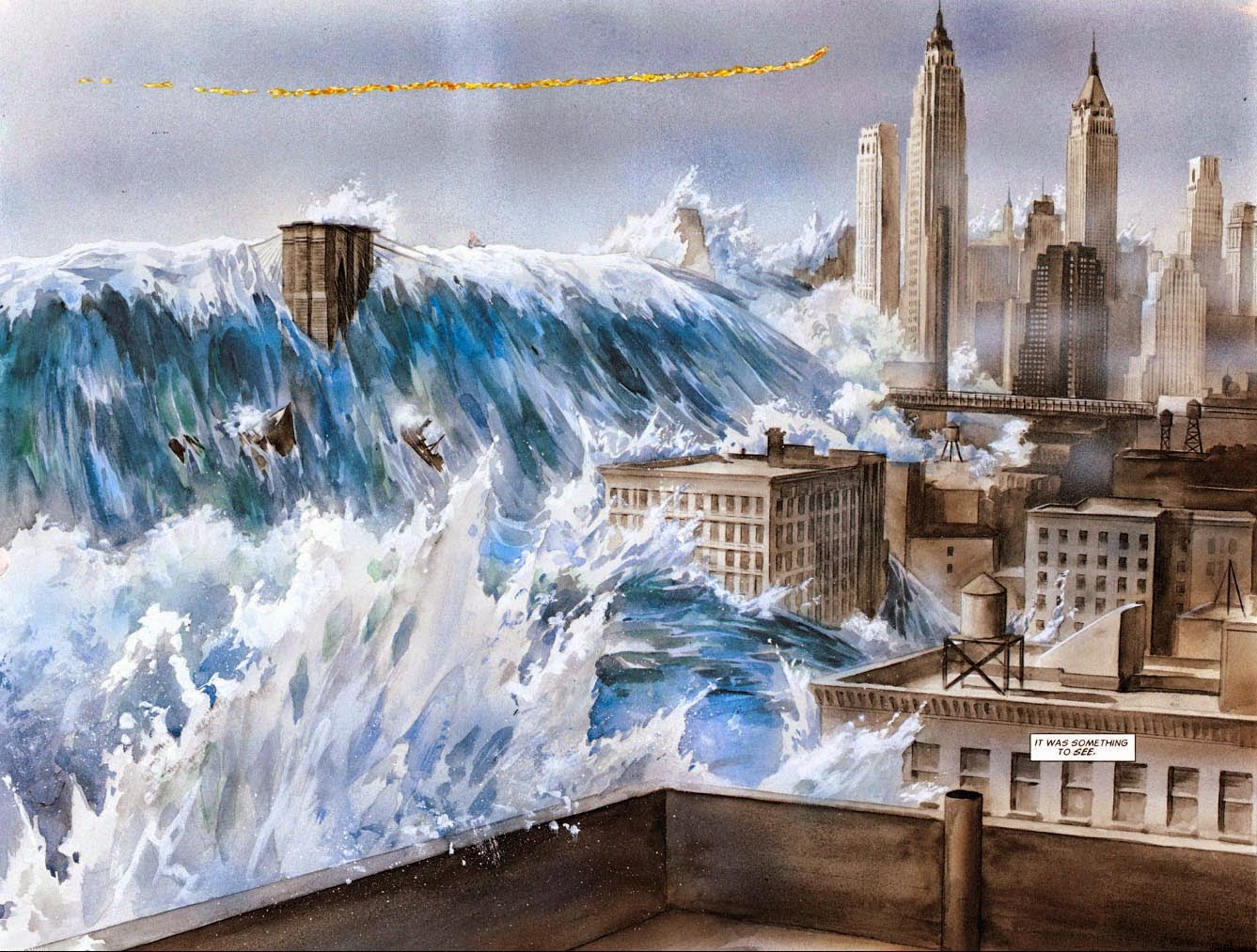
Doug: Of course the story also had a few "weirdities", such as Namor prancing around in his birthday suit. I have a reprint of Marvel Comics #1 (which actually reprinted the Crown Prince's first appearance from Motion Pictures Funnies Weekly) and the Sub-Mariner was wearing his trademark trunks throughout. So in spite of a heaping helping of his naked butt, I did enjoy the way Ross drew his ankle wings. They were huge! And c'mon -- if they actually were going to be used for flight, they'd have to be larger than the way we've generally seen them depicted. The panel where the Torch engages Namor and they wrangle over a steel girder is a lot of fun, and I've always loved the 2-page spread of the tidal wave crashing onto New York with a tiny Human Torch streaking across the top of the image.

Karen: Yeah, naked Namor...I did a little research and came back empty handed, so to speak. I couldn't find anything from Ross that indicates why he chose to do that. I suppose the logical conclusion would be that someone living underwater wouldn't wear clothes. But it did surprise me when I first saw it. Interestingly, in the back of my book, hand-written next to some of the sketches for Namor it says 'Freddie Mercury' but I don't think he wound up looking much like Queen's lead singer in the finished product.

Doug: Busiek did a solid job of making Phil Sheldon an interesting protagonist. I think his point-of-view is very believable, as an ordinary man who has come through the Great Depression with a renewed optimism, yet distressed at the coming events in Europe. But the arrival of the "Marvels" makes him feel small, and insecure as a man. His worry about being able to protect his loved ones, and whether it is wise to even consider bringing children into such an unsettled future drew me in. But his reverence for Captain America was noteworthy. As remarked in the story, he was "one of ours", and that set him apart from the Torch and Namor. 

Karen: The American public, ever fickle. It was completely believable to me that the crowd was swayed by the newsreels to suddenly accept the Torch and Namor as "our" boys. And then Captain America come on the scene -so big and strong, perfect chin, wrapped in the red, white and blue -well, he was manufactured to be The American Hero. Don't get me wrong, from childhood to now, I've loved Cap and that sense of honor, justice, morality, all the qualities that made Steve Rogers a hero regardless of the Super-Soldier formula. But let's face it, he was a pre-fab hero, before there was even a Madison Ave marketing racket to push him out. 

Doug: I think in Busiek playing up the hot/cold aspect of the crowd he was playing along with a trope Stan Lee had used throughout the Silver Age.

Doug: So you're saying Cap was a forerunner of the Monkees? 


Karen: Ha! You and I have been doing this so long, we're so in synch -I almost said "like the Monkees!" But yes, the way Cap is built up for the public, it's PR at least, propaganda at worst. Phil Sheldon's concern over both the war in Europe and the rise of the super-beings is understandable. But his decision  to delay marrying his girlfriend Doris -I don't know, maybe because I'm a woman, it all seemed rather foolish. The idea of having to "protect" her, and not being able to do that in the face of these new beings, diminishing him, making him unworthy -he really had an inferiority complex going on here! Not that it's an impossible reaction but it seemed a bit like he was running away to me.

Doug: I agree that Sheldon seemed off base with his line of thinking. Why wouldn't he feel better about protecting Doris if he had married her and could be around her more? You know, above you talked about how quickly the crowd turned, but Busiek does a nicely subtle job of showing really how their world turned. At the beginning of this first issue Sheldon remarked how they'd beaten the Depression and how everyone's spirits were up -- they were invincible. Yet just a few months later Hitler had become a serious focal point in all their lives, and the advent of the Marvels complicated life even more. I think Steve Martin's album "Let's Get Small" could have been a mantra. But hey -- if Phil hadn't decided to abandon Doris, we'd have not had the pleasure of being introduced to Willie Lumpkin!

Karen: I did smile when I saw Willie Lumpkin -or 'Bill.' And hey, Mickey Rooney was in the theater audience too.

Doug: Alex Ross flirted with racism just enough to really give some of the war scenes a bit of Golden Age authenticity. His depiction of the Japanese soldier bordered on caricature, but stopped short of crossing that line. Busiek did include the term "Japanazi", which again was a nice throwback to a different time.


Karen: Was "Japanazi" a term that people actually used back during the war years? I've often wondered if it was something made up in the comics... I don't know if I've seen it anywhere else. ...OK, I looked it up and apparently it was a term used on war posters of the time period (I saw a few, including one with Popeye), so I suppose it's legit.

Doug: I have all of the Fleischer Superman cartoons on DVD, and I think the term is used somewhere in those. But I could be misremembering (that's so Brian Williams...). So what did you think of that last scene -- the assault on the Nazi stronghold? Sort of made the Invaders look like the minor leagues!

Karen: It's a breath-taking scene! I love the high, overhead angle -I know we've talked about Ross overdoing it recently on some covers with the odd angles but this one really works for me. I could identify eight of the ten heroes but had trouble with two of them. The ones I recognized were Cap and Bucky (and this Bucky is quite obviously a kid, being carried by Cap the way he is), Namor, the Vision, the Destroyer, and the Black Widow (none of these three related to the later Marvel versions), the Blazing Skull, and the two Torches. From the reference section in the back of my book, I found the identities of the other two: the Thunderer and the Black Marvel. These are some pretty cool-looking cats. More appealing than most of the Liberty Legion! I know some of these characters have been brought into current or recent books, like the Skull and original Vision.

Doug: Yes, Ross's depiction of the very young James Buchanan Barnes does fly in the face of Ed Brubaker's thoughts on the character's age during the war. Personally, I always thought of him as Ross does. However, I fully accepted that he must have been closer to 16 in the Liberty Legion story that ran through Invaders #s 5-6 and Marvel Premiere #s 29-30. And in regard to the coolness of those Golden Age heroes: I have so tried to get into that material but it's just so difficult. The art and the stories are so crude as compared to the stuff we focus on (late 1960s-mid 1980s) that I just can't do it. I've several times been ready to pull the trigger on the Golden Age volume in the Marvel Firsts series but have always talked myself out of it.

Doug: In our next installment, we'll delve into Marvels #2 and the dawn of the Silver Age! No promises when that will be, but this has been fun getting back into the "what we do around here" of comic reviews.

Friday, January 2, 2015

BAB Firsts (the 1st Partner Review): The Comics Code Authority: Revised to Relax


This post was originally published on July 13 2009

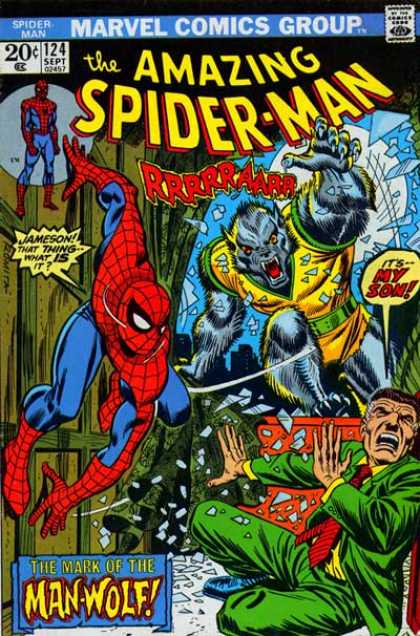
Amazing Spider-Man #124, September 1973
“The Mark of the Man-Wolf!”
Gerry Conway/Gil Kane & John Romita

Doug: Welcome to our initial installment of an on-going series on post-Code comics. Periodically in the coming weeks and months we’re going to discuss Marvel’s venture into previously forbidden territory: werewolves, zombies, vampires, demons – you name it. If it was too violent or too occult, then it was too much for the Seduction of the Innocent-inspired Comics Code Authority!

Karen: I’m sure everyone knows that the Code was established in 1954, in part in response to the EC Comics of the day, which often featured gruesome stories of the macabre. The Code was very restrictive, and outlawed the depiction of zombies, vampires, werewolves, and so forth. It was not until the Code was revised in 1971 that monsters were again free to prowl the comic racks! At least, vampires and werewolves were; for some reason, zombies were still off-limits (although Marvel got around this by calling them zuvembies!).

Karen: So Marvel decided to jump on the monster bandwagon. Many new monster characters began appearing in the 70s, including the subject of this review, the Man-Wolf. In an interview in Comic Book Artist #13, then-Marvel editor Roy Thomas describes the birth of the Man-Wolf:

“Stan just wanted a character called Man-Wolf. It was that whole Marvel-flooding-the-market- thing! If you’ve got Dracula, you can have Morbius. If you’ve got Werewolf, you can have Man-Wolf. We didn’t have a concept for Man-Wolf, and Gerry (Conway) and John Romita were trying to come up with something. My only contribution was to say, ‘Hey, make it J. Jonah Jameson’s son! He was an astronaut, and he went up in space, and he found a moon rock, and it turns him into a wolf!’ Just like Morbius was a science-fictional vampire, we could make Man-Wolf a science fiction werewolf.”

Doug: As any true Marvelite will know, Amazing Spider-Man #124 comes only two months after the fateful events that concluded in ASM #122 – the deaths of Peter Parker’s long-time love Gwen Stacy and his most dangerous enemy the Green Goblin. In fact, Spidey thinks to himself (and to clue us in) that it’s only been 10 days since those deaths.

Karen: It’s interesting to me how Peter is shown as trying to get past the death of his girlfriend – at one point he thinks, “All I want to do is forget---start my life over again.” I think Conway hit this right on the nose, as I’ve seen this sort of thing in a number of male friends and family who have lost someone. For some, there’s a desire to avoid dealing with the pain and to just begin anew.

Doug: Do you think, though, that when Conway tells us that it’s only been 10 days that there is a slight reconciliation of time problem for the reader – after all, for him/her it had been 60 days! Ah, the old discussion of Marvel-time vs. real-time…

Doug: Conway is at the top of his game in this story. You know, every time I read a Bronze Age-era story, I’m just overcome with joy at the characterization, the amount of words per page, and the use of narration boxes and thought balloons to move the story along. Conway, of course, currently works as a screenwriter and one can see how he cut his teeth back in the day in the storyboard-like genre of comic books. He nails J. Jonah Jameson and Robbie Robertson – their verbal sparring is spot on given the way Stan Lee used to write them. Conway also gives us a great deal of emotion in Peter, fully displaying his anguish and insecurity over the events of the past two weeks.

Karen: I know what you mean Doug; you actually have to spend 20 minutes or more reading these old books! When I read a new comic, it’s usually done in 5 minutes! Personally, I like the thought balloons and captions; it gives us a way of seeing in the characters’ heads that’s not afforded by current methods – which apparently are driven by the idea that comics should be like movies, which is ludicrous; they’re two distinctly different art forms.


Doug: The art in this story is by Gil Kane with embellishment by John Romita. This is a nice combination – I’ve often felt that while JR’s Spidey is the quintessential look for the character, Kane brought back a little bit of Ditko-esque presentation to the book. Kane tends to be longer, sinewy, wiry. Romita, while his pencils were graceful, didn’t have quite the same pell-mell look to Spidey that Ditko had begun. Where Romita really adds to Kane’s linework is in cleaning up the faces and giving them a consistent look with which we’d grown familiar.

Karen: Kane was the artist on the title when I began reading it. But I was aware of Romita because of Marvel Tales, and I’ve always thought of Romita when I think of Spidey. That being said, I like Kane’s depiction of Spidey for the same qualities you mention: the leaner look is appealing. I enjoyed Romita’s inks because it also meant I didn’t have to look up everyone’s nose! I never understood Kane’s obsession with that…

Doug: Gil Kane’s noses – no doubt!! Noses were the main thing that put me off toward Kane when I was a kid. As an adult, I’ve really come to appreciate his work (particularly his Silver Age Green Lantern and Atom for DC).

Doug: The basics of the story are this: We are reintroduced to J. Jonah Jameson’s son John. To the best of my knowledge, John was last seen in ASM #42 (which is also the first appearance of Mary Jane Watson), and hadn’t been seen since. John is an astronaut, reportedly the last man to walk on the moon. Jonah is justifiably proud of John, and even more so when introduced to John’s fiancée. But John holds a secret, contained in the necklace he wears. A side observation here, yet pertinent to the story: in his original appearance, John was a redhead but in this book his hair is some shade of gray. But think about it – have you ever seen a red werewolf? Anyway, John does indeed turn into a werewolf, and of course ends up in pitched battle with Spider-Man. We are left with an approaching sequel to that battle as our last-panel cliffhanger.

Karen: I always liked the look of Man-Wolf. I suspect that he was gray so as not to be confused with Marvel’s other lupine hero, Werewolf by Night! Manny also had a more bestial look to me – more of a snout than WBN. But you’re right; Jameson had reddish hair in his previous appearances. He also re-appeared in ASM a few times after ish 42. In issues 55-58 he was the security chief for a special project (“The Nullifier Weapon”!) and even met Robbie Robertson then, something that obviously neither Gerry nor Roy remembered! He showed up for a few panels in issues 71 and 88 as well.

Karen: It occurs to me that Manny is one of the few gray-colored characters to stay that color. Of course the Hulk started as Grayskin and became Greenskin, and the Beast, who had mutated into his furry form just a year before this comic came out, was also originally gray, but quickly became blue – because there are so many blue-furred animals in nature!

Doug: You are a reference goddess, Karen! As you can see, my laziness has arisen to bite me on the behind. So, with minimal effort I will provide a link to the Marvel Wikia, which will give the curious observer not just the above-stated young JJ appearances, but all of his appearances on Earth-616: http://marvel.wikia.com/wiki/Category:John_Jameson_(Earth-616)/Appearances

Karen: A nice aspect of this story is that it gives us a chance to see Jonah as something other than just a comedic foil for Spidey. Every once in awhile, Stan would show us that there was more to J.J.J. than all his bluster, and Conway does it here too. His feelings towards his son illustrate that he was more than a one-dimensional character.

Doug: Back to the Code for a second – I have to ask, after reading this story: What was so bad about the werewolf angle? There wasn’t any blood, there wasn’t really a graphic use of Man-Wolf’s claws – really nothing that would scare or alarm a reader outside of normal (whatever that is!) super-baddie behavior!

Karen: I think the Code had really been devised for the more gruesome comics of the 50s; under Stan, Marvel books always had action, but very little real violence. In this story, Man-Wolf is no more violent than any other Spidey villain. I don’t think that was necessarily the case with the stuff EC had put out, although I doubt it would have turned kids into psychopaths. I think Werewolf by Night was a little more graphic, with the Werewolf actually attacking people, but again, at least in the color books, the violence was minimal. It was just the way Stan wanted to do things, to keep the comics mild enough for kids.

Karen: Next time we’ll look at the exciting conclusion to our tale!

Monday, August 26, 2013

There Must Be Some Misunderstanding: Amazing Spider-Man 161


Amazing Spider-Man #161 (October 1976)
"...And the Nightcrawler Came Prowling, Prowling"
Len Wein-Ross Andru/Mike Esposito/Dave Hunt

Doug:  Hey, after that Marvel Team-Up 3-parter we just concluded, let's fast forward about three years and look in on some team-ups in Spidey's own mag.  We're going to conclude the month (and actually stretch just a couple of days into September) with a throwdown involving Spidey, Nightcrawler, the Punisher, and the introduction of Jigsaw!  So on with it, then!


Doug:   Man, I was excited to purchase this one off the spinner racks just after I'd turned 10.  I was already hooked on the All-New, All-Different X-Men, and that this story opens in the Danger Room of all places was about all I could handle.  Nightcrawler's perusing a copy of the Daily Bugle during what appears to be a lull in the normally-death stakes workouts that Cyke usually prepared for the new team.  Wolverine seems especially mischievous and totally out-of-character as written by Len Wein here -- I really got a bad vibe from the normally abrasive little psychopath.  Anyway, Wolverine bounces off a trampoline and cuts the cord on the high ring from which Nightcrawler was hanging.  As he falls, Kurt rips the paper in half and comes up fighting mad.  Colossus has to intervene, as you know Wolverine popped his claws at the first sign of trouble.  Nothing comes of it, and Kurt takes the high road and stalks off through an open window.

Karen: Doug, I was also very excited to see Nightcrawler guest-starring in ASM, as he was my favorite X-Man. I realize that I always gravitated towards the stranger-looking characters in books. Nightcrawler filled that bill in X-Men, but it was also his personality that pulled me in. Of course, when Dave Cockrum was drawing the book, Kurt got more of the spotlight, but that changed when Byrne came on-board. I agree with you regarding Wein's handling of Wolverine -- seems a bit off. For comparison's sake, also cover dated October 1976, was X-Men #101, so we'd seen Wolverine in that title for eight issues at this point (not counting the Giant-Size X-Men nor his Hulk appearances). I think by this time we had a decent idea of his personality, and this kind of practical joke/maniacal laughing stuff just doesn't fly with what we know about the runt so far.

Doug:  Cut to Coney Island, where Peter Parker and Mary Jane Watson are on a wild rollercoaster ride.  Peter does a good job of feigning fright and sickness, and once he, MJ, Harry Osborn, and Liz Allen are back on solid ground, they head over to Nathan's Hot Dogs for some refreshment.  But in a Spidey mag, nothing's ever as easy as it seems, and sure enough -- Peter turns back toward the coaster just in time to see a man shot in the head by a sniper!  Doing the usual I've-gotta-get-pictures-for-the-Daily-Bugle routine, Pete dashes away to switch to his web-slinging duds.  But also on the scene, and unbeknownst to Peter, is Kurt Wagner.

Karen: Even though I am a West Coaster born and raised, I have heard of Nathan's, so that was a cool inclusion. I want to note here also how fierce and demonic-looking Andru makes Nightcrawler look. It seems like he is all fangs. I always think of Kurt as such a nice guy!

Doug:  Very true in regard to his personality.  But what do you think is the most visually appealing aspect of his design?  In the Nightcrawler story we ran a little over a week ago, his thick mop of hair seemed to dominate my view of him, but in this story I'd say it's his hands (particularly in a scene toward the end of the story, which we'll show you).

Karen: His whole costume is unconventional, and I like how his inhuman appearance contrasts with his very human personality. I think Dave Cockrum (in his first go-round on X-Men) drew him best.

Doug:  As the shot is fired, Nightcrawler's lurking in the shadows beneath the rollercoaster.  Musing to himself that on that paper he'd accidentally torn up back in Westchester was a photo of an old friend, a carnival worker named Eric Hoffman, Kurt is now seeking to find the killer.  As he's moving through the shadows, he looks up to see the sniper, still holding a smoking rifle.  Bounding up and over the wall, Nightcrawler sees the shooter vanish into the roof's door.  However, instead of just teleporting through it and pursuing his target, for some reason he remains outside, tugging on the locked barrier.  I definitely did not understand that part.  Nightcrawler then leaps back to his starting point, where the rifle had been dropped and landed.  He wraps it up in a white cloth (found just laying around?) and thinks that he will turn it in to the police, who will need it as evidence.  At that point, he's knocked for a loop by a double-legged kick from some familiar boots.


Karen: I think there were plenty of opportunities for Nightcrawler to teleport in this story, but Wein was holding off until later in the fight, to give it more impact. 

Doug:  Spider-Man introduces himself in a most aggressive way -- it's funny to read this now and think that Kurt's surprise at actually meeting Spidey was genuine.  Nightcrawler had probably been in the States for less than a year at this point.  As you might imagine, a genuine tussle occurs, with neither combatant giving any quarter.  Nightcrawler eventually stuns Spidey long enough to get away, rifle in hand, but Spider-Man gives chase.  The battle moves to a ferris wheel, which is a cool visual as both heroes run up the spinning ride.  Spidey leaps at Nightcrawler, pinning him to the top of a car; the rifle falls to the ground.  Sensing this is turning futile, now Nightcrawler teleports away.

Karen: When Spidey punches Kurt it really looks powerful. I was always under the impression that Kurt's strength was just a wee bit greater than normal, so this would be a big mismatch, at least in strength. But in pure acrobatic ability - well, I'd think they're pretty evenly matched. I agree, the scene of the two running on the ferris wheel, with the view from above, is spectacular.

Doug:  Spider-Man goes to find his trusty camera so that the evening won't be a total loss (what happened to MJ, Harry, and Liz?).  Nightcrawler, again lurking in the shadows, sees Spidey swing away and also notices the camera.  Since it's far too early for the All-New X-Men to go public, something has to be done about that film.  So where was Spidey swinging to?  To see his buddy Joe "Robbie" Robertson, city editor at the Daily Bugle.  It's now late when Spider-Man arrives, and he surprises Robbie.  Spider-Man wants information on the snipings that have been going down, and Robbie tells him that the Punisher is suspected.  "Great", Spidey thinks... Just what he needs.  During the conversation, J. Jonah Jameson starts to enter Robertson's office, but then backs out when he hears Spider-Man's voice (why didn't Spidey's spider-sense go off?).  As Spidey finishes, he asks Robbie about fighting fuzzy forked-tail demons.  Robbie says he should have his head examined.  As Spider-Man swings away, JJJ goes back to his own office and removes a crumpled envelope from a locked drawer.  Sliding he contents out and spreading it around his desk, we see that someone has sent Jonah a series of photos... of Spider-Man disposing of the Peter Parker clone!

Karen: Oh that damned clone! Well at least we don't have to deal with that in this review. I always liked Robbie and Pete/Spidey's relationship with him. Robbie was that nice voice of reason in contrast to JJJ's hysterics. This was back when I actually thought the Punisher was an interesting character. He was still very much grounded in the adventure novels and crime films of the day, and despite being willing to kill bad guys, he still had a code. He wasn't a psycho, which I feel he eventually became in the 90s and on.

Doug:  We then get an interlude featuring the Punisher.  Ol' Frank Castle comes to a haven of underworld types, offs three of them, and gets the information he wants from one Joey Whisper -- who has been going around town pulling jobs in imitation of the Punisher?

Karen: Hey, he said he just wanted to talk! They didn't have to pull their guns on him.

Doug:  Spider-Man's out on patrol when he stops for a break, atop the 59th Street bridge and the new Roosevelt Island Tramway.  He's thinking that in his limited encounters with the Punisher, there's not been a single innocent harmed.  What's been going down just doesn't have his stamp on it.  Suddenly Nightcrawler appears and whacks Spidey upside the head, twice and hard!  Now tell me something -- unless Nightcrawler had trailed Spider-Man to the Bugle and away, how the heck did he find him?  Anyway, Nightcrawler grabs the camera from Spidey's belt and makes tracks.  Spider-Man gives immediate pursuit to Nightcrawler, who has now begun to traverse the cables of the tramway.  As the Wallcrawler catches up, Nightcrawler rips the film from the camera and tosses the device back to Spider-Man.  Well, that doesn't exactly please ol' Webhead, who right-crosses Kurt Wagner right off his perch.  However, in mid-descent Nightcrawler teleports and lands right behind Spidey.  Not to be taken by surprise again, Spider-Man shoots a web at Nightcrawler's chest and pulls him forward, only to sock him one -- knocking the mutant off the ironwork.  Both combatants end up lighting on the tram cables when a cable car comes along and stops right where they do battle.  And who should lean out of the car?  The Punisher, that's who.  He says he knows who's been impersonating him, and he's come to exact his own form of justice -- by killing that man!

Karen: I've said before that Andru doesn't do a whole lot for me. I don't dislike his work but I don't love it -- it's just OK to me. But I do really love that shot of Spidey swinging high above the tram tower. To me it captures the freedom and thrill of his web-slinging. It looks fantastic. Nightcrawler's assault on Spidey was fun -what was he doing, putting some sort of nerve blocks on the webhead? Those were strange moves. I love how he's apologetic about the whole thing -that's in character for Kurt. Their ballet on the cables was cool. Of course, having the Punisher make his declaration at the end of the book was the perfect cliff-hanger.

Doug:  I enjoyed this issue.  It's all basically set-up for next week's conclusion, but it was a fun, easy read.  You know, we've remarked over the past several weeks about fun issues being so easy to write about and clunkers can be difficult motivation-wise.  But other than some of my nitpicks with Wein's script (again, I'd have never caught those discrepancies when I was 10), the art job was pretty solid.  Mike Esposito and Dave Hunt did a nice job of softening some of the harsh facial expressions that Ross Andru could draw during this era.  I have no complaints on the storytelling, either -- this one was very clear as to what was going on, pacing, etc.  For my money, this was a decently-spent 20 minutes of my time.

Karen: I couldn't agree with you more about this issue. It moved along nicely, the plot was clear, characters were well handled (with that possible exception of Wolverine) and the art was pretty solid. After three weeks of some pretty awful reviews, it was great to have a solid issue to work with!

Related Posts with Thumbnails