Showing posts with label Frank Robbins. Show all posts

Thursday, April 14, 2016

If I Had a Buck... The Many Artists of Captain America


Martinex1: Captain America's costume has not changed much over the years that he has worn it.  Sure there were some more noticeable fashion updates in the past decade, but for the most part our star-spangled Steve Rogers has been known for his red, white, and blue, for his stars and stripes, for his winged head and his pirate boots, for his chain mail and his shield.   

It is interesting to see how different great artists depicted the American hero. So this $1 Challenge has a simple premise; here are 14 covers with Cap in charge, but all handled by different artists. Pick your favorites and discuss why that is.   There were so many great covers to choose from, so if you have a favorite you'd like to share, be my guest.

These are all in the Quarter Bin, so get a bang for your buck... four comics, four colors, four quarters...what can be better? 

Captain America #109; Jack Kirby.
Captain America #110; Jim Steranko.
Captain America #132; Marie Severin.
Captain America #140; John Romita.
Captain America #183; Gil Kane
Captain America #222; Ernie Chan
Captain America #225; Frank Robbins
Captain America #230; Ron Wilson
Captain America #241; Frank Miller
Captain America #254; John Byrne
Captain America #260; Allen Milgrom
Captain America #263; Mike Zeck
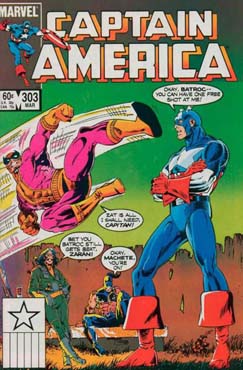
Captain America #303; Paul Neary
Avengers #340; Ron Lim (Okay this is a great Wasp cover too, but it is one of my favorite Cap covers of all time).


Monday, November 16, 2015

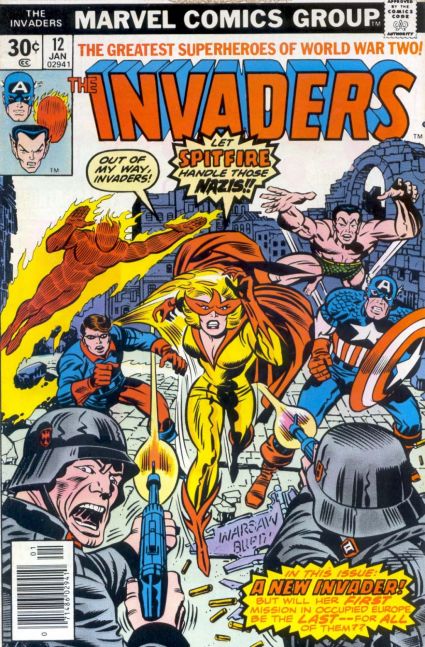
Dancing a Complex Step - Invaders 12


Invaders #12 (January 1977)
"To the Warsaw Ghetto!"
Roy Thomas-Frank Robbins/Frank Springer

Doug: I'll be proceeding with caution today, friends. Two reasons: No. 1 is the presence of Frank Robbins on the penciling. You know by now how I feel about that (his writing aside, which I enjoyed on many a Batman yarn). No. 2 is the title of the story. Our long-time readers know that I have done educational contract work for the United States Holocaust Memorial Museum since 2005. I'm just a bit leery to see how the Warsaw Ghetto (and largely the Holocaust) will be portrayed by the folks at Marvel. Fingers crossed. So the next obvious question would be, "But wait, Doug -- didn't you read this mag as a 10 1/2-year old?" The answer would be "yes", but the memory would say "Uhhhhhhhh...." You know what I mean. In spite of my strong reservations about the art on this title I was a regular reader when I could find it. I think I came on with the Liberty Legion crossover in #5 and stayed when I could through the end. I was never so happy to see Alan Kupperberg! I'll be reading and scanning from the Invaders Classic, Volume 2 trade paperback. Onward, then.

Doug: We open with the Human Torch (Original variety) flying through the night skies of London. He's mad at events that had just transpired, and we get a recap of some of the events of Invaders #s 7-11 which featured the "return" of Union Jack, the introduction of his daughter Jacqueline Falsworth, the introduction of a Professor Gold's Blue Bullet armor, the wounding of Jacqueline, and finally her healing after a blood transfusion from the android Torch -- which, by the way, gave her super speed! Got it? So the Torch decides he's going to the Tower of London to visit the now-imprisoned traitor Gold. After proving his identity to the Tower guards, our friend Jim Hammond is escorted to Gold's cell. Confronted, Gold says he's not interested in speaking about anything; he merely wishes his execution. But the Torch tells him he thinks he knows why Gold used the Blue Bullet armor to fight the Invaders on behalf of Hitler's Reich: Gold must be Jewish, and there must be more to his story.

Doug: Gold begins to sob, his head in his hands, and tells the Torch that his name was anglicized from Goldstein. He then begins to narrate his story. The Goldsteins were Hasidic Jews from Warsaw, and John Goldstein (the professor) had a younger brother named Jacob. Both boys were interested in science, John in physics, Jacob in geology. When September, 1939 came and the Germans invaded Poland, the Goldsteins were among the millions of Polish Jews who began to face intense discrimination. The Goldsteins were moved to the Warsaw Ghetto (this would have been late in 1940), but John managed to emigrate to Great Britain -- he does not say how, but does tell that his brother refused to come along. Once in England, Goldstein began to work on the Blue Bullet project. Until, that is, he was visited by a shadowy figure. The Torch puts all of the pieces together -- it was the Nazi agent who blackmailed Goldstein into turning the armor on the Invaders. Hammond ask him if the Invaders could get Jacob out of Warsaw, would the professor come back to the Allied side? In a minute, John exclaimed -- but only after seeing his brother alive. The Torch flew off, obviously with a mission in mind.


Doug: The Torch returns to his teammates and is met by Cap and Namor. Cap wants to talk -- you see, the Torch had originally flown off because when Jacqueline had awoken she jumped into Cap's arms. But it was the Torch who'd fallen for her -- now he couldn't see hanging around the team if he was going to have to see the girl he was sweet on chasing one of his mates. The Torch said he had not decided if he was quitting the team, and didn't want to discuss it. They had other issues with which to deal. So he told Goldstein's story, and it was Lord Falsworth who spoke first. The older gentleman voiced his regret that he'd not be able to join them as Union Jack. But just then, a female voice erupted from stage left -- it was Jacqueline, now sporting the costume we know as Spitfire! Of course the boys try to talk her out of it, but she baits them into a trial -- a trial she wins as no Invader can lay a hand on her. Lord Falsworth's again melancholy about the injuries he'd suffered earlier, but gives his blessing to his daughter to accompany the Americans (and Atlantean).

Doug: Namor's flagship transported the team into the heart of Europe, landing under cover of the night near the Warsaw Ghetto. As the team began their quest they came upon a couple of SS harassing a Jewish woman. Spitfire was the first to action, followed by Captain America. The fight did not last long. Cap speaks Jacob Goldstein's name aloud, and the German Jewess understands. Spitfire interprets her German, and they ascertain that Goldstein is in a book store not far away. The men go to him and tell they've come from his brother. But Goldstein says he's not leaving -- his place is in Warsaw with his books and his studies. And then one of the Invaders (off-camera, but I assume it was Cap) utters the first line in the story that gave me pause: "But all of you are in peril! Why don't you fight back?" Having studied this history for many years, I can unequivocally say that it just wasn't that easy. Goldstein tells him that the Jews must submit, and await the will of God. He even invokes an old Jewish belief from Prague -- that the Golem will save them. Cap loses it -- he screams about Hitler's atrocities, the camps and ghettos, and that Goldstein's brother can help them combat all this if Jacob will accompany them to London. As they argue, Bucky comes to the window and say they'd better get outside -- company's coming.

Doug: The Nazis bring a tank unit and the Invaders meet it head on. As you might suspect, this, too, is not much of a fight. Spitfire notices that one of the tanks had gone off to the side and has it's turret aimed directly at Goldstein and three others. The Invaders don't even debate surrender, quitting the battle immediately. A gas grenade knocks them all out (the Torch included), and they are captured. But Jacob Goldstein makes a stand, only to be kicked in the back and thrown to the ground. As the tanks roll back out of the ghetto, Goldstein says that he knows what he must do. And it's back to his bookstore, to fight back. The next issue title? "The Golem Walks Again!" You see where this is headed.


Doug: Although I didn't read it for detail, I did skim Invaders #13 so I could report to you how this 2-parter turns out. The Invaders are captured and bound in creative ways (think Batman '66). There's a Nazi thug who mocks them, but the festivities are broken up by the appearance of the Golem. He's big and bad, and wreaks havoc on the Germans. And at the end of the story Jacob still commits to staying in Warsaw, even positing that some day his people may rise up against their oppressors. It's a heroic, if tragic, monologue. And here lay my misgivings about this story -- to my recollection the only time this magazine dealt with the Holocaust. I wish they hadn't. Not because it's not an important part of the Second World War -- it most certainly was and is. But to introduce super-powered heroes to that narrative, to have them in the Warsaw Ghetto and so close to the Treblinka killing center without doing anything about the events that our heroes were obviously privy to... it just serves to increase the magnitude of the genocide and the missed opportunities for Allied intervention. Yes, this is fictional, but what of the real-world intelligence that had exposed these events to the West? What of the Allied leaders who had this information yet chose to remain focused elsewhere? "Win the War first." I get that. I also get that some 12 million Jews/non-Jews perished in the Holocaust. And like I tell my students -- don't dwell on those numbers that your mind cannot comprehend anyway. Instead, think of it as it happened, in human lives: 1 and 1 and 1 and 1. Surely the Invaders could have offered some succor to those trampled under Hitler's boots.

All that being said... would that have been even more disrespectful to the history?


Thursday, April 2, 2015

True or False: Bad Art Ruins Good Writing


Doug: ...and its antithetical question, also True or False: Bad Writing Ruins Good Art. Have at 'em!

Exhibit A is for the art -- I'm not saying the dialogue is akin to Shakespeare

I'm not saying this art is good, but hey -- the writing is by Bendis...


Monday, November 24, 2014

Arc of Triumph? Invaders 5,6, Marvel Premiere 29, 30


Karen: This four-parter, over four months, was the introduction of the Liberty Legion, the American homefront WWII super-team full of obscure characters that Roy Thomas plucked out of his old comics and brought back to give modern Marvel some history. I dug it, even if they didn't pop up too often. There were a bunch of artists who worked on these four books: Rich Buckler, Dick Ayers, Don Heck, and of course...Frank Robbins. Any thoughts on this hero-filled extravaganza?

Wednesday, November 5, 2014

Oh, I've Got to Set Myself Free

Doug: Today we'd like some lists, and some specifics attached to those ideas. As has been said, the main reason I moved away from the comics reviews and urged Karen to join me in our current "Arc of Triumph?" series was that the writing and art scanning just wasn't fitting in well with an increasingly busy personal life and professional schedule. So a few weeks ago I decided that I could use an hour or so of this new "free time" to just read some comics, sans the written summaries and opinions. I went downstairs and grabbed the Captain America and the Falcon: Nomad trade paperback off my shelf. I'd purchased it many moons ago, and had never taken the time to crack it open. As a kid, I had a buddy who had a few of the issues collected within, notably the Golden Archer issue that featured a wonderfully stupid rubber mask panel with Hawkeye. But I've long wanted to read the entire arc, so it seemed to be time.

Doug: The first several issues were a joy -- the Falcon solo, Steve Rogers wrestling with staying out of action after his retirement as Captain America, and some goofy villains like Lucifer and Aries from the Zodiac cartel. Author Steve Englehart was riding the crest of the wave he'd built up in the "Secret Empire" saga, and was keeping me entertained through the first half of the tpb. And then... and then it happened. Sal left. Gone. And in his place? Frank Robbins. Now I know there have been a few Robbins apologists among our readership through the years, and I'm not going to rain on anyone's parade by starting an argument. So I'll do what I do in my classroom when I have something of great personal import to bestow upon the young minds -- "Hear me: this is MY opinion!" and then I go on. I bought the Invaders mag for a long time, and never felt satisfied. Sure, the stories were OK, and I really liked the WWII settings. But that book never ever went all the way for me. And you get one guess as to why.

Doug: So here's my problem, and here's where you come in. That Cap/Falc trade has been sitting on the shelf of one of our end tables for a month now. It's half-read. And I am harboring serious doubts as to whether or not I'll pick it up to finish it! So what I want you to do today is reminisce on those books from the past where you had a little run going and then (either gradually or suddenly) said "I'm out!" List 'em, and tell what that impetus was for your departure. As is the case here, we're not doing any rip jobs because we're all mature and just flat-out nice in this corner. But we all have personal tastes, and it's just OK to not like something. I'm looking forward to some stories!


PS -- Doug: I wrote the body of this post on October 29. Later that evening I didn't have anything pressing to do, so I decided to pull the book out. Seriously -- I found that I could enjoy the first two Robbins-penciled issues if I did not look at the pictures. Seeing them only out of the corner of my eye I could allow Robbins to move me through Englehart's words and make sense of it all. But whenever I'd get to the bottom of a page I'd stop and give some time to the individual panels. And I'd miss Sal... I did see that there's a 2-issue break coming up where the art is by Herb Trimpe and it actually looks pretty good. Then it's back to Robbins for the conclusion. But if I'd been buying this off the rack way back when, I think I'd have dropped the book. It's just that jarring. 

Monday, May 26, 2014

Ain't a Rubber Mask Big Enough to Hide Those Ears! Detective Comics 407


Detective Comics #407 (January 1971)(cover by Neal Adams)
"Marriage: Impossible"
Frank Robbins-Neal Adams/Dick Giordano

Doug: Here we are, back with another Man-Bat tilt in the pages of Detective Comics. About two weeks ago I set out to review 'tec #400 and then realized, in all my glorious senility, that I'd already reviewed it! So I flipped through a few pages in my hardcover copy of Batman Illustrated by Neal Adams, volume 2, and found the next Man-Bat story -- 'tec #402. The last story was so good, and had a nice cliffhanger (Man-Bat laying unconscious on the floor of the Batcave), so I wanted to satisfy my own curiosity. And hey -- by today's title, you can see that one of true loves in the life of a BABer is coming up. The rubber mask.

Doug: If you'll recall, back in Detective #400, Kirk Langstrom got himself into this mess while creating a bat exhibit for the Gotham City Museum of Natural History. On this day, as Batman peruses the newspaper he finds that Langstrom's work is finally set to be unveiled to the public. Even more attention-grabbing is the next paragraph in the story where the writer tells that Langstrom will marry his childhood sweetheart, Francine Lee. Batman's off to the church as quickly as he can go. I found it odd that on the way, Batman thought to himself that Langstrom was "the deluded genius who secretly turned himself into a Man-Bat!" OK, I suppose Langstrom did do it to himself, and I suppose it was his fantasies of being like the Batman that caused him to research the possibilities, but what struck me about this line was Batman's former sympathy and genuine concern for Langstrom in the previous installment of this story. As the clergyman is about to pronounce Langstrom and Lee husband and wife, the Dark Knight swoops in and grabs... you guessed it -- a rubber mask off of Langstrom's head, exposing him as a Man-Bat!


Doug: Man-Bat took off to the heights of the cathedral, while his would-be bride burst into tears. Batman asked her why she was so upset -- that surely she could not have thought of going after Langstrom in his present form. Francine told Batman that if he thought her love for Langstrom ended that night not too long ago, he was wrong. The Dark Knight then thought back to that fateful night in the Cave, when Langstrom lay prostrate on the floor, his head battered by the closing door to the Cave as he'd sought to escape. Batman, knowing Langstrom had wanted an antidote to his present condition, took it upon himself to try to duplicate the serum. But where he went wrong was in talking to himself as Langstrom came back around. It would seem that the Man-Bat took exception to being called a "creature" -- the blow to the head had unseated Langstrom's former consciousness and left him an angry Man-Bat, now seeing things quite differently than he had only hours earlier. This Man-Bat saw Batman as inferior to him as a man, and as a bat. This Man-Bat had animosity on his mind.

Doug: Batman's alarmed at Langstrom's last comment as he left the Cave -- that he wanted to be a Man-Bat. Knowing he could not talk Langstrom down in the current state of affairs, Batman left the Cave to get Francine. Perhaps she could coax her fiancee from the shadows. But it was no go -- Langstrom had evidently fled the Cave through the same crevice he'd used to enter. Batman dropped Francine back at her home, and left a phone number at which he could be reached in an emergency. But soon after their parting, Francine heard scratching on her window pane. It was the Man-Bat, silently asking her to let him inside. She complied, and Langstrom started right in with a challenge to her -- could she look at him without being repulsed? She said yes, and leaped into the arms of the Man-Bat. But she hinted that she wanted him to change back to a human form; this angered Langstrom and began to show us the deepness of his mental changes. She offered to call the Batman for the antidote, but Langstrom ripped the number from her hands and destroyed it. Not only was he volatile, but borderline hostile. He asked Francine to unequivocally prove her love for him.

Doug: Francine was charged with going to the Museum and presenting the director with a request from Langstrom -- feigning illness, Langstrom had written a note requesting that Francine have access to his laboratory. The director complied, and Francine was able to gather a large case of materials to bring to Langstrom. We're not clear as to what exactly she brought, but let's just say that the next time we see Kirk Langstrom he is no longer a Man-Bat but his old self. You guessed it again -- the BEST rubber mask ever crafted! You get a look at that Man-Bat dude's ears? How in the world would you tuck those under a rubber mask?? So Langstrom goes to the Museum himself, and greets his boss. He requests to be able to finish the exhibit and then promptly slams the door in the guy's face. Once inside the gallery, he removes his mask and talks to the stuffed bats as if they were real. Bonkers...

Doug: Back at the cathedral, Francine finishes relating this chain of events to the Batman. She says that she is going to call Langstrom back to the altar and marry him. Batman tells her that her marriage would be a mockery; and then I think Frank Robbins left the typewriter and Bob Haney sat down, because Francine suddenly removes a rubber mask to reveal that she is a She-Bat!! Holy Coyote-Ugly, Batman -- it's the NEW best rubber mask ever crafted! The Dark Knight recoils in shock, as Francine's leathery arms suddenly appear from beneath her long-sleeved wedding gown. She takes to the shadows high in the cathedral's rafters, looking for her mate.


Doug: Batman barely evades a huge chandelier sent crashing his way by Langstrom, and then tries to figure out a way to get to the two bats before they fly off. Our hero truly wants to help them, but if they get out of the church, his chances are about nil. He quickly elevates to the bell tower -- the only place with open windows. As he arrives, Francine attacks from below by ringing the bell, throwing Batman off-balance. At about the same time Langstrom attacks, making Batman drop the vial of antidote he'd carried. But in a desperate effort to reacquire it, the Caped Crusader stretched his arm as he'd never stretched before and grabbed it. Taking it strongly in his right hand, he was able to jab it into Langstom's leg. As Francine moved in for the supplemental attack, he swung the needle at her, also connecting. The two bats fell to the landing of the bell tower, and slowly began to revert to their human form. And with their change in form came a change in their psyches. They were human again, and Kirk apologized to his fiancee for what he'd put her through. The Batman had been successful in his goal to heal Dr. Kirk Langstrom.


Doug: Although separated by eight issues and seven months, this 3-parter was really a lot of fun. As I remarked in my previous review, I had no prior experience with Frank Robbins' writing, but found him more than capable in handling the adventures of the Dark Knight. Of course I poked fun at the big reveal of Francine, but Neal Adams' rendition of that scene was just great. Really, we could perceive the Man-Bat character as a horror derivative, and Adams really hit a home run on that single panel. I'd recommend this "series" to anyone who digs Man-Bat; for most of us, I would guess our main exposure to the character came in the pages of The Batman Family. And oh how I wish I still had those in my collection!

Monday, May 19, 2014

On the Wings of the Man-Bat - Detective Comics 402, + Alex Ross Does Batman '66


Detective Comics #402 (August 1970)(cover by Neal Adams)
"Man or Bat?"
Frank Robbins-Neal Adams/Dick Giordano

Doug: Often Karen and I joke to each other, and even to our readers, how bad our memories have become. Well, today's a case study in that for me. About three months ago I scheduled my individual reviews through the spring on alternating Fridays (NOTE: due to scheduling necessitites, this post was adjusted in our queue to run today), as has become my custom. I had been thinking about doing some more Neal Adams Batman, and thought -- "Wow -- Detective Comics #400 would be perfect!" So I set it up, added the cover and the creator credits, and then forgot about it until late in April. One night I got out my copy of Batman Illustrated by Neal Adams, volume 2 and began to read that issue. It looked awfully familiar -- moreso than it should have, given the last time I thought I'd read it. Well, there's a reason for that. Into the first autumn of this blog's existence, Karen and I began to do "BAB Two-In-One" reviews, where we'd each take a look at a book in a short review. You guessed it -- back in 2009 I reviewed 'tec #400... and completely forgot that I had! So, while I can't bill today's review as one of "Doug's Favorites", it is the sequel to that first Man-Bat story, and should serve us well in seeing the character fleshed out.

Doug: I'll be reading and scanning from the aforementioned Batman Illustrated by Neal Adams, volume 2. As has been mentioned before, Adams recolored every cover and story in the book, so be sure to leave a comment on that at the conclusion of today's review. I'm wondering if, given the characters involved in today's yarn, we'll like it better than we often do.

Doug: We open in a dark storeroom inside Biochem, Ltd. Some hoods are on the floor, attempting to crack a safe. Unbeknownst to them, a figure hangs from the rafters, watching their every move. That figure is one Kirk Langstrom, the Man-Bat. Langstrom has come here, too, to get some chemicals that he hopes will serve as an antidote to his new "condition". As the baddies open the safe, Langstrom prepares to descend on them -- just as his idol, the Batman, would do! But speaking of the Batman -- guess who enters the room? You guessed it... the Dark Knight storms through a window and disrupts the drug heist. Man-Bat is beside himself -- he was prepared to take what he needed and go about his business. This now complicates matters. Man-Bat decides that if he doesn't move, Batman may defeat the criminals and close the safe. So he drops from the ceiling, just as Batman is collared by the gang. Langstrom's presence of course tips things in favor of the "good guys" and the two Bat-Men win easily. Batman greets his new "friend", recalling how they'd teamed just a short time earlier at the Museum of Natural History. But Man-Bat isn't in the mood for talking -- he's distraught, and tells his hero that he himself came for something in the safe. Batman takes exception to the idea of stealing, and even when Man-Bat shows that he has cash to leave on site, Batman still hassles him. The two tussle, and Batman tries to remove the "mask" of the Man-Bat. You know what happens -- it's real! Langstrom begins to break down, yelling that he never wanted to become what he is. And then he uses Batman's distraction to cheapshot the Caped Crusader.


Doug: As Langstrom knelt over the fallen Batman, he envied his "foe" for being able to stay a man once out of his Bat-disguise. With the booty in tow, Langstrom bolts from Biochem, Ltd. and heads back to his headquarters -- the Museum. Letting himself in with a key, Langstrom heads for his lab. Batman recovers pretty quickly, but can't discern what is missing from the safe. He wonders to himself just what he's come up against. Meanwhile, Langstrom's fiancee has arrived and is being held up by a security guard. The guard explains that no one is permitted inside the Museum after hours except Dr. Langstrom -- no exceptions. But Batman arrives, and hears Ms. Francine Lee's story of Langstrom feigning a trip to Chicago to see his sick mother; his sick mother who was never sick! Batman says he thinks he knows what is going on.

Doug: Up in his lab, Kirk Langstrom prepares to take the chemical he'd pilfered earlier in the evening. But as he cautions his optimism, he hears footsteps. Immediately Batman and Francine enter the lab. Langstrom starts, and drops the vial he'd held! Now hurt, dazed, and upset, he turns and leaps right through a 3rd-story window. Sure he'll be killed in the fall, Francine and Batman rush to the broken pane, only to see Langstrom light softly on the ground and sprint in the direction of Gotham's Central Park. Neal Adams does a fantastic job throughout these early scenes in conveying emotion on Langstrom's bat-like face -- fear, uncertainty, anger, etc. All feelings are evident and obvious to the reader. Francine turns to ask Batman why he thinks that was Kirk; Batman says that before the creature cried out, he could tell that his lips had mouthed the word "Francie"; Francine breaks down. But Batman picks up the bottle from which Langstrom had drawn his hopeful remedy -- he recognizes the chemical, and says that he has the ability in his own lab to duplicate it. He only hopes that he can find Kirk quickly, and swings away.

Doug: Batman soon picks up Langstrom's trail. He finds him atop a cliff in the park. Langstrom spies a bat, spooked from a tree. He marvels how it has a home, yet in flight is free. He wishes he could have that. Batman calls to him from below, and expresses his desire to help. Langstrom scoffs at his idol, and then launches himself off the cliff. Batman worries that Langstrom will kill himself, when suddenly Langstrom's trenchcoat begins to fall off -- revealing long leathery bat-wings! The transformation is complete: Kirk Langstrom has become a Man-Bat! Batman returns to Francine and breaks the news to her. He then calls the GCPD and asks them to issue an all-points bulletin for something they are not going to believe...


Doug: Man-Bat has fixated on the bat he'd seen in the park, and trails it. Kirk Langstrom wants a home, and following his "brother" is about as good an idea as he knows. The bat approaches a wall of rock, and disappears into a crevice. But the hole appears too small for Langstrom's humanoid form. But he twists, and squeezes, and finally manages to fit his body inside... and a gigantic cave opens before his eyes. It's a site that Langstrom quickly deduces can only be the headquarters of the Batman! Does anyone besides me ever wonder how they got that giant penny into the cave? But these were the days when Bruce Wayne had left Wayne Manor and the Cave behind for a penthouse HQ atop the Wayne Foundation building. Nevertheless, in order to duplicate the serum that could save Kirk Langstrom, the Dark Knight needed to be in the Cave's lab. As the Batmobile approached, the lights came up to full strength, and Man-Bat cried out in pain. A nocturnal creature, his eyes blazed. Then he remembered his sonar sense.

Doug: As the Batmobile enters the Cave, Man-Bat hones in on the opening in the cave wall. He takes flight toward that opening, coming into view of the car's headlights. Batman sees him, and worries that Langstrom will fly right into the car. Attempting to create a diversion, Batman slams on the brakes and leaps from the car. Unfortunately, Man-Bat had sensed the car and had taken evasive action -- on a flight path right into Gotham's Guardian! Both men tumbled, but Langstrom seemed to regain his senses first. As he took flight again, Batman grabbed onto his ankles. Up, up, they flew to the roof of the cave, when the Man-Bat wheeled and used his hands to break Batman's grip. Down, down fell the Batman, landing a bloodied mess. Man-Bat now flew straight for the Cave's opening; Batman thought that if Langstrom got out, there'd be no further opportunity to help him. Fingering the Batmobile's remote on his utility belt, Batman called the car to him, which in turn closed the opening in the wall -- just as Langstrom arrived. Crashing hard into it, the Man-Bat fell limp at its base.

Doug: Batman limped over to his quarry as quickly as he could, fearing the worst. But feeling a pulse, the Dark Knight knew he had to save Langstrom's life with the serum. But wait -- what if the severe blow Langstrom sustained had wrecked his mind? Would Batman cure him, only to leave him living as a vegetable for the remainder of his life? Batman fretted for a moment and then made the fateful decision -- even if Kirk Langstrom lost his quality of life, he'd do so as a man and not as a monster. Batman rushed to concoct the antidote.


Doug: That's it. This story was only a 16-pager due to the Robin back-up. So talk about a cliff-hanger! Wow -- but, dear reader (gotta talk like we're on the letters page of a Silver Age DC), fear not! The next installment of this now serialized adventure appeared in Detective Comics #407... which happens to be included in the very same hardcover I am using today! So rest assured -- at some point we'll revisit the Man-Bat. Shoot -- I can't wait to see what happens next! But in regard to this story, I'd be hard-pressed to name an art team better than Neal Adams and Dick Giordano. Hitting on all cylinders in this era, certainly. And I don't think Frank Robbins' script was bad -- I actually found it quite good. I'll freely admit to my prejudice against his work based on my feelings toward his art. But several readers, not to mention other commentators, have heaped high praise on his Batman writing. Sign me up -- this is good Batman writing! I hope you enjoyed this as well -- we know Adams has his detractors among our frequent commenters. As I said at the top, leave us a thought. Oh, and about the coloring? I thought its moodiness was perfect given the time of day and settings for the script of today's story.

PS: After writing this, I really did think it would be cruel -- on all of us -- if I didn't continue to review these adventures. This is a fun story! So, sit back and relax for a bit. My review of Detective Comics #407 ("The Bride of Man-Bat!") will run next Monday, May 26th. Can't wait!


Doug: I just saw this in DC's new solicitations. It's the cover to Batman '66 Meets Green Hornet #3, and is by Alex Ross. Thoughts?


Related Posts with Thumbnails