Showing posts with label Gardner Fox. Show all posts

Monday, April 11, 2016

Breaking Up is Hard To Do - Detective Comics 369


Detective Comics #369 (November 1967)
"Batgirl Breaks Up the Dynamic Duo!"
Gardner Fox-Carmine Infantino/Sidney Green

Doug: My Bronze Age connection to this Silver Age gem? I first came across this tale between the covers of Batman Family #2 (Nov./Dec. 1975), which I acquired in some unknown manner; I know I didn't buy it off the spinner racks. So despite the fact that I'll be scanning from Tales of the Batman: Carmine Infantino (2014), I've known of this story for many a'moon. I'm curious as to the intentions of Gardner Fox and Carmine Infantino (and editor Julius Schwartz) -- this was only the 4th appearance of Batgirl, having debuted in Detective Comics #359 (cover dated January 1967). We know of her tie-in with the William Dozier television program, but I almost have to wonder if there wasn't some intent to create more of a triangle relationship between the three caped crimefighters. And no, I'm not even going to entertain the posits that float around about Batman and Robin -- that never occurred to me as a kid, and I'd prefer to leave that in the realm of people just stirring up trouble. But certainly Dick Grayson as an adolescent male, suddenly confronted with a powerful (and powerfully beautiful) female every bit his equal... well, who wouldn't take a second look? But I'm curious about Dick's age in the comics at this point. Without digging too deep, I'll assume that he was still high school aged (15 or 16?) -- which seems younger than he was portrayed on TV where I felt he was 18 or maybe 19. Even if the older suggestion is true, that would still put him a good 3-4 years or so younger than Barbara Gordon. While one can complete a bachelor's degree in library science, it was my sense that Barbara was a little higher up at the Gotham City Public Library and so perhaps had her M.S. -- she'd then be 23 or 24. So anyway, the match-up wasn't quite making sense to me as a kid, and I still have reservations and curiosities about it on the reread. I'd sure like to see others' take on this.

Doug: I've said it before, I'll say it again -- I have an affinity for Batman comics with Batgirl and for Superman comics with Supergirl. I don't know why... I guess I really like the feminized derivative costumes. So let's jump into this with a 100-Word Review and see just what the Dominoed Daredoll (yes, Fox uses that painful, PAINFUL expression on the third page of the story -- meet me in the "Ugly" section below) was up to in trying to end the Dynamic Duo.
Batgirl’s installed a “multi-color light-tracer beam” on her Batcycle that allows her to lock in on the specific vibrations of a car’s motor. This allows her to beat the Dynamic Duo to crime scenes – better tech = better crimefighting! Batman chauvinistically tries to take over, but in doing so ends up in a quicksand swamp. Batgirl soon deduces that he’s contracted the “swamp fever” and tells Robin. Knowing Batman won’t get bedrest, the new Dynamite Duo plot to beat him to every crime so he won’t have to work hard. In the end, Bruce Wayne is cured in the hospital.
The Good: Carmine Infantino's art trumps Gardner Fox's sometimes dopey script and dialogue. The plot is pretty typical Silver Age fare, but then I reflected on it and thought to myself, no -- Batman probably wouldn't quit crimefighting to mend from his illness. We've agreed in the past that Infantino is one of the classic cover designers, on par with any of the other artists in the "best" conversation. He's also not too bad at laying out a story. His pacing is great, and while I'd argue that he's as guilty as the next guy of using "stock poses", it works for me. It's a Carmine Infantino book. That being said, I'll stand by my comments that I did not generally care for his Bronze Age work at Marvel. But here, ten years earlier and at DC his pencils feel comfortable.

I enjoyed the camaraderie between Robin and Batgirl. As I said above, I'm not certain if there weren't romantic motives on the part of the powers-that-be, but if we just look at it through the lens that the two of them were closer in age it still works. There's also that generational element, with the "old guy", Batman, squeezed out. "Never trust anyone over 30", indeed! The creators do a nice job of ramping up the tension in the "triangle" once Batman is afflicted with the swamp fever. It's priceless when Batgirl shows up with a sidecar on her bike and Robin's logo affixed to it. This follows one of those uncomfortable times we all faced as kids when a parent had to drive us somewhere. Yep -- Robin can't drive the Batmobile alone, so Batman has to take him to his rendezvous with Batgirl! Awesome... The new "Dynamite Duo" do their best to keep Gotham City under control while Batman further spirals down with his illness. The whole time I was reading this, I just wanted to scream, "Tell the poor guy!", but as I said before -- there was no quit in the Dark Knight. The Bat-team of Fox, Infantino, and Schwartz came up with a fun solution.

The Bad: I don't really have anything of note here, other than perhaps the stock poses employed by Carmine Infantino. But since I feel like I need to raise at least one stink to show that this wasn't a perfect book, I'll settle on Catwoman's outfit. She appears in the last three panels of the story in her secret identity of Selina Kyle. Ahead of its time, Detective Comics #369 actually continued into the December issue of Batman (#197 - Holy crossover!) where a jealous Catwoman would seek out Batgirl to let the young interloper know that Batman was off-limits. The Infantino book reprints the cover (and there's that costume for which I don't care), but not the story. I'd have liked to read that!

The Ugly: Nicknames! Within these fourteen pages lurk the following: Boy Wonder, Caped Crusader, Teen Titan, Dynamic Duo (all of those are just on the splash page!), the aforementioned Dominoed Daredoll, Gotham Gangbusters, Masked Maiden, Bat-Beauty, Masked Manhunter, Chic Crimefighter... and several of those are repeated throughout the story! People complain about Bob Haney's forced language in the Teen Titans, but this style of Gardner Fox's is equally annoying. I know -- you can argue that it's part of the charm and I should view this as a "period piece". I get it. And I agree. But it was still a bit much in a 15-minute span.

Doug: Several of us have praised DC for getting all manner of Batman (mostly Bronze Age) material back in print through these hardcover series -- "Tales of the Batman" and "Legends of the Dark Knight". The books are certainly pricey if you're into paying the cover rate; me -- I usually pre-order my copies or get them from places like In-Stock Trades. I feel like if I can pay $30 for one of these rather than $50, then I've taken care of myself both economically and nostalgically. And, since I don't buy comics any more these books are a wonderful way to acquire a nice run at prices below what I'd pay for back issues. Win!


Monday, June 22, 2015

Strange Visitor to Another Planet - Showcase 17


Showcase #17 (November/December 1958)(cover by Gil Kane)
"Secret of the Eternal City"
"The Planet and the Pendulum"
Gardner Fox-Mike Sekowsky/Bernard Sachs

Doug: As I mentioned in last Tuesday's anniversary post, straying from the regular writing of comics reviews has cost me the joy of reading comics regularly. That's not to say that I haven't read a single book since Karen and I reviewed our last issue of Marvels back in April. On the contrary, I've read a few, including the entire New Frontier series as well as some Lee/Kirby Thor. But I do miss that week-to-week reading and writing. Also as I mentioned last week, I'm going to be very intentional about publishing my reflections on a few issues here before the summer ends. And, with some minimal arm-twisting, I think I'll have my partner along for the ride twice.

Doug: So back in February we ran an Open Forum where I posited that there are characters I know of, sort of like, but really know nothing about. Adam Strange was my guy. A few weeks after that post I found a deal on eBay that was simply too good to pass on -- the first two volumes of the Adam Strange Archives for around $25 total. You're going to be the beneficiary of that purchase today. The character bowed in Showcase #17. I was surprised that the initial adventures were penciled by Mike Sekowsky, he of the Super-universe titles. My assumption was that I was going to see Carmine Infantino, or perhaps even Gil Kane. Infantino became the regular penciler of the strip once it moved to the Mystery in Space mag -- Adam Strange's fourth appearance. But today we're going to see his first two outings: the origin story, sans costume, and then a short tale where he dons the familiar red space suit.

Doug: We open in the Andes mountains of Peru at an ancient Inca site. Archaeologist Adam Strange has found the secret city of Caramanga, which really sounds like something a Ninja Turtle would shout. And with that found city -- a treasure not plundered by the conquistador Francisco Pizarro. But as Strange further investigates, he's set upon by a very angry detachment of Inca warriors -- still dressed in 16th century garb! One has to "love" 1950s racism... Strange wheels and runs for his life, quickly reaching the precipice of a deep canyon. The divide spans some 25 feet, but Strange's only choice is to back up and race toward what will certainly need to be the best long jump of any track career he ever had. As he hurtles into the gap, he's suddenly in the midst of some sort of power beam. Blink! Gone is Strange from our planet, only to arrive on some distant world. He's immediately chased by some sort of giant lizard, but is saved by a small aircraft. The vessel ensnares the beast with a strong net, and then a beautiful young woman emerges from the cockpit. She attempts to converse with the stranger, much to his frustration. He understands, however, that she wants to spirit him away. Having no idea where or when he is, he consents -- so one must assume that her looks trumped any mistrust Adam may have felt. Soon they are in the city of Ranagar, and in the company of the young woman's father.

Doug: This plays out like an episode of Flash Gordon -- we have the beauty and her dad, we'll see some ray guns, space fighters, weird creatures and settings... Alanna, the woman, places a metal band around Strange's head. Instantly his brain is infused with all knowledge of the language he moments earlier had not understood. The man's same is Sardath, and he is a scientist (of course). Sardath explains that four years ago the people of Rann attempted to contact the people of Earth, firing zeta-beams at our planet. It must have happened that when Strange fled the Incas he leapt right into the beam. Alanna offers that in the time the zeta-beams had been active, some space radiation must have converted them from communication beams to teleportation beams! Man, this truly is great 1950s fare!

Doug: Alanna offers Adam a tour of the city, and explains some local history to him. Suddenly they are attacked by blast rays from a space ship -- trouble is, Rann has no space ships. This is an alien invasion! Alanna finds a radio frequency (ha!) that alerts she and Adam to the goings-on: a race called the Eternals has come to Rann seeking a metal called Vitatron. It seems like some Vitatron had landed on their planet years ago, and they quickly deduced that its properties could render their people immortal. However, the metal began to fade in intensity, so they sought another source. Their sensors determined that Rann had some. Alanna heard all this, and wondered if it might be located in the city of Samakand, an odd location that appears in our dimension only once every 25 years! She and Adam set out to investigate.

Doug: In Samakand, Alanna and Adam meet with some priestly officials who confirm that they indeed have the metal. But -- how to keep it away from the Eternals, and Samakand has no weapons! Adam says to leave it to him. And then this Earthman archaeologist offers to pilot a space fighter in an effort to drive the Eternals away. I have to convince myself that I'm in that 10-year old target group that DC drove at. You know, and I said this just above, this science fiction is fun -- and it's not generally in my wheelhouse. So Adam, as you might guess, successfully defeats the Eternals in space. But when a detachment continues to follow Adam and Alanna back to Rann, Adam urges Alanna to parachute from their ship, leaving it on auto-pilot to return to Samakand. The Eternals follow, but arrive just as Samakand fades out -- not to reappear for another 25 years! But at the same moment? Adam begins to fade also. Did the zeta-beam wear off?


You betcha -- but back on Earth, Adam is at least armed with the knowledge of the location of one of the other zeta-beams. Maybe, he will be able to get back to Rann, and to Alanna.

Doug: This issue of Showcase actually contained two Adam Strange tales, and in the second one we see our hero in his customary costume. We begin with Adam wondering about the zeta-beam. He's in the south Pacific, near Singapore -- that's where he'd calculated the beam to strike. Counting down to its anticipated arrival, at "zero" Strange throws himself from his boat and into the beam. He'd been right! However, he arrives on Rann not near Alanna, but in the presence of some barbarians. They overwhelm Adam and haul him to their leader. That guy, Zoora, tells his minions to take Adam to the Tower of the Rainbow Doom. Strapped into a chair, a kaleidoscope of colors begins to swirl -- and suddenly Adam Strange is no more! But we see that he's not really disappeared, but has been teleported. Scanning the sky, he sees he's in the middle of a meteor shower. But seeing a crashed space ship -- one that looks exactly like the one he and Alanna had used to defeat the Eternals -- causes Adam to race to it and enter. At the controls lies Sardath, unconscious. Elsewhere Adam attends to crew members, and finally to the lovely Alanna. I know you're asking -- what are the chances? Me, too! Alanna awakens and relates a tale of their fate, how they'd been contacted by the scientists of Samakand. As they were heading into the fourth dimension for the next 25 years, they left all their scientific knowledge with the city of Ranagar. This allowed Ranagar to attain technology of which they'd only dreamed.

Doug: Before the scientists had gone into exile, they set up a colony on a nearby planet. The city-state had a large artificial lake, and a dome to protect the people from meteor showers. Sardath wanted to see if those people were still there, so built a spaceship and assembled a crew. But on the way there they were attacked by another ship, and crash landed. The Rainbow Doom was a teleportaton device, hence sending Adam to the spot of the crash. Donning a space suit found in the craft (yep -- you know what it looks like), Adam told Alanna they could search for the city Sardath had sought. Again using a space radio (this still cracks me up that they felt advanced societies would rely on common radios), Adam and Alanna send out a distress signal. The people they're seeking actually pick up on it, and arrive to rescue our stranded party. But once aboard the vehicles, another tale of alien attack is told. The same ship that had sent the Rannian craft into distress had returned to the domed city, but this time with a scythe attached to a pendulum on the lower hull of the ship. You got it -- think of some of the perils from the Batman television show and you know what we're dealing with. Of course Adam suits up, dons a jet pack and packs a blaster and he's off to the stars. Our guy single-handedly whips the enemy and preserves democracy and all that jazz. But when he's ready to receive the adoration of his lady friend, what should wear off but the zeta-beam? And so it's back to Earth! Adam still has the space suit on, and says he'll have to hide it away. But when he finds that next zeta-beam, he'll be ready to defend Rann... and his new love, Alanna (with whom he's spent what? -- all of 48 hours?).


Doug: I enjoyed these stories. Sure, they were hokey, but they did fill in that knowledge gap that I've had for Adam Strange. I liked them enough that I'll return to this book as well as the second Archive volume. I'd lie if I didn't tell you I got sort of a "Spaceman Spiff" vibe from some of the situations in which Adam found himself. Gardner Fox's stories were what I'd have expected from a Silver Age DC (remember, they entered that "period" years before Marvel did), and Mike Sekowsky's art was pretty solid for the time. I'm always amazed when I read a story by Fox, and perhaps moreso by Bob Haney, at how many twists and turns there are in a plot. Marvel's longer, linear, narratives seemed to flow so much better and could be infinitely easier on the reader to just go along for the ride. Sometimes when I read some of the DC scribes, I feel the need to flip back a page or two and ask myself, "Now what just happened there?"

Doug: I would like you to take a look at the panel below. At the top of this post I'd mentioned Carmine Infantino. We know that by the time this saw print Infantino was one of DC's studs. I don't know to what extent he had any duties in art correction, but the face in the panel below can only be his work -- there is no other panel in either story included in Showcase #17 where there is a profile of Adam Strange drawn in that manner. What do you think? Of course, my line of questioning spins out of our discussion a couple of weeks ago on John Romita, where Marie Severin's name also came up. I just think that Carmine redrew that face -- and that's not to denigrate Sekowsky, who was overall quite solid. So leave a comment, you who knew all about this character, as well as those of you who have either had your curiosity piqued or who may not care at all!


Tuesday, June 17, 2014

Carmine Infantino's Batman - Detective Comics 363


Detective Comics #363 (May 1967)
"The True-False Face of Batman!"
Gardner Fox-Carmine Infantino/Sidney Green

Doug: Saturday, the 7th of June was a day of anticipation -- the fine folks at Amazon.com told me that was the day the postal service would deliver my pre-ordered copy of Tales of the Batman: Carmine Infantino. And what a beautiful book it is -- well worth the wait. I'm one among you who have maligned Carmine's Bronze Age work, particularly at Marvel on some Avengers one-shots and on the second half of the Nova run. However, I've always admired his Silver Age work and was looking forward to having a decent stock of Batman stories. At 520 pages and a 31% discount off the $50 MSRP, I say "mission accomplished"! And speaking of the huge page count, you'll notice that today's scans are blurred on the edges. Sorry -- huge book + pretty tight spine = below-standard scans!

Doug: In past Open Forums, we've asked our readers about their trading coups and dismal defeats. I've remarked in those discussions of my 1989 flea market acquisition of a longbox of Batman comics -- Batman, Detective Comics, Brave and the Bold. Lots of boss stuff -- 'tec #400, B&B #59 (the first Batman team-up), and a whole lot of other cool issues. It's all been sold by now, but it was neat to leaf through the Infantino book and see some "old friends" again. The story I'm reviewing today wasn't one of them, but I chose it anyway. I wanted a Batgirl story, but didn't want to go with her origin; one of the follow-ups, "Batgirl's Costume Cut-Ups" (Detective Comics #371 -- one that I did have at one time) has only the cover included in the Infantino collection, and I'd forgotten that Gil Kane did the interiors. So this issue is the one I chose for a closer look. Shall we?

Doug: Detective Comics #363 is the second appearance of Batgirl. From that bastion of historical knowledge and truthfulness, Wikipedia (hyperlinks preserved):
Her creation came about as a joint project between DC Comics editor Julius Schwartz and the producers of the 1960s Batman television series. In order to boost ratings for the third season of Batman, the producers requested a new female character be introduced into publication that could be adapted into the television series. At Schwartz's direction, Barbara Gordon debuted in Detective Comics #359 titled, "The Million Dollar Debut of Batgirl!" (1967) by writer Gardner Fox and artist Carmine Infantino. Depicted as the daughter of Gotham City police commissioner James Gordon, her civilian identity is given a doctorate in library science and she is employed as head of Gotham City Public Library, as well as later being elected to the United States Congress. As Batgirl, the character operates primarily in Gotham City, allying herself with Batman and the original Robin Dick Grayson, as well as other prominent heroes in the DC Universe.
In her origin appearance, Batgirl coyly responds to Batman's request for her identity, "...I'll exchange mine for yours!" So we continue her career four months after her debut. It's all-out action right from the start, as we are dropped into a burglary at the Amerindian Museum in Gotham City. Batgirl is roughing up a couple of toughs who were intent on stealing some gold artifacts. Batgirl thinks to herself that the clues she'd tracked added up -- she had guessed right on the location of this particular crime. It's a classic group of baddies, some with jackets and khakis, others with suits and hats -- Carmine gives us a mash-up of criminal get-ups from the '40s through the '60s! Batgirl isn't really tested, even when one of the hoods levels a gun on her. As two crooks argue whether or not to shoot her, with a gun firing into the floor in the scuffle, she reaches into her bag of goodies and pulls a "laser-strafer" -- apparently it's a pocket version of Cyclops's eyebeams. The bad guys are on their heels when one of them musters enough balance and energy to grab Batgirl from behind and places a tracer on top of her cowl. As he tightens his grip in an effort to make her tell how she knew about their potential heist, the Dynamic Duo arrive.

Doug: Once Batman and Robin arrive, Carmine uses the next several panels to choreograph a fight scene torn right off your television. Again, glancing through the Infantino hardcover it is so obvious how his "new look" Batman really came to life on the small screen. Some of the mannerisms of the Bat-stable of characters became the movements of Adam West, Burt Ward, et al. As the fight ends (and one of the burglars gets away), Batgirl asks her would-be partners how they knew to come to the museum. Batman says that when the gun had gone off the Batmobile's sensors picked up on it and directed them to the site. Batman returns a question to Batgirl -- how did she know the burglary would take place? Batgirl won't divulge her sources. I don't think at this point Batman was frustrated, but he does immediately come up with a ploy: he steps outside to call Commissioner Gordon on the Batphone housed in the Batmobile, and then returns to tell Batgirl that they are taking her to the Batcave!

Doug: On the ride to the backside of Wayne Manor, Gardner Fox gets us inside the head of Barbara Gordon so we can see just how she figured out the location of the museum heist. In her position as head librarian of the Gotham City Public Library, Barbara was privy to peculiar check-out patterns (talk about attention to detail!). A couple of days earlier she noticed that the same man had checked out a book that had to do with gold -- and there was a robbery of gold that night. A pattern formed, one that involved not only the man in front of her, but an accomplice as well, who would later check out the same books. Barbara knew something was up, so played a hunch and ended up at the Amerindian Museum and foiled the theft of some Inca gold. We get a virtual duplicate of a scene played out in Batgirl's first appearance -- that of how her normal clothes become her costume. It's a bit of a stretch, but I imagine it would have been fun for both boys and girls reading these comics 47 years ago.


Doug: At the Batcave, the Dynamic Trio emerge from the Batmobile. Before Batgirl's blindfold is removed, Batman begins to take off his mask. Robin is incredulous, as you might imagine -- he knows nothing of this plot. And how he contained himself when the cowl and the blindfold came off -- and Batgirl gazed on the face of... Bruce Wayne! But she immediately tells herself that he's lying. "Bruce" had some waxy residue on his face, and his hair looked freshly dyed. Nope -- this was some guy made up to look like Bruce Wayne in an attempt to throw her off. And no way she was going to trade her identity now! He asks, but she tells him it would be too easy for her to just tell. Nope -- he will need to use his detective skills to figure out who she really is. You can see Batman's explanation for this charade in a page sample towards the end of this review. Sketchy at best, at least to me. So it's back under the blindfold and back into the Batmobile. But once inside, Batman gives Robin the signal to be silent. Now the Boy Wonder is thoroughly baffled. But while they ride, the Dark Knight plucks the transmitter from Batgirl's cowl -- the one secretly planted (on the top of her head, no less) by one of the goons at the museum. Robin, an able detective in his own right, quickly deduces the who/what/where of the situation.

Doug: A short while later, the Caped Crusader and his youthful ward make their way through the woods to a cabin. Still not speaking aloud, we are let into Robin's thoughts: the heroes have come here to corral the bad guys, who will soon arrive, thinking that they will be corralling Batgirl. Ah, the trouble one little tracer can cause! Batman enters the cabin and seats himself low in a chair, facing the fireplace. Sure enough -- three thugs enter the building and attempt to sneak attack Batgirl. Only that ain't Batgirl in the chair, brochachos! In a fairly violent maneuver, Batman hurls his two attackers headlong into the brick fireplace. They'll get out of that with severe concussions, minimum. The third man was their ringleader, Paul Crowell, he of the checked out library books. Robin takes out Crowell moments before Crowell could get a shot off at Batman's back. With all three men down for the count, Batman moves to exit the building in order to raise Gordon on the Batphone. But little does he know that there are other men lurking just outside -- with machine guns trained on that door!


Doug: Of course we all would have assumed that Batgirl would not stay out of this as Batman had requested. And it's a good thing she followed, as she is able to swing through the two gunmen and ruin their attempt at murder. Now with five bad guys out of commission, and the Commissioner alerted, the Batman heads back inside to do his own interrogation of Crowell. Paul Crowell has no shame -- he's gonna spill it all in hopes of getting off easy. I've included the last two full pages of this story and exhibited them below -- you can see for yourself Crowell's explanation. And as you read that material, be awed at Gardner Fox's script. Holy disquisition, Batman! Bendis would have used at least six issues to handle the two pages below! And this thought occurs to me -- no wonder it took 20 minutes to read a comic book up until the last decade. There is some tender loving care put into the plot of this story, from beginning to middle to the very wordy (yet well-crafted) ending.


Doug: As I've commented during reviews of many of our DC subjects, it was not often that the reader got a full 21-22 page tale of the book's main character. In this era Ralph Dibny was holding serve in the back of Detective Comics, so our story above was only a 15-pager. But man -- as I just said, the creative team crammed a ton of action (and explanation) into this yarn. I found it very satisfying, and I'll admit to being a sucker for Batgirl stories. This was an interesting Batman: confident, smart, no one's stooge, rough-and-tumble, yet reserved, caring, and not at all dark. There was only a little bit of camp here and there, so I wouldn't say this version of the character was derived from the television show. It's there -- shoot, look at the top two panels on the page just above at right. Tell me that's not straight off the telly! So this was a wonderful slice of that Bat-era, landing somewhere between the Rainbow Batman in the high Silver Age and the O'Neil/Adams redo in the Bronze Age. Oh -- and how about Barbara Gordon channeling Leia Organa?


Friday, December 20, 2013

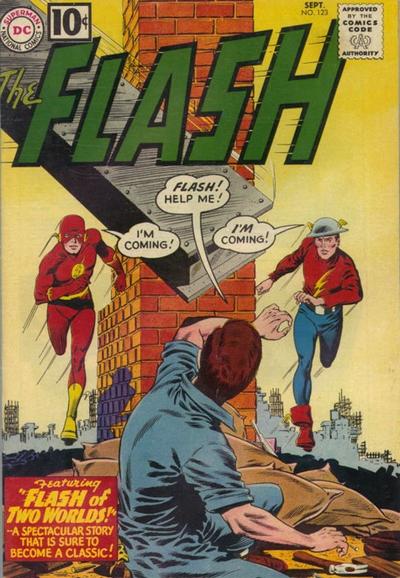
Creating a Crisis? The Flash 123


The Flash #123 (September 1961)
"Flash of Two Worlds!"
Gardner Fox-Carmine Infantino/Joe Giella

Doug:  One of the books I picked up at WizardWorld Chicago back in August was the DC Comics Library edition of The Flash of Two Worlds.  It contains the first six meetings of Barry Allen and Jay Garrick, from The Flash #s 123, 129, 137, 151, and 170.  Today we're obviously going to discuss that first landmark story, a tale that touched off DC's alleged continuity quandary that would result in the "Crisis on Infinite Earths" event and then ultimately the undoing of most of that.  Ugh...  But hey, this is a fun story, so let's wait to dwell on its future until the comments section.

Doug:  I have to say from the start that Carmine Infantino's art (of which, at least in the Bronze Age, I am not a fan) throughout this story is pretty darn good.  However, could the Barry Allen Flash look any more like Gazoo in that splash page?  What a huge melon!  But what an incredible cover -- truly, that image has to be one of the highlights of any age of comics.  And how exciting would that have been for a youngster picking this one off the spinner racks (hey, were spinner racks invented in 1961?)?  Help a brother out, here -- was DC reprinting their Golden Age material as the Silver Age was dawning?  I do not know the answer to that, so I'm wondering if a 10-year old in 1961 would have recognized the Jay Garrick Flash?  Surely his old man would...  Let's get on with the story, which at a whopping 25 pages felt like an Annual to me.

Doug:  Barry Allen is of course late to a commitment he'd made to Iris West.  Iris is chairing a fundraiser for a local orphanage, but is furious as Barry arrives.  He assumes it's because of him, but he really had a legitimate excuse this time.  But no, she's upset that her magician who was tabbed as the entertainment for the children hasn't shown up.  Barry says he can't stay (wait, weren't they supposed to be together at the fundraiser?), but wonders if Iris would like him to phone the Flash as a potential stand-in for the magician?  She's elated, so Barry slips away, pops his special ring, and emerges moments later as the Fastest Man Alive.  The Flash goes through a litany of skills and showmanship, but stuns the crowd when he climbs a rope that he's set to spinning beyond the human eye's capability to see and disappears.

Doug:  Flash is next shown on a country road, still holding the rope.  He wonders where he could possibly be, and then muses that he could have vibrated so fast that he broke through time and space.  Call-out to Flash fans -- had Barry ever done that before?  I would assume that this is the first time doing any sort of warping, but I don't know -- the fact that he thought he could vibrate the rope and make himself disappear and then reappear has me wondering.   Assuming he's outside Central City, the Flash sets his course back toward where he thinks the city is.  But as he enters the city limits, all is not what he'd thought it would be.  Many of the landmarks that he expected are not present.  He now wonders if he's gone through time and has emerged at a time in Central City's past.  Running to the spot where he thinks he'll find Iris's place of work, he's stunned to see that instead there is a building housing the Keystone City Herald.  Now thoroughly confused, the Flash runs to a newsstand and picks up a paper.  It's date?  June 14, 1961 -- "today", as far as the Flash is concerned.  He asks the vendor where Keystone City is located, and the guy looks at him like he has three heads.  Then the Flash begins to really wonder -- a guy he knew before used to live in Keystone City.  A guy named Jay Garrick, the original Flash!  But wait -- that was only in the comic books!  The Flash finds a telephone book and sure enough -- there's a Jay Garrick in it.  So, a quick run and a quicker change, and Barry Allen is about to announce himself to a childhood hero.

Doug:  Barry rings the bell of Jay Garrick's apartment.  Garrick opens, and Barry says that he recognizes him.  Jay's of course a little weirded-out by this, but humors his guest.  We get a nice recap of the original Flash's origin told by Barry, which further confounds Jay and his wife Joan.  As they lament the "secret" no longer being so, Barry says to wait -- he has something to show.  He activates his ring, and out pops the Flash costume which he dons.  Now seated in full hero garb in the living room of the Garricks, Barry surmises that he must have somehow vibrated through a space warp and landed on an alternate Earth.  Barry further guesses that the two Earths vibrate at different frequencies, which keeps them apart.  On his Earth, Central City is very much like Garrick's Keystone City, with a few pronounced differences.  Barry then relates his own origin, and tells how he was inspired to become the Flash after having read the adventures of Jay Garrick.  Garrick is astounded -- how did Barry read of him??  Barry then does a bit of fourth wall-breaking by bringing writer Gardner Fox into the tale.  Barry says that Fox wrote of the Golden Age Flash, and alleged that the adventures came to him in dreams.  Barry wonders if somehow, while sleeping, Fox was "in tune" with Jay Garrick's world.  Barry says that Flash Comics ceased publication in 1949; Garrick is amazed, as that was the very year he retired as the Flash.  OK, kids -- there is the explanation for DC's multiple Earths.  What do you think?


Doug:  Garrick says that lately he's been thinking of coming out of retirement, and relates to Barry some crimes that have happened locally.  Of course, Barry says he's in if Jay will have his help.  Oh, how the seeds of a team-up for the ages are sown!

Doug:  In the second chapter we are (re-)introduced to three baddies from the Golden Age Flash's rogues gallery:  the Thinker, the Fiddler, and the Shade.  Of course, by modern standards these three dudes wouldn't cause most heroes to break a sweat, but as many of DC's villains go they each have a schtick.  The Thinker wears an army helmet with all sorts of wires on it -- he can cause anything he can think of to actually happen if within 50 yards of him.  The Fiddler can cause strange accidents to happen by playing his Stradivarius (and riding in his Fiddle Car, no less).  The Shade uses his cane to create absolute darkness.  The three do-badders plot to a) steal the Neptune Cup from millionaire Edward Jarvis (hmmm... you think that's Edwin's long-lost twin?), b) steal the "European crown jewels" (there's a European crown?), and c) steal a collection of historical curios.  Say, did you ever wonder who fences all of the loot that comic book bad guys steal?

Doug:  As the rogues get on with their crime spree, the Flashes decide to separate and attempt to cover the city faster.  The GA Flash comes across the Jarvis mansion, and is warned by two watchdogs that the Thinker is inside!  Odd, but when you're in the superhero biz I'd assume you reach a point where nothing surprises you.  Flash enters the mansion, but the Thinker uses his collander-doohickey to trick Flash into thinking he's caught his man.  Flash literally gets tired running around the Jarvis study chasing the Thinker, and finally slams headfirst into a door.  Barry Allen is tracking the Shade to a ship offshore of Keystone City.  The ship is engulfed in darkness, but once aboard the Flash whips the murky ether into a pillar.  The Shade sees this and uses it as his cue to depart.  Jumping into a motor boat the crook speeds away.  The Flash follows him, running on the water.  The Shade uses his cane to not only emit the dark stuff, but by mixing oil into it the Flash loses his concentration and begins to sink into the sea.  Super-baddies 2, fastest men alive 0.

Doug:  The chapter just past shows why books like All-Star Comics were fun, because the Justice Society would be broken into smaller teams to solve crimes and bad guys.  I suppose it was somewhat of a nod to that past here in breaking the Flashes apart.  But as we segue into chapter 3 we get what all youngsters wanted in the first place -- these two titans teamed as one!  We haven't seen our heroes deal with the Fiddler yet.  Rectified.  As the Beethoven lookalike rides through town on his Fiddle Car (seriously -- see for yourself), the Flashes race toward their encounter.  On the way, though, we get the scene that the cover was drawn from (or vice versa -- no idea which came first).  The Flashes divert their path to save a construction worker menaced by a falling steel girder.  It's a nifty bit of teamwork, and foreshadows (we hope) what they'll do to the soon-to-be-assembled rogues.  But in the meantime, they encounter the Fiddler.  Away from this area of town, the Thinker and the Shade get back together and relate their adventures.  In recounting the play-by-play, they determine that there must be two Flashes -- the Fiddler could be in trouble! They race off to help their partner, only to find him playing away as our heroes dance like puppets for him.  Not good.

Doug:  The Fiddler gloats to his buddies about how simple this was, and that he actually got the Flashes to steal the crown jewels.  He says as a final show of his power, he'll freeze the Flashes in place for 24 hours.  As the villains turn to leave, however, the Flashes suddenly run toward them and overpower their enemies with the element of surprise!  At the local precinct, the Fiddler wants to know how the Flashes were able to resist him.  Simple, Jay says -- the Fiddler neglected to order the Flashes not to try to escape.  Additionally, when the Fiddler ordered Jay and Barry to bring him the larger jewels, they took the smaller ones and inserted them in their ears, thus distorting the musical commands.  That, pals, is how they resisted!  Later, Jay and Barry congratulate each other on a job well done.  Jay pledges to go on being the Flash -- because you know, if he stayed retired we wouldn't get to do this again!  Barry spins his body, hoping to duplicate the vibrations that allowed him to breach the barrier between their Earths.  He re-materializes on the stage from which he'd left -- but in real time.  Everyone has gone home!  Racing to the newspaper, he finds Iris and tells her that he had to leave... on a most unusual mission.  She of course scoffs, and our hero thinks that the only person who would believe this is... Gardner Fox.  And he's going to look him up to tell him!


Doug:  That was a lot of fun!  I'd never read this story before writing today's review.  I know I have a reprint of it in my copy of The Greatest Team-Up Stories Ever Told, but I sure don't recall having read this before I bought the Flash hardcover that I've used as my resource today.  Anyway, enough about my memory.  I would think that as a kid my eyes would have been wide with the possibilities of a story like this.  Parallel Earths where heroes from the comic books lived.  Wow!  I for the most part am in the continuity camp, but I'm not so tied to it that I can't accept that what went on in Marvel Team-Up could conflict with the rest of the Marvel Universe and it would be OK.  So that DC felt that they were creating these convoluted stories that people couldn't understand seemed silly to me at the time, and it does now.  If nothing else, I think many of us would agree that what came after the "Crisis" had more warts than what had gone before.  That being said, I am glad that we got John Byrne on the Superman books, Mike Grell on Green Arrow, George Perez on Wonder Woman, etc.  That was, at least in my collecting life, a golden age all its own for DC.  But regardless of what this story wrought in its wake, it was a fun tale and ushered in many a fun tale subsequently.  Yearly meetings of the JLA and JSA?  Bring 'em on!


Related Posts with Thumbnails