The Eternals #1 (July 1976)
"The Day of the Gods!"
Jack Kirby-Kirby/John Verpoorten

Doug: As I begin today's review, it's actually last Monday (that just screwed you up temporally, didn't it?) and we've had about a dozen comments on the
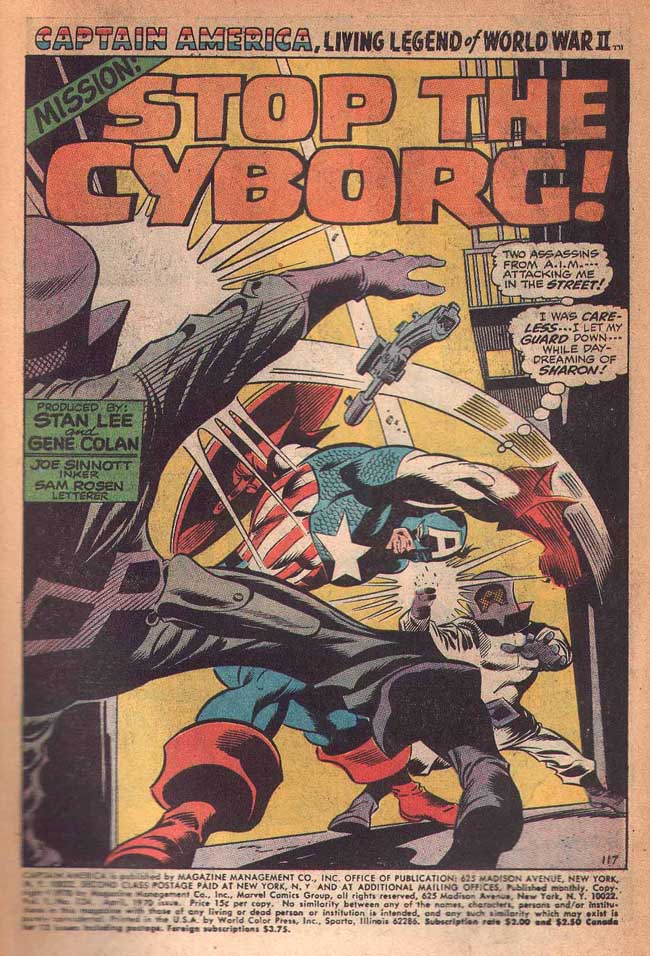
Captain America #193 post. Surprisingly to us, as Karen wrote in a comment of her own, our readers tended to agree with us on the writing prowess of Jack Kirby in the latter Bronze Age. I'm not going to sit here and tell you that the book we're about to review has a script that's Bard-worthy, but I will offer that it's better than what we dealt with seven days ago. It will be up to us, and you once you get to typing your own missives at the conclusion of the post, to determine just how and why this might be so. So as they (who?) say, let's do this thang.

Doug: I am sad that Kirby didn't do one of those photo montages he was so renowned for back in his
FF and
Thor days as a way to lead this one off. The drawn outcome is a bit murky, but it mirrors the cover and gets us on our way. Our three protagonists -- Dr. Damian, his daughter Margo, and their associate/videographer Ike Harris, have entered an enormous cave or chamber -- the belly of a pyramid, perhaps. The three had been on a search for the mythical Chamber of the Gods, allegedly located deep within the Andes Mountains. What they discovered is incredible -- Inca-like relics combined with star-faring vehicles, god-like images of beings not of this planet. Dr. Damian is beside himself, but gains enough composure to begin to verbally document what he is seeing. At that point we learn that Ike Harris may be more than we at first assumed, as he begins to pontificate on the origins of the relics and how they fit into a larger picture of terran existence -- stating as fact that man is not, nor has he ever been, alone. Damian recoils as if reacting to heresy.
 Karen: As much as I ripped on Kirby's art in Captain America, these first few pages are fairly spectacular, with Kirby doing his best versions of Incan styles mixed with his own cosmic sense. I have to say that this whole book was a real blast from the past. It was like watching a bunch of episodes of the old Leonard Nimoy show, In Search Of - we have ancient astronauts, hidden races, Lemuria, mysterious warped zones of time/space, UFOs - you name it! Like you though, I felt this fairly screamed for a photo-montage!

Doug: As Ike Harris continues, Dr. Damian announces that he's through with the college pranks. Margo, no great thinker in her own right, just gives off a sort of "yay, Dad!" Harris stoops to look for some sort of device on the floor -- a kind of gateway that will bring the gods back to Earth! We then cut to the Pacific Ocean to find an airplane swallowed up by some serious Kirby Krackle in a Bermuda Triangle-like disappearance. We are privy to the device that was the culprit -- a craft that then descends into a long tunnel toward the depths of the sea itself. We are then introduced to some dudes that could have walked straight outta Apokalips.
There's red-faced Kro, Jabba-like Brother Tode, and a fair(ly ugly) unnamed maiden. We learn that they are Deviants, and they remind me somewhat of one of Kirby's earlier creations, the Inhumans. Apparently each Deviant looks different, and there are some traits that are more desireable than others.
Karen: This theme is repeated again and again isn't it -- not just the Inhumans, but all Marvel mutants too, are a race that "doesn't breed true". But the Inhumans and the mutants tended to be pretty decent looking. These guys are just nasty! Kro's kinda groovy with his glasses, and Brother Tode reminds me a bit of Modok, with his big noggin.

Doug: Kro is charged with going to the Inca cave to find the beacon which can herald the arrival of the gods. Brother Tode cautions that the Eternals may find it first; Kro brags that he will return with it within the hour. So we shift back to the cave, where Margo is shaking in her Lara Croft-boots at weird ol' Ike Harris.
Harris has discovered some sort of intergalactic telescope, which to me more resembles Reed Richards' gateway to the Negative Zone. The cosmic cat is now out of the bag, and Dr. Damian and Margo now approach Harris and ask him to confirm that he is not one of them. Harris does, and begins to narrate a genesis story. I've read many times that Jack Kirby was fascinated with religion and ideas of creation. Here he again gets to explore some of his wonderings.
Doug: In Kirby's origins of life tale, the gods had come to Earth after its creation. They decided to capture and alter an early man, called the Dawn Ape, and allow it to breed the three great races: the Deviant, the Human, and the Eternal. The Deviants were increasingly ugly and warlike, man was... well, man, and the Eternals were immortal. Deviants went underground to live in the bowels of the Earth where they could plot, humans of course occupied the surface and evolved through conquest and subjugating other life forms, and the Eternals took to the skies and mountaintops -- living apart. As Ike Harris finishes his story, his attention reverts to the view screen as he sees an energy trail from the gods' spaceship!


 Karen: Kirby really shows all the stuff he's been reading, or maybe also watching on TV (like the previously-mentioned In Search Of...). He's taken ideas from Erich von Daniken, the Shaver Mysteries, and a variety of other sources and synthesized them and filtered them through that unique mind of his to produce this mythos. Just looking at these pages, I was struck by the huge scale of it all. It really would make a great movie, wouldn't it?
Doug: I think this is why Jack would have worked best with an editor -- his mind just exploded, but without anyone else to temper his mental outbursts, the ideas were like a stampede!
Doug: But, at the same time the gods appear, Kro and his minions close in on the Inca cave. As they ascend from the aquatic entrance, they hear an alarm sounding -- it is the beacon, and the Eternals found it first! Wait, what? What Eternals? Well, in another one of Kirby's painfully awful play-on-names, ol' Ike Harris is really Ikaris of the Polar Mountains! The jig's up, and it's game on! Ikaris creates an energy field that holds the Deviant army at bay, and then removes his sunglasses. We are told that it's an Eternal's eyes that contains the true power and Ikaris uses his to wipe out Kro's cohorts. However, one baddie levels a gun on Ikaris and hits him with a shroud, shutting down the Eternal's eyeblasts. Kro charges, but Dr. Damian steps in to buy time. Margo removes the cover from Ikaris but the entire assemblage is startled by the arrival of the spaceship alluded to earlier. The gods have returned!
 Karen: The "Ikaris/Ike Harris/Icarus" thing sort of bothered me even as a kid as "Ike Harris" is not pronounced anything like "Icarus" but I guess after all these years I can let it go. It's interesting that there was so much focus on the Eternals' powers coming mainly from their eyes -- I don't seem to recall this being the case in later appearances in other titles but I could be wrong. It does remind me however of Darkseid's omega effect being so central to that character. I really liked the seemingly gigantic spaceship landing, with all the raw energy pouring out of it.
Doug: I told Karen three weeks ago when I read this for the first time that I enjoyed it. In fact, if I could get my hands on the next couple of issues I'd be quite interested to read those as well. Some of you remarked last week that Kirby was perhaps at his best when working with characters with no prior continuity. In this book he was perhaps able to continue to explore themes he'd broached at DC in his Fourth World material. At any rate, his dialogue was much stronger and the story seemed to be more linear and less pell mell. For me, this was a definite improvement over his return to
Captain America.

Karen: I'd agree, this was a much more interesting and stronger read, though I wouldn't necessarily say that the dialog was vastly improved; actually, the whole book felt like it belonged to an earlier age. It does feel a bit stuffy. But we are able to come to it with no pre-conceived notions about who the characters are and how they should act. We're unfolding a mystery and frankly Kirby's graphics hold up pretty well here and help to pull the reader along. This was the one Kirby title that when it came out, I did buy it somewhat regularly, mainly because it was right up my alley at the time, what with my fascination with all this kind of stuff. I think I lost interest in less than a year, but it was more attention than I gave to any of the other books Kirby worked on. It has to be considered his biggest success in his second tenure at Marvel. The Eternals were initially planned to be outside the Marvel continuity, but by issue #6 were starting to be shoe-horned into the MU. Eventually, the characters and concepts were adopted by later writers and worked into the threads of the Marvel tapestry such that they are as much a part of Marvel history as their predecessors, the Inhumans. In fact, apparently in some sense the existence of the Eternals supposedly lead to the Kree creating the Inhumans! (Check the wikipedia listing for the Eternals if you don't believe me). Much like what happened at DC with Kirby's Fourth World characters, the Eternals found little success while Kirby handled them, but later became a mainstay of the Marvel Universe.

 Karen: Since we've been talking about Jack Kirby's return to Marvel, let's play a little game of 'What If' and instead of discussing the books he did work on, let's discuss the titles you wish he had worked on.