X-Men #126 (October 1979)
"How Sharper Than A Serpent's Tooth...!"
Chris Claremont/John Byrne-Byrne/Terry Austin (cover by Dave Cockrum/Austin)
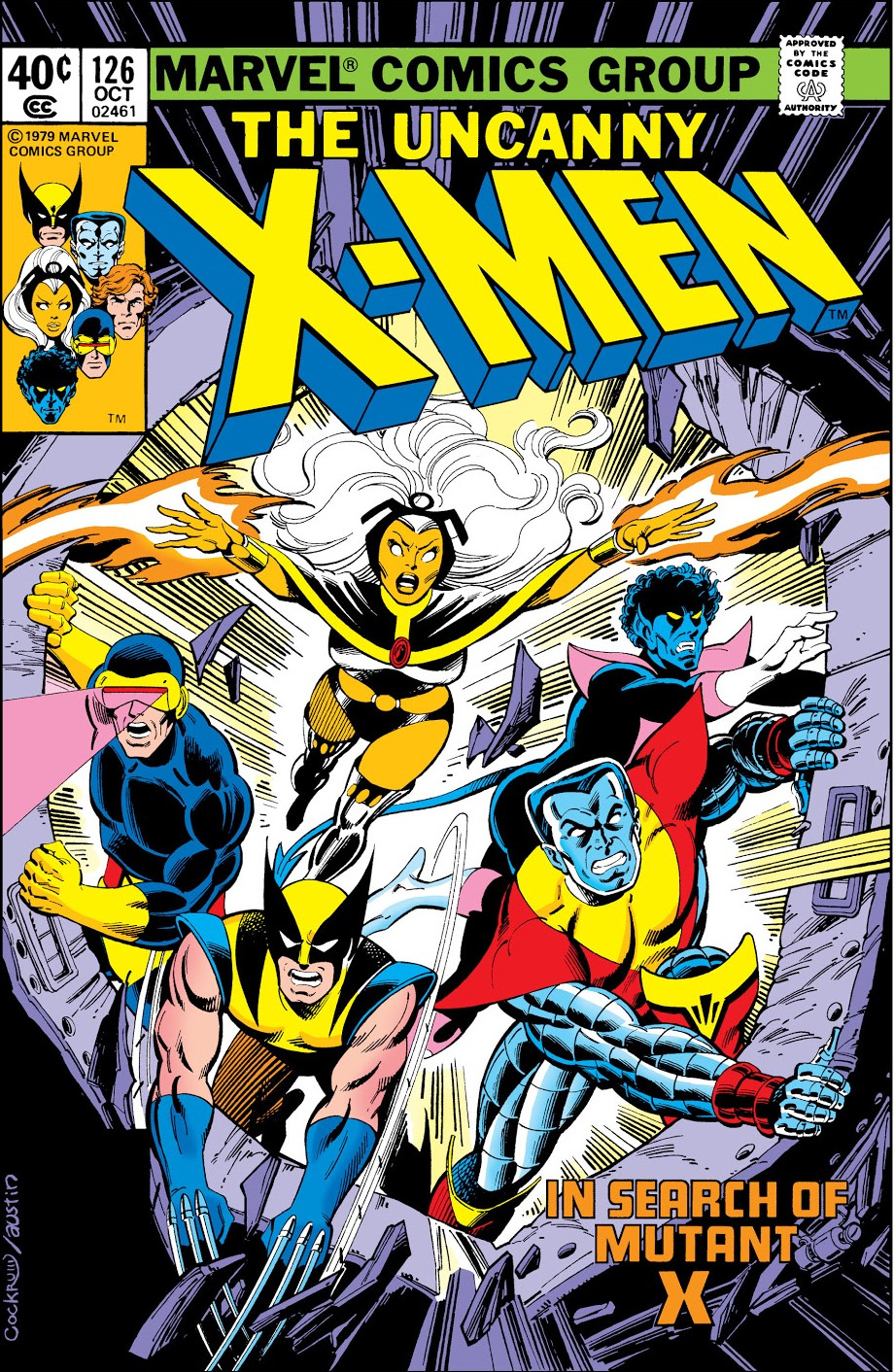
Doug: Neither one of us mentioned it last week, but Dave Cockrum did the covers for
Uncanny X-Men #'s 125 and 126 -- and what an effort today. Talk about poster-worthy, and I'm not making any comparison to those pin-up covers of today. This one has action
and characterization. It's a great image, and you can feel Terry Austin's presence in the art, can't you? If you wait two more weeks, you'll get to see George Perez do an X-Men cover. What a great era... How 'bout we get ourselves over to Muir Island?
Doug: And getting over to Muir Island apparently only takes an hour when Cyke's at the controls of the Blackbird (and
despite Karen's concern, they don't crash it this time!). Last week in the comments section our readers discussed some of Chris Claremont's plot holes and oddities, such as the Scott Summers-Colleen Wing relationship and her lack of mentioning that, oh yeah - Jean's alive. While that may be true, I'm going to offer the man a tip of the hat for characterization over the first four pages. It's just wonderful writing -- we
know these characters! Here's the deal: the X-Men left upstate New York after Scott heard Lorna Dane scream on the phone call from Moira MacTaggert's Mutant Research facility. Knowing that Jean was in Scotland, the team hightailed it onto the Blackbird and made record time. Approaching the island, Scott ordered Colossus to do his landing thing, Storm to inspect the isle from above, and once on the ground Nightcrawler to teleport inside the living quarters.

Banshee gave a slight admonishment to Cyclops for driving everyone so hard; Cyke countered that Sean had not heard Lorna's scream. Knowing her abilities as Polaris, it must have been something horrible to have spooked her so.
Karen: I love that cover! One has to wonder what a Claremont/Cockrum/Austin run might have been like? On to our story though - I agree, we get a great sense of each character in a short time span. You can really feel Cyclops' urgency here. I love how each member has their own way of making an entrance. And hey, how strong must Storm be to go hauling Wolverine around, with all that adamantium he's got inside of him?
Doug: I actually had the same thought as she's toting Scott just a bit later on -- it had been some time since any artist had drawn him as "Slim" Summers!
Doug: Nightcrawler was the first to find any clues. He actually found Lorna, and her assailant, collapsed on top of our heroine. Radioing Scott and Banshee, Kurt urged them to come to him as quickly as they could. Once in the house, they rolled the man off of Lorna -- only to reveal a horribly decomposed husk, almost like a mummy. Banshee inspected Lorna's vital signs and determined that she would be fine. Scott tells Kurt to 'port over to the lab, where hopefully he'll find Havok, Madrox, and Jean. As Scott heads outside to flag down Ororo, he worries about Banshee's inability to bounce back from the injuries to his voice he'd suffered in Japan (X-Men #'s 118-119, which we will review at some future date).

At the lab, Kurt takes to the shadows, but not enough that he's not seen by Havok. Alex fires a bolt Nightcrawler's way and orders him -- whoever he is -- to come out of the shadows. As Havok begins to power up again, he's suddenly grabbed and bear-hugged... by Colossus! Piotr had landed in the lab and was doing his own scouting when he heard the ruckus. Alex is amazed to see his believed-dead comrade. Elsewhere, Scott and Ororo are also in the lab building and encounter Moira -- through a slight machination from Storm. There is the now-familiar surprise at the reunion, and then Moira tells Scott what they're up against -- Mutant X. Concerned, Scott nevertheless goes off on his own to find Jean.
Karen: Banshee tells Scott that he'll stay with Lorna since, without his sonic powers, he's not of much use (also notice, he's carrying a side arm). It's interesting that Banshee hung around in the book, powerless, for 10 issues -he lost his powers in #119 and finally stepped out in #129. I think he was a nice counter-balance to Scott at first, but eventually he became unnecessary, especially with Professor X around. They really didn't need two authority figures in the book.
Doug: It doesn't take long for Cyke to find Jean, collapsed in a corner. He approaches her, but when he gets her upright and says her name, she answers by calling him "Jason". I thought the long reveal of Jason Wyngarde's plotline was really done well. Month to month, the suspense just kept building. I never felt it was too long, and it really kept me on the edge of my seat... until I started high school just as
X-Men #131 was being released and missed the whole pay-off.

What a dummy. Anyway, Scott (certainly taken aback) assembles all of the X-Men back at Moira's house where they debrief on what exactly has gone on. Jamie Madrox tells of his encounter with Mutant X, and how he was psychically assaulted through one of his clones. Jamie tells that there's no way he could have stopped the enemy. Moira comforts him, while Wolverine begins to itch for the scrap. Of course he and Scott exchange words, but Wolverine surprisingly backs down and defers to Scott's plan. Aside with Moira, Scott tells her that he's checked all the files and there is nothing on any Mutant X. Moira coyly tells him "it's a private matter". Scott pushes her, and she admits -- Mutant X is her son.
Karen: Oh Doug -how could you stop reading this book before the whole "Dark Phoenix" saga ended? Dude.... anyway, I agree, I can readily recall the sense of anticipation I had each month waiting for the next issue. Scott and Jean's relationship certainly had its complexities. At the time, and even today, I feel Claremont may have made a mis-step by having Scott react so strangely to Jean's supposed death. It never made any sense to me that he at first felt nothing, as he told Storm in the Savage Land, and later began to see Colleen Wing. But here, he seems anxious to find Jean, and to find her by himself -not knowing how he'll react. Well, I'm sure he wasn't expecting 'Jason'! I like the way the debriefing scene is drawn too, where there's some distance between he and Jean, and the look on her face is somewhat troubled.

Doug: We scene shift to the village of Stornoway, where we find a quite-possessed Jamie Madrox-clone prowling the shadows. This creature thinks to itself that it is consuming its new shell too quickly. It's a nice tip, as we can assume that part of Mutant X's skill set is some sort of vampiric leeching. Well, what would you know -- just as Mutant X is feeling a little low, who should walk out of the pub but our boy Jason Wyngarde? Mutant X stays in the shadows, but is able to do some sort of probe before assaulting his victim -- but is immediately repelled by psychic shields. Hmmm... the plot does thicken with this Wyngarde fellow. And in regard to my comment above, about leaving comics in the fall of 1980, it would be many a'moon before I knew of Wyngarde's true identity. So, with no opportunity to take over Wyngarde, Mutant X found a young guy in another part of town and commandeered his body.
Karen: Yes, Wyngarde's identity was quite a mystery for some time. I really had no clue! I thought this sequence, and many of the other sequences featuring the possessed victims of Mutant X, were very creepy -a credit to the art team. I also liked the brief scene where Wolverine barks at Cyke, accusing him of being scared for not going right after Mutant X. This would set things up nicely later on.
Doug: Back at the research complex, the X-Men break into teams to cover as much of the island as possible and as quickly as possible. Scott rides in a jeep with Moira, and gets a little more insight on Mutant X. We learn that he has two fundamental weaknesses: metal, and a constant need for new host bodies. Sounds like Wolverine's our guy. Jean is on airborne reconnaissance when she is seen by Wyngarde. Instantly Jean's mind is not her own, and she's riding in an 18th century hunting party with Wyngarde by her side. The dogs corner and take down a stag, and it's Lady Grey's right to deliver the final blow to the animal. But as Jason hands her the hilt of a knife, it's no animal she looks down on -- Master Jason lauds her for the wonderful idea of hunting a man, dressed as a stag!

As Jean comes to her senses, she stands over the husk of the young man Mutant X had last possessed -- and wonders what is wrong with her mind.
Karen: Isn't it lucky for the X-Men that two of their team members have metal bodies or body parts? OK, this might have been a bit convenient, but honestly, I didn't think about it at all when I first read the story! Even now, I'm enjoying it enough that I can let it slide. Wyngarde's manipulation of Jean's mind, of her morals even, is downright disturbing.
Doug: On another part of the isle, Wolverine is tracking through the mists while Nightcrawler follows in a jeep. Kurt tells that Cyclops has just contacted him via radio to report that Jean had found a body -- and a fresh one. Wolverine tells him to pipe down, that he's ruining the trail. Kurt says they have to go -- that the body is only 10 miles away, but that's far enough that Mutant X couldn't be close to them. Wolverine isn't buying it, because... what if Mutant X took a car? Sure enough, they come upon a policeman standing outside his squad car. But what's interesting is that Wolverine is spoken to in a "normal" voice. In a scene very reminiscent of
Wolverine's attack on the Marvel Girl Sentinel in X-Men #100, the senses don't lie -- Wolverine barks, "'Crawler! Trouble!" Mutant X reveals himself immediately and attacks Wolverine psychically -- he screams. As Nightcrawler drives up, Logan tells him to stay back. As Logan moves in, Mutant X withdraws slightly -- he's sensed the metal throughout Wolverine's body!

But as he regroups, he tells the X-Men that while they call him Mutant X, his real name is Proteus, and he is the mutant who masters reality!
Karen: Ah, back in the days when Wolverine was still a lot of fun, not infallible or unstoppable but very intriguing. His connection to nature was still a strong aspect of his character. His heightened senses made him very grounded in the here and now, and Proteus would really put him to the test.
Doug: To say that the next two pages would look like how I feel when getting off a rollercoaster (I hate those) would be an understatement. Reality warps, it spins, it's topsy turvy and inside-out. Kurt and Logan struggle to decide if it's an illusion or if they really are out of the normal plane of existence. I have to wonder (I'm half serious) if Byrne held drawings up in front of a hall-of-mirrors type of display and then redrew them all crazy -- it's really that sort of an effect in this scene. Suddenly Storm arrives, and she ain't happy! Knowing she cannot bring herself to kill her enemy, she instead launches the mother of all lightning strikes at the police car, destroying it and injuring Proteus in the process. He in turn lashes out at her, knocking her from the sky and making her land hard on her right shoulder. Now afraid to attempt to fly, her only option is to conjure hurricane-force winds -- Wolverine grabs Nightcrawler and crawls on top of him, extending his claws into the earth as an anchor to hold the two of them down. As the gale rages... Proteus advances.

Karen: The art is just fantastic -even the panel layouts are unconventional. It really feels as if one is being shot through some twisted version of reality. Storm's code against killing struck me - this was the standard for super-heroes back in that time, but today...well, I suppose this would seem unrealistic to readers?  I did like this about her, her respect for life, and it was one of the reasons 'mohawk Storm' never worked for me. The visual of Wolverine and Nightcrawler hunkering down, with Wolvie digging his claws into the ground, is just a great one. The wind blasting all around truly conveys Storm's sheer power.
Doug: Talk about a downhill ride, constantly picking up momentum! This was a great issue, paying off on the suspense that had ended the previous issue. The pacing is quick, but not hurried. The subplot involving Jean and Wyngarde shows up three times, but it never seems forced -- it's a quickening storyline, and we know that a resolution must come. The question for the reader is, will Jean be worth anything to the team before it all plays out? And the art. The art. What's left to say? This is the midst of the creative team's pinnacle, and as we pointed out last week, that compliment includes Glynis Wein and even letterer Tom Orzechowski.


 Doug: Here's a strong suggestion for you -- buy this book! Seriously, if you liked Sean Howe's Marvel Comics: The Untold Story, if you're a fan of the Silver Age Fantastic Four, or if you are interested in the never-ending debate of "who did what" in regard to Stan Lee and Jack Kirby, then you need to own this. I bought this when it was first available, but as can be my habit did not immediately get to it. It's been long on the "to read" list, and as March turned to April I sat down to read it. Well, that took only a couple of days, as it is just gripping. Author Mark Alexander goes where others have gone before in terms of Marvel history and some anecdotal evidence skewed toward either Lee or Kirby -- but it's his own point of view often interjected that makes this part history, part blog, and part biography. The outcome is a well-wrapped package that showcases a partnership that one could say was to comic books what Lennon and McCartney was to popular music. NOTE: I'll supply just a few page samples in this review. At the end of the post there will be a link to the TwoMorrows site, where you can open a much longer .pdf preview of the book. Thanks.
 Once Alexander gets to the Lee/Kirby collaboration on the Fantastic Four mag, it's really a buckle-your-seatbelt ride. Perhaps the most refreshing thing about Alexander's style is that in spite of the fact that this book was published within the sometimes-Kirby-apologist The Jack Kirby Collector, it's a very, very objective study. In the Introduction, publisher John Morrow tells us that The Wonder Years was originally imagined as a long article or series of articles in TJKC. Mark Alexander had published articles in the magazine before, and through his relationship with Morrow was able to make the case that this could be a book. The results are very nice, as this has all of the visual qualities of a regular issue of TJKC, but with a singular focus. Anyway, back to Alexander's impression of Stan Lee... From the chapter "This is a Plot?": A funny thing happened on the way to this book. From the outset, a conscious decision was made to avoid any "who did what" debates regarding Jack and Stan's individual contributions to Fantastic Four. But with no preconceived agenda whatsoever, we kept finding more and more evidence that shows Stan was actively involved in the plotting of Fantastic Four, to some degree or another, during Kirby's entire run on the series (p. 146). For me, it's the willingness to report what was dug up, to cite the folks who were there (Flo Steinberg, Roy Thomas, Marie Severin, and Sol Brodsky), and then to just let the reader reflect on his or her own prejudices that makes this a great read and a nice resource to own.
 Mark Alexander is not hesitant to heap praise on Fantastic Four or on either or all of the book's creators. Conversely, he is quick with criticism as well. Of note, he really has harsh words for the transition of Madame Medusa from a sexually-charged villainess who, in the author's opinion could have gone on to be a major villain, and to Stan Lee for his major faux pas in #99 where he reveals that Crystal and Black Bolt are brother and sister. Wait... then that would make Black Bolt and Medusa... oh my. He also traces developments in the magazine that can be directly tied to mandates from Martin Goodman, such as the order that multi-part stories cease to be written. Another example of Goodman's influence was the switch away from "twice-up" 12"x18" bristol board to the smaller 10"x15" art board. Kirby felt especially constrained by the smaller drawing surface, and Alexander notes two direct results -- more close-ups of characters, and a regular use of four-panel lay-outs on Kirby's pages.