Wednesday, April 20, 2016

Star Trek at 50: Miri


Season 1
Episode 11: Miri
Filmed: August 1966
First Air Date:October 27, 1966 (8th episode aired)

Karen: I don't like 'Miri.' There. I've gotten that out of the way. It's not that it's bad, like 'And The Children Shall Lead' or anything like that. I can see it has redeeming qualities. But for me, personally, it grates. Like nails on a chalkboard, oh, it grates.

Karen: I think what gets to me is mainly the two chief guest actors, Kim Darby and Michael J. Pollard. Darby's Miri is a simpering woman-child who does little to make me feel like her planet is worth all the effort the Enterprise crew makes towards saving it. Pollard is quite simply obnoxious. I get that he's doing his shtick, but it's not something I find amusing. So - this coupled with what I find to be a weak premise -a planet ridiculously similar to 20th century Earth that has fallen victim to a biological experiment that wiped out all but the children -makes for a poor Trek for me. Plus, a lot of Yeoman Rand. Of course, your mileage may vary.Sorry about the poor video quality in the trailer.


Karen: Even though I personally don't care for this episode, it's worth noting that it was at this point that Gene Coon jumped aboard as a producer on Star Trek. Coon's influence cannot be underestimated. He provided a great deal of re-writing help with scripts, as well as story outlines and scripts himself. Although he would leave during the second season, he would continue to submit scripts under a pseudonym, Lee Cronin, during the third season. Coon was responsible for much of the geniality among the crew and outright humor that made its way into the series. Prior to Trek, Coon had worked on a number of shows, including The Wild, Wild West and had even come up with the initial concept for The Munsters, although he did not receive credit for it.


Gene Coon
Karen: Writer Marc Cushman details Coon's arrival and how he contributed to the script for 'Miri' in his book, These are the Voyages, Vol.1. The story, originally written by Adrian Spies, went through several rewrites, first by Spies, then by Gene Roddenberry and then-associate producer John D.F. Black. But Roddenberry still felt the script wasn't quite there. Coon came aboard on August 8th, 1966. After a quick course in Star Trekology, he went to work on the script over a weekend. While Coon left in most of the established story structure, he tightened up the dialog and made the situation more mysterious. In earlier drafts of the script, everything is explained to the Enterprise crew - the meaning of the terms 'grups' and 'onlies', even what happened on the planet and the nature of the disease. Coon reworked the script so that things were revealed slowly, with our intrepid cast figuring it out for themselves. It makes for a much better story, with less exposition, and the crew doesn't look like a bunch of dimwits.


Karen: Despite my dislike of it,  this IS a memorable episode, simply for all the weirdness with the kids in their 'Lord of the Flies' setting, and the unforgettable lines -"Tell 'em Jim, tell 'em Jim" and "Bonk bonk on the head" and such. Many people remember the show because of Miri's crush on Captain Kirk. Cushman quotes director Vince McEveety as describing Darby, who was just 18 at the time, as being "extremely strange. She had a neurotic and very, very bipolar kind of personality. She'd do a scene and I was happy with her performance - very happy, I thought she was wonderful in that respect -and then she'd go off and cry like a baby afterwards. I'd never know why and, after a while, I didn't care." Darby admitted in another interview that she had completely fallen for Shatner, so apparently Miri's crush was shared by the actress portraying her.Well, who could blame her for falling in love with the dashing Captain of the Enterprise?


Tuesday, April 19, 2016

Avengers Assemble! Wait... How'd You Get In?


Doug: Welcome back to our second journey to the 1980s Marvel Handbooks and DC Who's Who (which we will get to next week). Karen and I thought it would be a kick to revive a question she posed many a'moon ago, namely, are the Avengers an elite team or is joining the team as easy as getting a Costco membership? Using a visual roster of Earth's Mightiest Heroes from the first issue of the 1986 Official Handbook to the Marvel Universe, we're going to explore that again. Here's what Karen wrote on September 3, 2010:

Karen: There was a time when the Avengers were considered to be the elite team of the Marvel universe. To be an Avenger was a mark of honor. While the Fantastic Four was a family, and the X-Men were united by their common genetic status, the Avengers was sort of like a pro sports team: not everyone would make the cut. But currently, just about everyone in the Marvel universe seems to be a member of the Avengers.

Karen: Sure, you could point back to the 80s and characters like Deathcry and Rage being brought on the team, and say, "Hey, it's been going on for years!" Well, to some degree, that's true. There were some bad calls along the way. But the biggest explosion in the team has occurred in the last few years.

Karen: Nowadays it's actually easier to name the characters who aren't Avengers than the ones who are, because essentially everyone is an Avenger. They've grown to the size of the Legion of Super-Heroes!
While I enjoy team books, it sort of takes away from the specialness of being an Avenger if everyone can be an Avenger. And I like characters like Luke Cage, Iron Fist, Dr. Strange,Valkyrie, Nova, etc, but where do you stop? The only characters who really haven't joined up en masse are the X-Men. Most of them are just X-Men only. Except for, of course, Wolverine, whose healing power apparently also enables him to appear in 20 books a month - I hear he's joining the Justice League next week.


Doug: And, as promised above, below are the four pages that represented the Avengers' history and roster through about 1985. What jumps out at you?

Karen: Things actually aren't too bad here, but I do think you can see the beginning of the problem on page 4, with Starfox, aka Eros, there. What the heck is he doing in the Avengers? And the Thing? I love Ben, but he belongs in the FF. Of course, for a brief period Mr. Fantastic and the Invisible Woman were both Avengers. That just doesn't work for me.

Doug: I agree. But what I'm first struck by is that for the first eight years or so there had only been 14 Avengers, and I think I can rationalize and even approve of every single one of them (I'm talking from Thor through the Black Knight, not counting Goliath, Yellowjacket, and Goliath II). As you asked in your original post, I couldn't even guess how many there have been by now.  It heads south for me right where Tigra's headshot appears, but I'll confess that from her through the Thing -- all of those folks joined during my hiatus from comics. Of course, then the next thing that strikes me is that I consider Mantis a "classic" Avenger!


Doug: In retrospect, Mantis seems like a character whose tenure on the team is now quite confined. Yes, I know she appeared in subsequent mini-series like Avengers: Celestial Quest, but that was primarily because Steve Englehart, her creator, wrote that. As to Mr. Grimm, of the members of the Fantastic Four (did Johnny ever join, because I'm thinking he did not) his tenure in the West Coast Avengers made more sense to me than did Reed and Sue's time spent with the East Coasters. Perhaps that's because I was just used to Ben mixing with the Marvel Universe from his Marvel Two-In-One books.

Karen: I don't think Mantis was even formally recognized as an Avenger until after her... whatever it was - transformation. She just came along with the Swordsman, whose claim on membership was tenuous at best. But I would agree with you that up to a point there are Avengers I wouldn't dispute -- probably ending with the Black Knight. So can we make a case for "classic" Avengers and then, what? I can't call Mantis, the Beast, Ms. Marvel and those guys 'modern' -- that was 40 years ago! But yes, they definitely feel sort of like the next wave. I like many of them -- Beast was great, so was Ms. Marvel, I liked She-Hulk and Wonder Man, and Captain Marvel (Monica Rambeau). All worthy characters. But as I had said six years ago -- wow, time flies -- at some point, it just felt like anyone could join.

Doug: When you think of George Perez's famous 30th anniversary poster, there are even more Avengers, due in large part to the WCA. But Perez also chose to include the Guardians of the Galaxy, who I guess had received honorary status after the "Korvac Saga"? Not sure what the definitive answer is there. Speaking specifically of the poster below, Perez has gone on record stating that he regrets depicting the characters as they were in 1993 rather than in their regular costumes. Hence (wait for it) the bomber jackets.


Karen: Dude, everyone knows you love the bomber jackets! I think this image illustrates the problem. There's just too many of them, and honestly, too many that don't belong on the 'A' team. Deathcry? Stingray? Spider-Woman (whichever one that one was in the black and white suit)? Tigra? I just think being an Avenger should mean more, should require... more. Although I suppose one could say, what made Quicksilver so great? Or Ant-Man? or the Wasp? Or... well, you could quickly whittle the team down to about five or six people if it means you have to be either a heavy hitter or somebody of stature, like Cap.

Doug: Yet, some of my favorite Avengers tales lack the presence of Thor and Iron Man. But I agree with your basic posit about a certain degree of power or gravitas.

And then there's the Hulk. Who the "man on the street" thinks has always been an Avenger. Oh, boy...


Monday, April 18, 2016

A Modern Stone Age Fantasy - Marvel Fanfare 1-2


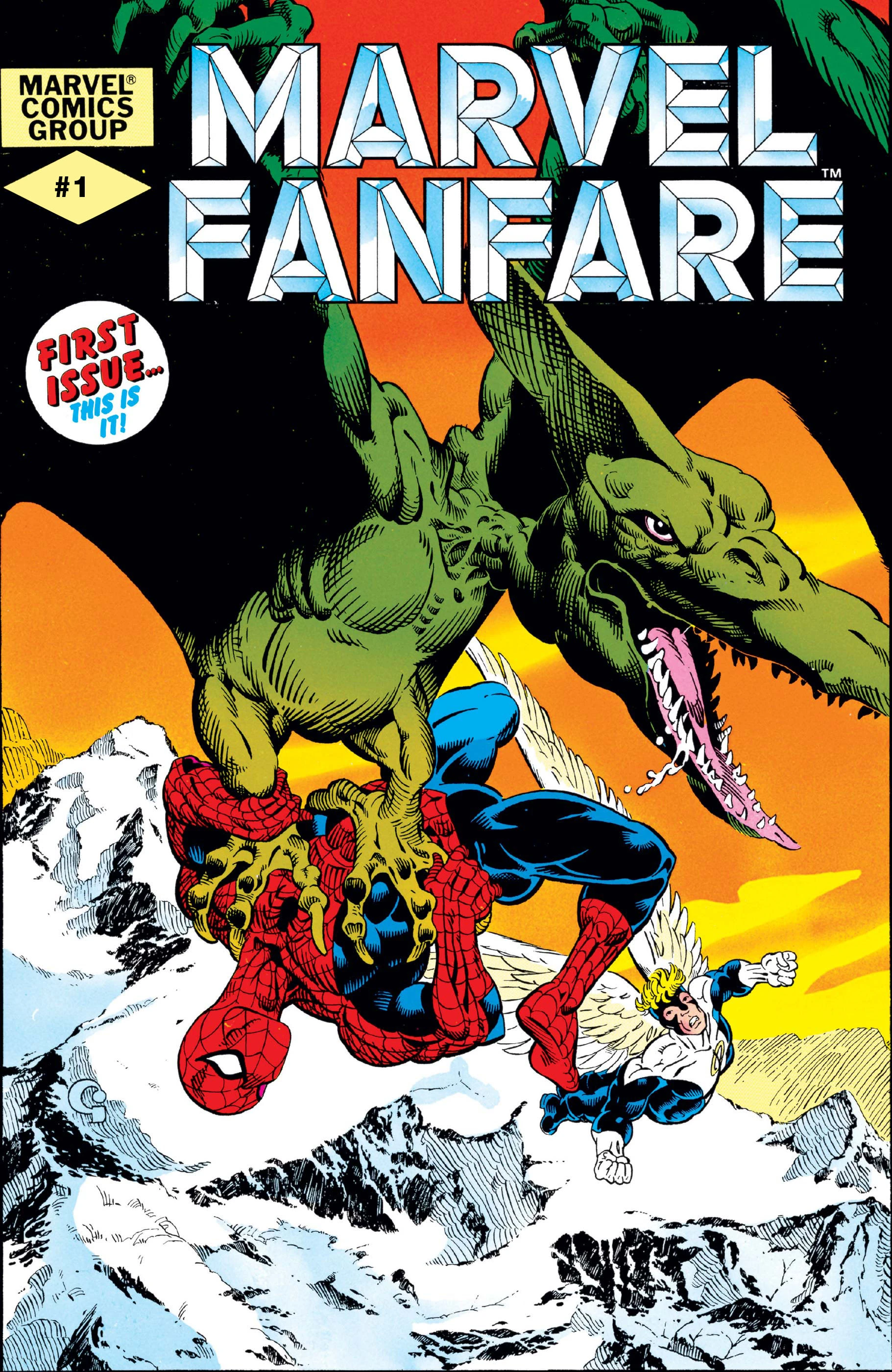
Marvel Fanfare #1 (March 1982)
"Fast Descent Into Hell!"
Chris Claremont-Michael Golden

Marvel Fanfare #2 (May 1982)
"To Sacrifice My Soul"
Chris Claremont-Michael Golden

Doug: Hey, it's a Two for Tuesday! Except today is Monday. Well, you're still going to get some extra bang for your time spent on the BAB today, kids. Marvel Fanfare was a book that landed during my hiatus from comics, which stretched from around the spring of 1980 to the spring of 1985 (give or take). The whole direct market thing, comic shops, creator-owned properties, the "Indies"... all of that rose up while I was chillin' in high school and my first three semesters of college. Today's review material came to me in the form of one of Marvel's very early forays into the trade paperback business, in a tome titled The Savage Land (1987) and containing reprints of Marvel Fanfare #s 1-4 -- all for the low, low cost of $5.95! I also have the collected Wolverine mini-series in the same format; maybe we'll get to that some day (if I can stand Claremont's repeated "I'm the best at what I do, and...").

Doug: That's a sweet cover above left, isn't it? I always gape at it in all its airborne terror. That is, until I look at Spidey's legs. Umm... yeah, it just looks weird. But then I come back to the flying lizard from the bowels of hell, Spider-Man's hands working to free himself, and the Angel -- and I gape at it some more. But those legs.

Doug: Today, as you can see, we're going to look at the first two issues of Marvel Fanfare, brought to you by long tenured (even by 1982) X-Men scribe Chris Claremont and artist Michael Golden. At the time Golden was perhaps best known as the penciler of the Man-Bat feature that ran in Batman Family, the Mister Miracle book, and long runs at Marvel on Micronauts, ROM, and Savage She-Hulk. To me, Golden's detailed and expressive style at times channels Alan Davis, but also Marshall Rogers. Not bad company, huh? -- at least in my mind. Here's some background on the series, from Wikipedia (one reference is left in for those concerned with such things):

Marvel Fanfare was envisioned as a showcase of the comics industry's best talent. Each issue featured 36 pages of material with no advertisements and it was printed on magazine-style slick paper. it was more than twice as expensive as standard comic books ($1.25 in 1982 when most titles were 60 cents and $2.25 in 1991 when most were $1).
Editor Milgrom wrote of his experience with the series:
Doug: I know not whether the material we're looking at today was "inventory" or specifically created to launch the book. My guess is that even if it was inventory for an annual or some such thing, Al Milgrom made a solid choice in choosing it. I think you'll agree that the story is OK, but the art is simply gorgeous! Let's get rolling then, with not one but two 100-Word Reviews (one for each issue) --
Marvel Fanfare #1 (17 pages): Tanya Anderssen loved Karl Lykos. Trouble was, Lykos was the mutant energy vampire Sauron, who leached life force from others to keep himself alive. Lykos was believed killed in the Savage Land, until a photograph of him surfaced, taken six months prior. Anderssen enlisted the Angel to find Lykos. Meanwhile, the Daily Bugle is doing a feature on the Savage Land and sends Peter Parker to do the photos; he ends up on the same transport as the Angel and Anderssen. The chopper is wrecked and our heroes are captured by Magneto’s Savage Land mutates. To be continued!

Marvel Fanfare #2 (19 pages): Brain Child hooked Spider-Man and the Angel up to some nefarious gizmo that would in turn mutate each of our heroes. Ka-Zar and his warrior friends rescue Tanya Anderssen from a t-rex attack, but later they themselves are attacked by the horribly disfigured Angel and Spider-Man. Anderssen is kidnapped by the Angel; Spider-Man fights his transformation. Ka-Zar figures out that our heroes are at Zaladane’s citadel, so leads a band to rescue them. Brain Child, however, has subjected Anderssen to his ray, devolving her. Lykos knows only one way to reverse the process, so drains some of her life force. And Sauron returns…

The Good: As you may have guessed, and can see plainly for yourself from the samples I've provided, Michael Golden's art is fabulous. He is also the credited colorist on both issues. You can see that the evolution of paper and printing technologies really gives the art a clean, lush look. I mentioned above the level of detail -- there is great care taken in the rendering of each panel, every figure and even most backgrounds. Golden truly took no shortcuts here. And I think the fact that he was the whole enchilada on the pictures really gave him an investment in the work.

The teaming of Spider-Man and the Angel provides some solid visuals, although I'd argue that dropping Spidey into the Savage Land strips the character of some of his strengths -- notably web-swinging. Still, Golden's backgrounds, colors, and detailed clothing pulled my attention away from that small gripe. I enjoyed the links between this story and X-Men #s 60-63 and #s 113-116 with appearances by Magneto's Savage Land Mutates and references to Garokk and Zaladane. The Savage Land truly is a great backdrop for a story; who doesn't like dinosaurs?

The Bad: I don't really have any severe complaints at all about the story. Sure, Claremont's writing is Claremont's writing, and I can't say I didn't get what I was expecting. But I think taking Spider-Man and mutating him into a voiceless Spider-creature detracted from what one might normally wish to receive in a Spidey mag. In that regard, this was a loss -- sort of like Jeremy Renner's Hawkeye in Marvel's The Avengers. Dude spent 2/3 of the film possessed! Same thing here. But the Ka-Zar and Zabu action sort of made up for it.

The Ugly: Brain Child is one ugly dude. Barbarus is another. Sauron is also one ugly dude. A flying lizard with tattered pants and a gun. But then, what's not to like? I would say, on the serious side, that Ka-Zar comics suffer from one of the same tropes that Tarzan stories suffer, and that's the great white hope coming to save (and even subjugate) the local savages. We get a little of that here, but it's somewhat tame.

Doug: In that Wikipedia article linked above there was a section that shows where several Marvel Fanfare stories have been reprinted. I have the Marvel Premiere Hardcover Black Widow: Web of Intrigue that reprints a George Perez-drawn Widow story. There are plenty of other locations for this material. However, it's high time Marvel did a nice, neat package in their relatively new Epic Collection format and put this varied product between two covers.

Doug: At some point maybe I'll return to finish this tale -- obviously it ends in a pteranodon-level cliffhanger! Marvel Fanfare #3 features the X-Men and was drafted/finished by Dave Cockrum and Bob McLeod; Marvel Fanfare #4 has pictures provided by Paul Smith and Terry Austin. Shoot, those art teams alone are reason enough to revisit!


Saturday, April 16, 2016

The Vision -- Looking Fresh!


Doug: Excitement is building for the release of Captain America: Civil War, at least where this Bronze Age Baby is concerned. Today I wanted to guide you to a few additional clips from the film, in the event you'd not seen them. You can access those, as well as some interviews, by clicking here. But what really made me smile is this screen grab from one of those very clips -- check out the Vision! And what a great homage to a previous "Vision sartorial moment" from the "Kree/Skrull War". Love it!


Friday, April 15, 2016

Guest Review - Origins of Marvel Comics


Doug: Thomas F. is back again this week with some thoughts on a book that immediately takes me back to Christmases when I was an elementary school-aged boy. For four years in a row, Christmas morning was especially brightened by the appearance of one of Marvel's huge "Origins" books. The first to appear under my tree was actually Son of Origins of Marvel Comics, followed by the initial installment (today's subject) for my birthday in June. Then the next three years Bring On the Bad Guys, The Superhero Women, and Marvel's Greatest Superhero Battles arrived in succession. Along with Treasury Editions, these books are among the best memories outside of actual comics. Thanks, Thomas.


Origins of Marvel Comics (1974 Edition)
Stan Lee, author

Thomas F.: As may be surmised from its title, Origins of Marvel Comics reprints the classic origins of Marvel Comics’ most legendary characters. It should be noted that at the time, trade paperbacks were new on the scene.
Origins of Marvel Comics includes entertaining and informative commentary inserted prior to each origin tale, full of the quirky language, peppered with superlatives, that is so typical of Stan Lee. The introductions evoke Lee’s penchant for showmanship, a trait which made him instantly identifiable as the embodiment of all that is Marvel. Some revealing comic industry background is touched on by Lee as well, plus little tidbits of the day-to-day activities of a newly-resurgent company.

Also included in the volume are reprints that were, in 1974, still fairly recent tales. This was done in order to show the contrast between “then” (the early 1960s) and “now” (the early 1970s), and how Marvel’s comics had evolved in the span of just a decade. Naturally, the origin tales—presumably, for which the reader purchased the book in the first place—are of primary interest.


As far as I’m concerned, these vintage origin tales, though somewhat quaint and dated, are just as appealing today as they were a half-century ago, and this magical quality was infused into them by Stan Lee.

Here is a list of the reprinted contents of Origins of Marvel Comics, 1974 edition:
 

Fantastic Four #1 (Origin story, Fantastic Four vs. the Mole Man)

Fantastic Four #55 (Featuring the Jack Kirby creation, the Silver Surfer)

Amazing Fantasy #15 (Origin story)

Amazing Spider-Man #72 (Spider-Man vs. the Shocker)

Incredible Hulk #1 (Origin story)

Incredible Hulk #118 (Incredible Hulk vs. Sub-Mariner)

Journey Into Mystery #83 (Thor origin story)

The Mighty Thor #143 (Thor vs. the Evil Enchanters)

Strange Tales #110 (First appearance of Dr. Strange)

Strange Tales #115 (Origin story)

Strange Tales #155 (Dr. Strange vs. Umar)

It goes without saying that much of Marvel’s success is to be attributed to Lee’s many collaborators, the artists who co-created the pantheon of Marvel’s superheroes in the early 1960s—especially Jack Kirby, Steve Ditko, and John Romita, Sr. Together, Stan Lee and Jack Kirby revolutionized the flagging comic book industry when the Fantastic Four made their iconic first appearance back in November 1961.


This new breed of superheroes were not godlike, omnipotent beings. They were depicted as flawed—full of human foibles, insecurities, and eccentricities. They were often unsuccessful in their personal lives, like Peter Parker/Spider-Man, grotesque freaks like Ben Grimm/The Thing, or even outright embittered outcasts like Dr. Stephen Strange.


To me, it is absolutely clear that it was Lee’s personal brand of dynamism that defined the flavor of Marvel Comics and became the standard to which his successors tried to measure up, and there is no doubt that they took pains to imitate his literary style. True, they may not have had much choice in the matter, since it was company policy to maintain a certain degree of consistency in Marvel’s considerable output.


In 1972, Stan Lee became publisher and handed off the reins to Roy Thomas, who became editor-in-chief. An interesting fact: it was Roy Thomas who instructed that the familiar words “Stan Lee Presents” be added onto the first page of each issue.


Not surprisingly, Origins of Marvel Comics was followed by multiple sequels, the first being Sons of Origins, due to the commercial success of the first installment. Sons of Origins picks up where Origins of Marvel Comics leaves off, showcasing Marvel’s next wave of heroes: the X-Men, Iron Man, Nick Fury, Daredevil, and the Silver Surfer.


For comics book fans new and old alike, Origins of Marvel Comics does not disappoint. It has sentimental value to many and the cultural impact of its dazzling content cannot be understated.


Thursday, April 14, 2016

If I Had a Buck... The Many Artists of Captain America


Martinex1: Captain America's costume has not changed much over the years that he has worn it.  Sure there were some more noticeable fashion updates in the past decade, but for the most part our star-spangled Steve Rogers has been known for his red, white, and blue, for his stars and stripes, for his winged head and his pirate boots, for his chain mail and his shield.   

It is interesting to see how different great artists depicted the American hero. So this $1 Challenge has a simple premise; here are 14 covers with Cap in charge, but all handled by different artists. Pick your favorites and discuss why that is.   There were so many great covers to choose from, so if you have a favorite you'd like to share, be my guest.

These are all in the Quarter Bin, so get a bang for your buck... four comics, four colors, four quarters...what can be better? 

Captain America #109; Jack Kirby.
Captain America #110; Jim Steranko.
Captain America #132; Marie Severin.
Captain America #140; John Romita.
Captain America #183; Gil Kane
Captain America #222; Ernie Chan
Captain America #225; Frank Robbins
Captain America #230; Ron Wilson
Captain America #241; Frank Miller
Captain America #254; John Byrne
Captain America #260; Allen Milgrom
Captain America #263; Mike Zeck
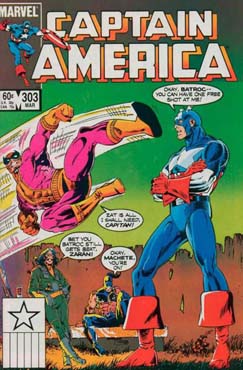
Captain America #303; Paul Neary
Avengers #340; Ron Lim (Okay this is a great Wasp cover too, but it is one of my favorite Cap covers of all time).


Wednesday, April 13, 2016

Star Trek at 50: Dagger of the Mind


Season 1
Episode 10: Dagger of the Mind
Filmed: August 1966
First Air Date: November 3, 1966 (9th episode aired)

Karen: Mind games! A prestigious doctor abuses his power at a penal colony and tests his mind control device on prisoners -and Captain Kirk. Pushed to the limits, the instrument can cause madness, to the point of no return. There are aspects of this episode that make it worthwhile -actors like James Gregory and Morgan Woodward certainly help, and the horror of a mind wiped clean by a device is certainly a strong premise. But maybe its claim to fame is that it gave birth to the Vulcan mind meld.


Karen: I'll admit that 'Dagger of the Mind' has never been high on my list of favorites, but it's not an episode I dislike either. It's just sort of there. Tristan Adams, played by Gregory, is another mad scientist type, although a relatively calm one. His motivations never seemed especially clear to me and he wasn't a very interesting villain. The neural neutralizer though, is a terrifying device, capable of doing everything from implanting false memories to driving a man mad to completely wiping out one's mind. One of the most memorable sequences in the episode is when Dr. Helen Noel, who has accompanied Kirk to the Tantalus colony, plants a suggestion in Kirk's mind as they test the device. She draws on a brief flirtation the two shared at an Enterprise Christmas party, now suggesting it went further. (Helen Noel...at the Christmas party...see what they did there?) We see the Captain in the neutralizer chair imagining that he swept her off her feet and carried her to his quarters. This was pretty daring stuff for 1966.


Karen: Morgan Woodward plays Van Gelder, an assistant of Adams' who had been experimented upon and escaped. In the original script, Spock used hypnotism to interrogate the screaming-mad Van Gelder. NBC felt it was inappropriate for Spock to be the one using hypnotism to examine Van Gelder; they pointed out that if it was presented as a true medical technique, it should be Dr. McCoy administering it.  Gene Roddenberry revised the scene by creating Spock's now famous Vulcan mind meld -his ability to link minds with other beings and read their thoughts. This came in quite handy in a number of circumstances. In this episode, Spock is able to discern that Van Gelder is not an inmate of the colony but a researcher, which is a big clue that things are not as they seem...


Karen: Woodward would reappear in the second season episode 'The Omega Glory' as Captain Ron Tracy. He was also prominently featured in a number of TV shows and films, including Cool Hand Luke.


Karen: Author Marc Cushman notes in his book These are the Voyages Vol.1 that the original script for this episode called for Yeoman Janice Rand to go to the penal colony with Kirk. But a decision was made to substitute the character of Dr. Helen Noel instead. A number of possible reasons were given for this, depending on who was asked. The most reasonable were that they wanted to avoid having Rand and Kirk get too close, and that it made more sense for a medical professional to accompany Kirk and test the device on him than it did his yeoman. Actress Marianna Hill portrayed the very capable Dr. Noel.


Karen: The writer of this script, Shimon Wincelberg, felt Gene Roddenberry's numerous revisions had gone too far from his work, and demanded a pseudonym be used, so 'S. Bar-David' appeared in the credits. This was not the first nor the last time a writer felt annoyance over what happened to his or her script once it got in the hands of Roddenberry. But the creator/producer of the show felt he knew the characters best, and needed to make the changes. The reality probably lies somewhere in the middle, as usual.


Tuesday, April 12, 2016

Inaugural Post: The Ever-Changing Blue-Eyed Thing


Doug: Ever have an idea percolating in your brain for... forever? This is that. For many months I've been wanting to do something on the blog with one of the greatest aspects of the end of the Bronze Age and beyond. In the early-mid 1980s Marvel Comics published a periodical encyclopedia called The Official Handbook of the Marvel Universe; the Distinguished Competition's entry in the genre was the equally entertaining Who's Who in the DC Universe. There is a nearly bottomless mine of good stuff for us to discuss, so we'll see if today's inaugural foray gets any kind of commenter love. And I don't want to hog this idea -- if anyone reading wants to submit a post in this vein, by all means email us.

Doug: Below you'll find the entry for the Thing, as it appeared in the second volume (1986) of The Official Handbook of the Marvel Universe:


Doug: My focal point for today's discussion is the height of Benjamin J. Grimm. From the moment I first laid eyes on this issue of the Handbook I was a little skeptical as to the accuracy of whatever tape measure was used to check the Thing's height. However, doing a quick image search for the purpose of researching my accusation that something must have been amiss, I found that by and large through the Silver and Bronze Ages the Thing was drawn at about the same height as Reed Richards. In the Handbook, Ben Grimm is listed at an even 6'0", while Reed Richards is a bit taller at 6'1". See the images below from superstar FF creators Jack Kirby, Joe Sinnott, and John Buscema. Nowhere do we find the Thing towering over his teammates --


Doug: Additionally, we can use the Hulk for comparison's sake. From the earliest days of the "splash tops" that ran on page one of Bronze Age Marvel Comics, we knew what we were dealing with in terms of the Hulk's massive scale:


Doug: And here are some visuals in support of the Thing's "diminutive" stature:


Doug: Going hand-in-hand with the Thing's relatively short height is his weight of "only" 500 pounds. So at 6'0", 500 pounds, the Thing is certainly not imposing in the presence of She-Hulk's 6'7" height, Thor at 6'6" and 640 pounds, or even Captain America (6'2", 220 lbs.). But then the "Image era" began and Benjy grew... and grew... and grew (please excuse the glorification of Sue's assets (ahem) -- after all, it was the 1990s):


Doug: Obviously there are many more points of interest in the Thing's biography. But today let's center on the man's scale, particularly as compared to his fellow denizens of the Marvel Universe. How's that stature? Too small for you? In the Fantastic Four films of a few years ago, featuring Michael Chiklis made up as the Thing, Ben was no taller than his male teammates. But then, what of some of the latter samples I posted -- too large? In the FF film from last year, the CGI Thing seemed more in line with the art above. That being said, I suppose Ben would still be in scale with the Hulk, as ol' Jade Jaws is now never depicted on film as shorter than 10 feet (or so it seems). Have at it, and thanks in advance for your thoughts.

Related Posts with Thumbnails